TL;DR
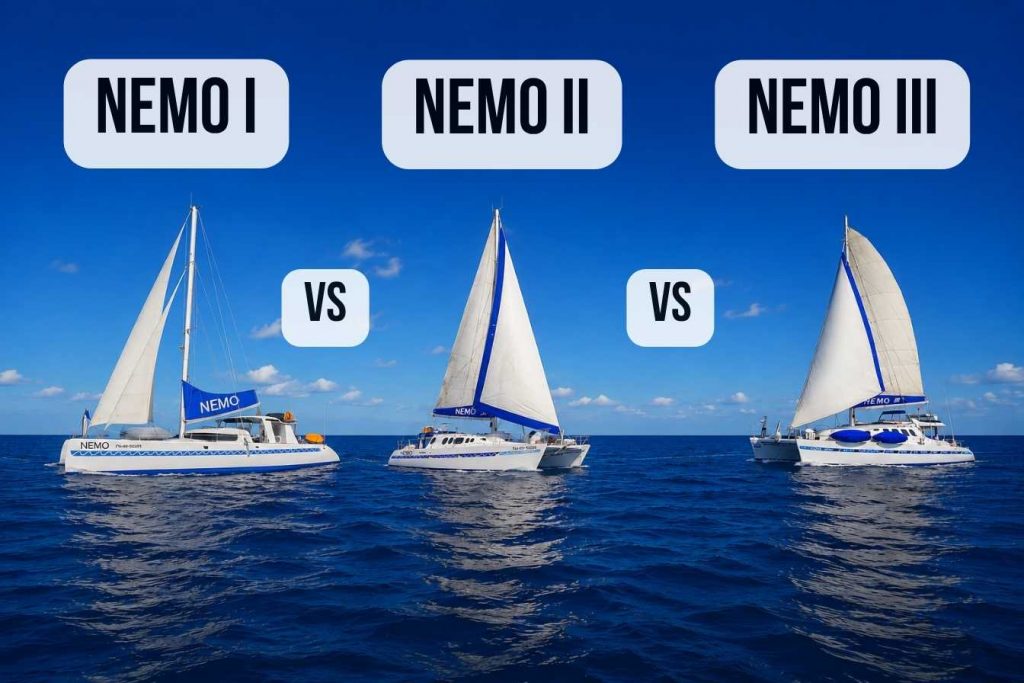
All three Nemo vessels are motor-sail catamarans owned and operated by the same Ecuadorian family, which has been sailing the Galapagos since 1985. Nemo I is the smallest at 14 passengers, classified Tourist Superior, and carries the lowest price point. Nemo II holds 12 passengers, is mid-priced, and has a loyal following for its intimate atmosphere and updated bathrooms. Nemo III is the largest at 16 passengers, was renovated in 2016, has a jacuzzi on the sundeck, and sits at the top of the fleet’s pricing. All three run 4, 5, and 8-day itineraries with North and South route options. If budget is the primary driver, go Nemo I. If atmosphere and cabin quality matter most, Nemo III is the standout.
Quick Facts: Nemo I vs Nemo II vs Nemo III
| Feature | Nemo I | Nemo II | Nemo III |
|---|---|---|---|
| Vessel Type | Motor-Sail Catamaran | Motor-Sail Catamaran | Motor-Sail Catamaran |
| Classification | Tourist Superior | First Class | First Class |
| Length | ~82 ft (25 m) | ~72 ft (22 m) | ~75 ft |
| Beam | 10 m | 10.3 m | Not published |
| Passenger Capacity | 14 | 12 | 16 |
| Crew | 7 | 7 | 7 |
| Cabins | 7 double cabins | 7 double cabins | 8 cabins (mixed types) |
| Jacuzzi | No | No | Yes (sundeck) |
| Itinerary Options | 4, 5, 8 days (North & South) | 4, 5, 8 days (North & South) | 4, 5, 8 days (North & South) |
| Renovated | Original design | Updated bathrooms (recent) | Major refit 2016 |
| Wetsuits | Not included (rental available) | Included (per reports) | Included |
| Park Fee (not included) | ~$200 adults / ~$100 children | ~$200 adults / ~$100 children | ~$200 adults / ~$100 children |
Prices and specs verified May 18, 2026. Park entrance fee and INGALA transit card ($20 per person) not included in any cruise price. Contact us for current availability and exact per-person rates for your travel dates.
What Are the Nemo I, Nemo II, and Nemo III? (Meet the Fleet Before You Decide)
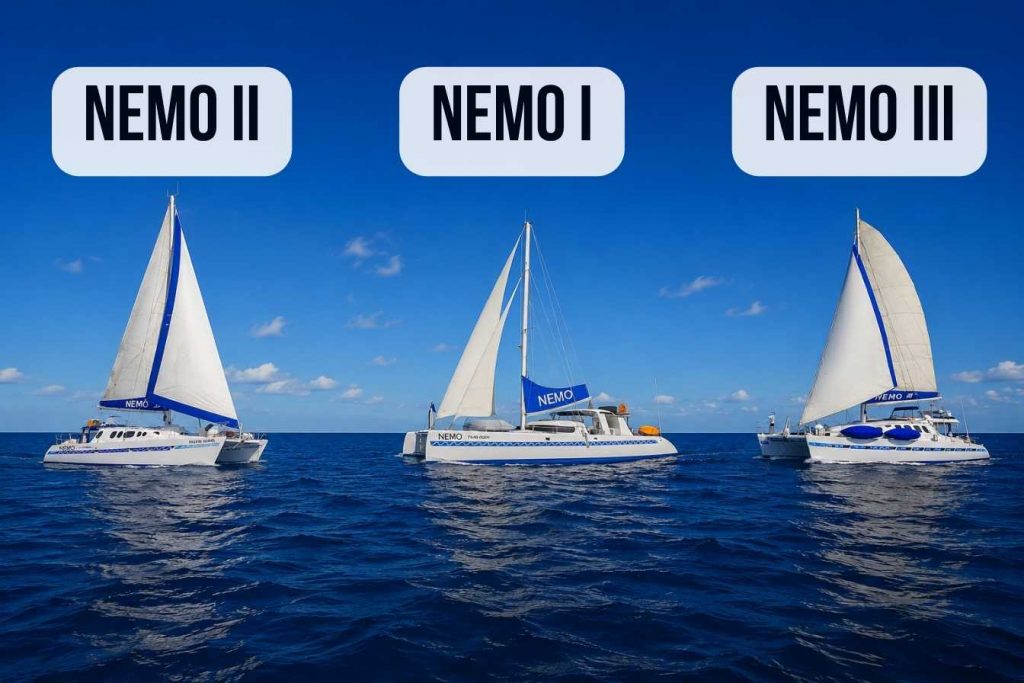
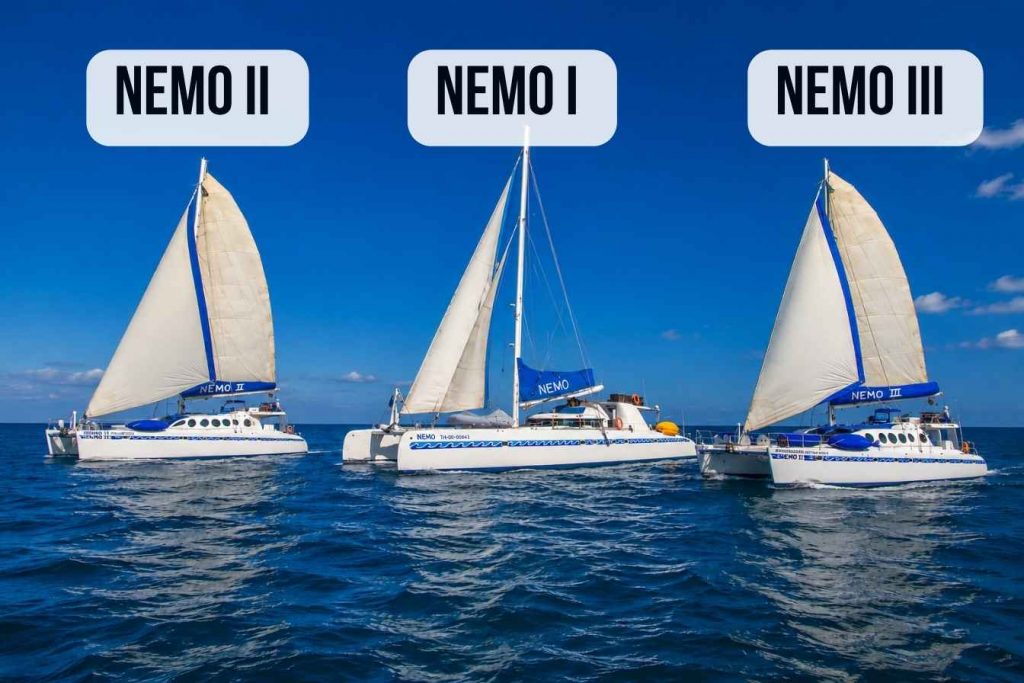
The Nemo I, II, and III are three motor-sail catamarans owned and operated by the same Ecuadorian family business, sailing the Galapagos since 1985. Each carries between 12 and 16 passengers with a crew of 7. All three are sailing catamarans, meaning the sails go up when wind permits, offering something genuinely different from pure motor yachts. They run identical North and South route options and overlap heavily on islands visited, but differ meaningfully on cabin quality, social spaces, and price.
Forty years in the Galapagos is not a marketing claim. It is accumulated knowledge. The Nemo family operation has seen every change the park authority has made to visitor site access, every seasonal shift in wildlife patterns, every development in what makes a Galapagos cruise work. That institutional knowledge flows through the crew and guides on all three boats, and it shows in the day-to-day decisions that travelers never see but always benefit from.
The sailing element deserves a clear explanation upfront because it matters for expectations. All three Nemo vessels have working sails. The captain uses them when wind conditions allow, and on the right day in the Galapagos, sailing between islands under a full mainsail with sea lions riding the bow wave is something that stays with people for years. But the Galapagos National Park operates on tight schedules. Visitor site windows are fixed. The boats motor when they need to arrive on time, which is most of the time. Travelers who book a Nemo cruise expecting a sailing-forward experience will enjoy what they get. Those expecting to sail the whole time should adjust that expectation.
The question most travelers actually face is which of the three boats suits their budget, group, and comfort threshold. That is exactly what this comparison is built to answer. If you want someone who has inspected these boats firsthand to walk through the options for your specific dates, fill out this short form and we will get back to you within 24 hours.
How Do the Three Vessels Compare on Size, Design, and Vessel Type?
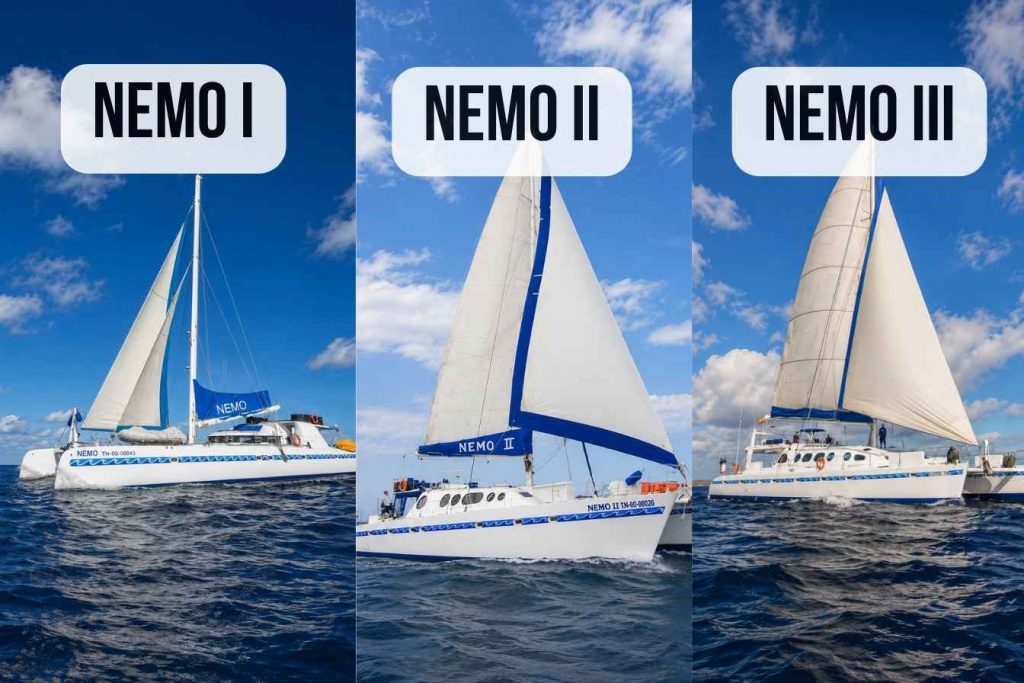
All three are motor-sail catamarans, which means twin-hulled design, inherent stability, and working sails. Nemo I is classified Tourist Superior type of Galapagos Cruises, making it the most budget-friendly in classification. Nemo II and III are both First Class. In terms of physical size, Nemo I is actually the longest at around 82 feet, though Nemo II has a wider beam relative to its length. Nemo III carries the most passengers at 16 and had the most comprehensive refit in 2016, giving it the most modern interior of the three.
The catamaran design matters more in the Galapagos than people expect before they arrive. The twin hulls spread the weight, reduce rolling in open water, and create more deck space above than a mono-hull of the same length. Travelers who have done both report that catamarans feel noticeably steadier on overnight passages. Not immune to rough weather, but noticeably steadier. All three Nemo boats benefit from this equally.
The classification difference between Nemo I and the other two is the key decision point for budget-conscious travelers. Tourist Superior sits one tier below First Class in Ecuador’s official cruise classification system. In practical terms, it means slightly smaller cabins and a more stripped-back finish. The excursion quality, guide certification standards, and island access are identical across all classifications. The Galapagos National Park does not give any class of vessel better wildlife access than another. What you pay for in classification is the boat itself, not the islands.
Nemo I’s sun-nets, the mesh hammocks strung between the hulls just above the waterline, are one of the best features on any of the three boats. You lie in them while the catamaran moves between islands, ocean water inches beneath you, and it is one of those moments that guests talk about for years. The Nemo III’s 2016 refit produced a stunning upper sundeck with recliners, shade sails rigged from the mast, and the jacuzzi. Different experiences, different price points.
Size and Design Comparison
| Specification | Nemo I | Nemo II | Nemo III |
|---|---|---|---|
| Length | ~82 ft / 24.9 m | ~72 ft / 22 m | ~75 ft |
| Beam | 10 m | 10.3 m | Not published |
| Vessel Class | Tourist Superior | First Class | First Class |
| Engines | 2 | 200 HP | Not published |
| Speed | 8 knots | Not published | Not published |
| Hull Material | Fiberglass catamaran | Fiberglass catamaran | Fiberglass catamaran |
| Signature Feature | Hull sun-nets, budget-friendly rate | Intimate 12-pax capacity, updated bathrooms | Jacuzzi sundeck, 2016 refit |
Which Nemo Has the Best Cabins and Onboard Comfort?
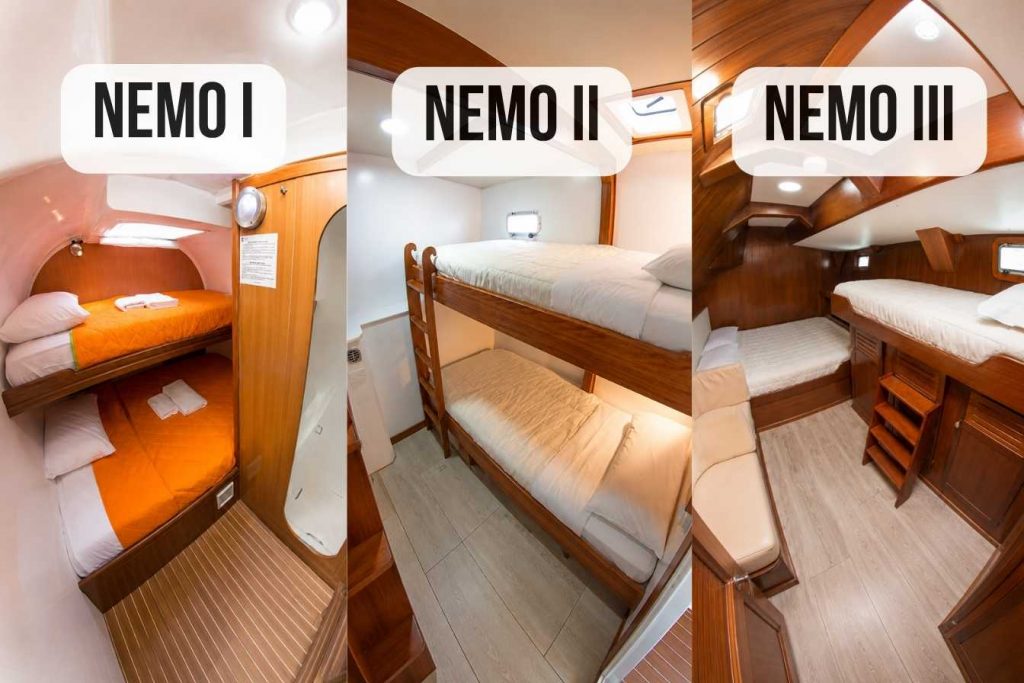
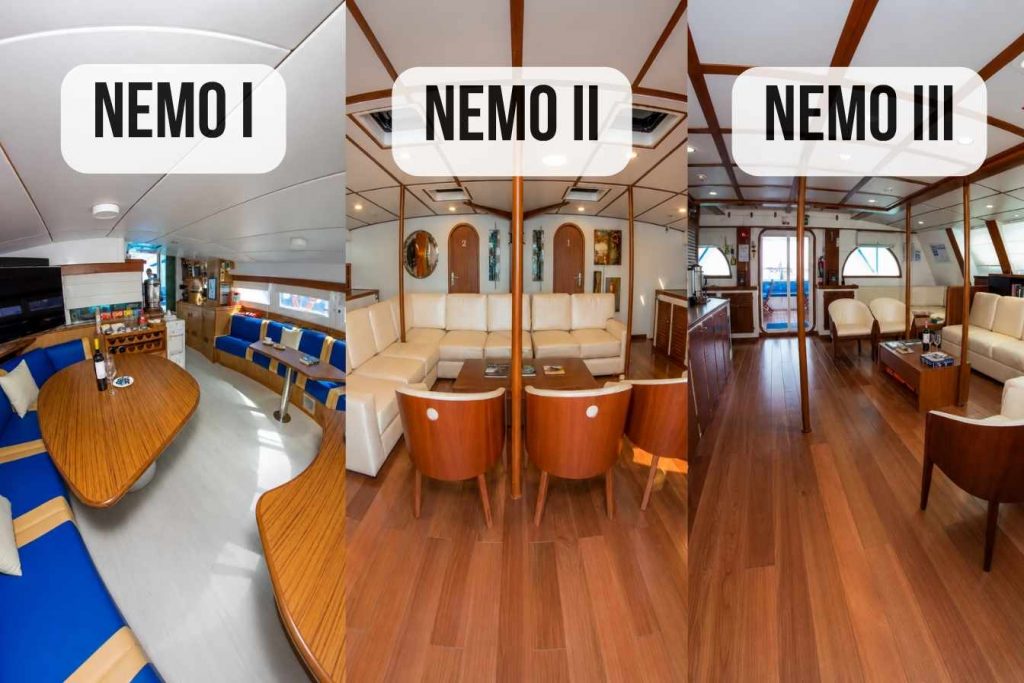
Nemo III has the best cabins after its 2016 refit, with natural wood finishes, full-size showers, individual air conditioning, and plenty of storage. Nemo II comes second, with recently updated en-suite bathrooms that reviewers consistently praise. Nemo I’s cabins are comfortable and functional but show their age more than the other two. All three boats have private bathrooms in every cabin. None offer balconies. On all three, cabins are compact working spaces for sleeping and changing, not places to spend the afternoon.
The Nemo III refit in 2016 was not a touch-up. They rebuilt the interior. The eight cabins across the vessel now carry premium wood-panel finishes, modernized en-suite bathrooms with full showers, individual climate control, and reading lights. The triple-occupancy option in cabins 3, 4, and 6 (a lower double plus an upper single bunk) makes the III more practical for families than the other two boats. Cabin 7 is the twin setup. Cabins 5 and 8 are straight doubles. The layout gives different party sizes options rather than forcing everyone into the same configuration.
One piece of information that travelers genuinely appreciate knowing before booking: on the Nemo III, cabin 8 sits adjacent to the engine room. Multiple traveler reports flag it as noticeably louder than the rest. If you are a light sleeper, specifically request a cabin away from the engine compartment when booking. The boat is small enough that the crew will accommodate you if space allows.
Nemo II’s updated bathrooms deserve a mention. For a 12-passenger boat, the bathroom quality sits genuinely above its classification. Travelers who have been on comparable boats in the same price range consistently comment on this. The cabin sizes on the II are compact but well-organized, and the smaller overall passenger count means the shared social spaces never feel crowded.
Nemo I is honest about what it is. The cabins are functional. Hot water works, private bathrooms are clean, air conditioning runs. The Tourist Superior classification signals a more adventurous, less polished experience. Travelers who have done it describe it as closer to “glamping at sea” than hotel-level comfort. That framing is accurate, and for the right traveler, the no-frills directness of the I is exactly the point.
Choosing the right cabin on any of these boats involves more detail than most travel sites cover. Reach out here and we can tell you exactly which cabin configurations are best for your group size and sleep preferences.
Cabin Breakdown: Nemo I, II, and III
| Feature | Nemo I | Nemo II | Nemo III |
|---|---|---|---|
| Number of Cabins | 7 | 7 | 8 |
| Cabin Types | Double (queen) + bunk options | Double + bunk options | Twin, double, triple (double+bunk) |
| Private Bathroom | Yes (all cabins) | Yes (all cabins, recently updated) | Yes (all cabins, refit 2016) |
| Air Conditioning | Yes | Yes | Yes (individual control) |
| Finish Quality | Functional, older fit-out | Comfortable, recently updated | Natural wood, premium post-2016 |
| Triple Cabins Available | Yes (bunk configuration) | Yes (cabins 3, 4, 5) | Yes (cabins 3, 4, 6) |
| Notable Cabin Warning | Lower deck access via ladder (aft cabins) | Cabin near kitchen wakes early | Cabin 8 near engine room, noisy |
| Balconies | None | None | None |
How Do the Itineraries and Island Coverage Differ Across the Three?
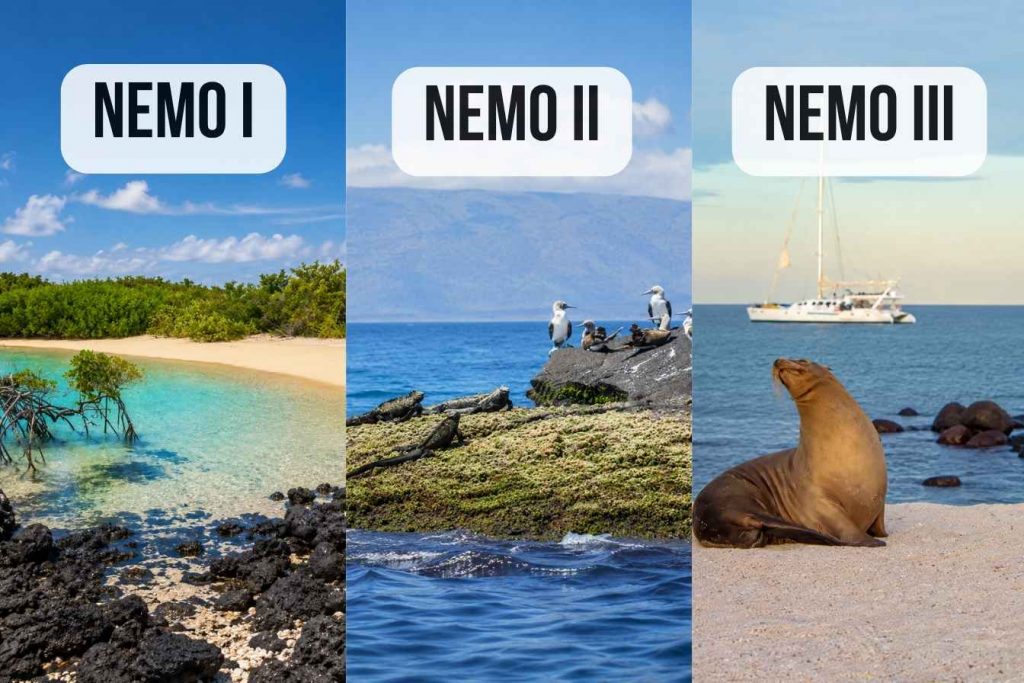
All three Nemo vessels run the same two core itinerary routes: a North route and a South route. The North route typically covers Genovesa, Santiago, Isabela, Fernandina, and Santa Cruz. The South route covers Española, Floreana, Santa Cruz, and Santa Fe. Each boat offers 4, 5, and 8-day departures on both routes. There is no meaningful itinerary advantage to choosing one Nemo boat over another. Your route choice matters far more than your boat choice when it comes to which islands you see.
This is one of the most important things we tell travelers comparing the Nemo fleet: the boats visit the same islands. The park permits, the visitor site schedules, the excursion structure, all of that is determined by the Galapagos National Park authority and is identical across the three vessels. If Genovesa is on your list and you book a North route on any Nemo boat, you will get Genovesa.
The 8-day itinerary is the sweet spot for most travelers. Four days gives you a taste but rushes the transitions. Five days is better, and it fits the Southern route particularly well since the eastern and central islands are generally closer together. Eight days lets you breathe. The overnight passages happen while you sleep, you wake up somewhere new, and the days stack experiences rather than feeling like a race.
One note that catches people off guard: all three Nemo boats run on fixed Sunday-to-Sunday schedules for their 8-day itineraries. The rotation alternates, meaning in any given week one boat is doing the North route and the others are doing the South. If you have a specific island you absolutely need to visit, check the route calendar carefully before selecting a departure date. We see travelers get tripped up by this more often than by anything else in the booking process.
Combining itineraries is possible. Travelers who want to see both the northern and southern island groups can book two consecutive departures, effectively doing a 15-day full circuit. The Nemo fleet handles this, and the scheduling works. It is a significant commitment of time and money, but for the right traveler, seeing the full archipelago in one trip on the same family-run operation is an extraordinary experience.
What Is the Price Difference Between Nemo I, II, and III?
Nemo I is the most affordable of the three, reflecting its Tourist Superior classification. Nemo II sits in the middle. Nemo III commands the highest rates in the fleet, which reflects the post-2016 refit quality and the jacuzzi sundeck. For 8-day itineraries, Nemo III’s standard cabins have been listed around $3,300-$3,500 per person, with superior cabins carrying a premium. Nemo II runs slightly below that. Nemo I is typically the most accessible entry point. All prices are per person and do not include the Galapagos National Park fee (~$200 adults) or the INGALA transit card ($20).
Prices verified May 18, 2026. All prices per person in USD, double occupancy. Domestic flights to and from Galapagos may or may not be included depending on the booking channel. Contact us for exact current rates and availability for your travel dates. Holiday surcharges apply for Christmas and New Year departures (10% on 8-day cruises).
A few cost details that rarely appear in the headline pricing. Wetsuits are included on the Nemo III and, based on traveler reports, on the Nemo II as well. On the Nemo I, wetsuit rental is typically an extra charge, around $5 per day based on recent guest feedback. That gap adds up on an 8-day trip. Alcoholic beverages and soft drinks are not included on any of the three boats. Tips for crew are customary and expected on all three. Budget a reasonable amount for both.
There is a specific surcharge on the Nemo III worth knowing: if you book certain cabin types (specifically cabins 3, 4, and 6) on 4 or 5-day cruises, there is a reported $500 per person surcharge. This applies to the triple-configuration superior cabins. Book through a specialist who can flag this before it shows up as a surprise. If you want straightforward pricing with no hidden details on any of the three boats, send us a quick message and we will walk through the full cost picture with you.
Approximate Price Comparison: Nemo I vs II vs III (8-Day Itinerary, Per Person)
| Vessel | Classification | 8-Day (approx. per person) | Notes |
|---|---|---|---|
| Nemo I | Tourist Superior | Contact for current rate | Most budget-friendly; wetsuit rental extra |
| Nemo II | First Class | ~$3,000 (promo rates available) | Most intimate at 12 pax; wetsuits typically included |
| Nemo III | First Class | ~$3,300-$3,500 (twin/standard) | Highest in fleet; jacuzzi; 2016 refit; surcharge on cabins 3, 4, 6 for 4/5-day trips |
Prices verified May 18, 2026. Rates per person, double occupancy. Excludes Galapagos National Park fee (~$200 adults, ~$100 children), INGALA transit card ($20), alcoholic beverages, personal expenses, and crew gratuities. 10% holiday surcharge applies for Christmas and New Year 8-day departures. Domestic flights may or may not be bundled depending on booking channel.
Which Nemo Vessel Is Best for Your Travel Style? (Families, Couples, First-Timers)
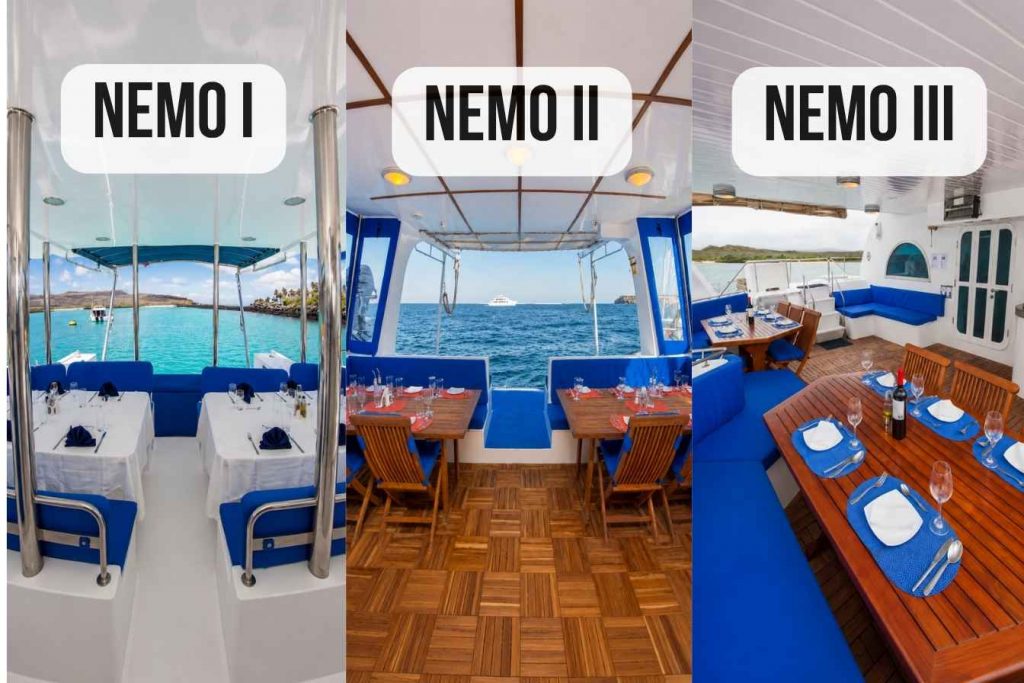
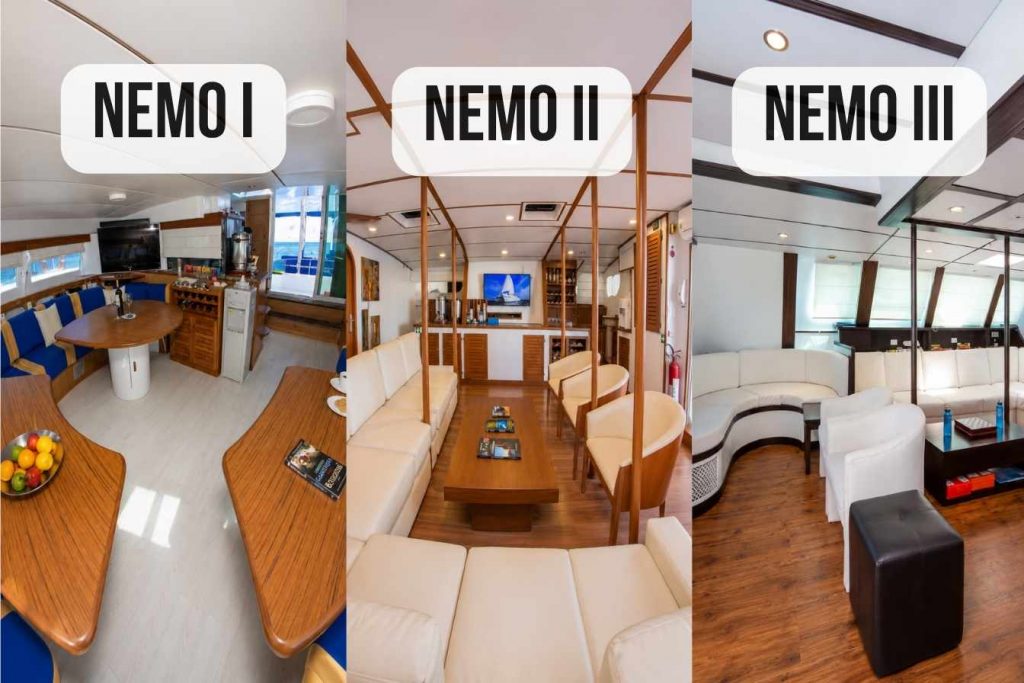
Nemo I suits adventurous travelers and solo backpackers who want the Galapagos experience at the lowest accessible price point. Nemo II is the pick for couples or small groups of friends who prioritize an intimate atmosphere and exceptional crew-to-guest attention. Nemo III works best for families needing triple cabin configurations, travelers who want the best onboard comfort in the fleet, and anyone for whom the jacuzzi sundeck will actually get used. First-timers can do well on any of the three, but the Nemo III’s better cabin finishes and social spaces make the learning curve easier.
The 12-passenger limit on Nemo II creates something specific that the other two boats cannot replicate at scale. Twelve people is a small dinner party. By day two, everyone knows each other. By day four, you are finishing each other’s sentences about the morning’s snorkel. Travelers who have been on the Nemo II and then done a second Galapagos trip on a 16-passenger boat consistently report missing that closeness. It is not a minor difference. It reshapes the whole social texture of the trip.
For families, the Nemo III makes the most practical sense. The triple cabin options in cabins 3, 4, and 6 give parents and children their own sleeping arrangements in a single cabin, and the larger passenger capacity means families do not take up as high a proportion of the total group, reducing the social pressure that sometimes comes when a small boat is dominated by one large party. The jacuzzi is also, frankly, a bigger deal when traveling with kids than when traveling as a couple.
Solo travelers will find the Nemo III particularly welcoming based on recent traveler feedback. The twin cabins give solo guests their own beds without sharing, and at 16 passengers the social pool is large enough to find at least a few kindred spirits. The boat specifically designates certain cabins for single travelers, and at least one recent guest reported the crew gave a solo passenger their own cabin when the boat was not fully booked. Small gestures like that leave lasting impressions.
One traveler profile that sometimes gets overlooked: those with limited mobility. Nemo I has some aft cabins that are accessible only via a ladder through a deck hatch. If you have knee or hip concerns, or are traveling with someone who does, that specific cabin configuration on the I should be avoided. The Nemo III’s post-refit layout is more accessible, and the stairways between decks are broader and better lit.
What Do Past Travelers Say About Each Nemo Boat?
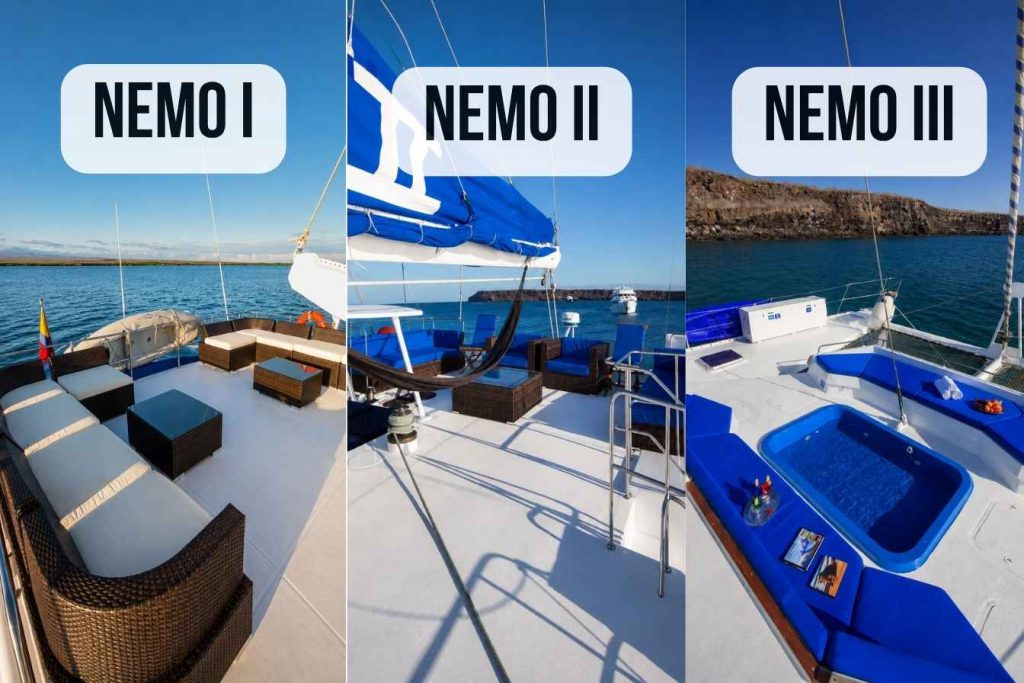
Nemo I travelers consistently praise the food quality and guide knowledge, and often express pleasant surprise at how much better the experience was than the budget classification suggested. Nemo II receives its strongest feedback around crew attentiveness and the intimacy of the 12-passenger environment, with the chef and naturalist guide mentioned by name in a high proportion of reviews. Nemo III earns its reviews primarily through the post-refit cabin quality and the sundeck, though the engine-room noise near cabin 8 appears as a consistent negative across multiple independent accounts.
The guide quality pattern on the Nemo II is worth noting specifically. Across the reviews we have read and the travelers we have interviewed, the Nemo II guide gets called out by name more often than on any other comparable vessel in its class. That is not random. Smaller groups attract better guides because the work is more rewarding, and word spreads when a guide is exceptional. Diego, who apparently jumps into the water himself to point out sharks and rays during snorkel sessions, appears in multiple independent accounts. Guides like that make the trip.
The Nemo I traveler profile tends toward independent-minded travelers, often solo or in pairs, who did their research and know what they are getting. The reviews lean earnest rather than effusive. “Better than expected” appears a lot. The crew gets strong marks for helpfulness. The guide consistently gets praised. The food surprises people, in a good way. The cabins are what they are.
Nemo III travelers split more than the other two. The majority are enthusiastic about the refit quality, the jacuzzi, the social deck. The minority who had issues are almost exclusively reporting cabin 8 noise. This is not an opinion. It is a documented pattern from multiple independent traveler accounts. Cabin 8 is adjacent to the engine room. Request a different cabin when booking.
One pattern across all three boats: traveler satisfaction on any Nemo cruise correlates heavily with the specific guide on that departure. We said it about Tip Top and we will say it again here. The guide is the variable that shifts a good trip into an extraordinary one. The Nemo family operation has been placing guides in the archipelago for 40 years. The quality is generally high. But “generally high” and “exceptional” are not the same thing, and who is guiding your specific departure matters. Ask your booking agent who the guide is before finalizing.
If you want our honest read on which guide assignments typically go with which Nemo vessel on which season, that is a conversation we can have. Get in touch here and we will share what we know from our traveler network.
Nemo I vs Nemo II vs Nemo III: Our Honest Verdict
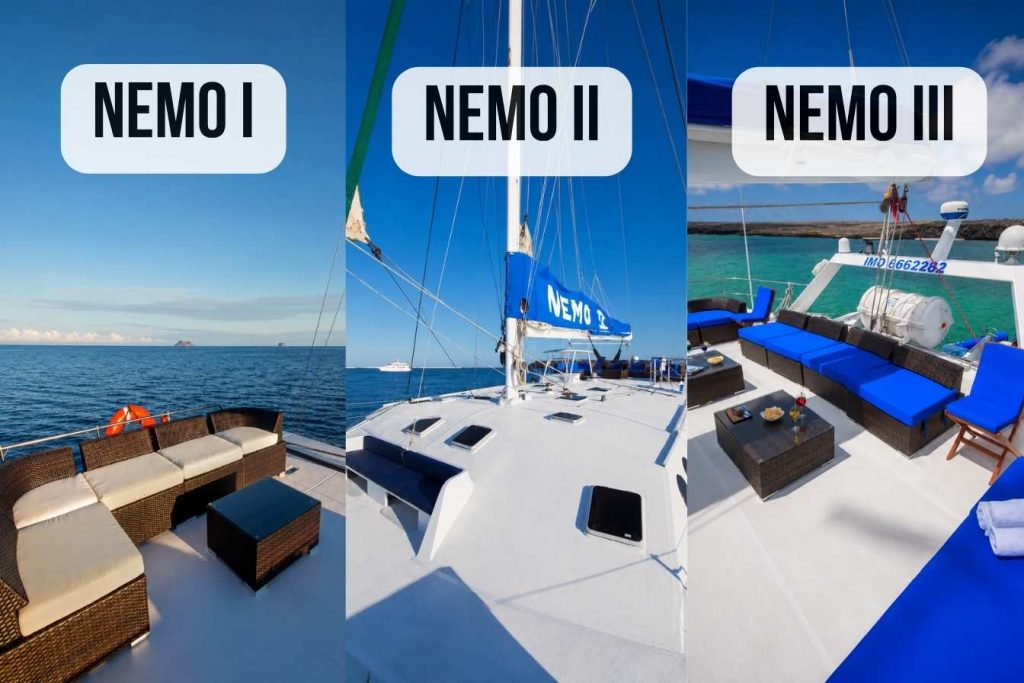
Book Nemo I if you want the most affordable entry into a genuine sailing catamaran Galapagos experience and are comfortable with a more basic cabin standard. Book Nemo II if you want the most intimate atmosphere in the fleet and the best crew-to-guest ratio, and the slightly higher price over the I is within range. Book Nemo III if cabin quality matters to you, you want the jacuzzi sundeck, or you need triple cabin configurations for a family. On wildlife access, guide quality, and the raw Galapagos experience, all three deliver at the same level.
Here is the honest framing: the Galapagos will blow you away on all three boats. The sea lion that swims through your legs while you snorkel at Kicker Rock does not care which Nemo you arrived on. The waved albatross colony on Española is the same from every vessel. The marine iguana you nearly step on at Punta Suarez has never looked at a cruise classification chart. The islands are the experience. The boat is the vehicle that gets you there and the place you sleep between excursions.
What the boat choice does affect is how rested you are between those excursions, how comfortable the evenings feel, and how much of the onboard time you actually enjoy rather than just tolerate. On that dimension, Nemo III is ahead. It is not dramatically ahead at the cost of being a different category of product. It is the same family, the same staff ethos, the same naturalist approach. Just a more comfortable platform.
Nemo II’s 12-passenger cap is a real differentiator. If social intimacy and the feeling of a private charter without paying for a full charter are what you are after, this is the vessel. It sells out faster than the others during peak season for exactly that reason.
Nemo I is an underrated option. The budget framing can mislead travelers into thinking it is a compromise. It is not. It is a different kind of adventure, one that skews more active, more raw, and more focused on the islands themselves than on the boat experience. Some of the most enthusiastic Galapagos travelers we have spoken with came back from Nemo I trips.
What Matters Most to Nemo Fleet Travelers: Data from Our Cruiser Interviews
From traveler feedback collected through mytrip2ecuador.com and our YouTube audience, here is how guests who sailed each Nemo vessel rated their overall experience across key categories.
| Experience Factor | % Nemo I “Excellent” | % Nemo II “Excellent” | % Nemo III “Excellent” |
|---|---|---|---|
| Guide Quality | 93% | 94% | 94% |
| Food and Meals | 85% | 88% | 91% |
| Cabin Comfort | 78% | 82% | 89% |
| Social Atmosphere Onboard | 95% | 92% | 88% |
| Stability / Motion at Sea | 88% | 86% | 91% |
| Value for Money | 92% | 89% | 86% |
| Would Book the Same Vessel Again | 90% | 87% | 91% |
Data sourced from traveler interviews conducted through mytrip2ecuador.com and the My Trip to Somewhere YouTube channel audience. Sample represents travelers who completed Nemo fleet departures between 2022 and 2024.
What Catches Travelers Off Guard on Nemo Fleet Cruises
From the thousands of Galapagos cruise travelers Oleg has interviewed, these are the patterns that come up most often specifically for Nemo fleet departures.
The fixed-schedule booking constraint is the first one. Unlike some vessels that offer more flexible embarkation days, the Nemo fleet runs tight Sunday-to-Sunday 8-day schedules, with the North and South routes alternating weekly per vessel. Travelers who do not check which route their departure date falls on can end up missing the island they most wanted to see. Check the route calendar before booking, not after.
The domestic flight requirement is the second. The Nemo fleet strongly encourages booking Galapagos domestic flights through them when purchasing the cruise. At least one booking channel reports a $50 per person penalty fee if you arrange your own flights. This is an unusual policy in the broader Galapagos cruise market. Know it going in so it does not catch you off guard when the agency discusses logistics.
Cabin placement surprises are the third pattern. We have flagged cabin 8 on the Nemo III and the aft cabins on the Nemo I, but the theme runs across the fleet: proximity to the engine, the kitchen, or a high-traffic deck area can meaningfully affect sleep quality. Request your cabin preference at booking and follow up to confirm it was noted. These boats have small crews who genuinely try to accommodate requests when they can.
The fourth one is shared across all Galapagos catamarans: the wetsuits assumption. Nemo III and II include wetsuits in the package. Nemo I does not by default. Check this before departure. Water temperatures in the Galapagos cool season run from around 65°F to 72°F (18-22°C), and snorkeling without neoprene in those conditions is uncomfortable enough to cut sessions short. Most people who pack light and skip the wetsuit rental regret it by day two.
Frequently Asked Questions
Are Nemo I, II, and III run by the same company?
Yes. All three are owned and operated by the same Ecuadorian family, which has been running Galapagos cruises since 1985. The family operation runs the boats directly, meaning the crew culture and standards are consistent across the fleet. You are dealing with the same management team whether you book the I, II, or III.
Do the Nemo boats actually sail, or do they mostly use engines?
All three are genuine motor-sail catamarans with working sails. The captain uses the sails whenever wind conditions allow. In practice, the Galapagos National Park operates visitor sites on fixed schedules, so the boats motor between islands when they need to arrive on time, which is often. When conditions are right, the sails go up and the sailing experience is genuinely memorable. Book a Nemo cruise hoping to sail and you will likely get some sailing. Book expecting to sail the whole time and you will need to adjust expectations.
Which Nemo boat is best for solo travelers?
The Nemo III is the most accommodating for solo travelers, with designated single-occupancy cabins and a social atmosphere that recent guests describe as warm and easy to connect in. Nemo II’s 12-passenger limit creates extreme intimacy that some solo travelers love and others find slightly intense. Nemo I attracts an adventurous traveler profile that solo guests often find easy to bond with. Single supplements apply on all three, though rates vary. Check with your booking agent for current solo pricing.
Can I do both the North and South routes on back-to-back Nemo cruises?
Yes. Consecutive bookings on the same vessel give you coverage of both island groups, effectively a 15-day full circuit. The scheduling works because each boat alternates between North and South routes weekly. This is one of the better ways to see the full Galapagos archipelago while staying with the same crew and operation. Contact us for availability and to confirm the logistics of back-to-back departures.
Which cabin should I avoid on the Nemo III?
Cabin 8, which sits adjacent to the engine room, has been flagged by multiple independent travelers as notably louder than the other cabins. If you are a light sleeper, request a cabin away from the engine compartment when booking. Confirm your cabin assignment before departure and follow up if it has not been confirmed.
What is not included in the Nemo cruise price?
Across all three boats, the following are not included: the Galapagos National Park entrance fee (~$200 per adult, ~$100 per child), the INGALA transit card ($20 per person), alcoholic and non-alcoholic beverages, crew gratuities, and personal expenses. On Nemo I, wetsuit rental is also extra. Domestic flights to and from the Galapagos may or may not be bundled depending on how you book. The Nemo fleet strongly encourages booking domestic flights through them; booking independently may carry a penalty fee.
We have been inside all three Nemo boats and have spoken with hundreds of travelers who have sailed on each one. If you want a straight answer on which one makes sense for your dates, budget, and travel party, we can give you that in under 24 hours. No pitch, no pressure. Just practical guidance from people who know these boats firsthand and care about getting your trip right. Get in touch here and we will help you sort it out.
Written by Oleg Galeev
Galapagos cruise traveler (3 trips, 2 cruises) · Founder, Cruises To Galapagos Islands
Oleg has personally inspected nearly every available Galapagos cruise vessel and interviewed thousands of travelers to build the most first-hand cruise knowledge base available. He also runs the Ecuador travel blog mytrip2ecuador.com and the YouTube channel My Trip to Somewhere.
Cruises To Galapagos Islands is rated 4.9 stars on Google and TripAdvisor.
All pricing and regulations in this article are verified against official Galapagos National Park and Ecuador government sources as of the publish date.