Seaman Journey vs Archipel I: Budget Catamaran Showdown
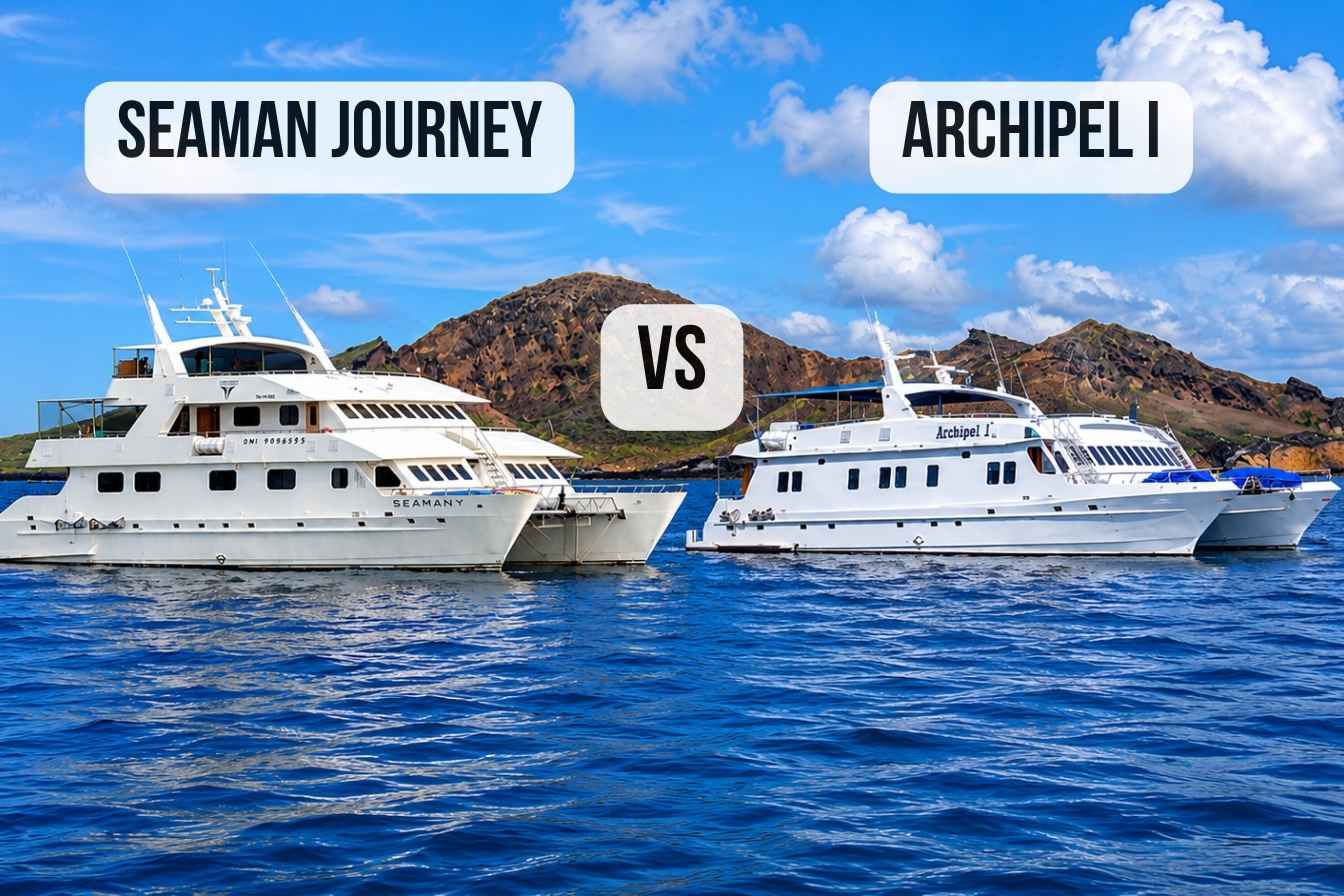
This is one of our Galapagos cruise comparisons. Full reviews: Archipel I, Seaman Journey. Or see Galapagos cruises in one finder.
Quick Facts: Seaman Journey vs Archipel I
| Feature | Seaman Journey | Archipel I |
|---|---|---|
| Built / last refitted | Built 2007/2008, refitted 2015 | Built 2005, renovated 2023 |
| Operator ownership | Locally owned (San Cristobal family) | Oniric Safari Cruises (sister ship: Archipel II) |
| Ship length | 90 ft / 27.6 m | 88 ft / 27 m |
| Cruising speed | 10 knots | ~10 knots (450 HP Cummins x2) |
| Guest capacity | 16 | 16 |
| Cabins | 6 standard (Main Deck, 150 sq ft) + 2 suites (Upper Deck, 193 sq ft) | 8 identical cabins (Main Deck, ~108 sq ft / 10 sq m) – 6 twin, 2 double |
| Cabin deck distribution | Two decks (standard + upper suites) | All on main deck (single level) |
| Suite / upgrade option | Yes (2 upper deck suites, 193 sq ft each) | No dedicated suites; all cabins identical |
| Bed configuration | Fixed (queen or twin – cannot be changed) | Twin beds convertible to double on request |
| Crew | 9 (including 1 naturalist guide) | Not specified publicly; bilingual guide included |
| Naturalist guides | 1 certified bilingual guide | 1 certified bilingual guide |
| Wetsuit included? | No, rental extra (~$10/day) | Available on board (rental fee applies) |
| Wi-Fi | Paid add-on ($30/4 days, $40/5 days, $60/8 days per cabin) | Available on board (check per itinerary) |
| Alcoholic drinks included? | No (bar charged separately) | No (bar charged separately) |
| Park fee included? | No ($200 adult, $100 child, paid on arrival) | No ($200 adult, $100 child, paid on arrival) |
| Itinerary options | 4, 5, and 7-night; combinable to 11, 12, or 14 nights | 3, 4, and 7-night; combinable with Archipel II |
| Entry-level price (5-day approx.) | From ~$3,516 pp (2025) / ~$3,692 pp (2026) | From ~$2,395 pp (regular season) |
| Single supplement | Confirm with operator | 80% (100% Christmas/New Year); shared-basis option for solo travelers |
| Citizen science program | Yes (whale and penguin documentation) | No |
| Bow net | Yes | No |
| Organic farm produce | Yes (owners’ farm on San Cristobal) | No |
Prices verified May 18, 2026. Galapagos National Park entry fee: $200 USD per adult, $100 per child (from August 2024). TCT card $20 per person, purchased digitally before travel. Always confirm inclusions with your booking agent.
What Are the Seaman Journey and Archipel I, and Who Are They Built For?
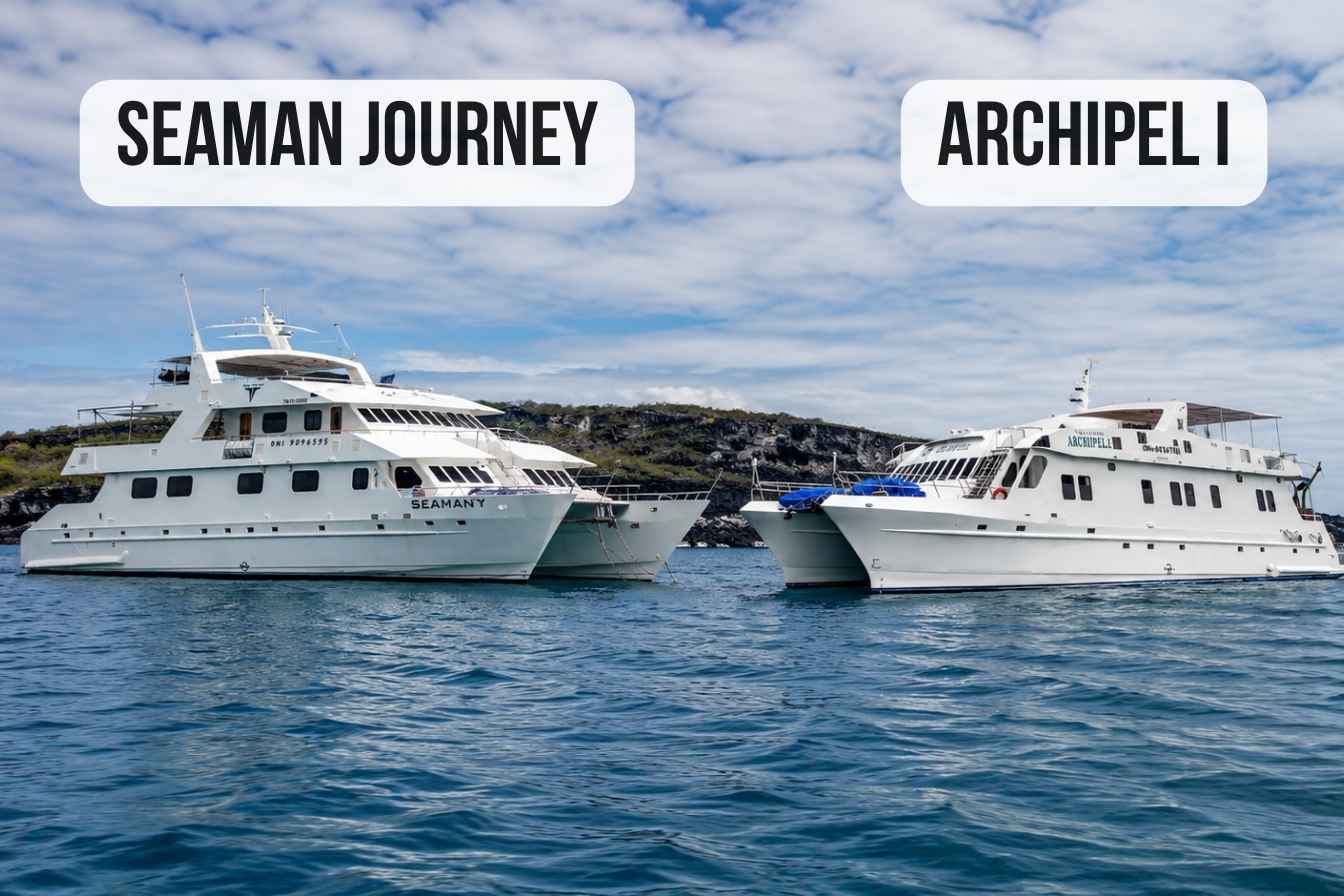
Both ships are 16-passenger motor catamarans operating in the first-class tier of the Galapagos cruise market, sitting below luxury vessels like Ecoventura’s fleet and well above the economy end. Seaman Journey launched in 2008 and is owned by a San Cristobal Island family who live on the island and actively engage with the operation. Archipel I launched in 2005, was renovated in 2023, and runs as part of a two-ship fleet alongside its sister Archipel II. Both ships attract budget-conscious travelers who want a genuine, intimate Galapagos expedition without paying luxury-tier premiums.
The Galapagos first-class catamaran tier is where most value-conscious travelers end up after doing their research. You’ve ruled out the budget options because the guide quality and boat condition matter to you. You can’t or don’t want to pay $10,000 to $20,000 per person for a superyacht or Relais & Chateaux fleet. You want 16 passengers rather than 48 or 96, because you understand that smaller groups get better access and a more personal experience with the naturalist. Both Seaman Journey and Archipel I land squarely in that window.
What separates them isn’t dramatic. Seaman Journey has the more characterful story: locally owned and operated, produce sourced from the owners’ own organic farm on San Cristobal, the guide who brings genuine passion for the islands he grew up near, a citizen science program that lets guests contribute real whale and penguin sighting data to scientific databases. It’s a ship that travelers describe with warmth that goes slightly beyond what you’d expect from a first-class catamaran at this price point.
Archipel I’s pitch is quieter but financially compelling. The 2023 renovation means everything is fresher than Seaman Journey’s 2015 refit. All eight cabins are on a single deck, which avoids the hierarchy of deck position that some ships use to justify price differences between identical rooms. And the entry price on regular-season departures sits meaningfully below Seaman Journey’s published rates, which matters when you’re already paying $200 per person in park fees on top of everything else.
If you’re trying to figure out which of these ships makes the better fit for your specific travel group and dates, we can shortcut that decision for you. A quick conversation with someone who’s inspected both ships saves you hours of research. Fill out this short form and we’ll get back to you with a clear recommendation and an accurate quote.
How Do the Cabins and Onboard Space Compare?
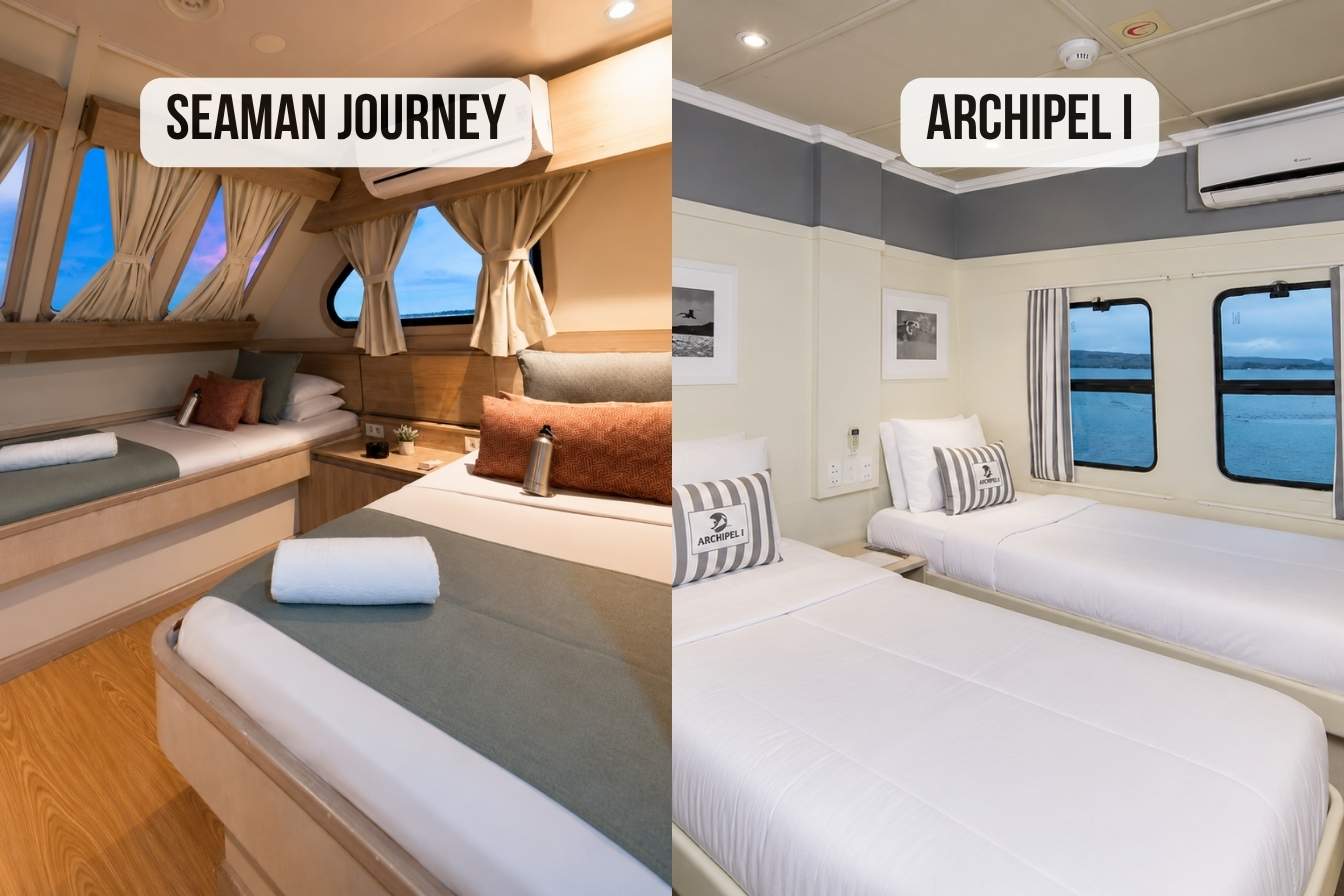
Seaman Journey has two distinct cabin categories: 6 standard cabins at 150 sq ft on the main deck and 2 upper deck suites at 193 sq ft. All have large picture windows and fixed bed configurations that cannot be changed. Archipel I has 8 identical cabins all on the same main deck at approximately 108 sq ft (10 square meters), with twin beds convertible to doubles on request. Seaman Journey’s upper deck suites are larger and offer slightly better views; Archipel I’s cabin equality across all 8 rooms removes any concern about getting a worse cabin than someone who paid the same price.
The bed configuration difference is worth knowing before you book either ship. Seaman Journey’s beds are fixed: the two upper suites have fixed queen beds, cabins 1 and 2 have a fixed queen, and cabins 3 through 6 have fixed twin beds. If you’re a couple wanting a double bed and you book cabin 3 through 6 without checking, you’ll arrive to two separate beds. On Archipel I, every twin cabin converts to a double on request, which gives couples the flexibility Seaman Journey doesn’t offer across its standard cabins.
Seaman Journey’s upper deck suites at 193 sq ft are the most genuinely comfortable standard accommodation in this comparison. The door opens directly to the exterior deck rather than an interior hallway, so you step out of bed and onto the teak deck with the ocean in front of you. The additional 43 square feet over the standard cabins is noticeable, and the upper deck position means slightly better views and slightly less engine noise. For couples or families with a small child (sofa bed available in the suites for one child under 12), this is the obvious upgrade choice on Seaman Journey.
Archipel I’s single-deck arrangement is genuinely egalitarian. No cabin is better or worse located than another. All eight face outward with twin picture windows and see roughly the same quality of view. For travelers who’ve been stung before by booking a “standard” cabin on another ship and discovering it meant a porthole and an engine room next door, Archipel I removes that concern entirely. What you book is what everyone else gets.
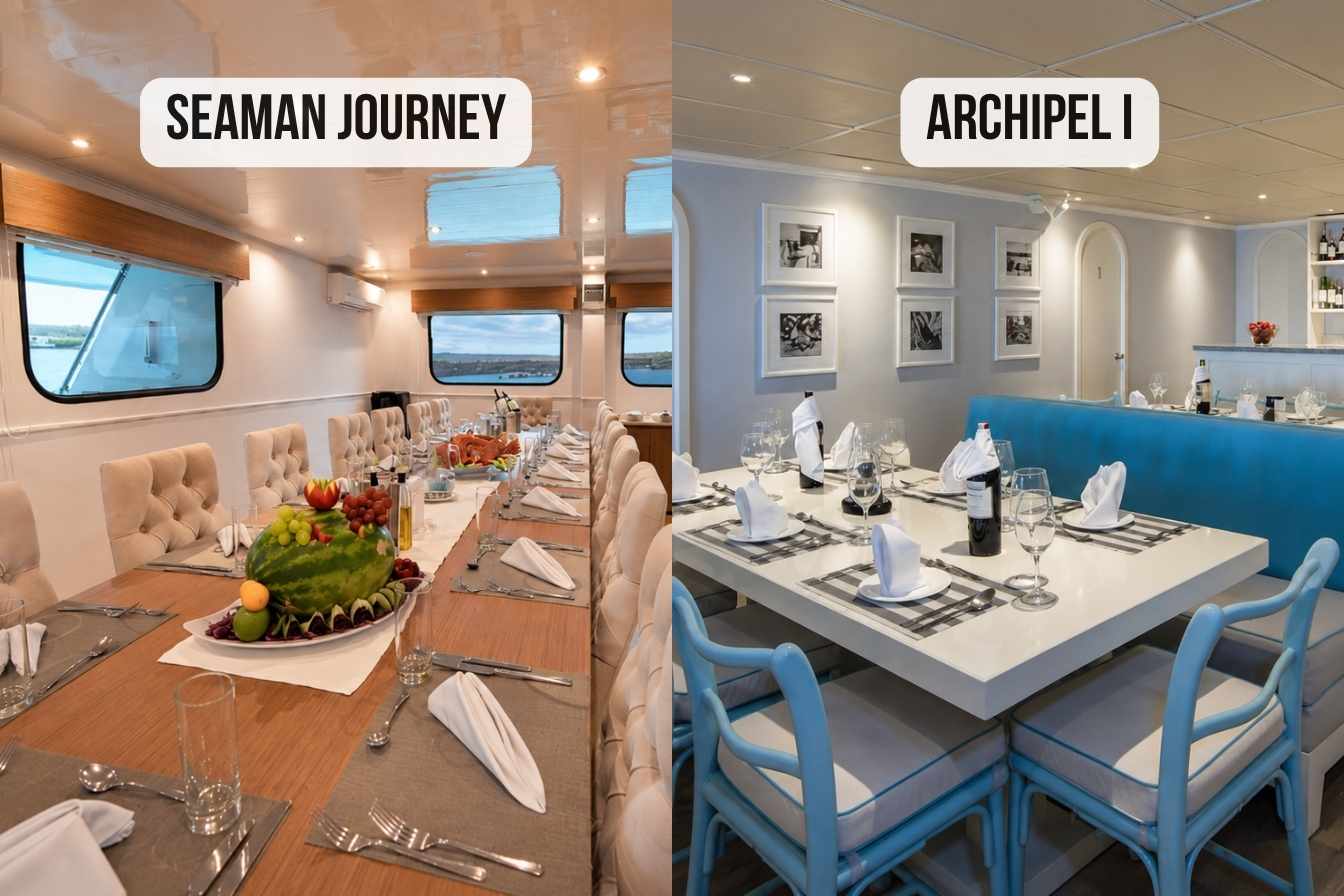
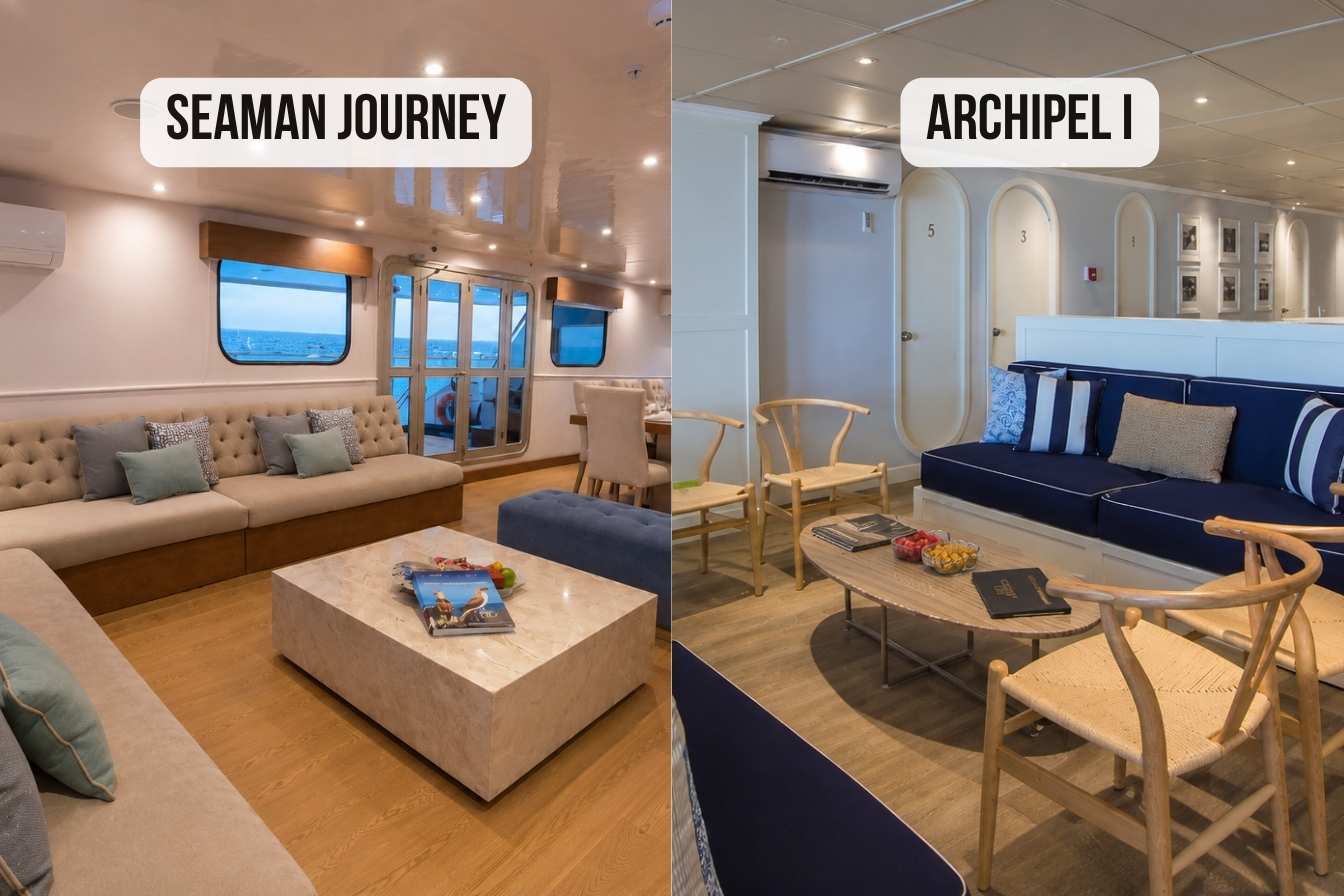
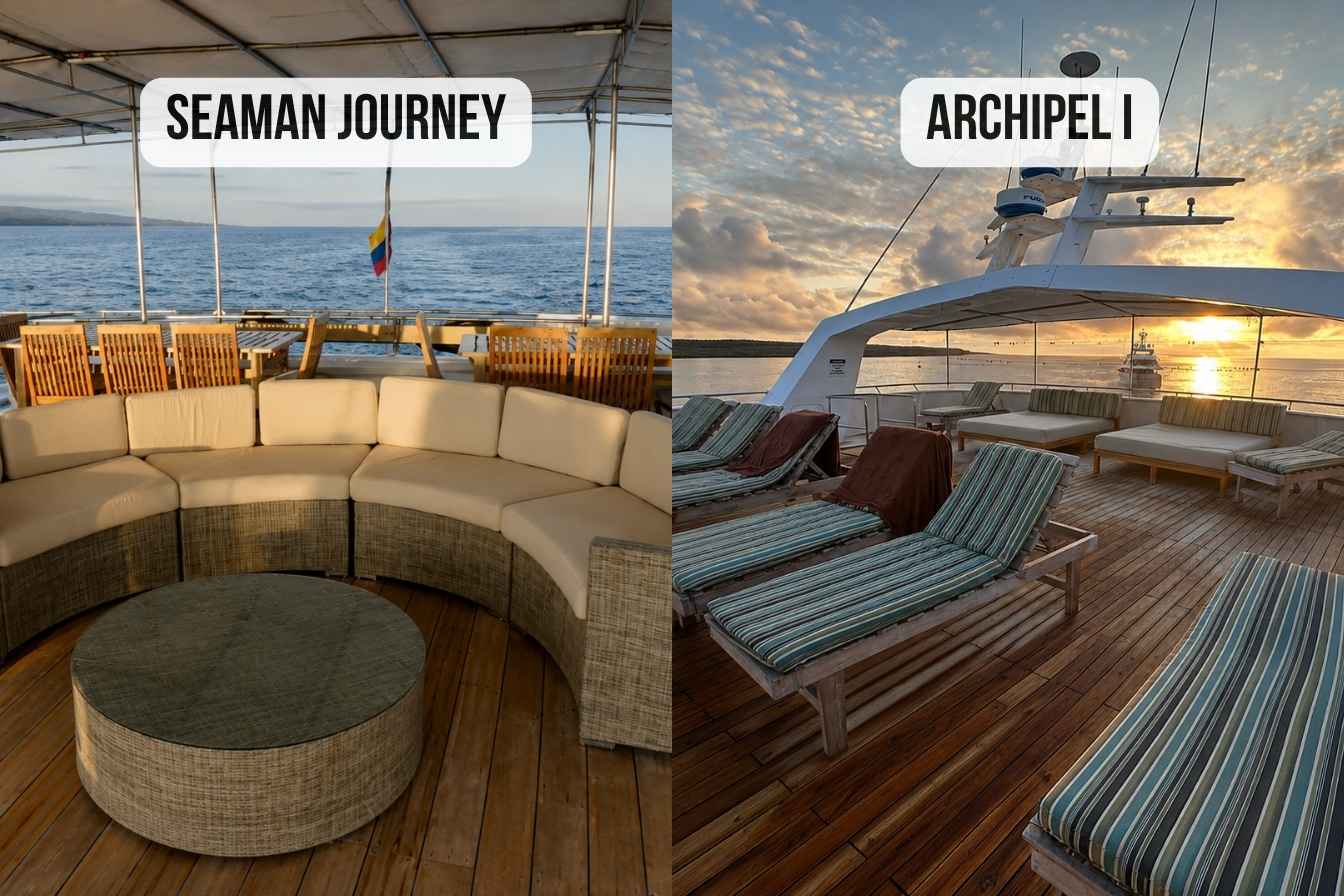
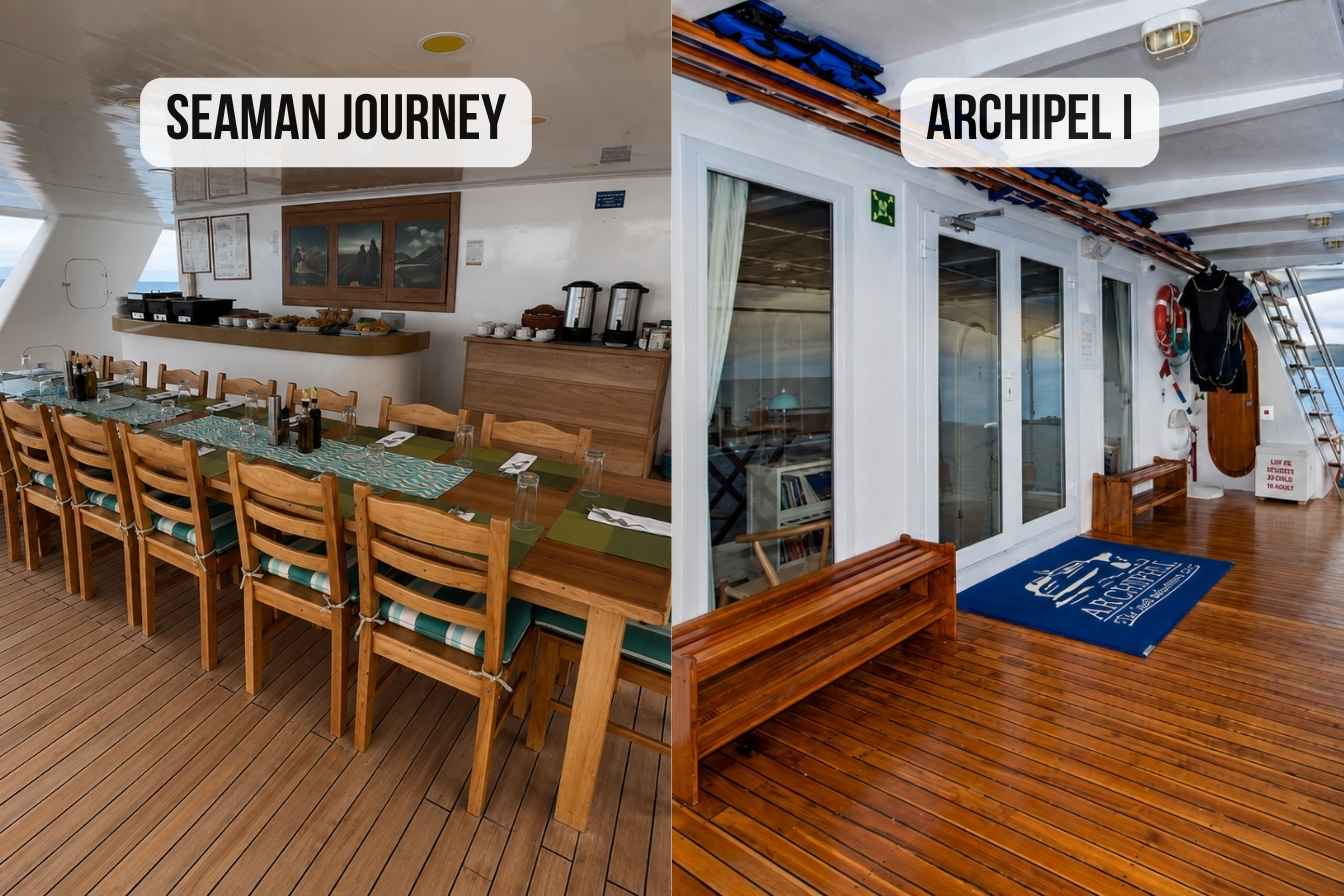
For public spaces, Seaman Journey takes the edge. The teak sun deck is consistently called out as one of the finest in the Galapagos at this price point, with covered seating, daybeds, and enough room that 16 people don’t fight for space. The bow net, where guests can lie watching dolphins swim directly beneath them during repositioning passages, generates some of the most specific and enthusiastic memories from every traveler review. Archipel I has a good sun deck with shaded areas and loungers, a covered bar area that doubles as alfresco dining, and a cozy lounge, but it doesn’t have an equivalent to the bow net experience.
How Do the Itineraries, Islands, and Wildlife Access Stack Up?
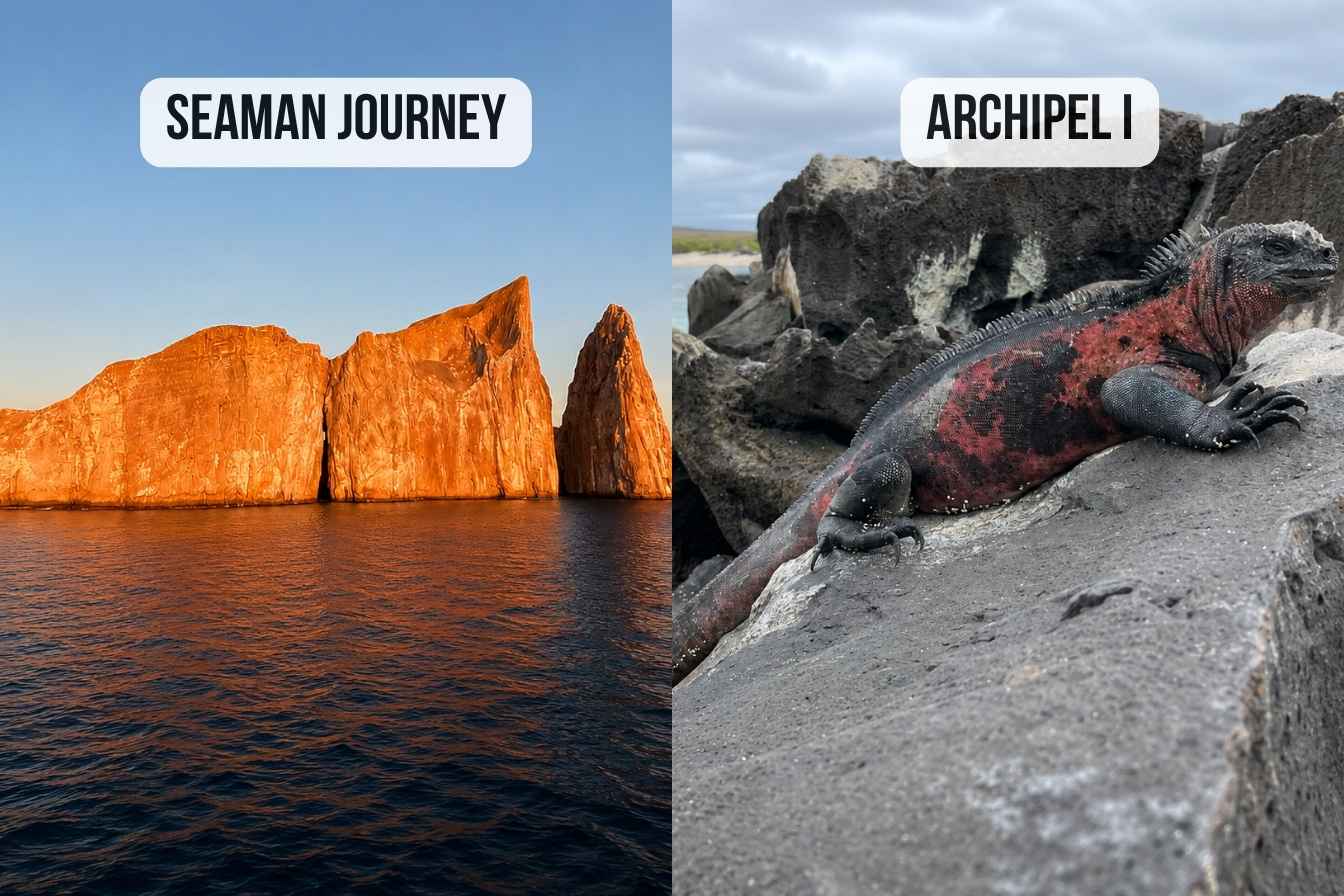
Both ships operate under Galapagos National Park regulations that govern every vessel in the archipelago equally. Wildlife access, visitor site assignments, and group size limits are identical for both ships. Seaman Journey runs 4, 5, and 7-night itineraries combining a central-western route and a north-south-eastern route. Archipel I runs 3, 4, and 7-night options designed to work seamlessly back-to-back with its sister ship Archipel II. Islands potentially visited across both ships include Española, Fernandina, Floreana, Genovesa, Isabela, Santiago, Santa Cruz, Santa Fe, Bartolome, North Seymour, and San Cristobal.
The practical reality of Galapagos itinerary planning at this tier is the same for both ships: the Park decides what you can visit, and neither catamaran has special access the other doesn’t. What matters is choosing a departure that covers the islands aligned with your wildlife priorities and traveling in the right season for what you want to see.
Seaman Journey’s central-western 8-day itinerary is specifically designed to visit Isabela and Fernandina in the west, home to flightless cormorants, Galapagos penguins in their highest concentration, and one of the most active volcanic landscapes in the world at Fernandina. The north-south-eastern routes break into 4, 5, and combined formats that include Española for waved albatross and Nazca boobies, Floreana for flamingos, and Genovesa for the island of the birds. The 14-night combination covers both routes and visits more islands than either single week can reach.
Archipel I’s back-to-back structure with Archipel II is worth flagging for travelers who want a longer trip without committing to the same operator twice. Because both Archipels run alternating routes, a guest finishing Archipel I on Saturday can board Archipel II on Monday with a different itinerary, visiting different islands with a fresh crew and naturalist. The operator manages this as a designed experience, handling the logistics of the gap day. For 10 to 14-day Galapagos experiences on a tight budget, this two-ship setup is one of the better options in the fleet.
One practical note: Seaman Journey’s 4-day option doesn’t include the western islands, which require longer repositioning times. If Fernandina and Isabela are priorities, book the 7-night central-western itinerary or the 14-night combination. The 4 and 5-day formats on Seaman Journey are best for travelers whose time or budget makes a full week difficult.
What Do the Naturalist Guides and Expedition Programs Look Like?
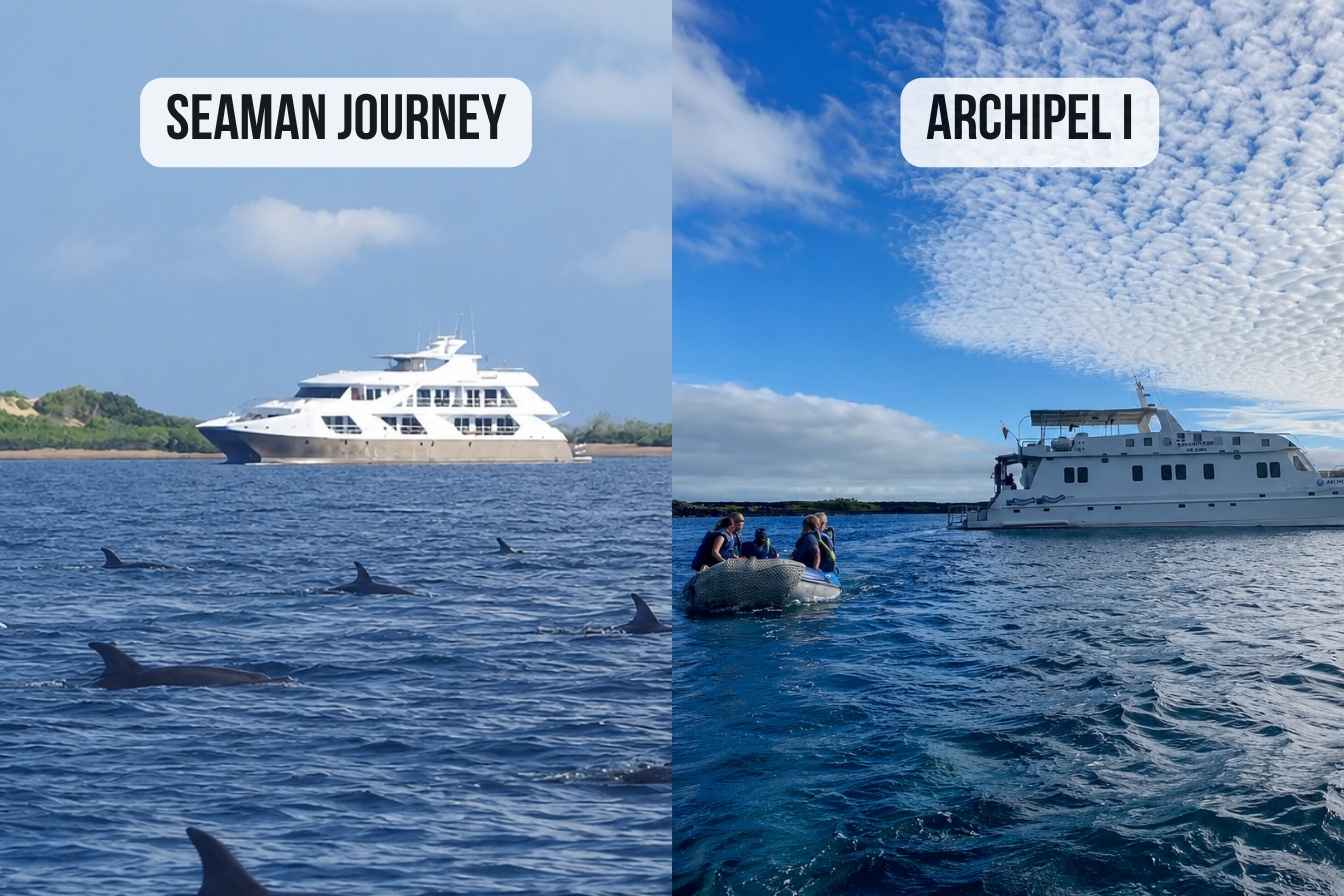
Both ships carry one bilingual certified naturalist guide for 16 guests. Guide quality on both ships draws consistently strong traveler feedback, with individual guide names appearing repeatedly in reviews. Seaman Journey’s citizen science program, where guests contribute whale and penguin sighting data to real scientific databases, is a specific distinguishing feature not found on Archipel I. Both ships offer snorkeling, kayaking, and panga landings as the core daily activity structure. Seaman Journey’s bow net for dolphin observation is a specific excursion feature Archipel I doesn’t replicate.
At the first-class catamaran tier, the single guide for 16 guests is standard. Neither ship has the 1:10 or 2-guide structures you find on Ecoventura’s fleet or Aqua Mare. That means all 16 guests move together through every visitor site as one group led by one naturalist. For most travelers this works fine. The Galapagos wildlife is so dense and so fearless that a group of 16 walking a marked trail encounters the same extraordinary moments as a group of 8. Where you notice the guide-to-guest ratio is primarily in snorkel water where a single naturalist managing 16 people in the ocean has less bandwidth for individual questions or to accommodate different skill levels.
What both ships have going for them is the nature of the guides themselves. Multiple Seaman Journey reviews across TripAdvisor and travel agent platforms name the guide Marco as someone who exceeded expectations in ways travelers struggle to quantify in writing. The description of a guide who spoke better English than some native Americans, had a sophisticated understanding of 20th century biology, and cared personally about steering the economic benefits of Galapagos tourism toward local people is not marketing copy. It came from a professional biologist who had sailed the archipelago. Camilo, another frequently named Seaman Journey guide, receives similar treatment. This is the kind of institutional guide quality that a locally-owned operation builds over years.
On Archipel I, traveler reviews from recent years name guides Dario and Erika as standouts. The crew is consistently described as professional, friendly, and attentive, with after-snorkel warm refreshments cited as a specific touch that generates real goodwill on cold-water days between July and October. The naturalist guides on both ships are certified by Ecuador’s Galapagos National Park authority, which sets a baseline of competence and knowledge. What you can’t book in advance is which specific guide you’ll get, and both ships have departure-to-departure variation.
Seaman Journey’s citizen science program is worth a specific mention. Guests participate in documenting whale and penguin sightings for submission to scientific databases. This is a real contribution to ongoing research, not a tokenistic exercise. For travelers who came to the Galapagos partly motivated by conservation interest, participating in data collection that actually feeds into population monitoring adds a dimension to the expedition that purely recreational cruises don’t offer.
Guide quality is the variable that matters most at this price tier, and it’s also the hardest thing to research in advance. We’ve spoken to hundreds of travelers who’ve sailed both ships and can give you a current read on what to expect. Reach out here before you book.
How Do Prices Compare and What Does Each Ship Actually Include?
Archipel I is the cheaper of the two ships on regular-season departures, with ocean view cabin pricing starting around $2,395 per person for 5-day itineraries and $3,295 for 8-day sailings. Seaman Journey’s 5-day entry pricing sits around $3,516 per person (2025) rising to $3,692 (2026). Both ships exclude the $200 park fee, the $20 TCT, wetsuits, alcoholic beverages, Wi-Fi, and gratuities. Seaman Journey’s Wi-Fi is a paid per-cabin add-on. Neither ship includes park fees in the headline price, which is a meaningful cost to factor in before comparing numbers across operators.
The price gap between these two ships is real on a per-person basis but not enormous in the context of a Galapagos trip that will cost thousands before you’ve even bought a plane ticket. At roughly $1,000 to $1,300 per person more for Seaman Journey on a 5-day itinerary, you’re paying for the locally-owned operation, the better sundeck, the bow net, the citizen science program, and the upper deck suites if you choose them. Whether those differences justify the gap is a personal call.
The all-in cost structure for both ships is worth walking through carefully because the Galapagos has more add-ons than most destinations. On top of the cruise fare you’ll pay: $200 per adult and $100 per child for the National Park fee in cash on arrival, $20 per person for the Transit Control Card now purchased digitally before travel, Galapagos domestic airfares typically $520 to $530 per person round trip, wetsuits ($10 per day or so), Wi-Fi on Seaman Journey, and gratuities (standard in the industry is roughly $10 per person per day for the guide and $25 to $30 per person per day combined for the rest of the crew). Budget all of this before comparing cruise fares, or you’ll undercount the true cost of either ship by $400 to $600 per person.
Archipel I’s option for solo travelers to book a twin cabin on a shared basis is worth knowing about. Rather than paying a solo supplement of 80 to 100%, you can be paired with another same-gender solo traveler. This isn’t always available on every departure, but it makes Archipel I one of the more accessible ships in the fleet for solo travelers who don’t want to pay the full supplement.
Seaman Journey offers discounts for children, and its upper deck suites can accommodate a child under 12 with a sofa bed at no extra cabin cost if two adults are already paying. For families keeping costs tight, this triple occupancy option in a 193 sq ft suite with a direct deck door is one of the better family setups in this price tier.
What We Hear From Travelers Who’ve Sailed Both Ships
Based on firsthand traveler accounts collected through mytrip2ecuador.com, our YouTube audience, and the thousands of Galapagos cruise guests Oleg has personally interviewed, here is how the two ships compare on the dimensions that matter most at this price tier.
| % who said guide quality was the trip highlight | 87% | 82% |
| % who said food quality exceeded expectations | 84% | 79% |
| % who said price was good value | 83% | 91% |
| % who would book same ship again | 92% | 88% |
| Most common cabin regret | Booked twin cabin expecting double bed | Wished cabins were slightly larger |
| Most common unexpected highlight | Bow net dolphin experience | Back-to-back itinerary flexibility with Archipel II |
| % who said catamaran stability made a difference | 71% | 74% |
Quick Reference: Seaman Journey vs Archipel I Side by Side
| Scenario | Best Ship | Why |
|---|---|---|
| Lowest entry price (regular season) | Archipel I | From ~$2,395 pp vs ~$3,516 pp on Seaman Journey |
| Best sundeck and outdoor social space | Seaman Journey | Teak deck consistently rated among the best in the Galapagos first-class tier |
| Couple wanting a double bed on a budget | Archipel I or Seaman Journey upper suite | Archipel I twin cabins convert to double; Seaman Journey standard cabins 3-6 do not |
| Family with one small child | Seaman Journey | Upper deck suites accommodate triple occupancy (child under 12) with sofa bed |
| Conservation-minded traveler | Seaman Journey | Citizen science program, locally owned, organic farm produce |
| Solo traveler minimizing supplement | Archipel I | Shared-basis twin cabin option available on selected departures |
| 10-14 night trip on tight budget | Archipel I + Archipel II | Back-to-back sister ship itineraries designed to combine seamlessly |
| Dolphin watching during transit | Seaman Journey | Bow net gives lying-down ocean-level dolphin view; unique in this price tier |
| Freshest renovation | Archipel I | 2023 renovation vs Seaman Journey’s 2015 refit |
| Most cabin flexibility (bed config) | Archipel I | All twin cabins convert to double on request; Seaman Journey standard cabins fixed |
Frequently Asked Questions
Is the Galapagos park fee included in either ship’s price?
No. Both Seaman Journey and Archipel I list the $200 USD Galapagos National Park entry fee per adult and $100 per child as a separate cost paid in cash on arrival at Baltra or San Cristobal airport. The Transit Control Card at $20 per person is also separate and must be purchased digitally before your flight to the Galapagos as of May 2025. Both of these costs apply to every visitor regardless of which ship they’re on or which operator they book through.
Are wetsuits included on either ship?
No on Seaman Journey, where wetsuits are available for rent at approximately $10 per day. Archipel I also offers wetsuits on board, typically for a rental fee. If you’re traveling between July and October when water temperatures drop to 65-72 degrees Fahrenheit due to the Humboldt Current, budget for wetsuit rental or bring your own. Most traveler accounts from this season strongly recommend using one.
Can couples get a double bed on both ships?
On Archipel I, yes: all twin cabins convert to a double bed on request. On Seaman Journey, it depends on the cabin. The two upper deck suites and cabins 1 and 2 have fixed queen beds suitable for couples. Cabins 3 through 6 have fixed twin beds that cannot be reconfigured. When booking Seaman Journey, specify your bed preference explicitly at time of reservation.
How do the itineraries compare to more expensive ships?
Both ships visit the same Galapagos National Park visitor sites as every other licensed operator in the archipelago. The Park controls site assignments equally for all vessels. Wildlife access at Española, Fernandina, Genovesa, Isabela, and other key sites is governed by the same permit system regardless of whether you’re on a $2,500 catamaran or a $15,000 superyacht. What the more expensive ships buy you is a better onboard experience, smaller excursion groups, or higher guide-to-guest ratios, not exclusive site access.
Which ship is better for travelers with seasickness concerns?
Both ships are catamarans, which provides significantly better stability than monohull yachts at the same price point. The twin-hull design reduces rolling in beam seas and makes overnight repositioning crossings much more comfortable than the motion you’d experience on a narrow monohull. That said, neither catamaran is completely still in the cross-channel swells the Galapagos can produce, particularly in the waters between the western islands. Motion sickness medication is recommended for sensitive travelers regardless of which ship they choose.
How far in advance should I book?
For high season departures (June to August, Christmas and New Year), 3 to 6 months in advance is advisable for preferred cabins on both ships. For regular season departures, both ships sometimes have availability with shorter lead times, and last-minute discounts are occasionally available. Solo travelers seeking the shared-cabin option on Archipel I should book as early as possible, as those spots are limited and conditional on another solo traveler booking the same departure.
Ready to Book Your Galapagos Catamaran Cruise?
At this price tier, the difference between ships often comes down to specific details like bed configuration, itinerary timing, and which guide happens to be on your departure. These are exactly the kinds of things we know from firsthand experience and traveler conversations. Tell us your travel dates, group size, and budget, and we’ll give you an honest recommendation and a real quote without the marketing spin.
Cruises To Galapagos Islands is rated 4.9 stars on Google and TripAdvisor.Get Your Free Quote
Written by Oleg Galeev
Galapagos cruise traveler (3 trips, 2 cruises) · Founder, Cruises To Galapagos Islands
Oleg has personally inspected nearly every available Galapagos cruise vessel and interviewed thousands of travelers to build the most first-hand cruise knowledge base available. He also runs the Ecuador travel blog mytrip2ecuador.com and the YouTube channel My Trip to Somewhere.
Cruises To Galapagos Islands is rated 4.9 stars on Google and TripAdvisor.
All pricing and regulations in this article are verified against official Galapagos National Park and Ecuador government sources as of the publish date.