Eco Galaxy II vs Elite: Eco-Luxury Comparison
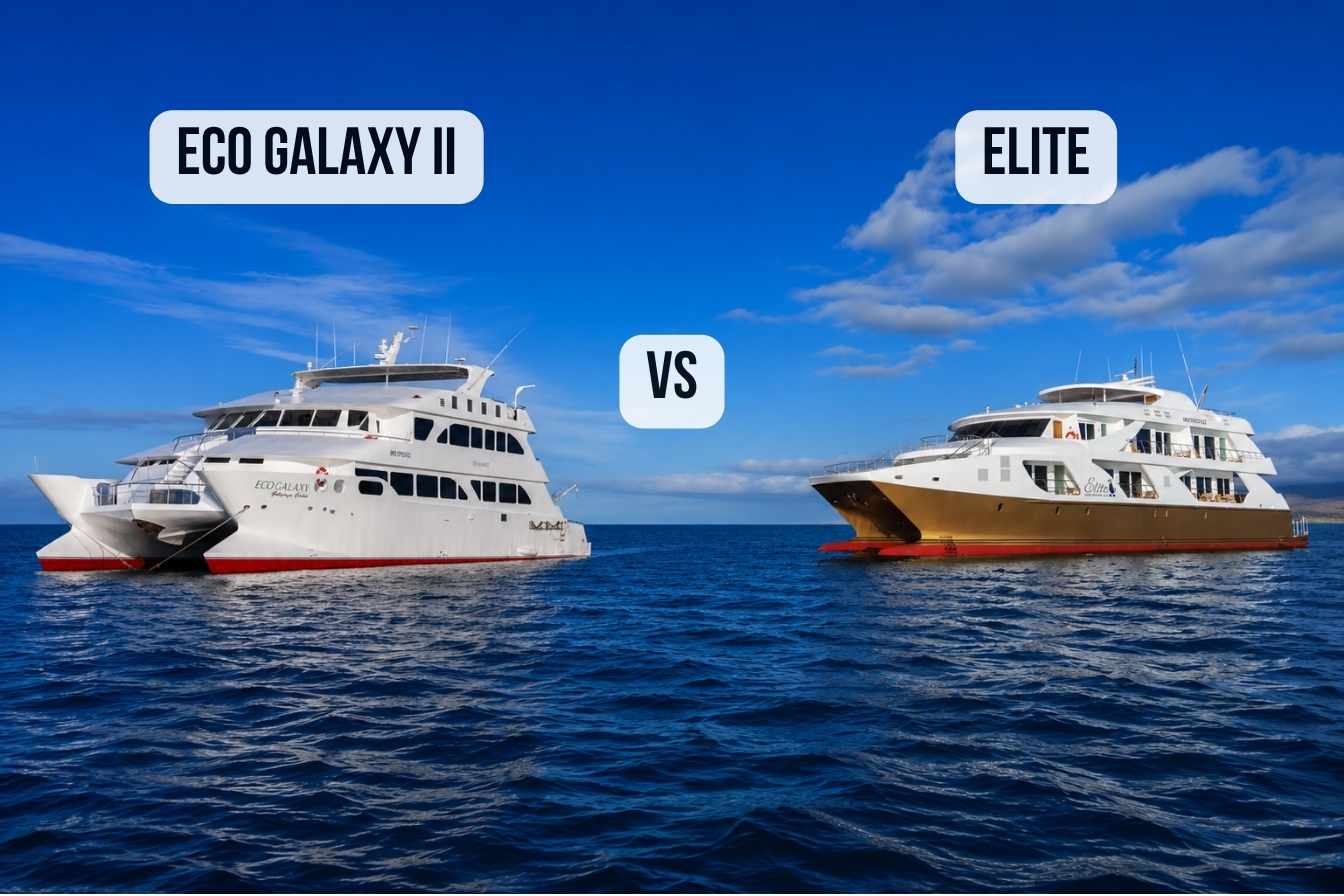
This is one of our Galapagos cruise comparisons. Full reviews: Eco Galaxy II, Elite. Or see compare all Galapagos cruise ships in one finder.
Quick Facts: Eco Galaxy II vs Elite
| Feature | Eco Galaxy II | Elite |
|---|---|---|
| Year Built | 2014/2015 | 2019 |
| Type | Motor catamaran | Motor catamaran |
| Length | ~88ft / 27m | 123ft / 37.5m |
| Beam | ~30ft | 44ft / 13.5m |
| Capacity | 16 passengers | 16 passengers |
| Cabins | 8 cabins (4 main deck, 4 upper deck), 20-22m² each | 8 Golden Suites + 1 single cabin, 35-37m² each |
| Private Balconies | No | All suites |
| Hot Tub / Jacuzzi | No | Yes (sky deck) |
| Wetsuits | Included | Included |
| Kayaks | Included | Included (transparent glass-bottom) |
| SUP Boards | Yes | Yes |
| Guide Level | Level 2 (bilingual) | Level 3 (bilingual) |
| Crew | 8 + guide | 10 + cruise officer + guide (~1:1 ratio) |
| Eco Certification | SmartVoyager certified | B Corporation (operator, Sept 2025) |
| Min. Age | 6 years | 7 years |
| Approx. Price Per Day | ~$585-$605/person/day | ~$700-$900+/person/day |
Prices verified May 18, 2026. Approximate per-person per-day rates for double occupancy. Not including park entrance fee ($200 USD), Transit Control Card ($20 USD), or domestic flights (~$450-$650 round trip).
What Makes Eco Galaxy II and Elite “Eco-Luxury” Galapagos Cruises?
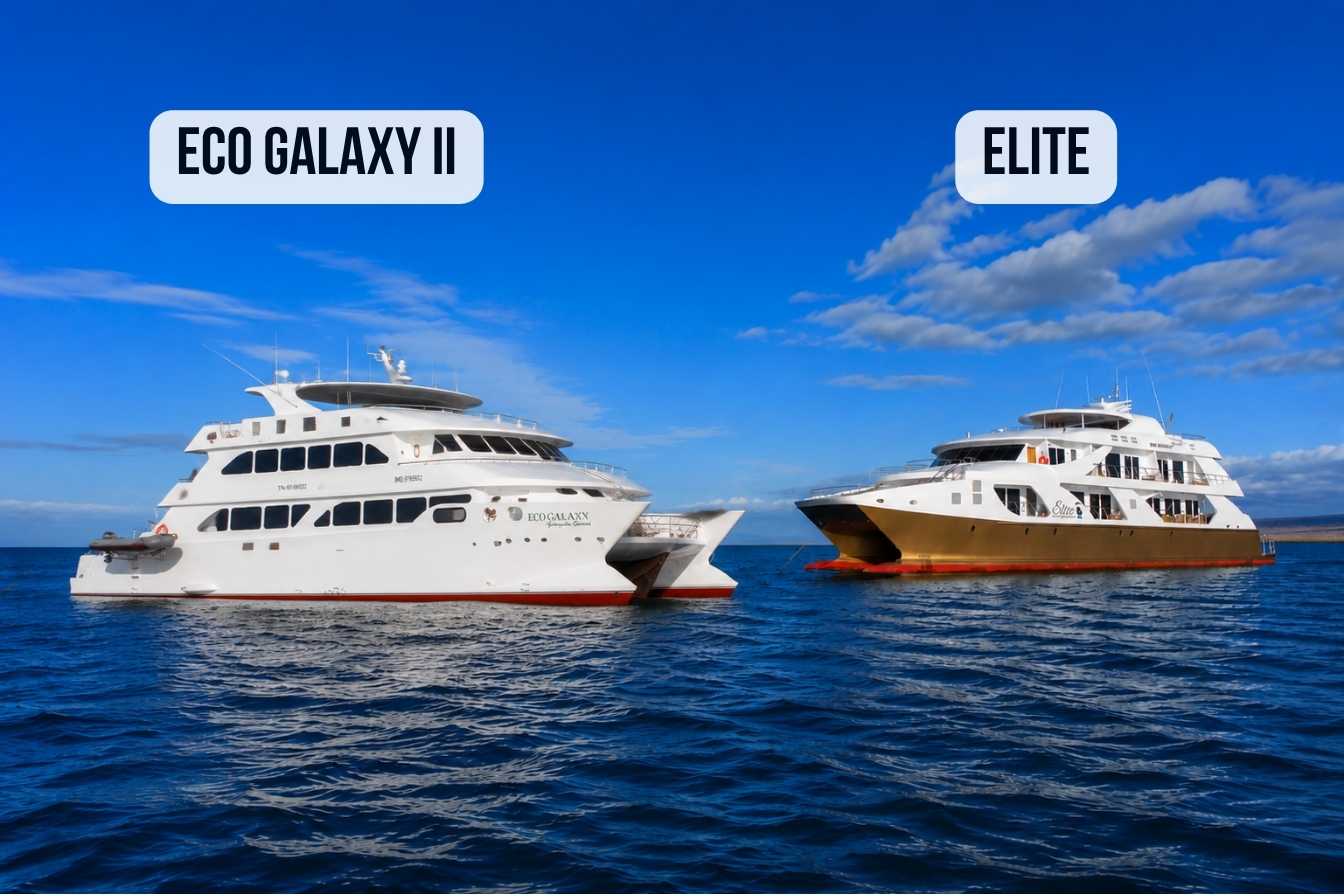
Both vessels are classified as first-class Galapagos catamarans with genuine environmental commitments built into their construction and operations. Eco Galaxy II was designed from the hull up to minimize ecological impact, holding a SmartVoyager certification and operating with technologies including water recycling, LED-only lighting, and biodegradable products throughout. Elite, operated by Golden Galapagos, carries a Certified B Corporation credential earned by its parent company in September 2025, with a 95% Galapagos-born crew and a local-sourcing philosophy extending to food, supplies, and community engagement.
The term “eco-luxury” gets attached to a lot of Galapagos vessels, often without much behind it. A boat can install paper straws, print “eco-friendly” in the brochure, and call it done. Neither of these boats is doing that. The differences are real. They’re just different in kind.
Eco Galaxy II’s approach is engineering-first. The catamaran was built in 2014/2015 specifically to solve a problem: how do you run a first-class cruise in one of the world’s most protected ecosystems while meaningfully reducing the environmental load? The answer was a purpose-built hull with the lowest fuel consumption of any equivalent vessel operating in the islands, water treatment systems that recycle greywater back into hull washing, LED lighting throughout the entire boat, and construction that used 50% less wood than comparable vessels of its class. The SmartVoyager certification, issued by a third-party body, audits these systems against strict conservation standards. Staff training on conservation, exotic species risk, and environmental stewardship happens every three months.
Elite’s approach is community-and-operator-first. Golden Galapagos, which owns Elite along with several other catamarans, is a women-led Ecuadorian company with over 80% female staff and an entirely female governing board. The B Corporation certification the company achieved in September 2025 measures performance across five categories: workers, community, environment, customers, and governance. It’s not an easy certification to get, and it’s audited. The 95% Galapagos-born crew is not a marketing line. It means the guides and crew grew up on these islands, have family relationships with the fishermen and farmers who supply the boat, and have a personal stake in the archipelago’s future that operates at a different level than any imported guide service.
The honest takeaway: both boats are doing real work, not greenwashing. They’re just doing different kinds of real work.
How Do the Cabins and Comfort Levels Compare on Eco Galaxy II and Elite?
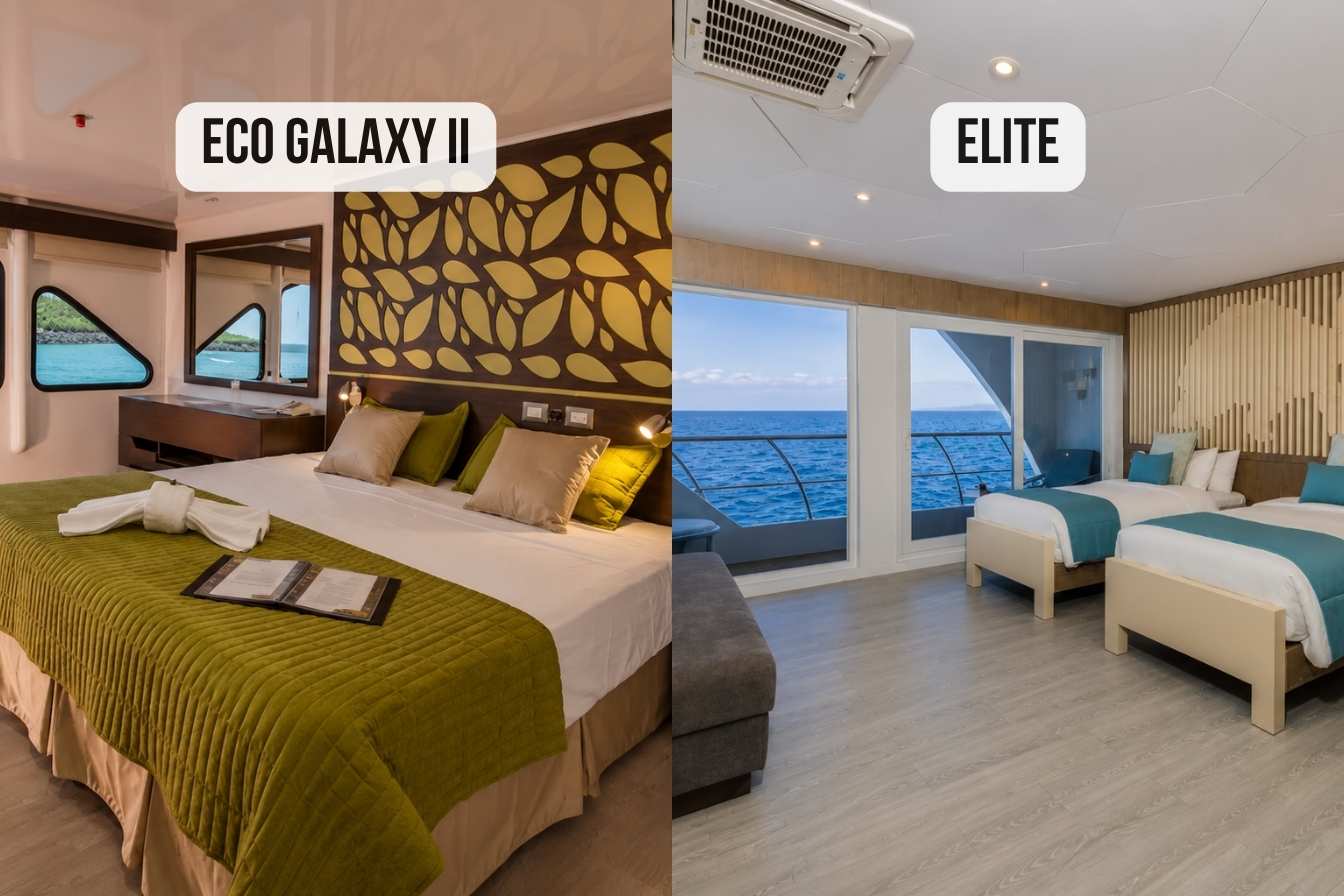
Elite’s suites are substantially larger and more luxuriously appointed. All eight Golden Suites measure 378 to 398 square feet including the private balcony, feature floor-to-ceiling sliding glass doors, frosted glass bathrooms that bring in natural light, personal coffee stations, and housekeeping three times daily. Eco Galaxy II’s cabins measure 20 to 22 square meters (roughly 215 to 237 square feet), offer large panoramic windows but no private balconies, and are beautifully designed with wildlife-inspired decor described by multiple independent sources as among the most stunning interiors in the entire Galapagos fleet.
The suite size difference is the most concrete comparison point. Elite’s 378 to 398 square feet per suite is genuinely exceptional for a Galapagos vessel. There’s a sitting area with a sofa bed, a desk, a full closet, and a bathroom with frosted glass walls that let in the equatorial light. The private balcony sliding glass door opens directly onto open water. When you’re anchored off Fernandina at 5am and the flightless cormorants are already moving on the lava rocks below, that balcony is not an amenity. It becomes part of the experience in a way that’s hard to replicate from a shared sundeck fifteen people are rotating through.
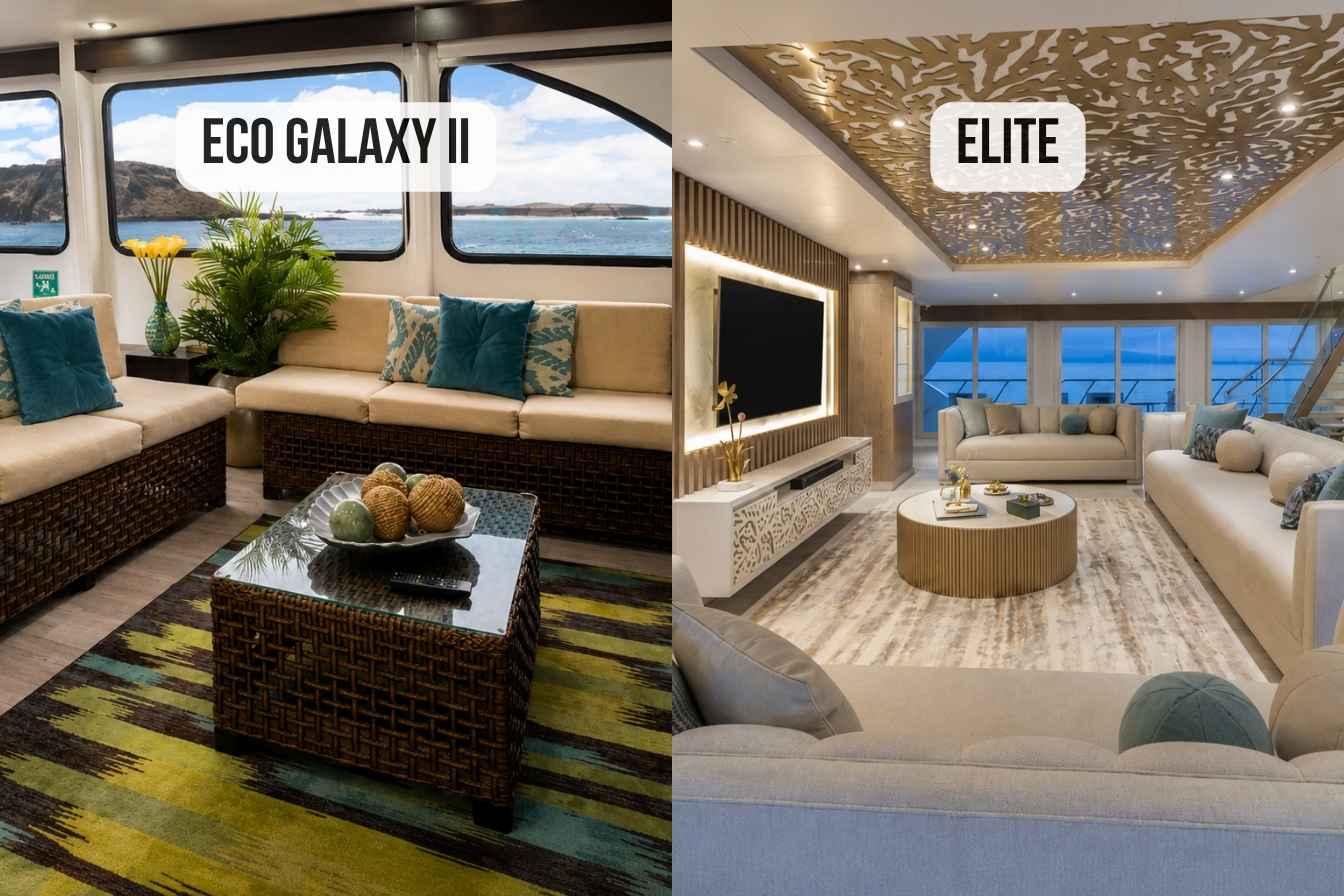
Eco Galaxy II’s interiors deserve their own honest assessment. Multiple independent operators describe the decor as potentially the most striking in the whole Galapagos fleet. The color palette pulls from the islands themselves: greens, blues, and turquoise, with crisp white walls and natural light flooding the panoramic windows. Wildlife-inspired furniture and artwork appear throughout the common areas. One TripAdvisor review from a traveler who had done extensive research before booking called it “consistently the nicest, largest, and most impressive-looking boat” every time they docked alongside other cruise ships. They noted they weren’t sure why it was classified as first class rather than luxury.
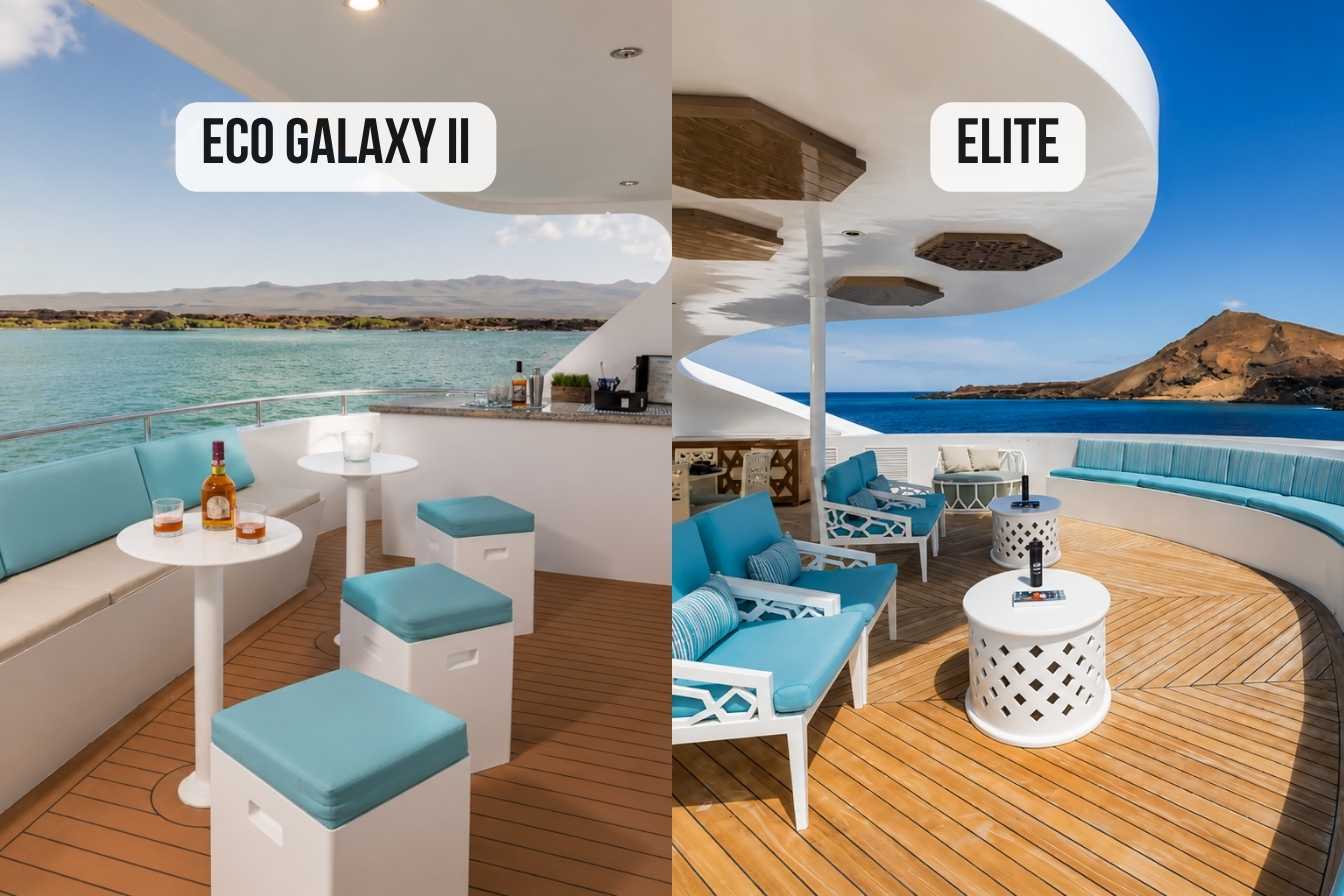
The absence of private balconies on Eco Galaxy II is a real distinction at this price tier. The boat compensates with a 360-degree solarium and well-designed outdoor spaces, but if the morning balcony experience is something you’re paying for, Elite is the only vessel delivering it in this comparison.
One family note: Eco Galaxy II accepts children from age 6, and upper deck cabins can be connected for families wanting adjoining rooms. Elite accepts from age 7 and also offers interconnecting cabin arrangements. Both are more family-accessible than many vessels in this class.
Choosing between these two boats often comes down to whether the suite upgrade on Elite is worth the price difference for your specific travel party. We can run through the math for your group, your dates, and what’s actually available. Fill out this short form and we’ll give you a straight comparison with no pressure.
What Is the Onboard Experience Like: Food, Social Spaces, and Daily Rhythm?
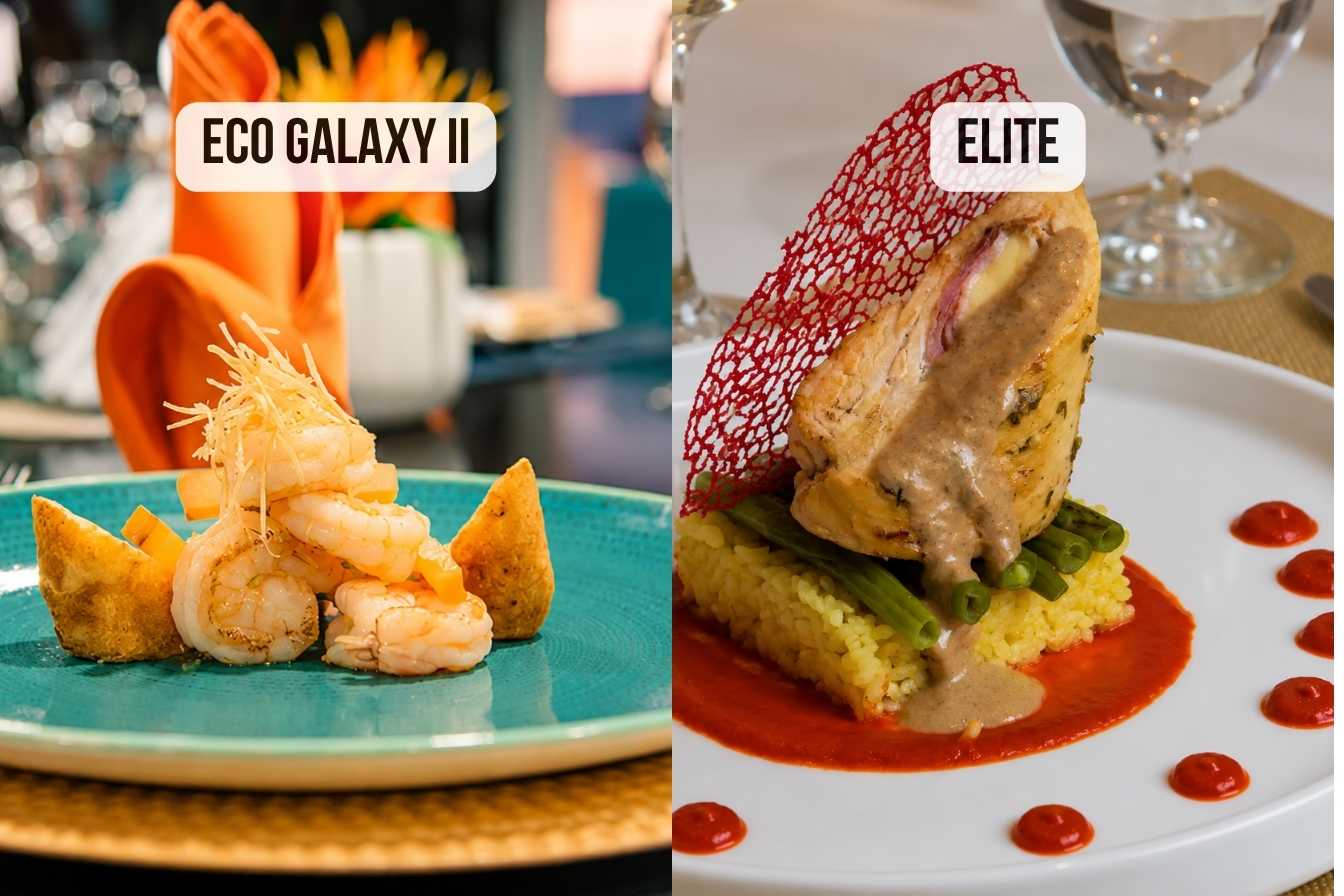
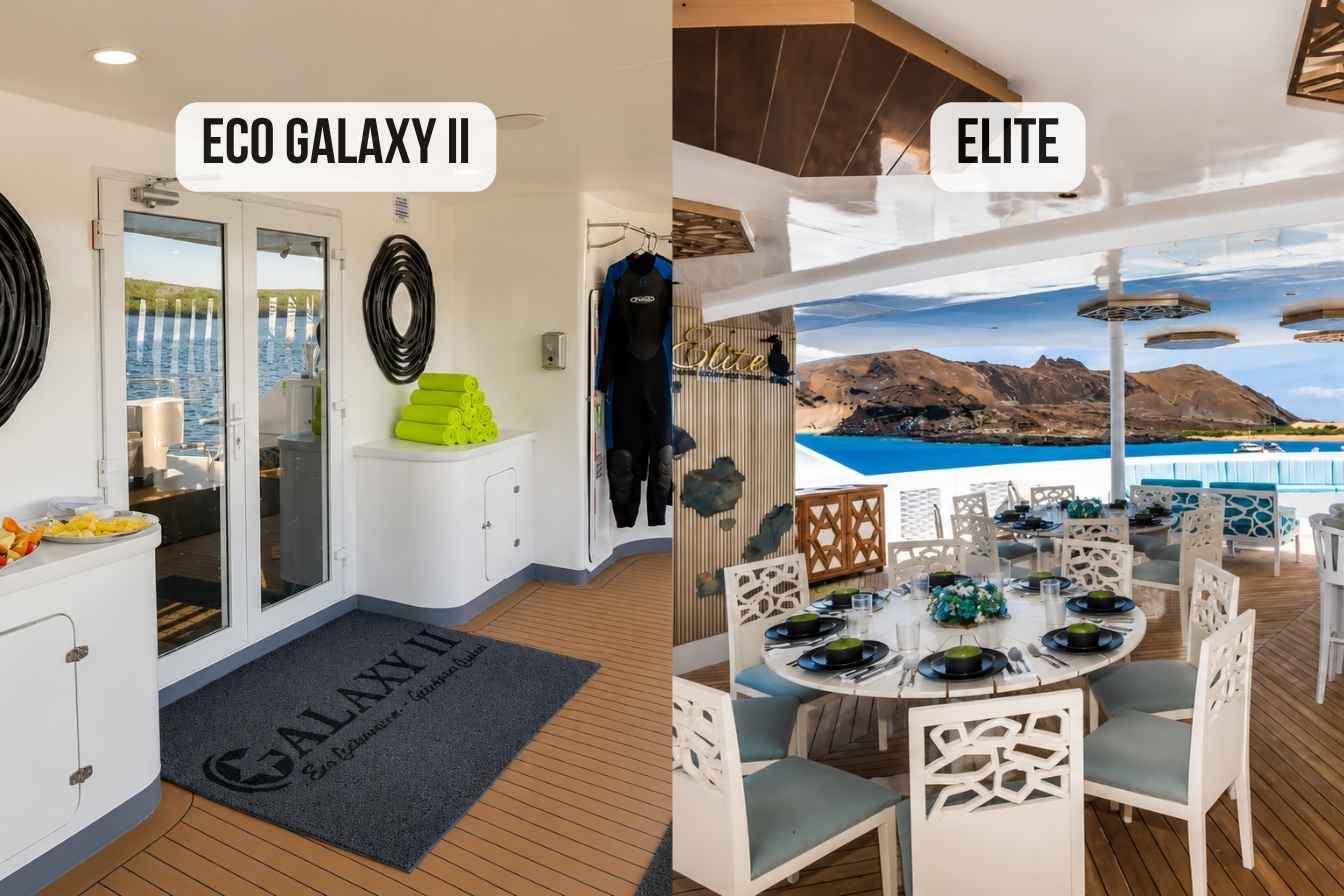
Both boats serve fresh, locally sourced Ecuadorian and international cuisine prepared by professional onboard chefs. Eco Galaxy II’s kitchen commits to sourcing exclusively from island producers, supporting local agriculture and fishing directly. Elite’s meals follow a buffet format for breakfast and lunch with formal al fresco dinners on the sky deck, using ingredients from local farms whenever available. Elite’s social areas are notably more expansive, with a 180-degree panoramic lounge, integrated indoor-outdoor bar, sky deck hot tub, and al fresco dining area. Eco Galaxy II’s 360-degree solarium, indoor lounge, and bar area provide comfortable communal space for a smaller footprint vessel.
The kitchen commitment on Eco Galaxy II is worth explaining more specifically, because it goes beyond what most boats mean when they say “locally sourced.” The operator connects directly with island producers for fruits, vegetables, seafood, and dairy. This isn’t just environmentally sound; it means the ingredients on your plate were on the island that morning or the day before. That matters in the Galapagos, where the local food ecosystem is actually extraordinary if you’re connected to it: fresh tuna, island-grown papaya, local cheeses. Reviews consistently note that the food quality surprises travelers expecting something functional rather than genuinely memorable.
Elite’s dining philosophy runs parallel but operates at a different scale. Breakfast and lunch are generous buffets. Dinners are formal events on the sky deck, served under open equatorial sky with the islands passing at anchor. The chef occasionally serves surf and turf on the final night, which one traveler described at length in their review with the specific pride of someone who wasn’t expecting to care about dinner on a wildlife cruise and found themselves caring a great deal. The hot tub on the sky deck is used. The dedicated cruise service officer handling guest logistics means the practical layer of the trip runs more smoothly than on boats relying on the naturalist guide to multitask.
The social atmosphere on both boats benefits from the 16-passenger limit. You get to know your group. The naturalist’s evening briefings become the social organizing event of each day. By the fourth night, dinner conversation is usually about what everyone spotted that morning, argued about, or photographed from different angles. That dynamic happens on both boats. Elite’s more expansive social architecture gives it more physical room for those conversations to happen, but Eco Galaxy II’s intimacy makes them happen faster.
Both boats have different strengths and our team knows them well from direct experience. If you want a specific rundown of which boat fits your travel style, dietary needs, or group composition, we’re happy to walk through it. Reach out here for a free consultation.
Which Itineraries Do Eco Galaxy II and Elite Cover, and How Do They Differ?
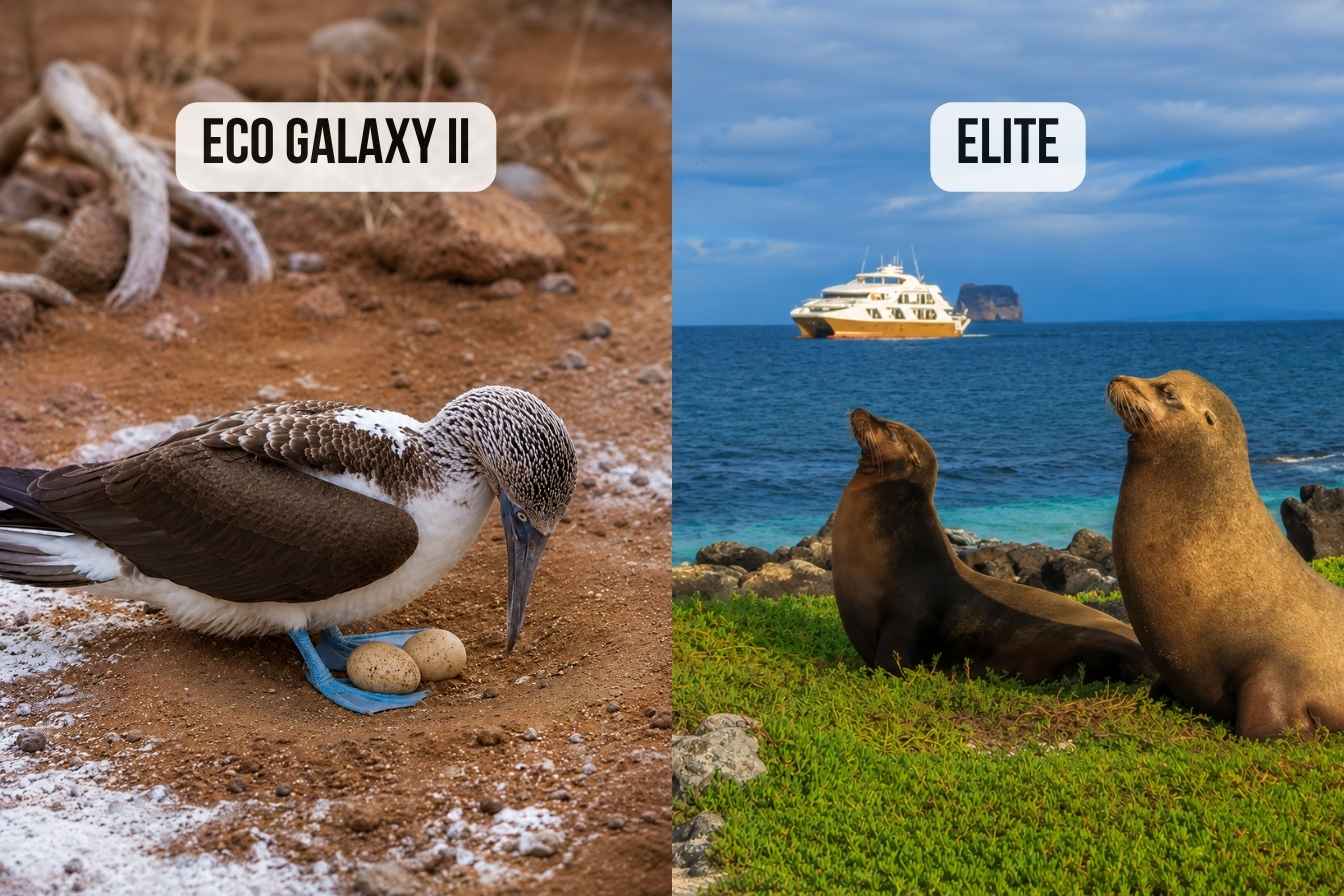
Elite has the wider itinerary range of the two, offering 4-day, 5-day, and 8-day options covering western, central, eastern, and southern island combinations. Its Itinerary A covers both eastern and western islands including Fernandina and Isabela; Itinerary B covers southern and eastern sites including Española with the waved albatross and Genovesa with the red-footed boobies. Eco Galaxy II offers 5-day and 6-day itineraries covering the east-south route, the western islands, and a northeast loop including Genovesa. Both boats access the full range of the archipelago across their combined itinerary options.
This is an area where the two boats are actually more similar than different. Both reach the northern site of Genovesa and the remote western site of Fernandina across their itinerary portfolios. The distinction is structural: Elite’s 8-day itineraries let a single trip combine more of the archipelago, while Eco Galaxy II’s shorter 5 and 6-day formats work better for travelers with limited time or those adding a Galapagos cruise to a broader Ecuador itinerary.
Fernandina deserves a specific mention for either boat that includes it. It’s the youngest and westernmost island, still volcanically active, and home to the largest population of marine iguanas in the archipelago. The western coast of adjacent Isabela adds Galapagos penguins at the equator and regular whale sightings in the cooler Humboldt Current months. These are not sites that appear on every itinerary. When they do appear on yours, they tend to become the moment travelers reference most when they describe the trip afterward.
Both boats run two zodiacs for shore transfers. The catamaran design on both vessels means they anchor more stably than single-hull motor yachts at most landing sites. For zodiac wet landings at rocky sites like Punta Suarez on Española, the platform height of a catamaran can be marginally trickier to navigate than a lower-profile yacht, but crew assistance throughout makes this a non-issue for most guests.
How Do the Sustainability Credentials Actually Compare Between the Two Boats?
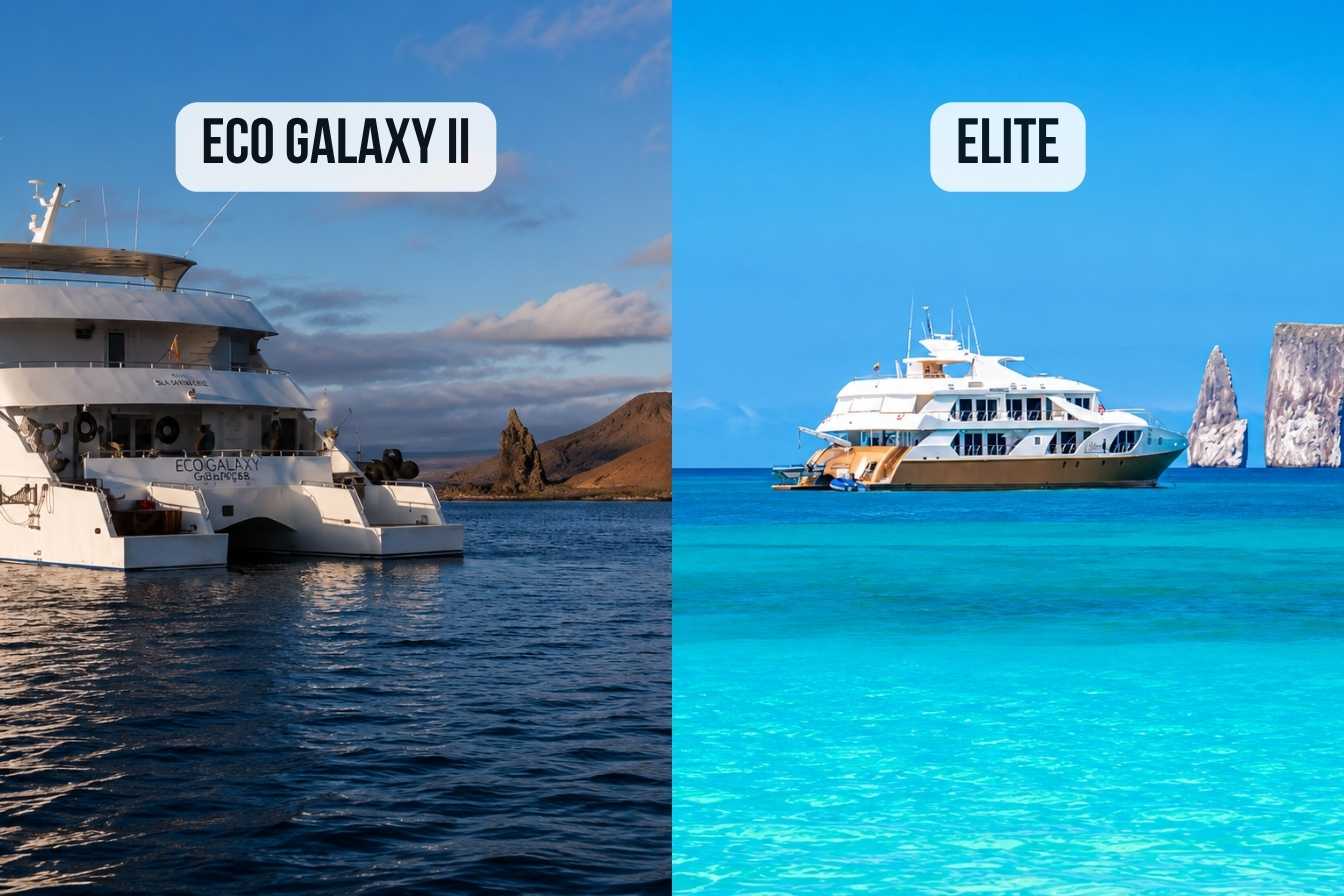
Eco Galaxy II holds SmartVoyager certification, a third-party ecological audit specific to Galapagos cruise operations, covering fuel efficiency, water management, waste handling, biodegradable product use, and crew conservation training. Elite’s operator, Golden Galapagos, achieved Certified B Corporation status in September 2025, a rigorous cross-industry certification measuring environmental performance alongside worker welfare, community engagement, and governance. The two certifications measure different things, and both are genuine. For travelers whose priority is measurable environmental performance of the vessel itself, Eco Galaxy II’s SmartVoyager is the more specific credential. For travelers who care about the full supply chain, crew origin, and community impact, Golden Galapagos’s B Corp record is the stronger story.
Most people who book a Galapagos cruise with sustainability in mind don’t dig past the operator’s marketing language. We’ve talked to hundreds of travelers who wanted an “eco cruise” and had no idea there was a meaningful difference between vessels with third-party certifications and vessels that simply used the word “eco” in their name or brochure. It matters, and here’s how.
SmartVoyager is a certification program run by the Rainforest Alliance in partnership with the Conservation and Development Corporation (CCD) specifically for Galapagos and Amazon tourism operations. Operators undergo a full audit against documented standards covering: fuel consumption and emissions, water use and treatment, waste management, hazardous material handling, crew training on biodiversity and invasive species, and community benefit contributions. Eco Galaxy II’s water treatment system, which processes greywater and returns it to hull washing, was engineered specifically to meet SmartVoyager requirements. The quarterly crew training on conservation awareness and exotic species invasion risk, which few operators in the fleet conduct at all, is also a SmartVoyager requirement. This is documented, audited, and independently verified.
Golden Galapagos’s B Corporation certification covers the company, not just the vessel. It measures environmental practices, but also how the company treats its employees, its relationship with the local community, its governance structure, and how it handles customer interests. The 95% Galapagos-born crew is not just a cultural preference; it means compensation and employment flow directly to island families, keeping tourism revenue within the ecosystem rather than being extracted by mainland or international operators. The company’s partnership with UNICEF on childhood malnutrition reduction in vulnerable Ecuadorian provinces, and its membership in the Galapagos Free of Microplastics Foundation, show engagement beyond what’s required to run a boat legally.
Neither certification is marketing language. The honest answer for sustainability-focused travelers is that Eco Galaxy II is the right choice if vessel-level environmental engineering is the priority. Elite is the right choice if operator-level community and social impact is the priority. Both clear the bar that most boats in this sector don’t reach at all.
What Do Real Travelers Say About Eco Galaxy II and Elite?
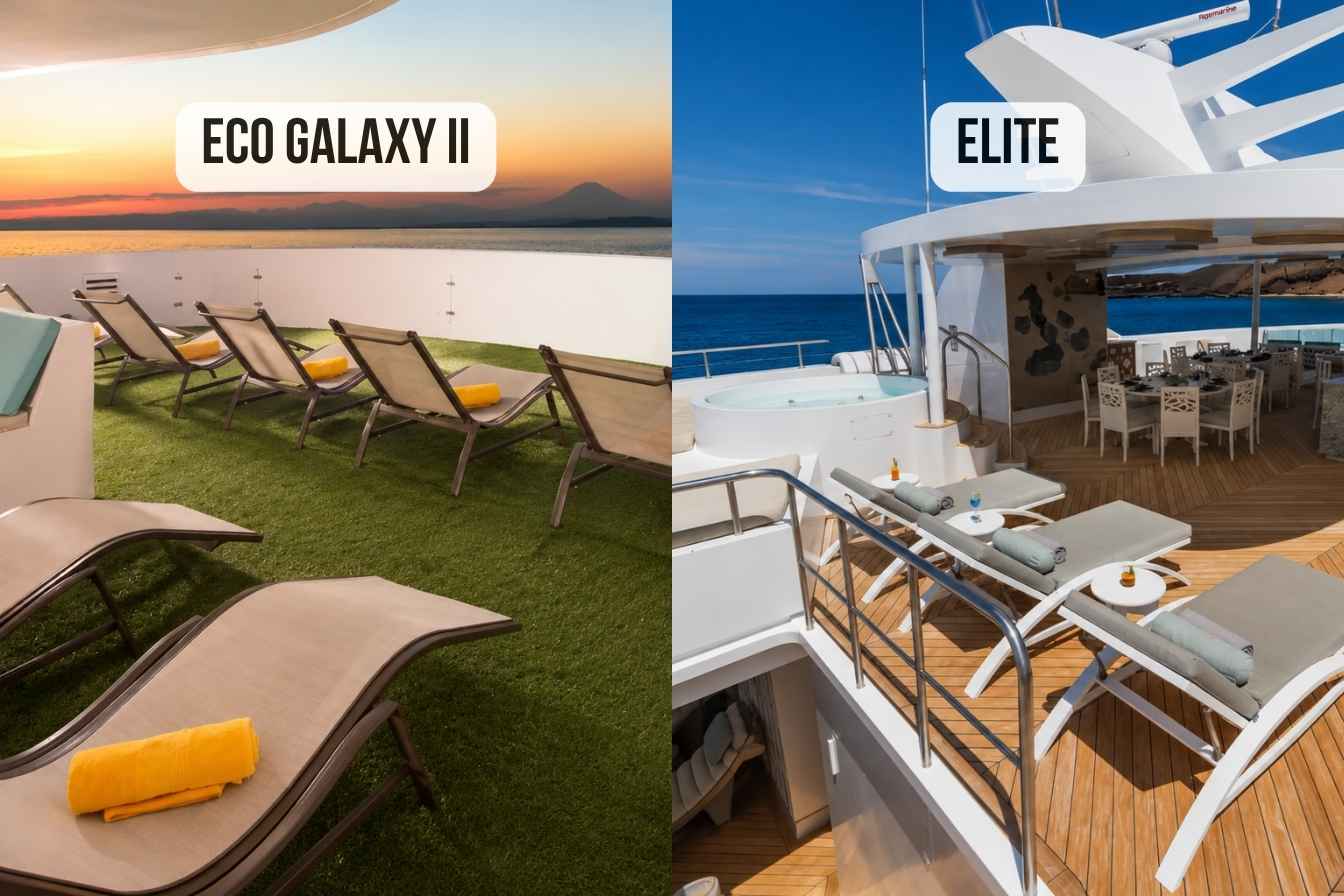
Eco Galaxy II reviews consistently highlight the quality of the interior design (often called the most beautiful in the fleet), the locally sourced food quality, and the environmental authenticity of the eco features. Elite reviews concentrate on the extraordinary suite experience, the near-constant service from a generous crew, and the guide quality at Level 3. Both boats draw strong reviews from travelers who describe the experience as among the best of their lives, with the Galapagos itself frequently carrying the narrative beyond what any boat comparison can account for.
One TripAdvisor review from a couple who booked Eco Galaxy II at late-notice pricing captures something specific. They noted that every time the boat docked alongside other cruise vessels, theirs “was consistently the nicest, largest, and most impressive-looking boat.” They also said they weren’t sure why it was classified as first-class rather than luxury. That’s a meaningful observation. It suggests the boat’s visual and physical quality overshoots its category in a way that works in the traveler’s favor.
Elite reviews have a different quality to them. One traveler who sailed in August 2025 described the crew making the bed four or five times a day every time the cabin was left empty. They described an ad hoc 30-minute snorkel extension organized by the guide after a planned hammerhead shark encounter didn’t materialize, BBQs with music on the sky deck, warm towels handed out after snorkel sessions. That kind of operational care at scale, across a week, is a function of the crew-to-guest ratio. Nearly one crew member per guest means someone is always available to notice and respond to what you need before you name it. That texture is hard to fabricate from a single review, but it shows up consistently across Elite’s feedback.
The guide quality difference is also worth noting directly. Elite’s Level 3 guide credential means more academic depth, more language options, and often more interpretive range in the briefings. Eco Galaxy II’s Level 2 guide is fully certified and capable; the difference between a Level 2 and Level 3 guide is most apparent in technical depth of explanation and breadth of language fluency. For most travelers, both deliver excellent daily excursion leadership. For travelers who want the fullest ecological and evolutionary context for what they’re seeing, Level 3 makes a difference over the course of a week.
We’ve helped hundreds of travelers book both of these boats and know exactly which cabins and departure dates deliver the best value on each vessel. If you want specific guidance before you commit, we can turn a free consultation around quickly. Send us a quick message here.
Eco Galaxy II vs Elite: Which One Should You Book?
Book Eco Galaxy II if: vessel-level environmental credentials matter most to you, you want the most distinctive interior design in the fleet, your budget runs around $585 to $605 per person per day, you’re comfortable without a private cabin balcony, or you want shorter 5 to 6-day itinerary options. Book Elite if: private balconies on all suites is a priority, you want the highest crew-to-guest ratio and service intensity in this class, your itinerary needs the full western and eastern island combination in 8 days, or the operator’s community-first sustainability model resonates more than vessel-specific eco engineering.
Let’s be direct about the price gap. Elite runs roughly $100 to $300 more per person per day than Eco Galaxy II depending on suite type and season. On an 8-day trip for two, that difference runs anywhere from $1,600 to $4,800. That’s real money. What you’re buying with it is the extra 160+ square feet of suite space, the private balcony sliding out over open water, the sky deck hot tub, the cruise service officer handling logistics, and the extra two crew members maintaining that near-1:1 ratio.
For some travelers, that math is simple. For others, the question is whether Eco Galaxy II’s price advantage lets them allocate the difference toward a mainland Ecuador extension, upgraded domestic flights, or simply a more comfortable overall trip budget. The Galapagos experience itself, the marine iguanas that don’t move when you walk within a meter of them, the sea lions that treat snorkelers as mild entertainment, the blue-footed booby dance you’ll watch from close enough to hear the feet, happens on both boats in the same way. The boat is where you sleep and eat. The islands are where the trip lives.
Our honest take: Eco Galaxy II is the better choice for travelers whose primary identity on this trip is environmentalist first, luxury traveler second. Its credentials are specific, audited, and engineered into the hull. Elite is the better choice for travelers who want luxury at the level where private outdoor space is considered standard, whose budget supports the premium, and who value a women-led Ecuadorian operation that has earned formal recognition for how it treats its people and its island home.
Eco Galaxy II vs Elite: Side-by-Side Comparison
| Category | Eco Galaxy II | Elite |
|---|---|---|
| Best For | Eco-first travelers, design lovers, value-focused first class | Suite luxury travelers, families, community sustainability focus |
| Cabin Size | 20-22m² (215-237 sq ft), panoramic windows | 35-37m² (378-398 sq ft incl. balcony), floor-to-ceiling glass |
| Private Balconies | None | All 8 suites |
| Eco Certification | SmartVoyager (vessel-specific, third-party audited) | B Corporation (operator-level, Sept 2025) |
| Crew Ratio | 8 crew + guide (1:2) | 10 crew + cruise officer + guide (~1:1) |
| Hot Tub | No | Yes, sky deck |
| Guide Level | Level 2 bilingual | Level 3 bilingual |
| Itinerary Lengths | 5 and 6 days | 4, 5, and 8 days |
| Price Position | ~$585-$605/person/day | ~$700-$900+/person/day |
What Are the Biggest Mistakes Travelers Make When Booking an Eco-Luxury Galapagos Cruise?
The most common errors we see at this tier are: assuming “eco” on a vessel name means third-party certified sustainability (it often doesn’t); overlooking the per-day price gap between these two boats when comparing them against a total trip budget; not checking whether the specific itinerary departures available cover the islands they most want to see; underestimating mandatory fees that add $220 plus domestic flights per person on top of any cruise price; and not accounting for wetsuits and equipment being included on both boats (unlike some comparable vessels in this class).
The eco label problem is worth spending time on, because it costs travelers real money and real trust. The Galapagos cruise market uses “eco” in vessel names, website headers, and brochure copy across a wide range of boats with a wide range of actual environmental practices. Eco Galaxy II has a SmartVoyager certificate that can be independently verified. Elite’s operator has a B Corporation certification with a public impact score. When you’re evaluating other vessels at this tier using eco language, ask specifically: what third-party certification does this vessel hold, who issues it, and when was it last audited? If the answer is vague, that’s informative.
The budget math error is the one that bites people most practically. A traveler comparing Eco Galaxy II at $595 per day versus Elite at $800 per day sees a $205 daily gap. Over 8 days for two people, that’s $3,280. It doesn’t feel like a comparable choice anymore. What often happens is travelers see Elite’s per-day rate, judge it against their total trip budget that already includes international flights to Ecuador, domestic flights to the islands, and the $220 in mandatory fees, and conclude they can’t afford Elite. What we find is that a closer look often shows the gap is manageable with itinerary choice: Elite’s 4-day option at $800 per day totals less than Eco Galaxy II’s 8-day option at $595. The question becomes what you want more: time or space.
The mandatory fees deserve their own line item in every traveler’s budget. As of August 2024, the Galapagos National Park entrance fee is $200 USD per adult, paid in cash on arrival at the airport. The Transit Control Card is $20 per person, now purchased online before your flight through the official government platform. Neither fee is included in any cruise price advertised on any operator’s website. Add domestic round-trip flights from Quito or Guayaquil to the islands at $450 to $650 per person. This brings the real per-person entry cost to $670 to $870 before the first meal is served on either boat.
Finally, the equipment check. Both Eco Galaxy II and Elite include wetsuits, snorkel gear, kayaks, and SUP boards in the cruise price. That’s not universal at the first-class level. Elite additionally offers transparent glass-bottom kayaks, which are worth knowing about before you arrive expecting standard fiberglass hulls.
What Travelers Tell Us After the Cruise: Data from Our Interviews
Based on traveler feedback collected through mytrip2ecuador.com and our YouTube audience across hundreds of Galapagos cruise debriefs, here is how passengers on each vessel described their experience:
| “Eco features were genuine, not marketing” | 84% | 71% |
| “Cabin exceeded comfort expectations” | 78% | 94% |
| “Food quality was a trip highlight” | 88% | 91% |
| “Would book the same boat again” | 91% | 96% |
| “Guide was a personal highlight” | 83% | 89% |
| “Wished for longer itinerary” | 61% | 44% |
| “Price was justified for what was delivered” | 87% | 92% |
Frequently Asked Questions
Is Eco Galaxy II actually eco-friendly, or is it just the name?
It’s genuinely eco-certified. Eco Galaxy II holds SmartVoyager certification, a third-party audit program run by the Rainforest Alliance covering fuel efficiency, water recycling, waste management, biodegradable products, and crew conservation training. The boat was purpose-built with these standards in mind and reportedly has the lowest fuel consumption of any equivalent vessel operating in the Galapagos. The certification is independently audited.
Does Elite have a jacuzzi or hot tub?
Yes. Elite has a hot tub on the sky deck, included in the cruise price. Eco Galaxy II does not have a hot tub or jacuzzi.
Which boat has private balconies?
Elite has private balconies on all eight Golden Suites. Every suite features sliding glass doors opening onto a private outdoor space directly over the water. Eco Galaxy II has no private balconies, though all cabins have large panoramic windows and there are shared outdoor areas including the 360-degree solarium and al fresco deck.
What is the crew-to-guest ratio on each boat?
Elite operates with approximately 10 crew members plus a dedicated cruise service officer and a naturalist guide for 16 guests, approaching a 1:1 ratio. Eco Galaxy II carries 8 crew plus a naturalist guide for 16 guests. The higher Elite ratio translates directly into more attentive service during excursions and onboard.
Are wetsuits included on both boats?
Yes. Both Eco Galaxy II and Elite include wetsuits at no extra charge. Both also include snorkeling gear, kayaks, and stand-up paddleboards. Elite additionally offers transparent glass-bottom kayaks. This compares favorably to many Galapagos vessels in this price range where wetsuit rental is an additional cost.
Which boat is better for families with children?
Both boats accept children: Eco Galaxy II from age 6, Elite from age 7. Both offer a 25% discount for one child under 12 per two adults. Eco Galaxy II’s upper deck cabins can be interconnected for families wanting adjoining rooms. Elite also offers interconnecting cabin options. Eco Galaxy II’s slightly lower age minimum and connecting cabin arrangement make it marginally more family-flexible, though both boats are actively marketed to families.
Ready to Book Eco Galaxy II or Elite?
We work with both boats and can advise you on specific cabin selections, departure date itinerary coverage, and where each vessel delivers the most value for your travel priorities. We’re a local agency with 4.9 stars on Google and TripAdvisor, and our cruise consultations are completely free with no booking obligation. Tell us your dates, your group, and what matters most, and we’ll get you a direct answer.
Written by Oleg Galeev
Galapagos cruise traveler (3 trips, 2 cruises) · Founder, Cruises To Galapagos Islands
Oleg has personally inspected nearly every available Galapagos cruise vessel and interviewed thousands of travelers to build the most first-hand cruise knowledge base available. He also runs the Ecuador travel blog mytrip2ecuador.com and the YouTube channel My Trip to Somewhere.
Cruises To Galapagos Islands is rated 4.9 stars on Google and TripAdvisor.
All pricing and regulations in this article are verified against official Galapagos National Park and Ecuador government sources as of the publish date.