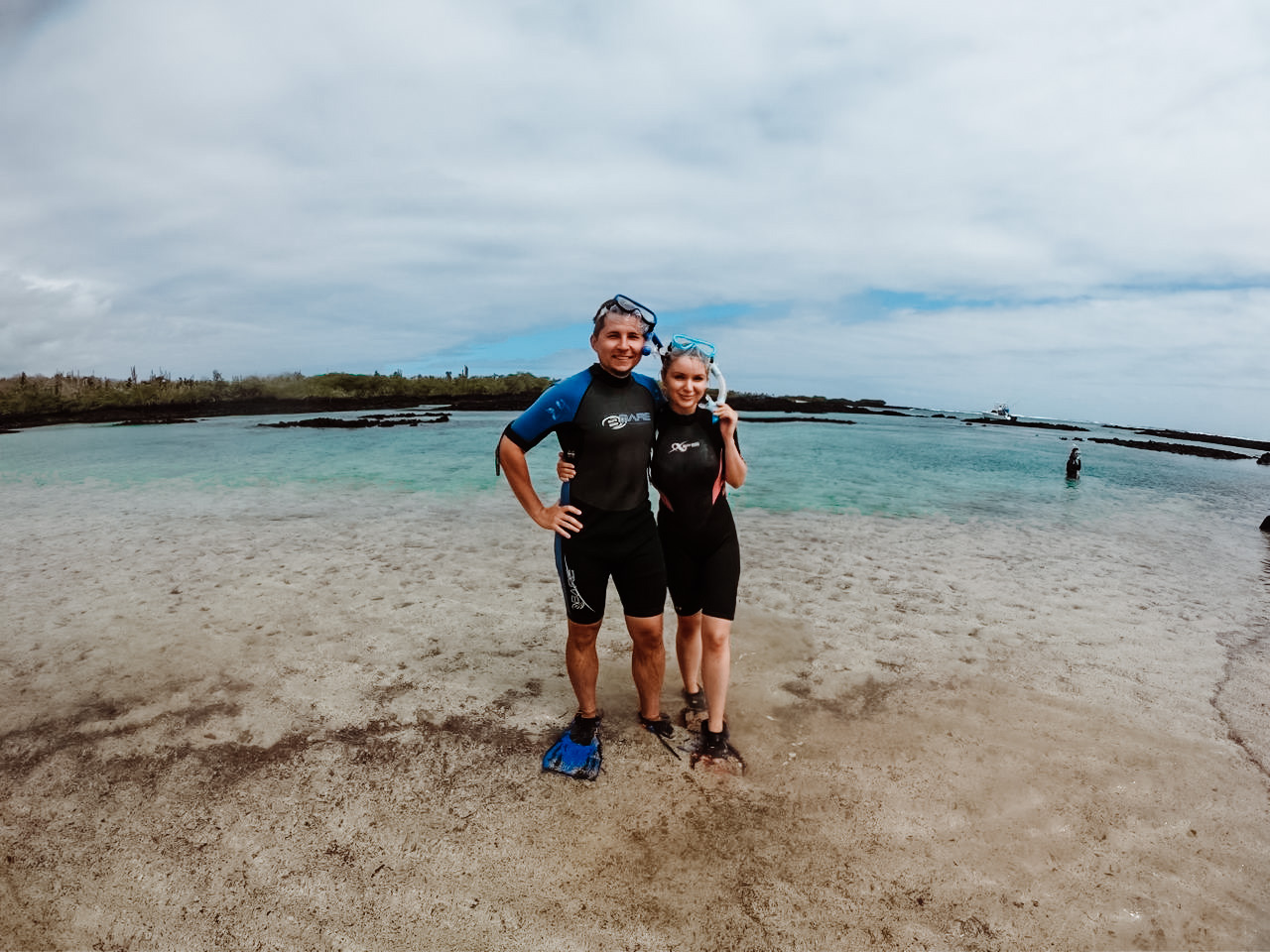
Mary Anne vs The Beagle: Classic Sailing Ship Comparison
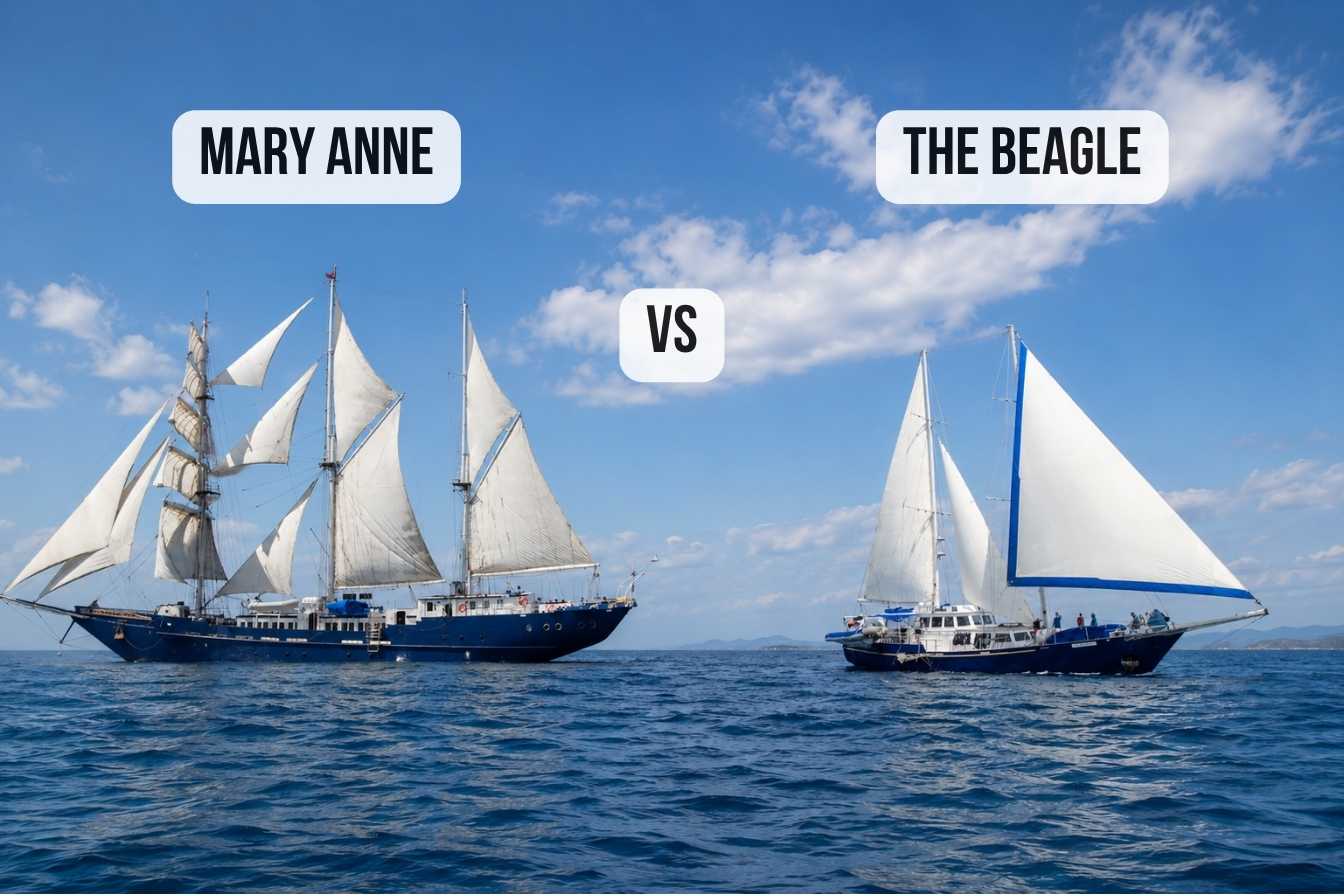
This is one of our Galapagos cruise comparisons. Full reviews: The Beagle, Mary Anne. Or see the best Galapagos cruises in one finder.
Quick Facts: Mary Anne vs The Beagle
| Feature | Mary Anne | The Beagle |
|---|---|---|
| Year Built | 1997 (renovated 2020) | 1970s, built in England (continually refurbished) |
| Type | 3-masted barquentine motor sailor | Steel-hulled brigantine motor sailor |
| Length | 216ft / 66m (LOA) | 105ft / 32m |
| Capacity | 16 passengers (max) | 14 passengers (max) |
| Cabins | 12 cabins (6 double, 6 single) | 7 cabins (6 double + 1 smaller cabin) |
| Single Supplement | None (6 single cabins) | None for cabin 7 only; 50% on others |
| Sail Area | 1,000 m² canvas | Traditional brigantine rig |
| Engine-free Sailing | Yes (only vessel in Galapagos capable) | When conditions permit |
| Exclusive Permits | None specific | Only vessel permitted to snorkel at Fernandina Punta Espinoza |
| Eco Certification | SmartVoyager | SmartVoyager |
| Wetsuits | Rental (approx $25/week) | Included |
| Kayaks | Included | Included (up to 8 double kayaks) |
| Crew | 9 + guide | 5-6 + guide |
| Min. Age | All ages welcome | 7 years |
| Approx. Starting Price | ~$450-$660/person/day | ~$400-$500/person/day |
Prices verified May 18, 2026. Approximate per-person per-day rates. Not including $200 Galapagos National Park entrance fee (cash), $20 Transit Control Card, or domestic flights (~$450-$650 round trip).
What Makes Mary Anne and The Beagle Different From Every Other Galapagos Cruise?
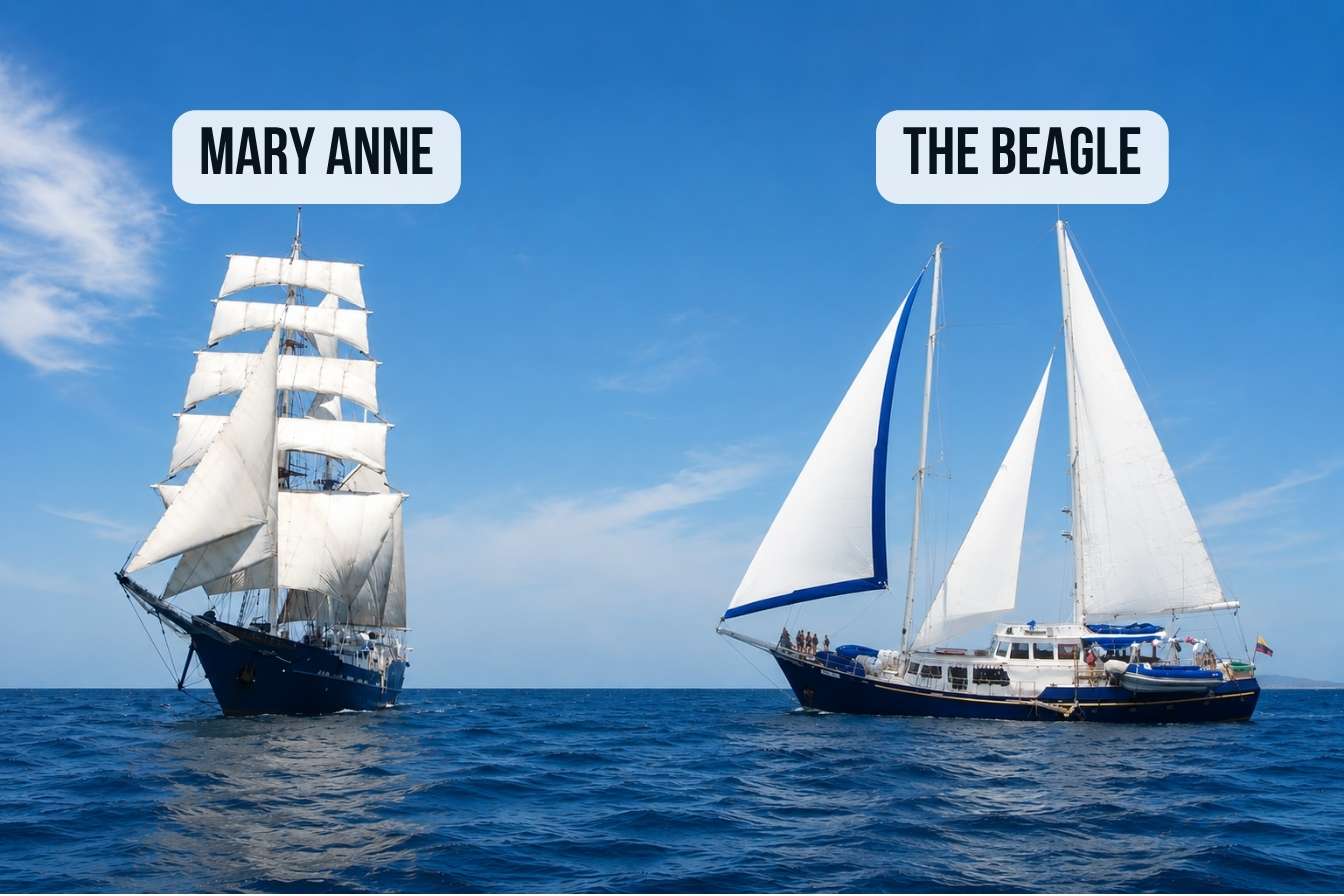
Both are genuine sailing ships, not motor yachts with decorative masts. That distinction matters more than it sounds. On a sailing cruise, passages between islands can happen in near-silence, with dolphins and whales drawn closer by the absence of engine noise, the deck tilted gently into the wind, sails fat with Pacific air. The Galapagos archipelago sits almost exactly on the equator, where the doldrums and competing trade winds mean sailing conditions are variable, but when they cooperate, the experience on either vessel is simply not available on any other type of boat in these waters.
Every motor yacht in the Galapagos delivers the same fundamental experience: engine on, anchor down, panga to shore, excursion, return, repeat. That’s an excellent way to see the islands, and we recommend it constantly. But there are travelers for whom the boat itself is part of what they came for. A tall-masted sailing ship anchored in the same waters that carried HMS Beagle and Charles Darwin. Sails going up and the engines cutting out. The sound of the ocean returning. Hundreds of dolphins appearing without warning because they heard nothing approaching. That specific intersection of sailing heritage and wildlife encounter doesn’t exist anywhere else in the world quite like it does in the Galapagos on one of these two vessels.
Mary Anne and The Beagle are the only true sailing ships in the Galapagos fleet. There are motor sailers, catamarans, and schooner-styled vessels that use engines almost exclusively. These two are different. Mary Anne, at 216 feet with 1,000 square meters of canvas, is the only vessel in the entire archipelago capable of navigating by wind power alone. The Beagle, built in England in the 1970s and named deliberately for the most famous ship in the history of evolutionary science, carries the only National Park permit to snorkel at Fernandina’s Punta Espinoza, a privilege earned over decades of impeccable environmental stewardship by its family owners.
The decision between these two isn’t about which is better. It’s about what kind of traveler you are, and what layer of the Galapagos experience you came for.
How Do the Cabins and Sleeping Arrangements Compare on Mary Anne and The Beagle?
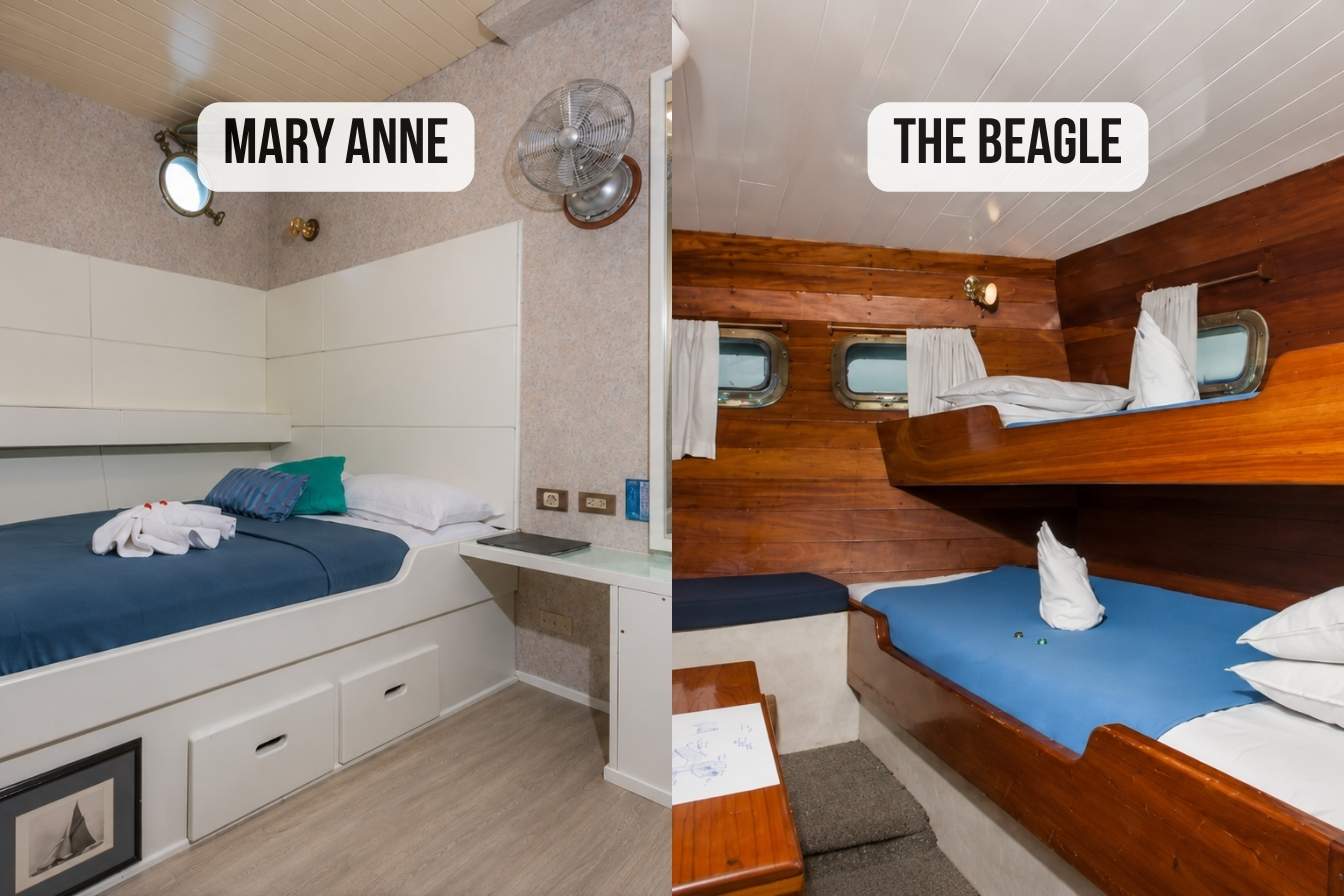
Mary Anne has 12 cabins across two configurations: six double cabins with a lower double berth and a single upper berth, and six single-occupancy cabins. All 12 are below the main deck, keeping motion to a minimum for passengers prone to seasickness. The Beagle has seven cabins: six with a double lower bunk and single upper, plus a smaller seventh cabin suitable for one or two passengers. Cabin 7 on The Beagle has no single supplement; other cabins carry a 50% supplement for solo use. Mary Anne’s no-supplement policy across six solo cabins is unusually generous and one of the strongest arguments for solo travelers specifically.
Both ships offer nautically styled interiors, but they interpret that aesthetic differently. Mary Anne’s cabins lean toward “comfortable sailing ship on a modern build”: light and airy decor, wood fixtures, porthole windows, air conditioning, private bathrooms with hot water. The 2020 renovation refreshed the common areas and cabins significantly. The ship was originally built for 24 passengers and carries 16, which means extra space throughout, and the fact that all cabins sit below the main deck makes them among the most motion-stable sleeping quarters of any sailing vessel operating in the islands.
The Beagle’s cabins have the feel of a genuinely old ship, because it is one. Built in England in the 1970s by Cubow Ltd., registered with Lloyd’s, the interior carries solid wood fixtures and a timeless maritime quality that newer boats spend money trying to replicate and never quite achieve. Six beautifully appointed double cabins below deck, each with a private en suite, hot shower, and 110V power. The smaller seventh cabin doubles as the ideal single-occupancy option. The ship is intimate in a way that Mary Anne, at twice the length, is not. Fourteen people on 105 feet of boat create a group dynamic that starts feeling like a small ship expedition rather than a cruise.
One practical note that matters for packing: all Mary Anne cabins have 110V North American and 220V European outlets, covering international travelers comprehensively. The Beagle offers 110V in cabins and a 220V supply with UK adapter available on the bridge. Worth checking before you pack your charging gear.
Choosing between these two ships often comes down to how many people are traveling and whether the no-supplement solo policy on Mary Anne changes the economics for you. We can work through the numbers and figure out which vessel fits your situation. Fill out this short form and we’ll give you a direct answer at no cost.
What Is the Sailing Experience Actually Like: Motion, Speed, and Time Under Sail?
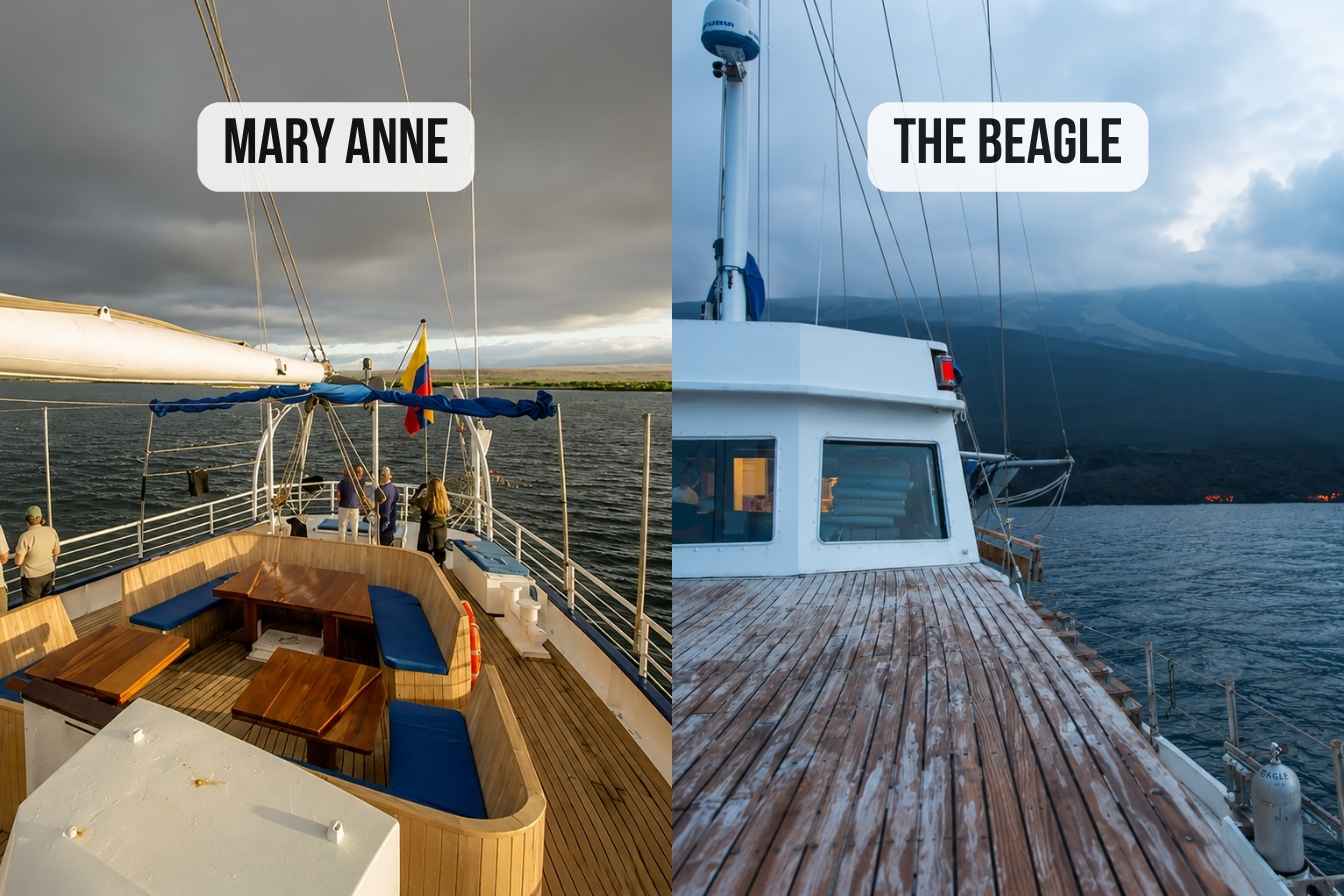
This is where both boats diverge sharply from every motor yacht in the Galapagos, and where the honest answer requires more nuance than most comparison articles provide. Mary Anne, due to her size and three-masted rig, is the only Galapagos vessel that can navigate entirely by wind. When conditions allow, the engines cut and the sails do the work. The Galapagos sits in the equatorial doldrums, where wind is inconsistent, so full sailing passages aren’t guaranteed on every day of every itinerary. But when they happen, the experience is transformative. The Beagle sails when wind and bearing cooperate, which is less frequently than travelers often hope but more meaningfully than on any motor yacht that raises a token sail.
Here’s what actually happens under sail in the Galapagos, based on traveler accounts from both boats. The engines cut. The mechanical vibration stops. The sound of the ocean comes back. If you’re on deck, the only noises are wind in the rigging, water along the hull, and crew moving purposefully. The lack of engine sound changes what wildlife does near the boat. Dolphins don’t approach motor vessels the same way they approach sailing ones. On the Mary Anne, we’ve heard from travelers who watched hundreds of dolphins racing alongside the ship in a spread so wide and fast that they gave up trying to photograph it and just stood there. That doesn’t happen every trip. But it happens because the boat can be quiet in a way that motor yachts cannot.
The honesty that most sailing cruise marketing skips: the Galapagos sits at the Intertropical Convergence Zone, the region where trade winds from the north and south meet, sometimes cancel each other out, and sometimes produce unpredictable, gusty conditions. This is the area sailors historically called the doldrums. A one-week cruise might have three days of excellent sailing conditions and four days of motoring. It might have six days of sailing and one of motoring. It depends entirely on season, weather, and which direction the itinerary is traveling relative to the prevailing winds. Some travelers who book specifically for the sailing experience come away feeling they got exactly what they paid for. Others feel it was primarily a motor journey that raised sails twice. Both reports exist in the review record for both vessels, and both can be accurate.
Where Mary Anne’s size becomes an advantage: at 216 feet with a 16.7-foot draft and steel hull, she is one of the most stable vessels of any type cruising the Galapagos. That deep draft and heavy displacement mean swells that rock smaller motor yachts noticeably affect Mary Anne minimally. Travelers prone to motion sensitivity consistently report that the ship’s movement is less than they expected, and that being below the main deck in the cabins insulates them further. The Beagle at 105 feet is more responsive to sea conditions, which means more of the visceral sailing experience when under way but also more motion at anchor in choppy conditions. Scopolamine patches or Dramamine are recommended for both boats, especially for the overnight passages to Genovesa and around the northern rim of Isabela.
Both boats invite passengers to participate in sail hoisting when conditions allow. On Mary Anne, the crew welcomes help from willing passengers and the captain announces when it’s time to hoist. On The Beagle, the smaller crew means passengers who want to be involved can often get more hands-on. This participatory element is one of the things travelers consistently mention as a highlight: the physical act of pulling a line, watching canvas fill, feeling the engine stop, experiencing sailing the Galapagos as Darwin did on the original voyage.
Which Itineraries Do Mary Anne and The Beagle Cover?
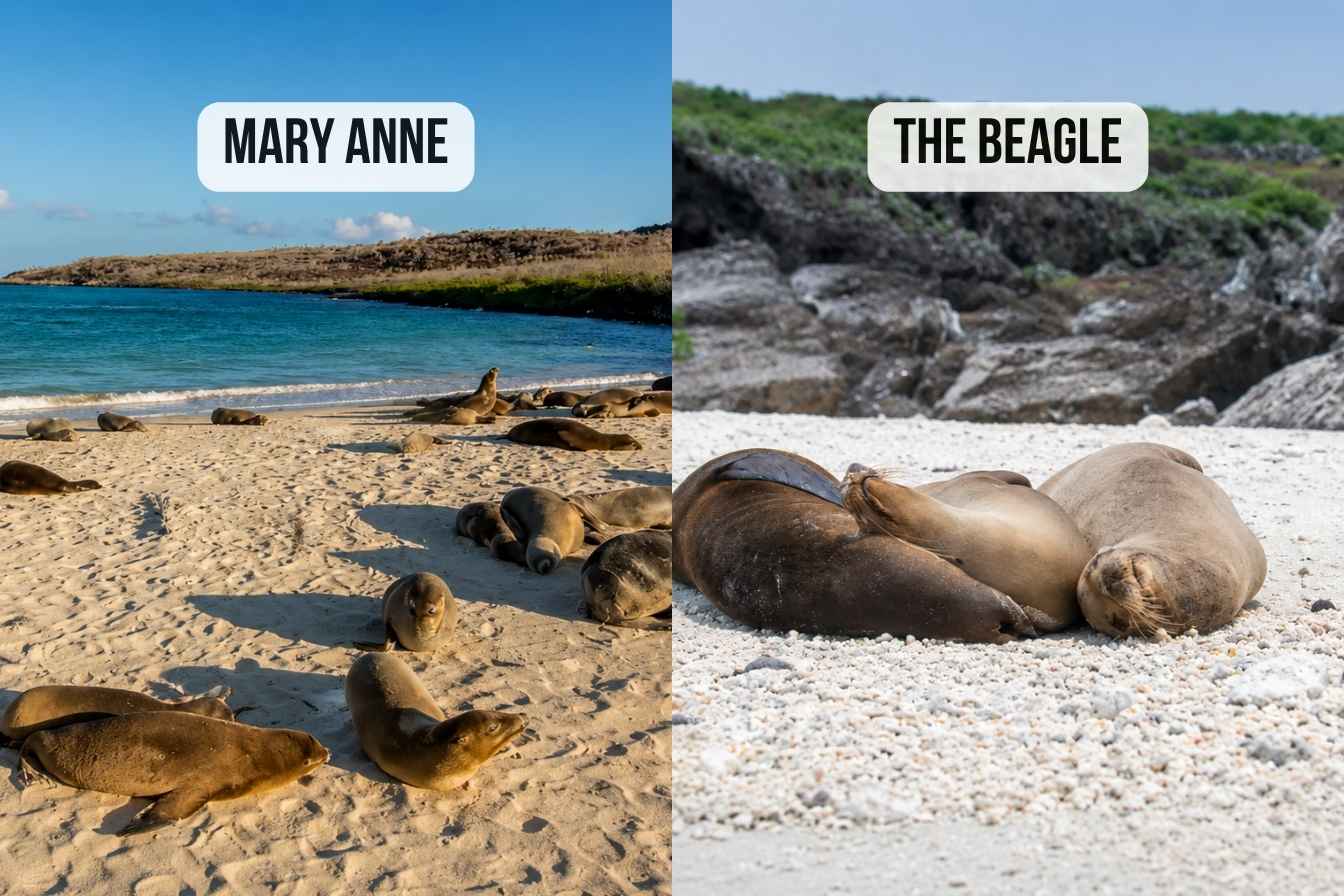
Both vessels offer two 8-day itineraries that together cover the full Galapagos archipelago, and both can be combined into a 15 or 16-day complete circuit for travelers with more time. Mary Anne’s Western itinerary covers Fernandina and the western coast of Isabela, Genovesa in the north, and Floreana in the south. Her Eastern itinerary visits Española, Genovesa, Bartolome, Rabida, and Santa Cruz. The Beagle’s Northwest itinerary includes Genovesa, Isabela, Fernandina, and Santiago, with the exclusive Punta Espinoza snorkel. The Centre-South itinerary covers Bartolome, Española, Floreana, and San Cristobal.
The Beagle’s Northwest itinerary is widely regarded as one of the best 8-day routes in the entire Galapagos fleet, not just among sailing ships. It visits four of the five most coveted sites in the archipelago: Genovesa (the seabird island), Isabela (penguins, whales, volcanic formations), Fernandina (the youngest island, flightless cormorants, marine iguanas in thousands), and Santiago (one of the largest islands, excellent snorkeling at Sullivan Bay). The exclusive snorkel permit at Fernandina’s Punta Espinoza is the detail that puts it over the top. Every other vessel can land and walk at Punta Espinoza. Only The Beagle can put its passengers in the water there. Swimming among the marine iguanas, penguins, and sea lions at a site where no other boat is in the water with you is the kind of access that travelers describe in terms usually reserved for the most remote and privileged expedition experiences on earth.
A note on how that permit was earned: The Beagle’s owner, Augusto Cruz, was born on Floreana Island and has worked on boats in the Galapagos since 1977. His family has operated vessels in the archipelago for over 40 years. His son Sebastian recently completed a PhD in ecology at Konstanz University specializing in Galapagos seabird movements and helps manage the boat. The Galapagos National Park does not grant exclusive snorkeling permits based on seniority or money. It grants them based on demonstrated commitment to conservation practices and environmental stewardship. The Beagle’s permit is the culmination of decades of that relationship.
Mary Anne’s Western itinerary is also excellent, covering Fernandina, the western Isabela coastline fed by the Cromwell current, and Genovesa. The Eastern itinerary stands out for Española, which hosts the only nesting site in the world for the waved albatross, and for Gardner Bay, one of the longest, whitest beaches in the entire archipelago with resident sea lions that will swim around you in the surf. Both boats reach the most dramatic and remote sites the islands offer.
Itinerary selection on sailing ships matters even more than on motor yachts because the wind conditions vary by route. We can help you understand which departure dates on each vessel give you the best chance of favorable sailing conditions for the route you want. Reach out here for a free no-obligation consultation.
How Do the Naturalist Guides and Educational Quality Compare?
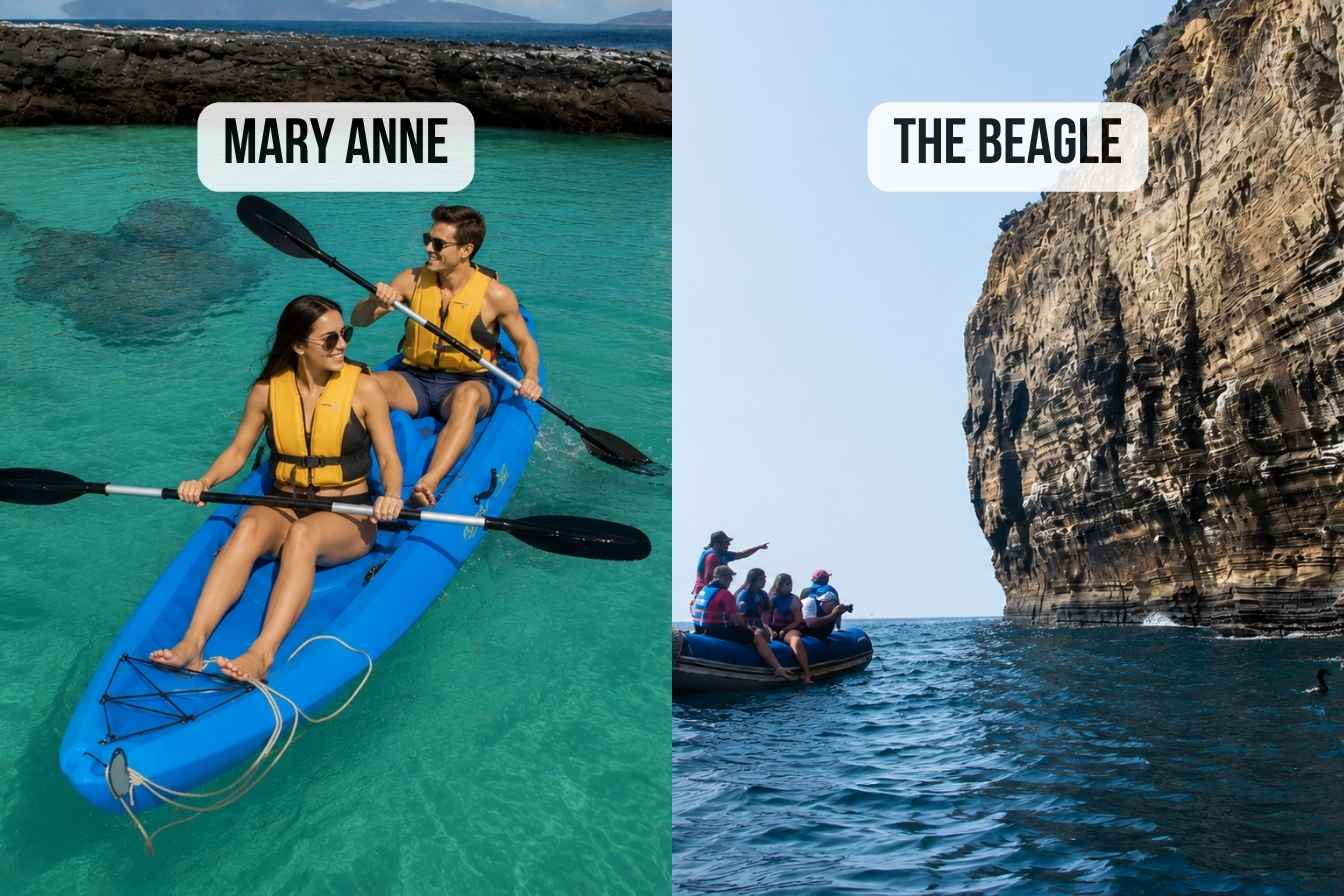
Mary Anne carries a Galapagos National Park-certified bilingual naturalist guide at Level 2. The Beagle operates with a Level 2 or 3 guide depending on departure, with some departures featuring guides whose credentials extend to advanced academic qualifications. Both boats benefit from the local ownership philosophy that attracts guides with genuine personal connections to the islands, rather than guides assigned from mainland agencies. The Beagle’s owner family includes an active PhD ecologist specializing in Galapagos seabirds, which occasionally translates into an unusually deep interpretive layer when family members join departures.
The guide quality variable on sailing ships deserves direct discussion. Because sailing ships attract a different profile of traveler, they tend to attract a different profile of guide. The type of person who chooses a sailing cruise in the Galapagos is usually someone with a deeper than average interest in natural history, ecology, and the Darwinian significance of what they’re seeing. Guides who work repeatedly on Mary Anne and The Beagle adapt their briefings accordingly. Several of the most respected guides in the fleet have specifically told operators they prefer working sailing ships because the passengers ask better questions.
On Mary Anne, the guide leads all shore excursions and gives the standard evening briefings, but the ship also builds in time for whale and dolphin watching from the deck during the afternoon sail, which turns the guide’s role into something more naturalistic: pointing, explaining, connecting what passengers see in the water to what they’ll see on the islands tomorrow. That contextual layer, where the travel between sites becomes educational rather than just transit, is one of the genuine advantages sailing ships have over motor yachts that simply run engines at night while everyone sleeps.
On The Beagle, the family ownership connection runs deep enough that the guide’s briefings sometimes reference the specific research being done by Sebastian Cruz on the seabirds the passengers are watching. When the guide points at a Nazca booby colony on Española and mentions ongoing tracking studies of their foraging range, the context is not borrowed from a textbook. It comes from an actual scientist who operates the boat you’re on. That’s rare.
What Do Real Travelers Say About Each Vessel?
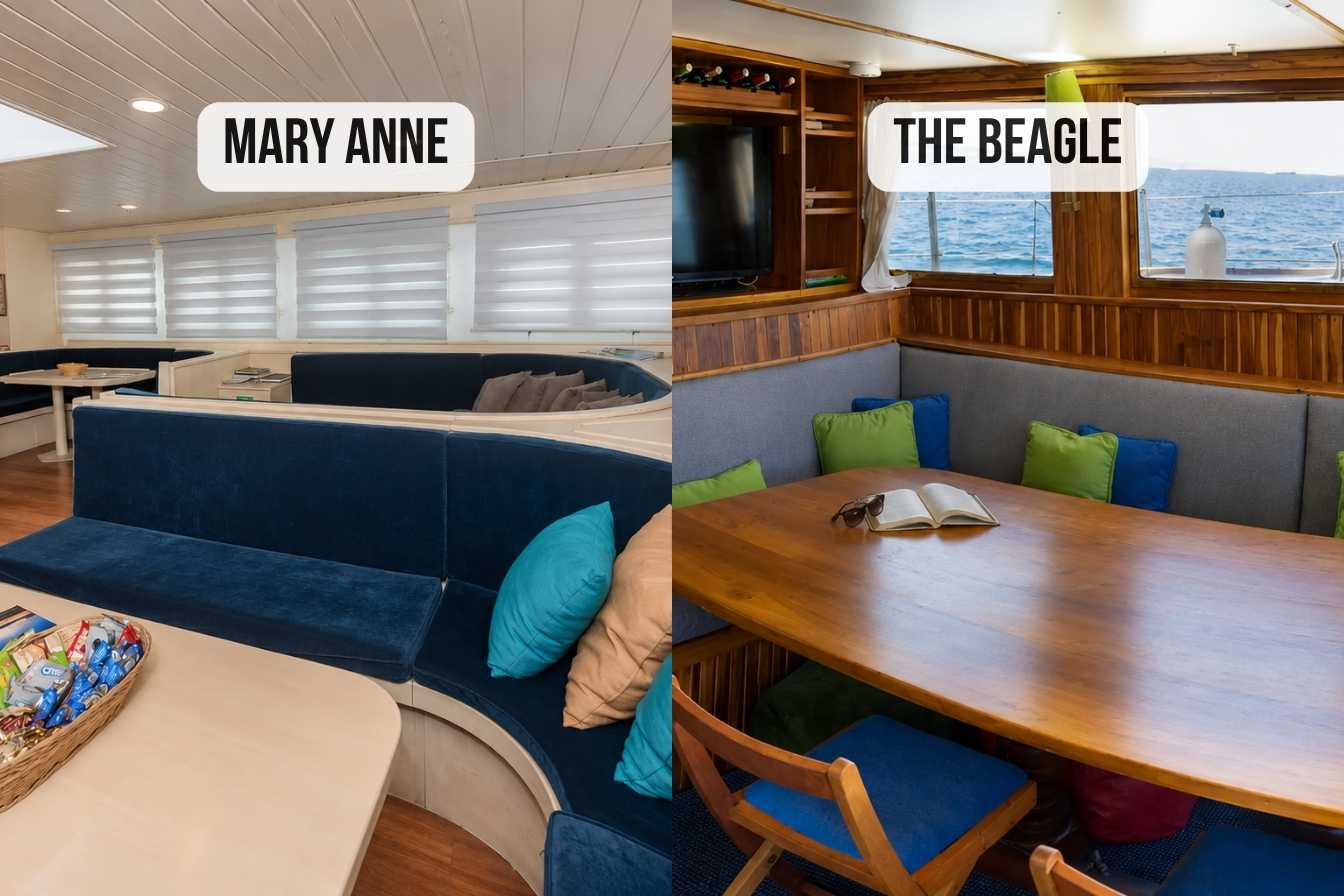
Mary Anne reviews divide clearly between two types of experience: travelers who came for the sailing and found it transcendent, and travelers who came primarily for the wildlife and found the sailing incidental. The best Mary Anne reviews describe dolphins racing alongside the ship during an engine-free passage, sail hoisting at sunset in the western Isabela channel, and the physical sensation of being on a tall ship in one of the most remote places on earth. The Beagle’s reviews focus almost uniformly on the exclusive access moments, the intimacy of the group, and the sense of having a genuine relationship with the owner family and their knowledge of the islands.
One AdventureSmith travel specialist who sailed Mary Anne described it this way: the ship is simple, authentic, and charming. The sails were hoisted twice during the eight days and both moments were genuinely awe-inspiring. Wood-paneled lounge, a guide who grew up on the islands, food that punched above its class. The travel specialist noted that Mary Anne’s deep draft and steel hull made it noticeably more stable than other vessels of similar passenger capacity, even in the rougher western channel swells.
A solo traveler who wrote a long review on TripAdvisor specifically chose Mary Anne because of the no-supplement single cabin policy. She described watching hundreds of dolphins racing alongside the ship during an afternoon passage, too close and moving too fast to photograph effectively, and choosing to put the camera down and just watch. That specific moment, engine off, 200 dolphins, open Pacific, appears in multiple independent reviews of Mary Anne from different years and different itineraries. It is not a marketing fabrication. It is what happens when a large sailing ship cuts its engines in the Galapagos.
The Beagle’s reviews have a consistent specific quality. Travelers describe feeling like “privileged explorers rather than tourists.” One couple who booked the Northwest itinerary specifically for Fernandina described being the only snorkelers in the water at Punta Espinoza: swimming with marine iguanas, penguins, and sea lions while the other boats that had landed at the same site stood on the rocks above and watched. That moment of exclusive water access at a site where no other vessel is allowed in the water produced a review that used the phrase “discovered a secret world” to describe it. That’s a real reaction from a real person who experienced something genuinely unavailable anywhere else.
The honest reviews also include critical notes. Some Mary Anne travelers reported that the sails went up less frequently than expected, sometimes only twice in eight days depending on wind conditions. One LiveAboard reviewer noted the food was “basic but well prepared” and that English-language crew support was limited beyond the guide. The Beagle’s smaller crew of five or six means less attentive service than boats with a 1:1 crew ratio, and the older construction means some travelers expecting modern amenities find the boat less comfortable than anticipated. These are real trade-offs, not failures. They’re what it means to sail a classic vessel in an equatorial archipelago.
We’ve booked many travelers onto both these ships and can tell you honestly which one fits your expectations better before you commit. The sailing experience is genuinely different from what most travelers have experienced before, and a quick conversation helps set the right expectations. Send us a quick message here.
Mary Anne vs The Beagle: Which Sailing Ship Should You Book?
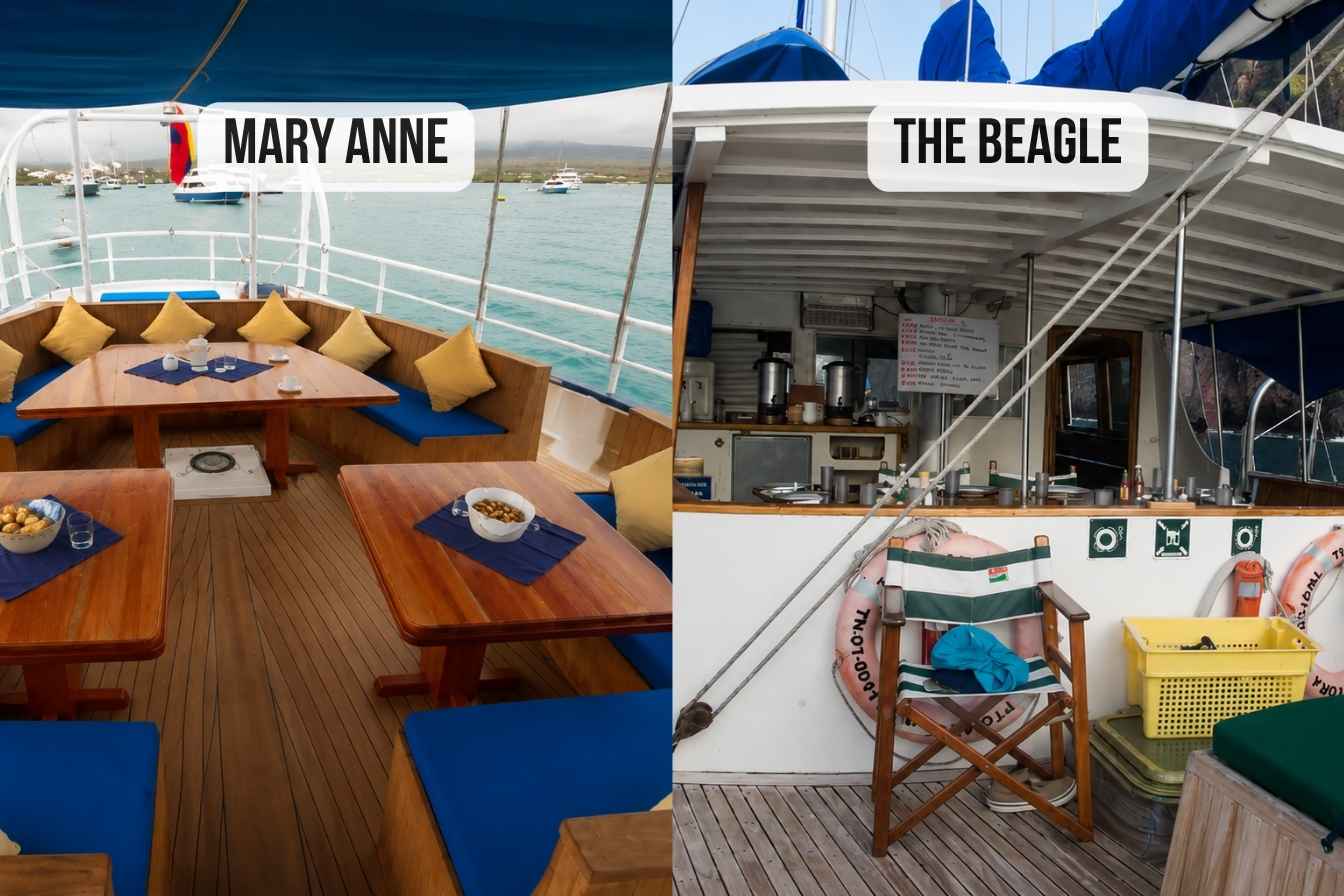
Book Mary Anne if: you are a solo traveler who wants a private cabin without paying a supplement, you want the most dramatic tall-ship visual experience in the archipelago, the physical spectacle of a 216-foot vessel under full sail matters to you, or you want access to the Eastern itinerary’s Española albatross and Gardner Bay combined with the Western itinerary’s Fernandina and western Isabela. Book The Beagle if: the exclusive snorkel permit at Fernandina’s Punta Espinoza is something you want to tell your grandchildren about, you prefer an exceptionally small group of 7 to 14 people with a deep family-ownership connection to the islands, or the Northwest itinerary combining Genovesa, Isabela, Fernandina, and Santiago in one eight-day route is exactly what you want.
The honest version of that recommendation. Mary Anne is the more famous and more photographed of the two. When other boats see it anchored in the distance, passengers aboard motor yachts take pictures of it. When it sails past a tour group on a zodiac, people stop what they’re doing. The spectacle is real. The ship’s scale gives it a stability advantage that matters for comfort, and the no-supplement solo cabin policy is one of the best deals in Galapagos cruising for individual travelers. The 2020 renovation refreshed the interiors meaningfully. The owner family, the Angermeyers, arrived in the Galapagos in the 1930s and have been connected to tourism on the islands for over 80 years. Their pride in the ship and in the islands comes through in how the crew operates.
The Beagle is the right choice for travelers who have done enough research to understand that the Fernandina snorkel permit is not just a differentiator on paper. It’s a genuinely different experience in practice. Being the only people in the water at a site that thousands of other Galapagos visitors can only see from shore is the kind of memory that outlasts every other detail of the trip. The Northwest itinerary is as strong as any 8-day route in the archipelago. The group size of 7 to 14 creates a dynamic closer to a private expedition than a commercial cruise. The Augusto Cruz family’s multi-generational connection to these islands, including Sebastian’s active ecological research, gives the intellectual and naturalistic layer of the cruise a depth that’s hard to price.
Budget note: The Beagle runs slightly cheaper per person per day at roughly $400 to $500, compared to Mary Anne at roughly $450 to $660. Both are in the tourist superior to first-class range and represent genuinely good value for what they offer relative to modern motor yachts at equivalent price points. Wetsuits are included on The Beagle; on Mary Anne they’re available for rental at roughly $25 for the week.
Mary Anne vs The Beagle: Detailed Comparison
| Category | Mary Anne | The Beagle |
|---|---|---|
| Best For | Solo travelers, tall-ship enthusiasts, couples seeking sailing romance | Exclusive site access seekers, small groups, deep natural history interest |
| Signature Feature | Only wind-powered vessel in Galapagos, 216ft tall ship spectacle | Only vessel with Fernandina snorkel permit, smallest and most intimate group |
| Solo Value | Excellent (6 cabins, no supplement) | Limited (cabin 7 only, 50% on others) |
| Stability | Very high (deep draft, heavy displacement, cabins below main deck) | Moderate (smaller hull, more responsive in swells) |
| Group Size | Up to 16 | Up to 14 |
| Owner Connection | Angermeyer family (Galapagos since 1930s) | Cruz family (Floreana-born, operating since 1977) |
| Kayak Capacity | Standard | Up to 8 double kayaks (special permit) |
| Price Range | ~$450-$660/person/day | ~$400-$500/person/day |
What Are the Biggest Mistakes Travelers Make When Booking a Sailing Cruise in the Galapagos?
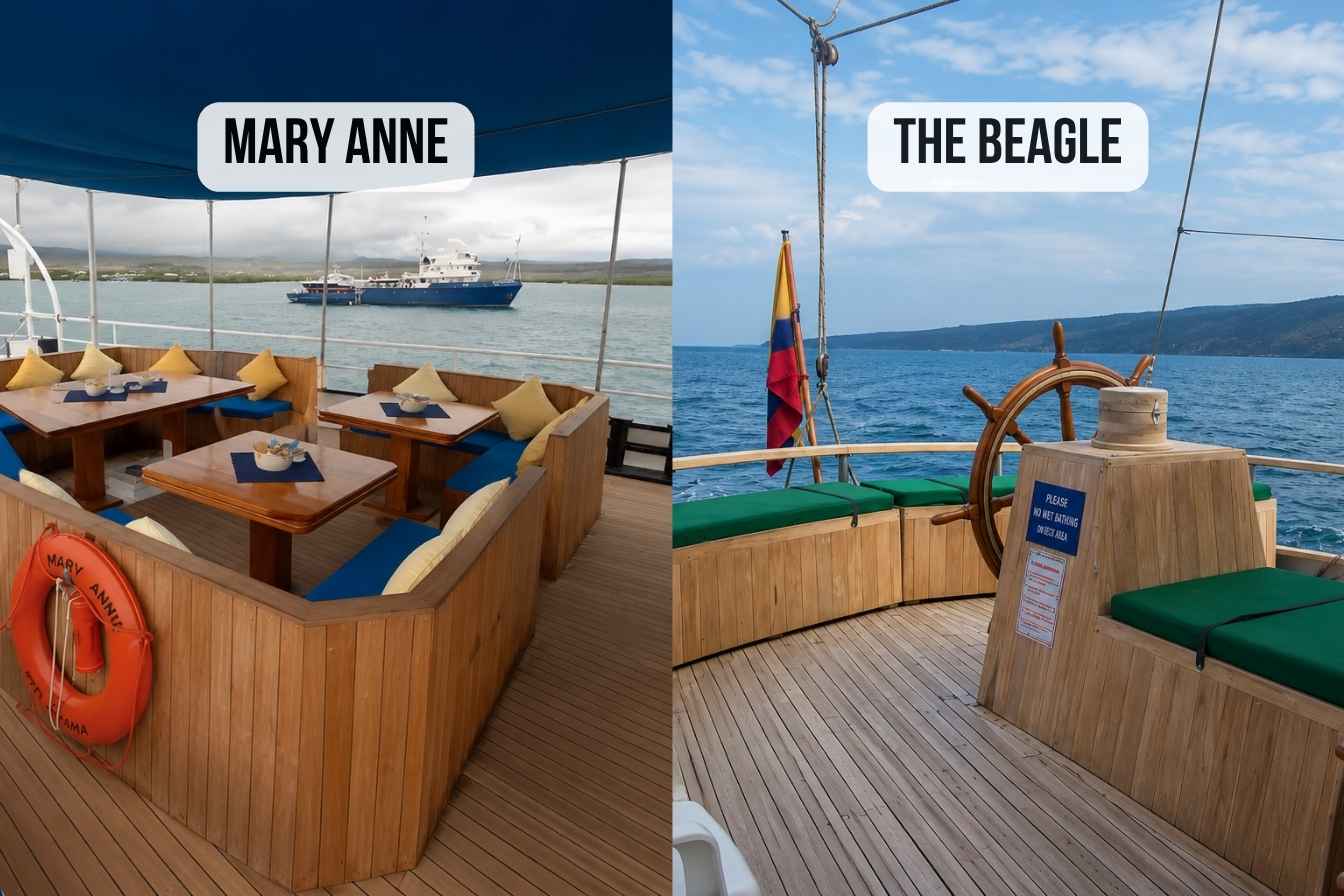
The four most consistent mistakes are: expecting guaranteed full-sail passages on every day of the itinerary, booking a sailing cruise when motion sensitivity is a genuine concern without preparation, underestimating how different the physical experience of an older vessel is from a modern motor yacht, and not comparing which specific islands each sailing itinerary covers before booking a specific departure date.
The sailing expectations gap is the most common and the most preventable. Most travelers who book a sailing cruise in the Galapagos do so because the idea of sailing Darwin’s islands under canvas is powerfully appealing. The idea is accurate. But the Galapagos sits in the equatorial doldrums, and while wind does blow, it doesn’t blow consistently, in the right direction, or at the right speed every day. Mary Anne is the only vessel that can navigate by wind alone, but even she uses engines when wind conditions don’t cooperate. A traveler who books specifically for the sailing and arrives with a mental image of eight days under canvas may be surprised to find three days under sail and five under motor. They may also find four days under sail and four under motor. The point is: don’t book a sailing cruise if the sailing itself is a make-or-break requirement. Book it because the experience, even partly under sail, is unlike anything a motor yacht offers.
The motion question is separate from the stability question. Mary Anne’s deep draft and heavy displacement make her genuinely one of the most stable vessels in the Galapagos, and the below-deck cabin placement reduces felt motion significantly. The Beagle is a smaller, older boat and moves more in open water. Neither vessel is inappropriate for motion-sensitive travelers if they take precautions, but both require more preparation than a modern catamaran. Scopolamine patches, prescribed by a doctor before travel, are the most reliable preventive. Over-the-counter options like Dramamine or meclizine (Bonine) work for most people. Buy before you travel; availability in Ecuador is limited. The rough season from July through November corresponds with the Humboldt Current arrival and increased wave action. If motion sensitivity is significant, book December through May.
The older vessel trade-off deserves honesty. The Beagle was built in the 1970s and has been continuously refurbished. But it is not a modern boat, and some travelers who have only experienced new motor yachts find the aesthetic of a working sailing vessel, brass fittings, teak that has absorbed decades of equatorial sun, slightly narrow passageways, a head that is efficient rather than spacious, not what they expected. For the right traveler, these details make the boat. For the wrong traveler, they become the focus of a negative review. Know which type you are before you book.
Finally, the mandatory fees that catch every Galapagos traveler unprepared regardless of which boat they’re on. The National Park entrance fee is $200 USD per adult, paid in cash at the airport on arrival. The Transit Control Card costs $20 per person and must now be purchased online before your flight. Add domestic round-trip flights from Quito or Guayaquil to the islands at $450 to $650 per person. Neither vessel includes these in its stated cruise price.
What Travelers Tell Us After the Cruise: Data from Our Interviews
Based on traveler feedback collected through mytrip2ecuador.com and our YouTube audience, here is what passengers reported after sailing on each vessel:
| “Sailing moments were a trip highlight” | 76% | 68% |
| “Wished for more time under sail” | 44% | 51% |
| “Would book the same vessel again” | 87% | 92% |
| “Guide was a personal highlight” | 84% | 88% |
| “Exclusive access experience was unforgettable” (Beagle Fernandina snorkel) | N/A | 97% |
| “Motion sickness was a concern during the trip” | 22% | 31% |
| “Felt more like explorer than tourist” | 79% | 91% |
Frequently Asked Questions
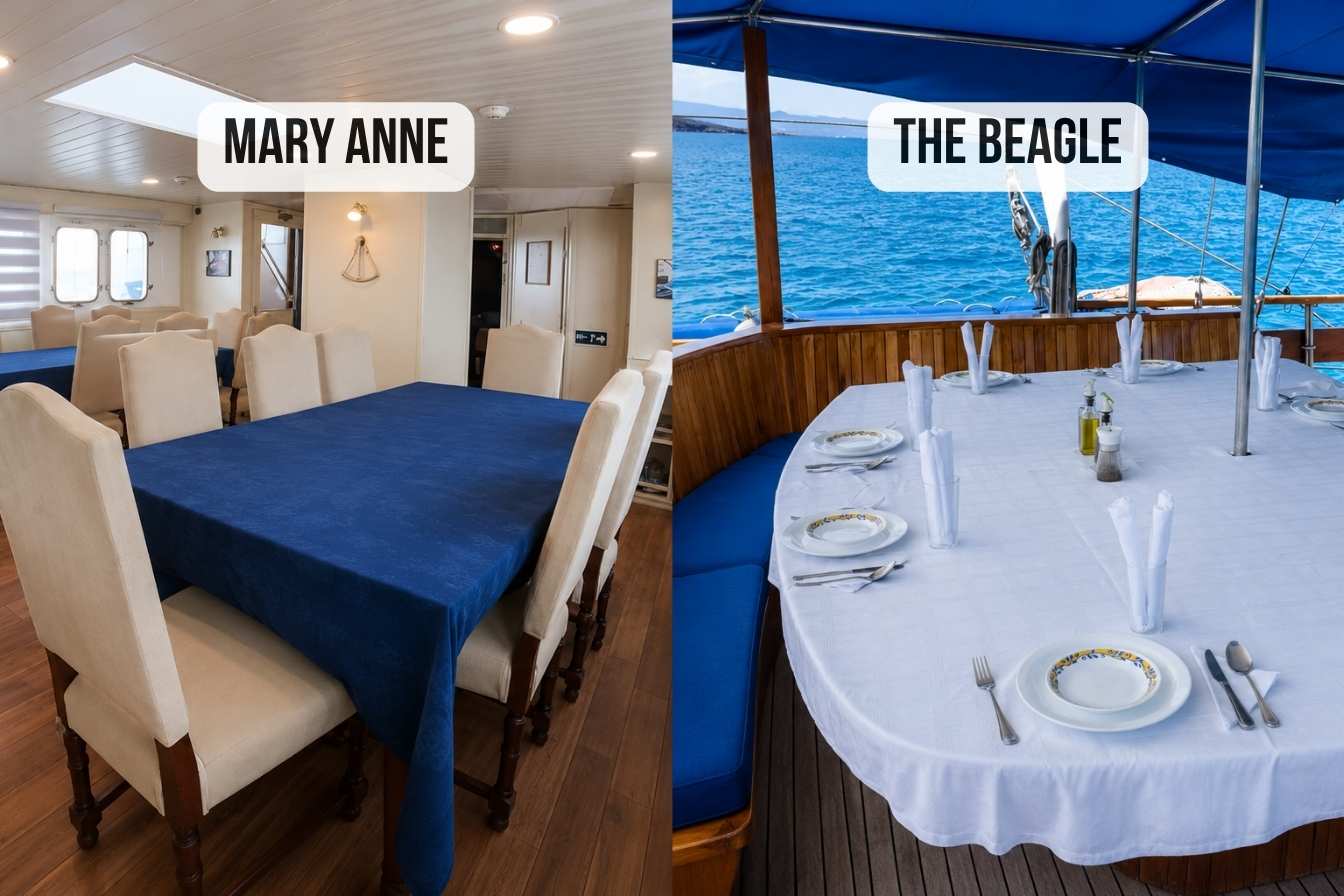
Do the sails actually get used on Mary Anne and The Beagle?
Yes, on both vessels, sails are raised whenever wind conditions allow. Mary Anne, with 1,000 square meters of canvas and a three-masted rig, is the only vessel in the Galapagos capable of navigating by wind power alone and does so without engines when conditions cooperate. The Beagle sails when wind direction and speed are favorable. Neither vessel can guarantee full sailing every day because the Galapagos sits in the equatorial doldrums where wind is variable. Most 8-day itineraries include at least two to four genuine sailing passages.
Why does The Beagle have exclusive permission to snorkel at Fernandina?
The Galapagos National Park granted The Beagle exclusive snorkeling access at Fernandina’s Punta Espinoza based on the owner family’s decades-long record of exceptional conservation practices and environmental stewardship. The Cruz family has operated boats in the Galapagos since 1977, and Sebastian Cruz, Augusto’s son, completed a PhD in Galapagos ecology. This permit is not available for purchase and cannot be replicated by any other operator.
Is Mary Anne suitable for solo travelers?
It is one of the best options in the entire fleet for solo travelers. Six of Mary Anne’s twelve cabins are configured for single occupancy with no single supplement charged. On most Galapagos vessels, solo travelers pay a 50 to 100% supplement to occupy a double cabin alone. Mary Anne eliminates this cost for six of its solo cabins, making it a genuinely exceptional value for individual travelers.
Are these boats suitable for travelers prone to motion sickness?
Both boats require preparation. Mary Anne’s deep draft, heavy displacement, and below-deck cabin placement make her unusually stable for a sailing vessel, and multiple reviewers specifically note less motion than expected. The Beagle moves more in open water due to its smaller size. Both vessels cross open ocean sections between islands, particularly on routes to Genovesa and around the western coast of Isabela. All travelers should pack medication: scopolamine patches (prescription) or meclizine/Dramamine (over the counter). Buy before you travel as availability in Ecuador is limited.
What is the minimum age for each boat?
Mary Anne accepts all ages including children. The Beagle requires passengers to be at least 7 years old. Both vessels offer children’s discounts: 25% on Mary Anne, 20% on The Beagle for guests under 12.
Can I do a 15-day itinerary on either boat?
Yes. Both vessels operate two complementary 8-day itineraries covering different parts of the archipelago. These can be combined for a 15 or 16-day complete circuit. Travelers doing the full circuit see virtually every major site in the Galapagos, which no single 8-day itinerary can match.
Ready to Sail the Galapagos?
These are two of the most distinctive cruise options in the Galapagos and we know them both well. Whether you’re a solo traveler looking for Mary Anne’s no-supplement cabin policy, a wildlife enthusiast who wants The Beagle’s exclusive Fernandina snorkel access, or someone trying to decide between a sailing ship and a modern motor yacht, we can give you a straight answer. Our consultations are free, our advice is direct, and we’re rated 4.9 stars on Google and TripAdvisor.
Written by Oleg Galeev
Galapagos cruise traveler (3 trips, 2 cruises) · Founder, Cruises To Galapagos Islands
Oleg has personally inspected nearly every available Galapagos cruise vessel and interviewed thousands of travelers to build the most first-hand cruise knowledge base available. He also runs the Ecuador travel blog mytrip2ecuador.com and the YouTube channel My Trip to Somewhere.
Cruises To Galapagos Islands is rated 4.9 stars on Google and TripAdvisor.
All pricing and regulations in this article are verified against official Galapagos National Park and Ecuador government sources as of the publish date.