Nemo III vs Reina Silvia Voyager: First Class Catamaran Compared
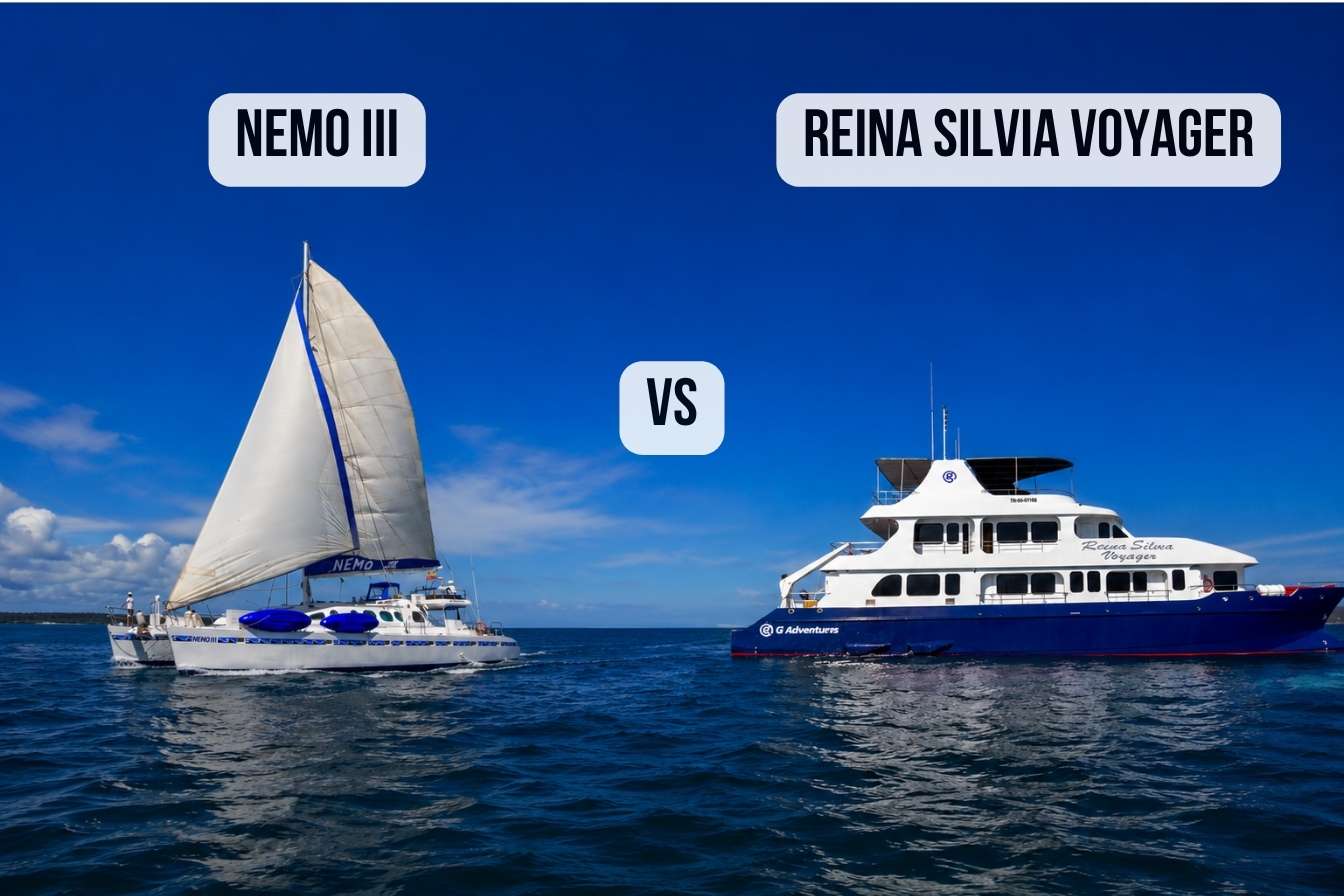
This is one of our Galapagos cruise comparisons. Full reviews: Reina Silvia Voyager, Nemo III. Or see the best Galapagos cruises in one finder.
Quick Facts: Nemo III vs Reina Silvia Voyager
| Feature | Nemo III | Reina Silvia Voyager |
|---|---|---|
| Built / renovated | Motor-sail catamaran; renovated 2016 | Purpose-built 2019-2020; commercial operation ~2022 |
| Operator | Nemo Galapagos (family business, sailing since 1985) | G Adventures (global adventure travel operator); custom-built vessel |
| Ship length | 75 ft / 23 m | 103 ft / 31.45 m |
| Beam | 37.4 ft / 11.40 m | 40.35 ft / 12.30 m |
| Max speed | Sail-assisted; 2 × 200 HP engines | 13 knots |
| Guest capacity | 16 | 16 |
| Total cabins | 8 cabins (sources vary: 6-8 depending on configuration) | 10 cabins (9 per some sources; confirmed 10 by G Adventures) |
| Cabin categories | Twin (Cabins 1, 2, 7); Double/matrimonial (Cabins 5, 8); Triple – double lower + single upper (Cabins 3, 4, 6) | Main deck twin with balcony (×4); Main deck double, no balcony (×1); Upper deck twin with balcony (×2); Upper deck single with balcony (×2); (some sources add upper deck double with balcony for 10 total) |
| Private balconies | None | 8 of 10 cabins have private balconies – one of the few Galapagos vessels with this feature |
| Solo cabins | Cabins 1 & 2 available for singles with supplement | 2 dedicated single cabins (upper deck, with balcony) – purpose-designed for solo travelers |
| Windows | Small windows in main deck cabins | All cabins have panoramic windows; balcony cabins add private outdoor space |
| Interior style | Traditional wood finishing (renovated 2016); warm, classic maritime feel | Contemporary design; artwork by local naturalist photographers; LED lighting; bright, modern |
| Crew | 7 crew + 1 bilingual naturalist guide | 8 crew + 1 CEO Naturalist Guide (~1:1 crew-to-guest ratio) |
| Guide title / program | Certified bilingual naturalist guide (Spanish/English) | CEO (Chief Experience Officer) Naturalist Guide – G Adventures proprietary guide training program |
| Sailing with sails | Yes, motor-sail catamaran; sails used when conditions permit at captain’s discretion | Motor catamaran — no sails |
| Jacuzzi | Yes, on sundeck | Yes, on sundeck |
| BBQ area | Al fresco dining area (outdoor meals) | Yes, dedicated BBQ grill station on upper deck; specifically praised |
| Kayaks | Included (single sit-on-top; reserve in advance) | Included as standard (two-person kayaks + walking sticks) |
| Wetsuits included? | Yes, included for snorkeling | Yes, included; note: some travelers specifically mention short wetsuits as cold in cool season; long wetsuits recommended |
| Snorkel gear included? | Yes | Yes |
| Park fee included? | No ($200/adult, $100/child) | No ($200/adult) |
| Alcoholic drinks included? | No, bar on board; charged separately | No, bar on board; charged separately |
| Stability profile | Low-built catamaran; highly stable; cabins close to sea level reduce motion | Catamaran design; 40-ft beam; generally smooth; praised for stability |
| Minimum passenger age | 3 years (FIT cruises); all ages on charter | Not published; active itinerary suits ages 12+ |
| Child discount | 10% for children under 12 (Superior cabin rate) | Not published |
| Itinerary lengths | 4, 5, 8-day; North (A) and South (B) routes; alternating weekly | 8-day (West/Central; East/Central); 10-day including Quito |
| Entry price (5-day approx.) | ~$3,300-$3,500/pp (8-day); shorter trips from ~$2,400/pp | From ~$7,399/pp (8-day per cruisestogalapagosislands.com); consult G Adventures for current rates |
| Single supplement | Available on Cabins 1 & 2 (twin beds) | 2 dedicated solo cabins with balcony – purpose-built for singles at no shared-cabin requirement |
Prices per person, verified May 2026. Both ships exclude park fees ($200/adult, $100/child from August 2024), TCT ($20), domestic Galapagos airfares (~$530 round trip), international airfares, alcoholic beverages, and gratuities. Confirm current rates and inclusions with the operator or booking agent.
What Are Nemo III and Reina Silvia Voyager, and Who Are They Built For?
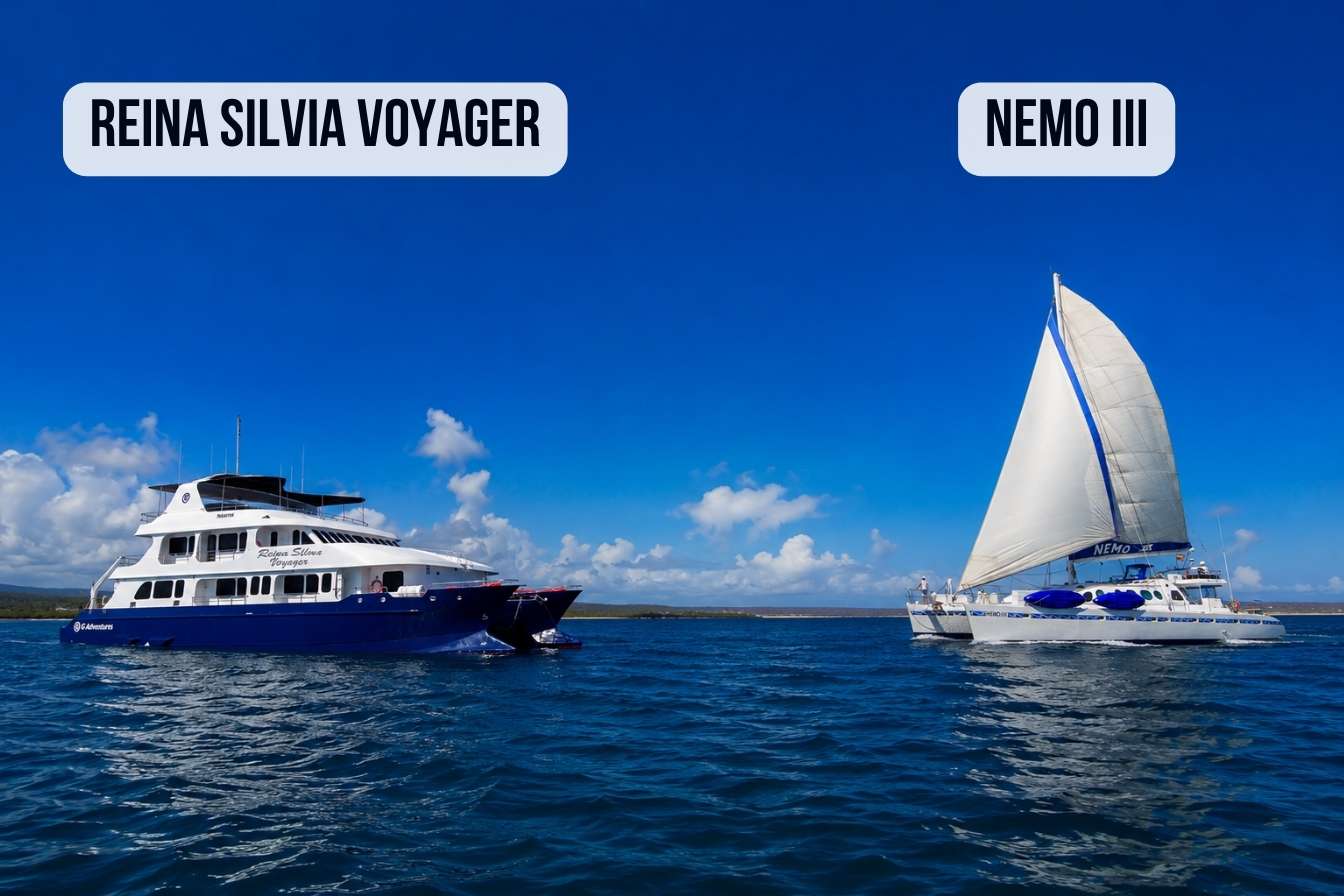
Nemo III and Reina Silvia Voyager are first-class Galapagos catamarans, both carrying a maximum of 16 guests and both delivering the guided excursion, snorkeling, hiking, and kayaking experience that defines first-class type of Galapagos cruising. The key distinction is who built them, why, and when. Nemo III is a 75-foot motor-sail catamaran operated by Nemo Galapagos, an Ecuadorian family business that has been sailing these islands since 1985 – one of the oldest continuously operating Galapagos cruise families. Reina Silvia Voyager is a purpose-built 103-foot motor catamaran launched by G Adventures in 2020, named after Queen Silvia of Sweden, specifically designed to address the growing solo traveler market with dedicated single cabins and to introduce private balconies to the first-class catamaran segment.
Both ships sit in what the industry categorizes as first class: above tourist-superior vessels in cabin quality and service, below the luxury catamaran segment occupied by Ocean Spray, Natural Paradise, or Endemic. At this tier, guides are certified Level II or III, meals are quality-driven but not Cordon Bleu, and the focus is on wildlife access and expedition quality rather than hotel-grade amenity competition. The decision between Nemo III and Reina Silvia Voyager is therefore not a luxury-vs-economy choice. Both are comparable in standard. The decision is about vessel character, cabin design, operator philosophy, and price.
Nemo III’s 40-year family operation produces a specific atmosphere that experienced Galapagos travelers recognize: a ship where the captain and guide have likely been operating together for years, where the crew knows the islands intimately, and where the service is personal in a way that reflects genuine local investment rather than corporate training. Reina Silvia Voyager’s G Adventures platform produces a different but equally compelling quality: a globally proven operator, a standardized guide certification program (the CEO – Chief Experience Officer – system), and a purpose-built modern vessel that solved specific problems (solo travelers, outdoor living space) that older catamarans hadn’t addressed.
Both ships have limited cabin inventory per departure – 16 guests maximum. The Reina Silvia Voyager’s dedicated solo cabins in particular book ahead. Contact us here with your travel dates and group size and we’ll check current availability on both vessels.
How Do the Cabins and Onboard Space Compare?
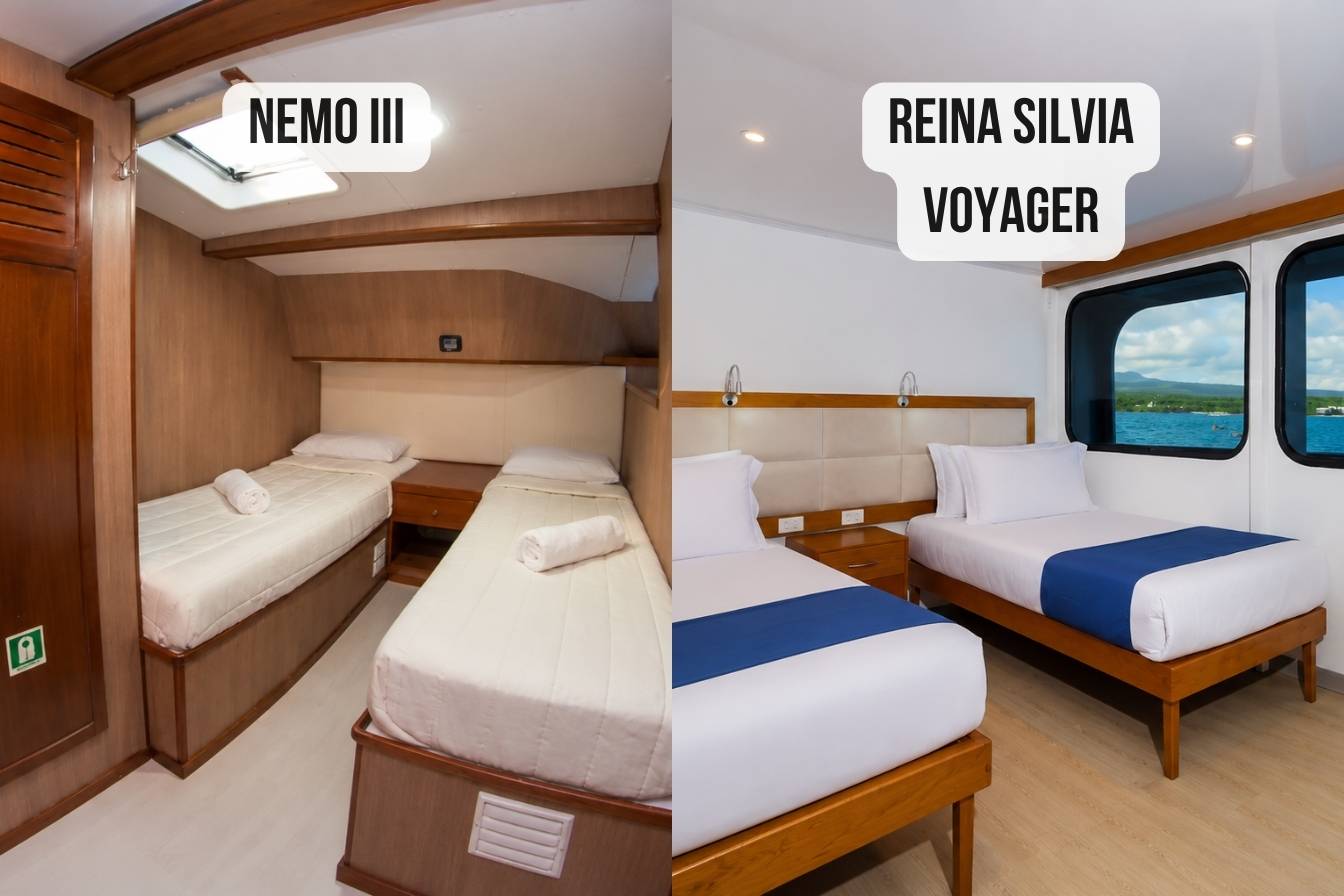
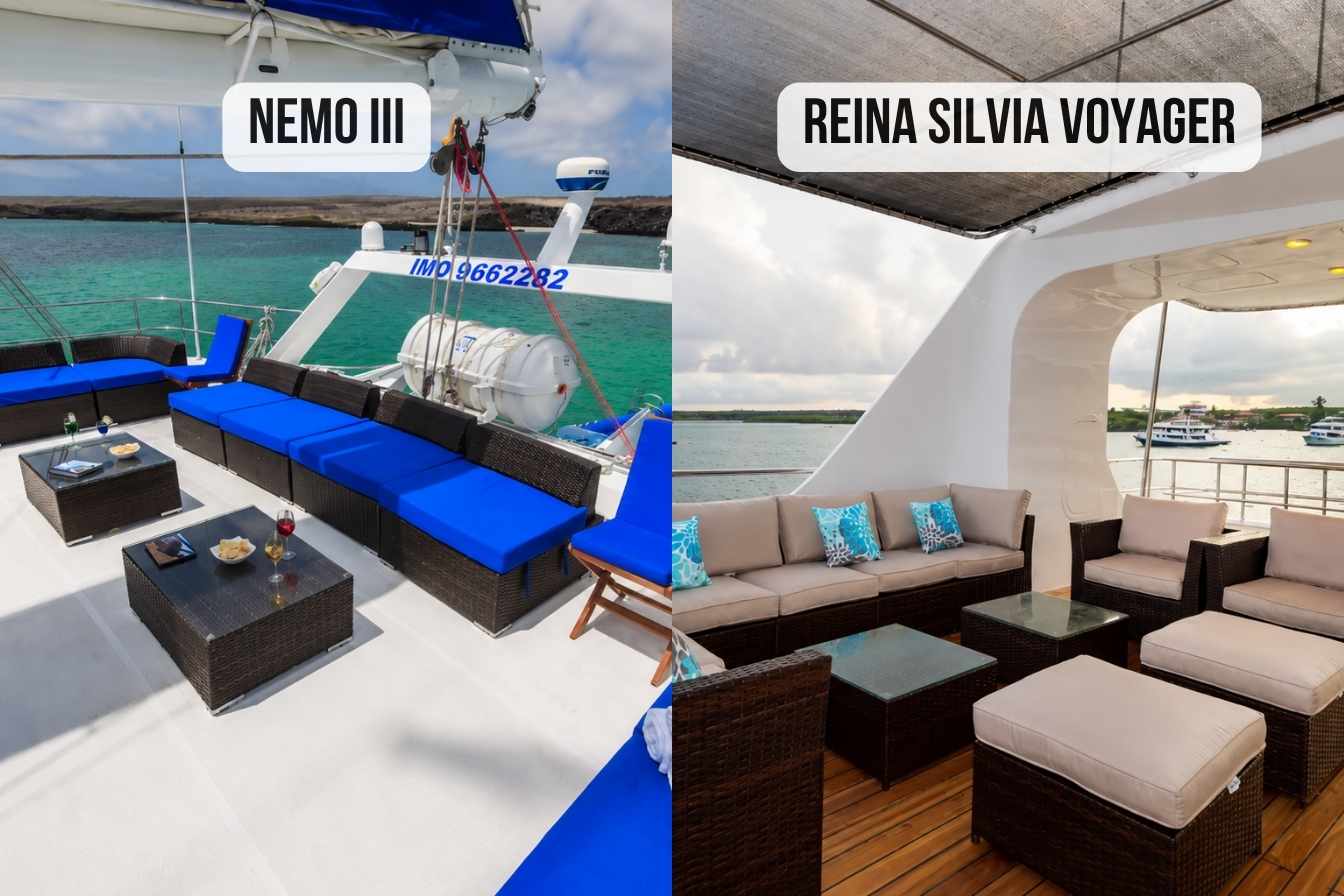
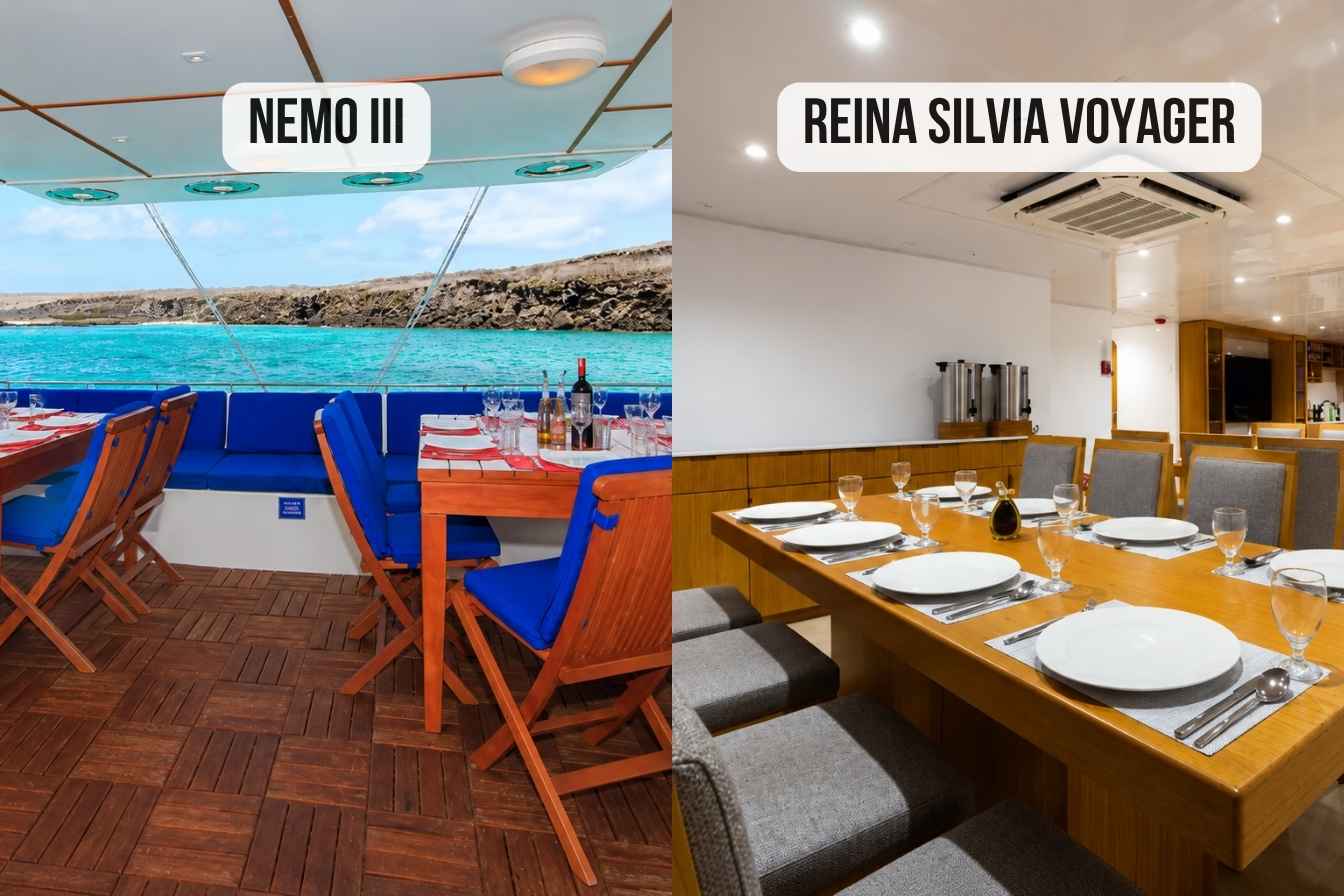
Reina Silvia Voyager’s private balconies are the single most differentiating physical feature in this comparison, and in the first-class catamaran segment more broadly. Eight of the vessel’s 10 cabins have private outdoor space – your own deck from which you can watch sea lions without going to the main deck, drink morning coffee with the islands in motion, or have a private sunset. No other catamaran in the first-class tier offers this consistently. Nemo III has no private balconies but compensates with a well-designed sundeck, a genuine Jacuzzi, an al fresco dining area with island views, and warm wood-finished cabins that feel more like a classic yacht than a modern hotel room.
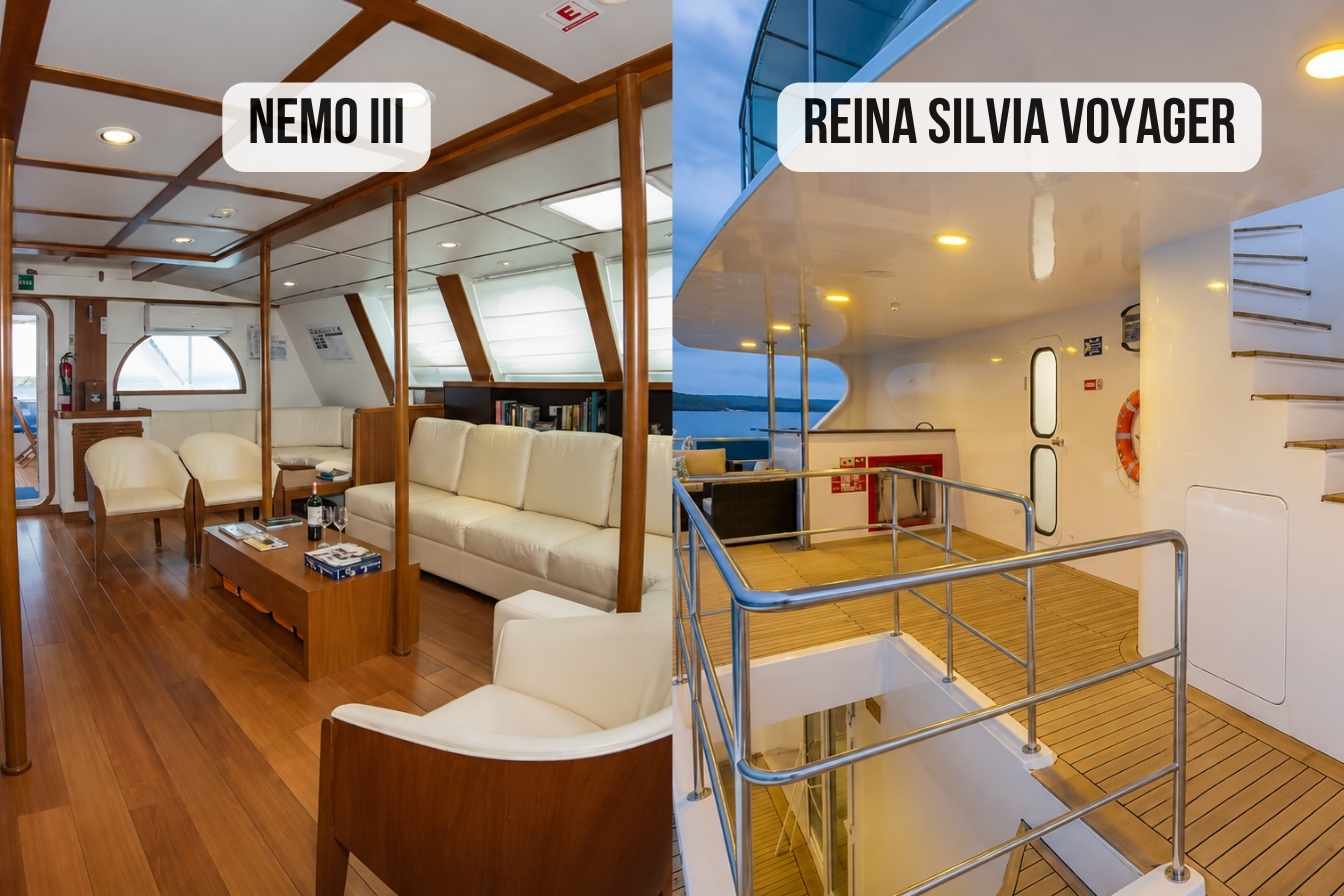
Nemo III’s 8 cabins (sources vary; the official breakdown gives 8 cabins across configurations) are arranged with wood finishes described as “among the best in her class” following the 2016 renovation. The cabins include twin beds (Cabins 1, 2, 7), double/matrimonial beds (Cabins 5, 8), and triple configurations with a lower double plus upper single bunk (Cabins 3, 4, 6) – the triple option is one of the most family-flexible cabin types in the first-class segment. Cabins have small windows rather than large panoramic views. The cabin space is described by multiple travel specialists as “relatively compact, but well designed and comfortable.” One solo traveler in Cabin 8 described it as “much larger than I expected, with lots of storage space and everything I needed” – a direct counter to the compact reputation.
Reina Silvia Voyager’s 10 cabins on two decks represent a broader configuration range than Nemo III. Four main deck twin cabins with balconies, two upper deck twin cabins with balconies, two upper deck single cabins with balconies, and one main deck double without a balcony represent the documented configuration. All cabins have panoramic windows, individually controlled air conditioning, closet storage, under-bed suitcase space, personal safes, writing desks, and complimentary toiletries. The contemporary design – featuring artwork by local Galapagos naturalist photographers and energy-saving LED lighting – makes the Reina Silvia Voyager feel different from any catamaran in the first-class segment.
The two dedicated single cabins on Reina Silvia Voyager are a specific structural innovation with no equivalent on Nemo III. G Adventures launched this vessel specifically noting the growing solo traveler market and the absence of affordable solo options on existing vessels. The single cabins have private balconies, full private bathrooms, and are sized for a single occupant rather than being a double cabin with one bed removed. This means solo travelers pay for solo accommodation rather than being charged a supplement for a double room they occupy alone.
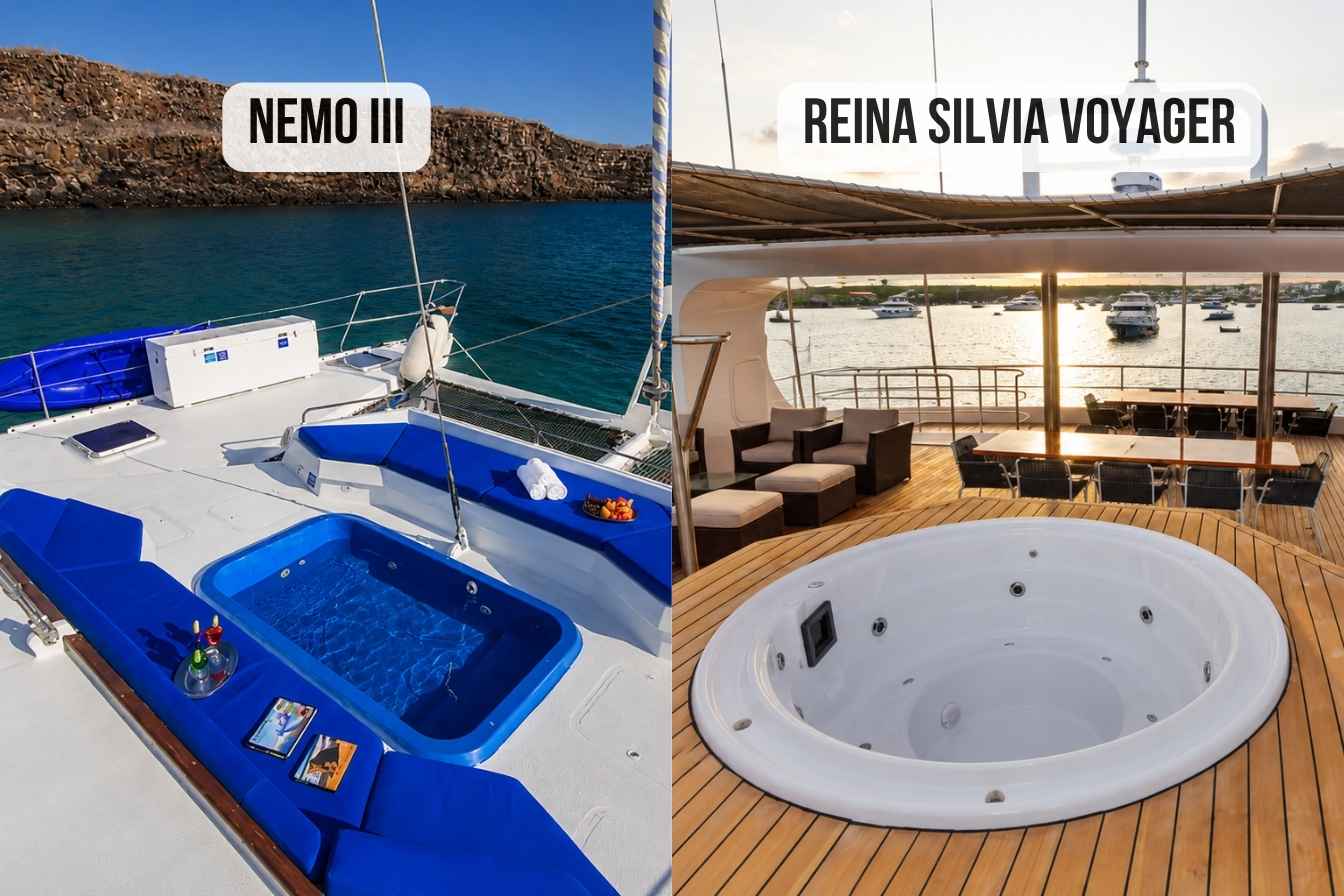
Both ships have Jacuzzis on the sundeck and BBQ/outdoor dining areas. Reina Silvia Voyager’s BBQ is specifically praised as a highlight across multiple traveler accounts (“more BBQ meals, those were the best!” is a specific request that appears in a review). The Nemo III sundeck with reclining loungers and Jacuzzi hot tub under sail-cloth parasols rigged from the mast is described by Galapatours as “the jewel in the crown” – an outdoor relaxation setup that makes the time between excursions genuinely enjoyable rather than merely a waiting period.
How Do the Itineraries, Islands, and Wildlife Access Stack Up?
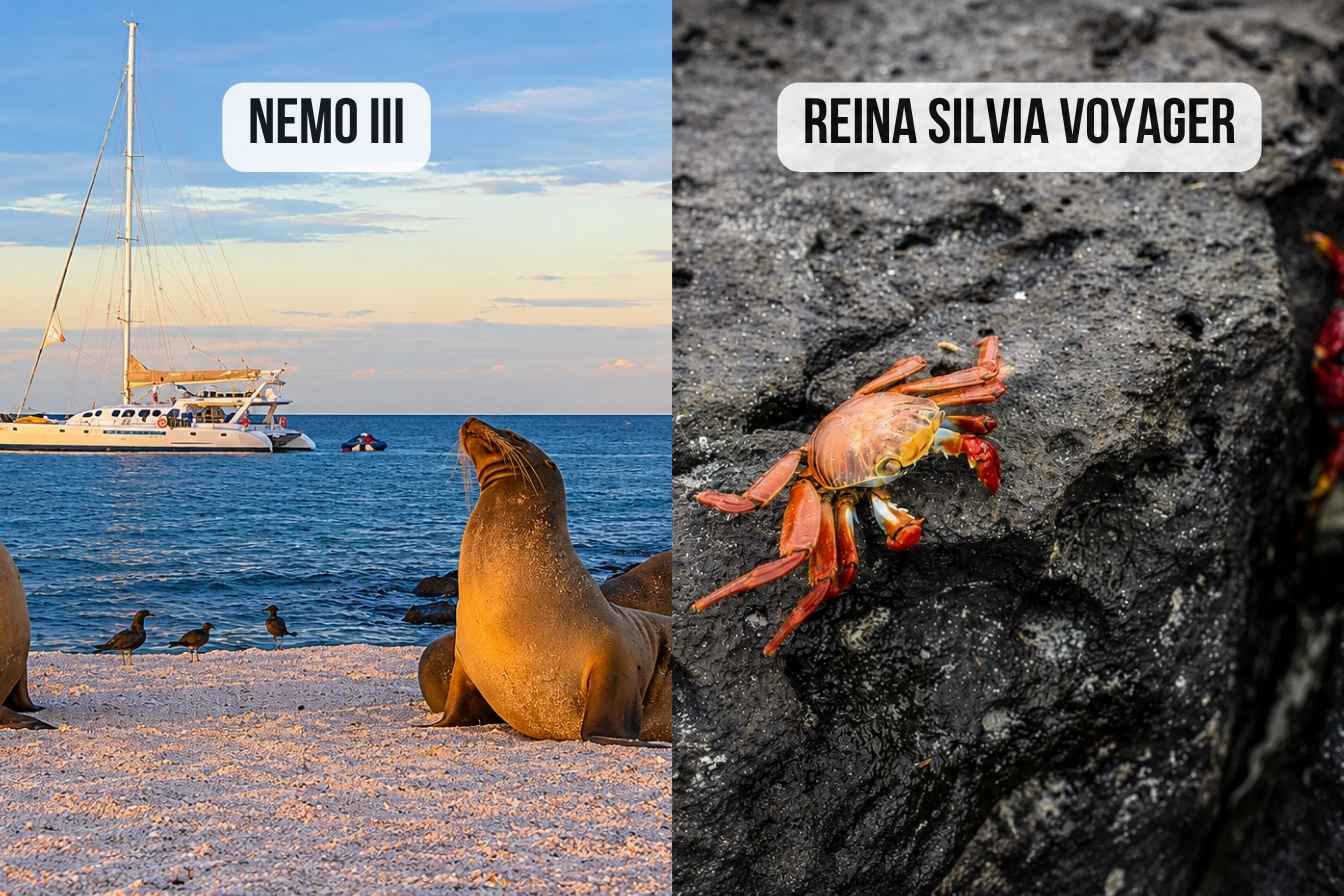
Nemo III runs two alternating 8-day itineraries (North/A and South/B), available in shorter 4-day and 5-day versions. The North A itinerary covers Genovesa (bird island), Santiago and Sullivan Bay, Isabela, Fernandina, and Buccaneers Cove. The South B itinerary covers Española, Floreana, San Cristobal and Bartolome. Both routes are considered equally strong by specialist operators. Reina Silvia Voyager runs three main itineraries through G Adventures: West and Central Islands (8 days), Central and East Islands (8 days), and a combined 10-day option including Quito. The western itinerary specifically includes Fernandina and the western Isabela coast – sites with some of the most pristine wildlife in the archipelago.
The itinerary question for these two ships is less about which is better and more about which specific islands you want to visit during your travel window. Nemo III’s North and South alternating pattern means your departure week determines your itinerary – you book based on what’s running that Sunday. Both the North and South routes visit fundamentally different islands, so checking which is departing during your dates is important rather than optional. The North route’s Genovesa visit is the only opportunity in the Nemo fleet to encounter red-footed boobies and the largest storm petrel colonies in the archipelago, which are otherwise inaccessible without specifically targeting that island. The South route’s Española visit is one of the best albatross encounters in the world.
Reina Silvia Voyager’s western itinerary under G Adventures is specifically notable for its Fernandina day. Punta Espinosa on Fernandina is one of the most pristine landing sites in the Galapagos – the island has no introduced species at all and supports enormous concentrations of marine iguanas alongside flightless cormorants, Galapagos penguins, and Galapagos hawks that have no learned fear of humans. The snorkeling at Elizabeth Bay on Isabela and the hiking at Punta Moreno through lava formations and past flamingo lagoons are equally strong wildlife days. Travelers specifically praise the western route for seeing things they could not access from land-based operations or shorter central island cruises.
The 10-day G Adventures package for Reina Silvia Voyager includes mainland Quito as a structured component – a night in Quito before and after the cruise, with guided city touring. This mirrors what HX Hurtigruten Expeditions offers on Santa Cruz II and adds meaningful Ecuador context to the Galapagos experience. For first-time visitors to Ecuador who would otherwise transit through Quito without exploring it, this structure is a genuine addition. For travelers who have been to Quito before, it’s an optional component worth evaluating on its own merits.
What Do the Naturalist Guides and Expedition Programs Look Like?
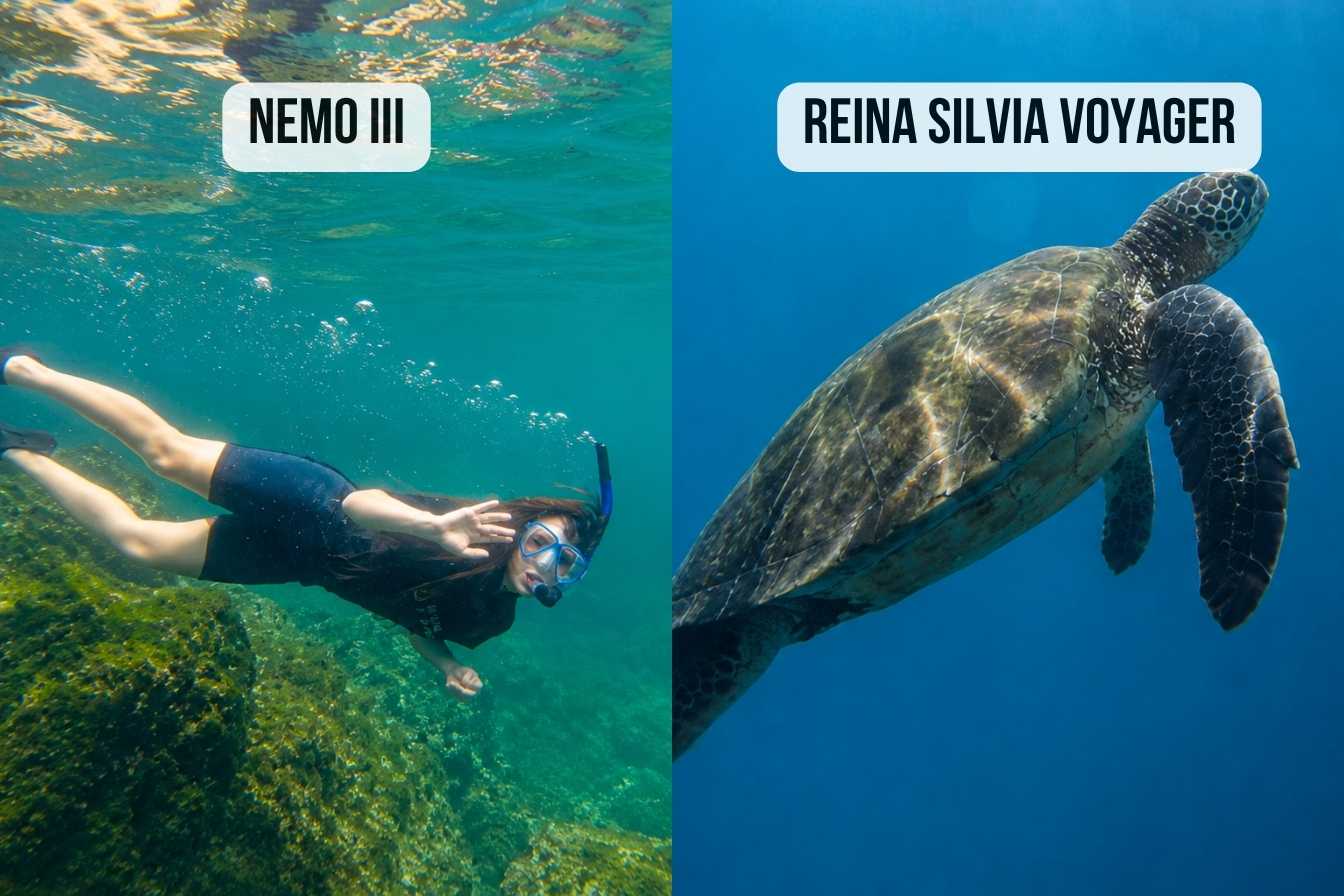
Both ships carry a single certified naturalist guide for 16 guests – the standard Galapagos National Park configuration at this vessel size. Nemo III’s guides are bilingual (Spanish/English) and certified by the National Park, with a track record of specific guide quality that appears in traveler accounts by name: guide Jairo and naturalist Peter are specifically mentioned across recent reviews. Reina Silvia Voyager’s guides operate under G Adventures’ CEO (Chief Experience Officer) framework: named guides Omar, Venus, and Indira Torres appear consistently across traveler accounts, each drawing sustained praise for knowledge, energy, and the ability to make wildlife encounters educationally meaningful.
The CEO system G Adventures uses is worth understanding because it differs from standard naturalist guide training in the Galapagos. G Adventures trains its CEOs in naturalist content but also in group facilitation, storytelling, and what the company describes as making guests feel the purpose behind the wildlife encounters rather than simply naming species. Indira Torres on the western itinerary is a native of the Galapagos who reportedly made the trip “the best tour I’ve ever been on” in the words of a traveler who had previously taken tours on multiple continents. Guide Omar on the eastern itinerary appears across the most reviews, consistently described as energetic, encyclopedic, and genuinely enthusiastic – someone who makes geological formations as interesting as the animals. The word “single-handedly” appears in multiple accounts to describe their guide’s contribution to the trip quality.
Nemo III’s guide culture produces equally personal accounts, reflecting the family operation’s continuity. Guide Jairo is mentioned in the context of creating a “warm and friendly atmosphere on board” that made the overall experience memorably enjoyable. Naturalist Peter is described as “probably one of the best in the area” by a German-speaking traveler who joined from a review. The small crew of 7 with a single guide means everyone on board knows the guide well within a day, and the guide’s knowledge is consistently described as expert-level across both wildlife and geological interpretation.
Both ships hold evening briefings as standard practice, where the guide previews the following day’s excursions. This is a universal first-class Galapagos convention but the quality of the briefing varies significantly by guide. Both ships’ guides use the indoor salon’s multimedia screen for presentations. Reina Silvia Voyager’s salon design specifically includes a large video screen for this purpose, which enables visual presentations that enhance the briefing with footage and images of the sites being visited. Nemo III’s lounge similarly has a TV and DVD system for the same purpose.
Guide assignments change by departure. If a specific guide’s name matters, and with both these ships it can meaningfully shape the trip – we track current roster assignments. Contact us here before you commit to a departure.
How Do Prices Compare and What Does Each Ship Include?
Nemo III is meaningfully more affordable than Reina Silvia Voyager. An 8-day Nemo III cruise runs approximately $3,300-$3,500 per person at full fare; shorter 4 and 5-day options are available from approximately $2,400/pp, with a 10% child discount for under-12s. Reina Silvia Voyager 8-day cruises start from approximately $7,399/pp – roughly double the Nemo III fare for a comparable 8-day duration. Both ships exclude alcoholic drinks, park fees ($200/adult), and gratuities. The Reina Silvia Voyager adds kayaks as standard inclusions (Nemo III has kayaks but recommends reserving in advance), while Nemo III includes wetsuits as Reina Silvia Voyager does.
The price gap between these two ships is the largest in any comparison we’ve done in the first-class catamaran segment. At approximately $3,500/pp (Nemo III 8-day) vs $7,399/pp (Reina Silvia Voyager 8-day), the difference is roughly $3,900 per person. For a couple, that’s $7,800. On an all-in Galapagos budget that includes flights, park fees, and domestic airfares, the Nemo III’s lower fare represents a material difference that can determine whether the trip is financially accessible at all.
The question is what the extra $3,900 per person on Reina Silvia Voyager buys: private balconies on most cabins, a newer 103-foot vessel vs a renovated 75-foot vessel, a G Adventures CEO guide framework, dedicated solo cabins, the larger beam (40 ft vs 37 ft) for greater stability, and the G Adventures booking infrastructure including Quito extensions and the 10-day package. Whether these features justify the premium depends entirely on the traveler. For a couple who would use the balcony every morning and evening and for whom the G Adventures global brand provides comfort, the premium is justified. For a family with children who want triple cabin flexibility and care more about the guide quality than the vessel’s age, Nemo III delivers equal wildlife access at substantially lower cost.
The “5-day vs 8-day” format question is practical for Nemo III and not applicable to Reina Silvia Voyager. Nemo III’s 4 and 5-day options give travelers with limited time a genuine first-class Galapagos experience without committing a full week. G Adventures’ Reina Silvia Voyager itineraries are structured as 8 or 10-day programs. There is no 4 or 5-day option through G Adventures on this vessel. Travelers with fewer available days who want a catamaran experience should note that Nemo III’s shorter formats specifically address this constraint.
What We Hear From Travelers Who’ve Sailed Both Ships
| % who said guide quality was the trip highlight | 88% | 93% |
| % who said food quality was a highlight | 85% | 82% |
| % who said price-to-value was excellent | 91% | 79% |
| % who would book same ship again | 90% | 93% |
| Most common watch-out | Compact cabins with small windows; no balcony; kayaks should be reserved ahead | Wetsuits provided are short – bring or request long wetsuits for cool season; alcoholic drinks extra cost |
| Most common unexpected highlight | Sailing atmosphere; guide quality; wood-finished cabin warmth; family-business personal service | Private balconies change the experience; BBQ meals; dedicated solo cabins; guide Omar/Venus/Indira |
Which Ship Should You Choose Based on Your Travel Style?
Choose Reina Silvia Voyager if private balconies matter to you and your cabin experience is part of what you’re paying for, you’re traveling solo and want a purpose-built single cabin without shared accommodation, you prefer the G Adventures booking and support infrastructure, the western Galapagos itinerary’s Fernandina and Isabela access is the priority, or the modern vessel design and G Adventures CEO guide program are the operator qualities you want. Choose Nemo III if the price difference matters and you want the same wildlife access at roughly half the fare, you’re traveling with children and need triple cabin flexibility, you want shorter 4 or 5-day options, you prefer an authentic family-business operation with 40 years of Galapagos institutional knowledge, or the sailing atmosphere of a motor-sail catamaran appeals.
For solo travelers, the choice tips clearly toward Reina Silvia Voyager. The two dedicated single cabins with private balconies, purpose-built for one person, solve the solo travel problem on Galapagos cruises that every other vessel handles awkwardly through single supplements on double rooms. If you’re traveling alone, this structural advantage is worth a meaningful premium – though the total fare at $7,399+ remains significant.
For families with children, Nemo III tips clearly in the other direction. The triple cabin configuration (Cabins 3, 4, 6 with lower double plus upper single bunk) is one of the most family-practical arrangements in the first-class segment, accommodating a family of three in one cabin rather than paying for two rooms. The minimum age of 3 years on Nemo III (vs no published minimum on Reina Silvia Voyager but an itinerary that suits 12+) and the 10% child discount under 12 compound into meaningful family savings. At the price differential, a family of 2 adults and 2 children could save over $15,000 on an 8-day trip by choosing Nemo III.
For couples, the decision is genuinely close. The balcony premium on Reina Silvia Voyager is most meaningful for couples who would use private outdoor space actively. If the dominant activities are excursions, snorkeling, and shared deck time, Nemo III’s guide quality, authentic atmosphere, and dramatically lower price produce equivalent or superior trip satisfaction for most travelers in this profile. The question is whether $7,800 extra (for two) buys enough balcony moments and vessel modernity to justify the difference.
Quick Reference: Nemo III vs Reina Silvia Voyager Side by Side
| Scenario | Best Ship | Why |
|---|---|---|
| Private balcony in your cabin | Reina Silvia Voyager | 8 of 10 cabins have private balconies; Nemo III has none |
| Solo traveler – own cabin without overpaying | Reina Silvia Voyager | 2 purpose-built single cabins with balcony; Nemo III uses double rooms with supplement |
| Family with children (triple cabin) | Nemo III | Cabins 3, 4, 6 offer triple config; 10% child discount under 12; min age 3 |
| Best price per day | Nemo III | ~$3,300-$3,500/pp for 8 days vs ~$7,399/pp on Reina Silvia Voyager |
| 4 or 5-day option available | Nemo III | 4-day and 5-day versions of both North and South itineraries; Reina Silvia Voyager minimum 8 days |
| Authentic sailing atmosphere | Nemo III | Motor-sail catamaran; sails deployed when conditions permit; Reina Silvia Voyager is motor-only |
| Newer purpose-built vessel | Reina Silvia Voyager | Purpose-built 2019-2020; Nemo III renovated 2016 but older vessel overall |
| G Adventures booking infrastructure | Reina Silvia Voyager | G Adventures CEO guide system, 10-day Quito package, global operator support |
| Family business, 40-year Galapagos track record | Nemo III | Nemo Galapagos operating since 1985; deep local knowledge and crew continuity |
| Western islands (Fernandina) | Reina Silvia Voyager (western itinerary) | Western route specifically covers Fernandina (most pristine island); Nemo III North also visits |
| BBQ outdoor dining | Reina Silvia Voyager | Dedicated BBQ grill station; specifically praised; Nemo III has al fresco dining but no dedicated grill |
| Kayaks included without reserving ahead | Reina Silvia Voyager | Standard included; Nemo III recommends reserving kayaks in advance |
Frequently Asked Questions
How old is the Nemo III and does it matter?
Nemo III is an older vessel that underwent a substantial renovation in 2016. Travel specialists who have been aboard describe the cabins and social spaces post-renovation as “way ahead of anything else in her class” at the time of the refit. The 2016 renovation updated cabins, bathrooms, lounge areas, and the sundeck. Vessel age is relevant only if it affects safety, comfort, or experience quality, and based on traveler accounts through 2025, Nemo III consistently delivers on all three. The Nemo Galapagos family has been maintaining this vessel continuously since 1985 and their operational continuity provides a level of institutional maintenance knowledge that newer vessels haven’t yet accumulated.
What is G Adventures’ CEO guide system on Reina Silvia Voyager?
G Adventures calls its naturalist guides CEOs – Chief Experience Officers. Beyond standard Galapagos National Park naturalist certification, G Adventures trains CEOs in group facilitation, storytelling, and the communication of conservation values. The system emphasizes making wildlife encounters meaningful rather than just informative. Named CEOs who appear consistently across Reina Silvia Voyager traveler accounts – Omar, Venus, and Indira Torres – are each specifically credited with making their departures exceptional rather than merely good. Indira Torres, a native of the Galapagos, has been described by one traveler as “probably single-handedly making this the best tour I’ve ever been on.”
Can the Nemo III actually sail with its sails?
Yes, but conditionally. Nemo III is a motor-sail catamaran and carries working sails. The captain deploys them when wind conditions and the required transit route permit. Whether sails are used on any given passage is entirely at the captain’s discretion based on safety and schedule. Travelers who experience a sail-assisted crossing describe it as one of the trip’s memorable moments. Travelers should not book Nemo III specifically expecting sailing as a guaranteed feature – it’s a bonus when conditions allow, not a scheduled activity.
Are wetsuits included on both ships?
Yes. Both ships include wetsuits for snorkeling. On Reina Silvia Voyager, multiple traveler accounts specifically note that the provided wetsuits are short (shorty style) and recommend requesting or bringing full-length wetsuits for the cool season (June through November) when water temperatures drop to 16-20°C in parts of the itinerary. On Nemo III, wetsuits are included without documented complaints about length, though cool-season snorkelers on any Galapagos vessel benefit from full-length neoprene coverage.
What is the minimum age on each ship?
Nemo III accepts passengers from 3 years old on regular (FIT) departures, and all ages on charter. A 10% child discount applies for children under 12 based on the Superior cabin rate. Reina Silvia Voyager does not publish a specific minimum age but its active itinerary – hiking, snorkeling, panga rides – is best suited to ages 12 and above based on the physical demands involved.
Ready to Book Your Galapagos First Class Catamaran?
Both Nemo III and Reina Silvia Voyager deliver the wildlife encounters that make the Galapagos one of the most powerful natural experiences on earth. The choice between them comes down to whether private balconies, a purpose-built modern vessel, and the G Adventures CEO guide system justify the price premium over the family-operated warmth, triple cabin flexibility, shorter itinerary options, and authentic sailing atmosphere of Nemo III. We’ve spoken with travelers who’ve been on both and can give you a direct recommendation based on your travel profile.
Cruises To Galapagos Islands is rated 4.9 stars on Google and TripAdvisor.Get Your Free Quote
Written by Oleg Galeev
Galapagos cruise traveler (3 trips, 2 cruises) · Founder, Cruises To Galapagos Islands
Oleg has personally inspected nearly every available Galapagos cruise vessel and interviewed thousands of travelers. He also runs the Ecuador travel blog mytrip2ecuador.com and the YouTube channel My Trip to Somewhere.
Cruises To Galapagos Islands is rated 4.9 stars on Google and TripAdvisor.
All pricing and regulations verified against official Galapagos National Park and Ecuador government sources as of publish date.