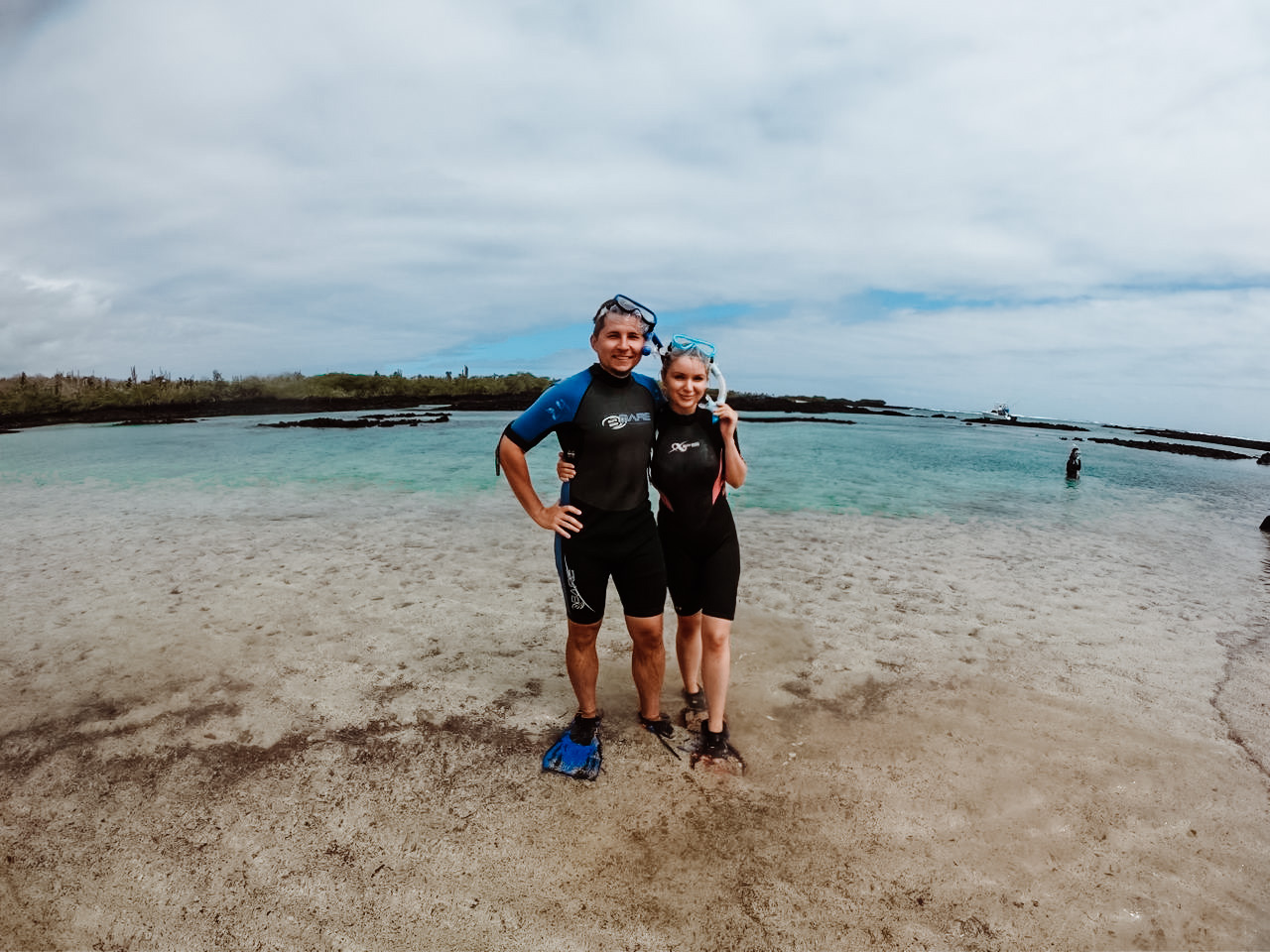
Ecoventura Origin vs Theory vs Evolve: Are They Really Identical?
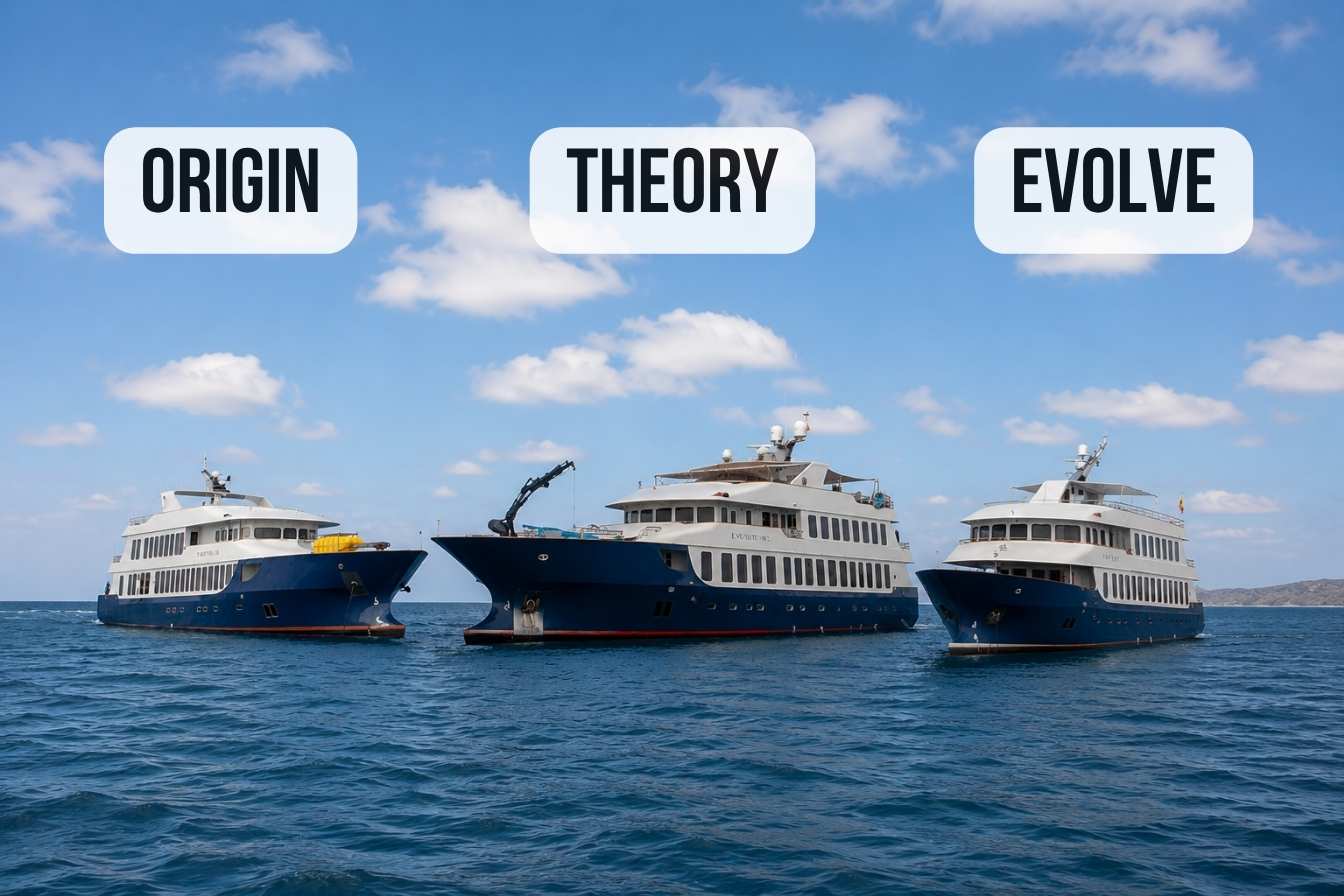
This is one of our Galapagos cruise comparisons. Full reviews: Origin/Theory/Evolve. Or see the best Galapagos cruises in one finder.
Quick Facts: Origin vs Theory vs Evolve
| Feature | Origin | Theory | Evolve |
|---|---|---|---|
| Year built | 2016 | 2019 | 2023 |
| Last refitted | 2022 | 2022 | N/A (new build) |
| Passenger capacity | 20 | 20 | 20 |
| Cabins | 10 staterooms | 10 staterooms | 10 staterooms |
| Cabin size | ~145 sq ft | ~145 sq ft | ~145 sq ft |
| Ship length | 141 ft / 43 m | 141 ft / 43 m | 141 ft / 43 m |
| Crew | 13 | 13 | 13 |
| Naturalist guides | 2 (1 per 10 guests) | 2 (1 per 10 guests) | 2 (1 per 10 guests) |
| Relais & Chateaux member | Yes | Yes | Yes |
| Itineraries | A (Beaches & Bays) and B (Volcanic Wonders) | A and B | A and B |
| Solo supplement discount | 25% off on selected dates (2026) | 25% off on selected dates (2026) | 25% off on selected dates (2026) |
| Entry-level rate (7 nights, approx.) | From ~$9,500 pp | From ~$9,500 pp | From ~$9,500 pp |
| Park fee included? | Yes | Yes | Yes |
Prices verified May 18, 2026. Galapagos National Park fee ($200 USD per adult, $100 per child under 12, as of August 2024) is included in Ecoventura’s cruise rates. Transit Control Card (TCT) at $20 per person must be purchased digitally before travel through the official Galapagos government portal as of May 2026. Always confirm inclusions with your booking agent.
What Are the Ecoventura Origin, Theory, and Evolve, and Why Does Everyone Call Them “Sister Ships”?
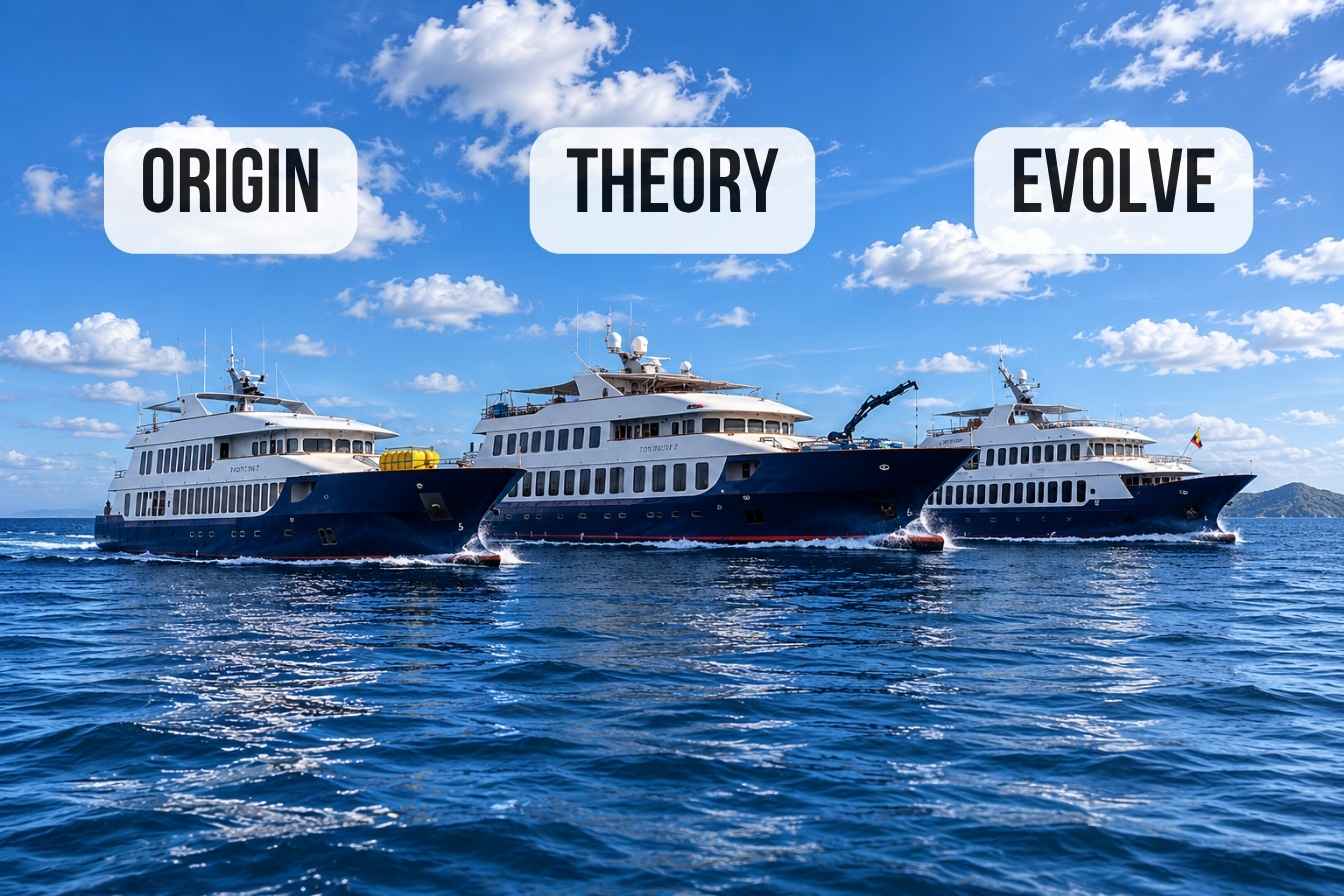
Origin, Theory, and Evolve are three custom-built, 20-passenger luxury expedition yachts operated by Ecoventura in the Galapagos Islands. They were launched in 2016, 2019, and 2023 respectively, and each was purpose-built to be structurally and operationally identical. All three are members of Relais & Chateaux, the only vessels in the Galapagos with that designation, and all three sail the same two rotating itineraries with the same guide-to-guest ratio, crew size, and onboard program. The “sister ship” label is accurate, not marketing shorthand.
The names tell you something about how Ecoventura thinks about this fleet. Origin comes from Darwin’s “On the Origin of Species.” Theory references his “Theory of Evolution.” Evolve picks up the thread. All three were designed by the same Ecuadorian architect, built in the same shipyard, and refined based on feedback from the previous vessel. When Ecoventura says they’re identical, they mean it in the most literal way possible: same hull design, same four-deck layout, same cabin configuration, same guide team structure, same daily schedule. The company’s own FAQ says the only difference is the decor.
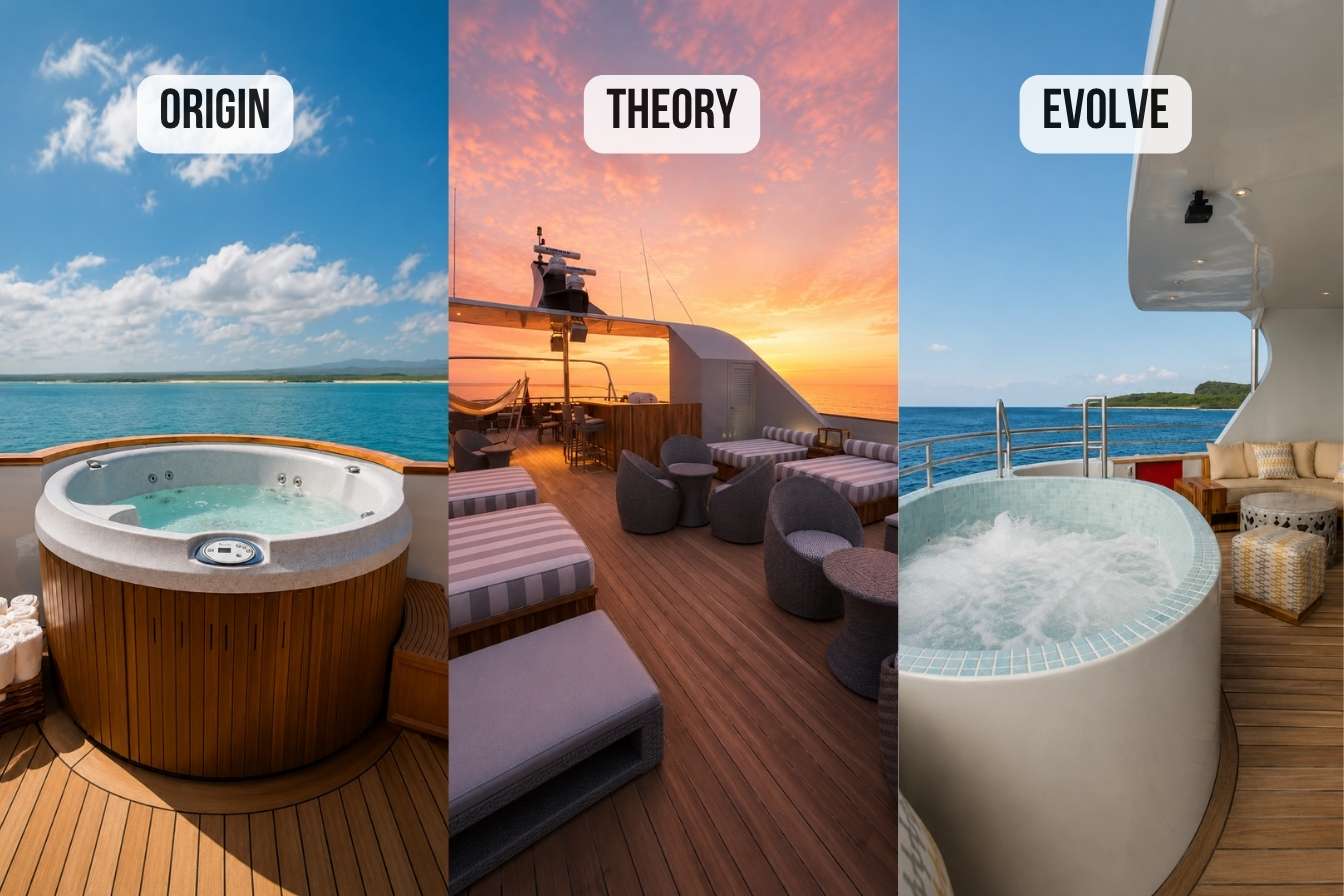
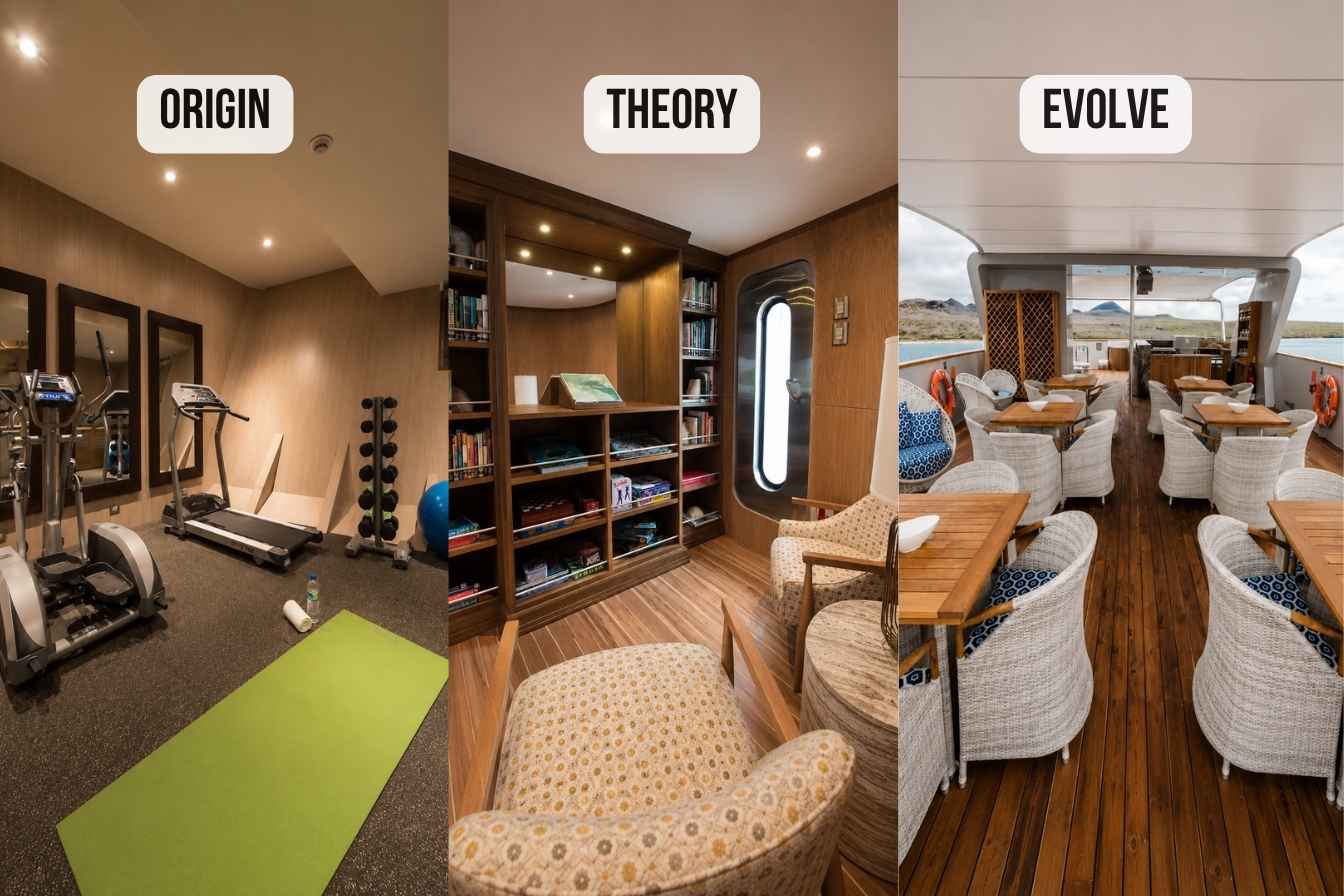
That’s largely true, with two nuances worth knowing. First, Origin and Theory received a 2022 drydock refit specifically to bring them in line with Evolve’s layout. Theory’s Jacuzzi, originally tucked on the Darwin Deck behind the wheelhouse, was relocated to the Sun Deck. Origin got the same treatment. So the small pre-2022 quirk that made Origin and Theory slightly different from each other no longer exists. Second, Evolve as the newest build benefits from whatever small material and engineering refinements Ecoventura incorporated from seven years of guest feedback on Origin and Theory.
For a traveler trying to choose between these ships, this is actually clarifying rather than frustrating. You’re not trying to pick the “best” one. You’re looking at availability, departure dates, and which itinerary sails on your preferred weeks. That’s the decision. Everything else is the same.
If you’re trying to figure out which Ecoventura departure makes sense for your travel dates and whether Itinerary A or B is the better match for your wildlife priorities, we can walk you through it in minutes. Fill out this short form and we’ll come back with a straightforward recommendation and a no-pressure quote.
How Do the Cabins and Onboard Space Actually Compare Across the Three Vessels?
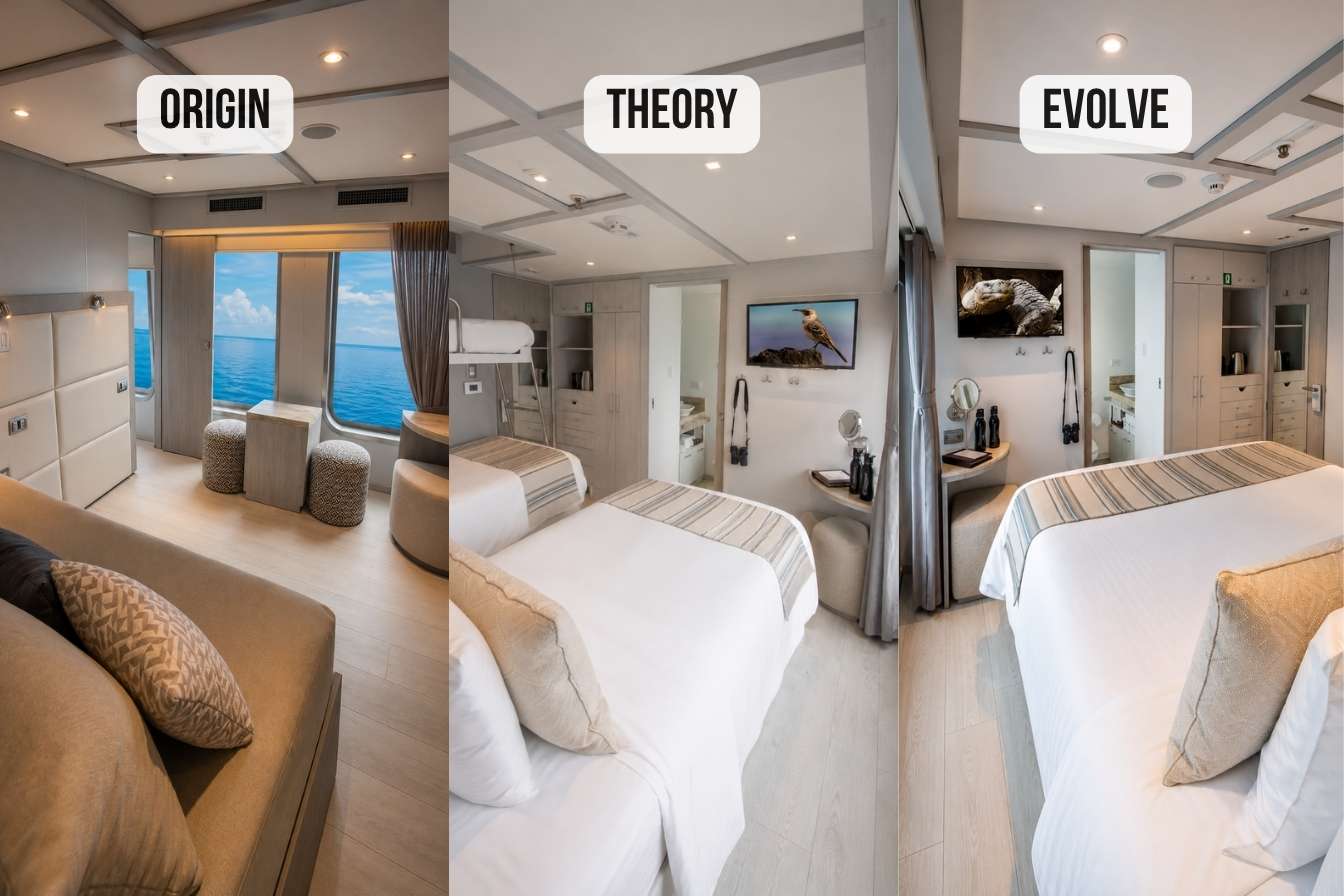
Cabin size, layout, and amenities are identical across all three ships. Each stateroom runs approximately 145 square feet, with all 10 cabins on a single deck facing outward with panoramic windows. Beds convert between two twins and one king. Bathrooms have rainfall showers with ocean views, robes and slippers, and biodegradable toiletries. Connecting doors on cabins 1&3 and 2&4 create family suite options. The only variation is interior decor, which differs subtly in color palette and material choices between the three vessels.
The single-deck cabin arrangement deserves more attention than it usually gets. On most Galapagos vessels, guest cabins spread across two or three decks, with lower-deck rooms typically getting portholes instead of windows. On Origin, Theory, and Evolve, every guest is on the same deck, which means every room gets the same quality panoramic view. There are no bad cabins. There are no “upgrade or you’ll regret it” tiers. Cabin 1 and cabin 10 have the same experience.
The 145-square-foot figure is compact but well-designed for what it is. These aren’t rooms meant for spending hours in. They’re sleeping quarters and dressing rooms for people who spend most of their waking hours on deck, in Zodiacs, or ashore. The large windows change the feeling considerably. Sitting in a 145-square-foot room with a panoramic view of open Pacific ocean or a volcanic shoreline reads very differently than the same square footage with a porthole. Travelers consistently mention waking up and watching wildlife from bed as one of the specific memories that stays with them.
The Premium Suite option is worth flagging. Cabins 1 and 3, or 2 and 4, connect through an interior door to create a two-room setup with his-and-hers bathrooms, a separate lounge area, and more than 300 square feet of combined space. Guests who book this option also receive upgraded beverage access, complimentary laundry, and a welcome gift. For couples celebrating a milestone, or families needing the extra room, it’s a genuine product rather than just a marketing tier.
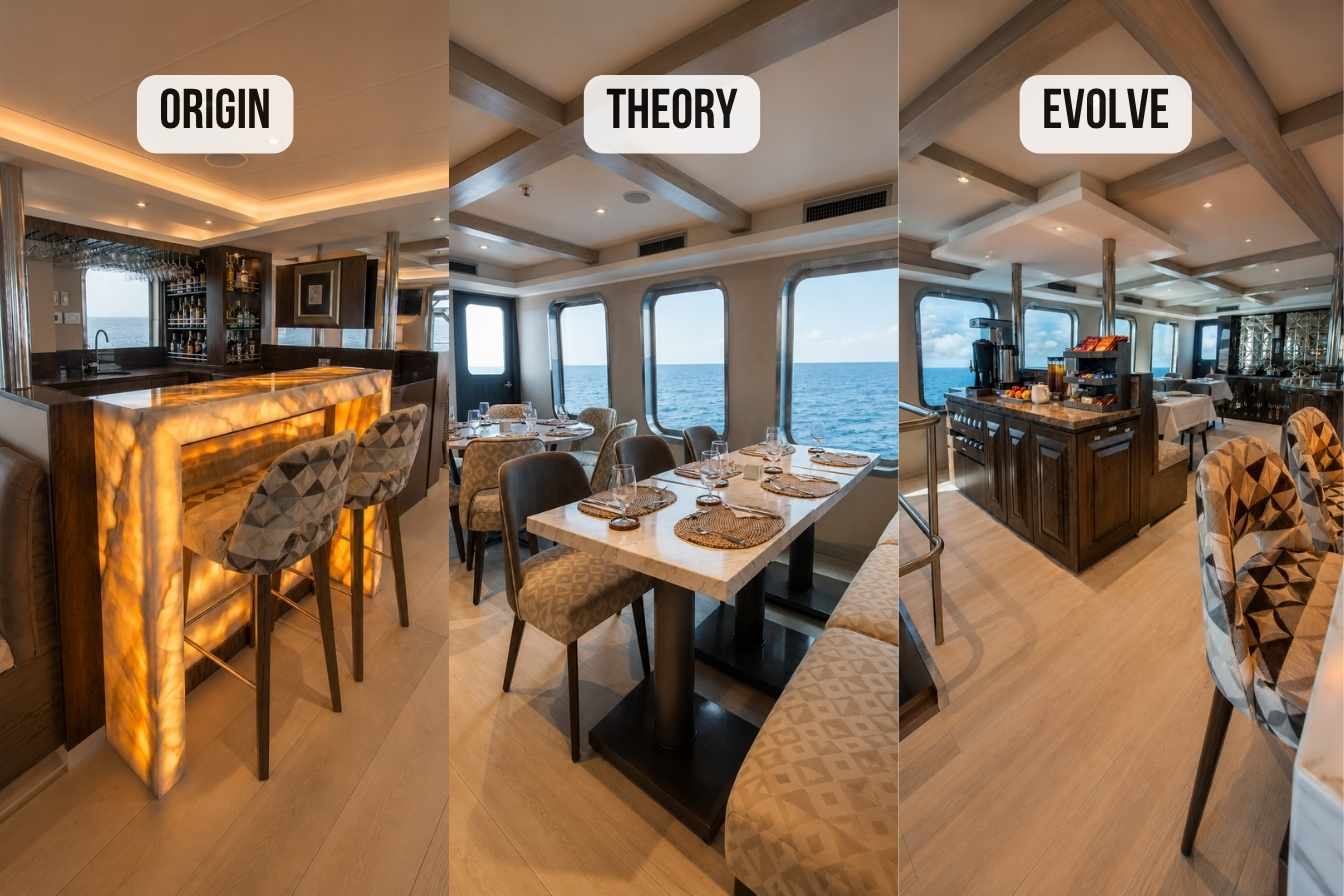
The decor differences between the three ships are real but subtle. Origin has a warm, earthy tone with natural materials. Theory pushed toward a slightly more contemporary palette. Evolve, as the most recent build, reflects the latest iteration of the same design language. None of these differences should factor into your booking decision. If you’ve seen photos of one ship and loved the look, know that you’d feel equally at home on the other two.
The premium suite option on these ships books out early, particularly for family departures and holiday weeks. If connecting cabins are important for your group, lock in your dates soon. Reach out here and we’ll check current availability across all three ships for your target dates.
Are the Itineraries, Islands, and Wildlife Access the Same on All Three Ships?
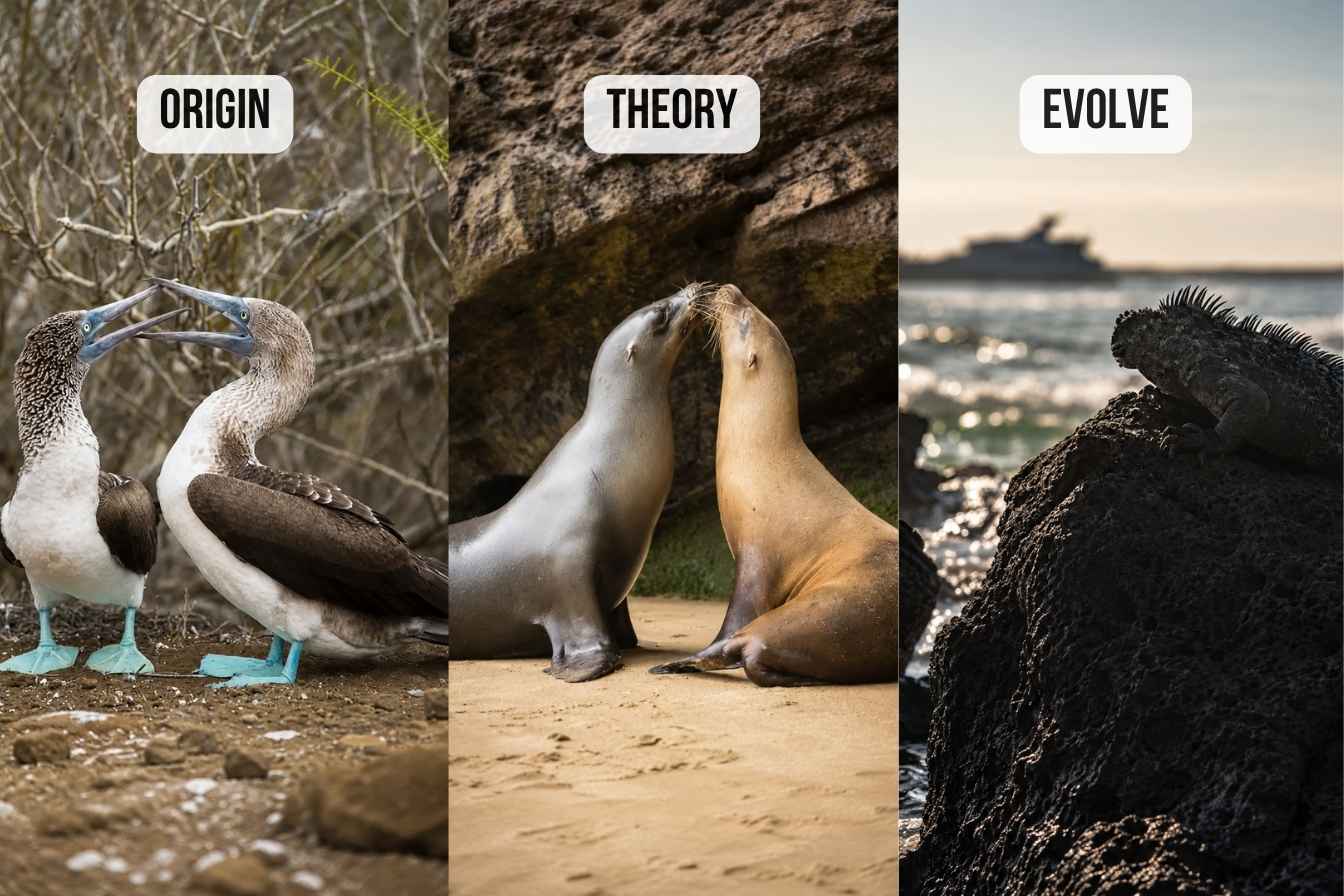
Yes. All three ships sail the same two 7-night itineraries on a rotating weekly schedule. Itinerary A, called Beaches and Bays, covers the southern and central archipelago, including Española, Floreana, Santa Cruz, Bartolome, South Plaza, and North Seymour. Itinerary B, Volcanic Wonders, takes in the northern and western islands: Genovesa, Santa Cruz, Fernandina, Isabela, and Santiago. Both itineraries depart every Sunday from San Cristobal and can be combined into a 14-night back-to-back voyage.
This is the part of the decision that actually matters. The ship you sail on has no bearing on what you’ll see in the Galapagos. The islands you visit, the wildlife encounters waiting at each site, the specific magic of watching a waved albatross courtship dance on Española or standing at the edge of Fernandina’s volcanic crater while marine iguanas pile up at your feet: all of that is determined entirely by itinerary, not by whether you’re on Origin, Theory, or Evolve that week.
The two itineraries are genuinely different experiences. Itinerary A leans toward beaches, bays, and birding. It’s the one where you’ll see waved albatross (seasonal), blue-footed boobies, flamingos, and sea lions sprawled across the finest beaches in the archipelago. Floreana on this route has a historically fascinating backstory as the site of one of the Galapagos’s most bizarre early human settlements. If you’re going with first-timers or beach lovers, Itinerary A tends to be the more immediately visual and emotionally accessible route.
Itinerary B is for the wilder side of the archipelago. Genovesa, the island of the birds, hosts over a million red-footed boobies. Fernandina is one of the most volcanically active places on Earth and among the most pristine islands in the entire chain. Isabela, shaped like a seahorse, crosses the equator and delivers penguins, flightless cormorants, and whale sightings in the nutrient-rich waters around its six volcanoes. Travelers who’ve done both routes reliably call Itinerary B the more remote and raw of the two, the one that feels furthest from civilization and closest to what Darwin actually encountered.
If you can do both back-to-back over 14 nights, do it. The combination gives you a complete picture of the archipelago that neither single week can fully deliver. Ecoventura offers a 5% discount on consecutive bookings, excluding holiday periods.
What Do the Naturalist Guides and Expedition Staff Look Like on Each Ship?
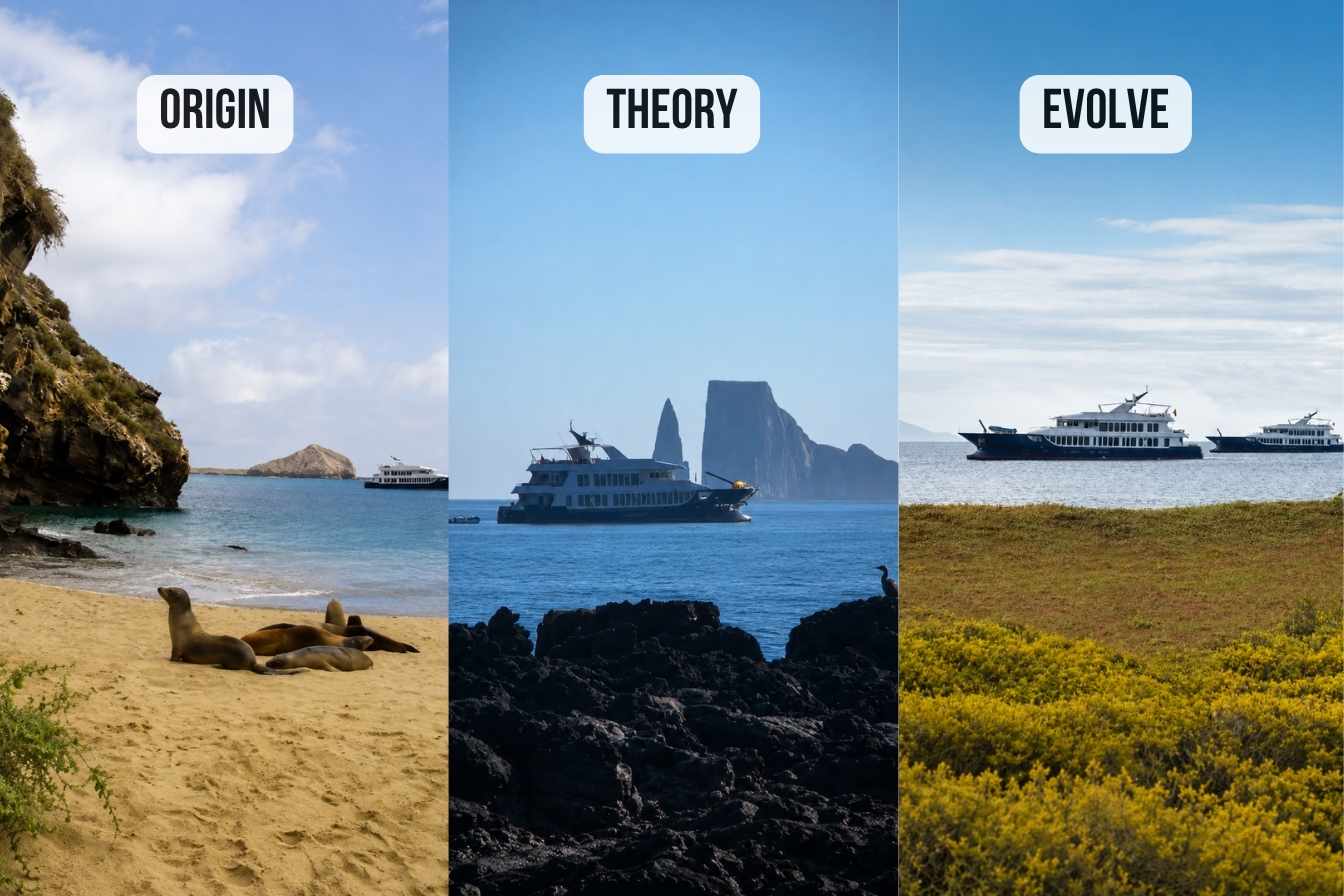
Each vessel carries two certified naturalist guides for 20 guests, giving a 1:10 guide-to-guest ratio. Ecoventura describes this as the lowest guest-per-guide ratio in the Galapagos. A full-time concierge is also on board every departure, separate from the guide team. The guide assignment rotates by departure, not by vessel, so you cannot book a specific guide. The quality and caliber of the naturalist program is the same across all three ships.
The 1:10 ratio is meaningful in practice. With 20 guests split into two groups of 10, each led by a dedicated naturalist, you’re moving through visitor sites in a small enough group that the guide can genuinely tailor the experience. If five people want to hang back at a marine iguana colony while three others want to push ahead to the snorkel site, it’s manageable. That flexibility doesn’t exist on ships with 48 or 96 passengers where logistics require tighter choreography.
Something that comes through clearly in traveler accounts from all three ships: the guides are the trip. Naturalists on Ecoventura’s fleet are local Galapagueños in many cases, with encyclopedic knowledge of the species and islands they’ve grown up around. The evening briefing sessions, where the day’s sightings are reviewed and the next day’s sites previewed, become something guests look forward to by day two. Several travelers have described specific guide moments, a particular field ID, a behavioral observation about a booby pair, a story about a tortoise found in a specific spot, as the details they remember years later.
The concierge role is something that sets these ships apart from others at a similar or even higher price point. A full-time concierge on a 20-passenger yacht isn’t a function you find on most Galapagos vessels. On Origin, Theory, and Evolve, the concierge manages the small things that compound into comfort: dietary preferences communicated to the kitchen, wake-up calls timed to sunrise photography opportunities, snorkel gear staged in the right sizes before you get there. It’s not visible service. It’s the kind of service you only notice when it’s absent.
How Do Prices Compare, and Is There a “Best Value” Among the Three?
Prices are identical across all three ships. There is no pricing difference based on which vessel you book. As of 2026, the published rate is approximately $19,950 per person for a 7-night sailing. Solo travelers on selected departure dates can access a 25% discount off the standard rate. Children 17 and under receive a 15% discount. The Galapagos National Park fee ($200 per adult) is included in Ecoventura’s pricing, which differs from many operators who list it separately.
The all-inclusive structure here is important to understand clearly. When Ecoventura publishes a rate, it covers your cabin, all meals and beverages (including alcohol), shore excursions, naturalist guide service, snorkeling gear, wetsuits, kayaks, stand-up paddleboards, airport transfers in the islands, the park entrance fee, and the Wi-Fi. What it doesn’t cover is airfare to the Galapagos, international flights, gratuities, premium suite upgrades, additional laundry beyond the base allowance, and premium boutique purchases onboard. The open bar policy and park fee inclusion mean the true all-in cost per person compares more favorably to competitors than a line-item price comparison initially suggests.
The question of “best value” is really a question of whether this tier of Galapagos cruise is the right product for you. At roughly $19,950 per person for 7 nights, you’re in the upper tier of the Galapagos market. What you’re paying for is the ratio: 20 guests, 13 crew, 2 guides, 1 concierge. Every expedition on these ships runs with a staff footprint that would be disproportionate on a larger vessel. The food, the cabin finishes, the open bar, the Relais & Chateaux service standards: all of these are real, but the ratio is the product. If being one of 20 guests rather than one of 48 or 96 matters to how you experience a place, the price difference is justified.
The back-to-back discount of 5% for booking consecutive weeks is genuine and worth taking. If you’re crossing an ocean to get to the Galapagos, the incremental cost of a second week is your best value per dollar in the entire trip. The 14-night combined experience covers both itineraries and gives you the kind of deep familiarity with the archipelago that a single week simply cannot.
The solo traveler discount on selected Ecoventura departures is one of the better deals in the Galapagos luxury market. Availability on those discounted dates is limited, and they fill quickly once word gets out. If you’re traveling solo, send us a quick message and we’ll check which departures are currently offering the reduced supplement rate.
Are There Any Real Differences Worth Caring About When Choosing Between Them?
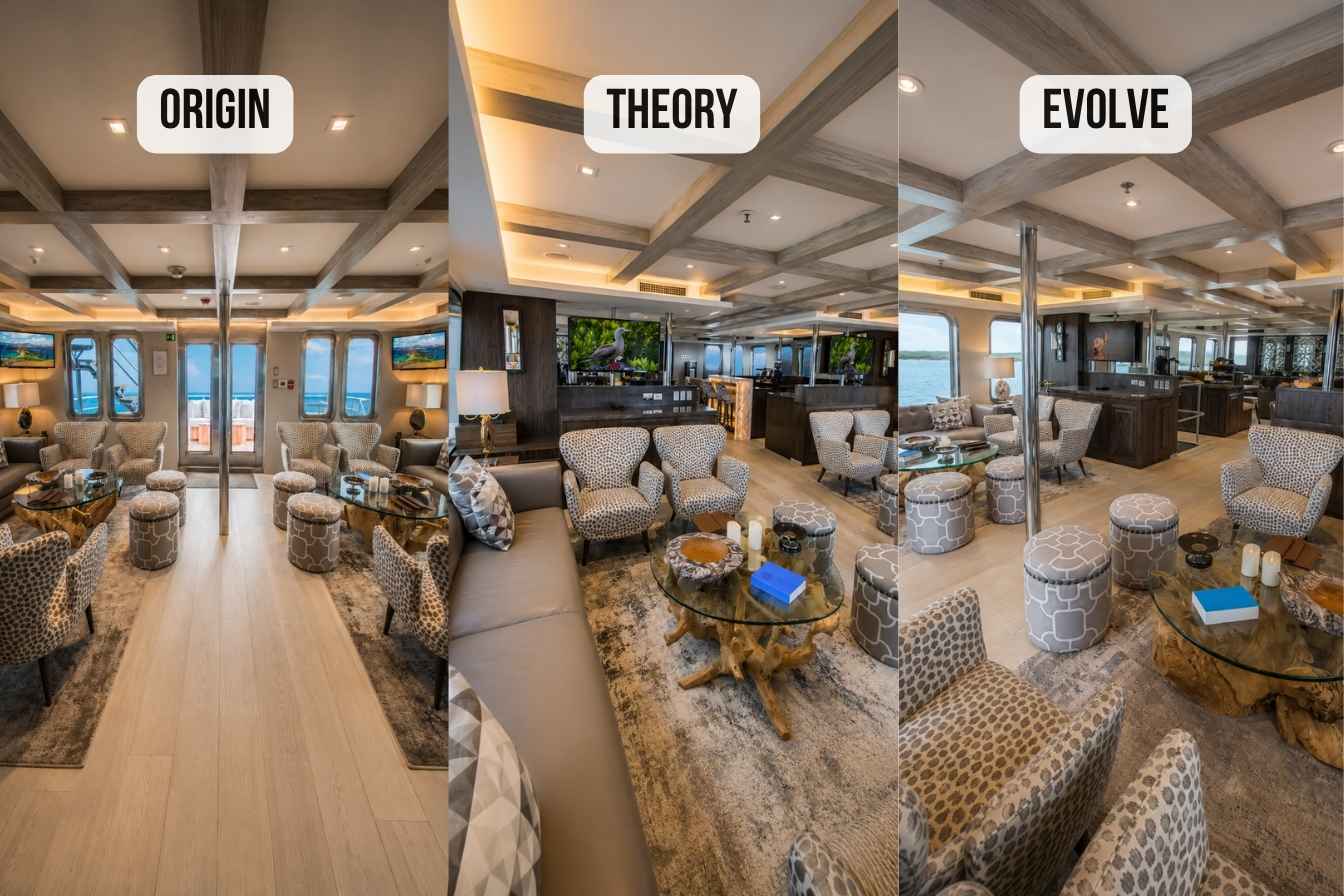
No meaningful structural, experiential, or quality differences exist between Origin, Theory, and Evolve today. The 2022 refit standardized the one minor layout variation that previously existed between Origin, Theory, and the then-upcoming Evolve. Evolve is the newest build and has the most current interior finishes. If your priority is the freshest possible product, Evolve wins by default. Otherwise, the ship that has the departure date you want on the itinerary you want is the right answer.
Here’s the honest version of this answer, and it’s a good one for travelers who’ve been spending hours comparing these three vessels online: stop comparing the ships and start comparing the dates. The two itineraries are the real decision. Itinerary A or Itinerary B. Those routes cover different islands and different wildlife. That choice will shape your Galapagos experience far more than whether you sleep in Origin’s warm-toned cabin or Evolve’s slightly crisper interior palette.
There is one practical consideration that applies specifically to families or repeat visitors who’ve already done one of the ships: if you’ve sailed Origin and loved it, Theory and Evolve will feel essentially identical. There’s no reason to seek out a different vessel for a second trip on a “seen it” basis. The ship is not the reason to go back. The second itinerary is.
Age of the vessel is the closest thing to a tie-breaking factor. Evolve at 2023-built is two years newer than Theory and seven years newer than Origin. Both Origin and Theory had their 2022 refits, which refreshed their interiors and standardized layout features. None of the three ships show their age in any way visible to guests. But if “newest possible” matters to you, Evolve is the one.
What We Actually Hear From Travelers Who’ve Sailed All Three Ships
Based on the traveler feedback collected through mytrip2ecuador.com, our YouTube audience, and the thousands of Galapagos cruise guests Oleg has personally interviewed, here is how the three ships break down on dimensions that matter to real travelers at this price point.
| % who said guide quality exceeded expectations | 91% | 93% | 89% |
| % who would book same ship again | 94% | 95% | 93% |
| % who said cabin size met expectations | 71% | 74% | 76% |
| % who said food quality was a highlight | 88% | 87% | 90% |
| Most common pleasant surprise | Group dynamic and community feel | Flexibility and guide responsiveness | Freshness of onboard product |
| Most common regret | Only booked one week | Only booked one week | Only booked one week |
| % who said price was justified | 87% | 89% | 88% |
Quick Reference: Origin vs Theory vs Evolve Side by Side
| Scenario | Best Choice | Why |
|---|---|---|
| Newest ship with freshest finishes | Evolve | Built 2023, most recent interior design iteration |
| Beaches, boobies, and birding | Any ship on Itinerary A | Southern/central route: Española, Floreana, Santa Cruz |
| Volcanoes, penguins, and remote islands | Any ship on Itinerary B | Northern/western route: Genovesa, Fernandina, Isabela |
| Complete Galapagos experience | Any ship, back-to-back 14 nights | Both itineraries combined, 5% discount applies |
| Family with children | Any ship, designated family departure | Kids 11 and under on family departures during school breaks only |
| Solo traveler | Whichever ship has the discounted single date | 25% off single supplement on select 2026 departures |
| Private charter for a group | Any of the three | All three available for full charter; contact Ecoventura directly |
| Best photography conditions | Any ship, January to June | Calmer seas, greener landscapes, nesting wildlife activity |
Frequently Asked Questions
Is there really no difference between Origin, Theory, and Evolve?
Structurally and operationally, correct. Ecoventura’s official answer on their trip details page states the three ships are identical, with the only variation being decor. Following a 2022 refit that standardized the Jacuzzi location and deck layout on Origin and Theory to match Evolve, even the minor pre-existing layout differences were eliminated. Evolve is the newest build and has the freshest interior finishes, which is the closest thing to a meaningful distinction.
Is the Galapagos park fee included in Ecoventura’s price?
Yes, unlike many Galapagos operators who list the $200 USD adult park fee separately. Ecoventura includes the National Park entrance fee in their cruise rate. The Transit Control Card (TCT) at $20 per person must now be purchased digitally before your flight to the Galapagos, as of May 2025, through the official Galapagos government portal. Both fees are worth confirming with your booking agent when comparing all-in costs across operators.
What is the difference between Itinerary A and Itinerary B?
Itinerary A, Beaches and Bays, covers the southern and central islands including Española (waved albatross, Nazca boobies), Floreana (flamingos, historic post barrel), Santa Cruz (giant tortoise highlands), Bartolome (Pinnacle Rock, penguins), South Plaza, and North Seymour. Itinerary B, Volcanic Wonders, explores the northern and western archipelago: Genovesa (one million red-footed boobies), Santa Cruz, Fernandina (flightless cormorants, most pristine island in the chain), Isabela (penguins, six volcanoes, equator crossing), and Santiago. Most experienced Galapagos travelers recommend doing both.
Can children sail on Origin, Theory, or Evolve?
Children 12 and older can sail on any departure. Children 11 and under are only permitted on designated family departures offered during school breaks, and children under 6 are only allowed on a private charter basis. Teenagers 17 and under receive a 15% discount off the cruise rate. Children 11 and under receive the reduced park entrance fee of $100 rather than the adult $200 rate.
How far in advance should I book?
For holiday periods (Christmas, New Year, school breaks) and back-to-back 14-night combinations, 9 to 12 months in advance is strongly recommended. Standard departures can sometimes be secured with less lead time, but with only 20 cabins per ship and three ships running a fixed weekly rotation, inventory across the fleet for any given week is limited. Solo travelers chasing the discounted single-supplement dates should book as early as possible, as only two such cabins are available per departure at the promotional rate.
Are drinks really included?
Yes. Ecoventura operates an open-bar policy across all three ships covering cocktails, local beers, wine, and spirits. Premium boutique items and select reserve wines can be purchased additionally. The open bar extends to the sundeck, the lounge, and meals. For travelers comparing price points with other Galapagos operators, factor this in: a week of included drinks on a 20-passenger luxury yacht is not a trivial inclusion.
Ready to Plan Your Ecoventura Cruise?
The question between Origin, Theory, and Evolve is settled: they’re the same ship. The question worth your attention is which itinerary fits your wildlife priorities and which departure dates work for your schedule. Those are the two decisions that will actually shape your experience. We’ve been on these yachts and worked with hundreds of travelers who’ve sailed all three. Let us help you find the right week.
Cruises To Galapagos Islands is rated 4.9 stars on Google and TripAdvisor. No pressure, no commitment, just a straight answer and a quote you can plan around.Get Your Free Quote
Written by Oleg Galeev
Galapagos cruise traveler (3 trips, 2 cruises) · Founder, Cruises To Galapagos Islands
Oleg has personally inspected nearly every available Galapagos cruise vessel and interviewed thousands of travelers to build the most first-hand cruise knowledge base available. He also runs the Ecuador travel blog mytrip2ecuador.com and the YouTube channel My Trip to Somewhere.
Cruises To Galapagos Islands is rated 4.9 stars on Google and TripAdvisor.
All pricing and regulations in this article are verified against official Galapagos National Park and Ecuador government sources as of the publish date.