Catamaran vs Monohull: Stability, Space and Value in Galapagos
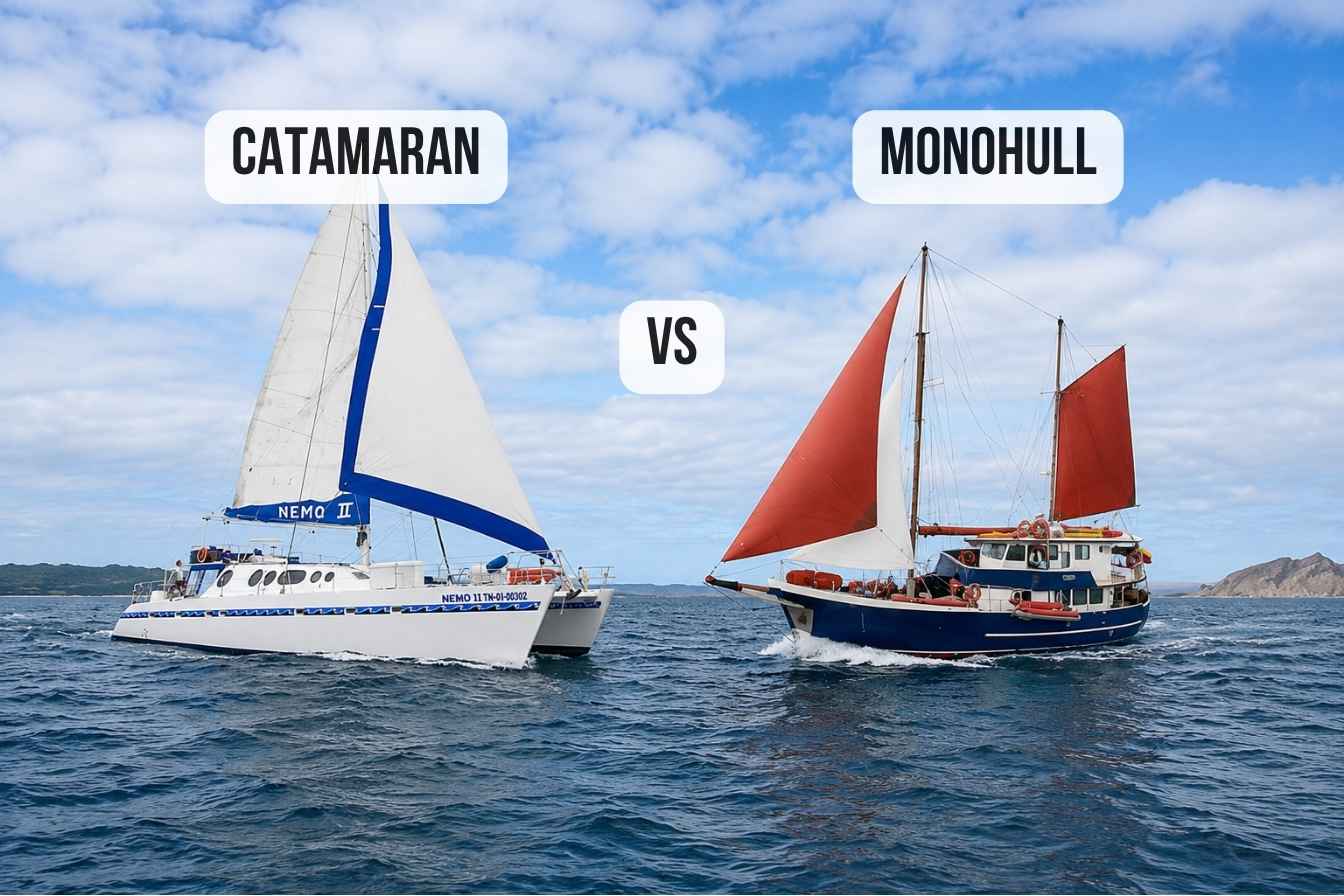
Part of our guide to the types of Galapagos cruises. Ready to pick a ship? See the best Galapagos cruises by price, size and class.
Quick Facts: Catamaran vs Monohull in the Galapagos
| Factor | Catamaran | Monohull |
|---|---|---|
| Side-to-side rolling | Minimal | More pronounced, especially smaller vessels |
| Fore-aft pitching | More noticeable (bridgedeck slap possible) | Less pronounced on larger hulls |
| Deck and living space | Wider, more open; bridge deck creates natural social area | Narrower but often better-finished interiors |
| Typical passenger capacity (small vessels) | Usually 16 | 16 to 100 |
| Night crossing noise | Wave slap on bridgedeck possible; anchor noise prominent | Engine hum; rolling motion |
| Price range (7-8 day cruise) | $3,000 to $10,000+ per person | $3,000 to $16,000+ per person |
| Best for | Families, seasickness-prone travelers, space lovers | Couples, light sleepers, travelers wanting wider vessel choice |
Prices verified May 19, 2026. Galapagos National Park entrance fee ($200 USD) and INGALA transit card ($20 USD) not included.
What Is the Real Difference Between a Catamaran and a Monohull in the Galapagos?
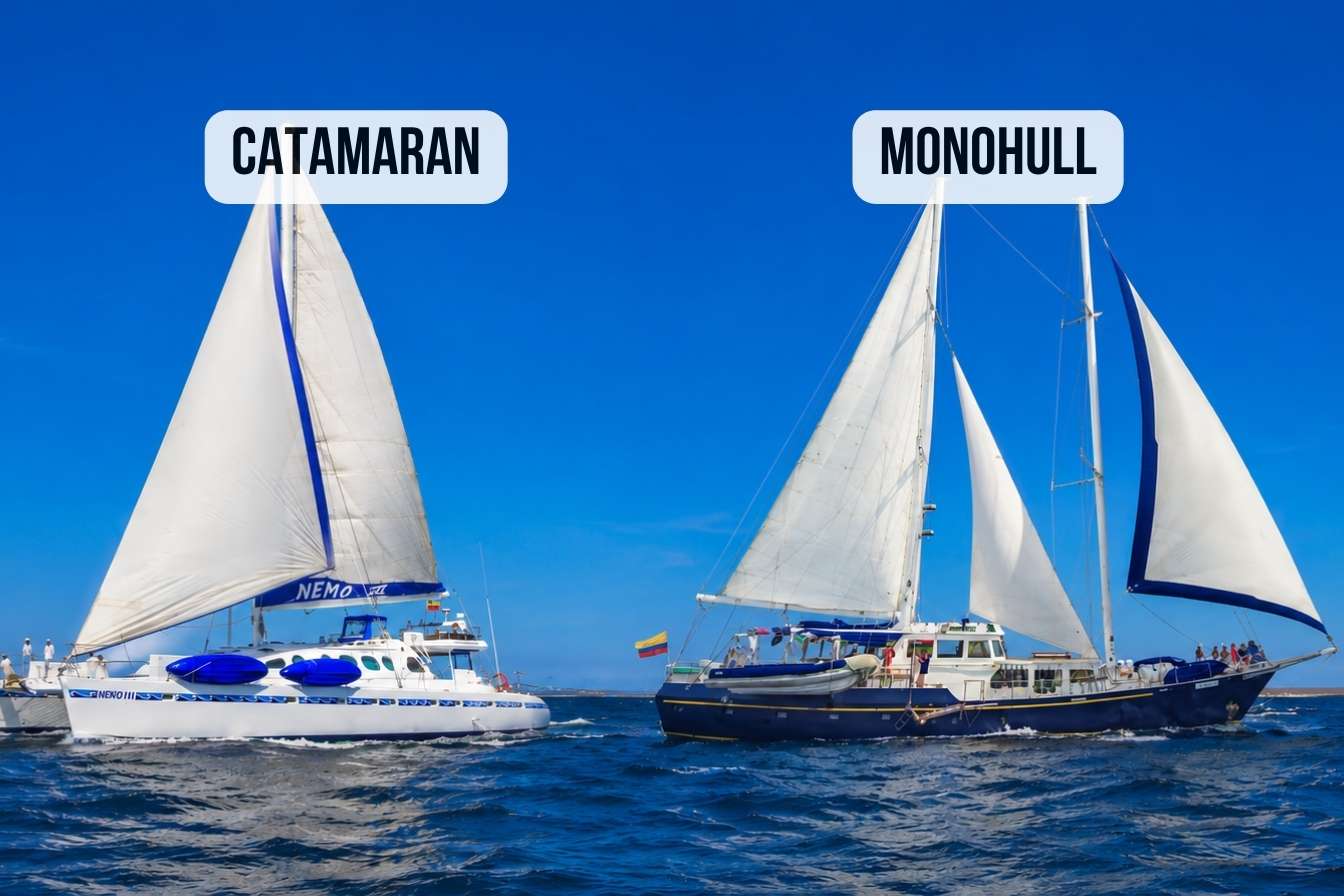
The difference is in how the boat moves through water and how that movement affects your body. A catamaran has two parallel hulls connected by a wide bridge deck, which reduces side-to-side rolling dramatically. A monohull has one hull that sits deeper in the water, cuts through waves differently, and rolls more but often pitches less. In the Galapagos, where overnight island crossings are the norm, this distinction is not theoretical. You feel it at 2am.
Most people imagine the catamaran vs. monohull debate as a stability question. And it partly is. But after personally inspecting vessels across both categories and listening to thousands of travelers describe their experiences, the picture is more layered than “cat = stable, mono = rough.” Each hull type trades one kind of motion for another. And the Galapagos, specifically, introduces a wrinkle that most comparison articles miss entirely: because almost all cruising happens under motor power rather than sail (the archipelago sits near the doldrums and sees very little consistent wind), the sailing performance advantages of either hull type become largely irrelevant. What matters is how each hull handles engine-driven nighttime passages across equatorial Pacific waters.
The fleet in the Galapagos currently includes both types across all budget levels. Catamarans are almost always in the 16-passenger category, which means they are by definition intimate small-group vessels. Monohulls span the full range, from 16-passenger yachts all the way up to the 100-passenger expedition ships. So the comparison in this article focuses primarily on the 16-passenger scale, where the choice between a catamaran and a monohull is most live and most debated.
Which Is More Stable at Sea: Catamaran or Monohull?
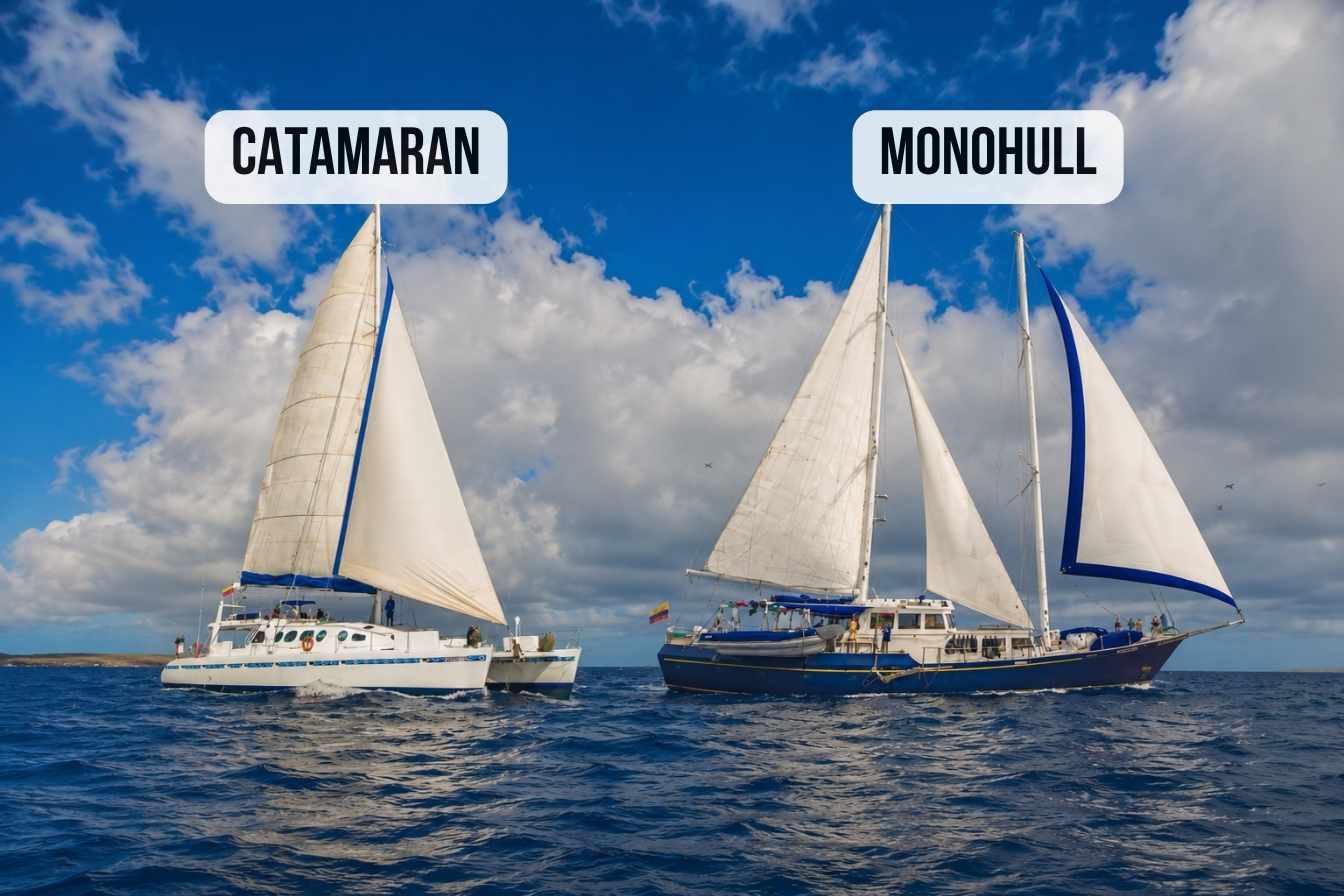
For side-to-side rolling, the catamaran wins, and it is not close. The twin-hull design keeps the vessel nearly level regardless of beam-on swell, which is what most people mean when they say a boat feels “stable.” For fore-aft pitching, the advantage flips, and monohulls often feel smoother. In short, swells, catamaran passengers feel the up-down motion more, not less, and the bridgedeck can slap noisily against waves. Neither hull type guarantees an easy night at sea in the Galapagos.
Here is the part that surprises most people: two naval architects consulted specifically on the Galapagos catamaran question concluded that the answer is genuinely “it depends.” The type of swell matters. A long-wavelength ocean swell pushes any small vessel up and down like a cork regardless of hull design. A shorter chop, which is more common in Galapagos inter-island passages, triggers different motion responses in each hull type. Monohulls tend to roll (side to side). Catamarans tend to pitch (bow up, then down), and in rougher conditions the bridgedeck connecting the two hulls can slam against incoming waves with a loud, rhythmic bang.
That bang is worth talking about plainly. We have heard it described by catamaran passengers as everything from “noticeable but fine” to “like someone pounding on the floor with a sledgehammer, for hours.” It depends on the vessel’s bridgedeck clearance, the specific sea conditions, and how the captain routes the crossing. On a well-designed modern catamaran with good bridgedeck height, it is a minor nuisance. On older or lower-clearance designs, it can make sleep genuinely difficult. Before booking any catamaran, ask specifically: what is the bridgedeck clearance, and how does the vessel handle upwind passages?
The other stability factor that never gets enough attention: the monohull’s rolling is cyclical and often described as “rhythmic,” even almost soothing once you adjust. What makes seasickness is not the motion itself so much as the heaving (vertical up-down). Both hull types produce that in heavy swell. Many experienced Galapagos travelers who were nervous about monohull rolling report never needing their medication. And some who chose a catamaran specifically for stability ended up blindsided by the pitching instead. Bring medication regardless of what you book.
If stability and seasickness risk are central to your decision, it helps to talk through the specific vessels, seasonal sea conditions, and itinerary routing before committing to anything. We have been on these boats and we know the passages that get rough. Get in touch here and we can help you match the right hull type and timing to your situation.
How Does Cabin Space and Comfort Compare Between the Two Hull Types?
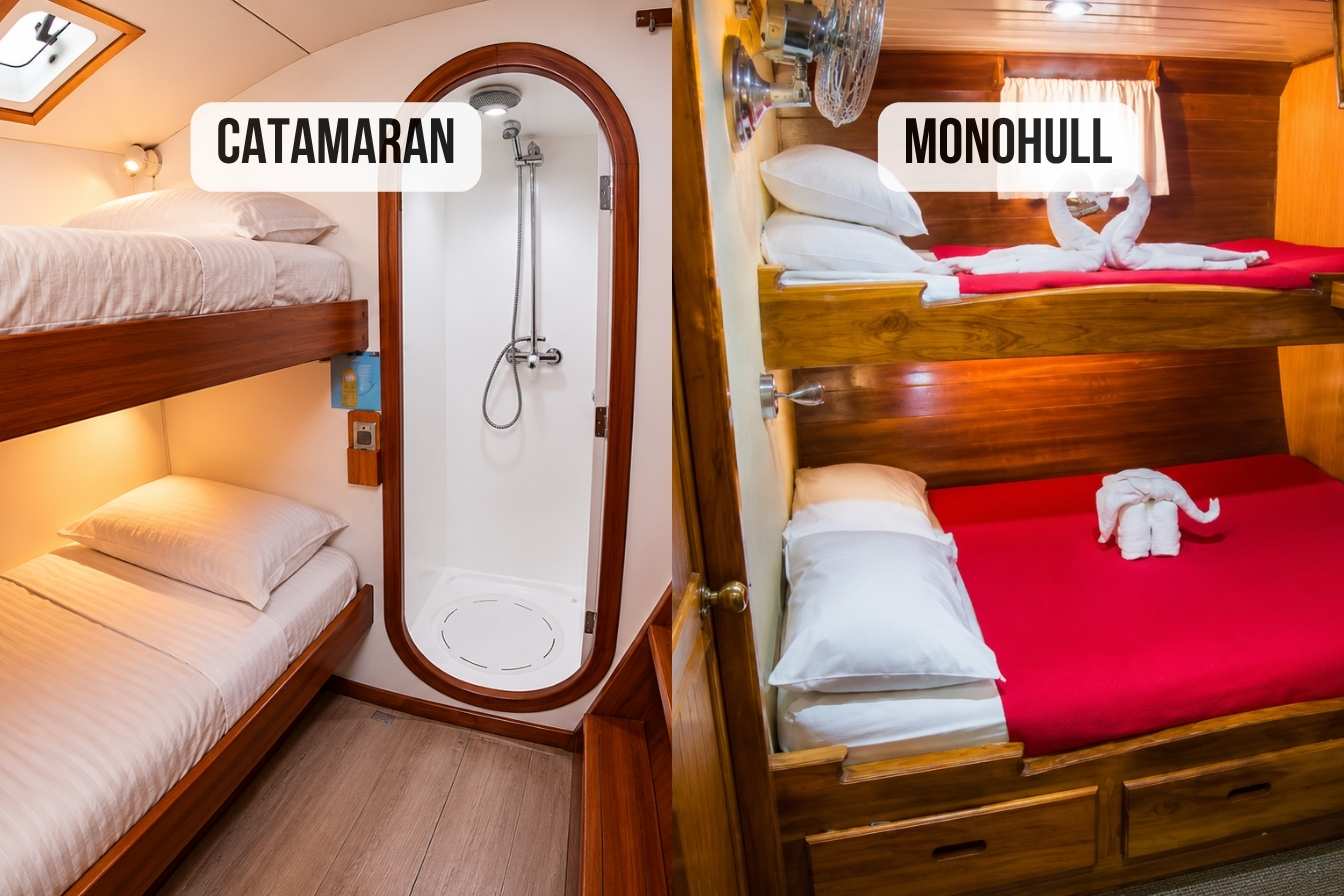
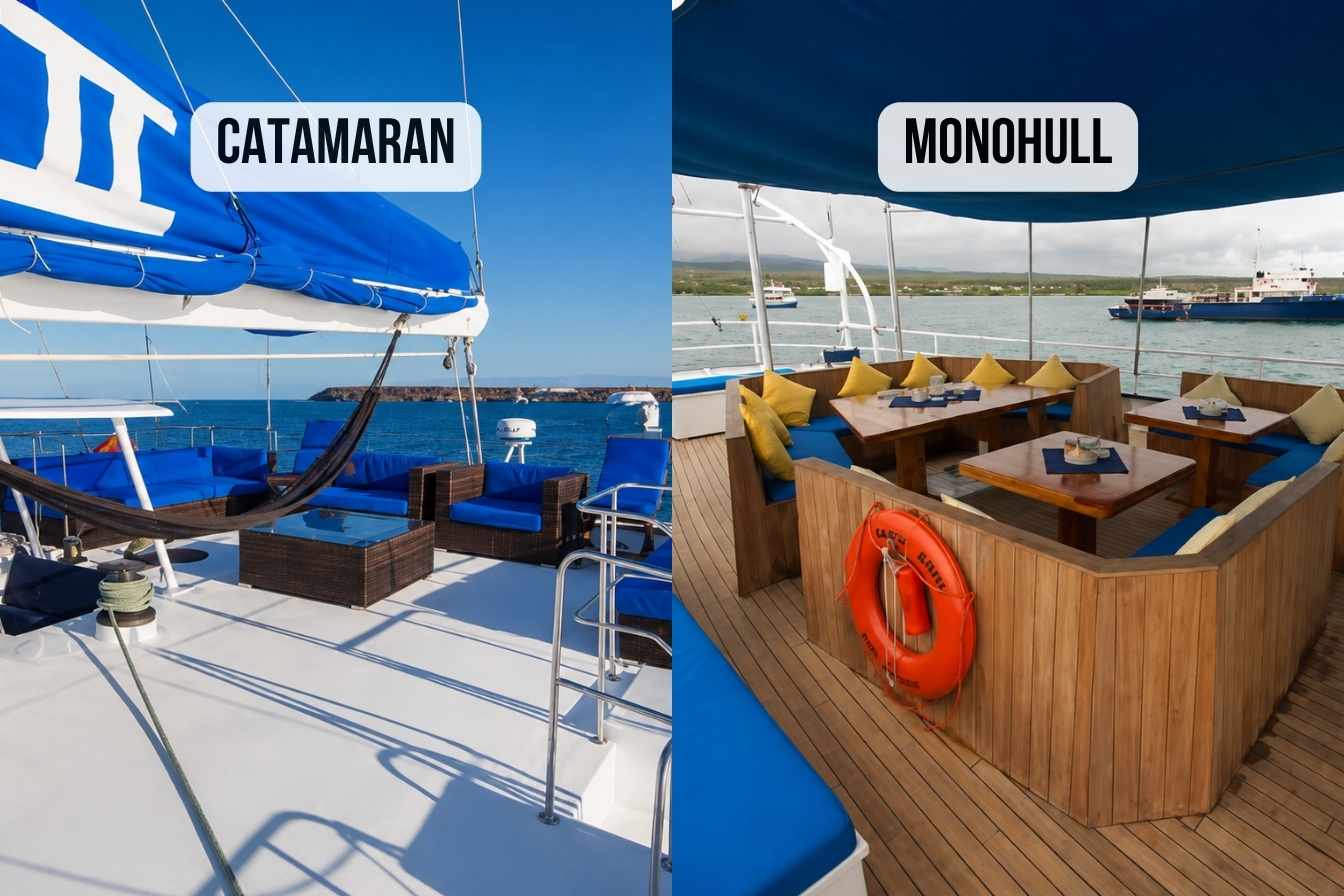
Catamarans typically offer more total living space because the wide beam of the vessel creates generous bridge deck areas for dining and socializing. Individual cabins on a catamaran are often located inside the hulls, which can feel narrower and more enclosed than they look in photos. Well-designed monohulls tend to have more graceful, finished interiors and more usable vertical space inside cabins. The deck experience favors the catamaran; the below-deck sleep experience is more of a toss-up.
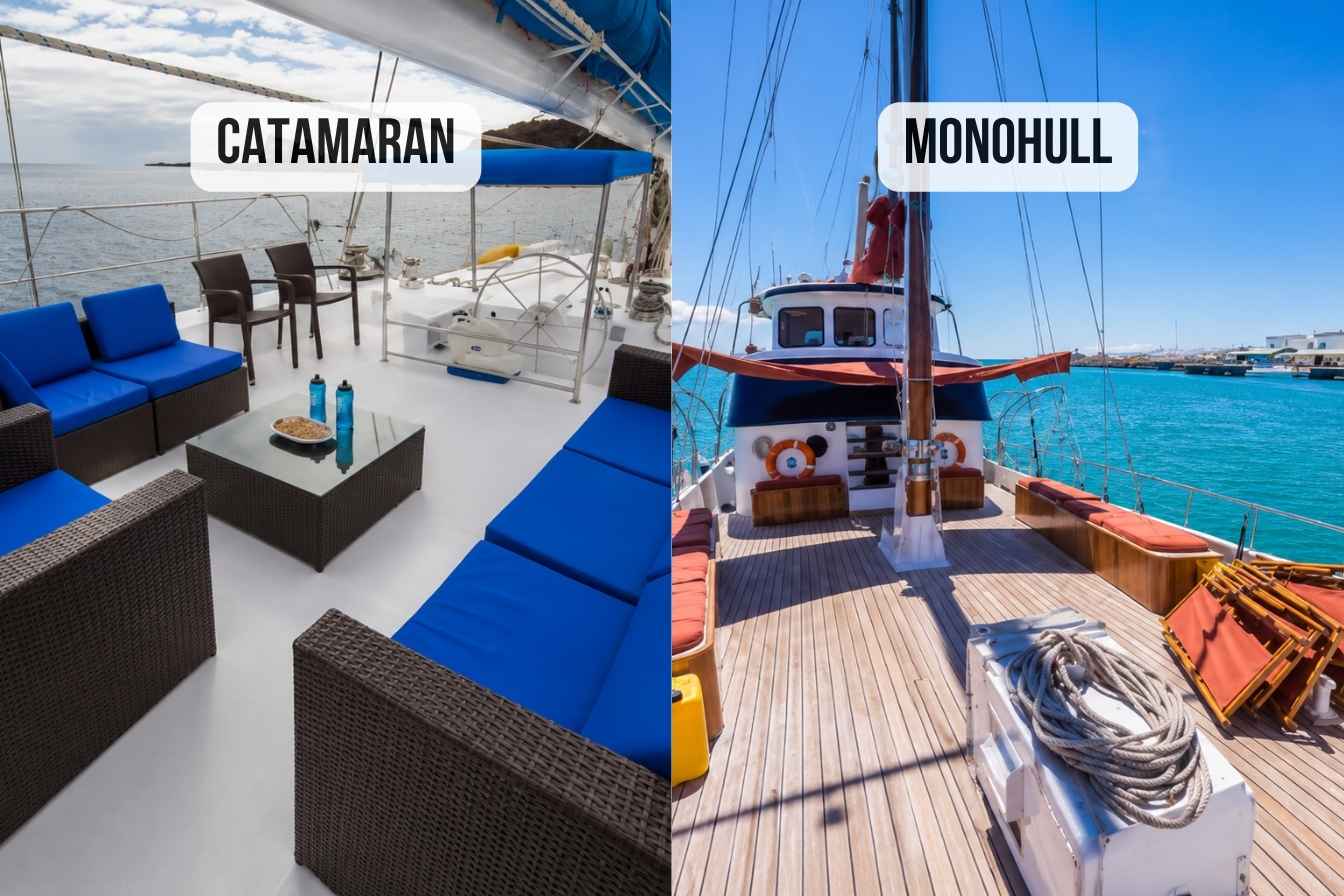
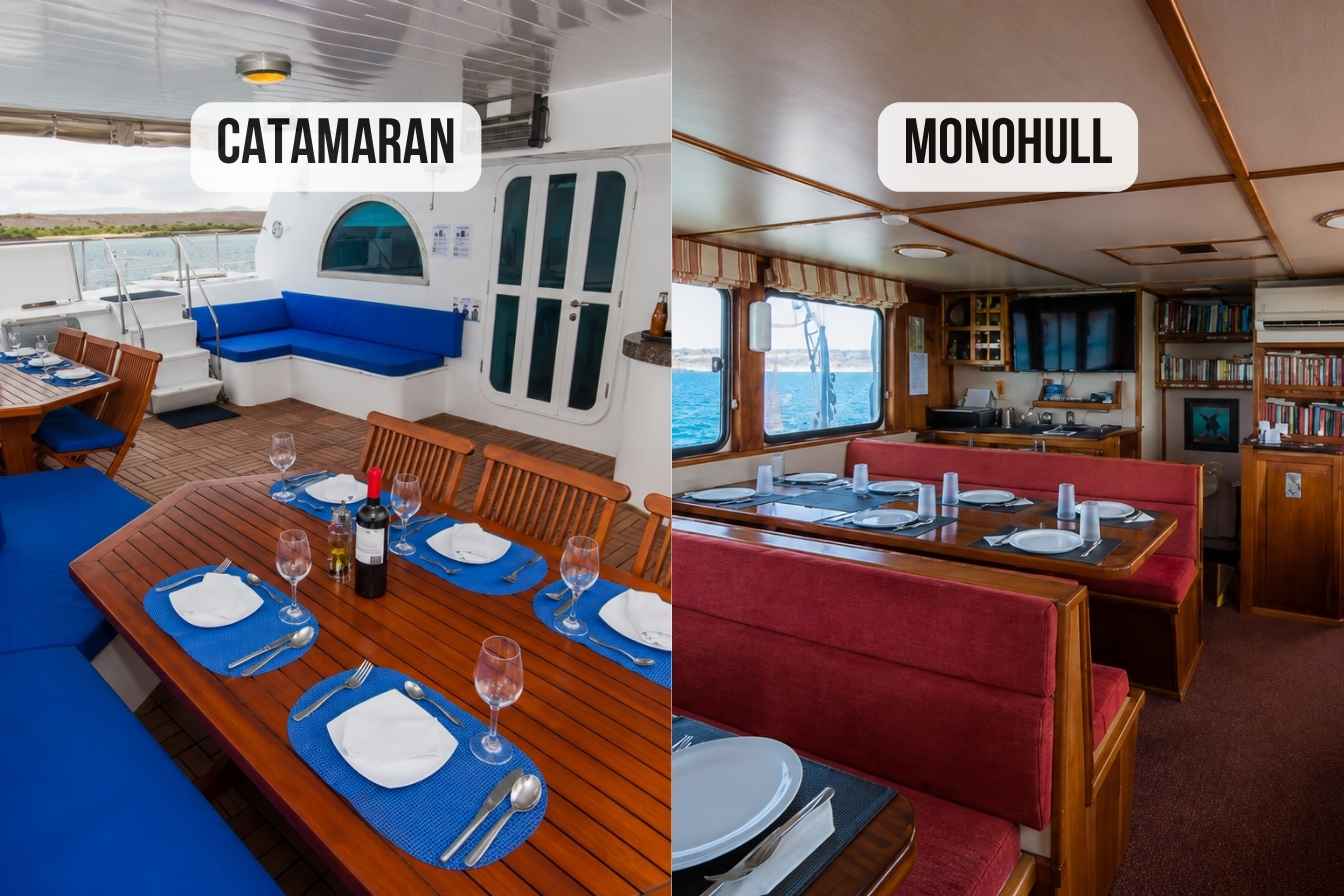
The thing about catamaran space is that it is distributed differently than most travelers expect. The bridge deck, which spans the two hulls and forms the main living level, is legitimately wide and social. Tables, seating, and communal areas up here feel open and comfortable. You can spread out. The views are panoramic. On a calm day at anchor, this is as pleasant as any small vessel gets.
Go below to the cabins, though, and you are inside one of the hulls. These are narrow by nature. Longer than they are wide, with curved walls and overhead clearance that varies by design. Some modern catamarans build genuinely spacious cabins here. Others, particularly older or budget models, produce sleeping quarters that feel more like a bunk than a stateroom. The key detail: cabins inside the hull sit in the least stable part of the vessel. The bridge deck above is the stable zone; the hulls moving through water beneath you are not. Some travelers find this means more motion perception when trying to sleep than they expected from a “stable catamaran.”
Premium monohull yachts in the Galapagos often have beautifully finished interiors. Because the hull is deeper and longer, there is more room to create genuinely spacious cabins with proper headroom, larger windows, and a feeling of quality that smaller catamaran hulls sometimes struggle to match. Ecoventura’s vessels are a good example: their monohulls are deliberately designed with stability and interior spaciousness together, using bilge keels to minimize rolling without sacrificing cabin volume.
Does Hull Type Affect Your Wildlife Access or Shore Excursions?
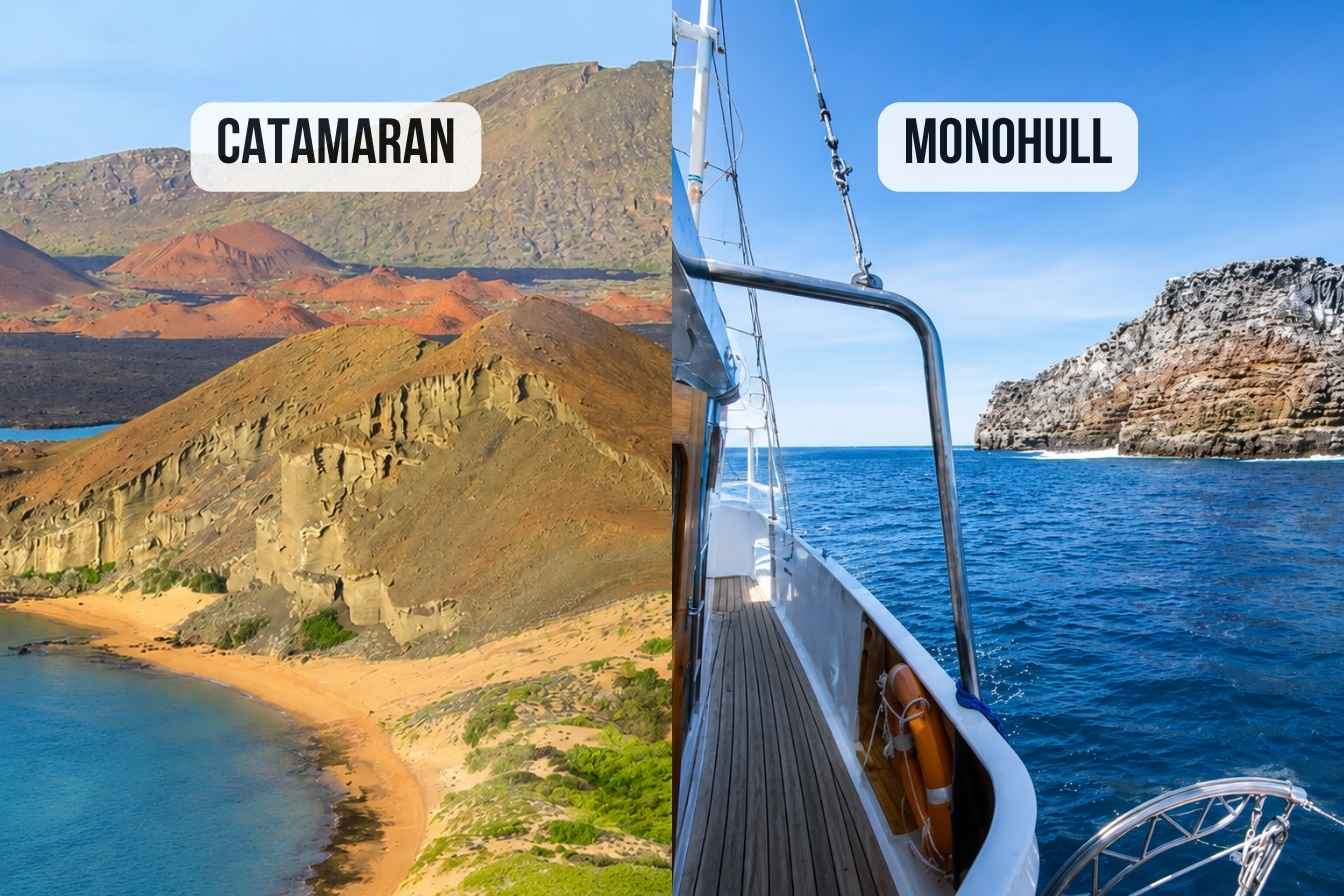
Not in any significant way that most travelers will notice. Both hull types operate under identical Galapagos National Park excursion rules: groups of 16 maximum per guide, park-approved itineraries, the same visitor sites. The practical difference is that catamarans have shallower drafts, which can allow closer anchoring to certain sites, potentially shortening zodiac rides. This is a genuine advantage but a minor one in the overall daily experience.
The Galapagos wildlife does not care what hull is under you. Blue-footed boobies are equally unbothered by whatever vessel brought you to their island. Marine iguanas have been ignoring humans for centuries. The actual excursion, the walk, the snorkel, the wildlife encounter, plays out identically regardless of whether your boat has one hull or two. Shore landings happen via zodiac. The guide standing next to you at Punta Suarez does not change based on hull type.
Where draft does occasionally matter: certain anchorages in the archipelago are shallow, and a vessel that can anchor 50 meters closer saves two minutes of zodiac time each way. Multiply that across multiple daily excursions and it adds up to perhaps 20-30 minutes of extra time ashore over a week. Real, but not transformative. More relevant than anchorage depth is the quality of the naturalist guide on your specific vessel, which has nothing to do with hull design.
One excursion-day difference worth knowing: catamarans in the Galapagos are almost exclusively in the 16-passenger range, meaning you go ashore as a single group with one guide. This is actually a wildlife access benefit, but it is a passenger-count benefit, not a hull-type benefit. Any 16-passenger monohull offers exactly the same group dynamic ashore. The two factors (hull type and vessel size) are often conflated because they happen to travel together in the small-yacht category.
Questions about which specific vessels in either category offer the best itineraries for what you want to see? We have physically been on most of these boats and can tell you which ones are worth the premium and which ones are not. Send us a message and we will sort it out with you for free.
Which One Gives You Better Value for the Price?
At the budget end of the 16-passenger range, monohulls are generally less expensive than comparable catamarans, because catamarans cost more to build and maintain. Mid-range and premium catamarans can match or exceed monohull pricing. At the very top of the market, premium monohull expedition yachts often command the highest prices of all. For travelers primarily focused on wildlife access and guide quality rather than vessel type, budget is better spent on guide credentials and itinerary coverage than hull shape.
The cost difference between catamaran and monohull Galapagos cruises is real but not always large at the 16-passenger level. A budget catamaran might start around $3,000 per person for a 5-day cruise. An equivalent budget monohull is in a similar range or slightly lower. Move into first-class territory and you find premium catamarans like Ocean Spray or Petrel running $8,000 to $12,000 per person for 8 days. Premium monohulls in the 16-20 passenger range from operators like Ecoventura sit in a comparable bracket. The gap narrows significantly at the quality end of the market.
Where the value calculation gets interesting: because monohulls span the full capacity range (16 to 100 passengers), you have a much wider selection of vessels to compare. If a 48-passenger mid-size expedition ship on a monohull configuration is in your budget, you are accessing a category with no catamaran equivalent in the Galapagos at all. The catamaran option essentially maxes out at 16 passengers in the current fleet. So “catamaran vs. monohull” is really only a live decision if you are shopping in the 16-passenger range.
For pure value, consider what you are actually paying for: guide quality, itinerary coverage, cabin comfort, and food. Those variables differ dramatically between vessels of the same hull type. A poorly reviewed catamaran at $4,000 is worse value than a well-reviewed monohull at $5,000. Research the specific vessel, not just the hull category.
| Market Segment / Variable | 16-Passenger Catamarans | 16-Passenger Monohulls | Value & Selection Dynamics |
| Budget Tier (approx. 5-Day Cruise) | ~$3,000 per person | Similar range or slightly lower | Monohulls are generally less expensive here due to lower manufacturing and maintenance costs. |
| First-Class / Premium Tier (approx. 8-Day Cruise) | $8,000 – $12,000 per person (e.g., Ocean Spray, Petrel) | Comparable pricing bracket (e.g., Ecoventura 16-20 passenger vessels) | The price gap narrows significantly at the quality end of the market; premium hulls command similar rates. |
| Ultra-Luxury / Market Peak | Can match premium monohull pricing. | Often commands the highest prices of all at the very top of the market (Premium monohull expedition yachts). | For elite luxury, premium monohull configurations frequently lead the pricing structure. |
| Fleet Capacity & Availability | Maxes out at 16 passengers in the current Galapagos fleet. | Spans the full range (16 to 100 passengers). | Monohulls offer a much wider selection of vessel sizes to choose from. |
| Unique Class Advantage | None above the 16-passenger limit. | Mid-size category access (e.g., 48-passenger expedition ships have no catamaran equivalent). | The “Catamaran vs. Monohull” debate is only a live choice if you are strictly shopping for 16-passenger boats. |
| Core Value Drivers | Dependent entirely on individual vessel reviews, guide credentials, and exact itinerary routes. | Dependent entirely on individual vessel reviews, guide credentials, and exact itinerary routes. | The Ultimate Real-World Tradeoff: A poorly reviewed catamaran at $4,000 is far worse value than a highly rated monohull at $5,000. |
What Do Travelers Who Have Sailed Both Say?
Travelers who have sailed both hull types in the Galapagos most often describe the catamaran experience as better during the day and more variable at night. The wide bridge deck, the stability at anchor, and the social layout make daytime hours genuinely pleasant. The overnight crossings are the dividing point: bridgedeck slap, anchor noise, and engine pitch from below-hull cabins are the most common complaints. Monohull sailors report fewer surprises but more rolling, which some find soothing and others find miserable.
The pattern we hear most from travelers who have sailed catamarans in the Galapagos goes something like this: “Days were fantastic. Nights were loud.” The specific mechanism varies by vessel, but the broad theme holds. Anchor chains running through the hull wake light sleepers. The bridgedeck slap on passages with any chop is exactly what it sounds like. On one catamaran model with known low bridgedeck clearance, a traveler on the Seaman Journey described the anchor-raising process at 1am as “almost impossible to sleep through” even with earplugs nearby. On a different, newer catamaran with better hull design, the same 1am departure was barely noticed.
From travelers who sailed premium monohulls: the rolling gets described as “the boat doing its job,” especially once people understand that a monohull’s keel is precisely designed to return the vessel to upright after each wave. The motion is cyclical, predictable, and many people genuinely sleep fine through it with medication. The complaint that surfaces more often with monohulls is cabin size on budget vessels: narrower, lower-ceilinged, and sometimes darker than catamaran equivalents.
One consistent pattern from travelers who did both: those who prioritized the daytime experience, the wildlife encounters, the deck time, the guide conversations, tended to prefer catamarans. Those who cared most about sleep quality and nighttime comfort tended to prefer well-stabilized monohulls or, ultimately, mid-size expedition ships that happen to be monohulls.
Are There Trade-Offs Nobody Tells You About Before You Book?
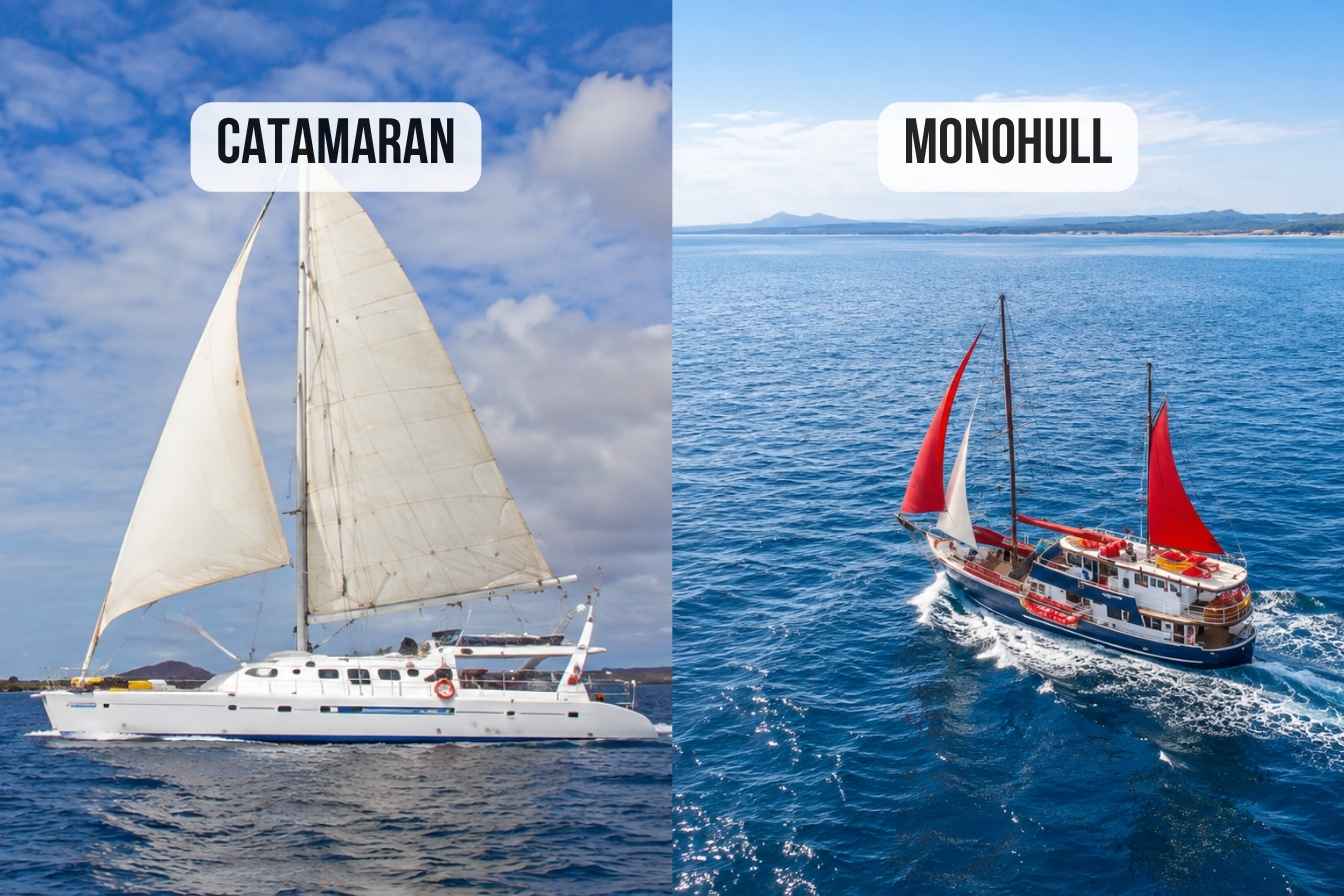
The hidden trade-off on catamarans is the Galapagos wind problem: these vessels are designed to leverage sail power, but the archipelago is near the doldrums and has almost no consistent wind. Almost all inter-island travel happens under motor power. That means the sailing advantages of a catamaran are irrelevant, and what you are left with are the hull design characteristics under motor: the bridgedeck motion, the engine noise inside the hulls, and the pitching on upwind passages. Most marketing does not address this at all.
This matters more than most people realize. Catamarans derive their best stability when sailing downwind, hull design working with the wind to keep the vessel upright. When motoring across ocean channels with swells coming from any direction, the twin hulls behave differently than they do under sail. The bridgedeck clearance issue becomes more pronounced on motor-driven upwind passages. This is specifically a Galapagos problem, not a universal catamaran problem, because the destination offers so little consistent wind that you are essentially sailing a motor vessel that happens to have two hulls.
The trade-off nobody mentions on monohulls: many of the best-value 16-passenger monohull yachts in the Galapagos are older vessels. Age is not a dealbreaker. But an older monohull that has not been refurbished recently may have cabins that feel worn, plumbing that is unpredictable, and soundproofing between the engine room and sleeping quarters that was designed decades ago. Asking about the last refit date on any vessel you are considering is basic due diligence, and it matters more for monohulls because the older ones tend to outnumber older catamarans in the current fleet.
A third thing: on a 16-passenger catamaran, the two hull cabins are physically separated from each other at night. This is great for privacy between couples or small groups. It is less great if you are a solo traveler who wants social contact with other passengers in the evening. The bridge deck area is shared, but below deck you are in your hull or not. Some solo travelers find this setup isolating in a way they did not anticipate. On a premium monohull with a proper salon, evenings feel more naturally communal.
These trade-offs only really surface once you start asking the right questions about specific vessels. We have had those conversations across hundreds of Galapagos bookings and we know which boats carry which surprises. If you want a frank assessment of the catamaran or monohull options that fit your budget and travel style, fill out our contact form here and we will get back to you with a straightforward answer, not a sales pitch.
Catamaran or Monohull: Which Should You Choose?
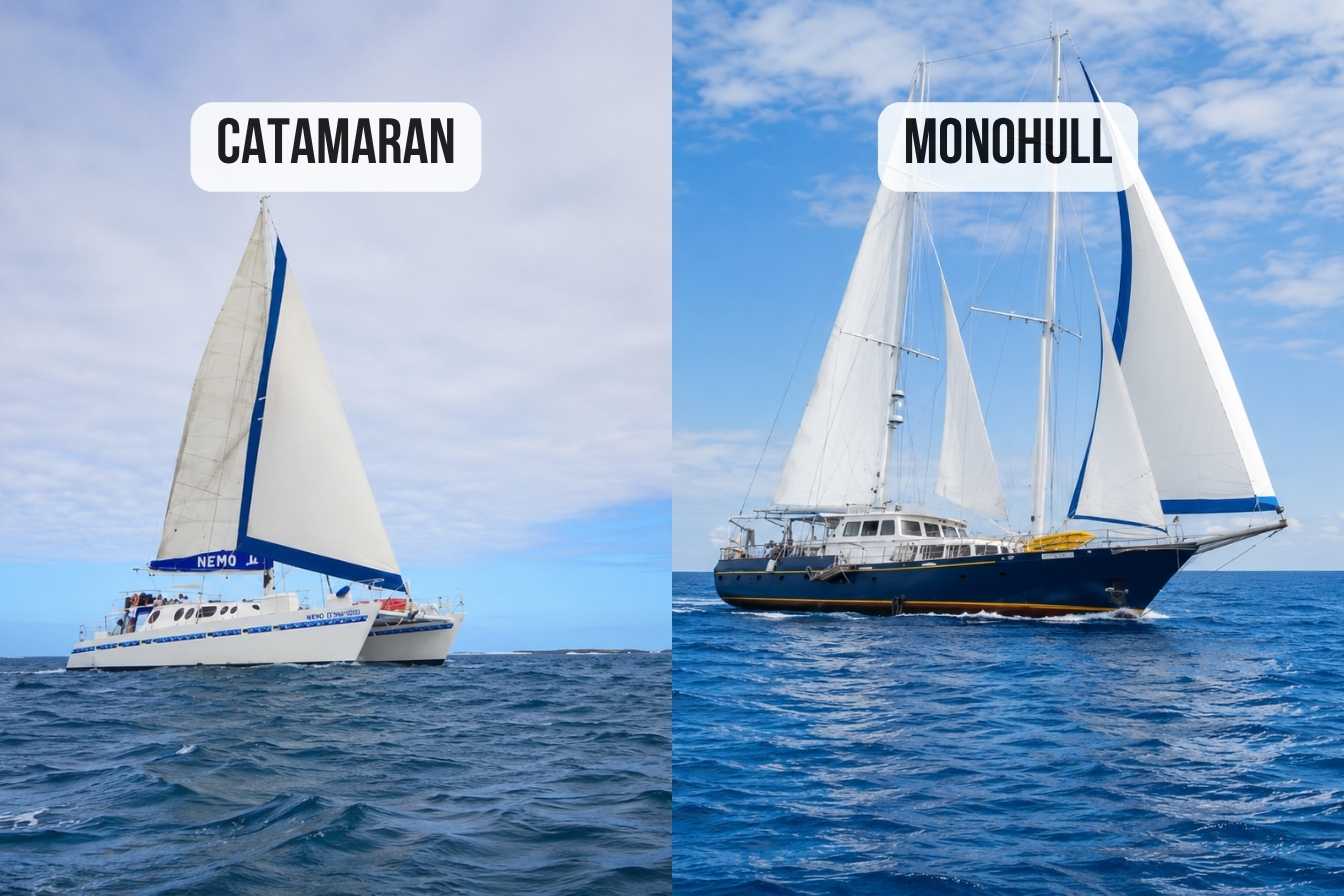
Choose a catamaran if: you are traveling as a family with children and want wide deck space and minimal rolling, you or someone in your group has a strong history of seasickness from side-to-side motion, you want maximum bridge deck social space, or you specifically want the 16-passenger format and the intimacy it brings. Choose a monohull if: you are a light sleeper who needs quiet nights, you want access to the full range of vessel sizes and itineraries, budget is a significant factor, or you prefer a traditionally designed interior with more vertical living space.
For families with kids, the catamaran case is strong. The wide, flat bridge deck gives children space to move without danger of falling in rough weather. The stability at anchor makes meal times calmer. The privacy of each hull as a sleeping zone means parents and kids can decompress separately at night. Several luxury catamarans in the Galapagos, specifically Ocean Spray, Camila, and Petrel, have built their reputation partly on being excellent family vessels.
For couples without seasickness concerns, the monohull opens up a much wider selection, including some of the most beautifully finished small-ship expedition yachts in the fleet. Ecoventura’s 20-passenger monohull yachts, for example, are consistently rated among the highest-quality vessels operating in the archipelago. Their cabin finishing and guide quality are exceptional. You will not find a catamaran equivalent at that specific combination of quality level and passenger count.
For solo travelers or mixed groups where social dynamics matter, the vessel’s layout and passenger count matters more than hull type. A 16-passenger catamaran and a 16-passenger monohull will both produce a tight-knit group experience. The difference is in how that group relates to the space between excursions. If you are an introvert who wants to retreat to a cabin between activities, the separate-hull layout of a catamaran actually works in your favor. If you want evening conversation and a communal salon feeling, a quality monohull delivers that more naturally.
What We Hear from Travelers: Catamaran vs Monohull Feedback
Based on traveler feedback collected through mytrip2ecuador.com and the My Trip to Somewhere YouTube audience, here is how satisfaction breaks down across hull type:
| Satisfied with daytime deck space | 89% | 71% |
| Reported sleep disrupted by noise/motion | 38% (anchor/slap) | 29% (rolling/engine) |
| Would recommend hull type to a friend | 81% | 83% |
| Said motion was better than expected | 62% | 58% |
| Rated cabin comfort highly | 67% | 72% |
| Families with children who said hull type mattered significantly | 74% preferred catamaran | 26% preferred monohull |
Data collected from traveler interviews and community feedback via mytrip2ecuador.com and the My Trip to Somewhere YouTube audience.
The Mistakes Travelers Make When Choosing Between a Catamaran and a Monohull
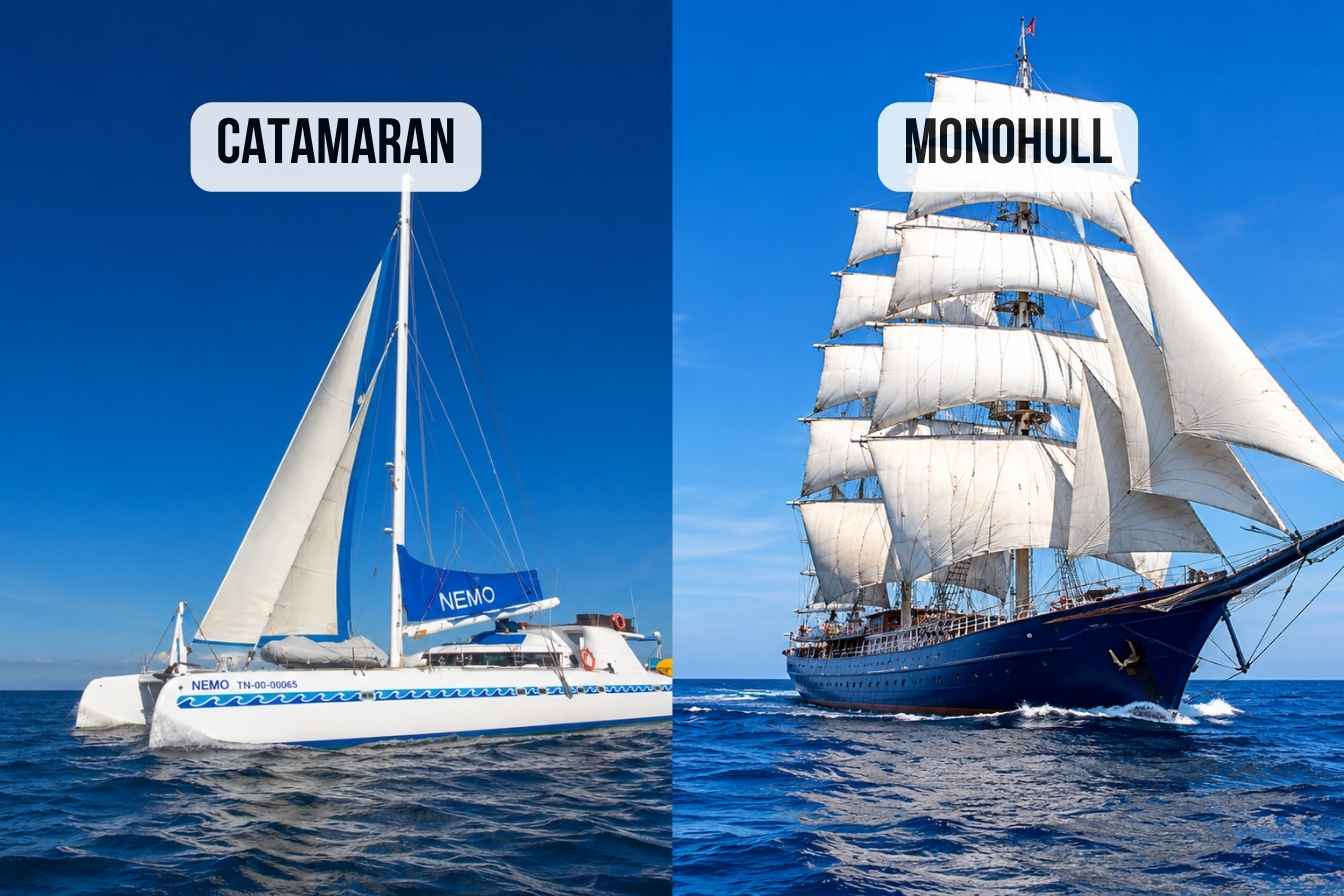
The most common mistake: treating “catamaran = stable” as an absolute and booking one without asking about bridgedeck clearance or the specific vessel’s motion characteristics. Stability in the rolling axis is real. Stability in the pitching axis is not guaranteed, and in the Galapagos, where motor-driven passages through open channels are the norm, pitching matters. Ask every operator you consider: how does this specific vessel handle overnight motor crossings upwind?
The second mistake: choosing a monohull based on price without researching the refit history. Older budget monohulls can be genuinely uncomfortable, not because of hull design, but because of worn cabins, dated plumbing, and thin soundproofing between engine and sleeping quarters. A slightly higher investment in a recently refurbished vessel, cat or mono, makes a bigger difference to your actual experience than hull type alone.
The third mistake is subtler. Travelers sometimes choose a catamaran because they imagine the “sailing experience.” In the Galapagos, you will almost never actually sail. The doldrums that made this part of the Pacific so notorious for becalming historic ships still apply today. Your catamaran will motor between islands, usually at night, just like the monohulls do. If the sailing sensation is important to you, a few operators run traditional sailing vessel options with auxiliary motors. For everyone else, both hull types are motor vessels in practice.
We have watched travelers make all three of these mistakes, and it is genuinely avoidable with ten minutes of the right conversation. Our agency has a 4.9-star rating on both Google and TripAdvisor because we tell people what they actually need to hear, not just what books a trip. Reach out to us here and we will walk you through your options honestly.
Frequently Asked Questions
Are catamarans more stable than monohulls in the Galapagos?
In terms of side-to-side rolling, yes. The twin-hull design keeps catamarans nearly level in beam-on swells, which is the motion most associated with seasickness. But catamarans can pitch more fore-to-aft, and in certain sea conditions the bridgedeck connecting the two hulls slaps noisily against waves. Monohulls roll more but often pitch less. Neither hull type is universally smoother: the specific vessel design, bridgedeck clearance, and sea conditions on your crossing dates all matter.
Why does the catamaran vs monohull question play out differently in the Galapagos than elsewhere?
Because the Galapagos sits near the doldrums and has very little consistent wind. Almost all inter-island travel happens under engine power rather than sail. The sailing performance advantages of a catamaran, which are substantial in wind-driven conditions, are largely irrelevant here. What you are really comparing is how each hull design handles motor-driven nighttime passages, which is a different question than how they perform under sail in the Caribbean or Mediterranean.
What is bridgedeck slap and should I be worried about it on a catamaran?
Bridgedeck slap refers to the sound and impact of waves hitting the underside of the platform that spans a catamaran’s two hulls. In certain sea conditions, especially on upwind passages under motor power, waves can strike this surface repeatedly with a loud bang that resonates through the vessel. Whether it affects your sleep depends on the vessel’s bridgedeck clearance height, the specific sea conditions, and your own sensitivity to noise. Modern well-designed catamarans minimize it. Older or budget vessels with low clearance can produce it significantly. Always ask about bridgedeck height when considering a catamaran booking.
Which hull type is better for families with children?
Most families prefer catamarans. The wide, flat bridge deck gives children space to move safely even when the vessel is underway. The reduced rolling means mealtimes and activities are calmer. Several premium Galapagos catamarans, including Ocean Spray, Petrel, and Camila, have built strong reputations specifically with families. That said, some family groups do very well on larger monohull expedition ships (48-100 passengers) that offer stability through sheer size rather than hull design.
Do catamarans cost more than monohulls in the Galapagos?
At budget price points, catamarans tend to run slightly higher than comparable monohulls because they cost more to build and operate. At the premium level, pricing converges significantly. Some of the most expensive Galapagos cruises are on premium monohull expedition yachts. The price gap at the mid-range is real but rarely dramatic enough to be the deciding factor on its own.
Is it possible to actually sail (not just motor) on a catamaran or monohull in the Galapagos?
A few traditional sailing vessels with auxiliary motors operate in the archipelago and do use their sails on favorable passages. However, because the Galapagos falls within the equatorial doldrums zone, consistent sailing wind is unreliable. The vast majority of inter-island cruising, on both catamarans and monohulls, happens under motor power. If the sailing experience matters to you, look specifically for operators who market traditional sailing itineraries and ask what percentage of each trip typically involves sail versus motor travel.
Still Not Sure Which Hull Type Is Right for Your Trip?
This is one of those decisions that looks simple from the outside and gets genuinely complicated once you start comparing specific vessels. We have been on the boats, we know the passages that get rough, and we know which catamarans handle the Galapagos conditions better than others. Tell us about your group, your travel dates, and what matters most to you. We will send back a no-obligation recommendation with real pricing, not a generic brochure range.
Rated 4.9 stars on Google and TripAdvisor · No commitment required
Get Your Free Cruise Recommendation
Written by Oleg Galeev
Galapagos cruise traveler (3 trips, 2 cruises) · Founder, Cruises To Galapagos Islands
Oleg has personally inspected nearly every available Galapagos cruise vessel and interviewed thousands of travelers to build the most first-hand cruise knowledge base available. He also runs the Ecuador travel blog mytrip2ecuador.com and the YouTube channel My Trip to Somewhere.
Cruises To Galapagos Islands is rated 4.9 stars on Google and TripAdvisor.
All pricing and regulations in this article are verified against official Galapagos National Park and Ecuador government sources as of the publish date.