TL;DR
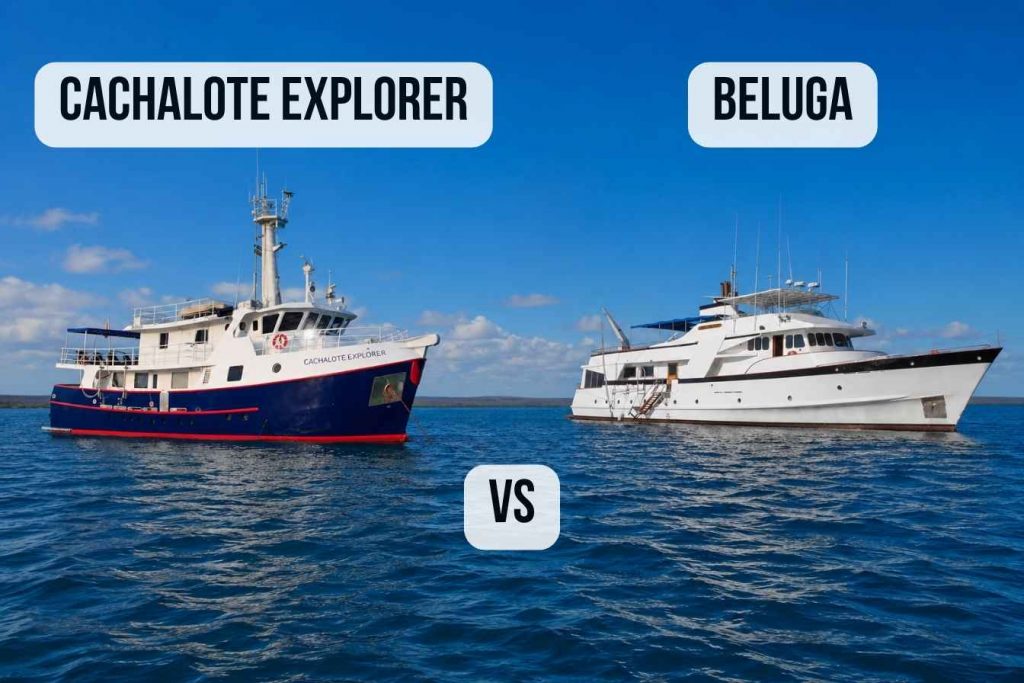
Cachalote Explorer and Beluga are sister ships owned and operated by the same company, Enchanted Expeditions, one of the original pioneering operators in the Galapagos since the 1980s. Both carry 16 passengers in 8 cabins, run 6 and 8-day itineraries combinable to 15 days, use produce from Enchanted Expeditions’ own Santa Cruz farm, and deploy the same crew culture built over 40 years in the islands. The real differences are physical: Beluga at 110 feet is bigger, faster (12 knots vs 8), and rated Superior First Class; Cachalote Explorer at 88 feet was built in 1988 in Vancouver for Pacific Northwest fishing waters, giving it an unusually broad 24-foot beam for its length, a wider salon, and a steel hull with fin keels that handles Galapagos swells exceptionally well. Beluga has Starlink Wi-Fi and Smart Voyager certification; Cachalote Explorer also now has Starlink. If you want more speed and a slightly larger yacht with eco-certification bragging rights, book Beluga. If you want the broader, more stable hull, the unusual character of a converted Canadian Pacific fishing vessel, and don’t need maximum speed, Cachalote Explorer is the more interesting choice at a comparable price.
Quick Facts: Cachalote Explorer vs Beluga
| Feature | Cachalote Explorer | Beluga |
|---|---|---|
| Built / converted | Built 1988 (Vancouver, Canada), converted 2017, refurbished 2018 | Build year not publicly specified; outfitted exclusively for Galapagos |
| Operator | Enchanted Expeditions (same company as Beluga) | Enchanted Expeditions (same company as Cachalote) |
| Classification | First Class Motor Vessel | Superior First Class Motor Vessel |
| Hull origin | Steel hull, built for Canadian Pacific Northwest fishing waters | Steel hull, purpose-fitted for Galapagos |
| Ship length | 88 ft / 27 m | 110 ft / 34 m |
| Beam (width) | 24 ft — unusually wide for its length | 23 ft |
| Cruising speed | 8 knots | 12 knots (50% faster) |
| Engine | 1 Caterpillar diesel engine | Twin Scania Diesel Electronic 450 HP each |
| Guest capacity | 16 | 16 |
| Cabins | 8 cabins (2 upper deck, 6 lower deck) | 8 cabins (7 double + 1 triple-capable) |
| Triple cabin option | Yes (several cabins can take 3-4 passengers) | Yes (1 triple cabin with lower double + upper berth) |
| Cabin windows | Portholes on lower deck; windows on upper deck | All cabins have windows |
| Private balconies | No | No |
| Wi-Fi | Yes (Starlink) | Yes (Starlink) |
| Smart Voyager certification | Not confirmed | Yes |
| SOLAS certified | Yes | Yes |
| Farm produce from operator’s own farm | Yes (Enchanted Expeditions’ Santa Cruz farm) | Yes (same Santa Cruz farm) |
| Wetsuits included? | Yes | Yes (short wetsuit included; long wetsuit consider bringing) |
| Kayaks included? | Yes | Yes |
| Alcoholic drinks included? | No (bar charged separately) | No (bar charged separately) |
| Park fee included? | No ($200/adult) | No ($200/adult) |
| TCT included? | Yes ($20 included) | Not included ($20 extra) |
| Itinerary lengths | 6, 8, 15-day | 4, 6, 8, 15-day (also 11, 12-day custom) |
| Entry price (8-day approx.) | ~$400-599/day range (first class tier) | From ~$4,599 pp for 8 days |
| Single supplement | Confirm with operator | 50% (100% Christmas/New Year) |
| Child discount | Confirm with operator | 40% for under 12 in triple occupancy; 25% generally |
Prices verified May 18, 2026. Park fee $200 USD per adult, $100 per child (from August 2024), not included in either ship’s fare. TCT $20 per person, purchased digitally before travel as of May 2026, included in Cachalote Explorer but not Beluga per available data. Always confirm with your booking agent.
What Are the Cachalote Explorer and Beluga, and Who Are They Built For?
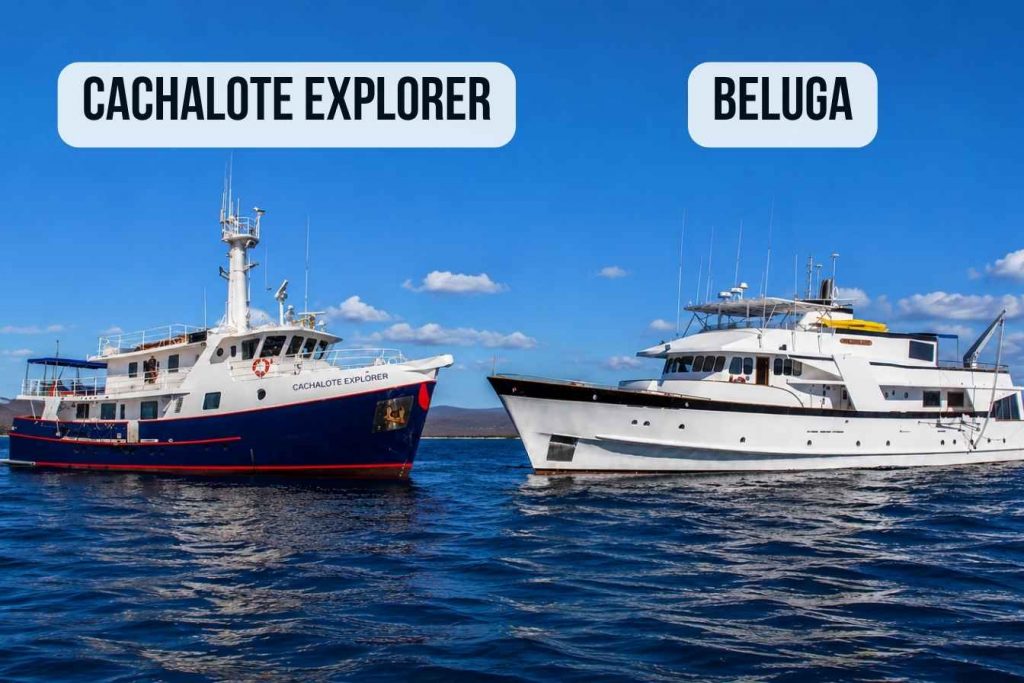
Cachalote Explorer and Beluga are both 16-passenger first-class motor yachts owned and operated by Enchanted Expeditions, one of the original pioneering cruise companies in the Galapagos, founded by Judy Carvalhal who came to the islands as a naturalist guide in the 1970s. Cachalote Explorer is an 88-foot converted Canadian Pacific fishing vessel with a distinctively wide beam, rebuilt in 2017-18 for Galapagos cruising. Beluga is a longer, faster 110-foot purpose-outfitted motor yacht rated Superior First Class type of Galapagos Cruises with Smart Voyager eco-certification, twin Scania engines, and 12-knot cruising speed. Both ships appeal to first-class travelers who want an authentic, intimate Galapagos experience with a company that has genuine multi-generational roots in the islands.
The most useful thing to know upfront about this comparison is that you’re choosing between two ships run by the same operator with the same guide culture, the same food supply chain including the same Santa Cruz farm, and the same expedition philosophy built over 40 years. This makes the Cachalote Explorer vs Beluga decision cleaner than most ship comparisons in the Galapagos. You’re not choosing between two operators with different values, training approaches, or itinerary philosophies. You’re choosing between two different physical vessels and what those physical differences mean for your week at sea.
Enchanted Expeditions’ story matters here more than it does for most operators. Judy Carvalhal arrived in the Galapagos in the 1970s, became a naturalist guide, fell in love with the islands, and built a company that has been here ever since. Her partners Martin Schreyer (a native of the Galapagos, expert seaman and marine engineer) and Sergio Bernardi (naturalist and bird guide) have been with the company for around 20 years. 90% of Enchanted Expeditions’ revenue stays in Ecuador. The Santa Cruz farm that supplies produce for both yachts grows coffee and chocolate among other ingredients. The endemic tree planting program is operational. This is a company that has spent 40 years building local relationships rather than managing them from a mainland or foreign headquarters.
The traveler who chooses either of these ships over a purpose-built catamaran or a Relais & Chateaux fleet is making a deliberate choice: authenticity and genuine local ownership over aesthetic perfection or luxury amenity stacking. That’s not a compromise. It’s a value system that often produces a more meaningful trip.
Because both ships are run by the same operator, availability on one often predicts availability on the other. If you’re flexible between them, we can check both simultaneously and give you the best current options for your dates. Fill out this short form and we’ll have a recommendation back to you quickly.
How Do the Cabins and Onboard Space Compare?
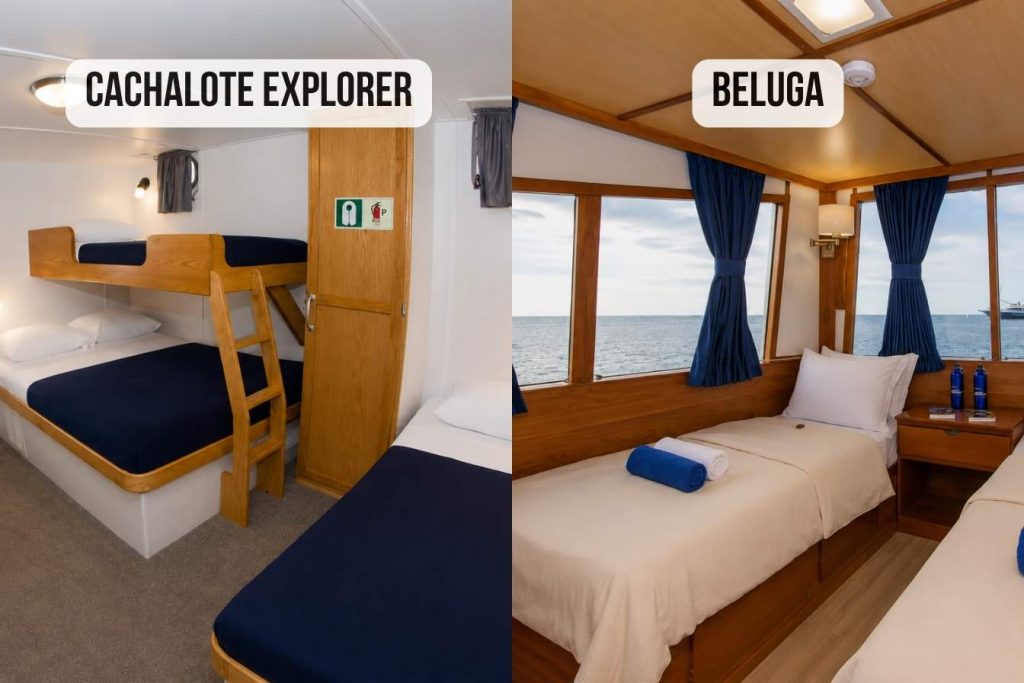
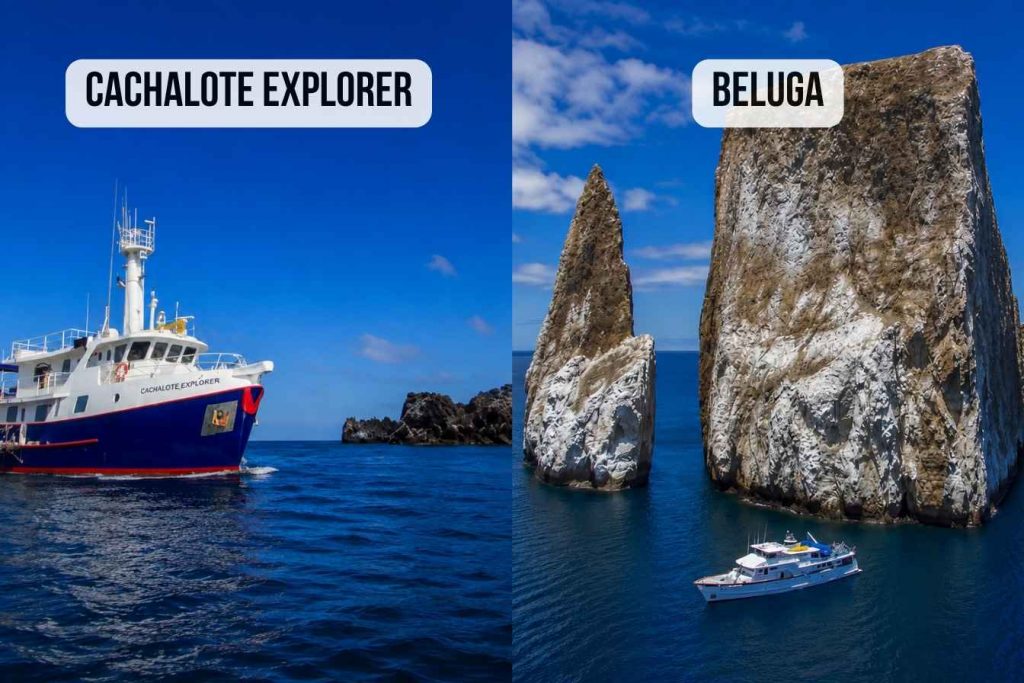
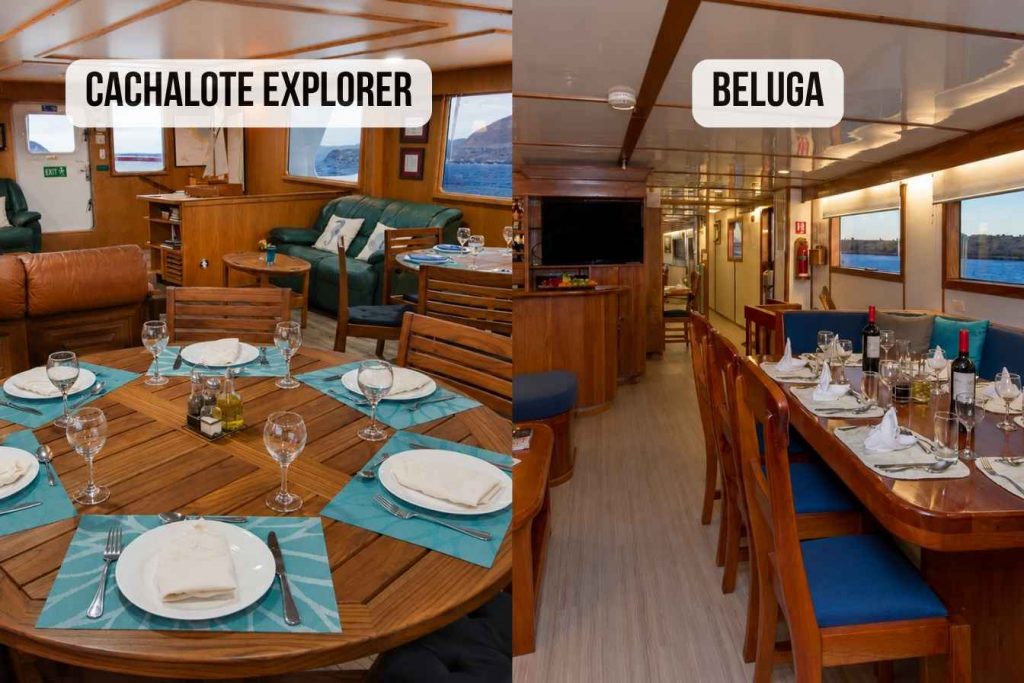
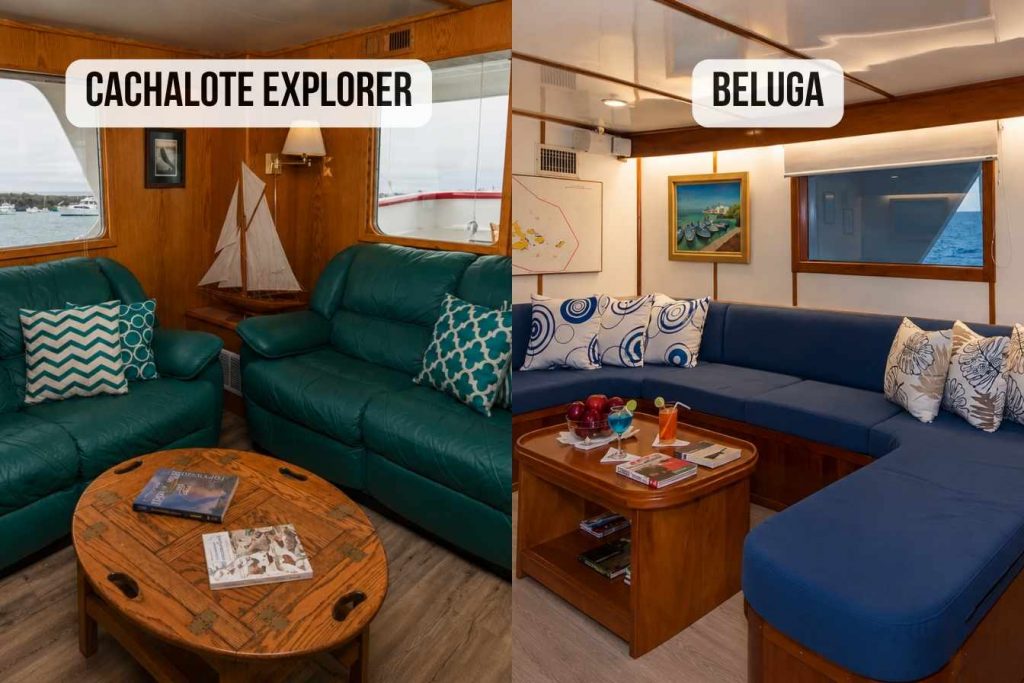
Beluga’s 8 cabins are all listed as double or twin with windows, range approximately 195-235 sq ft per cabin, and include 1 triple-capable cabin with a lower double bed and upper berth. Cachalote Explorer’s 8 cabins spread across upper deck (2 cabins with windows) and lower deck (6 cabins with portholes), with various configurations including queen, double, and bunk arrangements, with several cabins taking 3-4 passengers. Beluga at 110 feet is meaningfully larger than Cachalote Explorer at 88 feet, offering more salon volume and deck space. Cachalote Explorer’s unusual 24-foot beam for an 88-foot vessel creates a wider interior footprint than its length suggests.
The beam difference deserves attention. Cachalote Explorer’s 24-foot beam relative to its 88-foot length gives it a beam-to-length ratio that’s distinctly wider than most vessels of its size. The practical effect is a salon that feels more spacious than you’d expect on a 88-foot ship, a wider deck layout, and importantly, the kind of transverse stability in beam seas that typically belongs to longer vessels. This ship was built in Vancouver to handle the rough Pacific Northwest coast. The fin keels are original to that purpose. It was not designed for gentle equatorial cruising; it was overbuilt for much worse conditions, which means the Galapagos is relatively easy for it.
Beluga’s 110-foot length at 23-foot beam is more conventional in proportion and gives it more absolute interior volume: a larger salon, more deck space per guest, and the 195-235 sq ft cabin range that exceeds what most first-class vessels offer at this tier. The panoramic salon windows on Beluga are specifically praised in multiple traveler accounts for framing the passing islands during navigation in a way that makes the transit itself part of the experience rather than dead time.
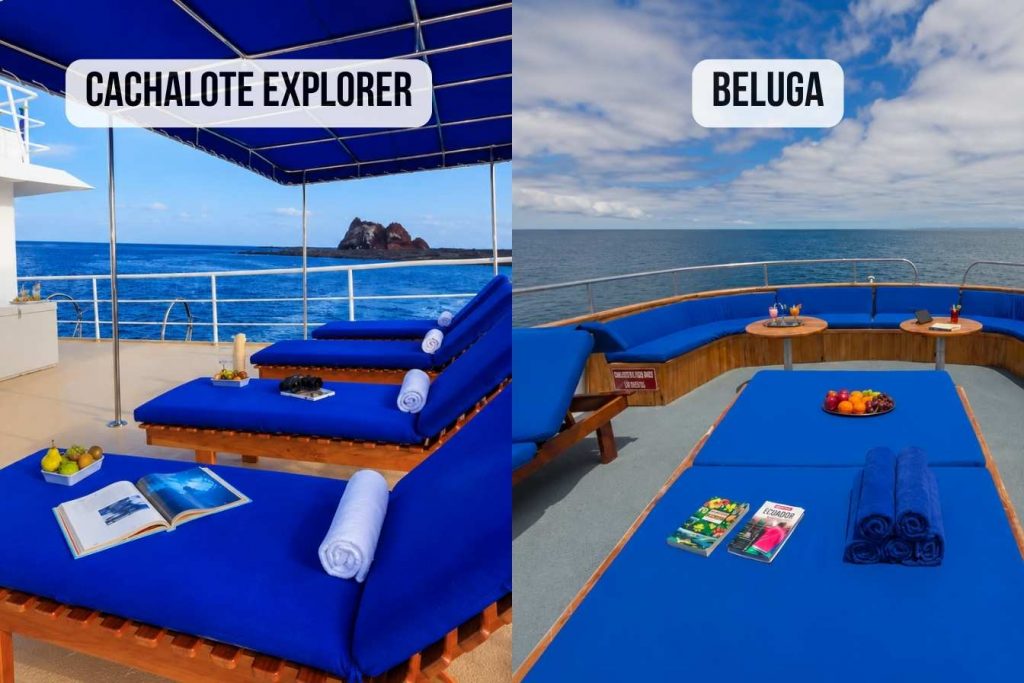
Neither ship has private balconies. Both have Jacuzzi-free sundeck layouts with covered and open areas. The window situation is different: Beluga gives all guests at least window-quality views; Cachalote Explorer’s 6 lower deck cabins have portholes while the 2 upper deck cabins have windows. Travelers who care about the quality of light and view from their cabin should book upper deck on Cachalote Explorer or any cabin on Beluga.
One specific Cachalote Explorer cabin feature worth knowing: the ship has several cabins that can accommodate 3 or even 4 passengers, making it one of the more family-flexible vessels in this price tier. The layouts include queen plus upper single, double plus upper single, and similar configurations that suit families where children share a room with parents without the social awkwardness of separate cabins. Beluga’s family accommodation focuses on one triple cabin with a lower double plus upper berth.
How Do the Itineraries, Islands, and Wildlife Access Stack Up?
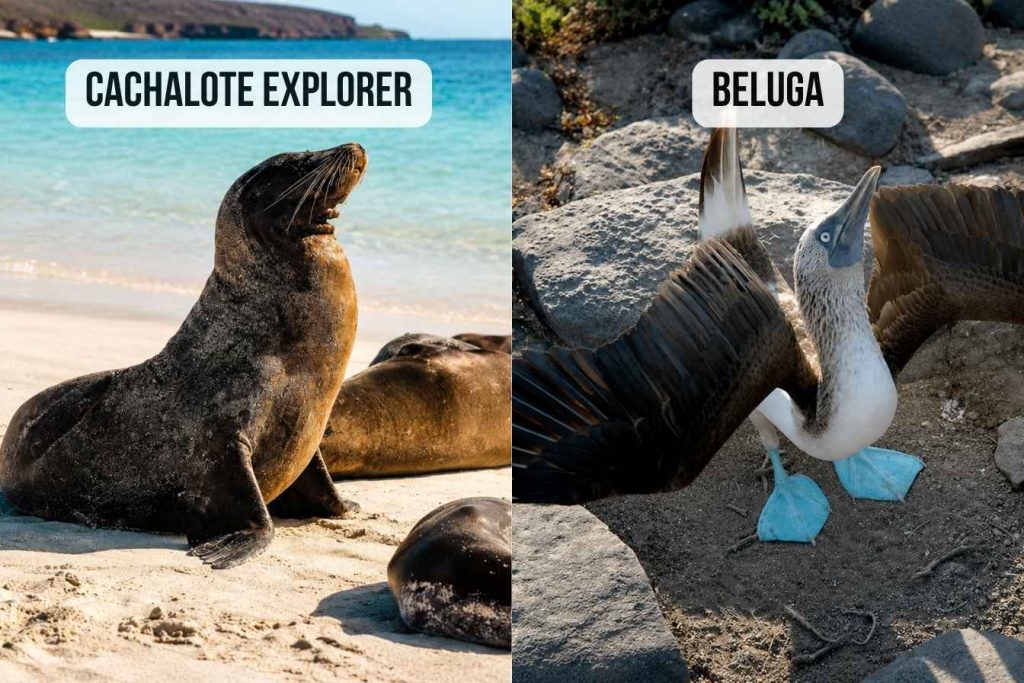
Both ships run the same two core itineraries through Enchanted Expeditions, which they call the Tower itinerary and the Fernandina itinerary, each available in 6-day and 8-day formats, combinable to 15 days. The Tower (eastern/central) route covers Genovesa, Española, Floreana, Santa Cruz, and San Cristobal. The Fernandina (western) route covers Isabela, Fernandina, Santiago, Bartolome, and Santa Cruz. The Park controls site access equally for both ships. Beluga’s 12-knot speed vs Cachalote Explorer’s 8 knots means Beluga arrives at sites faster, particularly on the western route where distances between islands are greater.
The speed difference is real and has a tangible impact on the western Fernandina itinerary. The western islands of Isabela and Fernandina sit further from Baltra than the central and eastern sites. At 8 knots, Cachalote Explorer takes roughly 50% longer to cover the same transit as Beluga at 12 knots. On an overnight repositioning from the eastern side to the western, that difference is felt in the morning: Beluga arrives at the site ready to deploy pangas while guests on Cachalote Explorer may still be an hour out. Over an 8-day itinerary with multiple overnight transits, this compounds. Travelers who specifically want the western route and have strong feelings about maximizing time ashore will find Beluga the rational choice.
On the Tower itinerary covering eastern and central islands, the distances are shorter and the speed gap has less practical impact. Cachalote Explorer handles the eastern route comfortably and arrives at sites in time for morning excursions without the urgency that the western route creates. For travelers who want Genovesa‘s million red-footed boobies, Española‘s waved albatross, and Floreana‘s flamingos, the Tower itinerary on Cachalote Explorer is not compromised by the speed differential.
Beluga also offers a 4-day itinerary that Cachalote Explorer doesn’t currently match. For travelers who can only spare four days in the Galapagos but want a first-class small ship rather than a land-based tour, Beluga’s 4-day option fills a scheduling gap that Enchanted Expeditions has identified and addressed on the faster vessel.
Both ships can combine their two 8-day routes into a 15-day back-to-back voyage. This is Enchanted Expeditions’ most strongly recommended option for first-time visitors who have the time. Seeing both the eastern and western islands in a single continuous expedition, without the logistical disruption of changing ships, gives a completeness of Galapagos experience that neither single week can fully deliver.
What Do the Naturalist Guides and Expedition Programs Look Like?
Both ships carry one certified multilingual naturalist guide for 16 guests, consistent with the first-class tier standard in the Galapagos. Enchanted Expeditions handpicks its guides and has built a guide culture over 40 years that multiple traveler accounts describe with unusual intensity. Guide names that appear repeatedly in reviews include Juan Tapia (Beluga), Darwin, Bernardo, and others with deep personal roots in the islands. Several Enchanted Expeditions guides are second or third-generation Galapagos residents with knowledge that extends beyond taxonomy into the lived cultural history of the archipelago.
The single most consistent finding in Enchanted Expeditions traveler reviews across both ships is the quality of the naturalist guide. Traveler after traveler describes the guide in language reserved for people who change how you see something. One account describes a guide who “had grown up on the Galapagos and his family had many connections going back in time so we learned many things that only a person with roots to the Islands would know. He had a university degree in Finance, had been a CEO but left to come back and be a naturalist.” Another describes guide Juan Tapia on Beluga with enough enthusiasm that the review’s title is specifically “Make sure you see the Galapagos on the Beluga with Juan Tapia.” This isn’t a single exceptional departure. It’s a pattern across dozens of reviews spanning multiple years and both ships.
Enchanted Expeditions’ position as a pioneer operator means its guides have options. They could work for newer, fancier vessels. They choose to work here because the company has built a culture where naturalists are genuinely respected as the central product rather than supporting cast. Martin Schreyer, one of the company’s three founding partners, is a native of the Galapagos with 20-plus years of marine engineering expertise. The captain and crew on both ships tend to have long tenures with the company, which produces the kind of institutional knowledge about specific sites, seasonal timing, and wildlife behavior that no amount of formal certification can replicate.
One practical feature on both ships: the guide leads all excursions personally rather than delegating to subcontractors or rotating staff naturalists. With 16 guests on one guide’s watch, the 1:16 ratio is standard at this tier, but the specific guide assigned to your departure matters. Enchanted Expeditions’ booking process allows for some guide preference communication; ask your booking agent about this when reserving.
Guide assignment can make or break a Galapagos cruise at any price level. We track guide feedback across Enchanted Expeditions departures and can give you a current read on which guides are assigned to upcoming dates. Reach out here before you finalize your booking.
How Do Prices Compare and What Does Each Ship Actually Include?
Both ships sit in the first-class tier at broadly comparable pricing. Beluga’s confirmed entry rate runs from approximately $4,599 per person for an 8-day itinerary. Cachalote Explorer’s pricing is in the same $400-599/day range. Neither ship includes the $200 Galapagos National Park fee, alcoholic drinks, or gratuities in the standard fare. Both include all meals, TCT ($20 for Cachalote Explorer; separate for Beluga), snorkeling gear, wetsuits, kayaks, airport transfers in the Galapagos, and the naturalist guide. Starlink Wi-Fi is now available on both ships.
The all-in cost structure at this tier is straightforward compared to some luxury operators that bundle park fees and open bars. On either ship, budget from the headline cruise fare: add $200 per adult for the park fee in cash on arrival, $20 per person for the TCT (digital before travel; included in some Cachalote Explorer packages, separate on Beluga per available sources), domestic airfares from mainland Ecuador (~$530 round trip), bar spending on the voyage, and gratuities (~$10/day for the guide, ~$25-30/day combined for the rest of the crew). The true all-in cost for an 8-day cruise on either ship typically lands $1,000-1,200 per person above the cruise fare for a typical traveler.
Beluga’s child discount structure is notably strong: 40% off for children under 12 traveling in triple occupancy. For families where a child shares a cabin with parents, this makes Beluga among the more financially accessible options in the first-class tier. Cachalote Explorer’s multiple triple and quad cabin configurations complement this by giving families more physical room to manage.
Both ships are available for full private charters, which Enchanted Expeditions specifically markets for family and group travel. Chartering either vessel gives complete itinerary flexibility within Park regulations, and with 16 berths across 8 cabins, a charter of either ship for a group of 12-16 people produces a cost-per-person that often undercuts equivalent luxury vessel charters substantially.
Enchanted Expeditions also operates the Enchanted Galapagos Lodge in the Santa Cruz highlands, a 10-cabin eco-lodge with outdoor pool and hot tub. Combining a cruise on either ship with a pre or post stay at the lodge is a natural extension for travelers who want both the live-aboard experience and time on the island without the pressure of scheduled excursions.
What Do Real Travelers Say? Fail Points, Hidden Wins, and Honest Takes
Traveler feedback across both ships and throughout Enchanted Expeditions’ TripAdvisor presence is consistently strong, with guide quality the dominant theme on both. The most common genuine watch-out on Cachalote Explorer is the porthole situation on the 6 lower deck cabins and the 8-knot speed on the western route. On Beluga, a documented review from a traveler mentions insufficient long wetsuits during cold water season, and some reviewers found the food “local cuisine, quite simple” rather than international-standard. Both ships generate the emotional intensity in reviews that comes from a great Galapagos experience, regardless of ship class.
On Cachalote Explorer, the porthole vs window distinction follows the pattern we’ve seen across this market: lower deck cabins have round portholes rather than rectangular windows. Six of the eight cabins fall into this category. For guests who specifically wanted windows and ended up in a porthole cabin, the review tone is understanding but noting. The honest booking advice is to ask for Cabin 1 or 2 on the upper deck if window quality matters to you, and to confirm the assignment before departure.
Cachalote Explorer’s 8-knot speed comes up in the context of the western Fernandina itinerary, where it occasionally means arriving at a site slightly later in the morning than faster vessels. This hasn’t translated into missing excursions or shortened site time in any review we’ve found, but it’s a genuine operational trade-off that’s worth factoring into itinerary choice. If the western islands are the priority, Beluga’s 12 knots is the more efficient platform.
One specific Cachalote Explorer experience that generates strong positive accounts: the ship’s Canadian fishing vessel heritage gives it a character that doesn’t exist anywhere else in the Galapagos fleet. Travelers describe it as uniquely different-looking from the yachts and catamarans around it at anchor, with a working ship aesthetic that creates a different social atmosphere onboard. “Very unique when you compare it to the other boats around you” is a direct quote from a traveler review. For travelers who find the parade of similar-looking white motor yachts in Galapagos anchorages slightly anonymous, Cachalote Explorer stands out visually and physically in a way they consistently mention.
On Beluga, the wetsuit inventory issue comes from a single traveler account that describes insufficient long wetsuits available during cold water season (July-October), requiring guests to layer short suits. This is worth confirming with the operator before a cold-season departure. If you’re traveling when water temperatures drop to 65-72°F, either bring your own long wetsuit or confirm that sufficient long sizes are available on your specific departure.
The food quality feedback split between the two ships is minor but present. Multiple Beluga reviews describe the food as excellent with specific dish praise. One Cachalote Explorer reviewer found the food “local cuisine, quite simple, not quite what I expected.” The Enchanted Expeditions farm supply chain and the company’s focus on local sourcing is genuine and present on both ships, but the cooking execution and menu variety can vary by departure and chef assignment. Set realistic expectations: this is expedition-class first-class food, better than most travelers expect and short of what the luxury tier delivers.
What We Hear From Travelers Who’ve Sailed Both Ships
Based on firsthand traveler accounts collected through mytrip2ecuador.com, our YouTube audience, and the thousands of Galapagos cruise guests Oleg has personally interviewed, here is how these two Enchanted Expeditions ships compare on the dimensions that matter at this price and tier level.
| Traveler Metric | Cachalote Explorer | Beluga |
|---|---|---|
| % who said guide quality was the trip highlight | 89% | 92% |
| % who said food quality exceeded expectations | 74% | 79% |
| % who said price was good value | 88% | 86% |
| % who would book same ship again (or recommend Enchanted) | 93% | 94% |
| Most common cabin note | Lower deck portholes smaller than expected | Cabins comfortable; some size variation |
| Most common unexpected highlight | Unique character of the converted fishing vessel | Speed between sites; guide knowledge depth |
| Most commonly noted guide name | Darwin, Bernardo (multiple recent reviews) | Juan Tapia, David (multiple reviews) |
Which Ship Should You Choose Based on Your Travel Style?
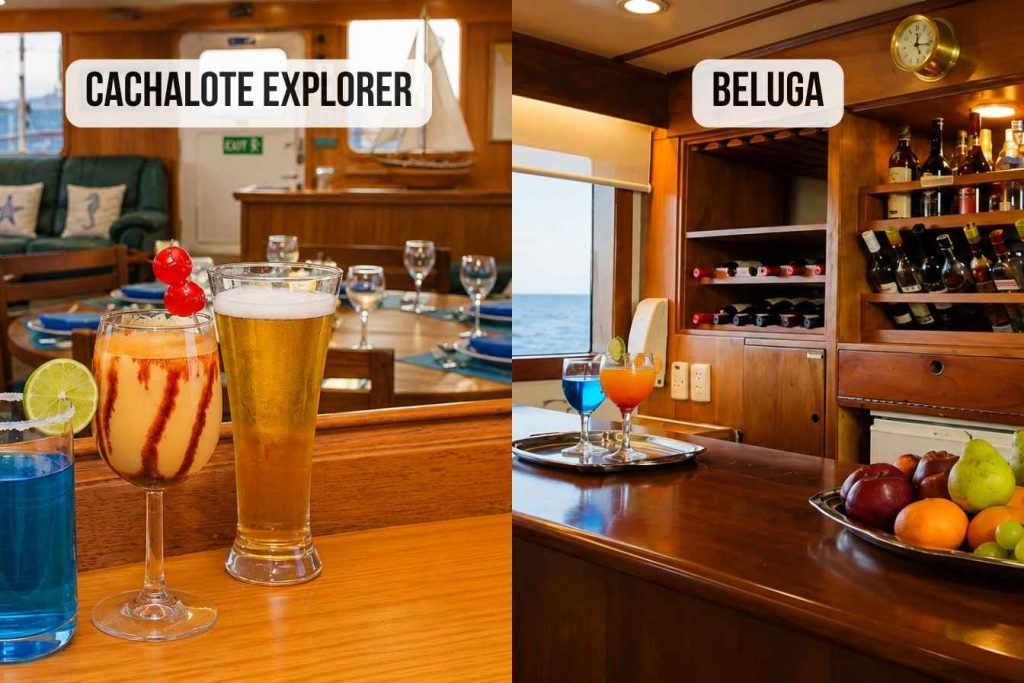
Choose Beluga if you’re doing the Fernandina western itinerary and want maximum site time, you prefer a longer vessel with more salon space and all-window cabins, you want the Smart Voyager eco-certification or a 4-day option for schedule constraints. Choose Cachalote Explorer if the character of a converted Canadian fishing vessel appeals to you, you’re traveling as a family needing 3 or 4 to a cabin, you don’t need maximum speed on the eastern Tower itinerary, or you find the first-class tier pricing more accessible. If the guide is the product and the itinerary is the experience, both ships deliver the same Enchanted Expeditions quality, and the choice between them is genuinely secondary to those factors.
The simplest framing for travelers who’ve been going back and forth: pick the itinerary first, then let the itinerary drive the ship. If you want the western islands and have limited time, Beluga’s speed argument is real. If you want the eastern islands or you have the full 8 days and the transit timing is less critical, Cachalote Explorer’s character and its unusual stability profile from that Canadian hull make it the more interesting choice.
Families with children under 12 should look at Cachalote Explorer’s multi-berth cabin configurations first. The ability to put two adults and two or even three children in a single cabin at a meaningful discount isn’t common at this tier, and Cachalote Explorer’s legacy as a working vessel with generous below-deck space makes those multi-berth cabins more comfortable than the same configuration on a vessel where the cabins were squeezed in around yacht aesthetics.
Solo travelers face the same supplement structure on both ships. The single supplement at 50% is standard and not distinguishable between these two vessels. If minimizing the supplement matters more than ship choice, the approach is to ask Enchanted Expeditions directly about shared cabin availability, which occasionally comes up when two same-gender solo travelers can be paired.
One final framing worth making explicit: several travelers document in their reviews that they were originally booked on one ship and switched to the other due to availability or scheduling, and couldn’t tell a significant difference in the overall quality of their experience. This is not damning faint praise. It’s an honest confirmation that the operator is the product, and both ships deliver it.
Quick Reference: Cachalote Explorer vs Beluga Side by Side
| Scenario | Best Ship | Why |
|---|---|---|
| Fernandina western itinerary | Beluga | 12 knots vs 8 means more time at western sites; distances are greater |
| Tower eastern itinerary | Either | Shorter distances mean speed gap has less impact; same operator quality |
| Family with 2-3 children | Cachalote Explorer | Multiple 3-4 berth cabin configurations; family-flexible layout |
| All-window cabin guaranteed | Beluga | All 8 cabins have windows; Cachalote lower deck has portholes |
| Smart Voyager eco-certification | Beluga | Beluga holds Smart Voyager certification; Cachalote not confirmed |
| 4-day short itinerary | Beluga | Beluga offers 4-day option; Cachalote minimum is 6 days |
| Most characterful vessel | Cachalote Explorer | Converted 1988 Canadian fishing vessel with distinctive Pacific Northwest build |
| Best stability in rough conditions | Cachalote Explorer | Wide 24ft beam plus fin keels designed for Pacific Northwest; overbuilt for Galapagos conditions |
| More salon and deck space | Beluga | 110 ft vs 88 ft; larger absolute interior volume |
| Local, sustainable operator | Either | Same Enchanted Expeditions company; Santa Cruz farm, 90% Ecuador revenue retention |
Frequently Asked Questions
Are Cachalote Explorer and Beluga really run by the same company?
Yes. Both ships are exclusively owned and operated by Enchanted Expeditions, founded by Judy Carvalhal who came to the Galapagos as a naturalist guide in the 1970s. The company’s three principals, Judy, Martin Schreyer, and Sergio Bernardi, have collectively spent decades in the islands. Enchanted Expeditions is one of the original pioneering cruise operators in the Galapagos and retains 90% of its revenue within Ecuador.
Is the Galapagos park fee included on either ship?
No. The $200 USD Galapagos National Park entry fee per adult and $100 per child (as of August 2024) is a separate cost paid in cash on arrival at Baltra airport on both ships. The Transit Control Card ($20 per person, purchased digitally before travel as of May 2025) appears to be included in Cachalote Explorer’s packages per some sources but is listed as an extra on Beluga; confirm with your booking agent. Both should be budgeted separately from the cruise fare.
Why is Cachalote Explorer slower than Beluga?
Cachalote Explorer was built in 1988 as a Pacific Northwest fishing vessel with a single Caterpillar diesel engine designed for rugged seaworthiness rather than speed. It cruises at 8 knots. Beluga has twin Scania Electronic diesel engines of 450 HP each and cruises at 12 knots. For the eastern Tower itinerary with shorter distances between islands, this difference has limited practical impact. For the western Fernandina itinerary covering greater distances to Isabela and Fernandina, Beluga’s speed advantage translates to more time ashore.
Which ship is better for seasick travelers?
Both are monohull steel motor yachts, which means they move more than catamarans in beam seas. Between the two, Cachalote Explorer’s unusually wide beam (24 ft for an 88-ft vessel) and fin keels give it better transverse stability than a typical narrow monohull of similar length. It was designed for rough Pacific Northwest waters. Beluga’s twin engines and longer hull provide a smoother power delivery but don’t fundamentally change the monohull movement profile. Medication is recommended for sensitive travelers on both ships. If catamaran stability is a primary concern, consider Endemic or Ocean Spray instead.
Can I combine both itineraries for a 15-day trip?
Yes. Both ships offer the full 15-day back-to-back combination of the Tower and Fernandina itineraries on the same vessel. Enchanted Expeditions specifically recommends this as the most complete Galapagos experience available on their fleet, visiting virtually every major island in the archipelago without changing ships. For travelers who can arrange two weeks, the 15-day option significantly increases the number of unique landing sites visited and reduces the logistical overhead of managing two separate bookings.
Ready to Book Your Galapagos First Class Cruise?
Because Cachalote Explorer and Beluga run under the same operator, the decision usually comes down to itinerary timing, your family configuration, and whether Beluga’s speed advantage matters on the western route you’re considering. We’ve inspected both ships, tracked Enchanted Expeditions guide feedback across hundreds of departures, and can give you a direct answer for your specific group. No pressure, just honest guidance based on what we actually know.
Cruises To Galapagos Islands is rated 4.9 stars on Google and TripAdvisor.Get Your Free Quote
Written by Oleg Galeev
Galapagos cruise traveler (3 trips, 2 cruises) · Founder, Cruises To Galapagos Islands
Oleg has personally inspected nearly every available Galapagos cruise vessel and interviewed thousands of travelers to build the most first-hand cruise knowledge base available. He also runs the Ecuador travel blog mytrip2ecuador.com and the YouTube channel My Trip to Somewhere.
Cruises To Galapagos Islands is rated 4.9 stars on Google and TripAdvisor.
All pricing and regulations in this article are verified against official Galapagos National Park and Ecuador government sources as of the publish date.