TL;DR
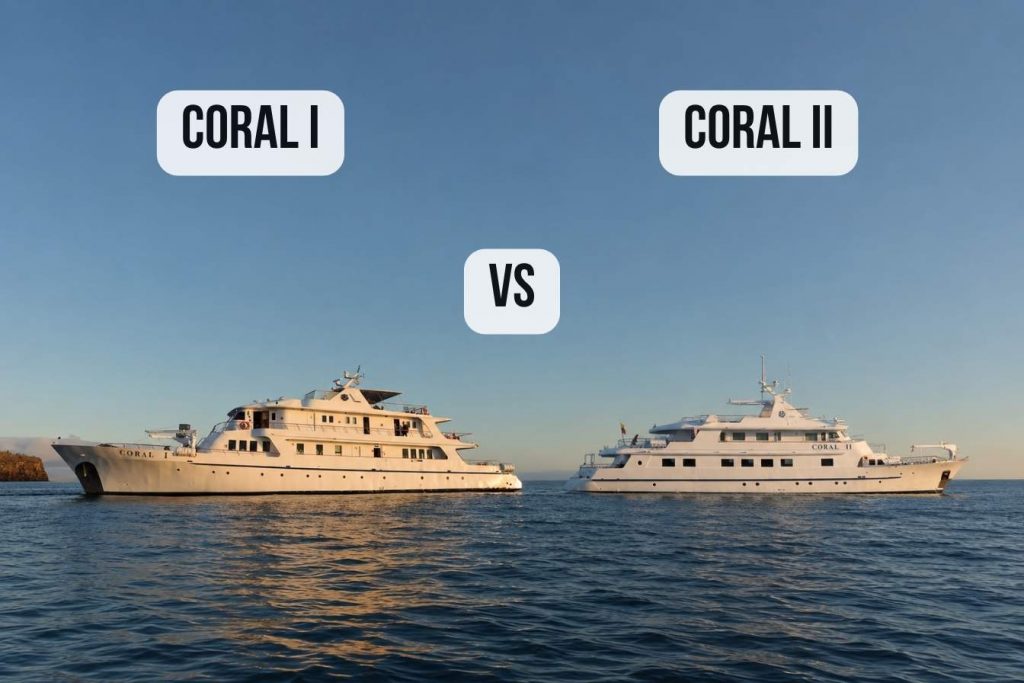
Coral I and Coral II are sister ships operated by KleinTours (Go Galapagos), one of the oldest tour operators in Ecuador. They run the same itineraries side by side through the Galapagos as the only tandem-operation in the archipelago. Coral I was built in Germany, holds 36 passengers across 18 cabins, and is the larger, more social vessel. Coral II was built in Holland, holds 20 passengers across 11 cabins, and is the more intimate option. Both are extensively refitted in 2016-17, both have the same three cabin categories, the same teak-and-brass interior style, the same BBQ Moon Deck, the same Jacuzzi, and the same guides operating from both ships on the same daily excursions. When you book a Coral cruise, most agents book you on “Coral I or II” and you may be assigned to either. If you want to guarantee the smaller, more intimate Coral II, you need to book it specifically. The practical decision is almost entirely about group size preference: 20 guests vs 36 guests.
Quick Facts: Coral I vs Coral II
| Feature | Coral I | Coral II |
|---|---|---|
| Built / refitted | Built in Germany; refitted 2016-17 | Built in Holland; refitted 2016-17 |
| Operator | KleinTours / Go Galapagos (same as Coral II) | KleinTours / Go Galapagos (same as Coral I) |
| Ship length | 130 ft / 39.7 m | 112 ft / 34.15 m |
| Beam | 27.88 ft / 8.5 m | 20.66 ft / 6.3 m |
| Max speed | 12 knots | 12 knots |
| Guest capacity | 36 | 20 |
| Number of cabins | 18 cabins | 11 cabins |
| Cabin categories | Standard (2), Standard Plus (8), Junior (8) | Standard (1), Standard Plus (4), Junior (7) – note: some sources cite 12 cabins total |
| Standard cabin size | ~75-118 sq ft; portholes; Sea Deck | ~75 sq ft (1 cabin bow position); portholes |
| Standard Plus cabin size | ~118-129 sq ft; portholes; Sea/Earth Decks | ~129 sq ft; portholes; Sea Deck |
| Junior cabin size | ~118-129 sq ft; picture windows; Earth/Sky Decks | ~108-151 sq ft; picture windows; Earth/Sky Decks |
| Interconnected cabins | Yes, Cabins 7&9, 8&10 (Sea Deck); 14&15, 18&19 (upper) | Yes, Cabins 7&8, 9&10 (Earth/Sky) |
| Triple cabin option | Yes (Junior cabins with sofa) | Yes (Junior cabin #6 can be triple) |
| Beds configurable? | Yes, all beds arrange as twin or double | Yes, all beds arrange as twin or double |
| Private balconies | No (Coral I has bow balcony/veranda area) | No |
| Interior style | Dark teak and bronze; panoramic lounge windows | Dark teak and bronze; marine-inspired décor; wide picture windows |
| Jacuzzi | Yes (solar-powered) | Yes |
| BBQ Moon Deck | Yes | Yes |
| Number of naturalist guides | 2-3 Level III guides | 2 Level III guides |
| Crew | 11 crew + 3 guides | 9 crew + 2 guides |
| Snorkel gear included? | Yes | Yes |
| Wetsuits included? | No, rental extra ($25-75 depending on duration) | No, rental extra ($25-75 depending on duration) |
| Kayaks | 3 double kayaks (extra cost) | 3 double kayaks (extra cost on some agents) |
| Wi-Fi | Available (onboard internet) | Available (onboard internet) |
| Park fee included? | No ($200/adult, $100/child) | No ($200/adult, $100/child) |
| Itineraries | A, B, C, D (4-day and 5-day); combinable to 8, 9, 15 days | Same A, B, C, D itineraries (side by side) |
| Entry price (4-day approx.) | ~$489-500/day (both ships same rate by cabin category) | ~$489-500/day (same cabin categories, same rates) |
| Single supplement | 50% (75% high season Dec 18-Jan 5) | 50% (75% high season Dec 18-Jan 5) |
| Child discount | 25% (double occupancy, 1 child with 1 adult); 50% (triple, 1 child) | Same |
| Can be assigned to either? | Yes, many booking agents sell “Coral I or II” | Yes, book specifically if you want to guarantee Coral II |
Prices verified May 18, 2026. Park fee $200 USD per adult, $100 per child (from August 2024). TCT $20 per person, purchased digitally before travel as of May 2026. Confirm current fuel surcharges and seasonal rates with your booking agent.
What Are the Coral I and Coral II, and Who Are They Built For?
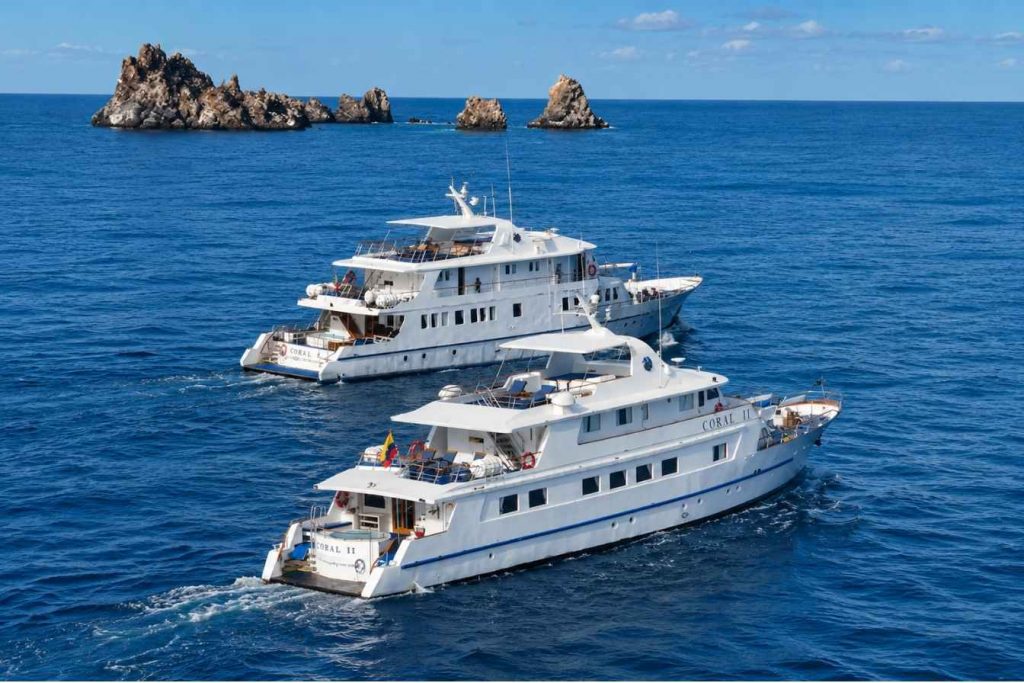
Coral I and Coral II are sister ships operated by KleinTours (marketed as Go Galapagos), one of the oldest and most established tour operators in Ecuador. Coral I was built in Germany and carries 36 passengers in 18 cabins across 130 feet; Coral II was built in Holland and carries 20 passengers in 11 cabins across 112 feet. Both were extensively refitted in 2016-17 with energy-saving equipment and updated furnishings, and both cruise identical itineraries simultaneously as the only tandem-operating ship pair in the Galapagos. They’re positioned squarely at the first-class tier: more comfort and more guided structure than tourist-superior vessels, at a price below the luxury catamaran segment.
KleinTours has been operating in the Galapagos for around 30 years and is consistently described by travel specialists as one of the most reliable mid-market operators in the archipelago. The company’s reputation for operational consistency, guide quality, and no-surprises execution has made the Coral ships a default recommendation for travelers who want a solid first-class experience without the research overhead of navigating a crowded fleet of vessels. “You are in good hands” is how a veteran Galapagos specialist summarizes KleinTours’ standing.
The tandem operation is the defining structural feature of the Coral program. Both ships follow identical itineraries and sail through the same waters on the same schedule. On land excursions, guides from both ships lead separate groups from their own vessel, which keeps excursion groups to the Park-regulated 16-guest maximum. At sea, you see the companion vessel sailing alongside, anchored in the same coves, and deployed in the same visitor site rotations. For travelers who’ve been on a solo-vessel Galapagos cruise, the visual companionship of the second ship is a distinctly different experience. Several traveler accounts describe it as one of the unexpectedly enjoyable aspects of the Coral program.
The traveler profile that consistently chooses the Corals is the one that wants a well-organized, value-conscious first-class experience with a proven operator, without spending the premium associated with catamarans like Ocean Spray, Natural Paradise, or Seaman Journey. Both ships draw families (thanks to the interconnected cabin options), multi-generational groups (thanks to the range of cabin sizes), and first-time Galapagos visitors who want a trusted name rather than an independent research project.
Most booking agents sell Coral I and II as interchangeable and will assign you to whichever has availability. If you want to guarantee the smaller, more intimate Coral II, or if you specifically prefer the larger social atmosphere of Coral I, tell us that upfront. Contact us here with your dates and group size and we’ll lock in the right vessel for you.
Are They Actually Different? Cabins, Layout, and What Sets Them Apart
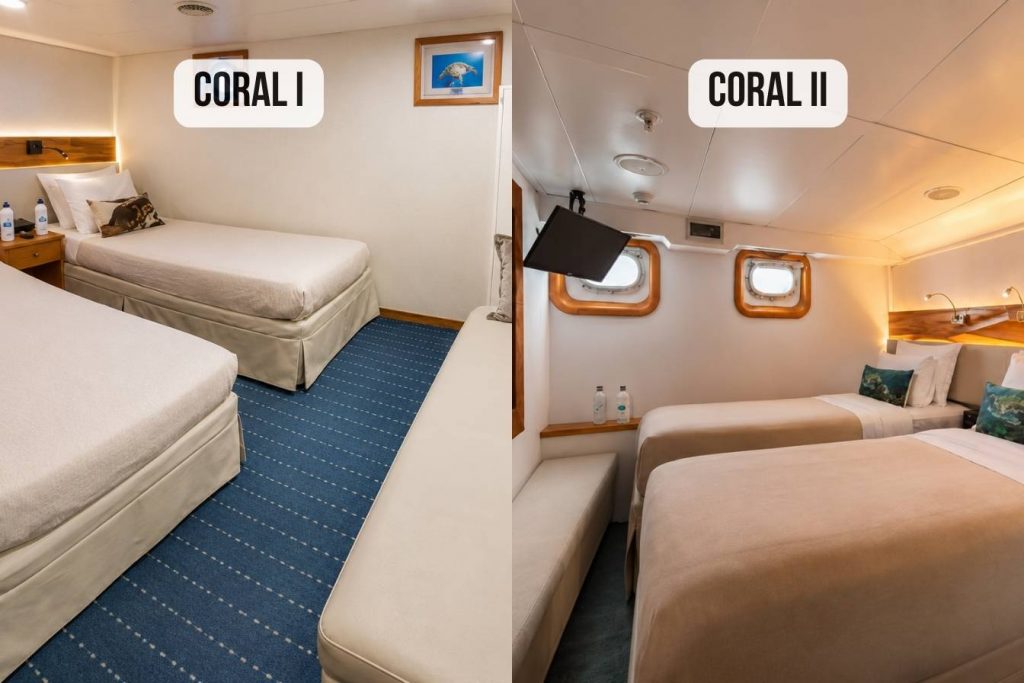
The honest short answer is: yes, but less than most travelers expect. Both ships have the same three cabin categories (Standard, Standard Plus, Junior), the same convertible twin/double bed configuration, the same teak-and-bronze interior finish, the same BBQ Moon Deck, the same solar-powered Jacuzzi, the same four itineraries, and the same KleinTours guides. The meaningful differences are size (36 vs 20 guests), specific cabin dimensions by category, the number of interconnected pairs, and the overall social atmosphere that comes from having 80% fewer people on board.
Coral I at 130 feet with 36 guests and 18 cabins is a meaningfully larger vessel than Coral II at 112 feet with 20 guests and 11 cabins. This size difference shows up in three ways that matter to travelers. First, the social atmosphere: 36 people forming social groups over a 4 or 5-day cruise has a different dynamic than 20. Larger groups tend to find their subsets and the overall energy is more animated. Twenty guests tends toward a closer-knit atmosphere where everyone ends up knowing everyone else by day two. Neither is better; they suit different travel personalities.
Second, the cabin dimensions differ by category even though the category names are the same on both ships. On Coral I, the Standard Plus cabins on the Sea and Earth decks run 118-129 sq ft. On Coral II, the Standard Plus cabins are consistently around 129 sq ft. The Junior cabins on Coral I’s Earth and Sky decks run 118-129 sq ft with picture windows. On Coral II, the Junior suites on the Earth and Sky decks run 108-151 sq ft – a wider range that makes Coral II’s best Junior cabin (the one at 151 sq ft) the largest individual cabin in the combined fleet.
Third, Coral II has one standard cabin in the bow of the Sea Deck that is notably small at approximately 75 sq ft. This is a single-occupancy cabin not typical of the rest of the ship. On Coral I, the two Standard cabins are also small but positioned differently. Budget-category cabin bookers on either ship should be aware that the Standard category is the entry-level option and reflects the pricing accordingly.
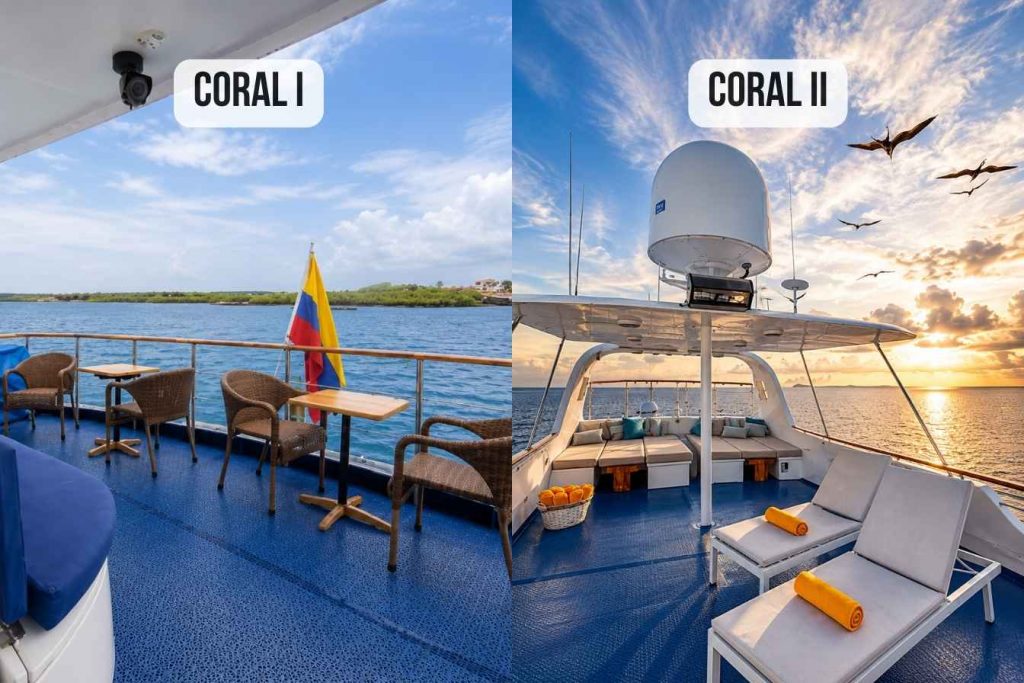
Both ships share the warm teak-and-brass interior finish that KleinTours consistently describes as a private yacht aesthetic. Coral II is specifically described as having a “romantic design” and “intimate ambiance” with its more compact scale. Coral I is described as more “modern and spacious,” with its larger lounge functioning as a fuller social gathering space. The panoramic lounge windows on both ships deliver excellent island views during navigation. Both have the three-deck layout with Moon Deck (BBQ + stargazing), Sky Deck (sundeck, Jacuzzi), and Earth Deck (dining room, bar, lounge, library, boutique).
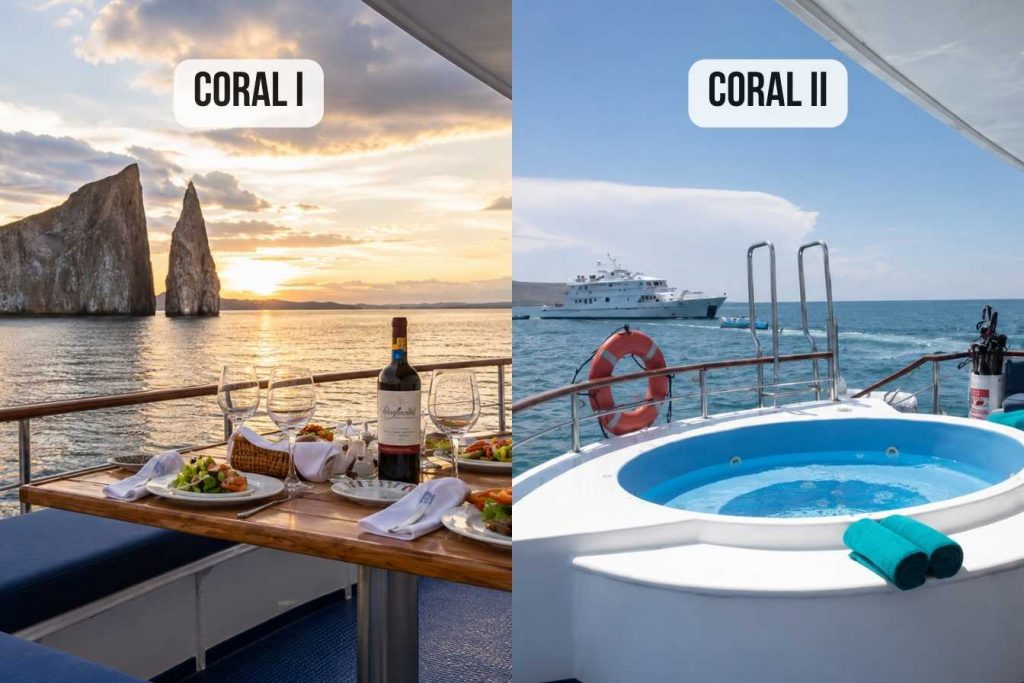
The BBQ Moon Deck dinner is one of the Coral program’s consistent highlights. Served at sunset with the islands as backdrop, this open-air meal under the stars is the single most frequently mentioned unprompted positive across the combined traveler review record. It happens on both ships on both vessels during their identical itinerary schedules. Whichever ship you’re on, it will happen and it will be good.
How Do the Itineraries, Islands, and Wildlife Access Stack Up?
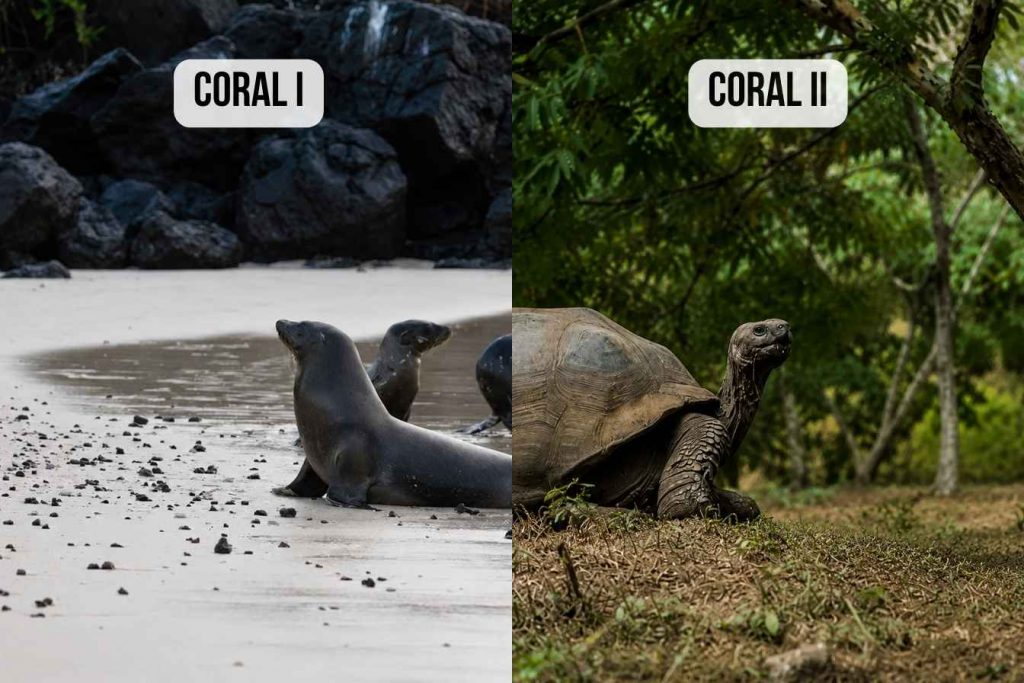
Both ships run the same four itineraries: Itinerary A (4 days, north-central islands including Genovesa, Rabida, Bartolome), Itinerary B (5 days, western islands including Isabela, Fernandina, Santiago), Itinerary C (4 days, central islands including North Seymour, Santa Cruz, Santa Fe, San Cristobal), and Itinerary D (5 days, southern and eastern islands including Española, Floreana, San Cristobal). These can be combined into 8, 9, or 15-day comprehensive circuits. Both ships visit every site simultaneously and share excursion landings with groups from each vessel taking their allocated time at each site.
The four itinerary structure covering the full compass of the Galapagos archipelago is one of the Coral program’s strongest practical features. Most first-class vessels run two 8-day itineraries that can combine to 15. The Coral program runs four shorter itineraries (A, B, C, D), which gives three genuine advantages. First, travelers with limited time can do a meaningful 4 or 5-day cruise rather than committing to a week. Second, travelers who can manage 8-9 days can combine A+B, C+D, or A+D for a trip that covers genuinely different island regions without repetition. Third, the full 15-day A+B+C+D circuit visits virtually every major Galapagos island and is considered one of the most complete available experiences at this price tier.
Itinerary B, the 5-day western route covering Isabela and Fernandina, is consistently flagged by travel specialists as the strongest single itinerary in the Coral program. Fernandina is the youngest and most pristine island in the archipelago, largely untouched by invasive species, and home to the world’s only marine lizard (the marine iguana) in extraordinary concentrations alongside flightless cormorants and the largest colony of Galapagos penguins. The western route is the one to book if you can only do one segment and want the most wildlife-dense single-week option in the fleet.
The tandem excursion structure has a practical implication for wildlife experiences. Because both ships operate simultaneously at the same sites, the combined total of roughly 56 guests (36 on Coral I, 20 on Coral II) arrives at a visitor site within the same window. The Galapagos National Park’s 16-guest-per-guide-per-group limit means both ships land separately, with each vessel running its own guide-led groups. In practice, Coral I lands two or three groups sequentially while Coral II lands one or two. The visitor site impact is the same; the order of entry rotates. Neither ship has a “seeing the other ship’s guests” problem at sites because the site turnover is managed by the Park.
Longer-trip passengers on Coral I specifically benefit from a program KleinTours has built in: on days when new passengers board mid-cruise, the continuing passengers are offered different activities so they don’t repeat content they’ve already experienced. This is specifically mentioned by a 15-day Coral I traveler as thoughtful and well-executed.
What Do the Naturalist Guides and Expedition Programs Look Like?
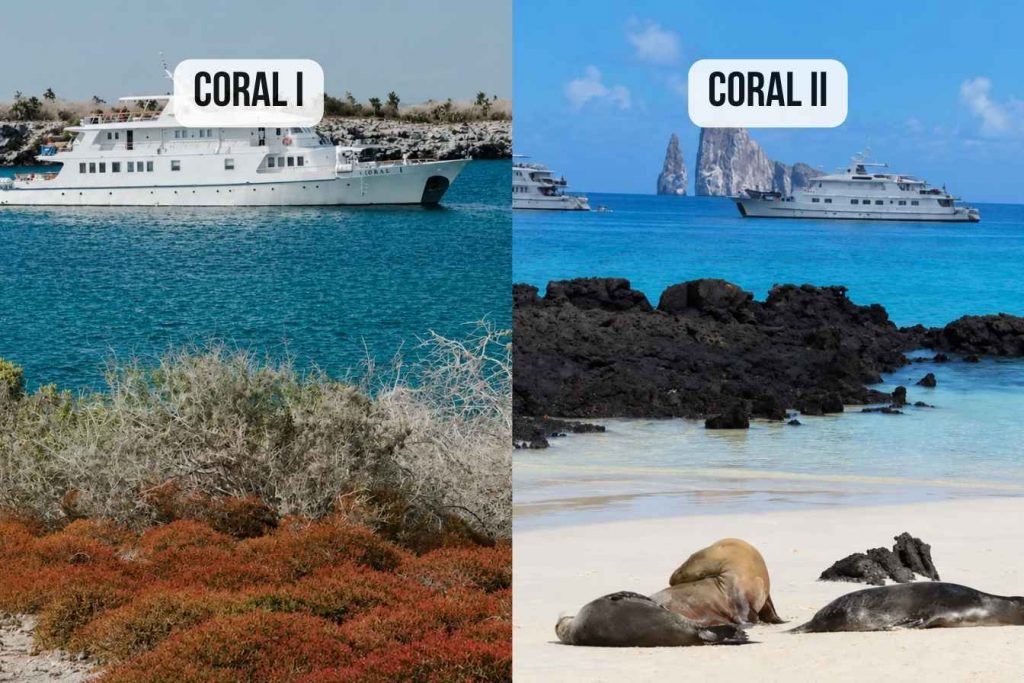
Coral I carries 2-3 Level III certified bilingual naturalist guides for up to 36 guests. Coral II carries 2 Level III guides for 20 guests. The guide-to-guest ratio is therefore better on Coral II: roughly 1 guide per 10 guests vs 1 guide per 12-18 on Coral I depending on how many guides are deployed. Both ships operate the twice-daily excursion structure required by the Galapagos National Park. KleinTours has 30 years of guide selection and training in the islands, and multiple named guides appear in traveler accounts with the kind of specific praise that indicates personal investment beyond job requirement.
The ratio difference matters practically at visitor sites. The Galapagos National Park limits groups to 16 guests per guide. On Coral II with 20 guests and 2 guides, both guides typically lead groups of 10 at each site. On Coral I with 36 guests and 3 guides, groups run approximately 12. Both are below the Park maximum and both deliver attentive guiding. The slight edge for Coral II comes from the intimacy of 10-person groups rather than 12, which over five days of hiking, snorkeling, and panga rides creates meaningfully more guide-to-guest interaction time.
KleinTours’ guide culture draws specific consistent praise. Named guides appearing in recent traveler accounts include Karin, Lars, Wilo, Cornelia, and unnamed guides described as combining deep natural history knowledge with genuine humor and enthusiasm. One Coral I traveler describes their guides as “top-notch” and specifically mentions “so many turtles, sea lions, fish, penguins” as a result of guided snorkeling sessions where the guide found wildlife others would have missed. The quality of a snorkeling guide is a specific skill set distinct from land guiding; KleinTours deploys guides competent in both.
Both ships hold onboard lectures and briefings before each excursion, which is standard across the Galapagos fleet. What distinguishes KleinTours’ program is the consistent pattern of guides going beyond the briefing content into natural history discussions, geology explainers, and conservation context that travelers describe as enriching rather than procedural. Wilo on one Coral I departure is described by a traveler as “very informative and very funny,” a combination that generates the kind of emotional memory that makes a trip stick.
Both ships have limited cabin inventory for peak season dates. If you’re looking at a 15-day circuit or a combination of two segments, availability planning six months out is worth doing. Contact us here and we can walk you through which segments are available for your target travel window and whether Coral I or II is the better fit.
How Do Prices Compare and What Does Each Ship Actually Include?
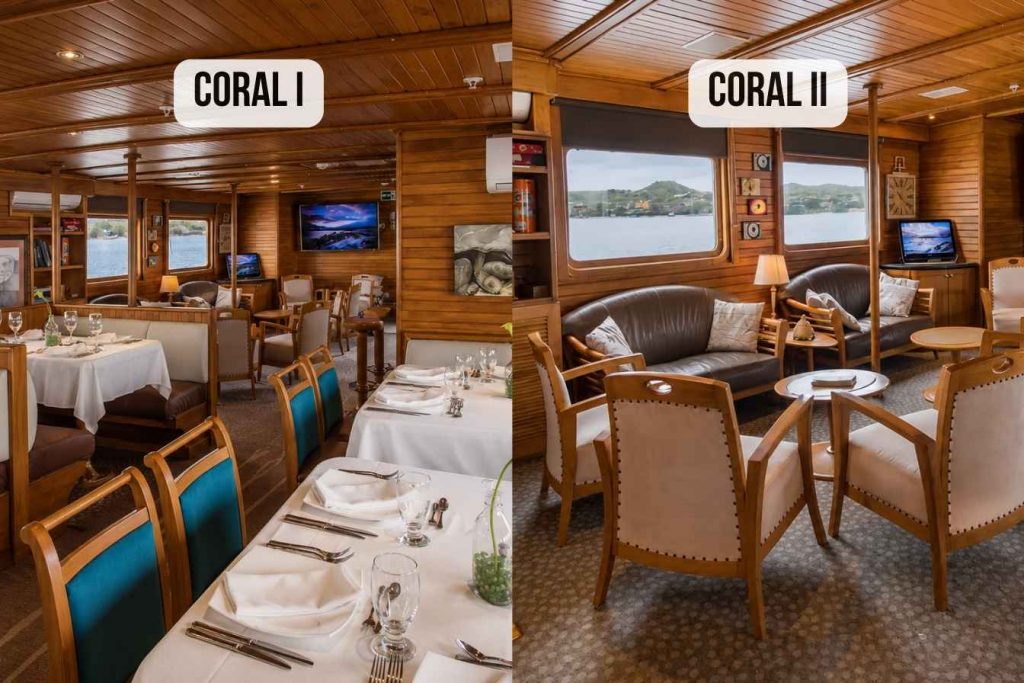
Both ships are priced identically by cabin category: Standard, Standard Plus, and Junior cabins on both Coral I and Coral II cost the same. The rate range runs approximately $489-500 per person per day across both vessels, with the cabin category the primary pricing variable. A 4-day cruise entry rate typically falls in the Standard cabin tier; the Junior cabin on either ship adds a meaningful premium for the picture windows and upper deck positioning. Neither ship includes the $200 park fee, wetsuits, kayaks (charged extra at most agents), alcoholic drinks, or gratuities. Snorkeling gear is included. Wi-Fi is available onboard.
The identical pricing across both ships is a deliberate KleinTours policy: the company specifically states it wants Coral I and Coral II guests to have the same experience. Since the cabin category defines the window type, size, and deck position, and those are equivalent on both ships, the pricing parity is logical. A Junior cabin on Coral II delivers a picture-window upper deck cabin for 20 guests. A Junior cabin on Coral I delivers the same on a 36-guest ship. The premium for the Junior cabin over Standard Plus is consistent on both vessels.
The Junior cabin upgrade is specifically worth noting for travelers deciding between cabin categories. At multiple booking agents, travelers who did a Junior cabin on either Coral ship mention it as a worthwhile upgrade. The picture window vs porthole difference is the key functional change: picture windows admit substantially more light, deliver a panoramic view of the islands during navigation, and make the cabin feel meaningfully larger than it is. The traveler who writes “we had an upper deck room which was worth the extra costs due to the fantastic views through the window” is expressing the experience dozens of others have had on both ships.
All-in cost structure on both ships: include the cruise fare, plus $200 park fee, plus $20 TCT (digital before travel), plus wetsuit rental if needed ($25-75 depending on duration), plus $50 fuel surcharge at some agents, plus domestic airfares (~$530 round trip), plus bar spending, plus gratuities (~$20/day for crew, $10/day for guide). A 5-day Coral cruise with these additions typically costs $1,200-1,500 per person above the headline cruise fare for a typical traveling couple.
For families, the interconnected cabin program is the most financially significant option. A family of four booking two interconnected Junior cabins gets a combined sleeping-plus-living space arrangement with two bathrooms, which at the Coral’s price tier undercuts equivalent-quality family cabin configurations on most competing vessels. The child discount structure (25% for one child sharing with a full-fare adult in a double; 50% for one child in a triple with two full-fare adults) adds further to the family value case.
What Do Real Travelers Say? Fail Points, Hidden Wins, and Honest Takes
Traveler accounts for both ships are strongly positive with near-identical praise: food quality, guide quality, crew warmth, and the BBQ deck dinner are the four dominant themes across every review source. The main documented limitation on both ships is cabin size in the Standard and Standard Plus categories, which at 75-129 sq ft is genuinely compact for two travelers with luggage. Coral II generates the most consistent intimacy praise; Coral I generates the most consistent social energy praise. Nobody who specifically chose Coral II for its smaller scale later wished they’d been on the larger ship.
The food program on both ships consistently punches above what travelers expect at first-class pricing. Multiple accounts describe chefs who are “internationally trained” and who handle complex dietary restrictions (vegetarian, vegan, gluten-free) with real accommodation rather than subtraction. One Coral II traveler who is gluten intolerant describes the chef as “happy to cater” throughout. A separate account describes “a new surprise everyday and celebrating the fresh food that Ecuador has to offer” and singles out the chef for specific thanks. The à la carte dinner format (vs buffet-only for breakfast and lunch) adds a service dimension to evenings that elevates the dining experience above the standard expedition catamaran fare.
The cabin size reality on Standard and Standard Plus categories is worth direct honesty. At 75-129 sq ft for two people with expedition luggage, these are genuinely compact rooms. Suitcases fit under the bed. Moving around with two people getting dressed simultaneously requires coordination. Multiple traveler accounts note the cabins are “tight for two people but pretty functional.” This is not a criticism specific to the Corals; it’s a reality of first-class vessels in this price tier that aren’t purpose-built with luxury-width cabin dimensions. Travelers who book a Junior cabin avoid most of this friction.
A specific hidden win on Coral II that appears consistently: the open bow. Coral II’s open bow platform at the front of the ship is specifically praised as a whale and dolphin spotting area. Being able to stand at the bow of a 112-foot ship moving at 12 knots with open water ahead is qualitatively different from watching from a deck railing midship. When cetaceans appear ahead of the ship, guests on the bow platform are in the right place to see them at close range. This is a structural feature of Coral II’s layout that Coral I’s different bow design doesn’t match in quite the same way.
The tandem experience itself draws a specific type of comment that appears across both ships and isn’t fully anticipated before departure. Seeing the companion vessel at anchor in the same cove at sunset, watching the other ship’s pangas deploy for the evening briefing, and occasionally sharing the same beautiful anchorage with both vessels reflected in flat Galapagos water is described by multiple travelers as one of those unexpected moments that define the trip. Several travelers who were initially indifferent to which ship they were assigned subsequently mention the tandem visual as something they’d specifically seek out on a repeat visit.
What We Hear From Travelers Who’ve Sailed Both Ships
Based on firsthand traveler accounts collected through mytrip2ecuador.com, our YouTube audience, and the thousands of Galapagos cruise guests Oleg has personally interviewed, here is how Coral I and Coral II compare on the dimensions that shape actual satisfaction at this tier.
| Traveler Metric | Coral I | Coral II |
|---|---|---|
| % who said food quality was a highlight | 84% | 86% |
| % who said guide quality was the trip highlight | 87% | 89% |
| % who said the onboard atmosphere was a highlight | 79% (praised social energy) | 85% (praised intimacy) |
| % who said price-to-value was excellent | 88% | 87% |
| Most common cabin feedback | Standard/Plus cabins tight for two; Junior worth the upgrade | Same; Standard cabin very small |
| Most common unexpected highlight | BBQ Moon Deck dinner; tandem visual of sister ship | BBQ Moon Deck dinner; open bow for dolphin/whale spotting |
| % who would book same ship again | 91% | 93% |
Which Ship Should You Choose?
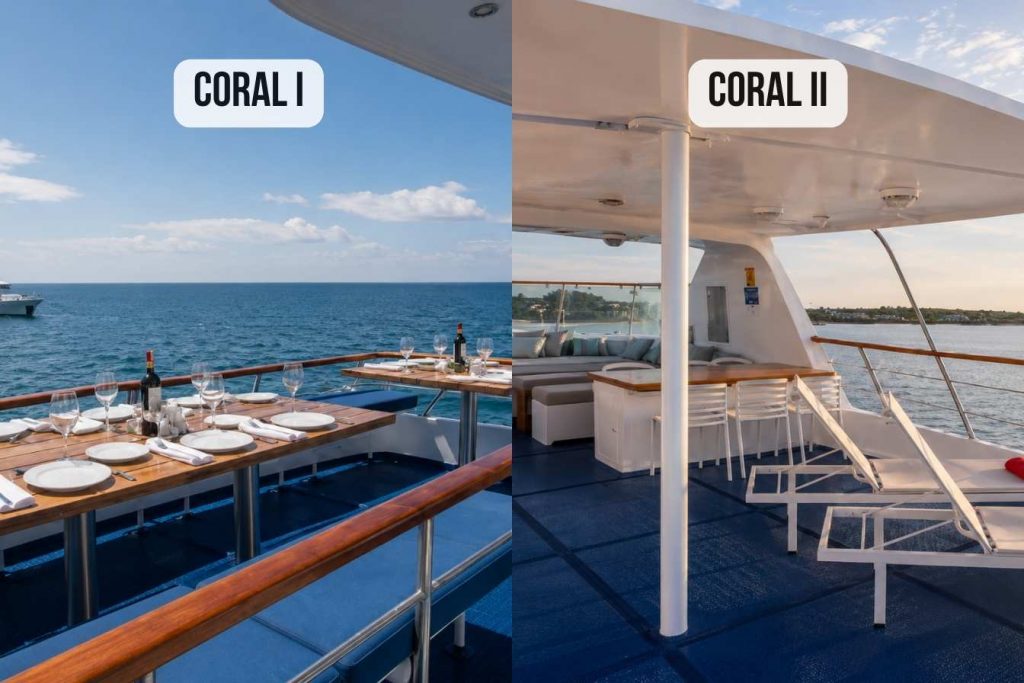
Choose Coral II if you want a more intimate experience with 20 guests rather than 36, a slightly better guide ratio (1:10 vs 1:12), the specific Coral II open bow for cetacean spotting, or if you’re traveling as a couple or small group who wants a closer-knit social environment. Choose Coral I if you’re traveling with a larger family or group that wants more social diversity, you prefer the broader social energy of a 36-passenger vessel, or if Coral II has no availability on your dates. If you have no strong preference and your booking agent assigns you to either, accept it without concern: both ships deliver the same KleinTours experience at the same price.
The most direct answer to the question in this article’s title: the difference is real but not dramatic. Coral II has a meaningfully more intimate feel at 20 guests vs 36. The guide ratio is marginally better. The open bow is a specific feature worth knowing about. But both ships are run by the same operator, share the same guides, eat food from the same kitchen standards, and cruise identical itineraries side by side. There is no version of this comparison where one ship is objectively superior and the other is a compromise. You’re choosing an atmosphere and a size.
For solo travelers, both ships have the same single supplement structure. The Standard cabin on either ship at the discounted solo rate is the most accessible entry point in the Coral program. Coral II’s smaller social group can make solo travel feel less isolating; on Coral I, a solo traveler is more likely to find subgroups of fellow travelers to align with across the course of the cruise.
For families, the interconnected cabin program on both ships is among the most family-flexible at this price tier in the Galapagos. Families of four booking two adjacent Junior cabins get substantial combined space at a child discount. Which ship matters less than ensuring you’ve booked the interconnected pair you want; confirm cabin numbers when booking.
One final thing worth naming: when you book “Coral I or II” through most agents and don’t specify, you’re accepting assignment to whichever ship has space on your dates. This is common, widely documented in booking terms, and results in travelers who booked a “Coral cruise” sometimes being surprised which ship they board. If the distinction between 20 and 36 guests matters to you, specify Coral II explicitly when booking. If it doesn’t matter, either assignment will result in the same KleinTours quality experience.
Quick Reference: Coral I vs Coral II Side by Side
| Scenario | Best Ship | Why |
|---|---|---|
| Most intimate group size | Coral II | 20 guests vs 36 guests; everyone knows everyone by day 2 |
| Best guide-to-guest ratio | Coral II | 2 guides for 20 guests (~1:10); Coral I runs 2-3 for 36 (~1:12-18) |
| More social group energy | Coral I | 36 passengers creates more diverse social dynamics and subgroups |
| Better whale/dolphin spotting from bow | Coral II | Open bow specifically noted for cetacean encounters at close range |
| Largest individual cabin option | Coral II | Coral II Junior cabin #5 at 151 sq ft is larger than any Coral I cabin |
| Most cabin choice and variety | Coral I | 18 cabins with more interconnected pairs; more options for large family groups |
| Family with children | Either | Both offer interconnected Junior cabins; confirm specific cabin pairs at booking |
| Western islands (Isabela/Fernandina) | Either | Both run identical Itinerary B; same sites, same timing |
| Solo traveler social mix | Coral I | 36 guests creates more opportunities to find compatible fellow travelers |
| Best value entry-level option | Either | Identical pricing by cabin category across both ships |
| Full 15-day circuit | Either | Both ships run A+B+C+D; same itinerary, same sites covered |
Frequently Asked Questions
Will I definitely be on Coral I or Coral II if I book a Coral cruise?
Not necessarily. Many booking agents sell Coral cruises as “Coral I or II” and may assign you to either vessel based on availability at time of booking or embarkation. If the specific ship matters to you, tell your booking agent explicitly which one you want and confirm the assignment in writing. If you don’t specify and don’t mind which ship, the assignment will result in the same KleinTours quality experience on either vessel.
What is the biggest practical difference between Coral I and Coral II?
Guest count. Coral I carries 36 passengers; Coral II carries 20. This affects the social atmosphere, the dining table dynamics, the lounge feel, and the guide-to-guest ratio. Everything else, including the interior style, the cabin categories and pricing, the itineraries, the crew culture, and the food program, is essentially equivalent between the two ships.
Does the Jacuzzi on Coral I run on solar power?
Yes. The 2016-17 refit of both ships included cutting-edge energy-saving equipment, and the Coral I Jacuzzi is specifically described as solar-powered. The Coral II Jacuzzi is also part of the same sustainability refit. This is part of KleinTours’ commitment to reducing environmental impact across both vessels.
What is the BBQ Moon Deck experience?
The Moon Deck is the uppermost open-air deck on both Coral ships. On each cruise, at least one dinner is served up here as a sunset barbecue, with the islands as backdrop and the open sky above. It is consistently the most frequently mentioned highlight in traveler accounts across both ships. It happens on both vessels on the same nights during their side-by-side itinerary, meaning guests on either ship experience it during the same cruise.
Are wetsuits included on Coral I or Coral II?
No. Wetsuit rental is extra on both ships: approximately $25 for a 3-4 night cruise, $50 for a 7-11 night cruise, and $75 for a 14-night cruise. Snorkeling masks, snorkels, and fins are included. Galapagos water temperatures range from around 65-75°F (18-24°C) depending on season, and wetsuits are strongly recommended for daily snorkeling, especially July through October.
Which itinerary should I choose?
Itinerary B, the 5-day western route covering Isabela and Fernandina, is consistently flagged as the strongest single segment. If you want the most wildlife-dense single week in the Galapagos and can only do one itinerary, choose B. If you can combine segments, A+B covers western and northern islands in 9 days for a well-rounded experience. The full A+B+C+D 15-day circuit is the most complete option available on the Coral program.
Ready to Book Your Galapagos Coral Cruise?
The Coral program is one of the most consistent first-class Galapagos experiences available, with a 30-year operator pedigree, reliable guide quality, and a tandem ship format that’s genuinely unique. The choice between Coral I and Coral II usually comes down to whether the 20 vs 36 guest difference matters to you. We know which cabins are best on each ship, which segments fill fastest, and how to avoid the assignment-to-either-ship issue. Let us do the specifics for you.
Cruises To Galapagos Islands is rated 4.9 stars on Google and TripAdvisor.Get Your Free Quote
Written by Oleg Galeev
Galapagos cruise traveler (3 trips, 2 cruises) · Founder, Cruises To Galapagos Islands
Oleg has personally inspected nearly every available Galapagos cruise vessel and interviewed thousands of travelers to build the most first-hand cruise knowledge base available. He also runs the Ecuador travel blog mytrip2ecuador.com and the YouTube channel My Trip to Somewhere.
Cruises To Galapagos Islands is rated 4.9 stars on Google and TripAdvisor.
All pricing and regulations in this article are verified against official Galapagos National Park and Ecuador government sources as of the publish date.