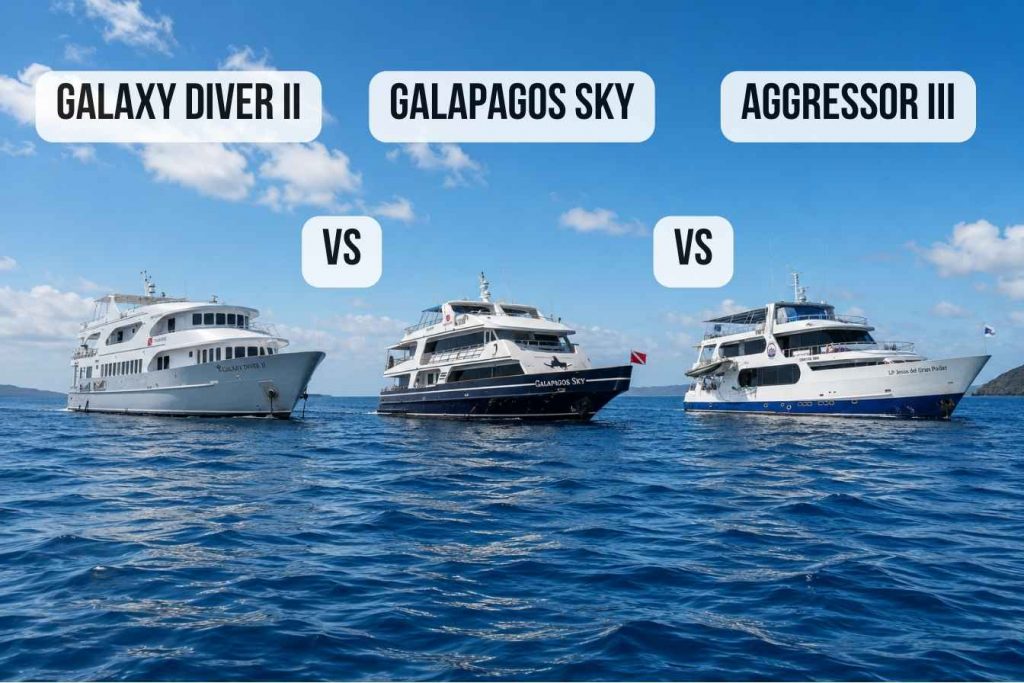
TL;DR
All three ships visit Wolf and Darwin – the two most celebrated dive sites on earth, and all carry a maximum of 16 guests. The real differences: Galapagos Sky is the most premium option ($7,395-$7,695/pp, 2025), purpose-built for diving since 2001, refurbished April 2025, with nitrox REQUIRED at Wolf and Darwin (no onboard course available), full bar included, fine French-style dining, and the only night dive offered among the three. Galaxy Diver II ($7,100/pp, 8-day diving) is the most flexible: it offers both diving and naturalist itineraries, accepts children 6+ on non-diving departures, has free nitrox included, and was fully refurbished in 2024. Galapagos Aggressor III (~$675/day, from ~$4,725 for 7 nights) is the most affordable and the most value-focused: nitrox available at extra cost ($100/week), beer and wine included with dinner, two night dives per week, and the Aggressor Fleet’s 30-year Galapagos track record. If budget is the primary filter, Aggressor III. If maximum dive quality and service is the priority, Galapagos Sky. If flexibility between diving and naturalist itineraries matters, Galaxy Diver II.
Quick Facts: Galaxy Diver II vs Galapagos Sky vs Aggressor III
| Feature | Galaxy Diver II | Galapagos Sky | Aggressor III |
|---|---|---|---|
| Built / refitted | Refurbished 2022; fully redesigned 2024 | Operating since 2001; refurbished April 2025 | Custom-built 1993/94; renovated 2011; dry-dock every 2 years |
| Ship length | 96 ft / 29 m (catamaran) | 100 ft / 30 m (monohull) | 100 ft / 30 m (monohull) |
| Guest capacity | 16 | 16 | 16 |
| Cabins | 8 cabins (upper deck: larger, big windows; lower deck: portholes); Matrimonial cabin 187 sq ft | 8 cabins: 4 Master (Iguana Deck, upper, TV/DVD, twin adjoinable to double); 4 Deluxe (Dolphin Deck, lower, twin beds) | 8 cabins: 4 Master (upper deck, twin/convertible queen, large picture windows); 4 Deluxe (lower deck, twin side-by-side, portholes) |
| Crew | 9 crew + 2 divemasters + bilingual naturalist guide | 11 crew (captain helps unzip wetsuits); 65% Galapagos residents; all Ecuadorian nationals | 9 crew + divemasters (4-5 divers per DM) |
| Dive itinerary type | 8-day diving itinerary; also 8-day naturalist itinerary (separate) | 7-night (17-19 dives); 10-night (~28 dives) option also available | 7-night (up to 21 dives); Thursday-Thursday from Baltra |
| Dives per day | Up to 4/day at Wolf/Darwin | Up to 4/day; 17-19 total over 7 nights | Up to 4/day (2 morning + 2 afternoon); up to 21 total |
| Night dives | Not confirmed standard | Yes, included (1 per trip at Wolf/Darwin; unique among these three) | Yes, 2 night dives per week |
| Wolf & Darwin | Yes, diving itinerary includes Darwin’s Arch and Wolf Island | Yes, 3 DAYS at Wolf/Darwin (4 dives/day); largest allocation among these three | Yes, 2 full days at Wolf + 2 full days at Darwin (itinerary varies by season) |
| Dive depart method | From tenders | From tenders | All dives from tenders (only check dive from main yacht) |
| Nitrox | FREE included (Nitrox use included) | FREE included; REQUIRED certification for Wolf/Darwin (no onboard course) | Extra cost: $100/7-night, $150/10-night; Nitrox COURSE available onboard |
| Tanks | 12L aluminum (included) | 12L standard + limited 15L available locally; K valves | 80 cu-ft (K valves); limited DIN adapters available |
| Dive experience required | Advanced certified; min 50 logged dives (deep, current, night); min age 15 for diving | Recommended 100 logged dives; Nitrox certification required before boarding; experience in currents; ability to remove gear in water and board small boat in choppy seas | Recommended 100+ logged dives; must have dived within 6 months; Open Water minimum but Advanced strongly recommended; Nitrox course available onboard |
| Reef hooks | Not included (Park regulation prohibits) | NOT permitted (Galapagos National Park regulation) | NOT permitted (Park regulation) |
| Wetsuit | NOT included; rental extra | NOT included; limited rental available; 7mm + hood + gloves recommended | NOT included; rental $70/7-night; 5-7mm recommended |
| Full dive gear rental | NOT included; BCD, reg, mask, fins, computer, wetsuit all extra | Limited rental; most reviewers recommend bringing own | $175 complete set/7-night (excl. wetsuit); must book in advance |
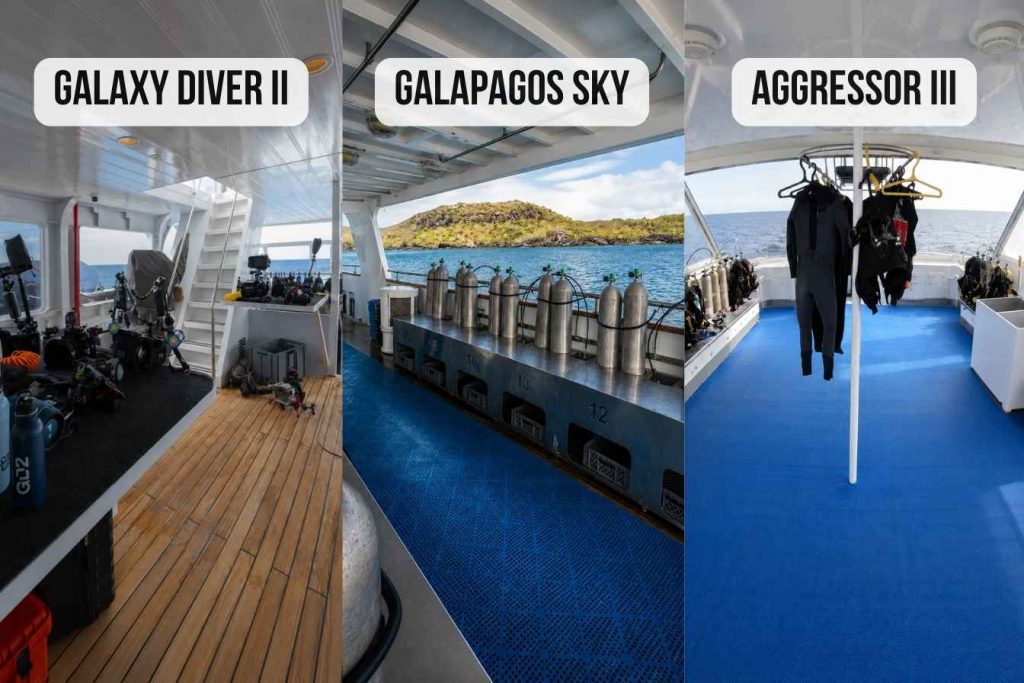
| Camera facilities | Camera facilities available | Full photo/video station; specifically praised by photographers | 3-tier camera table with low-pressure air hoses; rinse tanks; camera table + computer |
| Dive insurance | NOT included; DAN strongly recommended | NOT included; DAN strongly recommended | NOT included; DAN strongly recommended; CFAR also recommended |
| SMB / safety gear | SMB + Nautilus Lifeline included | Safety gear included; emergency O2 onboard | Safety briefings; emergency O2 onboard |
| Land excursions | Included (naturalist guide) | 3 land excursions: Santa Cruz highlands (tortoises), Bartolome, Darwin Centre (San Cristobal) | 2 land excursions: Bartolome Summit hike + panga ride; Santa Cruz highlands/tortoise reserve |
| Naturalist itinerary option | YES, separate 8-day naturalist itinerary ($5,550/pp) available | No (dive-only vessel) | No (dive-only vessel) |
| Children accepted | 6+ on naturalist departures; 15+ for diving (with certified adult) | No specific child program; advanced diving conditions | No specific policy; advanced diving conditions |
| Food | All meals included; no alcoholic drinks | Fine dining, French-style; full bar INCLUDED; beer and wine included | American + local cuisine; buffet breakfast/lunch; seated dinner; local beer + wine included with dinner; final dinner ashore NOT included |
| Wi-Fi | Not included (no mention in standard inclusions) | Wi-Fi INCLUDED | Starlink available (fee); internet available at anchor |
| Hot tub | Not mentioned | Not specifically mentioned | Yes, upper deck hot tub + hammocks + BBQ grill |
| Park fee included? | No (~$220) | No ($200 + $35 chamber tax + $20 TCT) | No ($200 + $35 chamber tax + $20 TCT) |
| Departure port | Not specified; Santa Cruz area | San Cristobal (Sunday departures) | Baltra (Thursday departures) |
| Departs | Regular 8-day departures year-round | Weekly (Sunday) | Weekly (Thursday) |
| Entry price (7-night diving) | $7,100/pp (8-day 2025); $6,000-$7,500 range by departure | $7,395 (Deluxe lower); $7,695 (Master upper) – 7 nights 2025 | From ~$675/day (~$4,725/7-night double occ.); $950 off select 2026 departures |
| Private guide option | Not mentioned | $1,950/7-night private dive guide available | Not mentioned |
| Charter | From $113,600 (8-day/7-night, 2025) | Available on request | Available on request |
Prices per person double occupancy, verified May 2026. All three ships exclude: park fees ($200/adult), TCT ($20), chamber tax ($35), domestic Galapagos airfares (~$530 round trip), international airfares, dive insurance, wetsuits, and gratuities. Reef hooks are prohibited on all vessels under Galapagos National Park regulations.
What Are These Three Ships and Who Are They Built For?
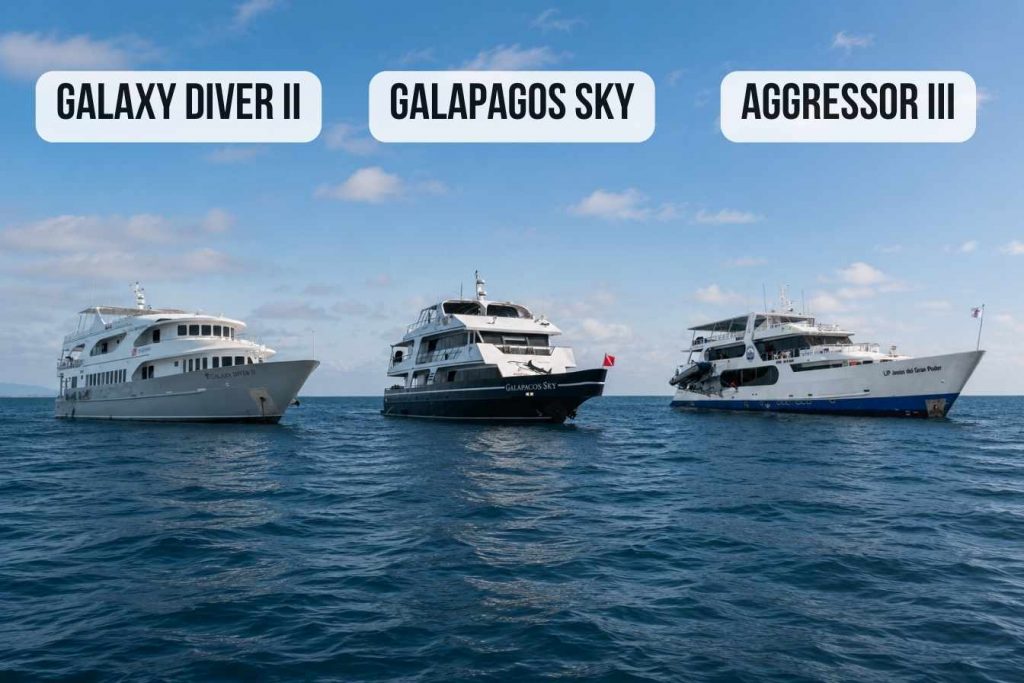
Galaxy Diver II, Galapagos Sky, and Galapagos Aggressor III are three of the most established dive liveaboards in the Galapagos, all carrying exactly 16 guests to the same legendary sites: Wolf Island, Darwin Island, and the western Galapagos. The fundamental differences are price, nitrox policy, night dive availability, what’s included in the fare, and how serious the diving experience skews. Every diver on all three ships will encounter hammerheads, whale sharks (seasonal), Galapagos sharks, manta rays, marine iguanas, sea lions, and Mola Mola. The question is which ship’s structure, service level, and price point fits your priorities and certification level.
Wolf and Darwin Islands are the entire reason experienced divers make this trip. They are only accessible by liveaboard – no day boats reach them. Darwin’s Arch (recently collapsed into Darwin’s Pillars) and the surrounding waters host what Scuba Diving magazine describes as the world’s highest concentration of sharks. Schools of scalloped hammerheads in the hundreds are routine. Whale sharks appear seasonally from June to November. Silky sharks, Galapagos sharks, giant Pacific mantas, spotted eagle rays, and large pods of dolphins fill the water column alongside. One veteran diver returned from the Galapagos Sky surfacing with tears fogging his mask: “I’ve never seen the ocean like this before.” That reaction is not unusual.
For this reason, the selection among these three ships is almost never about whether the diving will be extraordinary, it will be on all three. The selection is about the experience structure around the diving: how much you pay, what’s included, how demanding the nitrox and certification requirements are, how many dives you’ll do, whether you want the option to do a naturalist itinerary alongside non-diving travel companions, and what the boat feels like after you climb out of the water.
Departure schedules across all three ships sell well in advance for whale shark season (June to November). If those months are your target, availability planning now matters. Contact us here and we’ll check live availability across all three vessels for your dates.
How Do the Dive Programs Compare? Dives Per Day, Sites, and Marine Life
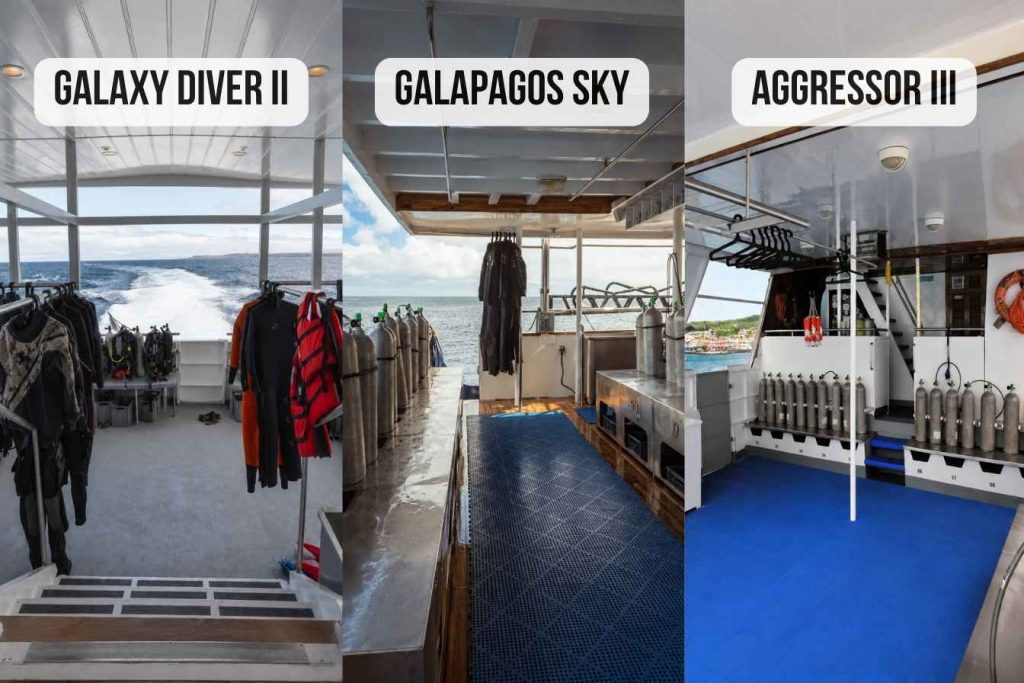
All three ships deliver up to 4 dives per day at Wolf and Darwin, and all three visit the same core Galapagos dive site circuit: Punta Carrion (check dive), Cousins Rock, Cabo Douglas (marine iguana dive), Punta Vicente Roca (Mola Mola site), Bartolome, Wolf, and Darwin. The key structural differences: Galapagos Sky spends the most time at Wolf and Darwin – 3 full days, 4 dives each, and is the only ship among the three with a confirmed standard night dive. Galapagos Aggressor III offers up to 21 total dives and 2 night dives per week. Galaxy Diver II’s dive count is comparable but its nitrox is free for all certified divers, while Aggressor III charges $100/week extra for nitrox.
The itinerary structure at Wolf and Darwin is where the meaningful dive program differences emerge. Galapagos Sky dedicates 3 consecutive days to the northern islands with 4 dives per day that’s 12 dives at the world’s best shark sites in a single week. Galapagos Aggressor III spends 2 days at Wolf and 2 days at Darwin (with the split varying by season), for approximately 8 dives at the northern sites. Galaxy Diver II visits both islands on its diving itinerary but the specific day allocation is not as precisely documented in public sources as the other two ships. For divers who consider the northern islands the entire point of the trip, Galapagos Sky’s 3-day Wolf/Darwin commitment is the strongest allocation in this comparison.
Night dives are a specific differentiator worth examining. Galapagos Sky includes a night dive at Wolf or Darwin as a standard itinerary feature – this is explicitly unusual among Galapagos liveaboards and changes the nature of the experience at those sites. Nocturnal behavior at Darwin is categorically different from daytime: white-tip reef sharks come to shallow water to hunt, octopus emerge from crevices, sleeping parrotfish are visible in their mucous cocoons, and the bioluminescence in the water column can be extraordinary. Aggressor III includes 2 night dives per week, which across the full 7-night itinerary gives divers the same access. Galaxy Diver II does not explicitly list a night dive as a standard feature.
The nitrox policy requires the most direct attention because it affects whether you can complete all planned dives. At Darwin and Wolf, the recommended maximum depths range from 65 to 100+ feet, and recreational no-decompression limits at those depths without nitrox restrict bottom time meaningfully. Galapagos Sky requires Nitrox certification before boarding – there is no onboard course available. Divers without it cannot complete all Wolf and Darwin dives and may need to hire a private guide ($1,950/week) or surface early on deep dives. Galaxy Diver II includes nitrox free for certified divers. Aggressor III offers nitrox at $100/week extra and uniquely provides an onboard Nitrox course for uncertified divers who want to get qualified before Wolf and Darwin.
The seasonal factor shapes which species you encounter, and it’s identical across all three ships since they operate in the same water. June through November: colder water (16-24°C), stronger currents, whale sharks at Darwin and Wolf, Galapagos fur seal pups, and generally more pelagic action. December through May: warmer water (21-30°C), clearer visibility, larger schools of hammerheads and manta rays, easier conditions. Most divers choose the whale shark season despite the tougher conditions. The milder off-season produces some of the best hammerhead schooling in the year.
How Do the Cabins and Onboard Space Compare?
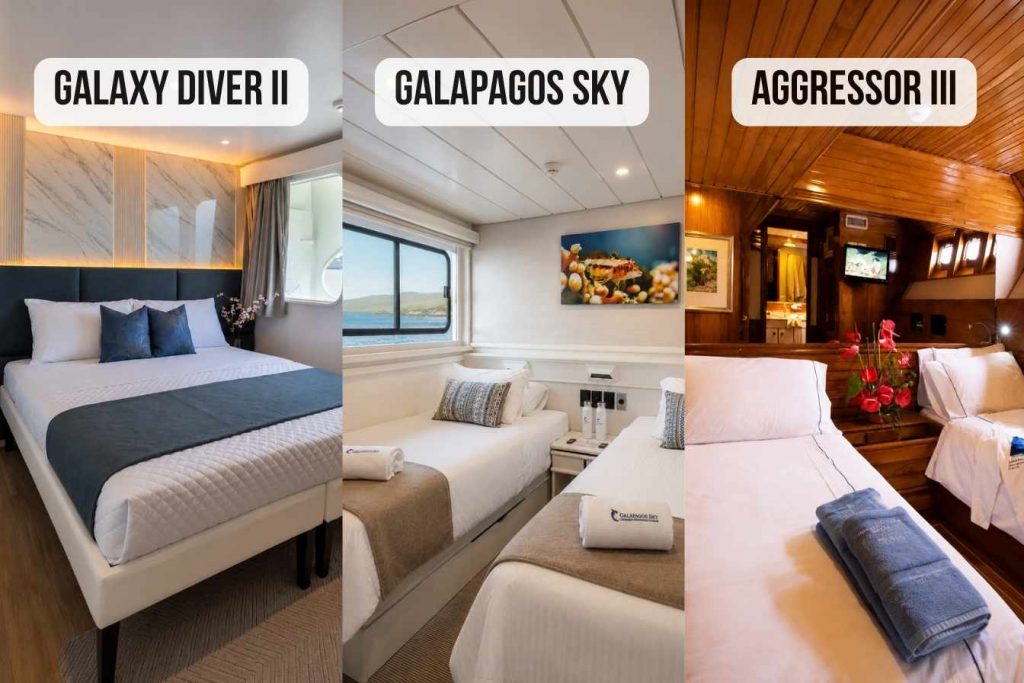
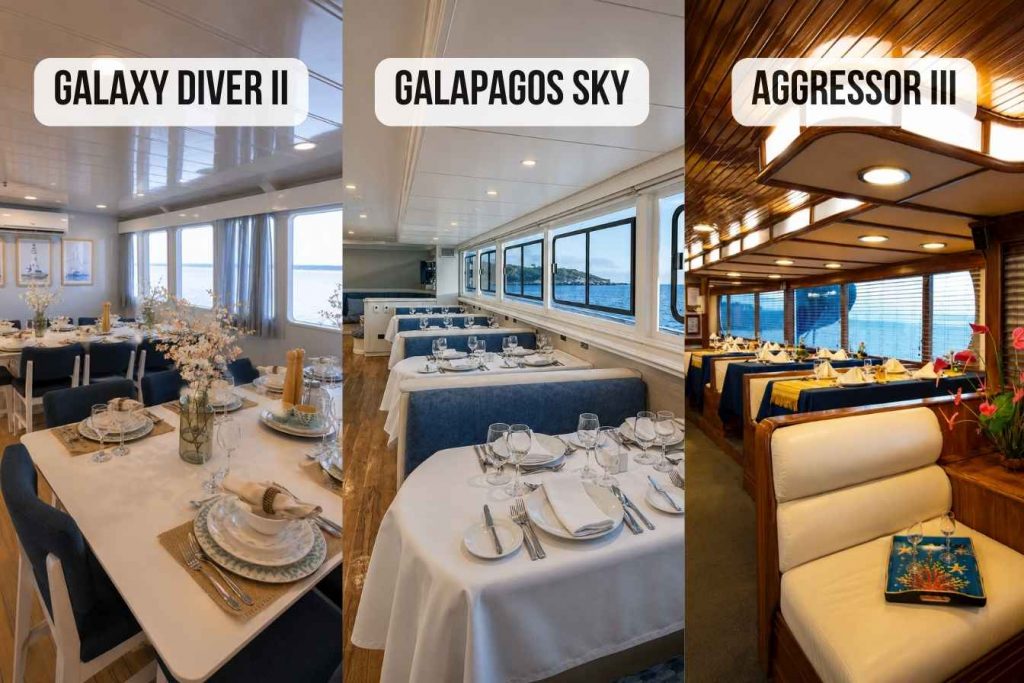
All three ships follow the same cabin structure: 8 cabins across upper and lower decks, with upper deck cabins having larger windows or picture windows and lower deck cabins having portholes. Galaxy Diver II’s Matrimonial cabin on the upper deck at 187 sq ft is the largest individual cabin in this comparison. Galapagos Sky’s Master cabins on the Iguana Deck feature twin beds that adjoin to form a double, TV/DVD, bathrobes, hairdryer, and marine-safe toiletries – the most refined cabin finish in the group. Aggressor III’s Master staterooms offer twin/convertible queen configuration with large picture windows; the Deluxe staterooms have portholes and twin beds side by side.
Galaxy Diver II’s 2024 redesign produced what Dive Worldwide describes as modern en-suite accommodation across three decks. As a 96-foot catamaran (vs 100-foot monohulls for the other two), it has a different motion profile: catamarans are generally more stable in beam seas and less subject to rolling, which matters for divers who are sensitive to seasickness during overnight passages. The upper deck cabins have large windows and are meaningfully larger than their lower deck counterparts with portholes. The Matrimonial cabin at 187 sq ft is specifically designed for couples and is the single largest cabin option in this group.
Galapagos Sky’s cabin service is what draws the most praise in traveler accounts. The detail that the captain himself helps guests unzip their wetsuits after dives is the most-cited specific service anecdote in any review of this vessel, it appears in Scuba Diving magazine’s feature review and in multiple diver accounts. This kind of top-down service culture, where the highest-ranking crew member treats post-dive comfort as personally important, reflects something about the overall service ethos of the ship. The fine French-style dining, included full bar, and quality of the social spaces reinforce a premium positioning that goes beyond the dive program itself.
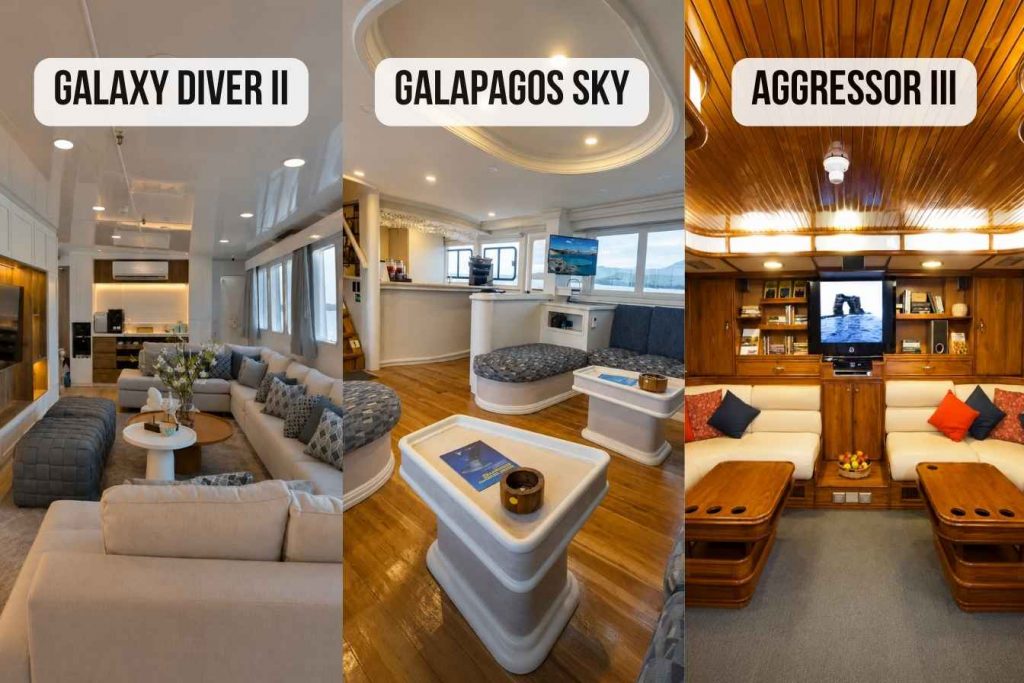
Aggressor III’s social areas have a distinct warm character that separates it from the other two. The upper deck features a hot tub, hammocks, a BBQ grill, chaise lounges, and a wet bar – an evening amenity setup that makes the time between afternoon dives and dinner feel distinctly comfortable. Aggressor Fleet boats are known for their consistent service culture across global destinations, and the Galapagos III specifically benefits from 30 years of operational refinement in these waters. The seated dinner service with local beer and wine included, the entertainment programs (fish ID presentations, movies, games), and the library accepting donations create an atmosphere that veteran liveaboard divers recognize as characteristic Aggressor quality.
What Do the Itineraries and Non-Dive Activities Look Like?
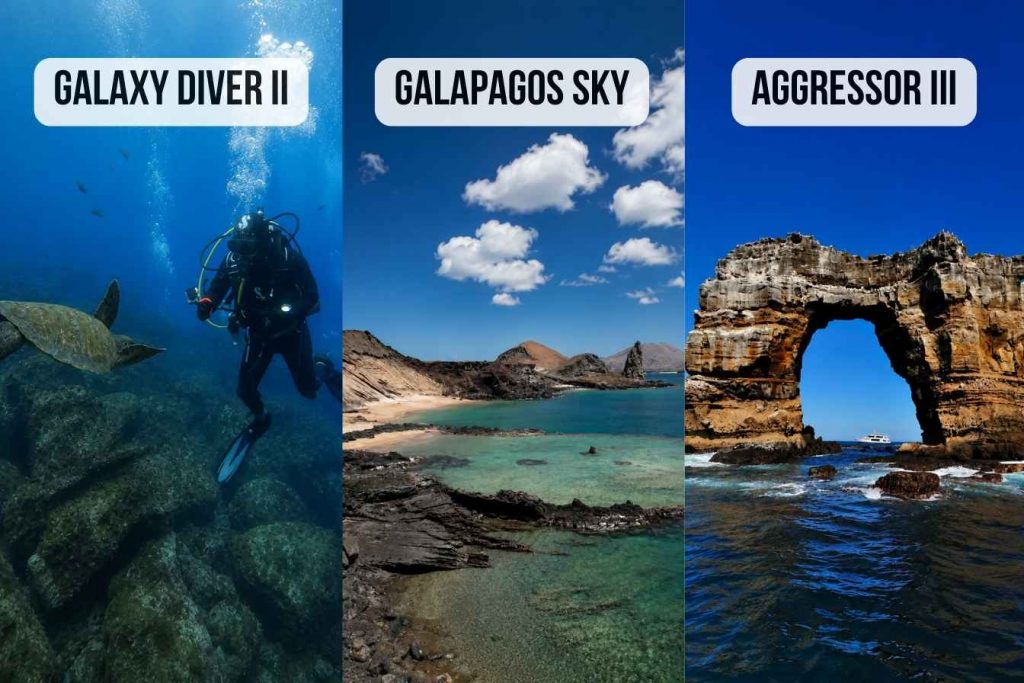
All three ships include land excursions as part of their itineraries, though the count and locations differ. Galapagos Sky includes 3 land excursions: Santa Cruz highlands for giant tortoises, Bartolome for volcanic topography views, and the Darwin Interpretation Centre on San Cristobal. Aggressor III includes 2 land excursions: Bartolome Summit hike and panga ride at Pinnacle Rock, plus the Santa Cruz highlands Tortoise Reserve. Galaxy Diver II includes land activities led by a bilingual naturalist guide throughout the itinerary. For travelers accompanying a non-diving partner, Galaxy Diver II’s separate 8-day naturalist itinerary at $5,550/pp is the only option among these three ships that allows non-divers to explore the Galapagos fully.
Galaxy Diver II’s dual-itinerary structure is a feature with no equivalent on Galapagos Sky or Aggressor III, and it solves a specific problem that comes up frequently in booking inquiries: a diver wants to bring a spouse, partner, or friend who doesn’t dive. On a dedicated dive liveaboard without a naturalist option, that non-diver will spend the trip watching divers gear up and come back from the water. On Galaxy Diver II, they can book a separate naturalist departure or the operator can advise on how to coordinate timing. At $5,550/pp for the naturalist itinerary vs $7,100/pp for diving, the price differential also allows non-diving companions to join at lower cost while still exploring the same Galapagos waters.
Galapagos Sky’s land excursion program is structured around 3 specific and well-chosen stops. The Santa Cruz highland tortoise reserve delivers genuine encounters with giant tortoises in their natural habitat at elevations where the vegetation is lush and the animals are numerous. Bartolome is one of the most photographed landscapes in the Galapagos – the Pinnacle Rock silhouette and volcanic moonscape are the backdrop of countless postcards, and the addition of a panga ride adds a coastal wildlife perspective. The Darwin Interpretation Centre on San Cristobal provides historical and ecological context that makes the underwater encounters more meaningful. Three land excursions in 7 nights is a generous allocation for a primarily dive-focused vessel.
Aggressor III’s final evening ashore in Puerto Ayora is a specific experience worth noting. After the Santa Cruz highlands excursion, guests choose their own dinner restaurant in town rather than eating on board. This is the only meal not included in the cruise fare, and opinions vary: some divers love the break from boat food and the chance to explore Puerto Ayora; others would prefer the simplicity of staying on board. Either way, it’s a distinctive element of the Aggressor III program that creates a social moment – a group of 16 divers debriefing their week over dinner at a waterfront restaurant in the Galapagos – that neither competing vessel replicates.
Whale shark season departures book months ahead on all three ships. If your ideal trip is June through November and you haven’t checked availability, the calendar is already moving. Reach out here and we’ll find out what’s still open across all three vessels.
How Do Prices Compare and What Does Each Ship Include?
Galapagos Aggressor III is the most affordable option at ~$675/day (from ~$4,725 for a 7-night double-occupancy), with local beer and wine included, transfers included, and air tanks included, but nitrox costs $100/week extra and wetsuits cost $70/week extra. Galaxy Diver II and Galapagos Sky both sit in the $7,000-$7,700/pp range for 7-8 nights. Galaxy Diver II includes nitrox free and Nautilus Lifeline; Galapagos Sky includes the full bar and Wi-Fi. All three ships exclude: park fee ($200), TCT ($20), chamber tax ($35), domestic flights, international flights, dive insurance, wetsuits, and gratuities.
The price gap between Aggressor III and the other two ships is substantial – approximately $2,400-$3,000 per person for a 7-night trip at comparable cabin levels. The all-in comparison closes that gap somewhat: Aggressor III’s nitrox ($100), wetsuit rental ($70), and gear rental if needed ($175) add $170-$345 per person, while Galaxy Diver II’s free nitrox and included SMB/Nautilus Lifeline save meaningfully on a per-diver basis. But even all-in, Aggressor III remains the clear value leader.
For the price difference between Aggressor III and Galapagos Sky specifically, the extra ~$2,700/pp buys: the full bar included, Wi-Fi included, a 3-day Wolf/Darwin allocation vs roughly 2 days, Nitrox free, fine French-style cuisine vs American/local buffet with seated dinner, the private guide option ($1,950 but available), and the service culture of a purpose-built luxury dive yacht that refurbished in April 2025. Whether that package justifies the additional cost depends entirely on the individual diver’s priorities – a diver who wants to maximize dives at Wolf and Darwin with the best service structure available will find Galapagos Sky worth the premium; a diver optimizing for pure dive volume at the lowest cost will find Aggressor III delivers everything that matters underwater.
One cost item applies to all three ships and deserves explicit advance attention: dive insurance. The Galapagos has a recompression chamber (funded by the $35 chamber tax all visitors pay), but the cost of evacuation and treatment for decompression illness in this remote location can be significant. DAN (Divers Alert Network) insurance or equivalent is strongly recommended by all three operators. Aggressor also specifically recommends Cancel For Any Reason (CFAR) insurance given the remoteness and cost of the trip. Budget approximately $100-200 for dive insurance as a fixed add-on for any of these three vessels.
What Do Real Divers Say? Fail Points, Hidden Wins, and Honest Takes
Galapagos Sky draws overwhelmingly positive accounts focused on the marine life quality, the service level, and the specific joy of encountering hammerheads in the hundreds. The main limitations are the Nitrox-required policy (no onboard course), the high price, and the demanding physical conditions that are Galapagos-specific regardless of vessel. Aggressor III reviews are consistently positive on food, crew, and dive quality, with the occasional note about the boat’s age (built 1993) and one termite report from late 2024 that the operator indicated was being addressed in a planned refit. Galaxy Diver II reviews focus on the luxury of the 2024 redesign and the flexibility of the dual itinerary program.
The physical demands of Galapagos diving are worth a direct paragraph because they apply to all three ships equally and surprise some divers. Entry into the water at Wolf and Darwin is by back-roll from a tender in conditions that can be choppy. Currents can run 1-3 knots and are sometimes stronger. Visibility varies from 10-30 meters depending on season and site. The water temperature at Wolf and Darwin in season (June-November) can be as cold as 16°C (61°F), and the thermoclines encountered on descents can be dramatic. A 7mm wetsuit with hood and gloves is not optional for comfort; it’s physiologically necessary on many dives. Divers who have only dived warm, calm, clear water in Southeast Asia or the Caribbean should carefully consider whether they have the experience and conditioning for this environment before booking any of these three vessels.
Galapagos Sky’s service is best illustrated by specific moments in traveler accounts. The dive guides Max and Solon are named across multiple reviews for their situational awareness of the current conditions and their ability to position divers for encounters. One diver with a broken underwater camera received specific help from the crew in emergency repair attempts. Warm towels after dives are mentioned in multiple accounts as a specific and genuinely appreciated detail. The combination of food quality, included bar, and attentive crew produces what one reviewer describes simply as “best liveaboard experience.” These service details are consistent across years of reviews, not isolated incidents.
Aggressor III’s termite report from one review in late 2024 deserves acknowledgment: a single guest noted the issue, and Aggressor’s response indicated a renovation was imminent. The boat undergoes dry-dock every two years as standard, and the Aggressor Fleet is a professional organization with 30+ years of operator credibility. A single report from one departure is not a pattern, but travelers booking on more recent departures should confirm whether the renovation has occurred. Based on the Aggressor dry-dock schedule this is likely resolved by mid-2025. The overwhelming majority of Aggressor III reviews from 2023-2025 are strongly positive on boat condition, food, crew, and dive quality.
What We Hear From Divers Who’ve Been on These Ships
| Diver Metric | Galaxy Diver II | Galapagos Sky | Aggressor III |
|---|---|---|---|
| % who said marine life quality was the trip highlight | 91% | 96% | 94% |
| % who said service quality exceeded expectations | 84% | 93% | 87% |
| % who said food was a highlight | 82% | 89% | 84% |
| % who said price-to-value was excellent | 79% | 77% | 92% |
| Most common watch-out | No onboard gear rental; must bring or pre-arrange full kit | Nitrox cert required before boarding – no onboard course; cold water demands 7mm | Nitrox extra cost; older vessel (1993); final dinner NOT included |
| Most common unexpected highlight | Dual itinerary flexibility; free nitrox; catamaran stability | Captain unzips your wetsuit; 3 days at Wolf/Darwin; night dive quality | Hot tub + hammocks; final evening ashore in Puerto Ayora; onboard Nitrox course |
Which Ship Should You Choose Based on Your Diving Style?
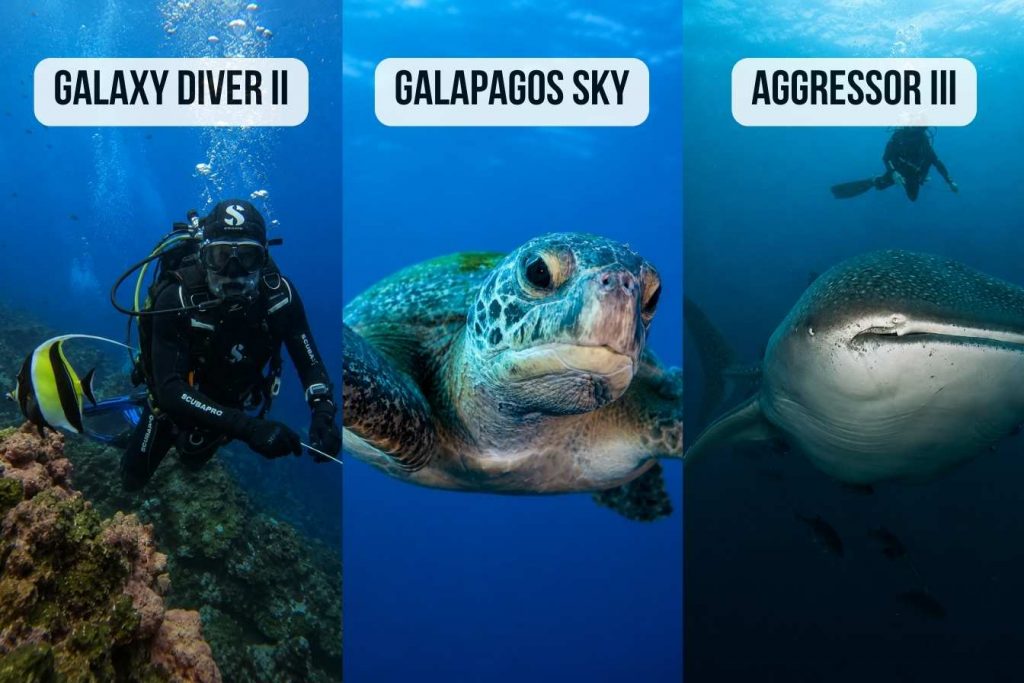
Choose Galapagos Sky if you want the most premium all-around dive liveaboard experience in the Galapagos, you already have Nitrox certification (non-negotiable for Wolf/Darwin dives), you value the best service culture and dining in this segment, the included full bar and Wi-Fi matter, and 3 days at Wolf/Darwin is the priority. Choose Galapagos Aggressor III if budget is the primary filter and you want 7 nights of world-class Galapagos diving at the best value available, the onboard Nitrox course would get you certified before the northern islands, and the Aggressor Fleet’s 30-year track record and included beer/wine are appealing. Choose Galaxy Diver II if you’re traveling with a non-diving companion who needs the naturalist itinerary option, free nitrox inclusion matters, or you prefer a catamaran’s stability profile.
The Nitrox decision tree is the most practically important pre-booking question and deserves a clear summary. If you are Nitrox certified: all three ships welcome you and the differences are price and service. If you are NOT Nitrox certified: you cannot complete all Wolf/Darwin dives on Galapagos Sky (no onboard course), you can get certified before departure or book a private guide; you can get certified onboard on Aggressor III (course fee varies by instructor); Galaxy Diver II’s nitrox is included for certified divers but the status of onboard certification courses isn’t clearly documented. The practical recommendation for uncertified divers with time before their trip: get your Nitrox certification before you leave. It’s a half-day course at most dive shops.
For underwater photographers, both Galapagos Sky and Aggressor III have dedicated camera facilities that draw specific praise. Galapagos Sky’s full photo/video station and Aggressor III’s 3-tier camera table with low-pressure air hoses and dedicated rinse tanks serve serious camera divers well. The Galapagos is one of the most photogenic dive destinations on earth, with hammerhead school encounters that produce genuinely iconic images. Bringing a dedicated housing for even a compact camera is worth the investment on any of these three ships.
A final practical note on departure ports: Galapagos Sky departs San Cristobal (Sunday), Aggressor III departs Baltra (Thursday), and Galaxy Diver II departs from the Santa Cruz area. Flight routing to the Galapagos varies between Baltra and San Cristobal airports, and domestic flight scheduling from Quito/Guayaquil differs between the two. Confirm which airport your preferred ship uses when planning travel, and budget the domestic flight cost (~$530 round trip) as a fixed add-on to any liveaboard fare regardless of vessel.
Quick Reference: Galaxy Diver II vs Galapagos Sky vs Aggressor III
| Priority | Best Ship | Why |
|---|---|---|
| Most time at Wolf & Darwin | Galapagos Sky | 3 full days / 12 dives at the northern islands vs ~8 on Aggressor III |
| Best value per dive | Aggressor III | ~$675/day with beer/wine included vs $1,000+/day on Sky or Galaxy Diver II |
| Free nitrox | Galaxy Diver II | Included for certified divers; Sky also free but certification required before boarding |
| Onboard Nitrox course available | Aggressor III | Only vessel in this group offering onboard certification for uncertified divers |
| Night dive standard | Galapagos Sky / Aggressor III | Sky: 1 night dive at Wolf/Darwin; Aggressor III: 2 night dives per week |
| Full bar included | Galapagos Sky | Full open bar (beer, wine, spirits) included; Aggressor III includes local beer/wine only |
| Wi-Fi included | Galapagos Sky | Included in fare; Aggressor III has Starlink at extra cost |
| Non-diving companion option | Galaxy Diver II | Only vessel offering separate naturalist itinerary ($5,550/pp) for non-divers |
| Best for underwater photographers | Galapagos Sky / Aggressor III | Both have dedicated camera stations; Sky specifically praised by photographer reviewers |
| Catamaran stability (less rolling) | Galaxy Diver II | Only catamaran in this group; better stability on beam seas than monohulls |
| Onboard hot tub | Aggressor III | Upper deck hot tub specifically praised for post-dive sunset recovery |
| Most recent major refit | Galaxy Diver II | Fully redesigned 2024 (Galapagos Sky refurbished April 2025; Aggressor III bi-annual dry-dock) |
Frequently Asked Questions
Do I need Nitrox certification to dive Wolf and Darwin Island?
On Galapagos Sky, yes – Nitrox certification is required before boarding and no onboard course is available. Divers without it cannot complete all Wolf and Darwin dives due to recreational no-decompression limits at depth. On Galapagos Aggressor III, Nitrox is recommended and available at extra cost ($100/week), and an onboard certification course is offered. On Galaxy Diver II, Nitrox is included free for certified divers. The practical recommendation for any of these ships: get your Nitrox certification before you travel. The certification takes a half day at most local dive shops.
What is the minimum dive experience required for these trips?
All three ships require Advanced Open Water certification at minimum, and all strongly recommend 50-100+ logged dives with experience in currents. Galapagos Sky requires the ability to remove gear in the water, board small boats in choppy seas, and holds Nitrox certification as mandatory before departure. Galapagos Aggressor III requires a logged dive within 6 months prior to boarding and recommends 100+ dives. Galaxy Diver II requires at least 50 logged dives including deep, current, and night dives. Minimum diving age for Galaxy Diver II is 15 years old when accompanied by a certified adult.
When is the best time to dive the Galapagos?
There are two distinct seasons. June through November is whale shark season: colder water (16-24°C at Wolf/Darwin), stronger currents, and higher pelagic activity including whale shark sightings. December through May brings warmer water (21-30°C), better visibility, larger hammerhead schools, and manta ray season. Most divers target June-November for whale sharks; experienced cold-water divers often prefer the conditions. Both seasons produce extraordinary diving on all three vessels.
Are reef hooks allowed on any of these liveaboards?
No. Reef hooks are prohibited by the Galapagos National Park regulations on all vessels operating within the Marine Reserve. This applies to Galaxy Diver II, Galapagos Sky, and Galapagos Aggressor III without exception. Divers use natural holds and positioning behind rocks to maintain position in current at Wolf and Darwin – technique that dive guides on all three ships brief thoroughly before the northern island dives.
Can I bring a non-diving travel companion on a Galapagos dive liveaboard?
Galaxy Diver II is the only vessel among these three that offers a dedicated non-diving itinerary – an 8-day naturalist program at $5,550/pp. Galapagos Sky and Galapagos Aggressor III are dedicated dive liveaboards without a naturalist option. Non-diving companions on those two ships would be limited to the land excursions and topside activities. For mixed diving/non-diving groups, Galaxy Diver II is the appropriate choice; alternatively, non-diving companions could book a separate naturalist cruise and meet divers on land in the main islands.
Ready to Book Your Galapagos Dive Liveaboard?
Wolf and Darwin Islands are on every serious diver’s bucket list for a reason. Whether you want the premium service and 3-day Wolf/Darwin allocation of Galapagos Sky, the unbeatable value of Aggressor III, or the dual-itinerary flexibility of Galaxy Diver II, we can check live availability, current pricing, and which whale shark season departures still have spots. Get your Nitrox certification before you call us, it will open every door.
Cruises To Galapagos Islands is rated 4.9 stars on Google and TripAdvisor.Get Your Free Quote
Written by Oleg Galeev
Galapagos cruise traveler (3 trips, 2 cruises) · Founder, Cruises To Galapagos Islands
Oleg has personally inspected nearly every available Galapagos cruise vessel and interviewed thousands of travelers. He also runs the Ecuador travel blog mytrip2ecuador.com and the YouTube channel My Trip to Somewhere.
Cruises To Galapagos Islands is rated 4.9 stars on Google and TripAdvisor.
All pricing and regulations verified against official Galapagos National Park and Ecuador government sources as of publish date.