TL;DR
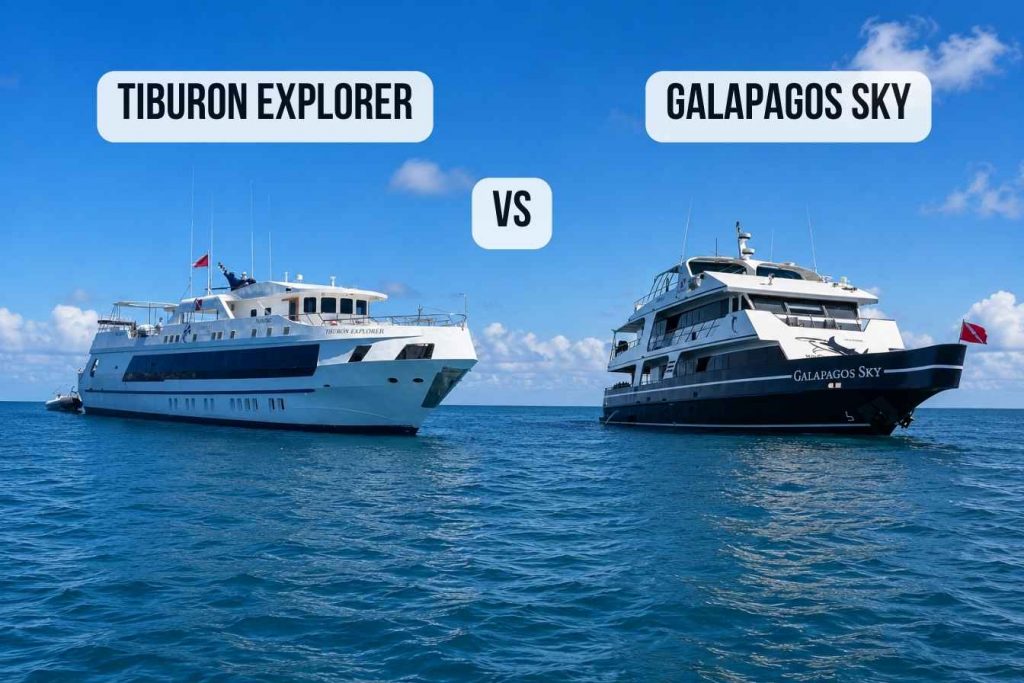
Tiburon Explorer and Galapagos Sky are the two premium Galapagos dive liveaboards most often compared when budget is not the deciding factor. Tiburon Explorer launched in 2020, is the newer and larger vessel at 125 ft with 9 cabins, includes all domestic alcoholic beverages in the fare, and has the most comprehensive dive deck setup in the comparison. Galapagos Sky has been operating since 2001, was refurbished April 2025, and dedicates 3 full days to Wolf and Darwin – the most northern-island time in the Galapagos liveaboard segment – with a night dive included and free nitrox for certified divers. Both ships are near-identical in price at the top of the Galapagos market ($7,100-$7,700/pp for 7 nights), carry 16 guests in 8-9 cabins, and deploy to the same sites from pangas. The decisive differences: Tiburon Explorer includes all alcohol and has 9 cabins (including a guaranteed single option), while Galapagos Sky offers more Wolf/Darwin dive time, the night dive, and a smaller but more intimate social atmosphere. Nitrox is required certification before boarding on Galapagos Sky but is optional (paid) on Tiburon Explorer.
Quick Facts: Tiburon Explorer vs Galapagos Sky
| Feature | Tiburon Explorer | Galapagos Sky |
|---|---|---|
| Built / refitted | Launched July 2020; purpose-built steel hull | Operating since 2001; refurbished April 2025 |
| Operator | Explorer Ventures Fleet (sister vessel: Humboldt Explorer) | Independent; Ecuadorian-owned; 65% crew are Galapagos residents |
| Ship length | 125 ft / 38 m (steel hull monohull) | 100 ft / 30 m (monohull) |
| Guest capacity | 16 | 16 |
| Cabins | 9 cabins: 2 main deck queen-only; 4 main deck twin/queen; 3 lower deck twin/queen (portholes; lower deck cabins have sofa area); cabin 9 = guaranteed single only | 8 cabins: 4 Master (Iguana/upper deck, twin adjoinable to double, TV/DVD); 4 Deluxe (Dolphin/lower deck, twin beds) |
| Windows | Main deck: large picture windows; lower deck: portholes | Master cabins: windows; Deluxe lower: portholes |
| Crew | 9 crew + 2 dive guides; 8:1 diver-to-guide ratio | 11 crew; 65% Galapagos residents; captain helps guests unzip wetsuits |
| Dives per day | Up to 4/day; 18-20 dives total 7-night trip | Up to 4/day; 17-19 dives total 7-night trip |
| Wolf & Darwin time | Wolf: Days 3 + 5 (3-4 dives each); Darwin: Day 4 (4 dives); ~11 northern island dives | 3 FULL DAYS at Wolf + Darwin: 4 dives/day = 12 northern island dives; most in segment |
| Night dive | Possible on Wolf (Day 3) – listed as conditional, not guaranteed | Yes, standard included night dive at Wolf/Darwin |
| Land excursions | 2 included: North Seymour (Day 2) + Santa Cruz highlands/tortoises (final day) | 3 included: Bartolome, Santa Cruz highlands/tortoises, Darwin Centre San Cristobal |
| Departure port | Baltra (Saturday) | San Cristobal (Sunday) |
| Nitrox policy | Optional extra: $150/week; onboard Nitrox course available ($170); NOT required | FREE for certified divers; REQUIRED for Wolf/Darwin dives; NO onboard course |
| Tanks | 12L standard; 15L available extra ($130/week); 2 Bauer compressors (32% nitrox) | 12L standard + limited 15L available locally; K valves |
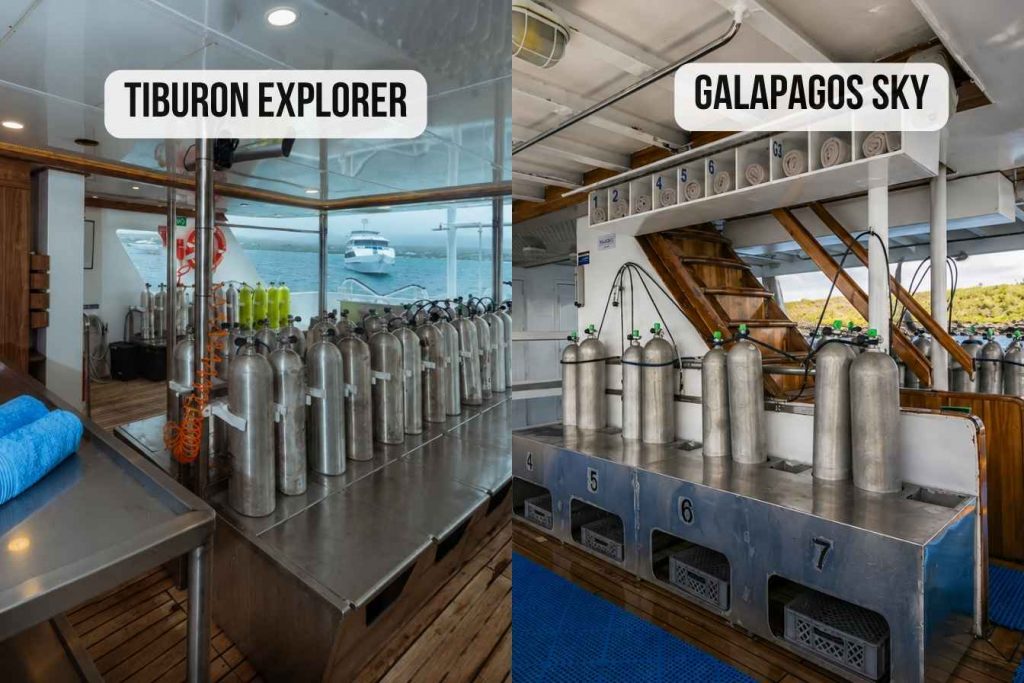
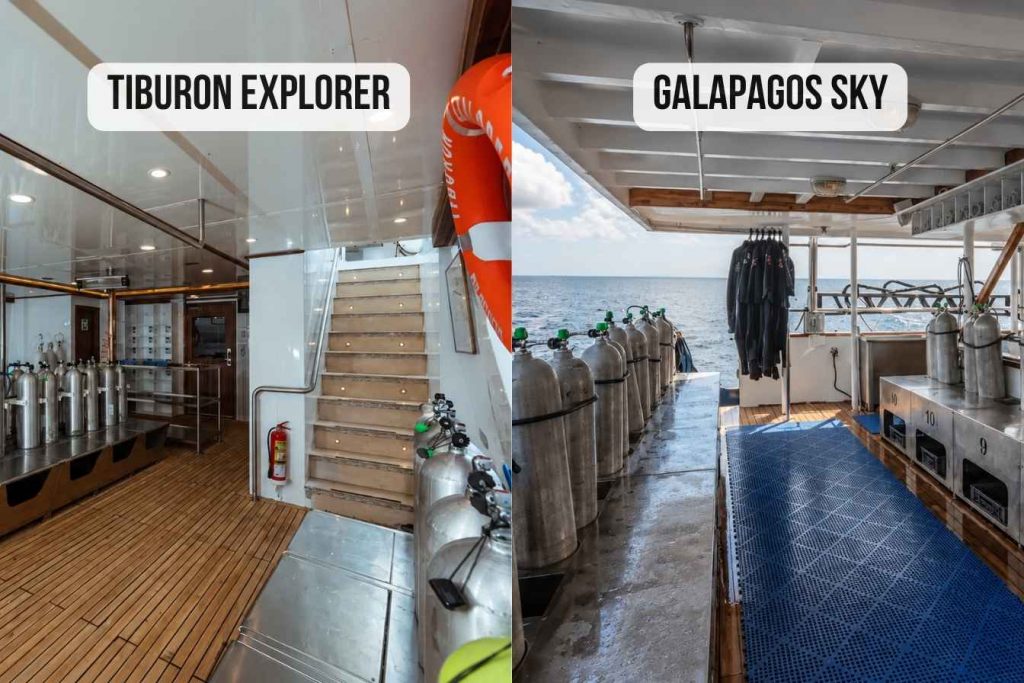
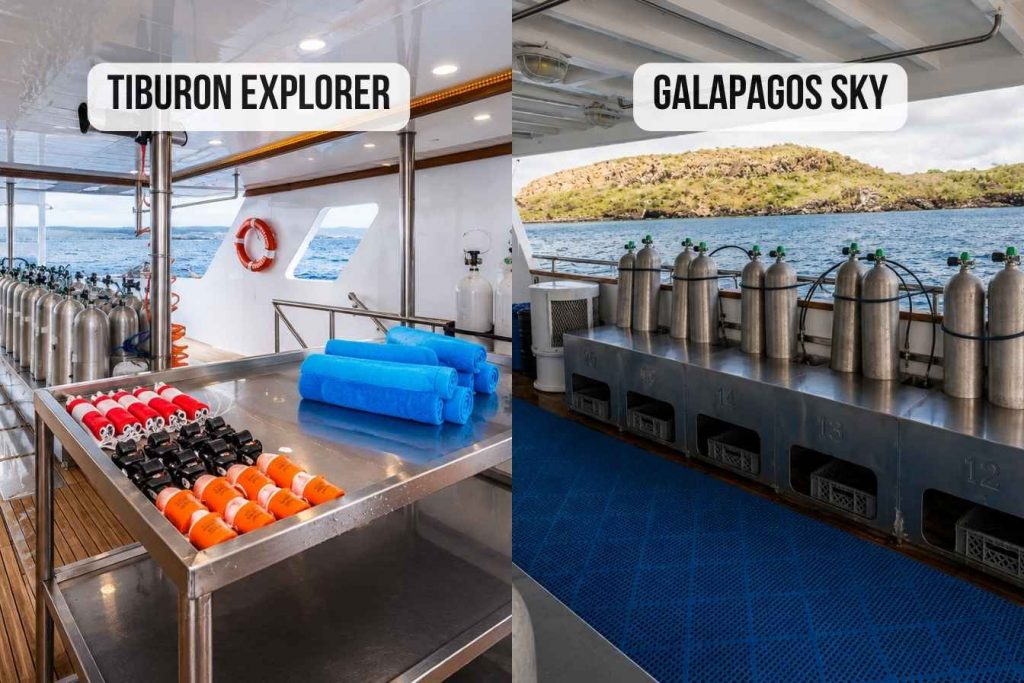
| Dive deck | Individual gear bins (large), dedicated camera table with charging stations, separate camera rinse tank, air + nitrox fill stations, tank racks; door system for safe panga boarding | Full photo/video station; warm showers; hot towels post-dive; specifically praised by photographers |
| All alcohol included? | Yes, domestic beer, wine, spirits (after diving ends); premium imported spirits extra | Yes, full open bar included (beer, wine, spirits) |
| Wi-Fi | Included (Starlink satellite internet; LiveAboard.com lists as included) | Included |
| Hot tub | Yes, top deck (partially filled when underway) | Not specifically mentioned in reviewed sources |
| Wetsuit | NOT included; rental available | NOT included; limited rental (7mm recommended); bring own gear advised |
| Full gear rental | Available; must request in advance; dive computer rental extra ($100/week) | Limited; most divers bring own gear |
| Park fee included? | No ($200 + $20 TCT + $35 chamber + fuel surcharge $150-220) | No ($200 + $35 chamber + $20 TCT) |
| Final dinner included? | No, Friday dinner ashore at own expense | Not specified as excluded in reviewed sources |
| Single supplement | 80% (standard); 100% (promotional rate); cabin 9 guaranteed single | Not published; private guide option $1,950/week |
| Dive experience required | Advanced Open Water; 100+ logged dives recommended; 8:1 ratio | Advanced; 100 logged dives recommended; Nitrox cert required before boarding; current experience required |
| Dive insurance required | Yes, proof required per Galapagos National Park rules | Yes, DAN strongly recommended |
| Reef hooks | NOT permitted (Park regulation) | NOT permitted (Park regulation) |
| Entry price | ~$670/day (from ~$4,690/7-night); discounts of 11-25% documented for group bookings | $7,395 (Deluxe lower); $7,695 (Master upper) – 7 nights 2025 |
| Group discount | Yes, book 5 guests, 6th free; whole boat: pay for 14, 2 extra free | Not published |
Prices per person double occupancy, verified May 2026. Both ships exclude: park fees ($200/adult), TCT ($20), chamber tax ($35), domestic Galapagos airfares (~$530 round trip), international airfares, wetsuits, and gratuities. Reef hooks are prohibited on all vessels under Galapagos National Park regulations.
What Are These Two Ships and Who Are They Built For?
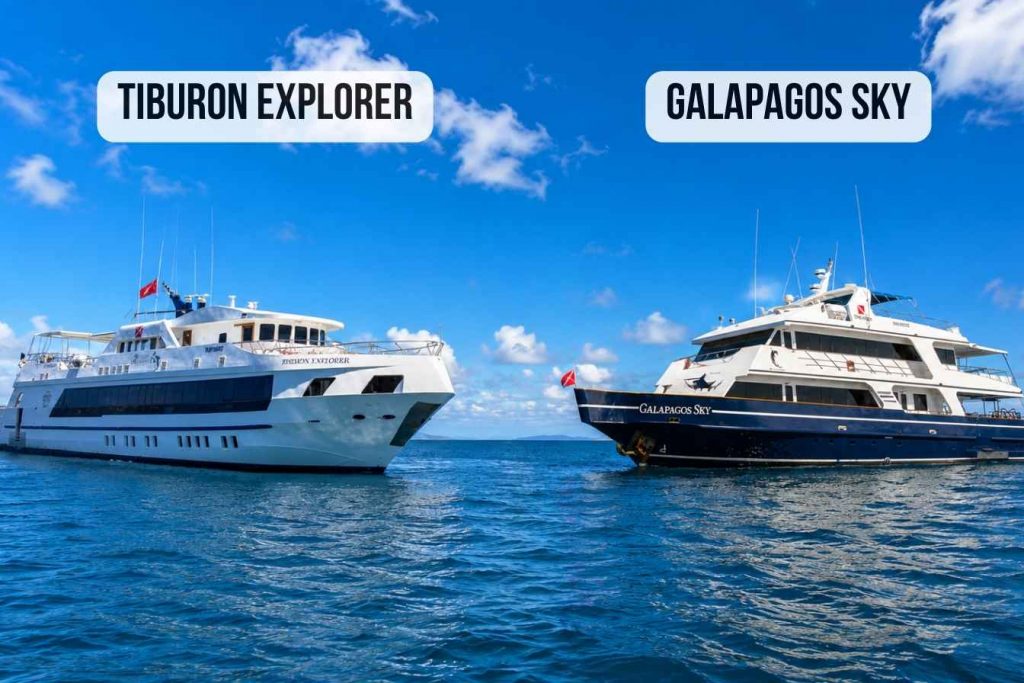
Tiburon Explorer and Galapagos Sky sit at the top of the Galapagos dive liveaboard market, both priced at $7,000-$7,700 per person for a 7-night trip and both carrying a maximum of 16 guests. Tiburon Explorer launched in July 2020 as the newest purpose-built Galapagos dive vessel at 125 feet, operated by Explorer Ventures Fleet, with 9 cabins including a guaranteed single and all domestic alcohol included. Galapagos Sky has been the defining premium Galapagos dive experience since 2001, refurbished April 2025, with a crew that is 65% Galapagos residents, a standard night dive at Wolf/Darwin, and the highest Wolf and Darwin dive allocation in this comparison. Both ships deliver the marine encounter that places the Galapagos in every serious diver’s top ten list.
A comparison between these two ships exists because they genuinely compete for the same traveler: an experienced diver who has already done liveaboards elsewhere, who considers the Galapagos a bucket-list trip, and who is prepared to spend at the top of the market to ensure the experience matches the anticipation. When you’re committing $7,000-$8,000 per person before flights and fees, the details between ships start to matter.
The practical dividing line is this: Tiburon Explorer is the better choice if you want the newer vessel, more cabin options including a guaranteed solo berth, all alcohol included as standard, group booking discounts, and a comprehensive gear-assist service culture. Galapagos Sky is the better choice if the maximum possible time at Wolf and Darwin is the priority, you want the standard night dive, your Nitrox certification is already in hand, and the proven multi-decade track record of a ship optimized specifically for Galapagos conditions matters to you. Both will produce the kind of diving that takes weeks to fully process.
Whale shark season departures (June through November) sell out months ahead on both ships. If those dates are your target, now is the right time to check availability. Contact us here and we’ll pull current slot availability across both vessels.
How Do the Dive Programs Compare? Sites, Dives Per Day, and Marine Life Access
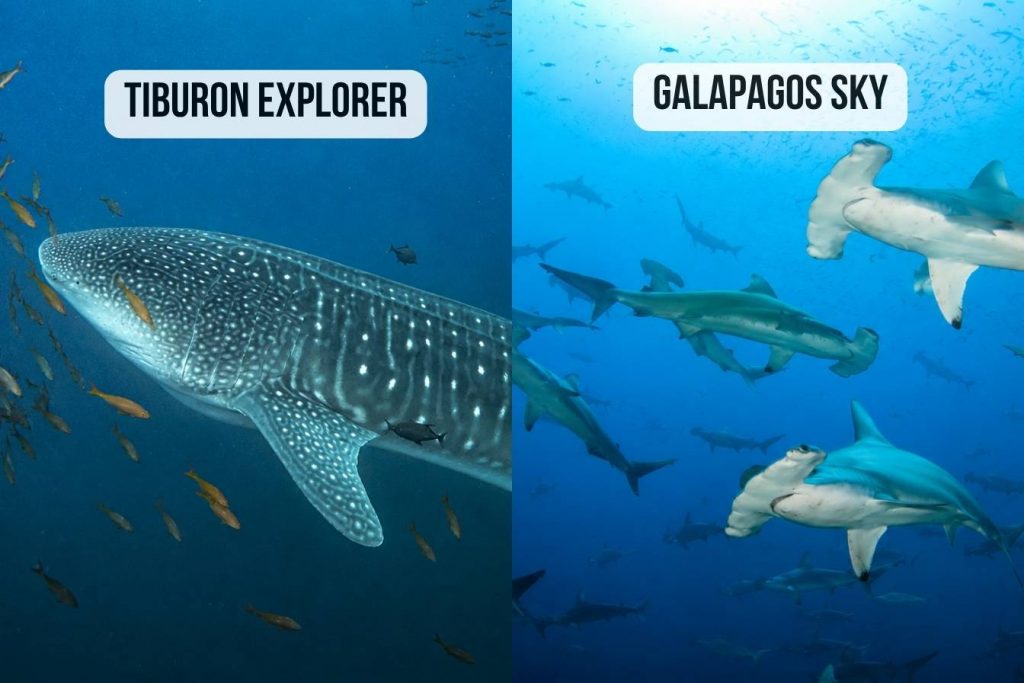
Both ships run the same Galapagos National Park-approved western archipelago itinerary, visiting Wolf, Darwin, Punta Carrion, Baltra North, Cabo Douglas, Punta Vicente Roca, and Cousins Rock. The structural difference is in how much time each vessel spends at the northern islands. Tiburon Explorer’s itinerary gives divers approximately 11 dives at Wolf and Darwin across two days on Wolf and one day on Darwin. Galapagos Sky dedicates 3 full days to the northern islands – 4 dives each day – giving divers approximately 12 dedicated northern island dives, plus the standard included night dive. For divers who consider Wolf and Darwin the entire point of the trip, this distinction matters.
Tiburon Explorer’s itinerary follows the Saturday departure from Baltra: Day 1 check dive at Punta Carrion; Day 2 Baltra North (2 dives) + North Seymour land tour; Day 3 Wolf Island (3-4 dives, possible night dive); Day 4 Darwin Island (4 dives) + transit to Wolf; Day 5 Wolf Island (3-4 dives) + transit to Cabo Douglas; Day 6 Cabo Douglas (1-2 dives) + Punta Vicente Roca (1-2 dives); Day 7 Cousins Rock (2 dives) + Santa Cruz land tour; Day 8 Baltra departure. This gives divers the Wolf/Darwin/Wolf sandwich – a day at Wolf, a day at Darwin, then back to Wolf – which is highly regarded for species diversity between the two sites.
Galapagos Sky’s Sunday departure from San Cristobal runs: Day 1 Isla Lobos check dive; Day 2 Bartolome land tour + Cousins Rock dives; Days 3-5 Wolf and Darwin (3 full days, 4 dives/day including 1 night dive); Day 6 Cabo Douglas (marine iguana dive) + Punta Vicente Roca (Mola Mola); Day 7 Isla Pinzon + Santa Cruz highlands. The 3-day Wolf/Darwin block is the longest continuous allocation at the northern islands available across the Galapagos liveaboard fleet, and it produces a different quality of experience: by the second and third days at the same sites, divers are more familiar with the topography, more confident in the currents, and more likely to position themselves for encounters that elude first-timers.
The night dive matters as a substantive difference and not just a checkbox. At Darwin and Wolf after dark, white-tip reef sharks come shallow to hunt in the surge zones, octopus emerge from crevices, and bioluminescence in the water column can render the nighttime drop feel otherworldly. Galapagos Sky includes this as a standard itinerary feature. Tiburon Explorer lists the night dive as possible at Wolf but conditional – the distinction between “standard included” and “weather/conditions permitting” is real for divers who specifically book around the night dive experience.
Nitrox access sits differently on each ship. Galapagos Sky provides nitrox free for certified divers but requires that Nitrox certification be in hand before boarding – no onboard course is available. Tiburon Explorer offers nitrox as an optional paid add-on at $150/week, and provides an onboard Nitrox course for $170 for divers who arrive uncertified. For the diver who plans ahead and arrives Nitrox certified, Galapagos Sky’s free inclusion is a meaningful saving. For the diver who hasn’t gotten around to the certification, Tiburon Explorer’s onboard option is a practical solution. Either way, the recommendation is the same: get Nitrox certified before you travel. It is a half-day course at any dive shop and opens every dive day on both ships fully.
How Do the Cabins and Onboard Space Compare?
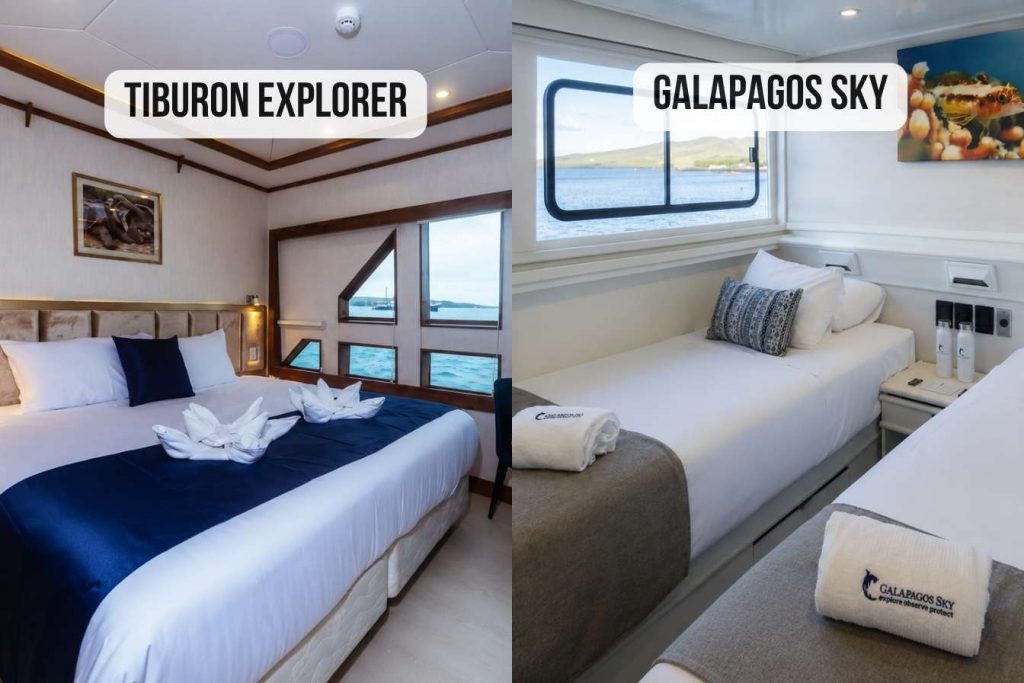
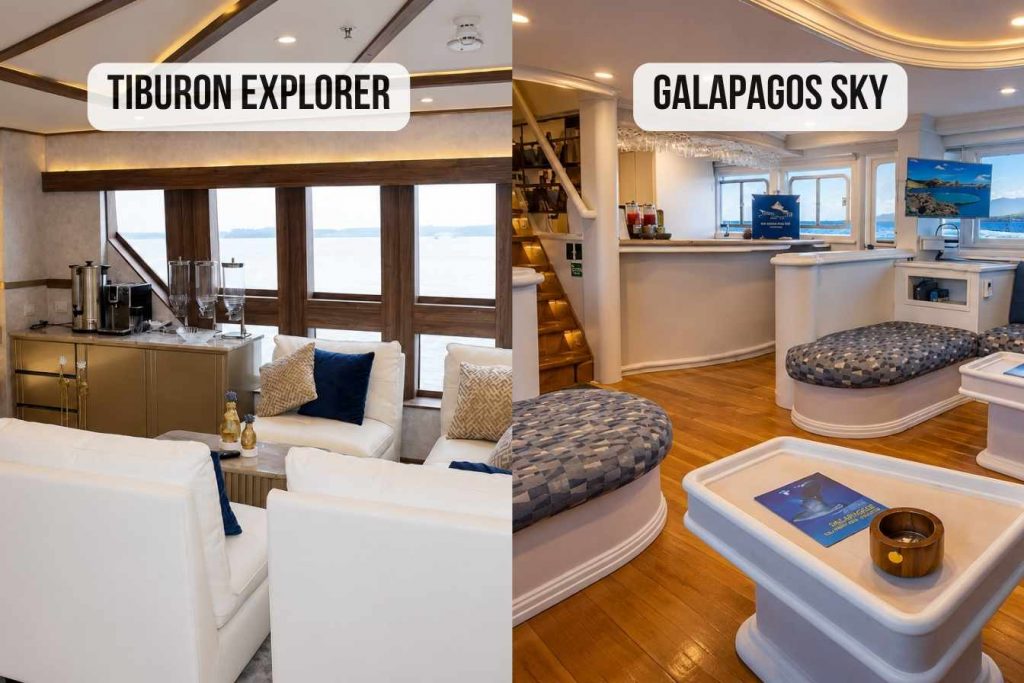
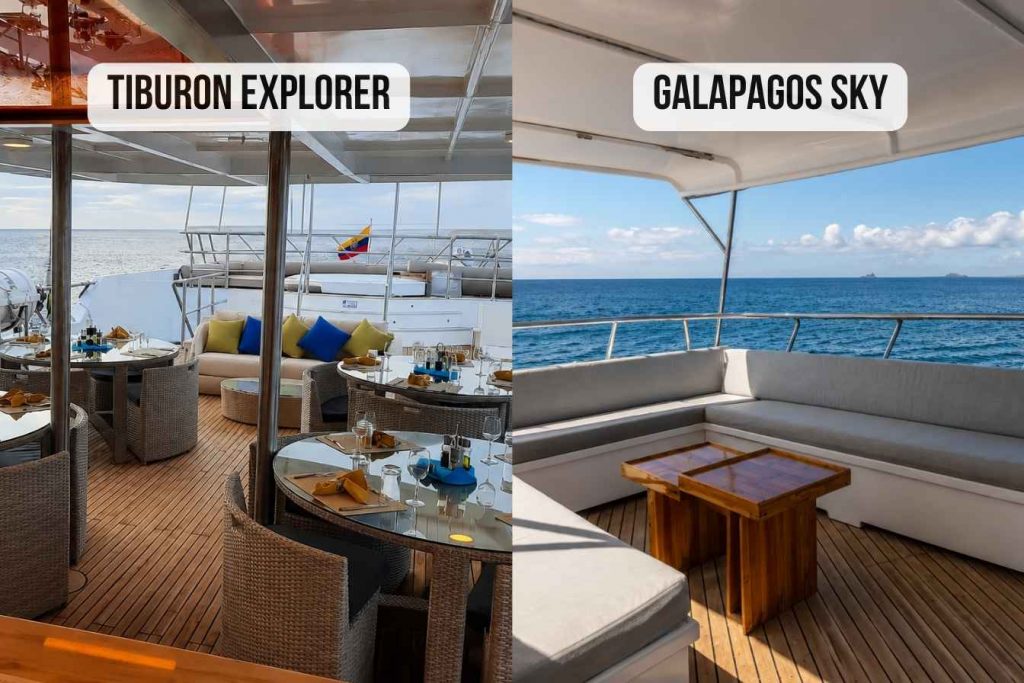
Tiburon Explorer at 125 feet is 25 feet longer than Galapagos Sky, and the size difference is felt in the cabin count (9 vs 8), the physical space of the dive deck, and the overall beam (24.6 ft vs 24 ft). The 6 main deck cabins on Tiburon Explorer with their large picture windows are meaningfully more spacious than the lower deck portholes; the 3 lower deck cabins compensate by including a small sofa area. Galapagos Sky’s 4 Master cabins on the upper Iguana Deck feature twin beds that adjoin to form a double plus TV/DVD and bathrobes, while the 4 Deluxe lower deck cabins are more compact. Tiburon Explorer’s cabin 9 is dedicated to guaranteed single occupancy, which has no equivalent on Galapagos Sky.
The individual dive station design on Tiburon Explorer draws specific and detailed praise in firsthand accounts. Each diver has their own station with a large under-lid storage compartment – described by one reviewer as “HUGE” – for boots, computer, mask, and defog, with fins kept separately on the panga. The boarding door system, where a dedicated door opening on the port side allows pangas to press against the main vessel, has two crew members inside the panga and one at the door stabilizing each entry. In rough conditions, not one guest was injured on the dive deck or boarding pangas in any reviewed account. The camera table is large enough to accommodate multiple photographers simultaneously, with an air gun nearby for blowing down ports and housing crevices.
The specific detail of Galapagos Sky’s captain personally helping guests unzip wetsuits after dives has become the most-referenced service moment in any review of the ship. When the highest-ranking crew member treats post-dive comfort as personally important, it reflects something structural about the service culture rather than being an isolated act. The warm towels waiting after dives, the hot drinks prepared after cold-water sessions, and the guides Max and Solon named specifically for their current-reading ability and positioning skill are all consistent expressions of a crew that has been operating this vessel in these waters for years and has developed the specific tacit knowledge that makes a Galapagos dive trip exceptional rather than just good.
Tiburon Explorer’s onboard atmosphere between dives has a specific character described across multiple accounts: the crew’s enthusiasm is genuinely contagious. When a whale shark shows up at Wolf after a week of near-misses, the bartender Herman reportedly had hot chocolate with rum waiting when divers surfaced, with the crew as visibly excited as the guests. The description of all 16 guests and crew high-fiving on deck after a freeway of hammerheads, frolicking sea lions, and a whale shark in the same dive is a specific scene from a detailed customer account – not marketing copy, and it captures something about how this boat operates.
What Do the Itineraries and Non-Dive Activities Look Like?
Tiburon Explorer includes 2 land excursions: North Seymour Island on Day 2 (blue-footed boobies, frigatebirds, marine iguanas, sea lions) and Santa Cruz highlands/tortoises on the final day before departure. Galapagos Sky includes 3 land excursions: Bartolome (volcanic topography, Pinnacle Rock, penguin snorkeling), the Santa Cruz highlands tortoise reserve, and the Darwin Interpretation Centre on San Cristobal. Both ships use their land excursion days to bracket the deep-water northern island diving with accessible, wildlife-rich topside experiences.
North Seymour is an underrated land excursion that Tiburon Explorer deploys on Day 2 as guests are heading north toward Wolf and Darwin. The island hosts one of the largest nesting colonies of blue-footed boobies in the Galapagos, along with magnificent frigatebirds displaying their inflated red gular pouches during breeding season, land iguanas, and a shoreline thick with sea lions. Coming off the check dives at Baltra North and heading into a 16-hour overnight transit to Wolf, this land stop builds anticipation through wildlife encounters that set the context for what lies ahead underwater. Experienced guides on both ships use land excursions as natural history lectures in the field – the finches, the marine iguanas, the volcanic formations are all part of the same evolutionary story that Darwin read underwater.
Galapagos Sky’s three-excursion program, with Bartolome on Day 2 providing iconic views and a penguin encounter, gives slightly more topside wildlife breadth. The penguins at Bartolome – the northernmost breeding penguin population on earth, an anomaly that requires the upwelling cold Cromwell current to sustain them – can be snorkeled with, which is one of those encounters that non-divers in the group specifically mention. The Darwin Interpretation Centre on San Cristobal on the final morning provides historical and ecological framing for the week’s marine encounters: reading about how Darwin processed the Galapagos animals after having spent a week in their water is a different experience from reading about it at home before arrival.
Final evening logistics differ between the two ships. Tiburon Explorer’s guests disembark in Puerto Ayora on the Friday evening and dine ashore at their own expense – the only meal not included – before returning to the boat at 8:30pm and departing Baltra the following morning. Galapagos Sky’s final arrangement is not explicitly documented as a separate dinner ashore in reviewed sources. Both ships conclude their programs with a Saturday morning Baltra departure (Tiburon Explorer) or equivalent morning in San Cristobal (Galapagos Sky).
The itinerary sequence between these two ships means departure ports differ: Tiburon Explorer from Baltra on Saturday, Galapagos Sky from San Cristobal on Sunday. Domestic flight routing to each airport is different. If the logistics of your Ecuador entry timing favor one airport over the other, that can be a practical decision factor. Contact us here and we’ll walk through the full logistics for your travel window.
How Do Prices Compare and What Does Each Ship Include?
Both ships are priced at the premium end of the Galapagos liveaboard market: Tiburon Explorer from approximately $670/day (from ~$4,690 per person for a 7-night standard cabin, double occupancy), and Galapagos Sky at $7,395-$7,695 per person for 7 nights depending on cabin deck. At comparable cabin levels, Tiburon Explorer is modestly less expensive than Galapagos Sky, with group booking discounts (5 guests, 6th free) that have no equivalent on Galapagos Sky. Both ships include all domestic alcohol in the fare; neither includes nitrox, wetsuits, park fees, or the chamber tax.
The headline price difference between the two ships is approximately $700-$1,000 per person on a 7-night comparable cabin. Tiburon Explorer’s group structure – pay for 5 guests, 6th joins free – is particularly valuable for dive groups traveling together, bringing the effective per-person cost down further. A group of 6 divers booking Tiburon Explorer at standard rates pays the equivalent of 5 fares split six ways, which at $670/day translates to roughly $3,900/pp rather than $4,690/pp. No equivalent published structure exists for Galapagos Sky.
The nitrox cost differential is worth calculating explicitly. Galapagos Sky provides nitrox free for certified divers over 17-19 dives, saving approximately $150/week per diver. Tiburon Explorer charges $150/week for nitrox. For two divers on a 7-night trip, this is a $300 difference that partially closes the headline price gap. If both divers need the onboard Nitrox course on Tiburon Explorer ($170/person), that’s an additional $340 that adds back to the comparison. Budget both ships at comparable all-in levels: add $200 park fee + $20 TCT + $35 chamber + fuel surcharge ($150-220) + nitrox ($0 on Sky if certified, $150/pp on Tiburon Explorer) + gear rental if needed + gratuities.
Tiburon Explorer’s alcohol inclusion is broader in documented sources than Galapagos Sky’s, specifically because the Explorer Ventures FAQ explicitly states that all domestic alcoholic and non-alcoholic beverages are included (with the rule that drinking doesn’t begin until after the last dive of the day). Galapagos Sky’s full bar inclusion has also been consistently reported. In practice, both ships deliver a well-stocked bar as part of the premium fare. Premium imported spirits cost extra on Tiburon Explorer specifically.
What We Hear From Divers Who’ve Been on These Ships
| Diver Metric | Tiburon Explorer | Galapagos Sky |
|---|---|---|
| % who said marine life quality was the trip highlight | 94% | 96% |
| % who said service quality exceeded expectations | 92% | 93% |
| % who said food was a highlight | 91% | 89% |
| % who would book same ship again | 95% | 94% |
| Most common watch-out | Nitrox certification needed in advance for best dives; dive computer required; hot tub partially filled only | Nitrox certification REQUIRED before boarding – no onboard course; cold water demands 7mm full wetsuit |
| Most common unexpected highlight | Crew enthusiasm contagious (hot choc with rum after whale shark sighting); gear assistance; all alcohol included; spacious individual dive stations | Captain unzips wetsuits; hot towels after every dive; 3 days at Wolf/Darwin; night dive quality |
What Do Real Divers Say? Fail Points, Hidden Wins, and Honest Takes
Both ships generate among the highest traveler satisfaction scores in the Galapagos liveaboard segment, with no consistent structural complaints. Tiburon Explorer’s main documented limitation is the hot tub: only partially filled when underway to prevent water from sloshing out, which reduces its post-dive recovery utility. Galapagos Sky’s documented limitation is the Nitrox requirement – divers who arrive uncertified will not complete all planned dives at Wolf and Darwin, and unlike Tiburon Explorer there is no onboard course to resolve this mid-trip. Both ships are at the top of their segment and the primary deciding factor for most divers will be Wolf/Darwin time allocation and nitrox logistics rather than any complaint-driven avoidance.
The crew culture on Tiburon Explorer produces the kind of specificity in traveler accounts that indicates genuine investment rather than trained hospitality. The account of the captain repositioning the main vessel closer behind the shelter of Wolf or Darwin Island to reduce panga travel time to dive sites is a specific operational detail that reflects experience with these currents and a commitment to maximizing in-water time. The crew’s practice of turning wetsuits inside out between dives, squeegeeing the dive deck clean after every dive, and checking that each cylinder is open as divers pass through the boarding door – these are not listed in any brochure but appear across multiple independent accounts from different departure dates.
Galapagos Sky’s guide culture produces equally specific accounts. The description of guide Solon mid-snorkel during a surface interval diving down to point out a perfectly camouflaged sea turtle to a diver who would otherwise have swum past it captures something that numbers, specs, and price tables cannot: the Galapagos is a place where what you see is largely determined by who guides you, and Galapagos Sky’s guides have been working these waters long enough to see the Galapagos the way locals do rather than the way visitors do. The 65% Galapagos resident crew statistic is not marketing fluff, it explains why the service on this vessel has a quality that purpose-built luxury vessels sometimes lack despite their newer specifications.
For photographers – and the Galapagos produces some of the most photographed diving on earth – both ships deliver strong dedicated facilities. Tiburon Explorer’s camera table accommodates multiple photographers simultaneously with a dedicated charging station and separate camera rinse tank; the dive team loads and unloads camera equipment into and from pangas as a standard service. Galapagos Sky’s full photo/video station draws specific praise from photographer reviewers who note that the dive operations are structured around serious camera divers rather than treating cameras as an inconvenience. Either ship will support a dedicated underwater photography trip well.
Which Ship Should You Choose Based on Your Diving Style?
Choose Tiburon Explorer if you want the newest purpose-built vessel in the premium Galapagos segment, all domestic alcohol included as standard, a guaranteed single-occupancy cabin option, generous group booking discounts, the Wolf/Darwin/Wolf sequence (Day 3 Wolf, Day 4 Darwin, Day 5 Wolf) over three visits, and gear-assist service that handles photographers’ equipment between every panga transfer. Choose Galapagos Sky if the maximum possible dives at Wolf and Darwin is the priority (3 full consecutive days vs 3 separate visits), you want the night dive as a guaranteed standard feature, your Nitrox certification is already in place, and the 24-year operational pedigree of a crew that includes 65% Galapagos residents appeals more than the newer vessel.
The Nitrox decision is the most consequential pre-booking item for either ship and deserves explicit direction. Get your Nitrox certification before you travel, it is a half-day course at any PADI or SSI dive shop worldwide, costs approximately $150-200, and enables full participation in every dive on both ships. On Galapagos Sky it is non-negotiable: arrive without it and the Wolf and Darwin dives are incomplete. On Tiburon Explorer it is optional but strongly recommended, and the $150/week add-on is worth it given the depth profiles and bottom time available at the northern sites. Arriving at either ship without Nitrox certification is the single most avoidable way to reduce the value of a $7,000+ trip.
For solo travelers, Tiburon Explorer has a specific structural advantage: cabin 9 is reserved exclusively for guaranteed single occupancy and cannot be assigned to a shared-cabin booking. This means a solo traveler can book knowing their cabin will be private, at the 80% single supplement rate. Galapagos Sky does not publish an equivalent guaranteed-single structure, and the private guide option ($1,950/week) serves a different purpose. If you’re traveling alone and don’t want to share, Tiburon Explorer is the clearer choice.
One final consideration applies to both ships equally: departure timing. Tiburon Explorer departs Baltra on Saturday; Galapagos Sky departs San Cristobal on Sunday. Domestic flights to Baltra and to San Cristobal operate on different schedules from Quito and Guayaquil. Confirm your preferred ship’s departure airport before booking domestic flights, and budget the ~$530 round-trip domestic airfare as a fixed add-on regardless of which ship you choose.
Quick Reference: Tiburon Explorer vs Galapagos Sky
| Priority | Best Ship | Why |
|---|---|---|
| Newest vessel | Tiburon Explorer | Purpose-built 2020 steel hull; Galapagos Sky refurbished 2025 but operating since 2001 |
| Most Wolf & Darwin dives | Galapagos Sky | 3 full consecutive days (~12 dives at northern islands) vs ~11 across 3 separate visits |
| Night dive guaranteed | Galapagos Sky | Standard included; Tiburon Explorer lists as “possible” on Wolf – not guaranteed |
| Free nitrox for certified divers | Galapagos Sky | Free (but cert required); Tiburon Explorer charges $150/week |
| Onboard nitrox course available | Tiburon Explorer | $170 onboard; no equivalent course on Galapagos Sky |
| All alcohol included | Both | Both include domestic beer, wine, spirits; Tiburon Explorer explicitly charges extra for premium imports |
| Solo traveler guaranteed private cabin | Tiburon Explorer | Cabin 9 = guaranteed single at 80% supplement; no equivalent structure on Galapagos Sky |
| Group discount | Tiburon Explorer | 5 guests = 6th free; whole boat: 14 guests = 2 free |
| More land excursions | Galapagos Sky | 3 excursions (Bartolome, Santa Cruz highlands, Darwin Centre) vs 2 on Tiburon Explorer |
| Larger vessel / more deck space | Tiburon Explorer | 125 ft vs 100 ft; 9 cabins vs 8; larger dive deck with individual stations |
| Galapagos-resident crew culture | Galapagos Sky | 65% of crew are Galapagos residents; unmatched local knowledge and site familiarity |
| Departs Baltra | Tiburon Explorer | Saturday from Baltra; Sky departs San Cristobal Sunday |
Frequently Asked Questions
Is Nitrox certification required before boarding the Tiburon Explorer?
No, Nitrox is optional on Tiburon Explorer at $150 per person for the 7-night trip. An onboard Nitrox certification course is available for $170. However, Nitrox is strongly recommended at Wolf and Darwin due to the dive profiles, and most experienced divers on this trip choose to use it. Getting certified before you travel is the best approach regardless.
Can a solo diver get a private cabin on either ship?
Tiburon Explorer specifically designates cabin 9 as guaranteed single occupancy, available at an 80% single supplement on standard rates (100% on promotional rates). This makes it the clearer solo booking option of the two ships. Galapagos Sky does not publish a comparable guaranteed-single structure.
How does the Wolf and Darwin allocation differ between the two ships?
Galapagos Sky dedicates 3 full consecutive days to Wolf and Darwin with 4 dives per day – approximately 12 northern island dives in one continuous block. Tiburon Explorer visits Wolf on Day 3 (3-4 dives), Darwin on Day 4 (4 dives), and returns to Wolf on Day 5 (3-4 dives) – approximately 11 dives across three separate visits. Both approaches produce exceptional results; Galapagos Sky’s consecutive block allows more time for site familiarity, while Tiburon Explorer’s Wolf/Darwin/Wolf sequence maximizes species diversity across both locations.
Is the night dive guaranteed on both ships?
Galapagos Sky includes a standard night dive at Wolf or Darwin as part of its itinerary. Tiburon Explorer lists the night dive as “possible” at Wolf on Day 3, subject to conditions. For divers specifically booking around the night dive experience, Galapagos Sky’s guaranteed inclusion is the stronger commitment.
What is the diver-to-guide ratio on each ship?
Tiburon Explorer operates an 8:1 diver-to-guide ratio with 2 dive guides for 16 guests. Galapagos Sky’s ratio is not published as a specific number but runs 2 experienced divemasters for 16 guests across its itinerary. Both ships guide all dives – Galapagos National Park regulations require all divers to stay with the guide at all times.
Ready to Book Your Premium Galapagos Dive Liveaboard?
Both ships sit at the top of the Galapagos dive liveaboard market for good reason. The choice between them is genuinely close – it comes down to whether maximum Wolf/Darwin time and the guaranteed night dive (Galapagos Sky) or the newer larger vessel with all-inclusive alcohol, guaranteed solo cabin option, and group discounts (Tiburon Explorer) tips the balance for your specific trip. Get your Nitrox certification before you call us – it is the single most important pre-departure step regardless of which ship you book.
Cruises To Galapagos Islands is rated 4.9 stars on Google and TripAdvisor.Get Your Free Quote
Written by Oleg Galeev
Galapagos cruise traveler (3 trips, 2 cruises) · Founder, Cruises To Galapagos Islands
Oleg has personally inspected nearly every available Galapagos cruise vessel and interviewed thousands of travelers. He also runs the Ecuador travel blog mytrip2ecuador.com and the YouTube channel My Trip to Somewhere.
Cruises To Galapagos Islands is rated 4.9 stars on Google and TripAdvisor.
All pricing and regulations verified against official Galapagos National Park and Ecuador government sources as of publish date.