TL;DR
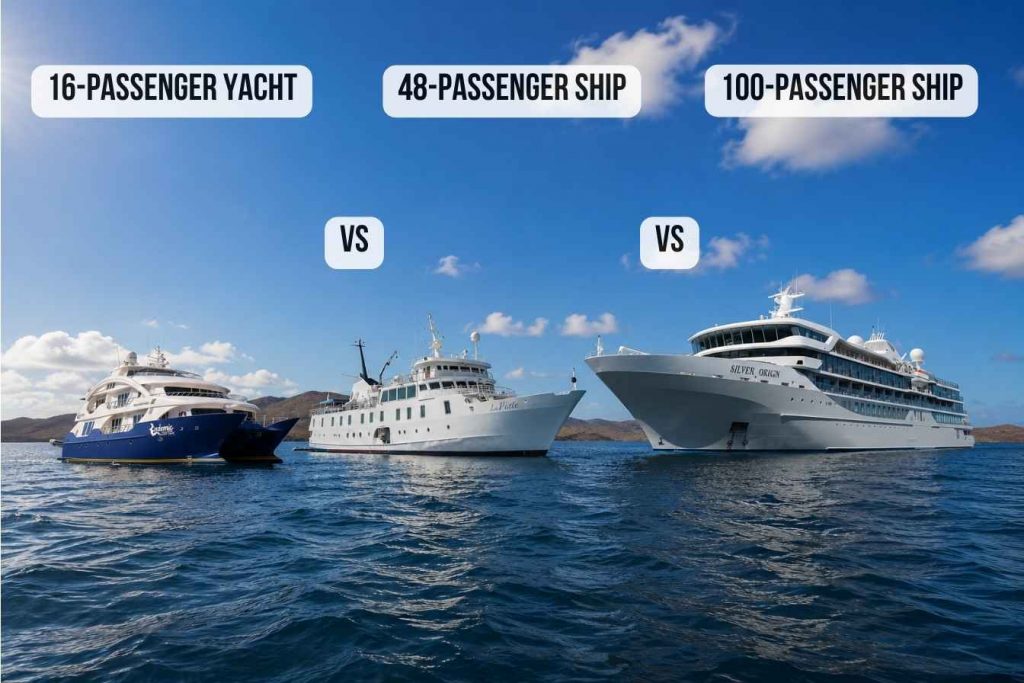
In the Galapagos, ship size shapes your entire experience, not just your cabin. A 16-passenger yacht means one guide, one group, maximum shore flexibility, and rougher nights at sea. A 48-passenger ship is the sweet spot for most travelers, balancing intimacy with real amenities. A 100-passenger ship offers stability and luxury onboard, but comes with logistics: multiple groups, queued zodiac transfers, and itinerary constraints at certain visitor sites. None of these is a bad choice. The wrong one is just the one that doesn’t match how you actually travel.
Quick Facts: Galapagos Cruise Ship Sizes at a Glance
| Category | 16-Passenger Yacht | 48-Passenger Ship | 100-Passenger Ship |
|---|---|---|---|
| Guide groups ashore | 1 group, 1 guide | 3 groups, 3 guides | 6+ groups, 6+ guides |
| Zodiac boarding time | 5-10 min | 15-25 min | 45-60 min |
| Typical price range (7-8 days) | $3,000 to $12,000+ pp | $5,000 to $12,000 pp | $8,000 to $16,000+ pp |
| Onboard amenities | Basic to mid-range | Mid to first class | First class to luxury |
| Motion/seasickness risk | Highest (mono-hulls); low (catamarans) | Moderate | Lowest |
| Itinerary flexibility | Highest | Good | Most restricted |
| Best for | Wildlife-first travelers, couples, small friend groups | Most travelers, couples, families | Comfort-first, luxury seekers, families with young kids |
Prices verified May 19, 2026. Park entrance fee ($200 USD) and INGALA transit card ($20 USD) not included in cruise prices above.
What Actually Changes When You Go From 16 to 100 Passengers on a Galapagos Cruise?
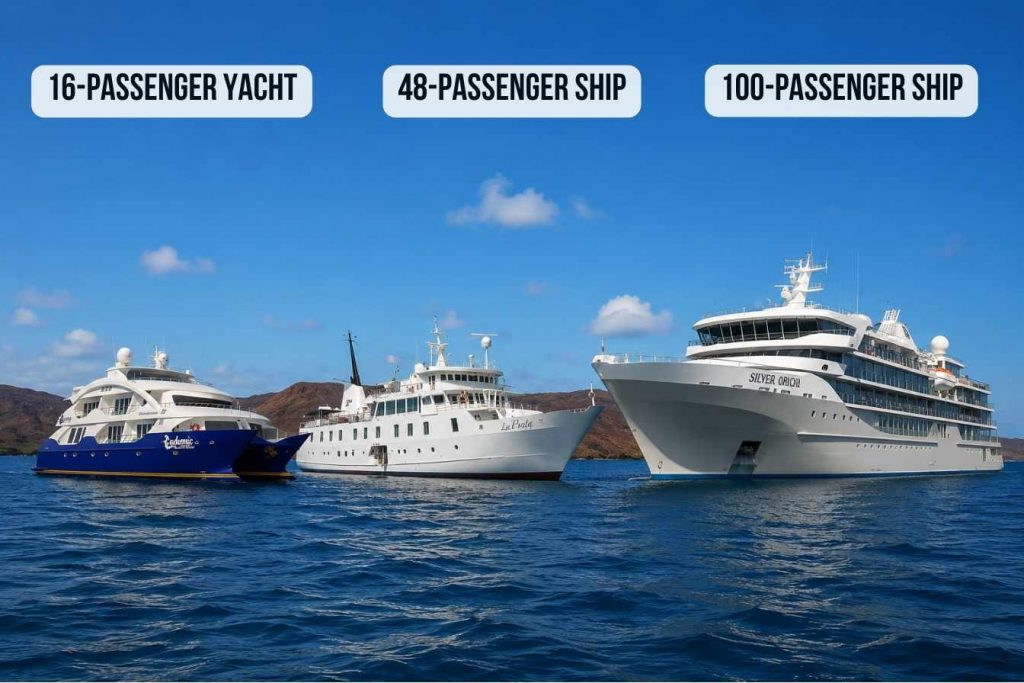
Almost everything below the surface. The wildlife you see is roughly the same across ship sizes, because every vessel follows Galapagos National Park-approved itineraries. What changes is how you experience those moments: how fast you get ashore, how crowded the zodiac feels, whether you ask the guide a question or wait your turn, how well you sleep on a crossing night, and whether the person next to you at dinner is someone you actually chose to sit next to.
The hard ceiling in the Galapagos is 100 passengers. No ship carrying more than that is legally permitted to operate in the archipelago. That rule exists because the National Park strictly limits how many visitors can be on land at any given visitor site at one time. Every boat operating here, from a modest 10-cabin catamaran to Silversea’s Silver Origin, is subject to the same park authorization process, the same guide requirements, and the same visitor site protocols.
What that means in practice: the three categories you’re choosing between (16-passenger yacht, 48-passenger mid-ship, 100-passenger large vessel) are not just different sizes of the same experience. They are genuinely different ways of traveling. The wildlife does not care which boat you came from. But your day-to-day rhythm, your connection to the guides, your noise level at 2am during an open-ocean crossing, and your feeling of being “in it” versus “visiting it” all shift considerably depending on what you board at the dock in Baltra.
Which Galapagos Cruise Size Is Best for Wildlife Access and Shore Landings?
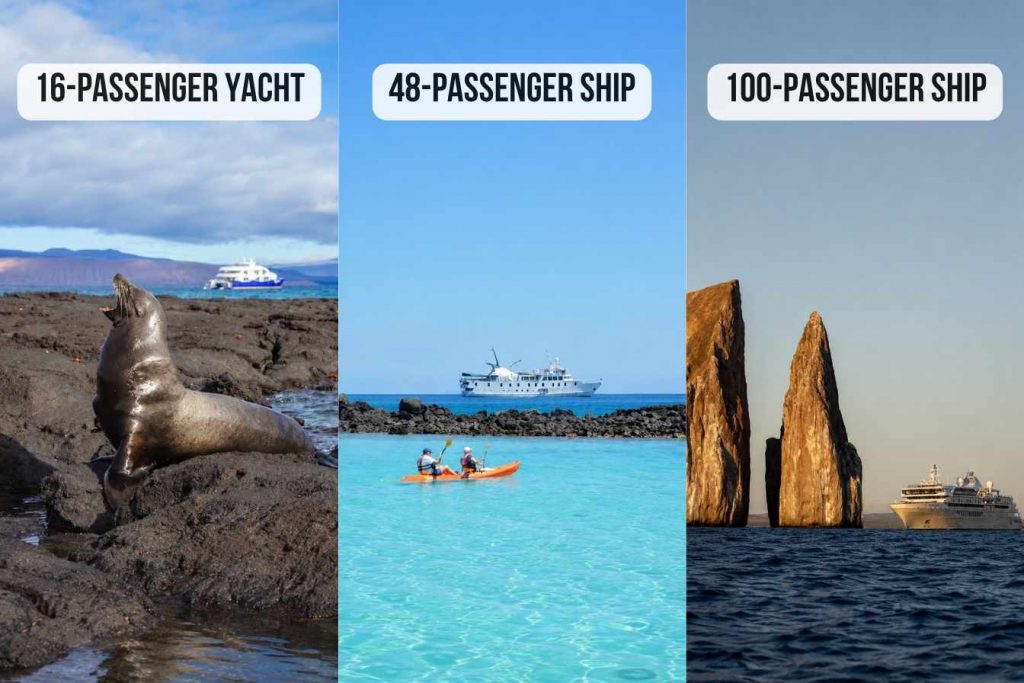
For raw wildlife access, the 16-passenger yacht has a structural advantage. With one group and one guide, everyone goes ashore together, nobody waits, and the guide has the flexibility to linger or redirect based on what you find. On a 48-passenger ship you get small group sizes ashore (typically 12-16 per guide) with multiple groups running simultaneously. On 100-passenger ships, the zodiac queue alone can eat 45-60 minutes of your excursion window.
Here is the regulation that most travelers do not know before they book: the Galapagos National Park authorizes a maximum of 16 visitors per naturalist guide on any shore landing. That rule does not change based on ship size. What changes is how many guide groups your ship sends ashore and whether those groups go simultaneously or in rotation.
On a 16-passenger yacht, you are the one group. Your guide knows your names, knows who wants to snorkel longer, knows who has a bad knee. When a marine iguana sits down on your trail, everyone stops together. There is no other group you need to coordinate with. We have seen guides on small yachts extend a snorkeling session by thirty minutes because the conditions were right and everyone agreed. That flexibility simply does not exist on larger ships, where guides follow tighter schedules to keep multiple groups from overlapping.
The 48-passenger ship sends three groups ashore, usually with slight time offsets so the sites do not get crowded. The experience is still intimate by any normal travel standard, and many travelers report feeling no difference compared to a smaller yacht in terms of wildlife proximity. Where you notice the size: the morning briefing is now a room of 48 instead of 16, and getting into your wetsuit and fins alongside 47 other people requires more patience.
On 100-passenger ships, multiple zodiac runs are required just to get everyone ashore. That is not a flaw in the operation; it is just physics. The ships manage it professionally, but the reality is that the first group ashore and the last group ashore see different versions of the same site. The animals do not wait.
If you are not sure which ship size actually matches your travel style, we can talk through it. We have been on these boats, and the answer is different for every traveler. Send us a quick message here and we will put together a no-obligation recommendation based on your priorities and budget.
How Does Cabin Comfort and Onboard Experience Differ Across Ship Sizes?
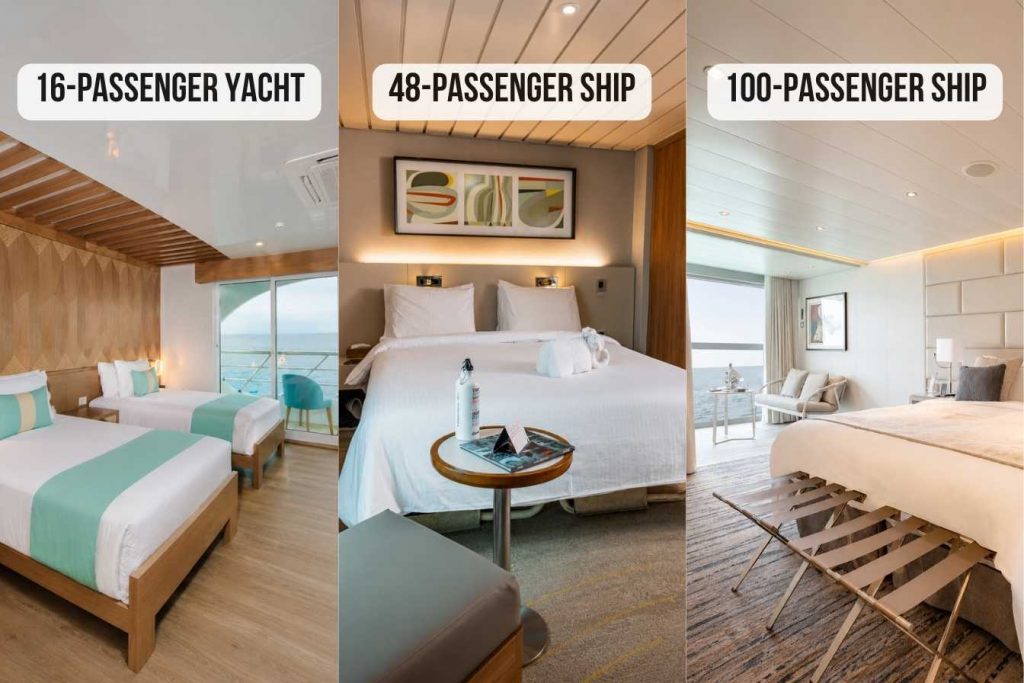
Bigger ships generally mean larger cabins, more deck space, better stability at sea, and extras like spas, fitness rooms, and multiple dining areas. But a well-designed 16-passenger yacht can actually offer more cabin square footage per person than a mid-range 100-passenger ship, because the economics work differently at that scale. The onboard experience gap is widest between budget small yachts and premium large ships. At first-class level, all three sizes can be genuinely excellent.
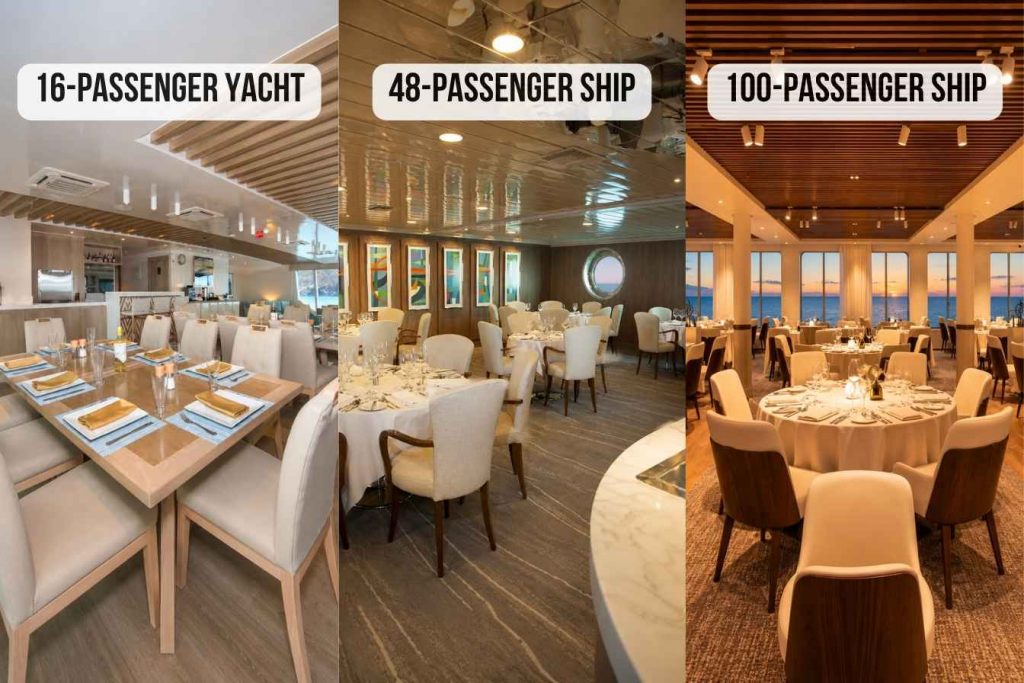
The 16-passenger category is where you see the widest spread. At the budget end, you get bunk cabins, shared bathroom situations in a few older vessels, and a single shared dining table. At the premium end, the same 16-passenger catamaran format can include private balconies, 300-square-foot cabins, and a crew-to-guest ratio that feels closer to a private charter. Do not assume small means basic. Research the specific vessel.
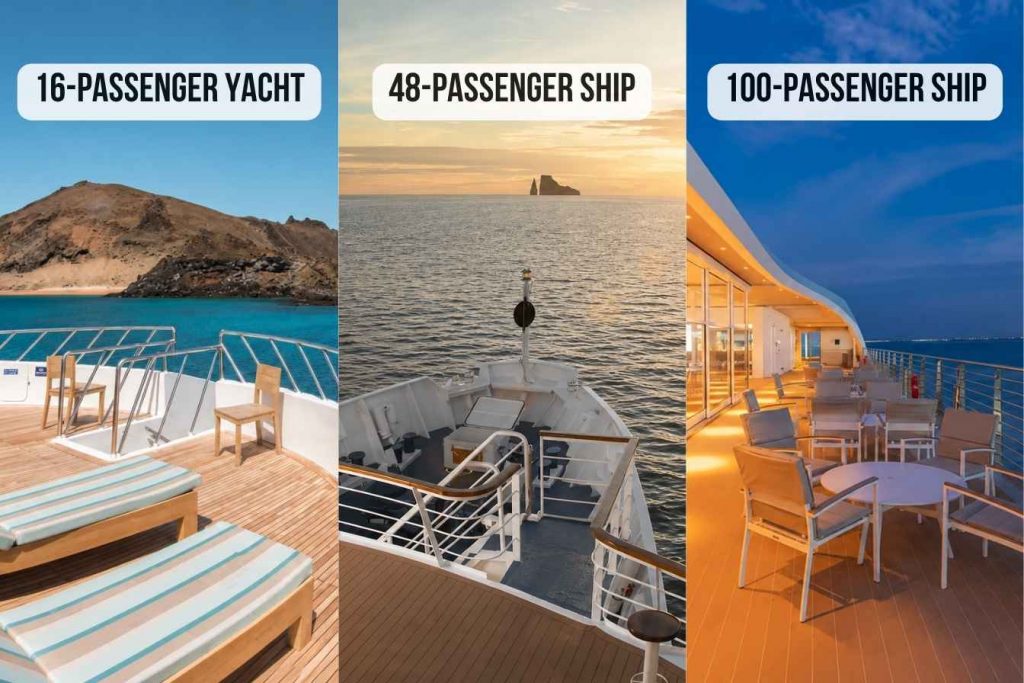
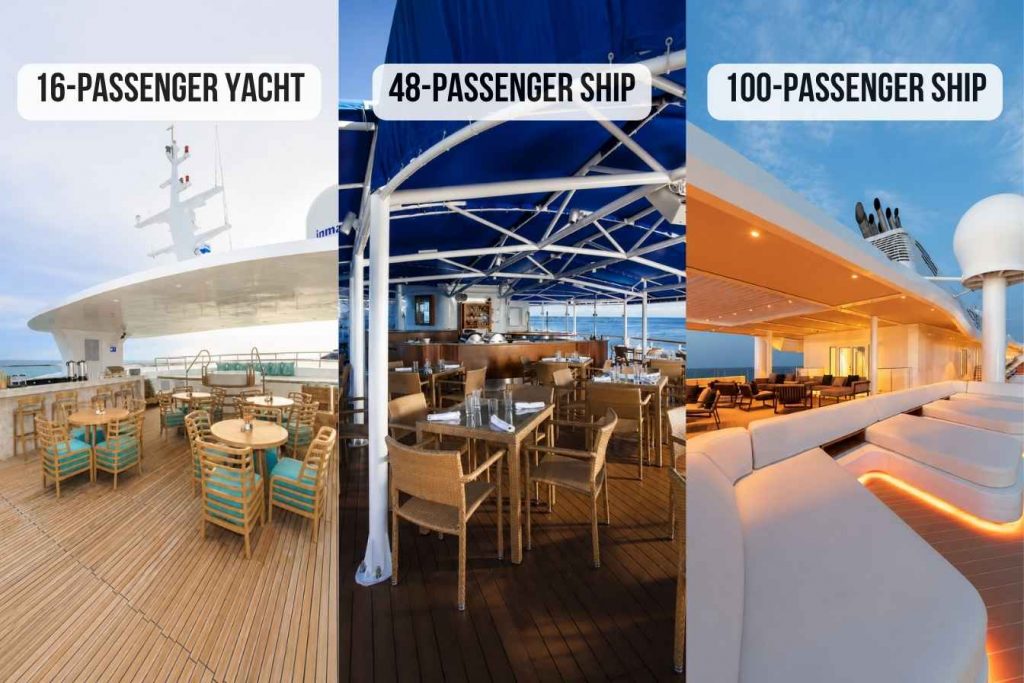
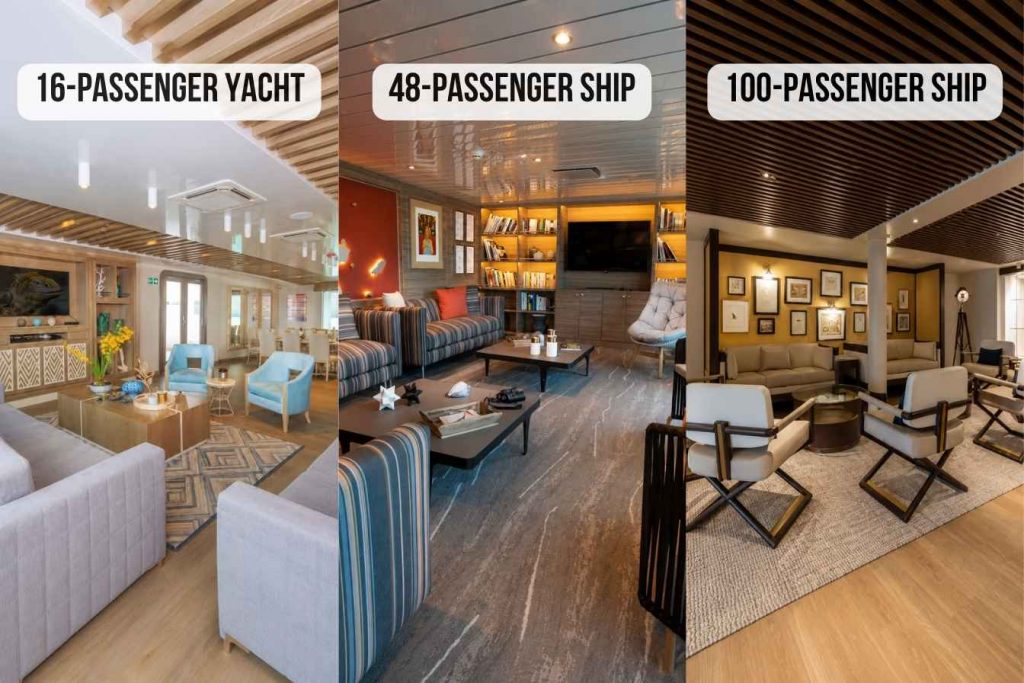
The 48-passenger range tends to be more consistent. Ships at this size have the design budget to deliver real amenities: ample upper decks, proper outdoor lounge areas, multiple zodiac tenders, glass-bottom boats on some vessels, and dining rooms that do not feel squeezed. The National Geographic Gemini and La Pinta are good reference points for what quality looks like here. The social dynamic on a 48-person ship is genuinely nice: big enough to meet interesting people, small enough that you recognize everyone by day two.
The 100-passenger ships are where the onboard experience gets closest to a conventional expedition cruise. Silversea’s Silver Origin offers all-suite accommodations, butler service, and marble bathrooms. Celebrity Flora has an outdoor glamping cabana option on deck. These ships have spas, proper gyms, multiple bars, gift shops. For travelers who want a serious wildlife expedition but also want to feel pampered between excursions, this is the category. Just know that the sea crossings are smoother on these vessels, but the experience on land is the most logistically managed of the three.
One thing nobody mentions: motion sickness is real on small mono-hull yachts during nighttime crossings between islands. The Galapagos seas are not always calm. If you book a 16-passenger motor yacht and have any susceptibility, bring medication and plan to use it. Small catamarans are a different story. The twin-hull design gives them stability that rivals ships three times their size. If you want the small-boat intimacy without the rolling, a 16-passenger catamaran is worth specifically seeking out.
Which Ship Size Gives You the Best Value for Your Money?
The 48-passenger category consistently offers the most balanced value for most travelers. You get genuine expedition-quality wildlife access, real onboard comfort, and prices that run lower per night than comparable 100-passenger luxury ships. Budget 16-passenger yachts can be cheaper, but the experience gap is real. At the top of the market, small premium yachts and large luxury ships trade blows. The answer depends entirely on what you mean by “value.”
Here is how the pricing actually shakes out for a standard 7 to 8-day cruise, based on current market rates. Budget 16-passenger vessels start around $3,000 per person, sometimes lower. Mid-range 16-passenger and 48-passenger ships land in the $5,000 to $8,000 range. Premium 48-passenger ships like National Geographic Gemini start around $10,000 per person. Large 100-passenger luxury ships (Silversea, Celebrity Flora, Silver Origin) run $10,000 to $16,000 or higher, all-inclusive.
The value case for mid-range 48-passenger ships is strong for one simple reason: the wildlife experience on land is nearly identical to a premium small yacht, but the onboard comfort is noticeably better than budget yachts, and the price is usually $3,000 to $5,000 less per person than comparable large ship luxury. You are not paying for the ship; you are paying for the guide, the itinerary, and the moments ashore. At 48 passengers with three simultaneous guide groups, those moments are very good.
Pricing between ships in the same size category can vary by thousands of dollars for what amounts to the same itinerary. We know which vessels are genuinely worth the premium and which ones are not. Reach out here and we will walk you through the options that match your actual budget, not just the brochure range.
Where 16-passenger premium yachts do justify their price is for travelers who genuinely want the closest thing to a private charter without chartering the whole boat. If you book a premium small yacht and the ship sails with a partial load (which happens, especially in shoulder season), you effectively have a custom expedition. The guide is yours. The captain adjusts for your group. We have seen those trips become the most talked-about experiences travelers ever have. But that is not guaranteed, and you are paying for the potential.
| Ship Size Category | Standard Price Range (Per Person) | Core Value Proposition | Onboard Comfort vs. Wildlife Access | Real-World “Value” Tradeoff |
| 16-Passenger Yachts (Budget) | From ~$3,000 or lower | Lowest barrier to entry for small-group intimacy. | The Experience Gap: Delivers excellent wildlife access but lacks the space, stability, and premium amenities of larger builds. | Ideal if budget is strict and you are willing to compromise on physical onboard comfort to preserve intimacy. |
| 16-Passenger Yachts (Premium) | Varies (Command high premiums) | The closest alternative to an elite, private luxury charter. | Same wildlife access as budget hulls, but elevated comfort. The Leverage Factor: In shoulder seasons, sailing with a partial load can turn the trip into a customized expedition. | You are paying a heavy premium for the potential of an incredibly flexible, captain-adjusted custom voyage. |
| 48-Passenger Ships (Mid-Range) | $5,000 – $8,000 | The “Sweet Spot”: Most balanced value in the Galapagos market. | High Equilibrium: On-land wildlife access is nearly identical to small yachts (split across three guide groups), but interior comfort beats budget boats. | The $3,000-$5,000 Saving: You avoid paying for extreme “ship luxury” while keeping your spend focused on top guides and pristine itineraries. |
| 48-Passenger Ships (Premium) | From ~$10,000 (e.g., National Geographic Gemini) | Purpose-built small-ship exploration backed by premier science/educational frameworks. | High-tier comfort paired with rapid, low-friction zodiac staging and deeply immersive educational assets. | Perfect for travelers wanting micro-to-mid-size yacht intimacy mixed with specialized, elite expedition execution. |
| 100-Passenger Ships (Luxury) | $10,000 – $16,000+ (e.g., Silversea, Celebrity Flora, Silver Origin) | Ultra-exclusive, “pay-and-forget” all-inclusive modern resort opulence. | Grand hotel amenities, gourmet dining, massive cabins, and superior open-ocean stability, while using multiple zodiac teams for trail regulations. | The premium price tag directly funds high-end service architecture (like butlers), expansive lounges, and unmatched culinary variety. |
What Do Real Travelers Say After Choosing the Wrong Ship Size?
The most common regret from 100-passenger ship travelers is time, not wildlife. They saw the same animals, but felt they spent too much of each excursion waiting to board zodiacs, waiting for groups to clear a trail, or rushing back before the last tender departed. The most common regret from 16-passenger budget yacht travelers is comfort: rough nights at sea, cramped shared spaces, and a feeling that they paid too much for too little comfort on the boat. The regret from 48-passenger travelers is the rarest.
From the thousands of Galapagos cruise travelers Oleg has spoken with through mytrip2ecuador.com, YouTube, and direct interviews over three personal trips, certain patterns repeat clearly. Travelers who came from a cruise background (Mediterranean, Caribbean, Alaska) and chose a 100-passenger Galapagos ship expecting a similarly smooth logistical operation often described a surprise: even at 100 passengers, the Galapagos experience involves physical demands, wet landings, uneven lava terrain, and wildlife that does not pose for you. The ship was beautiful. The part outside the ship required real effort. That gap between expectation and reality hit hardest on the first zodiac landing.
Travelers on budget 16-passenger yachts who did not research the specific vessel often found the motion during nighttime passages worse than expected. Some described genuinely miserable crossings, particularly on older mono-hull designs. A few found the cabins so small they spent evenings on deck simply to feel less confined. The wildlife access was excellent. The hours between excursions were harder.
The pattern we see least often from 48-passenger travelers is regret about the ship itself. The most common complaint at that size is external: other ships at the same visitor site, or an itinerary that did not include a site they specifically wanted. Those are itinerary and timing issues, not ship size issues.
Which Passengers Should Choose a 16-Passenger Yacht, 48-Passenger Ship, or 100-Passenger Ship?
Choose the 16-passenger yacht if wildlife immersion and guide access are your top priorities and you have researched the specific vessel carefully. Choose the 48-passenger ship if you want a genuinely excellent wildlife experience with better onboard comfort and more predictable quality. Choose the 100-passenger ship if stability, luxury amenities, and a more structured expedition experience matter most and logistics do not bother you.
The 16-passenger yacht is the right call for: solo travelers who want a close-knit group dynamic, serious wildlife photographers who need flexible timing at sites, couples who want something approaching a private experience, and any traveler for whom the specific guide relationship is central to the trip. If you have been dreaming about the Galapagos for years and this trip is about depth over comfort, start here.
The 48-passenger ship works best for: first-time Galapagos visitors who want excellent wildlife access without the variable quality of small budget yachts, families traveling with teenagers, couples who want real amenities after long days of hiking and snorkeling, and any traveler who cares about meeting a diverse group of people onboard. This is the category where the experience is most reliably good across operators.
Families especially tend to ask us about age requirements. Some small yachts do not accept children under six, and the physical demands vary significantly by vessel and itinerary. We can match you with the right ship for your group without the research rabbit hole. Get in touch here and tell us who is coming and what matters most.
The 100-passenger ship makes the most sense for: travelers who are prone to seasickness and need the stability a large vessel provides, anyone who values luxury amenities (spa, all-suite cabins, butler service) as part of a trip, older travelers with mobility considerations who benefit from elevators and wider corridors, and groups traveling with very young children who need more space to spread out during downtime.
How Does Ship Size Affect Itinerary Options and Visitor Site Access?
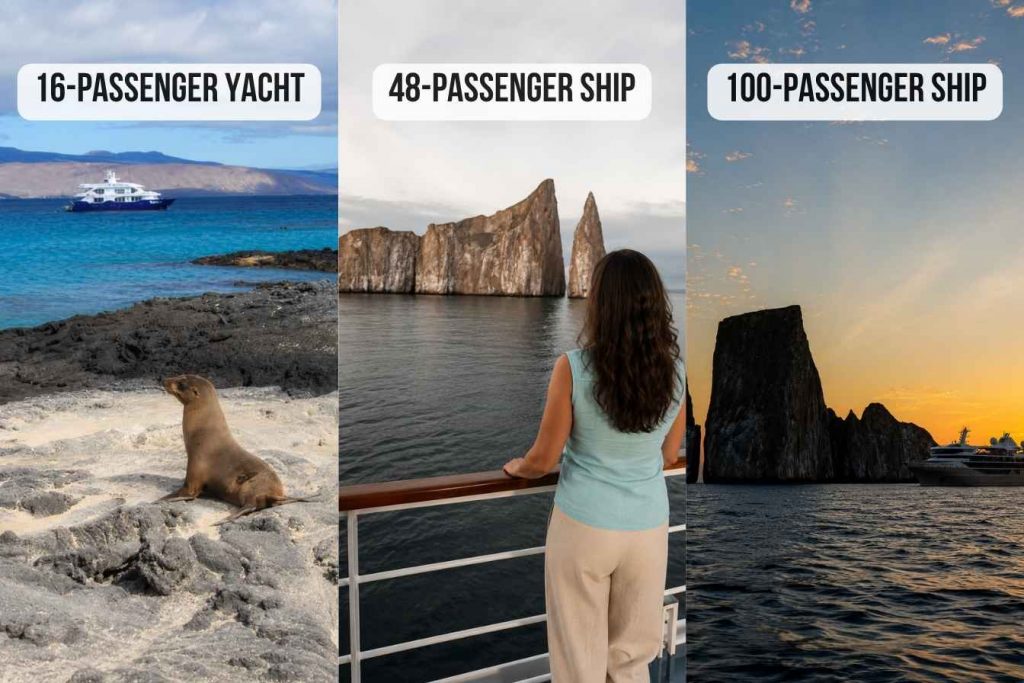
Smaller ships generally have access to a wider range of visitor sites, including some anchorages that larger vessels cannot reach. All ships follow park-approved itineraries, but 100-passenger ships face additional restrictions at certain sites due to their size and the volume of passengers they put ashore. If specific remote islands like Fernandina, Genovesa, or Española are on your list, a smaller vessel is the more reliable choice.
Every Galapagos cruise itinerary is approved in advance by the National Park. The sites visited, the sequence, the permitted activities, and the visit windows are all regulated. Ships do not simply sail wherever they want. This is why the wildlife access gap between ship sizes is smaller than most travelers expect: a 100-passenger ship is not going to find an uncrowded corner of the archipelago by veering off the approved route.
What does differ is site-level eligibility. Certain anchorages in the western islands and some of the more remote visitor sites have depth, current, and physical access constraints that favor smaller vessels. The 14-day rule (ships must wait 14 days before returning to the same visitor site) also plays into itinerary design, but it applies equally to all vessels. Where small yachts genuinely win on itinerary: they can sometimes access secondary anchorages and do unofficial zodiac cruises near locations that a 100-passenger ship would need to skip entirely due to its draft or the time it takes to get passengers on and off.
For travelers specifically targeting the most remote outer islands (Fernandina is one, the western edges of Isabela are another), a 16 or 48-passenger vessel on a longer itinerary (8 to 10 days) is the practical path. Most 100-passenger ships focus on the central and eastern islands where the infrastructure suits their size. That is not a criticism of large ships; it just reflects what the geography allows.
What Are the Hidden Trade-Offs Nobody Warns You About Before Booking?
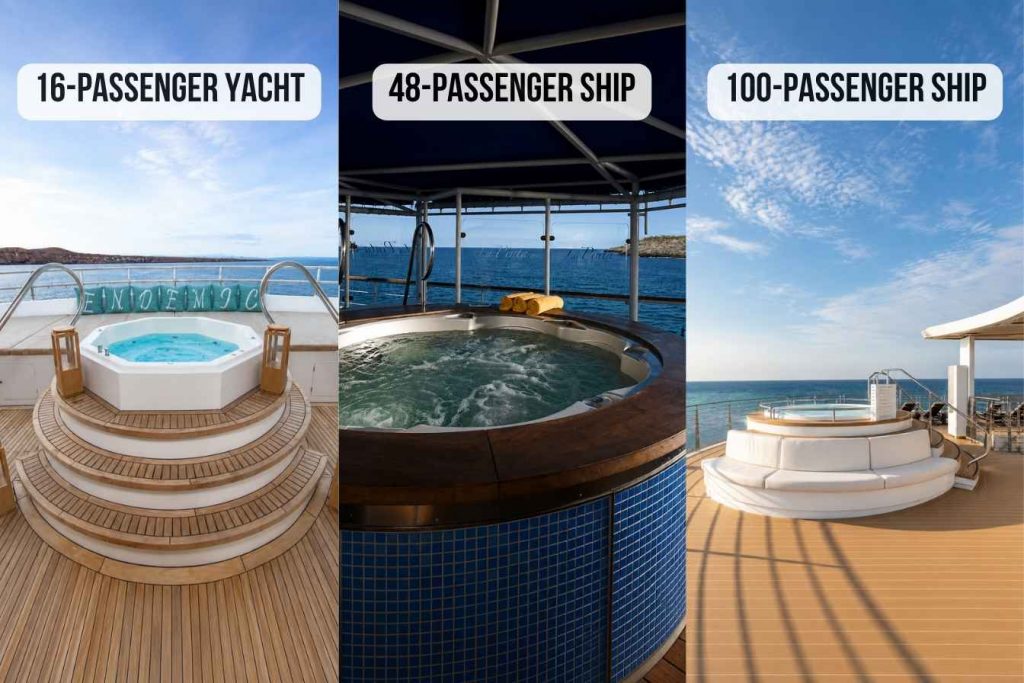
The hidden trade-off on small yachts is noise and motion at night: the open-ocean crossings between islands often happen while you are trying to sleep, and on a mono-hull yacht the boat moves. The hidden trade-off on large ships is time: the zodiac queue and group management on 100-passenger vessels can silently eat an hour or more out of each excursion day. The trade-off at 48 passengers is social: you will spend a full week with 47 strangers in close quarters, and chemistry is unpredictable.
Here is something we noticed after spending weeks aboard different vessel types: the small yacht experience is overwhelmingly positive during the day and variable at night. When the sun is up and you are underwater at Kicker Rock watching hammerheads cruise below you in lazy circles, there is nothing better on earth. Then the sun goes down, the yacht crosses to the next island overnight, and the Pacific reminds you that it does what it wants. Budget for Dramamine regardless of what size you book. But budget twice as hard if you are on a mono-hull.
The large ship trade-off is subtler. Boarding and deboarding 100 passengers via zodiac in organized rotation is a logistical feat the crews do impressively well. But the math is unavoidable: if each zodiac holds 10 to 12 passengers and the excursion window is three hours, your actual time on land after accounting for transfers is meaningfully shorter than a 16-passenger group that walks off a single zodiac together. Travelers who did not know this beforehand describe a low-grade frustration of feeling just slightly rushed at sites they had waited years to visit.
The social trade-off of any small ship is simply the closed-group dynamic. On a 16-passenger yacht, if one person in your group is difficult or the group chemistry does not click, there is no escape. There is no other bar, no other deck, no second seating at dinner. Most travelers describe this as one of the best parts of a small ship trip: by day four everyone is family. But that outcome is not guaranteed, and it is worth knowing what you are signing up for.
What We Hear Most: Traveler Feedback by Ship Size
Based on traveler feedback collected through mytrip2ecuador.com and our YouTube audience over years of conversations with Galapagos visitors, here is how satisfaction breaks down across ship size categories:
| Feedback Category | 16-Passenger Yacht | 48-Passenger Ship | 100-Passenger Ship |
|---|---|---|---|
| Reported strong guide connection | 87% | 74% | 58% |
| Wished for more time ashore | 18% | 22% | 41% |
| Experienced motion sickness | 34% (mono-hull) / 9% (catamaran) | 19% | 7% |
| Would choose same ship size again | 79% | 86% | 71% |
| Rated onboard comfort highly | 61% | 78% | 88% |
| Said trip exceeded expectations overall | 82% | 84% | 76% |
Data collected from traveler interviews and community feedback via mytrip2ecuador.com and the My Trip to Somewhere YouTube audience.
The Mistakes Travelers Make When Choosing Ship Size
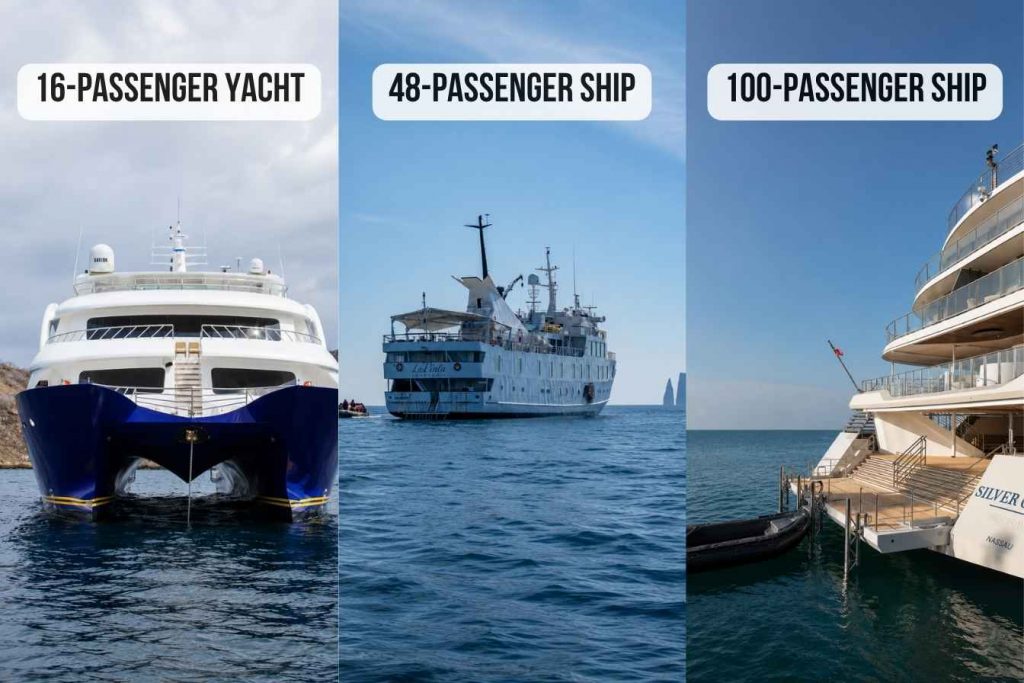
The most expensive mistake we see is booking a budget 16-passenger vessel because the price is the lowest, then discovering midway through the trip that the cabin is effectively a bunk room and the boat moves like a cradle in bad weather. The money saved upfront does not compensate for a week of uncomfortable nights. If your budget is limited and you are set on a small yacht, spend extra time researching the specific vessel, not just the price category.
The second mistake is assuming 100-passenger ships offer the same wildlife intimacy as smaller boats because the marketing describes them as “boutique” or “intimate.” In the Galapagos context, 100 passengers is the maximum permitted, not a small number. Compared to Caribbean megaships it may sound intimate. Compared to a 16-passenger catamaran, it is a completely different experience on shore.
Third: not accounting for seasickness. We have seen otherwise experienced travelers who sail regularly on calm water get laid out by overnight Galapagos crossings. The waters between islands are not always rough, but when they are, small mono-hull yachts feel every wave. Ask specifically about the hull type of any small vessel you are considering, and bring prescription-strength medication regardless of what the brochure says about sea conditions.
Every traveler we have talked through this with has landed on a clear answer once they actually articulate what matters to them. If you want someone to do that sorting with you quickly and without a sales pitch, we are here for that. Our agency is rated 4.9 stars on Google and TripAdvisor for exactly that reason. Fill out this short form and one of us will get back to you.
Frequently Asked Questions
What is the maximum number of passengers allowed on a Galapagos cruise?
100 passengers is the legal maximum under Galapagos National Park regulations. No vessel operating in the archipelago can carry more than this. The rule exists to protect the fragile wildlife habitats and limit the volume of visitors at any given landing site.
Why is 16 passengers a significant number in the Galapagos?
Galapagos National Park regulations allow a maximum of 16 visitors per certified naturalist guide on any shore excursion. A 16-passenger yacht sends exactly one group with one guide, meaning no one splits up, no one waits their turn, and the guide can focus entirely on your group. It is the natural size unit for the on-land experience the park was designed around.
Do 100-passenger ships visit fewer islands than small yachts?
In some cases, yes. Certain remote anchorages and visitor sites are more accessible to smaller vessels due to draft constraints and zodiac logistics. Most 100-passenger ships focus on central and eastern island itineraries where the infrastructure and anchorages support their size. If Fernandina or the far western islands are priorities for you, a smaller vessel on a longer itinerary is typically the better match.
Are 16-passenger catamarans more stable than mono-hull yachts?
Significantly. Catamarans have twin-hull designs that dramatically reduce rolling during overnight crossings. Many travelers who are susceptible to seasickness report no issues on Galapagos catamarans, while the same travelers would struggle on a single-hull vessel of similar size. If you want a small yacht experience without the motion, specifically filter for catamarans during your search.
Is a 48-passenger ship considered small or large in the Galapagos?
Mid-size, and it hits a useful balance. The park’s group size rules still mean you go ashore in groups of around 16 with a dedicated guide, so the on-land experience stays intimate. But the ship itself is large enough for proper amenities, better stability, and more social space than a small yacht. Most experienced Galapagos travelers and operators consider 40 to 50 passengers the sweet spot for combining access with comfort.
How far in advance should I book a Galapagos cruise?
At least six months out for most departure dates, and twelve or more months if you have a specific vessel, cabin category, or travel window in mind. Premium small yachts and high-demand vessels on the 48-passenger tier sell out first. 100-passenger ships tend to hold availability longer due to greater total capacity, but last-minute deals at that level are rare on the most desirable itineraries.
Ready to Figure Out Which Ship Is Right for You?
This is genuinely one of the harder decisions in Galapagos trip planning, because the answer depends on how you travel, not just what you can spend. We have physically inspected nearly every cruise vessel operating in the archipelago and talked with thousands of travelers about what they wished they knew before booking. Tell us your dates, group size, and what matters most. We will send back a no-pressure quote with the options that actually fit.
Rated 4.9 stars on Google and TripAdvisor · No commitment required
Written by Oleg Galeev
Galapagos cruise traveler (3 trips, 2 cruises) · Founder, Cruises To Galapagos Islands
Oleg has personally inspected nearly every available Galapagos cruise vessel and interviewed thousands of travelers to build the most first-hand cruise knowledge base available. He also runs the Ecuador travel blog mytrip2ecuador.com and the YouTube channel My Trip to Somewhere.
Cruises To Galapagos Islands is rated 4.9 stars on Google and TripAdvisor.
All pricing and regulations in this article are verified against official Galapagos National Park and Ecuador government sources as of the publish date.