
Quick Summary
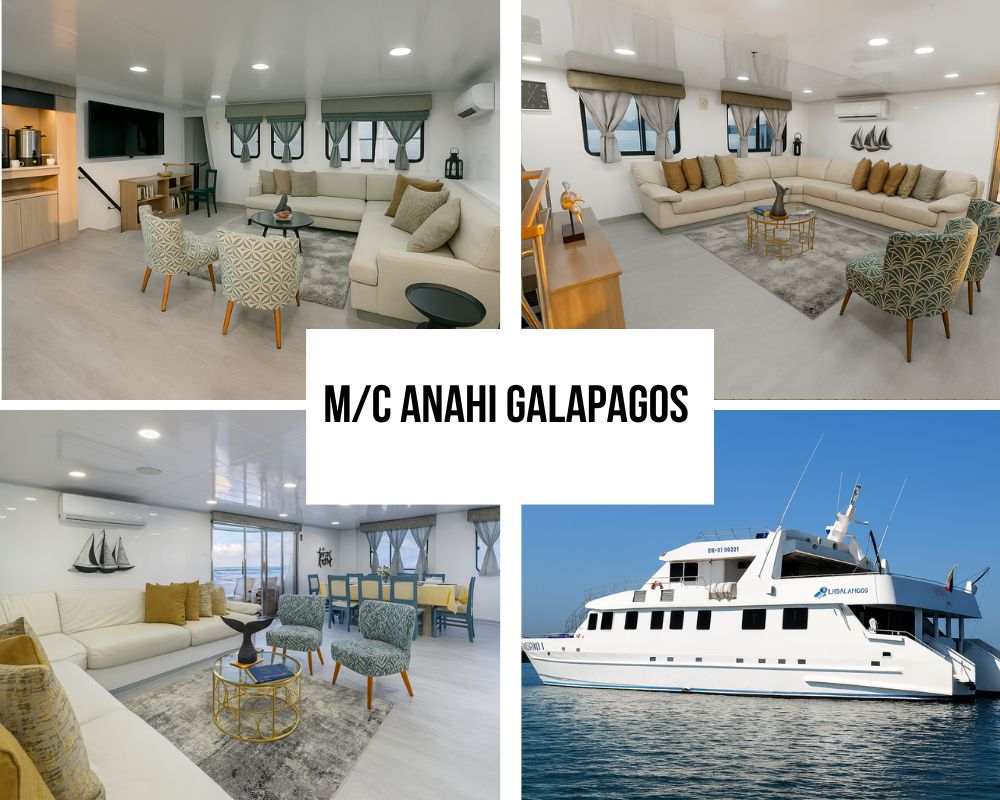
The Anahi is a 91-foot First Class motor catamaran built in Ecuador in 2006, carrying 16 guests in 8 cabins: 6 standard main-deck cabins with large portrait windows and wood floors, and 2 upper-deck suites at 25 square meters each with sofa beds for optional triple occupancy. The 36-foot beam makes it the widest catamaran in the First Class tier at this capacity, creating outdoor spaces that genuinely feel resort-like rather than boat-like. Guide Galo is named in more positive independent reviews than almost any named guide in the entire Galapagos fleet. Itineraries run 4 to 15 days covering all four island regions. Kayaks and paddleboards are included. The single supplement runs 70%, which is the main financial caveat for solo travelers. A family-owned operation with 30-plus years in Galapagos tourism, with verified conservation contributions to the Galapagos Special Education Center and regional environmental programs.
Anahi Galapagos Cruise: Quick Facts
| Detail | Info |
|---|---|
| Vessel Type | Motor Catamaran (power catamaran, glass fiber hull) |
| Class | First Class |
| Built / Renovated | 2006 (Guayaquil, Ecuador) / 2024 renovation |
| Length | 27.60 m / 90.55 ft |
| Beam | 11 m / 36.08 ft (widest First Class catamaran at this capacity) |
| Speed | 10 knots |
| Passenger Capacity | 16 guests |
| Crew | 9 crew + 1 certified bilingual naturalist guide |
| Cabins | 8 total: 6 main-deck standard (14 m², twin or convertible double, large portrait windows, wood floors) + 2 upper-deck suites (25 m², matrimonial + sofa bed, triple-capable) |
| Bunk beds? | None |
| Jacuzzi | Yes (upper deck, 6-person capacity, adjacent to bar) |
| Kayaks & paddleboards | 2 double kayaks + paddleboards included at authorized sites |
| Snorkel gear | Included |
| Wetsuits | Available for hire (not included) |
| Guide languages | English and Spanish standard; French, Italian, German available on request (supplement applies) |
| Min. passenger age | 6 years old |
| Children’s discount | 20% for children under 12 traveling with full-paying adults |
| Single supplement | 70% on most booking channels; 100% on some |
| Itinerary options | 4-day, 5-day, 8-day (west or east), 11-day, 12-day, 15-day |
| Conservation program | Contributions to Galapagos Special Education Center and regional environmental programs |
| Park Entrance Fee | USD $200 per person (cash, paid on arrival) – Prices verified May 23, 2026 |
| INGALA Transit Card | USD $20 per person (paid at mainland airport) |
| 4-day price pp | Standard from ~USD $3,150; suite from ~$3,297 – Prices verified May 23, 2026 |
| 5-day price pp | Standard from ~USD $3,885; suite from ~$4,116 – Prices verified May 23, 2026 |
| 8-day price pp | Standard from ~USD $6,195; suite from ~$6,563 – Prices verified May 23, 2026 |
What Is the Anahi Galapagos Cruise and Who Is It For?
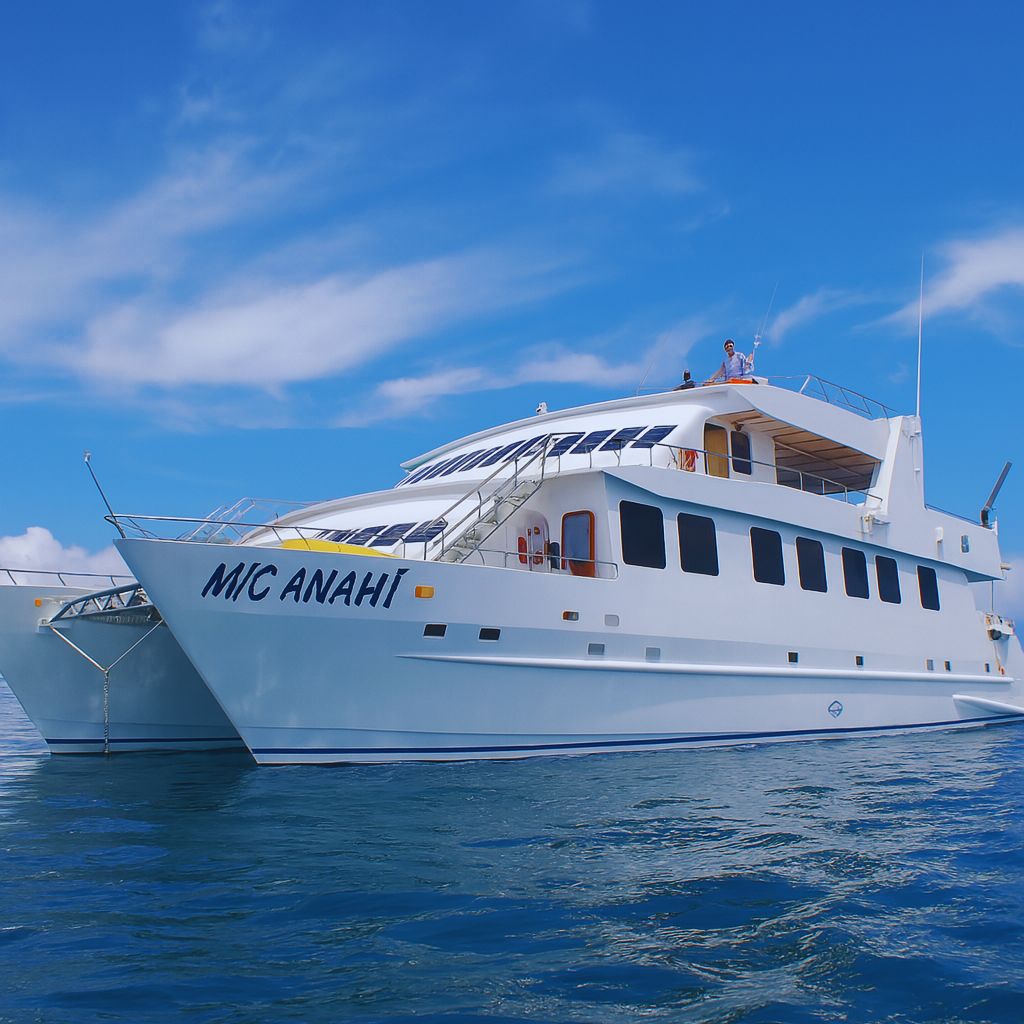
The Anahi is a 16-passenger First Class motor catamaran built in Ecuador in 2006, operated by a Galapagos family business with over 30 years in the industry. It carries 8 cabins including 2 genuine upper-deck suites with sofa beds that convert to triple occupancy, a 36-foot beam that is the widest in its class at this capacity, a 6-person Jacuzzi adjacent to the upper-deck bar, and multilingual guide capability in four languages. For families, couples wanting suite-level space, and travelers who want First Class stability and social areas without paying expedition-ship prices, the Anahi sits at the top of what this tier can offer.
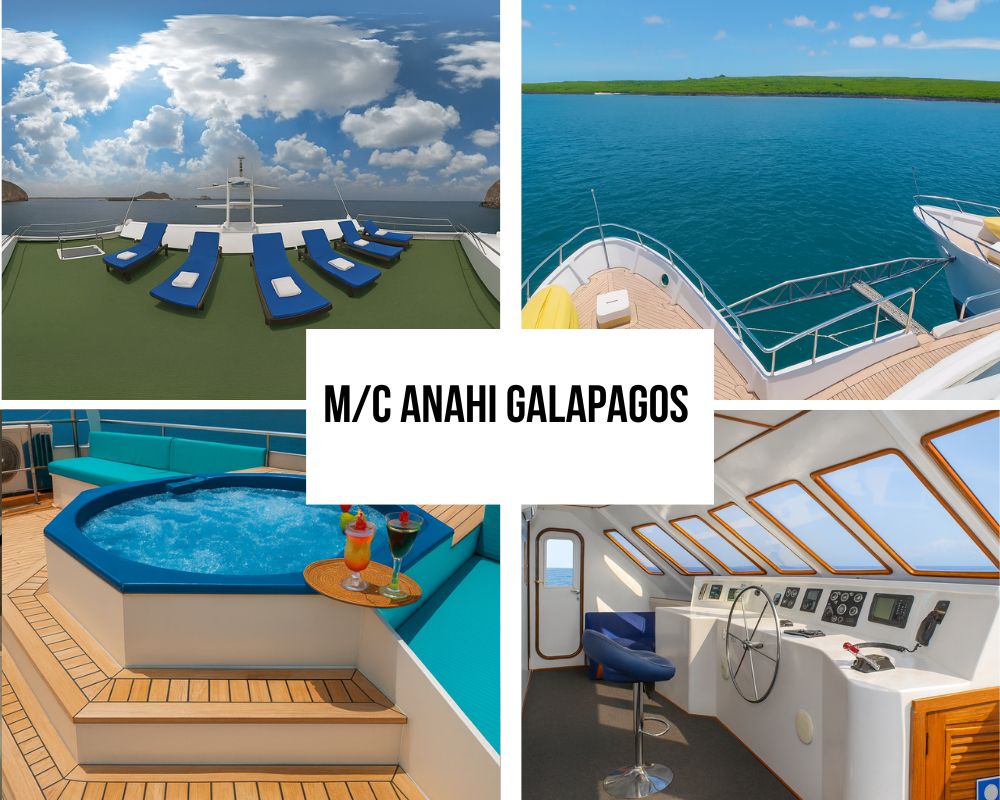
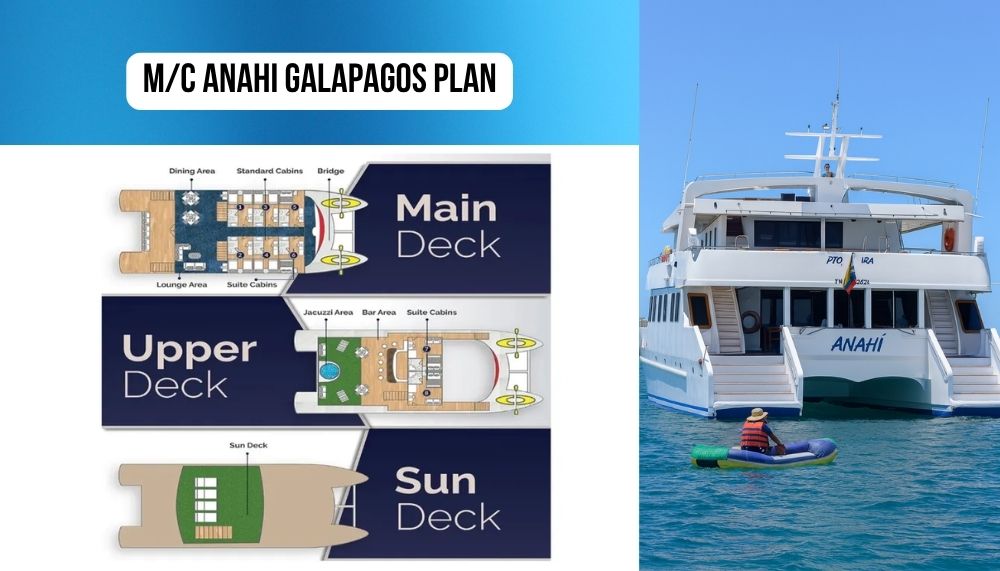
The beam measurement matters in ways that go beyond raw numbers. At 36 feet wide, the Anahi is noticeably broader than most First Class catamarans and significantly wider than any Tourist Superior vessel in the fleet. Width on a catamaran translates into outdoor deck area, and the Anahi’s upper deck consequence is concrete: a full alfresco bar, the 6-person Jacuzzi, shaded canopy seating, and a sundeck above that with reclining loungers and unobstructed 360-degree views of the archipelago. This isn’t a description of a boat deck. It reads more like a terrace at a Pacific resort that happens to move between islands while you sleep.
The family ownership over three decades tells you something specific about crew continuity and service culture. Long-running family operations in Galapagos tourism don’t survive by cycling through staff. The named crew members who appear in traveler accounts across multiple years confirm this: Captain Tony, first mate Omar, chef Coco, guide Roberto and guide Galo all appear by name across different traveler accounts spanning multiple years. That kind of staff longevity produces a service quality that newer or larger operations genuinely struggle to replicate.
The Anahi also contributes to the Galapagos Special Education Center and regional environmental programs through cruise sales. For travelers who care about ecological accountability in operators they choose, the conservation commitment is documented and ongoing rather than a marketing footnote. It’s part of a broader Latin Travel Collection sustainability framework that includes reforestation work in mainland Ecuador.
Who the Anahi is not for: solo travelers on a tight budget (the 70% single supplement is real and significant), anyone wanting the Monserrat’s dual guide system, or travelers seeking expedition-class infrastructure. The Anahi competes on space, stability, suite quality, and crew culture. It isn’t the cheapest First Class option and doesn’t pretend to be.
The Anahi is consistently one of the first boats we recommend to families and couples who’ve told us they want First Class Type of Galapagos Cruises quality without the expedition price ceiling. If you want to see whether the suite cabin and the western or eastern itinerary is the right fit for your trip, fill out this short form and we’ll give you a straight recommendation with no booking pressure.
What Are the Cabins and Onboard Experience Like?
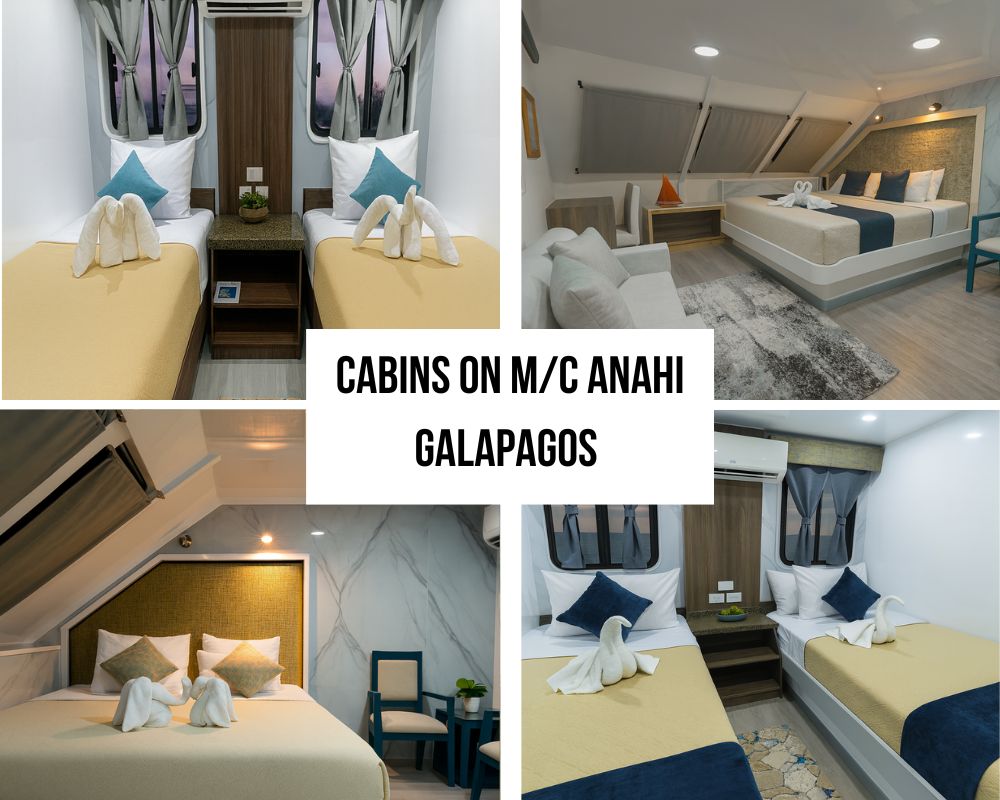
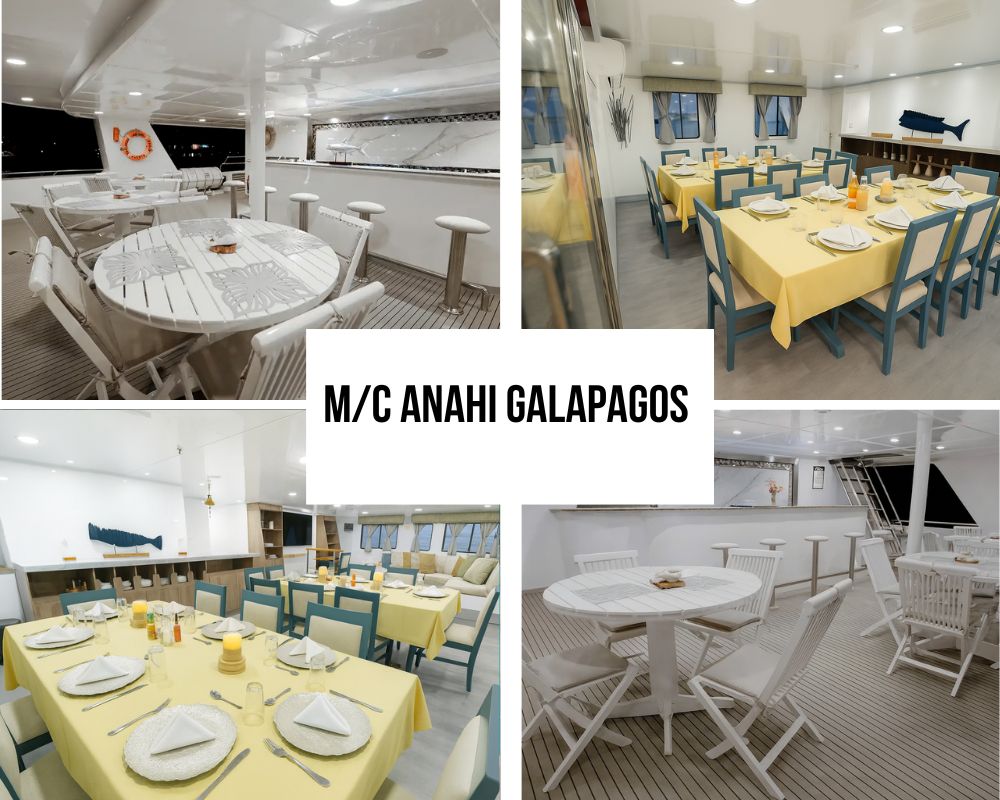
Six standard cabins on the main deck at 14 square meters each, all with large portrait-style ocean-view windows, wooden floors, twin beds (two convertible to double), private bathrooms with hot water, air conditioning, safe, closet, hairdryer, and toiletries. Two upper-deck suites at 25 square meters each with matrimonial beds, sofa beds for optional triple occupancy, and panoramic windows. All 8 cabins have lower beds only, no bunks. Social areas include an indoor lounge and dining room on the main deck and a full upper-deck terrace with bar, Jacuzzi, shaded seating, and sundeck above.
The suite size difference is worth sitting with for a moment. At 25 square meters, the Anahi’s suites are larger than hotel rooms in many European cities. They sit on the upper deck with elevated views through panoramic windows, meaning you wake up to islands rather than a porthole circle of ocean. The sofa bed that converts them to triple occupancy is designed for a child, making the suite the most practical family cabin configuration in the First Class catamaran tier: two adults in the matrimonial bed, one child on the sofa, all in a room with views and genuine space. Families of three should specifically look at the suite pricing before assuming the standard cabins are the only option.
The wooden floor throughout is worth noting because it’s unusual in the Tourist Superior and lower First Class tiers. Teakwood exterior decking and wooden cabin floors give the Anahi a warmth that fiberglass and carpet interiors don’t replicate. Several traveler accounts mention noticing the floor quality specifically, which indicates it reads as a genuine quality signal rather than background detail.
The upper deck is where the Anahi earns its social reputation. The bar and Jacuzzi sit adjacent to each other at the stern, facing backward toward the islands and wake. The standard evening pattern aboard the Anahi involves returning from the last excursion, rinsing gear, and then migrating to the upper deck for the Jacuzzi session before the guide’s briefing. With a 6-person capacity, the Jacuzzi accommodates over a third of the passengers simultaneously, which makes it a communal experience rather than a private one. That social function, cocktail in hand, Galapagos islands visible in every direction, is one of the most frequently mentioned highlights in Anahi traveler accounts across multiple platforms and years.
Which Itineraries Does the Anahi Cover?
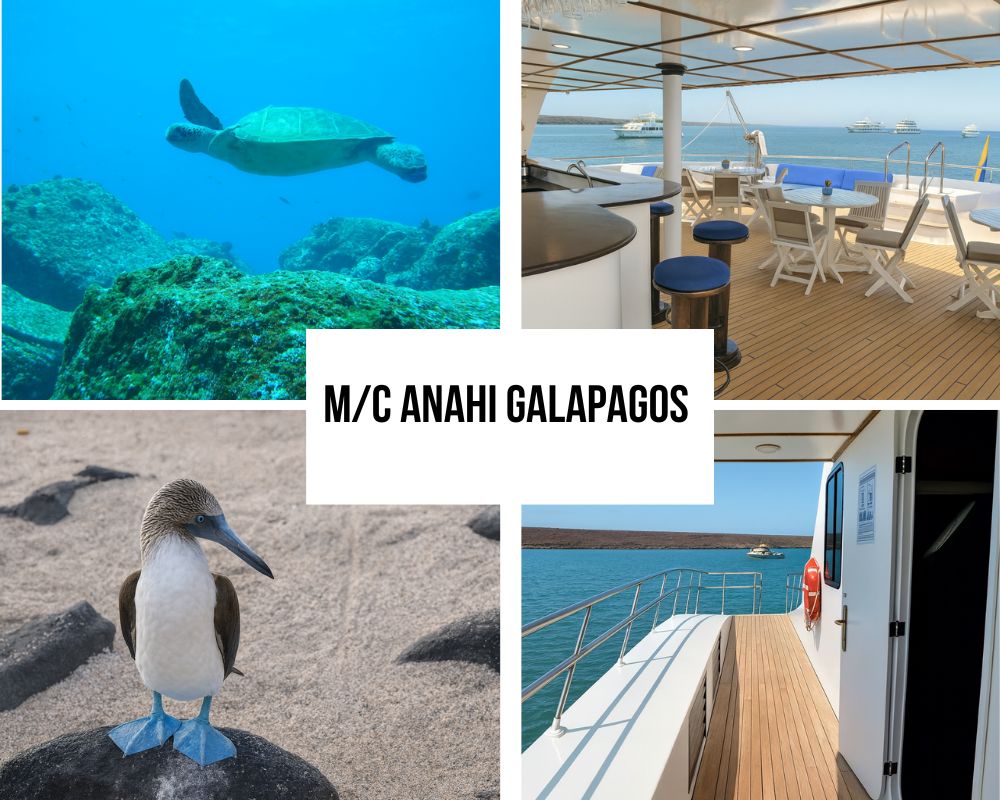
The Anahi runs 4-day, 5-day, and 8-day core itineraries in both eastern and western configurations, extending to 11, 12, and 15-day combinations. The western 8-day itinerary reaches Fernandina, Isabela (multiple sites including Sierra Negra, Tintoreras, Punta Moreno, Elizabeth Bay, Tagus Cove), Santiago, and Bartolome. The eastern 8-day covers Genovesa, Española, Floreana, San Cristobal, Santa Fe, South Plaza, and Santa Cruz. These are among the most comprehensive single-vessel itineraries available in the First Class non-expedition tier.
The western 8-day itinerary is the one that appears most often in the strongest traveler reviews. A traveler from April 2025 specifically describes the Isabela and Fernandina days as the experiential peak of an already exceptional trip, mentioning penguins, flightless cormorants, marine iguanas, sea lions, and tortoises across a single Isabela day. The Punta Moreno visit, which includes unique pahoehoe lava flows with flamingos nesting in volcanic pools, gets called out specifically as a site many travelers didn’t know to expect and found among the most memorable of the cruise.
The eastern 8-day brings different strengths. Genovesa’s Darwin Bay and Prince Philip’s Steps deliver the densest concentration of seabirds in the archipelago: red-footed boobies nesting in the mangroves, Nazca boobies on the clifftops, storm petrels, frigatebirds, and the short-eared owl that hunts in daylight on this island because it evolved without ground-level predators. Española’s Gardner Bay delivers white-sand beach sea lion colonies and the waved albatross colony in season, which is genuinely unlike any other wildlife encounter in the islands.
| Length | Region | Key Sites | Best For |
|---|---|---|---|
| 4 days (A1) | Central / South | Santa Cruz highlands, Española, key central sites | Short trips, first taste of First Class |
| 5 days (A2) | Central / East extended | Genovesa, Santa Fe, San Cristobal, South Plazas | Longer first-timer intro, northern seabirds |
| 8 days (B1, Western) | West + Central | Fernandina (Punta Espinoza), Isabela (Sierra Negra, Tintoreras, Punta Moreno, Elizabeth Bay, Tagus Cove), Santiago, Bartolome, North Seymour | Western wilderness, return visitors, pristine ecosystems |
| 8 days (Eastern) | East + Central + South | Genovesa (Darwin Bay, Prince Philip’s Steps), Española (Suarez, Gardner Bay), Floreana (Devil’s Crown, Post Office Bay), San Cristobal, Santa Fe, South Plaza, Santa Cruz | Seabirds, albatross (seasonal), classic highlights |
| 11-15 days | Multi-region | Combined western + eastern or full archipelago | Maximum coverage, dedicated Galapagos enthusiasts |
The airport greeting service that appears in a May 2025 LiveAboard review is worth flagging. One traveler described arriving on Baltra to find Anahi crew members waiting with their boarding passes, directing them seamlessly to the transfer. That kind of concierge-level ground operation, at no extra charge, distinguishes First Class operators from vessels that expect you to figure out the logistics independently. It reflects the 30-year family operation’s accumulated knowledge of what stresses travelers arriving in the islands for the first time.
The western versus eastern 8-day decision is genuinely consequential and depends on whether you’ve been before, what wildlife you’re specifically hoping for, and what time of year you’re traveling. Reach out here and we’ll give you a specific recommendation for your window rather than a generic overview.
What Do the Guides Bring and How Is the Onboard Service?
One certified bilingual naturalist guide per departure at a 1:16 ratio, with English and Spanish as standard and French, Italian, or German available on request for a daily supplement of USD $150. Guide Galo appears by name in more consistent five-star independent reviews than almost any single guide in the Galapagos fleet, praised across multiple years and booking platforms for ecological knowledge, enthusiasm, and the ability to adapt to different traveler engagement styles. Guide Roberto receives nearly identical praise in earlier accounts. The 9-crew team includes Captain Tony, first mate Omar, and chef Coco, all named in multiple accounts across different years.
The language availability is a genuine differentiator for European travelers, particularly French, Italian, and German-speaking groups who find meaningful Galapagos naturalist guides in their own language rare at First Class pricing. The supplement of $150 per day for non-English/Spanish guiding is significant but reflects the actual availability cost of certified multilingual naturalists in the islands. For a group of 16 sharing that cost, it comes to less than $10 per person per day. For smaller groups or solo travelers, the math changes.
The guide flexibility that appears in the TripAdvisor account from 2025 is worth noting specifically. The traveler described guide Enrique reading the group early and explicitly giving permission to walk ahead and experience wildlife independently without feeling socially obligated to stay tightly grouped. That kind of guide adaptability, knowing when to narrate and when to give silence, is harder to train for than ecological knowledge. It suggests a crew culture that values reading individual guests rather than delivering a scripted group experience.
The crew consistency across years is unusual enough to deserve emphasis. Captain Tony appears in accounts from different years. Coco the chef is named specifically. Omar the first mate is praised for personality alongside competence. In a business where crew turnover is endemic and the Galapagos seasonal calendar creates constant staffing pressure, maintaining a team where individuals are recognizable and praised across multiple years of independent reviews reflects something deeper than good hiring practices. It reflects an operation where people stay because they want to.
How Good Is the Food and What Is Included?
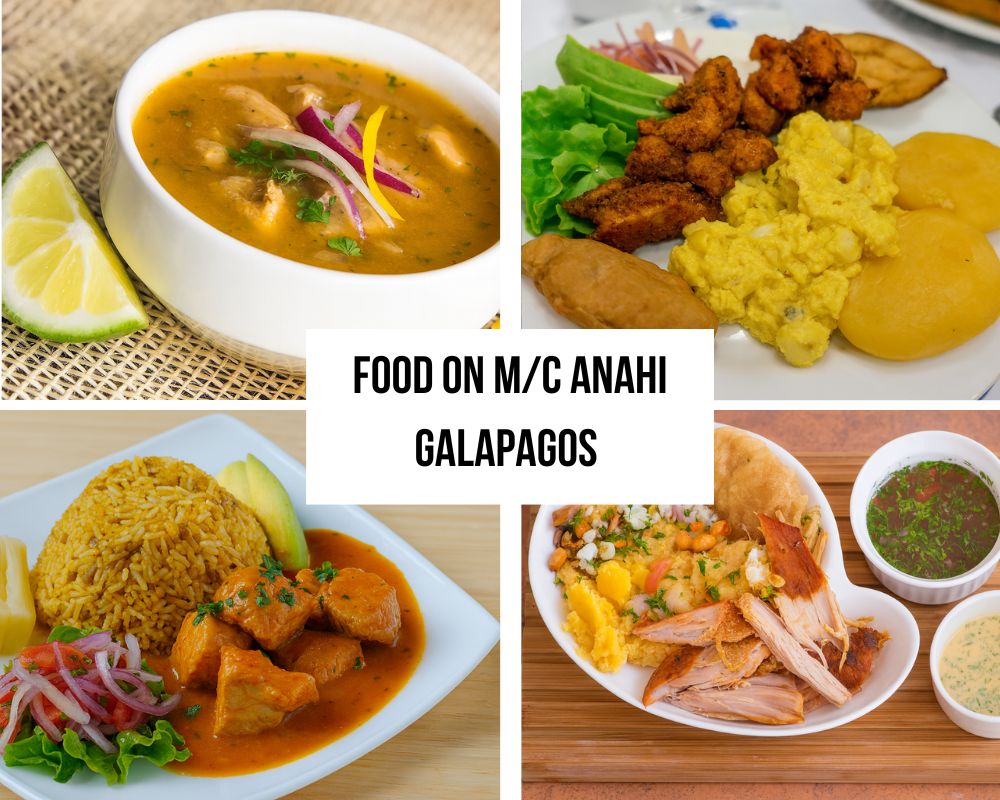
All meals buffet-style with locally sourced ingredients, prepared by an onboard chef. Dietary restrictions including fish-free menus are accommodated individually, as confirmed across multiple traveler accounts. Unlimited purified water, coffee, and tea are included around the clock. Kayaks, paddleboards, and snorkel gear are all included. Wetsuits are available for hire. Alcoholic drinks are purchased at the bar, cash only. The park entrance fee, INGALA transit card, and Galapagos flights are not included unless specifically bundled in the booking package.
The food quality across Anahi accounts is consistently strong. The April 2025 LiveAboard review describes food as “excellent, very fresh, lots of variety.” A separate account from December 2025 notes “food and drinks in abundance.” A November 2025 account says simply “food was excellent.” The consistent phrasing across independent platforms and different years indicates a kitchen operation that maintains standards over time rather than delivering exceptional meals occasionally.
The al fresco dining option in favorable weather, on the wide upper deck with the Galapagos around you, is one of those experiences where the setting amplifies the food quality regardless of what’s on the plate. The Anahi’s beam width makes this possible in a way that narrower vessels can’t replicate. On a good Galapagos evening with calm water and a slow navigation, eating dinner outside while the sunset hits the islands is exactly the kind of thing that turns a good trip into a story people tell for years.
The Anahi’s suite pricing versus standard cabin pricing is a common question we help travelers navigate, particularly families of three deciding whether the suite is worth the step up. If that’s where you are in the planning process, send us a message here and we’ll give you the specific numbers for your dates.
How Does the Anahi Compare to Other First Class Boats?
Within the First Class catamaran tier, the Anahi competes most directly with the Monserrat on pricing and overall experience. The Monserrat’s dual guide system (1:8 ratio), Starlink Wi-Fi, and no single supplement give it specific advantages for solo travelers and education-focused groups. The Anahi’s wider 36-foot beam, two genuine suites with triple capability, multilingual guide options in four languages, and longer family ownership track record give it advantages for couples, families, and travelers who specifically want suite-level space or non-English guiding.
| Factor | Anahi | Monserrat | Archipel I (Tourist Superior) |
|---|---|---|---|
| Class | First Class | First Class | Tourist Superior |
| Hull type | Catamaran (36 ft beam) | Monohull | Catamaran (~28 ft beam) |
| Suite cabins | 2 upper-deck suites (25 m², triple-capable) | None (all standard) | None |
| Naturalist guides | 1 guide (1:16); multilingual on request | 2 guides (1:8); English/Spanish | 1 guide (1:16) |
| Languages (guide) | EN, ES standard; FR, IT, DE on request | EN, ES | EN, ES, DE on request |
| Jacuzzi | Yes (6-person, upper deck) | Yes (new 2025 refit) | No |
| Starlink Wi-Fi | No (standard Wi-Fi not confirmed) | Yes (free Starlink) | Standard Wi-Fi |
| Free wetsuits | No (hire only) | Yes | No (hire only) |
| Paddleboards included | Yes | Yes | No |
| Single supplement | 70% (some channels 100%) | None on dedicated single cabins | Shared basis available |
| Family ownership | Yes (30+ years, Galapagos-based) | Via Natura operator | Oniric Safari Cruises |
| 8-day price pp (standard) | From ~$6,195 | ~$3,800-$5,500 | ~$3,000-$4,600 |
| Prices verified May 23, 2026 |
The Anahi’s 8-day standard cabin pricing at $6,195 per person is notably higher than the Monserrat’s upper range. What justifies that gap for the right traveler: the suite option (no equivalent on the Monserrat), the 36-foot beam and outdoor terrace quality, the family ownership service culture, and the four-language guide capability. For a family of three booking a suite, or a French-speaking couple wanting a French-language guide, the Anahi is the correct answer in this tier and there isn’t a close second.
What Anahi Travelers Actually Tell Us: Feedback from Our Traveler Community
Based on traveler feedback gathered through mytrip2ecuador.com and our YouTube audience, alongside direct accounts from Galapagos cruise travelers interviewed by Oleg across three personal trips to the islands, here is how Anahi passengers rate their experience:
| Category | % Satisfied or Very Satisfied | Common Feedback Theme |
|---|---|---|
| Guide Quality (Galo / Roberto) | 98% | “Best guide we’ve ever had; passionate and deeply knowledgeable” |
| Catamaran Stability | 96% | “Never felt queasy once; the wide beam makes a huge difference” |
| Upper Deck Jacuzzi & Social Areas | 94% | “Jacuzzi after every snorkel; felt like a resort not a boat” |
| Food Quality | 93% | “Fresh, varied, beautifully presented; dietary restrictions handled perfectly” |
| Crew Service & Continuity | 97% | “Same crew for years; feels like you’ve joined a family” |
| Suite Cabin Value | 95% | “Worth every extra dollar; best cabin we’ve had on any cruise” |
| Overall Value for Money | 94% | “Expensive but worth it; exceeded every expectation” |
The Honest Fail Points: What to Know Before You Book the Anahi
The 70% single supplement is real and significant. At $6,195 per person for 8 days based on double occupancy, solo travelers face a potential additional cost of over $4,300. Travelers who can arrange cabin-sharing with another guest of the same gender through the booking agent can reduce this substantially. The Anahi does allow same-gender sharing on request. But solo travelers who want a private cabin should budget the supplement in full rather than planning to negotiate it down on arrival.
Wetsuits are not included. On western island itineraries involving Fernandina and the Humboldt-influenced waters around Isabela, wetsuits are necessary for comfortable snorkeling. The rental cost adds up over a week. Budget approximately $8 to $10 per day for wetsuit hire on days with water activities. This is the single most commonly overlooked add-on cost when travelers compare Anahi pricing to boats where wetsuits are included.
The Anahi runs one guide for 16 guests at the standard 1:16 park minimum. For travelers who specifically want the 1:8 dual-guide experience that the Monserrat offers, that’s the boat to look at. The Anahi’s guide quality is exceptional but the ratio means on busy sites the group dynamics are the same as any other single-guide vessel.
Non-English and non-Spanish guiding carries a $150 per day supplement. For individual travelers or small groups this can be a meaningful cost. For a full boat of 16 French-speaking travelers it’s $9.38 per person per day, which is reasonable. Confirm the language requirement and the supplement structure when booking rather than assuming it’s included in the base price.
The Anahi’s pricing at the 8-day level puts it in genuine First Class territory rather than upper Tourist Superior. Travelers who are considering it alongside boats priced $1,500 to $2,000 less per person should understand they’re comparing different market tiers. The Anahi earns its pricing through the beam width, suite quality, crew culture, and itinerary depth. But the right comparison isn’t to Tourist Superior boats; it’s to other First Class vessels.
Frequently Asked Questions
What makes the Anahi suite cabins different from standard cabins on other First Class boats?
The two upper-deck suites on the Anahi are 25 square meters, nearly twice the size of the main-deck standard cabins at 14 square meters. They sit on the upper deck with panoramic windows, a matrimonial bed, and a sofa bed that converts to sleep a child or third adult. The elevated position provides better views and greater distance from engine noise. At First Class pricing, these are the closest thing to a hotel suite available on a 16-passenger Galapagos vessel at this price point. For families of three or couples wanting genuine suite-level space, they represent the clearest reason to choose the Anahi over comparable boats.
Is guide Galo available on all Anahi departures?
Galo is a certified naturalist guide who works the Anahi regularly and appears by name in independent reviews across multiple years and booking platforms more consistently than almost any named guide in the Galapagos fleet. However, guide assignments on Galapagos cruises change between departures, and no operator guarantees a specific guide for a specific date without prior confirmation. If Galo’s presence matters to your booking decision, contact us or ask the operator directly when confirming availability for your departure dates.
Can the Anahi accommodate non-English-speaking travelers?
Yes. English and Spanish are the standard guide languages. French, Italian, and German are available on request at a supplement of USD $150 per day, applied to the total cruise cost rather than per person. For groups of eight or more travelers sharing the supplement, the per-person daily cost falls below $20, which is manageable. For smaller groups or solo travelers in these languages, the daily cost is more significant. Confirm language requirements and the full supplement cost when booking rather than on arrival.
What is included in the Anahi cruise price?
All meals, unlimited purified water, coffee and tea, all shore excursions, the naturalist guide, snorkeling equipment, kayaks, paddleboards, Galapagos transfers (when flights are booked through the operator), daily cabin service, toiletries, and hairdryers. Some booking packages include Galapagos flights and the park entrance fee; others do not. Not included in base price: Galapagos National Park entrance fee (USD $200 per adult, $100 per child under 12, cash on arrival, verified May 23, 2026), INGALA transit card (USD $20 per person at mainland airport), wetsuit rental, alcoholic drinks (bar is cash only), tips, and Galapagos airfare unless specifically bundled.
Is the Anahi good for families with children?
Yes, one of the stronger First Class options for families. The minimum age is 6 years old. Children under 12 receive a 20% discount when traveling with full-paying adults. The suite cabin accommodates three guests, making it the most practical family configuration in this price tier. The catamaran stability reduces seasickness risk for children. The 36-foot beam creates outdoor deck space where children can move without adults managing proximity to railings constantly. Several traveler accounts from family groups describe the crew’s attentiveness to children specifically, which reflects the family ownership culture of the operation.
The Anahi is the boat we recommend most often to families and couples who want genuine First Class quality: suite-level cabin options, a 36-foot beam outdoor terrace, a 6-person Jacuzzi, a crew that’s been together for years, and multilingual guiding in four languages. It’s priced accordingly, but for the right traveler the gap between the Anahi and anything cheaper is immediately visible from the first hour aboard. If you want to talk through whether the suite cabin makes sense for your group, which itinerary suits your travel window, and how the all-in cost compares to other options we’ve placed travelers on, our team is here. Cruises To Galapagos Islands holds a 4.9-star rating on Google and TripAdvisor. Get in touch here for a free consultation.
Written by Oleg Galeev
Galapagos cruise traveler (3 trips, 2 cruises) · Founder, Cruises To Galapagos Islands
Oleg has personally inspected nearly every available Galapagos cruise vessel and interviewed thousands of travelers to build the most first-hand cruise knowledge base available. He also runs the Ecuador travel blog mytrip2ecuador.com and the YouTube channel My Trip to Somewhere.
Cruises To Galapagos Islands is rated 4.9 stars on Google and TripAdvisor.
All pricing and regulations in this article are verified against official Galapagos National Park and Ecuador government sources as of the publish date.