Galaxy Diver II Galapagos Cruise Review
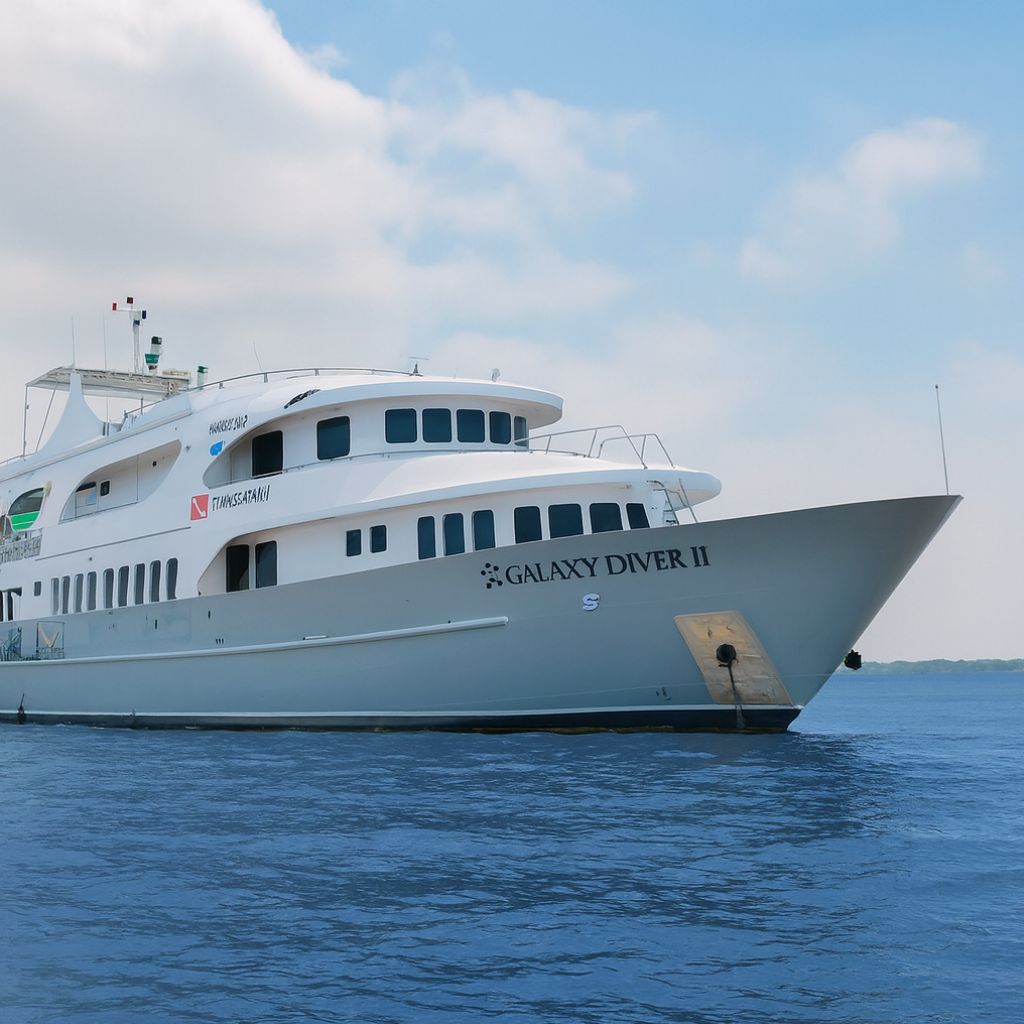
The Galaxy Diver II is one of 28 First Class ships we review. See all first class Galapagos cruises, or use our finder to see the best Galapagos cruises side by side.
Quick Facts: Galaxy Diver II Galapagos Cruise
| Detail | Information |
|---|---|
| Vessel type | Scuba diving liveaboard / naturalist yacht |
| Built / Refurbished | 2023 / fully refurbished 2024 |
| Length | 115 ft (35m) |
| Capacity | 16 guests / 9 crew + 2 dive masters (diving departures) or 1 naturalist guide (naturalist departures) |
| Cabins | 8 cabins: 4 upper-deck double/matrimonial (187 sq ft, panoramic windows); 3 main-deck twin; 1 lower-deck twin (portholes) |
| Dive equipment | 2 LW compressors, enriched air nitrox, 10/12/15L aluminum tanks, DIN and INT fittings, camera rinse tanks, trimix support available |
| Dives per day | Up to 4 dives including at least 1 night dive |
| Dive certification required | PADI Advanced Open Water minimum; 50 logged dives; cold water and strong current experience required |
| Itineraries | 8-day Diving (Wolf and Darwin Islands focus) / 8-day Naturalist (western and central islands, no diving required) |
| Approx. daily rate | ~$721-758 pp/day |
| Park entrance fee (not included) | $200 USD adults / $100 children under 12 – cash only on arrival |
| Transit Control Card (not included) | $20 USD per person – purchased at mainland airport |
| Included (naturalist itinerary) | All meals, naturalist guide and activities, purified water, tea and coffee, wetsuits, snorkel gear, kayaks, paddleboards, beach towels |
| Not included | Park fee, TCT, domestic flights ($60 fee if not booked through operator), alcohol and soft drinks, dive equipment rental, gratuities |
Prices verified May 26, 2026. Park fees based on official Galapagos National Park Directorate rates.
What Is the Galaxy Diver II and Who Is It For?
The Galaxy Diver II is fundamentally different from every other vessel reviewed on this site. It is a scuba diving liveaboard first and a naturalist yacht second. It was built in 2023 and refurbished in 2024 specifically to reach the Galapagos dive sites that no zodiac excursion from a naturalist cruise can access: Wolf Island and Darwin Island in the far north of the archipelago. These are not better versions of the snorkeling you’d do on any other Galapagos vessel. They are a categorically different encounter, and they require certification, experience, and physical readiness that most general Galapagos travelers don’t have.
Wolf and Darwin Islands sit about 170 kilometers northwest of the main Galapagos archipelago. They have no visitor landing sites – no trails, no dry landings, no shore excursions. You go there to dive. The sites there, particularly Shark Bay and The Window at Wolf and the area around Darwin Island formerly marked by Darwin’s Arch (which collapsed in 2021), aggregate marine life in concentrations that simply don’t exist anywhere else in the Galapagos or most other places on earth. Hundreds of scalloped hammerhead sharks in a single dive. Whale sharks seasonally from June through November. Galapagos sharks, silky sharks, manta rays, mola mola. Tiger sharks occasionally. These are the animals.
The Galaxy Diver II exists to get qualified divers to those animals. The 2024 refurbishment upgraded the dive facilities, cabins, and onboard systems. Two dedicated dive masters lead every dive. Nitrox is available. Technical diving infrastructure including trimix support is on board. Up to four dives per day with at least one night dive. The certification requirement is real and non-negotiable: PADI Advanced Open Water as a minimum, 50 logged dives, with cold water and strong current experience required. The currents at Wolf and Darwin are powerful and unpredictable. This is not a boat for newly certified divers regardless of enthusiasm.
A separate naturalist itinerary runs on non-dive departures. It covers the western islands including Fernandina, Isabela, and Rabida, with snorkeling, kayaking, and shore excursions led by a certified naturalist guide. Groups with mixed diving and non-diving members can travel together – divers on dive departures, non-divers on naturalist ones – though not simultaneously on the same departure.
What Does the Galaxy Diver II Look Like Inside? (Cabins, Decks, Common Areas)
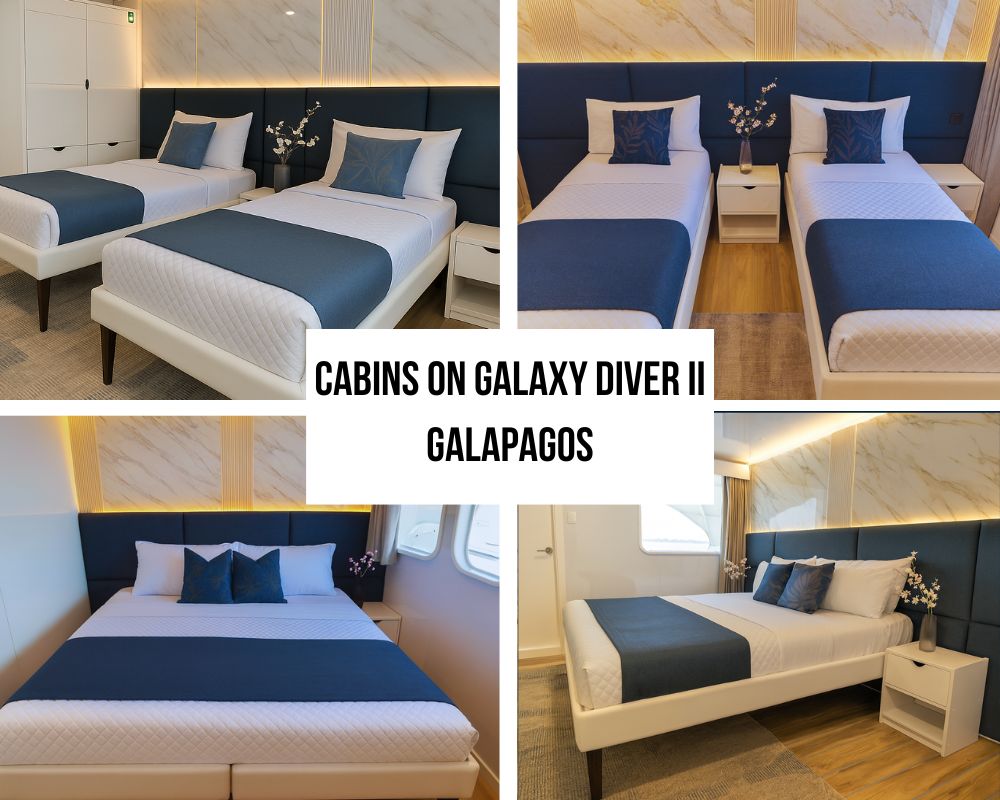
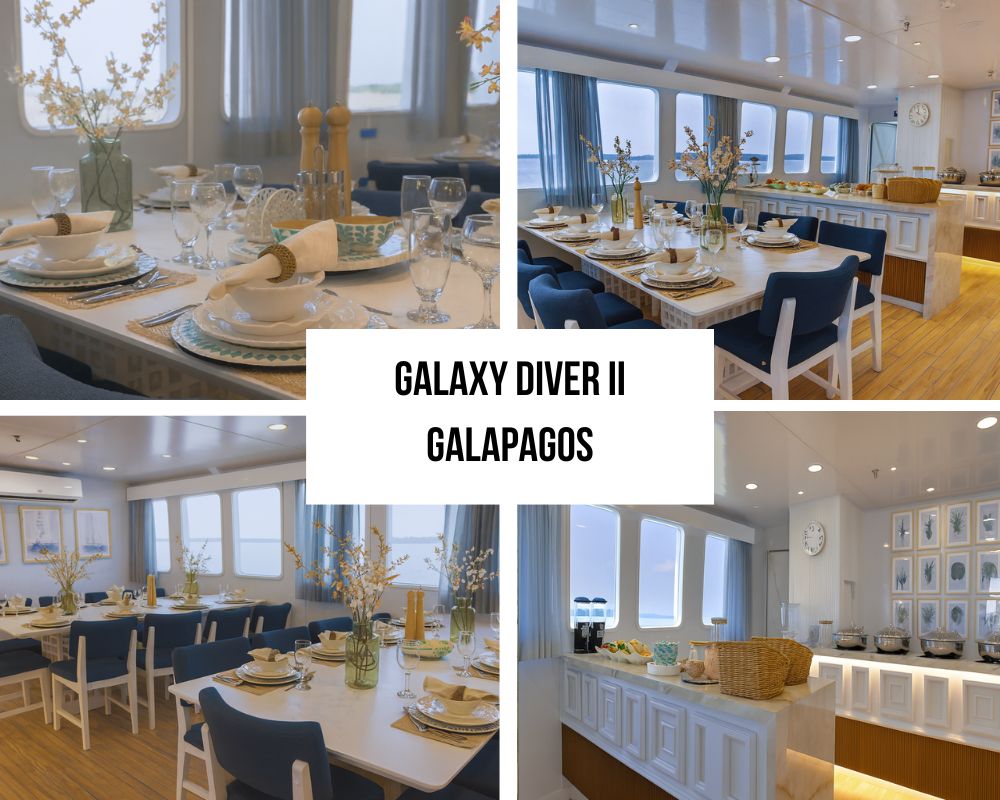
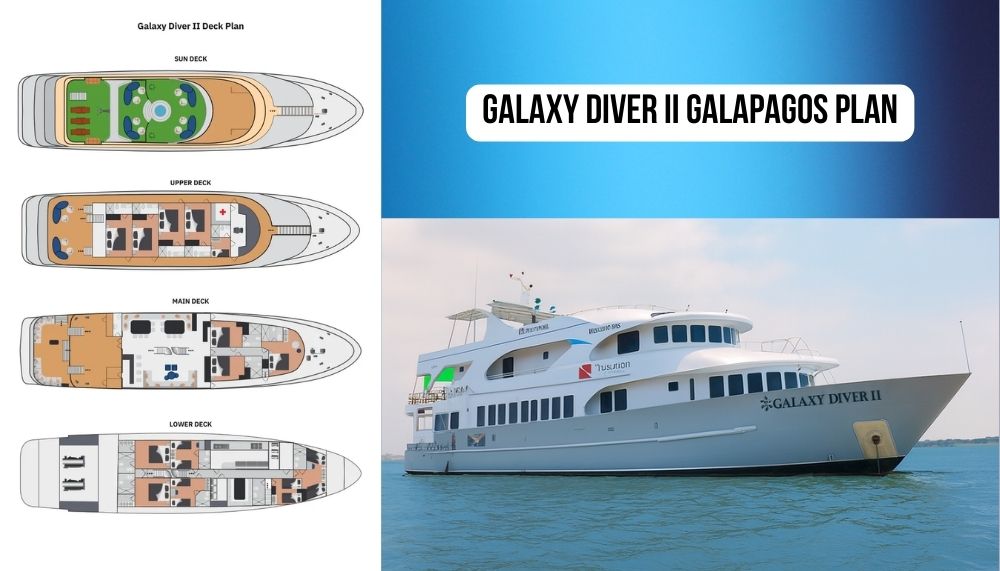
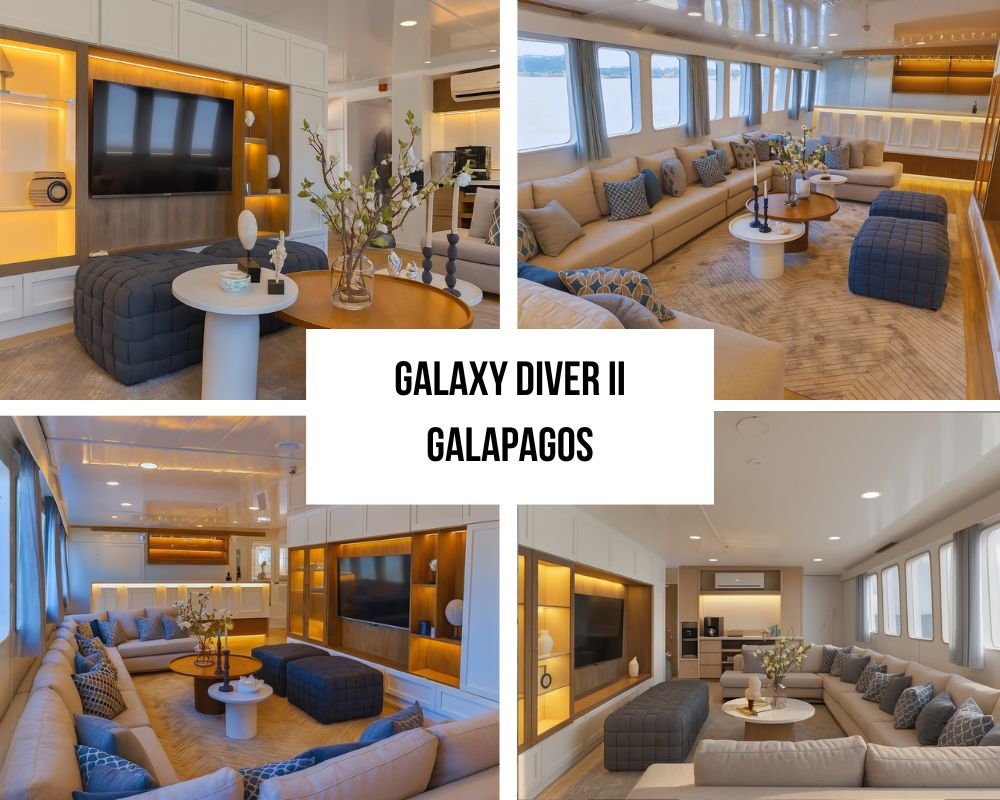
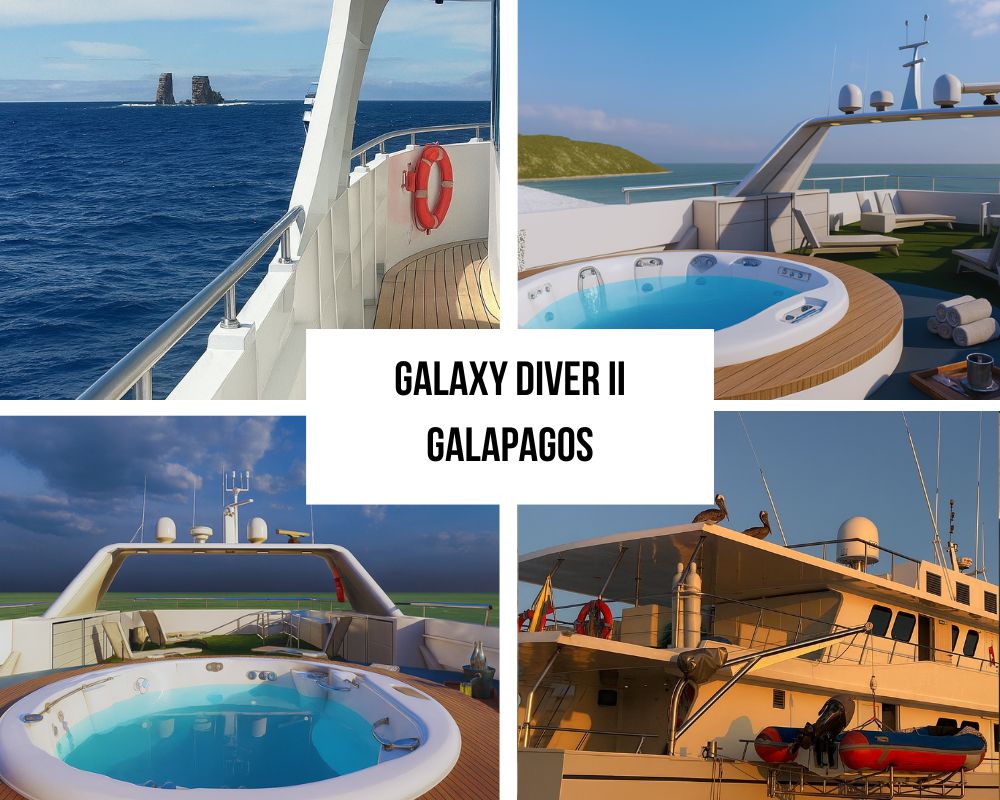
The Galaxy Diver II has 8 cabins across three decks. Four upper-deck double cabins at 187 square feet each have panoramic windows and convert between twin and matrimonial configurations. Three main-deck twin cabins offer flexible layouts. One lower-deck twin cabin has portholes. All cabins are air-conditioned with private en-suite bathrooms, TV, hairdryer, and USB charging. Common areas include a main-deck lounge and bar, a dining room, a shaded deck, and a sun deck with solarium and Jacuzzi. The dedicated dive platform at the stern is the operational heart of the vessel.
The 2024 refurbishment shows in the cabin condition. Reviewers coming from other Galapagos dive liveaboards consistently note the Galaxy Diver II cabin quality as among the best they’ve experienced. One reviewer described it as “a luxury hotel on water” – phrasing that reflects genuine surprise at the comfort level for a working dive vessel. The upper-deck panoramic window cabins are the clear preferred option. The lower-deck porthole cabin is darker and feels more compact, but sits closest to the waterline where motion on overnight passages is least noticeable – the same stability trade-off seen on the Tip Top IV and Coral I and II.
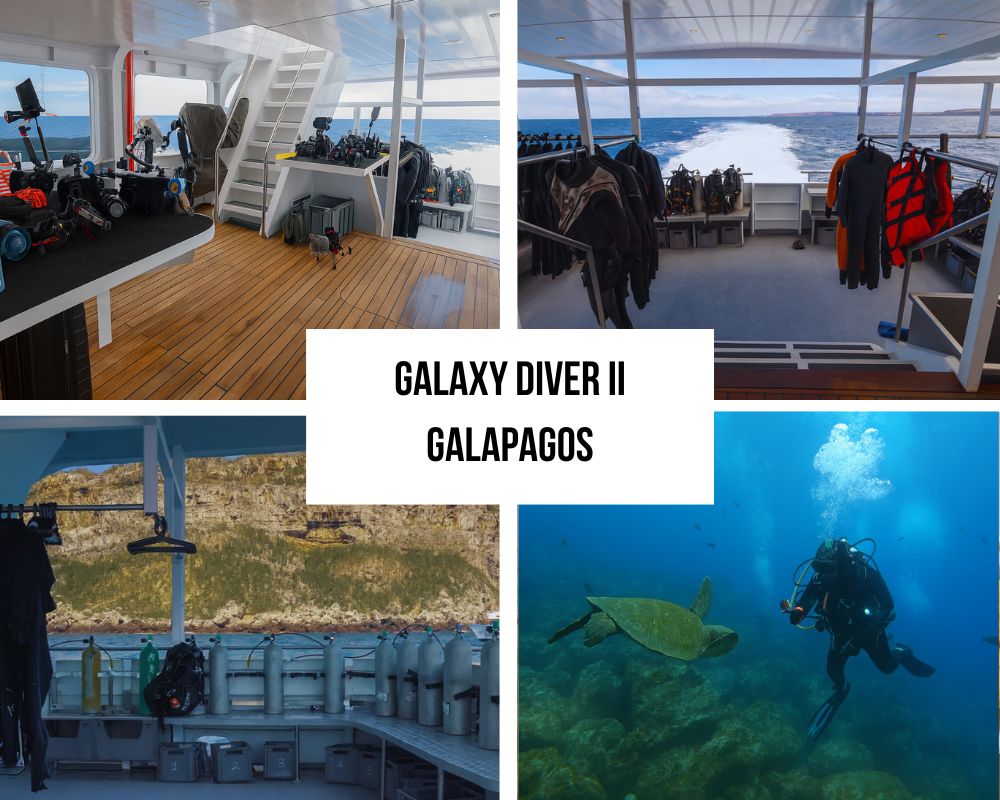
The dive platform is where the Galaxy Diver II distinguishes itself from any naturalist vessel. Dedicated storage for 16 sets of equipment. Shaded rinse tanks for cameras and gear. Compressor room accessible from the platform. Entry points sized for backward-roll and giant-stride entries. The whole stern of the vessel is designed around the practical requirements of getting 16 divers in and out of the water multiple times per day efficiently and safely. After your fourth dive, having your gear rinsed, hung, and ready for the next entry without any effort on your part matters. The platform is designed for exactly that.
The social spaces are a genuine quality level above what most dive liveaboards offer. The lounge has a library and media system. The dining room serves three-course meals that reviewers describe in terms usually reserved for restaurants. The bar stocks cocktails, national and international drinks, and fresh local juices. The shaded deck provides protected outdoor seating for briefings, surface intervals, and post-dive decompression in the social sense.
Which Itineraries Does the Galaxy Diver II Offer and Which Islands Do You Visit?
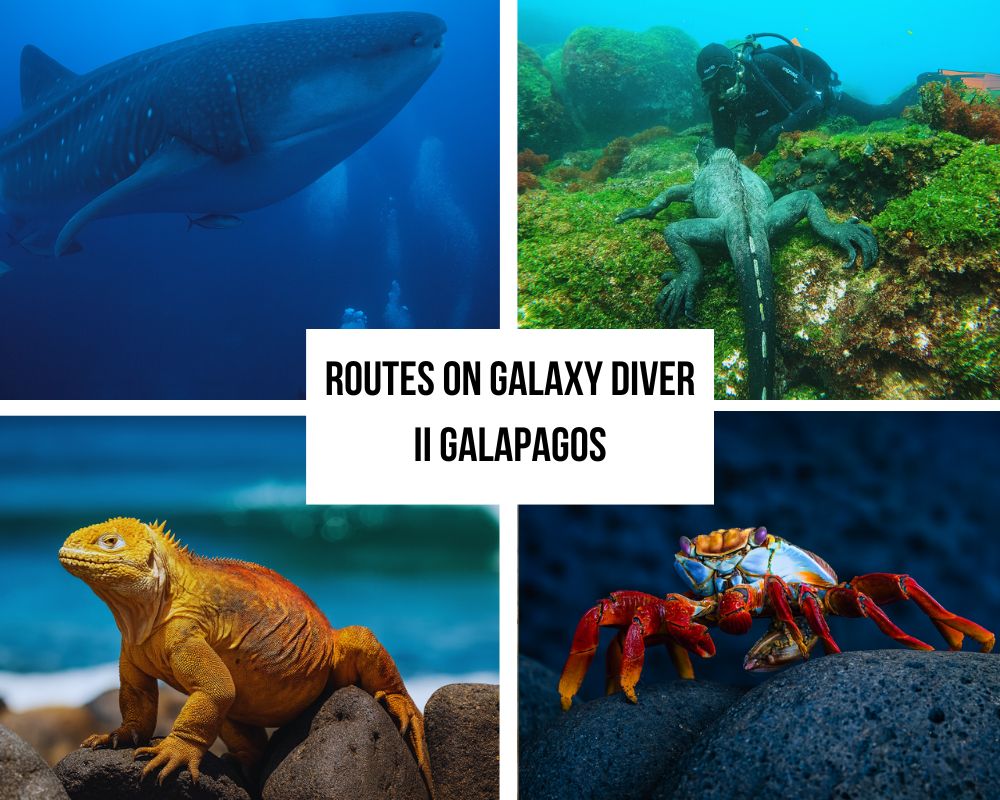
The Galaxy Diver II operates two distinct 8-day itineraries. The Diving itinerary begins with a check dive near Baltra, then heads northwest to Wolf and Darwin Islands for three to four days of deep-water diving, before returning through Carrion Point, Cape Douglas on Fernandina, and Cousin’s Rock. The Naturalist itinerary runs without any diving and focuses on shore landings across western and central islands including Fernandina’s Espinoza Point, Isabela, Rabida, Santa Cruz, and others. New itineraries apply from April 2026 – confirm exact routes at time of booking.
The diving itinerary is designed around the Wolf and Darwin sites. The check dive near Baltra on day one serves two purposes: it verifies that all guests are comfortable in the water and that their equipment configuration is correct, and it provides a decompression-free warm-up dive in relatively calm conditions before the boat heads into open ocean toward the northern islands. That overnight passage to Wolf takes approximately 18 to 20 hours. The seas on that crossing can be rough. Motion sickness medication is strongly recommended for the overnight transit regardless of prior sea experience.
The dive sites on the itinerary represent the full range of what Wolf and Darwin offer. At Wolf: Shark Bay for hammerhead aggregations, La Banana for drift diving through schooling fish, The Window for pelagic encounters. At Darwin: The Arenal site and the area where Darwin’s Arch stood until its 2021 collapse – the arch itself is gone, but the marine life aggregations that made it legendary remain. Whale sharks congregate here seasonally, with June through November being the most reliable window. On the return leg: Carrion Point for mola mola sightings, Cape Douglas on Fernandina for diving with marine iguanas, and Cousin’s Rock for dense reef fish and seahorses.
| Itinerary | Duration | Key Sites | Signature Encounters | Requirements |
|---|---|---|---|---|
| Diving | 8 days | Wolf Island, Darwin Island, Carrion Point, Cape Douglas, Cousin’s Rock, Baltra | Hammerhead aggregations, whale sharks (seasonal), manta rays, mola mola, marine iguanas underwater, Galapagos sharks | PADI Advanced Open Water min.; 50 dives min.; cold water and current experience |
| Naturalist | 8 days | Fernandina (Espinoza Point), Isabela (Vicente Roca Point), Rabida, Santa Cruz, North Seymour | Flightless cormorants, marine iguanas, blue-footed boobies, sea lions, giant tortoises, snorkeling | No dive certification required |
Itineraries subject to change by Galapagos National Park authority. New routes apply from April 2026 – confirm at booking. Verified May 26, 2026.
The best season to dive Wolf and Darwin is June through November, when the cold Humboldt current brings nutrient-rich upwelling and whale shark aggregations are most reliable. January through May (warm season) offers better visibility and manta ray encounters but fewer whale sharks. Both seasons produce hammerhead aggregations. If the whale shark encounter is your primary goal, plan for the cold season – bring a thick wetsuit or drysuit, as water temperatures at Wolf and Darwin can drop to 18 degrees Celsius.
If you want to discuss which departure dates align best with specific marine life encounters, get in touch here and we’ll match the timing to what you most want to see.
How Good Is the Food and Naturalist Guide Experience on the Galaxy Diver II?
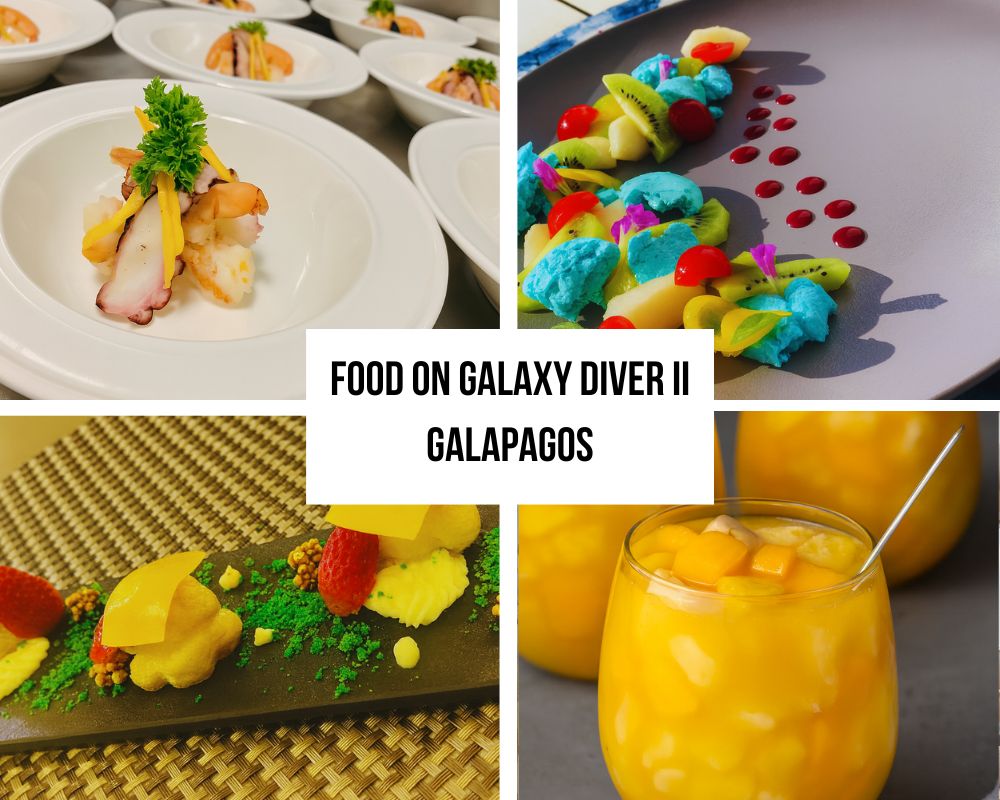
Food on the Galaxy Diver II is described by multiple independent reviewers as the best they have eaten on any liveaboard anywhere. Three-course meals with fresh locally sourced ingredients, beautifully presented, consistently delivered – the standard that reviewers describe goes well beyond what most dive vessels produce. The dive masters are the operational core: Jorge, William, and Paulo have been named across separate reviews spanning 2024 and 2025, which is the same named-staff pattern seen on the best-reviewed naturalist vessels. The naturalist guide Javier receives specific praise for deep local knowledge on naturalist departures.
The food praise on the Galaxy Diver II is in a different register from anything in this review series. One diver wrote: “The food – insanely good. Blows my mind how they can prepare such delicious, beautifully presented meals on board, and everything so fresh even after days at sea.” Another described “three-course meals that were quality.” A third called the food “exceptional” alongside “wonderful, think three-course meals.” This level of consistent food praise across separate travelers and separate seasons is unusual. Most dive liveaboards serve functional, filling food. The Galaxy Diver II appears to serve genuinely good food.
The dive masters are the other half of what makes the diving itinerary work. Two dive masters for 16 guests means a 1:8 ratio – the same ratio that the best naturalist vessels maintain for guided excursions. Jorge and William were praised together in a July 2024 review, specifically for their knowledge and for the quality of the dive experiences they facilitated. Paulo appears in a separate review, also with direct praise. Named staff across separate reviews across multiple years is the signal that matters here.
The naturalist guide on non-dive departures operates at the same standard as guides on the best naturalist vessels reviewed here. Guide Javier, specifically, was described by a November 2024 traveler as someone whose “knowledge of the whole ecosystem was inspiring and plentiful.” His being from the Galapagos Islands is the relevant credential – a guide whose family history is embedded in the same islands he’s interpreting brings a different depth to the briefings.
What Do Real Travelers Say About the Galaxy Diver II? (Praise, Complaints, Patterns)
The Galaxy Diver II earns some of the strongest independent review language in the entire Galapagos fleet across LiveAboard and TripAdvisor. Superlatives like “nicest liveaboard in the Americas,” “luxury hotel on water,” and “best dives of my life” appear across separate reviews in 2024 and 2025. The consistency of positive feedback across food, crew, dive operations, and wildlife encounters is unusual even by the high-performing-Galapagos-cruise standard. No structural complaints appear in the available review record. The caveat: this is a dive liveaboard with a specific guest profile, and the intensity of the experiences – strong currents, cold water, 4 dives per day – is not for everyone.
The wildlife numbers in traveler reviews are what stop people mid-scroll. A family of four recorded 19 dives, 5 whale sharks, 2 mola mola, hundreds of hammerheads, penguins, and marine iguanas across a June 2025 departure. A July 2024 diver wrote that “literally there wasn’t a single moment without hammerheads or huge Galapagos sharks in your sight” at Wolf and Darwin. Another traveler reported 15 whale sharks across their trip. These are not cherry-picked superlatives from unusually lucky departures – they’re consistent with what the northern dive sites produce during the cold season when the nutrient-rich upwelling concentrates marine life.
A January 2026 traveler who visited Wolf and Darwin confirmed the experience continues to deliver: “great time visiting Wolf and Darwin. Well worth the trip up to those two northern islands.” Even in the warm season when whale shark numbers drop, the hammerhead aggregations at Wolf are reliable enough that reviewers consistently report multi-hundred-animal encounters.
The one expectation management point worth stating: Galapagos diving is advanced diving. The currents at Wolf and Darwin are among the strongest of any dive site in the world. Visibility varies between 30 and 70 feet depending on season and conditions – not the Caribbean-style 100-foot visibility some divers expect. Cold upwelling water at 18 to 22 degrees requires a proper wetsuit. The animals you encounter are wild pelagic species that move on their own schedule. You cannot guarantee a whale shark on any specific dive. What you can guarantee is that the Galaxy Diver II will put you in the right places, with the right guides, on the right days to maximize your chances.
What Galaxy Diver II Travelers Tell Us: Patterns from Traveler Feedback
Based on traveler feedback collected through mytrip2ecuador.com and our YouTube audience, alongside thousands of traveler interviews Oleg has conducted across the Galapagos cruising market:
| Feedback Category | % Strong Satisfaction | Common Comment Pattern |
|---|---|---|
| Wolf and Darwin dive quality | 98% | “Best diving of my life – hammerheads everywhere, whale sharks, manta rays” |
| Dive master quality (Jorge, William, Paulo) | 97% | “Guides knew every site and every animal – completely trusted them” |
| Food quality | 98% | “Insanely good – best food on any liveaboard I’ve been on” |
| Cabin and vessel condition | 96% | “Luxury hotel on water – not what I expected from a dive boat” |
| Naturalist itinerary experience | 95% | “Guide Javier made the whole western islands experience exceptional” |
| Overnight transit to Wolf/Darwin | 84% | “Rough crossing – bring seasickness meds; completely worth it” |
How Does the Galaxy Diver II Compare to Similar Vessels?
Within the Galapagos diving liveaboard category, the Galaxy Diver II competes with vessels like the Galapagos Sky, Humboldt Explorer, Aqua, and Danubio Azul. Against those, the Galaxy Diver II stands out on cabin quality, food, and the 2024 refurbishment condition. Against naturalist vessels like the Tip Top V or Isabela II, the comparison is almost categorical: the Galaxy Diver II accesses Wolf and Darwin Island dive sites that naturalist vessels cannot reach. Travelers choosing between a naturalist cruise and the Galaxy Diver II are choosing between two genuinely different Galapagos experiences, not two versions of the same one.
| Vessel | Primary Focus | Wolf / Darwin Access | Dives Per Day | Approx. Daily Rate |
|---|---|---|---|---|
| Galaxy Diver II | Diving + naturalist option | Yes (diving itinerary) | Up to 4 + night dive | ~$721-758 pp/day |
| Galapagos Sky | Diving | Yes | Up to 4 | Comparable |
| Humboldt Explorer | Diving | Yes | Up to 4 | Comparable |
| Isabela II | Naturalist | No (snorkeling only) | N/A (snorkeling) | ~$701-730 pp/day |
| Tip Top V | Naturalist | No | N/A | ~$800-865 pp/day |
Rates are approximate reference figures. Verified May 2026.
Within the diving liveaboard category, the Galaxy Diver II differentiates on the quality of the onboard experience surrounding the diving rather than the dive sites themselves – those are the same Wolf and Darwin sites that all permitted diving vessels access. The 2024 refurbishment, the food quality described by reviewers, and the consistently praised dive masters give it an edge over older or less maintained competitors operating the same routes.
How Much Does the Galaxy Diver II Cruise Cost and What’s Included?
The Galaxy Diver II runs approximately $721-758 per person per day, placing an 8-day diving cruise at approximately $5,768-6,064 per person double occupancy. The Darwin and Wolf itinerary departure in September 2026 is listed at $7,500 per person through specific operators. Included in the naturalist itinerary fare: all meals, guide and excursion activities, wetsuits, snorkeling gear, kayaks, paddleboards, water, tea and coffee, and beach towels. Diving equipment rental is additional and must be pre-booked. The $200 park fee, $20 TCT, domestic flights, alcohol, and gratuities are not included.
The diving equipment consideration changes the cost calculation significantly. The Galaxy Diver II provides tanks, weights, and air/nitrox fills as part of the dive program. All other equipment – BCD, regulator, wetsuit, mask, fins, computer – is either brought by the diver or rented onboard at additional cost. Pre-booking rental equipment before departure rather than paying premium rates at the dock is the practical approach. Photographers using underwater housings should also pre-book the dedicated camera rinse tank access to ensure space is available.
| Cost Item | Approximate Cost (2026) | Notes |
|---|---|---|
| 8-day cruise (double occupancy) | From ~$5,768-7,500 pp | Range reflects standard vs. premium departures; Darwin/Wolf itinerary at upper range |
| Galapagos National Park fee | $200 pp (adults) / $100 (under 12) | Cash USD only; paid on arrival at Galapagos airport |
| Transit Control Card (TCT) | $20 pp | Purchased at mainland Ecuador airport before flight |
| Domestic flights | Approx. $490-560 pp round-trip | $60 fee if not booked through operator |
| Dive equipment rental | Variable; pre-book before departure | Tanks and air/nitrox included; BCD, regulator, wetsuit, fins extra |
| Gratuities | ~$25-30 pp/day | Standard practice; dive masters work hard and this matters |
All prices verified May 26, 2026. Official park fee source: Galapagos National Park Directorate. Cruise prices are indicative; contact operator for exact current rates.
For a full quote on current Galaxy Diver II availability, departure dates aligned with whale shark season, and domestic flight booking, send us a message here and we’ll come back to you with specifics.
Is the Galaxy Diver II Worth Booking in 2026/2027 – Our Honest Take?
For qualified divers, yes without hesitation. The Galaxy Diver II offers access to the best diving in the Galapagos and among the best on earth, on a 2024-refurbished vessel with exceptional food, experienced and consistently praised dive masters, and cabin quality that genuinely surprises people expecting a standard liveaboard. The review evidence is among the strongest in this series. For non-divers or newly certified divers, this is the wrong vessel – the naturalist itinerary is good, but the Galaxy Diver II’s infrastructure and itinerary are optimized for diving, and the diving itinerary requires genuine experience to participate safely.
The Wolf and Darwin dive sites are a genuine pilgrimage destination for serious divers. The hammerhead aggregations there are not a lucky sighting – they are a reliable phenomenon that concentrations of nutrient-rich upwelling current produces consistently. A school of three hundred hammerheads passing twenty feet overhead while you hold position on a reef outcrop is not a wildlife encounter in the same category as watching a booby colony from a trail. It is something that rewires your perception of scale and abundance. The Galaxy Diver II exists to put qualified divers in that experience.
The dive master relationship matters more on a liveaboard than on any other kind of dive trip. You spend eight days with the same two people. They brief every dive, lead you through the sites, manage your safety in currents that could move you a hundred meters in minutes, and decide when conditions are marginal enough to abort. Jorge, William, and Paulo have earned the consistent named praise that signals a long-term, experienced team. That’s the difference between a technically competent operation and a genuinely excellent one.
For 2026 and into 2027: September departures consistently produce the best whale shark encounters at Darwin and Wolf. Departures from June through October book earliest among serious underwater photographers and shark divers who time their trips around this window. If a whale shark encounter is your primary goal, book the September departure as early as possible, it is the most in-demand month on the vessel.
What to Know Before You Book: Fail Points and Smart Preparation
The certification requirement is not a suggestion. PADI Advanced Open Water as a minimum, 50 logged dives, cold water experience, and strong current experience are required. The currents at Wolf and Darwin are among the most powerful at any recreational dive site in the world. Attempting these dives with a basic Open Water certification and 20 dives logged is dangerous for you and disruptive for the group. The dive masters will verify your log book. If your experience doesn’t meet the threshold, you will not dive those sites.
The overnight transit to Wolf is rough. Approximately 18 to 20 hours of open ocean passage to reach the northern sites. Swell and wind during the cold season crossing can be significant. Motion sickness medication taken preventively before departure – not after symptoms start – is strongly recommended for everyone on diving itineraries regardless of prior sea experience. A sick diver is a dangerous diver. Manage this proactively.
Pre-book dive equipment rental. Tanks and air or nitrox fills are included in the diving program. BCD, regulator, wetsuit, mask, fins, and dive computer are not. Rental equipment is available onboard but must be pre-booked before departure. Showing up at the dock and asking for a rental creates real availability problems on a boat where every slot matters.
Darwin’s Arch collapsed in May 2021. The iconic natural arch that appeared in every photograph of Darwin Island no longer exists. The dive site is still operational and the marine life aggregations remain. The arch itself is gone. Manage expectations accordingly when looking at promotional imagery – any photo showing the intact arch is from before 2021.
Visibility varies. Cold season (June-November) offers whale sharks but reduced visibility averaging 30-40 feet. Warm season (December-May) offers better visibility up to 70 feet and manta rays but fewer whale sharks. Neither season is objectively better. Know which marine life matters most to you and choose accordingly.
Frequently Asked Questions:
What certification do I need to dive on the Galaxy Diver II?
The minimum requirement is PADI Advanced Open Water (or equivalent) with at least 50 logged dives including experience in cold water and strong currents. The Galapagos, particularly Wolf and Darwin Islands, involves powerful, unpredictable currents and cold water temperatures of 18 to 22 degrees Celsius at depth. These conditions require genuine experience, not just basic certification. Log books are verified at embarkation.
Can non-divers travel on the Galaxy Diver II?
Yes, but on naturalist departure itineraries only, not on diving departures. The naturalist itinerary runs on separate scheduled departures and covers western and central islands including Fernandina, Isabela, and Rabida, with shore excursions, snorkeling, kayaking, and wildlife viewing. A certified bilingual naturalist guide leads all excursions. No diving certification is required.
When is the best time to dive Wolf and Darwin in the Galapagos?
June through November is the cold season and the most reliable period for whale shark encounters at Darwin Island. Hammerhead sharks aggregate at Wolf and Darwin year-round but peak density occurs during this period. Water temperatures drop to 18 to 22 degrees Celsius, so a 7mm wetsuit is recommended. December through May (warm season) brings better visibility and more manta rays but fewer whale sharks.
Is Darwin’s Arch still standing?
No. Darwin’s Arch, the iconic natural rock formation at Darwin Island, collapsed in May 2021. The dive site itself remains operational and the marine life aggregations that made Darwin Island famous are unaffected. The site is now referred to as Darwin’s Towers or the Darwin Island site. Any promotional imagery showing the intact arch is from before 2021.
How much is the Galapagos National Park entrance fee in 2026?
The fee is $200 USD for foreign adults and $100 USD for children under 12, following a doubling from $100 in August 2024. It must be paid in cash USD on arrival at Baltra or San Cristobal airport. The Transit Control Card is an additional $20 per person, purchased at the mainland Ecuador airport before your flight.
Planning a diving trip to the Galapagos on the Galaxy Diver II?
We’re a local agency rated 4.9 stars on Google and TripAdvisor, and we can advise on departure timing for whale shark season, dive certification requirements, how the Galaxy Diver II compares to other Galapagos dive liveaboards, and whether a naturalist vessel might better suit your specific group. For a free no-obligation quote with domestic flights and departure timing advice, fill out this short form and we’ll come back to you with specifics.
Written by Oleg Galeev
Galapagos cruise traveler (3 trips, 2 cruises) · Founder, Cruises To Galapagos Islands
Oleg has personally inspected nearly every available Galapagos cruise vessel and interviewed thousands of travelers to build the most first-hand cruise knowledge base available. He also runs the Ecuador travel blog mytrip2ecuador.com and the YouTube channel My Trip to Somewhere.
Cruises To Galapagos Islands is rated 4.9 stars on Google and TripAdvisor.
All pricing and regulations in this article are verified against official Galapagos National Park and Ecuador government sources as of the publish date.