Tiburon Explorer Galapagos Cruise Review
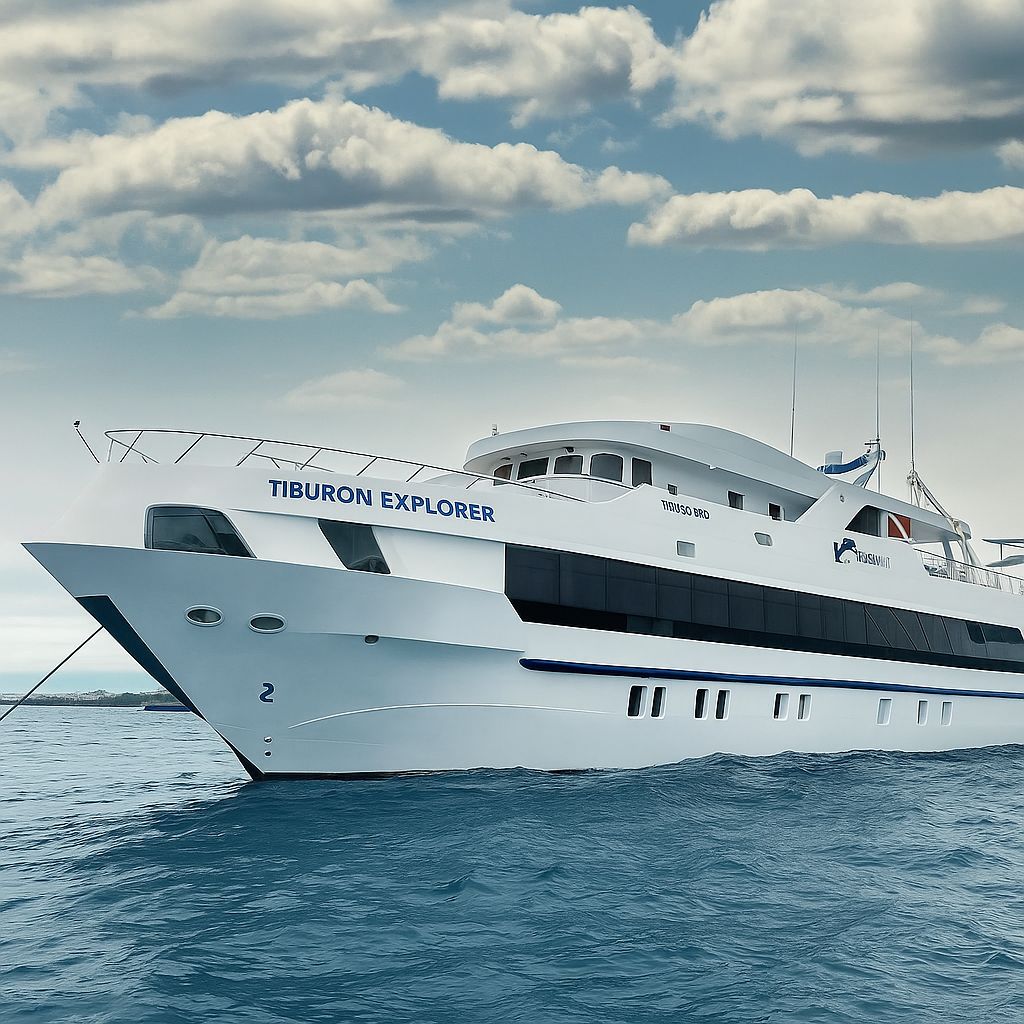
The Tiburon Explorer is one of 28 First Class ships we review. See all first class Galapagos cruises, or use our finder to see compare all Galapagos cruise ships side by side. It sails for Explorer Ventures: see all Explorer Ventures ships in the Galapagos.
Quick Facts: Tiburon Explorer Galapagos Cruise
| Detail | Information |
|---|---|
| Vessel type | Trimaran diving liveaboard |
| Built | September 2020 |
| Length | 129.6 ft (39.5m) |
| Operator | Explorer Ventures (US-based; explorerventures.com) |
| Capacity | 16 guests / 9 cabins / crew + 2 divemasters |
| Cabins | 6 main deck (large windows, ocean views); 3 lower deck; all with private bathrooms and AC; 2 fixed queen; 7 convertible twin/queen |
| Hull design | Trimaran (3 hulls – catamaran-class stability) |
| Dives per trip | 18-20 average; up to 4 per day including night dives |
| Dive ratio | 1 divemaster per 8 guests (standard); private guide available at extra cost |
| Price (until June 2026) | $7,295 pp (double occupancy) |
| Single supplement | 80% of retail price |
| Non-diver discount | 10% (December to June) |
| Group conditions | Pay 5 get 1 free / pay 10 get 2 free |
| Park entrance fee (not included) | $200 USD adults / $100 children under 12 – cash only on arrival |
| Transit Control Card (not included) | $20 USD per person – purchased at mainland airport |
| Included | All meals (4 daily), non-alcoholic drinks, local alcohol, guided excursions, air and 12L tank fills, weights, wetsuits (on some packages), airport transfers |
| Not included | Park fee, TCT, domestic flights (surcharge if not booked through operator), premium spirits, dive equipment rental, private guide fee, gratuities |
Prices verified May 26, 2026. Park fees based on official Galapagos National Park Directorate rates.
What Is the Tiburon Explorer and Who Is It For?
The Tiburon Explorer is a 2020-built trimaran liveaboard operated by Explorer Ventures, carrying 16 guests on 8-day itineraries that reach Wolf and Darwin Islands. It was designed from the keel up as a purpose-built Galapagos dive vessel. The trimaran hull – three hulls rather than one or two – provides a stability level that most dive liveaboards cannot match. It is for serious, certified divers who want the best infrastructure and the smoothest overnight passages available at the northern dive sites.
The hull design is the first thing to understand. A monohull rolls in swells. A catamaran is more stable. A trimaran adds a third hull – one central and two outriggers – which broadens the stance further and distributes buoyancy across more surface area than a catamaran of equivalent length. On the 16-hour overnight passage from the main archipelago to Wolf Island, this makes a real and practical difference. Divers who have been on monohull liveaboards and spent the Wolf transit seasick and unable to sleep will notice the improvement immediately on the Tiburon.
Explorer Ventures is a US-based operator with a fleet of liveaboards across multiple dive destinations. The Tiburon Explorer is their Galapagos vessel, launched in September 2020. The company brings operational standards from the international liveaboard market – the camera table with individual charging stations, warm towels after night dives, juice waiting on the dive deck as you surface – rather than working from a local Ecuadorian expedition model. Those small hospitality details separate the Tiburon from older or less polished competitors on the same routes.
Who books this vessel: experienced divers with 50-plus logged dives including cold water and current experience. Groups – the pay 5/get 1 free structure makes the Tiburon one of the better-value options for dive groups of 5 or 10. Underwater photographers who need a dedicated camera table with charging and rinse tanks. And divers who specifically want the trimaran stability on the Wolf and Darwin passage rather than enduring a rough monohull crossing.
What Does the Tiburon Explorer Look Like Inside? (Cabins, Decks, Common Areas)
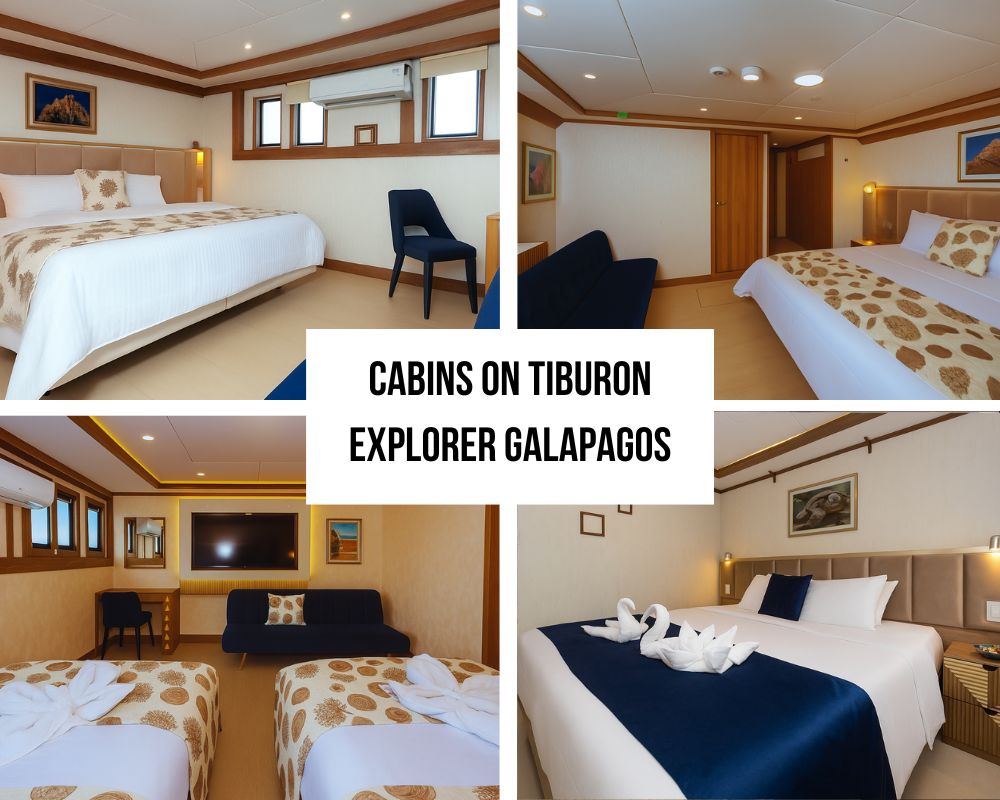
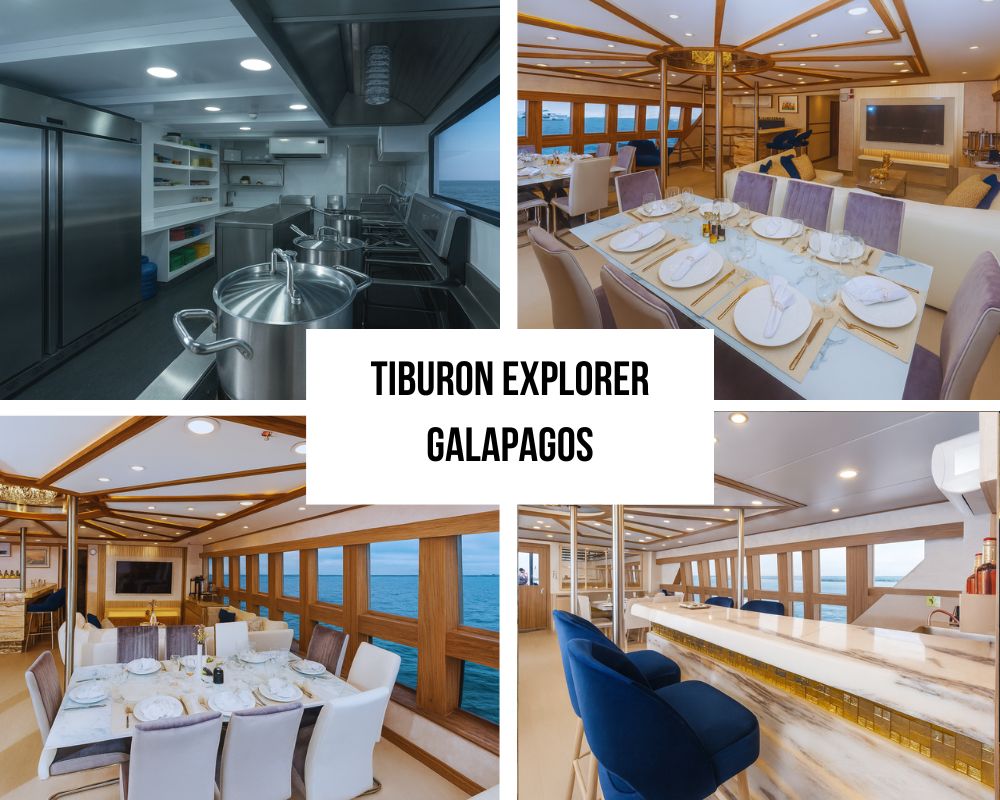
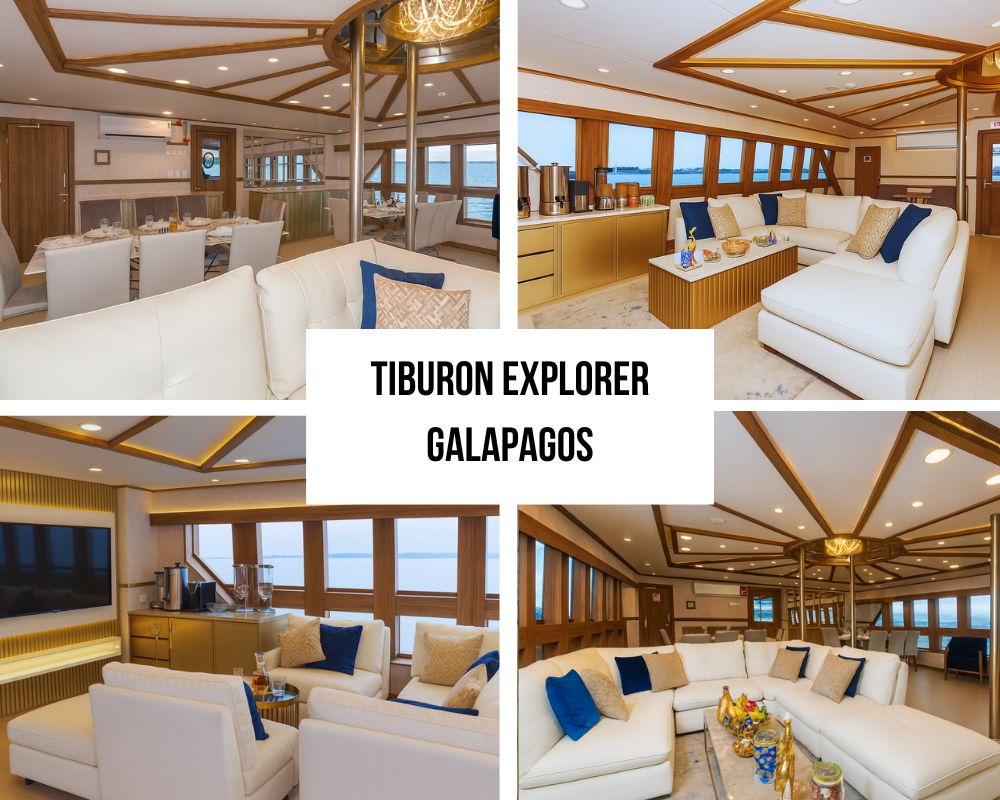
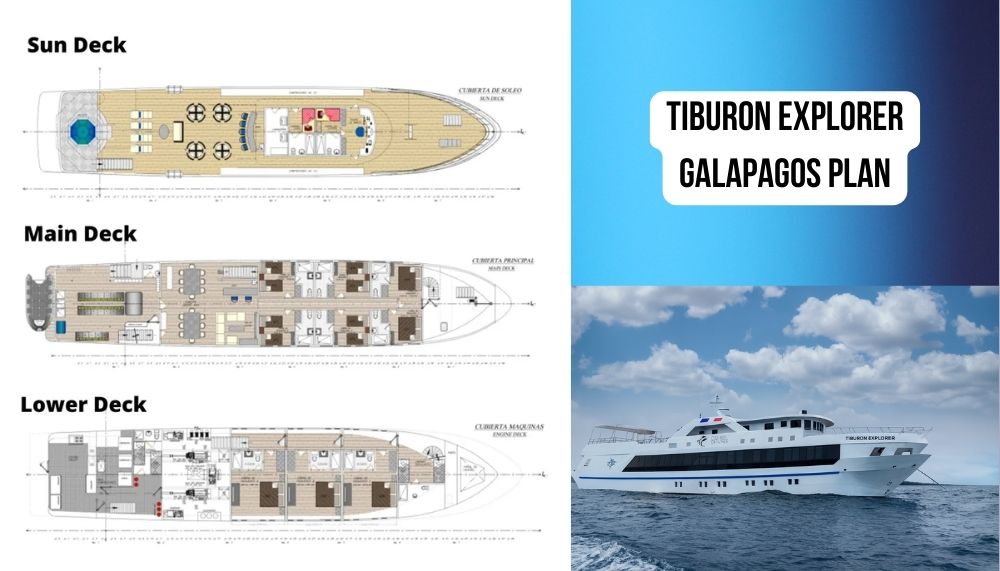
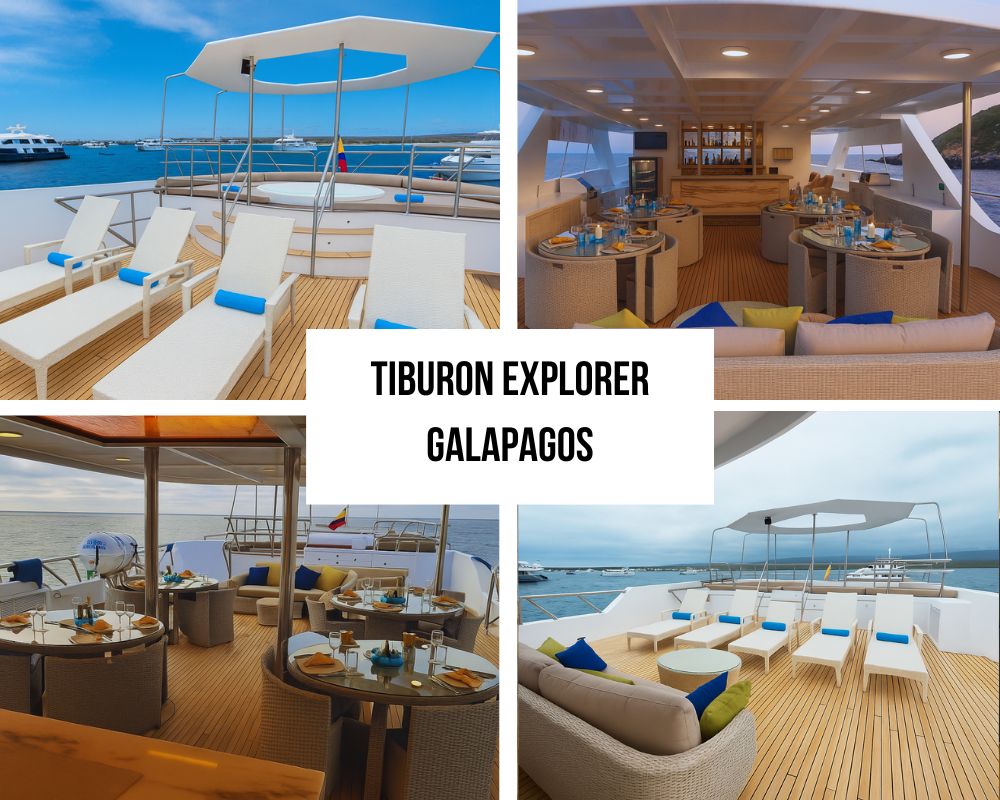
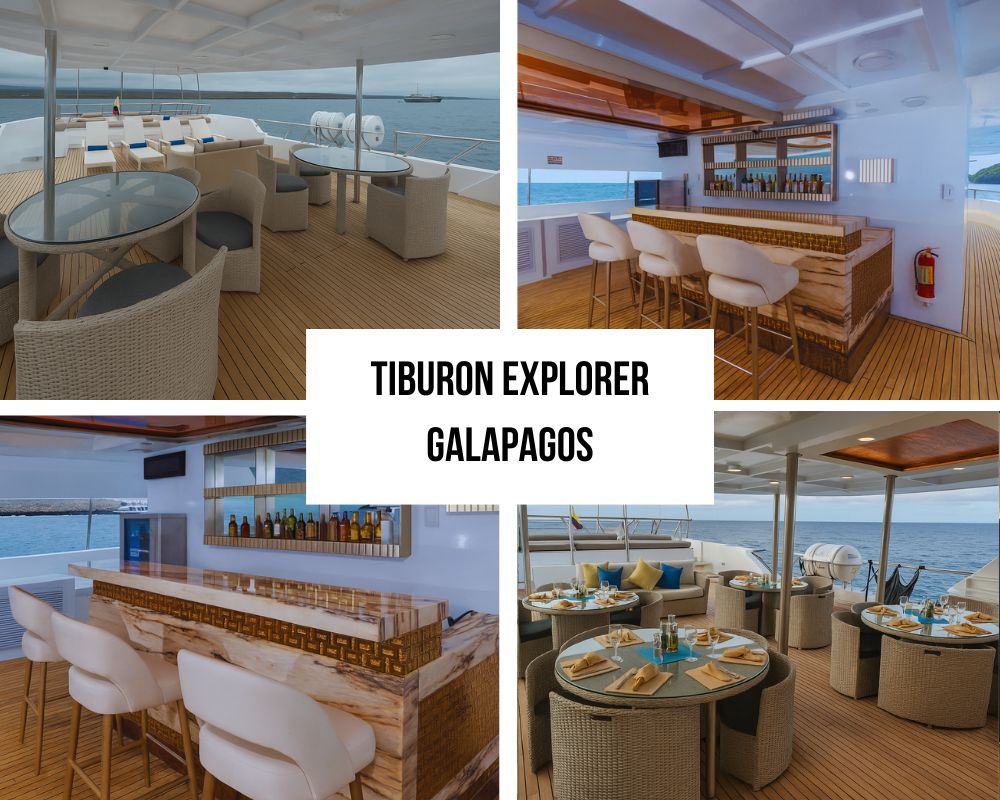
The Tiburon Explorer has 9 cabins across two decks. Six main-deck cabins have large windows with ocean views. Three lower-deck cabins sit closer to the waterline – less light but better stability for motion-sensitive guests on overnight passages. Cabins 1 and 2 on the main deck have fixed queen beds. All other cabins have twin beds that convert to queen. All 9 cabins are air-conditioned with private en-suite bathrooms. Social areas include a main-deck salon with dining, bar, and TV lounge; a partially covered sun deck with a hot tub; and the dedicated dive deck at the stern.
The cabin standard is consistently described in reviews as comparable to a luxury hotel room. That phrasing appears independently across multiple reviewers across multiple years – “the rooms were excellent, spacious and luxurious,” “our room was comfortable and luxurious,” “service from a luxury hotel.” This is not marketing language recycled into reviews; it’s the surprise reaction of people who expected a functional dive boat and found something better. The 2020 build means the interior is fresh, the plumbing works, the fixtures are modern, and nothing has the worn quality of an older converted vessel.
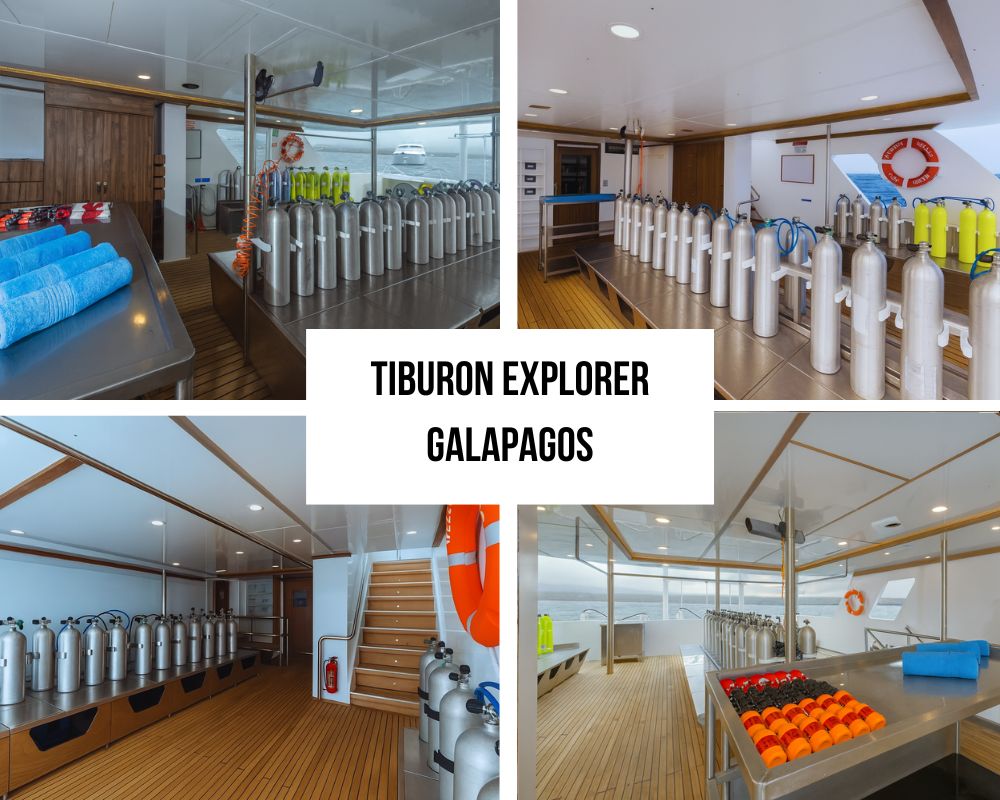
The dive deck at the stern is purpose-built and generous. Individual gear bins for all 16 divers. Air and nitrox filling stations. A camera table with individual charging points and a separate freshwater rinse tank for camera housings alongside a separate rinse tank for gear. Two large pangas (zodiacs) handle all dive operations, boarded directly from the deck. The deck layout means kitting up and gearing down is efficient rather than crowded – a real quality-of-life factor across 18 to 20 dives over 8 days.
The service details that come up across reviews are the ones that signal a thoughtful operation: warm towels and hot chocolate or tea waiting when divers surface from night dives, crew assisting with gear removal as divers climb out of the water, juice and snacks on the deck between dives. These aren’t standard on all liveaboards. They are standard on the Tiburon Explorer.
Which Itineraries Does the Tiburon Explorer Offer and Which Islands Do You Visit?
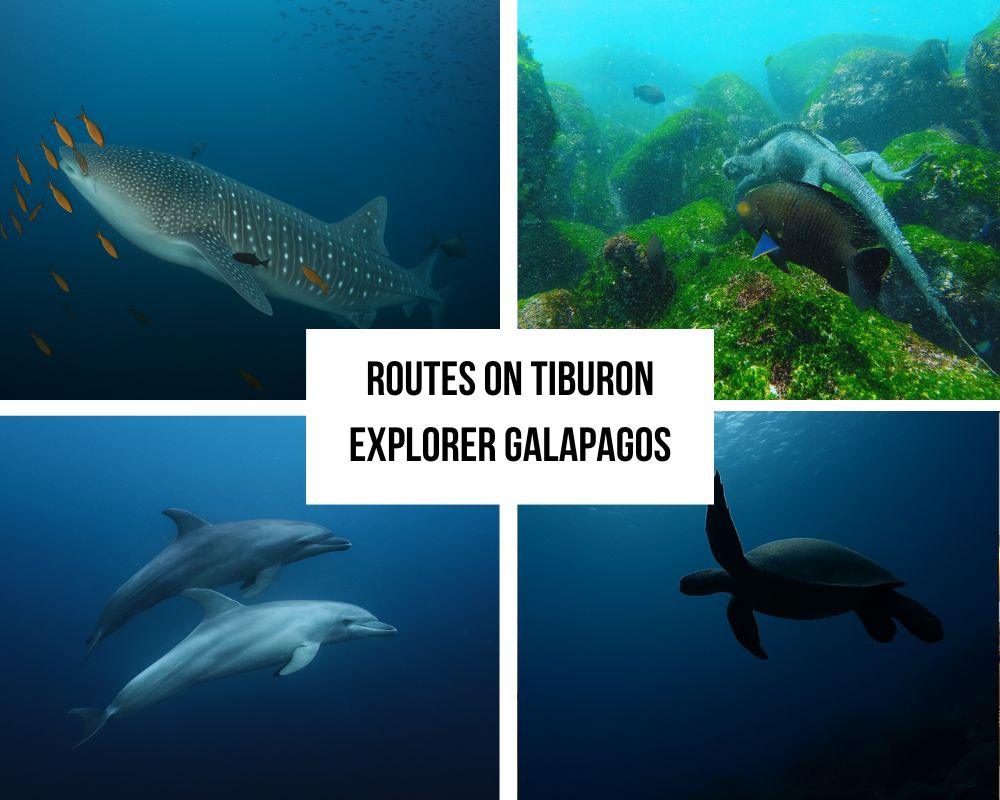
The Tiburon Explorer operates one primary 8-day itinerary: 7 nights departing and returning to Baltra, covering the Western Galapagos and the Darwin and Wolf Islands in the north. The route begins with a check dive at Punta Carrion near Baltra, includes a land visit to North Seymour, then heads northwest for the 16-hour overnight transit to Wolf. After two to three days at Wolf and Darwin, the vessel returns through the western islands including Cape Douglas on Fernandina and Cousin’s Rock before concluding at Baltra.
The check dive at Punta Carrion on day one is both a practical requirement and a useful warm-up. The dive masters verify that all guests are comfortable in their equipment configuration and have the skill level the subsequent sites require. Rays and schooling fish are typical at Punta Carrion – a gentle, rewarding dive that builds confidence without exposing anyone to Darwin-level currents before the team knows each other.
The North Seymour land visit on day one afternoon is the only shore excursion included in the diving itinerary. Blue-footed booby colonies, magnificent frigatebird nesting, sea lions, and marine iguanas, it gives divers one proper naturalist experience alongside the primary diving program without compromising the schedule. The vessel departs for Wolf that evening.
Wolf and Darwin consume two to three full days in the northern part of the archipelago. Specific dive sites across the two islands cover the full range of what makes these locations legendary: Shark Bay and La Banana at Wolf for hammerhead aggregations; the Darwin Island sites for whale shark encounters (seasonal, June through November most reliable); Carrion Point on the return leg for mola mola; Cape Douglas on Fernandina for the unique experience of diving alongside marine iguanas feeding on algae underwater.
| Site | Location | Signature Encounters | Conditions |
|---|---|---|---|
| Punta Carrion | Near Baltra | Rays, schooling fish, sea turtles | Calm; check dive only |
| Wolf Island: Shark Bay, La Banana | Northern archipelago | Hammerhead aggregations, Galapagos sharks, silky sharks | Strong currents; advanced divers only |
| Darwin Island sites | Northernmost point | Whale sharks (June-Nov), manta rays, hammerheads, tiger sharks occasionally | Very strong currents; most demanding sites |
| Carrion Point | Central archipelago | Mola mola, rays, cold upwelling species | Cold water; moderate current |
| Cape Douglas, Fernandina | Western archipelago | Marine iguanas underwater, flightless cormorants, sea lions | Moderate; unique macro experience |
| Cousin’s Rock | Central archipelago | Seahorses, coral hawkfish, reef fish, hammerheads | Moderate; excellent macro |
Itinerary subject to change by Galapagos National Park authority and weather conditions. Verified May 26, 2026.
The Darwin current is the single most important preparation point for anyone booking this vessel. It is among the strongest at any recreational dive site in the world. On entry, divers need to fully deflate their BCD and descend to 8 meters immediately or the current carries them away from the site. At least one documented incident involves a divemaster being swept away during a dive. This is not exceptional or unusual at Darwin, it is the standard condition. Divers who haven’t experienced it should hire a private guide for the Darwin dives specifically. We address this further in the fail points section below.
How Good Is the Food and Naturalist Guide Experience on the Tiburon Explorer?
Food on the Tiburon Explorer earns consistent strong praise: four meals per day (breakfast, lunch, dinner, plus snacks), three-course dinner service, and accommodation of vegetarian, vegan, and dietary restrictions with advance notice. Local non-alcoholic and alcoholic beverages are included in the fare. The divemasters are the operational heart of the trip – Alex, Ronnie, Victor, Kevin, Simon, Israel, Natalia, David, and Angel appear by name across separate reviews spanning 2023 to 2025, representing the widest named-staff pattern of any vessel in this review series.
Four meals per day is a genuine differentiator. Breakfast, lunch, dinner, and snacks between or after dives sustains 18 to 20 dives over eight days without divers running low on energy. The three-course dinner format is consistent with what Explorer Ventures markets and with what reviewers describe. One reviewer specifically called out “an incredible amount of food – four fantastic meals daily.” The beer-and-wine-with-meals inclusion (local alcohol, not premium spirits) is a thoughtful operational choice, it removes a significant bar tab from the end-of-trip accounting without creating an open premium-spirits policy.
The divemaster list across reviews is notable: Alex and Ronnie (February 2026 LiveAboard review), Kevin and Simon (June Trustpilot review), Israel and Kevin (separate Trustpilot review), Ronnie and Victor (another Trustpilot review), Natalia and David (DiveBooker review), Angel (TripAdvisor 2025 review). Nine named divemasters across reviews from different years. This isn’t one consistent pair – it’s a rotation of trained Explorer Ventures staff all delivering to the same standard. The consistency of the outcome despite rotating personnel is a mark of strong operational standards rather than dependence on any one individual.
The service gestures around diving deserve specific mention: crew members waiting on deck to assist divers removing equipment after surfacing; warm towels and hot chocolate or tea after night dives; juice offered on return between dives. These are not standard across Galapagos dive vessels. They are standard on the Tiburon Explorer and they reflect an operation that understands what divers need after extended time in cold water.
What Do Real Travelers Say About the Tiburon Explorer? (Praise, Complaints, Patterns)
The Tiburon Explorer holds one of the strongest review profiles of any Galapagos dive liveaboard across LiveAboard.com, TripAdvisor, Trustpilot, and DiveBooker. Superlatives like “best liveaboard I’ve been on,” “best of the best,” “paradise,” and “best liveaboard ever” appear across separate reviews in 2023, 2024, and 2025. No structural negative appears across the available review record. The most detailed honest account of the Darwin dive conditions comes from a 2025 TripAdvisor reviewer who has dived across multiple continents, which we use below to set accurate expectations.
The most useful review for setting expectations comes from a 2025 TripAdvisor contributor with diving experience spanning the Red Sea, Borneo, East Africa, Philippines, Indonesia, and Australia. Their conclusion: the Darwin dive was the most challenging they had ever done. The current at the site requires divers to enter the water with a fully deflated BCD and descend to 8 meters within seconds of hitting the surface, because the current otherwise carries you away from the site before you can get down. They watched a fellow diver – who happened to be a divemaster – get swept away on one of the dives. Their recommendation: hire a private guide for approximately 10% of the total trip cost. Their guide, Angel, was specifically credited with making the challenging dives feel safe.
That account is not a negative review. The same reviewer described the boat, food, and overall experience positively. It is the most accurate picture of what Wolf and Darwin diving actually requires, written by someone qualified to assess it. The Tiburon Explorer delivers excellent dive operations, but those operations take place at sites where the environment itself is demanding regardless of the operator.
Across the broader review record, the patterns are consistent: divemasters praised by name across separate years, food described as exceptional rather than just adequate, cabin quality surprising people expecting functional dive boat standards, and the specific after-dive hospitality gestures cited as memorable rather than incidental. One reviewer described the entire experience as “felt like paradise.” Another said it “exceeded all high expectations.” A third called it “the best liveaboard ever” based on prior experience at multiple liveaboards globally.
What Tiburon Explorer Travelers Tell Us: Patterns from Traveler Feedback
Based on traveler feedback collected through mytrip2ecuador.com and our YouTube audience, alongside thousands of traveler interviews Oleg has conducted across the Galapagos cruising market:
| Feedback Category | % Strong Satisfaction | Common Comment Pattern |
|---|---|---|
| Wolf and Darwin dive quality | 98% | “Epic – hammerheads everywhere; Darwin was the best dive of my life” |
| Divemaster quality (named staff) | 97% | “Guides were amazing, professional, encouraging and safe” |
| After-dive hospitality gestures | 99% | “Warm towels and hot drinks after night dives – crew thought of everything” |
| Food quality (4 meals daily) | 95% | “Amazing – four meals a day and every one was great” |
| Cabin and vessel condition | 96% | “Spacious, luxurious – not what I expected from a dive boat” |
| Darwin current conditions | Context required | “Most challenging dive I’ve ever done – came prepared and it was worth it” |
How Does the Tiburon Explorer Compare to Similar Vessels?
The Tiburon Explorer competes most directly with the Galaxy Diver II on Galapagos diving itineraries. Against the Galaxy Diver II, the Tiburon offers a trimaran hull for better stability, a higher price point ($7,295 vs. approximately $5,768-6,064), included local alcohol, a larger dive deck with more individual gear storage, and a more established review record across four-plus years of operation. The Galaxy Diver II counters with a 2023-2024 build versus the Tiburon’s 2020 construction and a naturalist-only itinerary option. Both reach Wolf and Darwin. Both earn exceptional reviews. The choice between them comes down to hull preference, budget, and whether alcohol inclusion matters.
| Vessel | Hull | Built | Alcohol Included | Group Discount | 8-Day Price |
|---|---|---|---|---|---|
| Tiburon Explorer | Trimaran | 2020 | Yes (local) | Pay 5/get 1 | $7,295 pp |
| Galaxy Diver II | Monohull | 2023/2024 | No | Not documented | From ~$5,768 pp |
| Humboldt Explorer | Monohull | Older | Varies | Explorer Ventures fleet | Comparable |
Prices are approximate reference rates. Verified May 2026.
For diving groups specifically, the pay-5-get-1-free structure is the most aggressive group discount in the Galapagos dive liveaboard market. A group of 5 divers effectively gets one spot free, reducing the per-person cost from $7,295 to $6,083. A group of 10 gets two spots free, reducing it further to $6,566 per person for the full group. For organized dive clubs, groups of friends, or dive operators running group departures, this pricing structure changes the competitive calculation significantly.
How Much Does the Tiburon Explorer Cruise Cost and What’s Included?
The Tiburon Explorer is priced at $7,295 per person double occupancy effective until June 2026. The single supplement is 80% of the retail price. Non-divers receive a 10% discount from December through June. Included in the fare: all four daily meals, non-alcoholic beverages throughout, local alcoholic beverages (beer and wine with meals), air fills, 12-liter tanks, and weights. Not included: park fee ($200), TCT ($20), domestic flights (surcharge applies if not booked through operator), premium spirits, dive equipment rental beyond tanks and weights, private guide fee, and gratuities.
The local alcohol inclusion is worth real money over eight days. A beer at dinner each evening and a glass of wine runs $8 to $12 per person per day on most liveaboards. Over eight days for a couple, that’s $128 to $192 in drinks that simply don’t appear on the tab on the Tiburon. Premium spirits are available at extra cost for travelers who prefer them. The inclusion of local beverages is a thoughtful middle ground – the social experience of a drink after the day’s last dive is part of the liveaboard culture, and removing the transaction from it improves the atmosphere.
| Cost Item | Approximate Cost (2026) | Notes |
|---|---|---|
| 8-day cruise (double occupancy) | $7,295 pp (until June 2026) | Includes meals, local alcohol, tanks, weights |
| Group rate (5 guests) | ~$6,083 pp | Pay 5, get 1 free applied across group |
| Group rate (10 guests) | ~$6,567 pp | Pay 10, get 2 free applied across group |
| Single supplement | 80% of retail ($5,836 extra) | Total solo cost: $13,131 pp |
| Non-diver discount | 10% off (Dec to Jun) | Partners traveling on diving departures without diving |
| Galapagos National Park fee | $200 pp (adults) / $100 (under 12) | Cash USD only; paid on arrival at Galapagos airport |
| Transit Control Card (TCT) | $20 pp | Purchased at mainland Ecuador airport before flight |
| Private divemaster (optional but recommended) | ~10% of trip cost (~$730) | Strongly recommended for Darwin dives; 1:1 vs. 1:8 ratio |
| Gratuities | ~$25-35 pp/day | Standard practice; crew and guides work hard |
All prices verified May 26, 2026. Official park fee source: Galapagos National Park Directorate. Onboard transactions subject to 15% VAT and 6% bank fee for card payments.
The onboard card payment surcharge (15% VAT plus 6% bank fee) applies to nitrox upgrades, dive equipment rental, and souvenir purchases. Bringing USD cash for onboard extras avoids this surcharge. For a full quote including domestic flights booked through the operator and current departure dates, reach out here and we’ll put together the numbers.
Is the Tiburon Explorer Worth Booking in 2026/2027 – Our Honest Take?
Yes, for qualified and experienced divers. The Tiburon Explorer delivers Wolf and Darwin Island diving on a purpose-built trimaran with exceptional hospitality, consistently praised divemasters, four meals daily with local alcohol included, and a review record that places it at the top of the Galapagos liveaboard market. At $7,295 per person it is priced above the Galaxy Diver II, but the trimaran stability, the group discount structure, the alcohol inclusion, and the Explorer Ventures operational standard justify the premium for the right diver. Budget an additional 10% for a private guide at Darwin – it is money well spent.
The trimaran hull is not a minor detail. The 16-hour overnight transit to Wolf is open ocean sailing in the Pacific. On a monohull, that passage can be uncomfortable even for experienced sailors. On the Tiburon’s trimaran, the three-hull design distributes the motion in a way that lets you eat dinner, sleep, and arrive at Wolf ready to dive rather than recovering from transit. Over an 8-day trip where the quality of every dive depends on how rested and comfortable you are, that matters from day two onward.
The private divemaster recommendation deserves direct treatment. The standard ratio is 1:8 – one divemaster for eight divers. At Cousin’s Rock or the Galapagos’ moderate sites, that ratio is manageable. At Darwin’s current-swept sites, it means the divemaster is physically unable to monitor all eight divers simultaneously while managing their own position in the current. A private guide at roughly 10% of the trip cost (approximately $730) gives you 1:1 attention at the most demanding sites. One experienced diver who hired a private guide for Darwin specifically credited that decision with making the otherwise most challenging dive of their career feel safe and controlled. At that price relative to the total investment, it is worth it.
For 2026 and into 2027: June through September departures fill first, aligning with the whale shark season at Darwin Island. Explorer Ventures group departures organized by dive clubs and operators take up substantial capacity on those months. Individual bookings for peak season should go in at least six months in advance.
What to Know Before You Book: Fail Points and Smart Preparation
The Darwin current is not a standard dive condition. It is among the most powerful at any dive site accessible to recreational divers anywhere in the world. Entry technique at Darwin requires immediate full BCD deflation and descent to 8 meters within seconds of hitting the water, because the surface current otherwise sweeps divers away from the site before they can descend. This has happened to at least one documented divemaster on a Tiburon Explorer departure. If you have 50 logged dives in tropical warm-water locations and nothing in strong currents, Darwin will be genuinely dangerous. Build current diving experience before you book this trip.
Hire a private guide for Darwin. The standard 1:8 ratio means your divemaster cannot watch all eight divers simultaneously in conditions where positioning errors have immediate consequences. A private guide at approximately 10% of the trip cost (roughly $730) provides 1:1 attention. Multiple reviewers and experienced Galapagos diving professionals recommend this, and the cost is small relative to the total investment and the risk it mitigates.
The single supplement is steep. At 80% of the retail price, a solo booking adds $5,836 to the $7,295 base fare for a total of $13,131 per person solo. This vessel is strongly priced for couples or groups. The pay-5/get-1 structure makes groups of 5 or 10 the economically efficient booking unit.
Card payments carry surcharges onboard. Nitrox upgrades, equipment rental, and souvenir purchases are subject to 15% VAT plus a 6% bank fee for card payments. Bring USD cash for onboard extras to avoid these charges.
Certification and experience are verified. Minimum PADI Advanced Open Water with 50 logged dives including cold water and strong current experience is required. Log books are checked. Divers who do not meet the threshold will not be permitted to dive the northern sites.
Frequently Asked Questions
Why is the Tiburon Explorer a trimaran and why does it matter?
A trimaran has three hulls – one central and two outriggers – which provides stability beyond that of a standard monohull and comparable to a catamaran. On the 16-hour overnight Pacific crossing to Wolf Island, this dramatically reduces rolling and makes the transit more comfortable than on comparable monohull dive vessels. Divers arrive at Wolf rested and ready rather than recovering from a rough overnight passage.
Should I hire a private divemaster on the Tiburon Explorer?
Yes, especially for the Darwin Island dives. The standard ratio is 1 divemaster per 8 guests. At Darwin’s current-swept sites, that ratio means one guide cannot monitor all eight divers simultaneously in conditions where current errors have immediate consequences. A private guide costs approximately 10% of the total trip price (roughly $730) and provides 1:1 attention at the most demanding sites. Multiple experienced reviewers specifically credit this decision with making an otherwise extremely challenging dive manageable and safe.
What certification do I need for the Tiburon Explorer?
PADI Advanced Open Water (or equivalent) with a minimum of 50 logged dives including cold water and strong current experience. Log books are verified at embarkation. Divers without sufficient current experience should build that skill at other destinations before attempting Wolf and Darwin.
Is local alcohol really included in the Tiburon Explorer fare?
Yes. Local non-alcoholic and alcoholic beverages (beer and wine with meals) are included in the $7,295 fare. Premium spirits are available at additional cost. Card payments for onboard extras are subject to 15% VAT plus a 6% bank fee – bringing USD cash avoids these charges.
How much is the Galapagos National Park entrance fee in 2026?
The fee is $200 USD for foreign adults and $100 USD for children under 12, following a doubling from $100 in August 2024. It must be paid in cash USD on arrival at Baltra or San Cristobal airport. The Transit Control Card is an additional $20 per person, purchased at the mainland Ecuador airport before your flight.
Planning a Tiburon Explorer trip or comparing it with other Galapagos dive liveaboards?
We’re a local agency rated 4.9 stars on Google and TripAdvisor. We can advise on departure timing for whale shark season, the private guide question for Darwin, how the Tiburon compares to the Galaxy Diver II, and group booking pricing. For a free no-obligation quote with domestic flights and departure availability, fill out this short form and we’ll come back to you promptly.
Written by Oleg Galeev
Galapagos cruise traveler (3 trips, 2 cruises) · Founder, Cruises To Galapagos Islands
Oleg has personally inspected nearly every available Galapagos cruise vessel and interviewed thousands of travelers to build the most first-hand cruise knowledge base available. He also runs the Ecuador travel blog mytrip2ecuador.com and the YouTube channel My Trip to Somewhere.
Cruises To Galapagos Islands is rated 4.9 stars on Google and TripAdvisor.
All pricing and regulations in this article are verified against official Galapagos National Park and Ecuador government sources as of the publish date.