
TL;DR
The Coral I (36 guests, 131 ft) and Coral II (20 guests, 113 ft) are KleinTours sister yachts that operate something no other vessel in the Galapagos does: a twin-ship expedition where both boats cruise identical itineraries simultaneously, staggering their landings so neither crowd overlaps on shore. You get the intimacy of a 20 or 36-passenger vessel plus the social range of a combined 56-person group. Interior is dark teak and polished bronze with a genuine classic-yacht feel. Prices run approximately $489-500 per person per day. Book Junior Suites minimum for panoramic windows. And book your domestic flights through KleinTours directly or face a $90 per person penalty fee.
Quick Facts: Coral I and Coral II Galapagos Cruises
| Detail | Coral I | Coral II |
|---|---|---|
| Built | Germany / refitted 2016-2017 | Holland / refitted 2016-2017 |
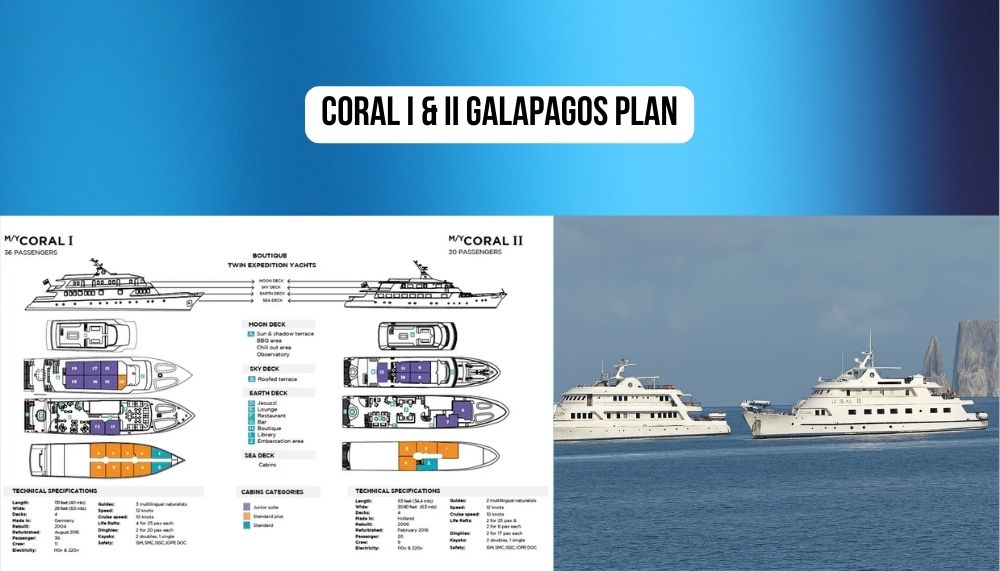
| Length | 131 feet | 113 feet |
| Capacity | 36 guests | 20 guests |
| Cabins | 18 (Standard, Standard Plus, Junior Suite) | 11-12 (Standard, Standard Plus, Junior Suite) |
| Operator | KleinTours / Go Galapagos Ecuador (est. 1983) | |
| Operation model | Twin-ship tandem cruising – identical itineraries, staggered landings | |
| Itineraries | 4-day routes A, B, C, D – combinable for 7, 8, or 14-day cruises | |
| Approx. daily rate | ~$489-500 pp/day | |
| Park entrance fee (not included) | $200 USD adults / $100 children under 12 – cash only on arrival | |
| Transit Control Card (not included) | $20 USD per person – purchased at mainland airport | |
| Domestic flights | Must be booked through KleinTours or $90 pp penalty applies | |
| Included | All meals, guided excursions, snorkel gear, water/tea/coffee, welcome/farewell cocktails, airport transfers, lectures | |
| Not included | Park fee, TCT, alcohol, kayaks (extra cost), wetsuit rental, Wi-Fi, gratuities |
Prices verified May 26, 2026. Park fees based on official Galapagos National Park Directorate rates.
What Are the Coral I and Coral II and Who Are They For?
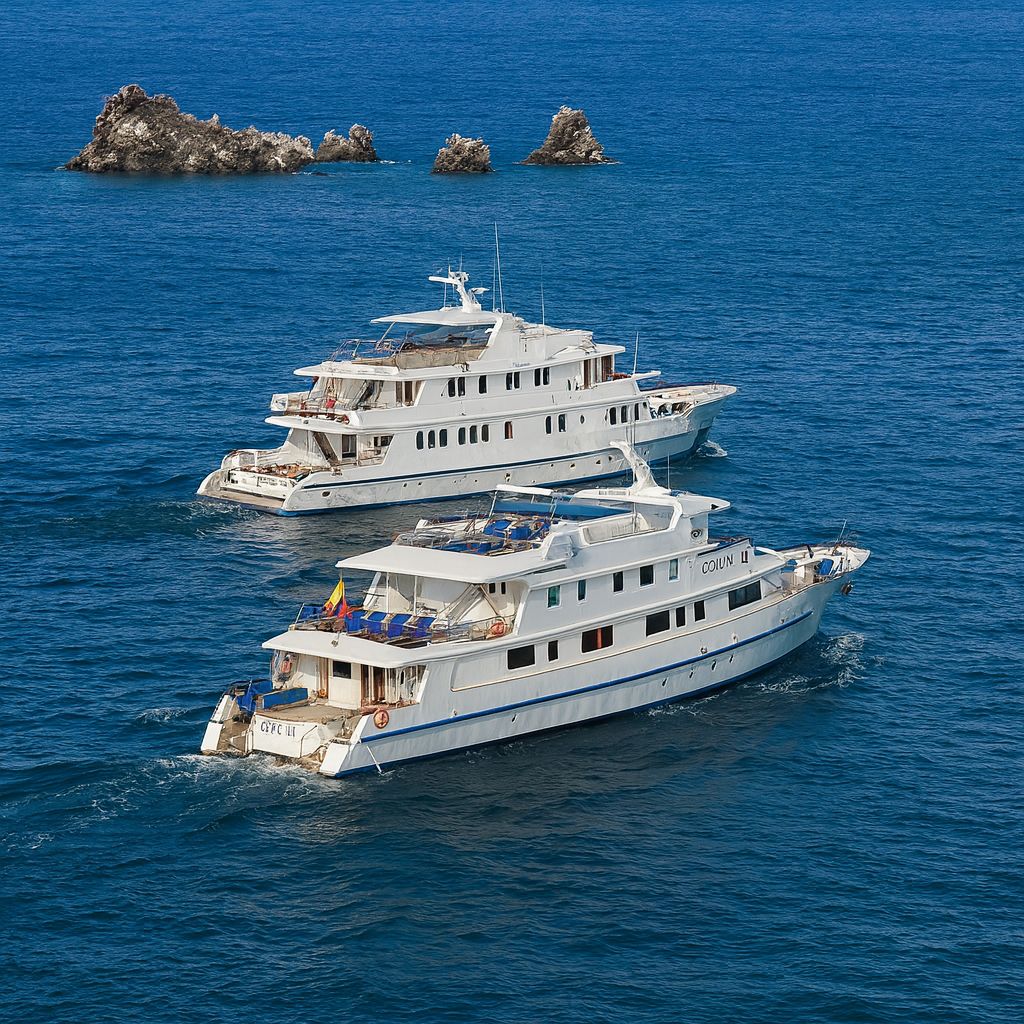
The Coral I and Coral II are KleinTours sister yachts that do something unique in the Galapagos: they cruise together. Both vessels follow identical itineraries simultaneously, staggering their landings on each island so neither group overlaps on shore. You travel on one boat with your own crew and guide, but you share excursion sites with the companion vessel’s guests and gather together for social events across the cruise. It is the only twin-ship operation in the Galapagos archipelago.
The practical effect of the twin-ship model deserves plain explanation because it’s unusual enough that travelers often misunderstand it. You board either the Coral I or the Coral II at the start of your cruise – you are not told in advance which one. Both boats carry the same itinerary. When the first boat lands on an island, the other waits offshore, then follows with a staggered timing so the two groups don’t crowd the same trail at once. National Park rules cap any single guided group at 16 passengers. On the Coral I with 36 guests, that means two groups ashore at slightly different times. On the Coral II with 20 guests, groups stay tight.
The social dynamic this creates is distinctive. On a standalone 16-passenger yacht, you’re with the same 15 people for the entire cruise – dinner, briefings, excursions, all of it. The Coral fleet gives you the intimacy of a small yacht aboard your own vessel plus the variety of meeting a different set of travelers from the companion boat at excursion sites and during shared Moon Deck events. For solo travelers and couples who find 16-person yacht social dynamics too intense, this is genuinely different.
Who books this: travelers who want first-class service and a genuine classic-yacht feel at a price meaningfully below the upper first-class tier. Couples and families who want good food and attentive crew without the clinical newness of a recently built vessel. Solo travelers who benefit from the broader social pool the twin-ship model creates. And anyone drawn to the teak-and-bronze interior aesthetic that sits at the opposite end of the design spectrum from the Scandinavian-influenced vessels like the Santa Cruz II.
What Do the Coral I and Coral II Look Like Inside? (Cabins, Decks, Common Areas)
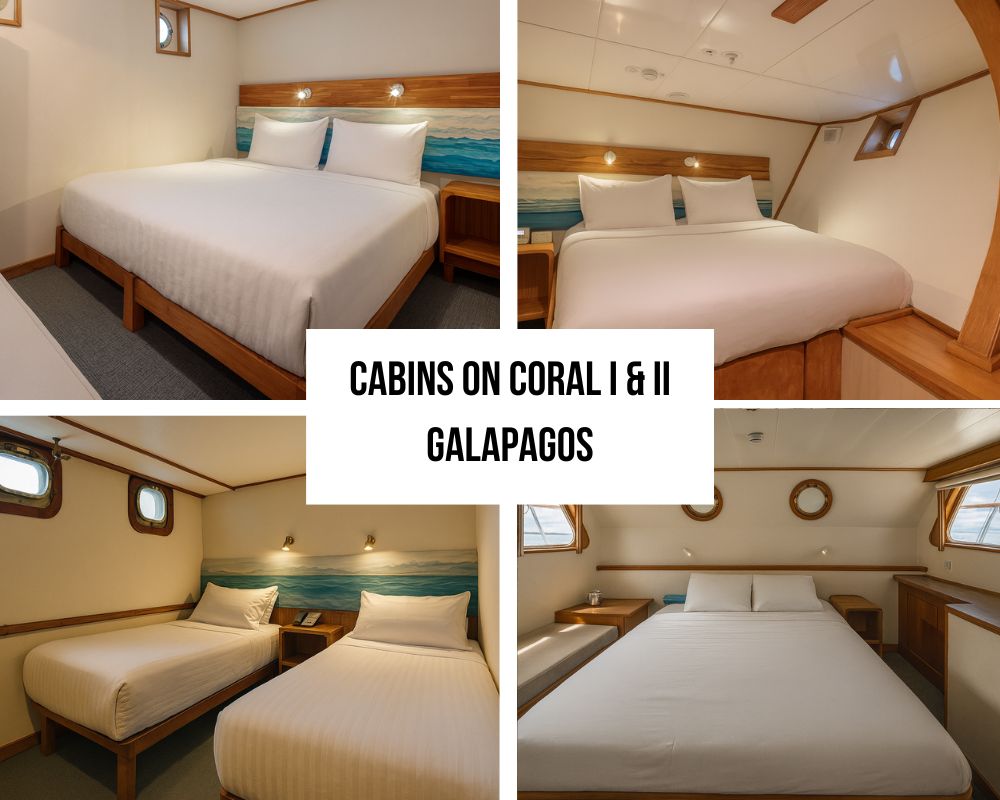
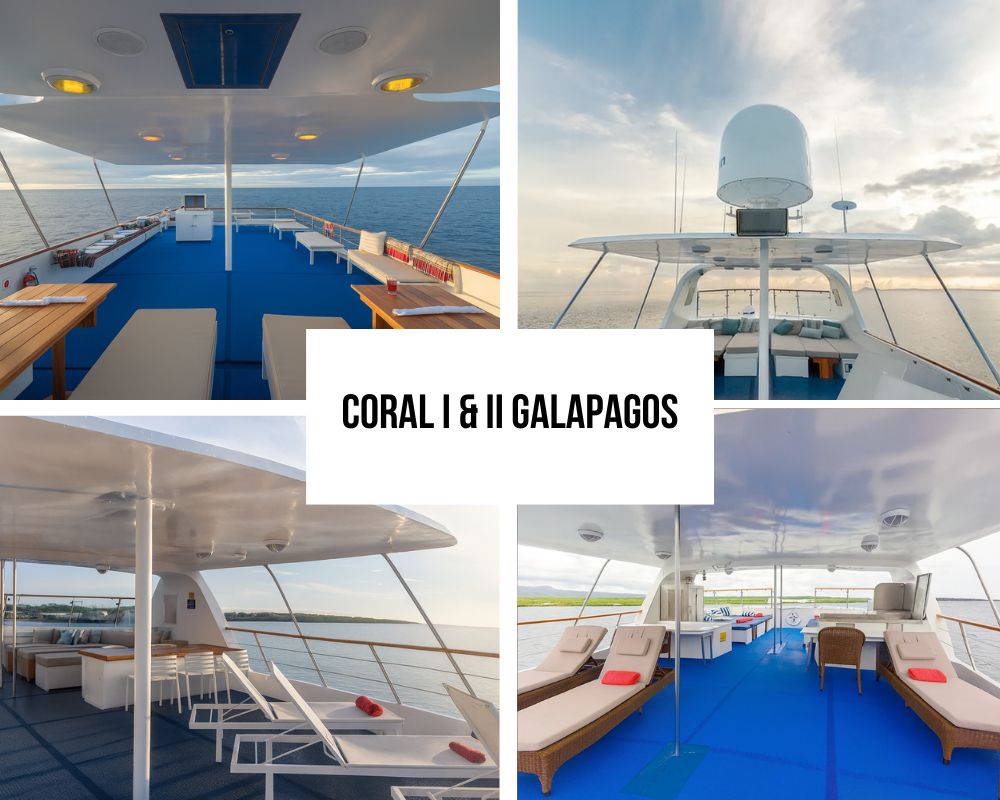
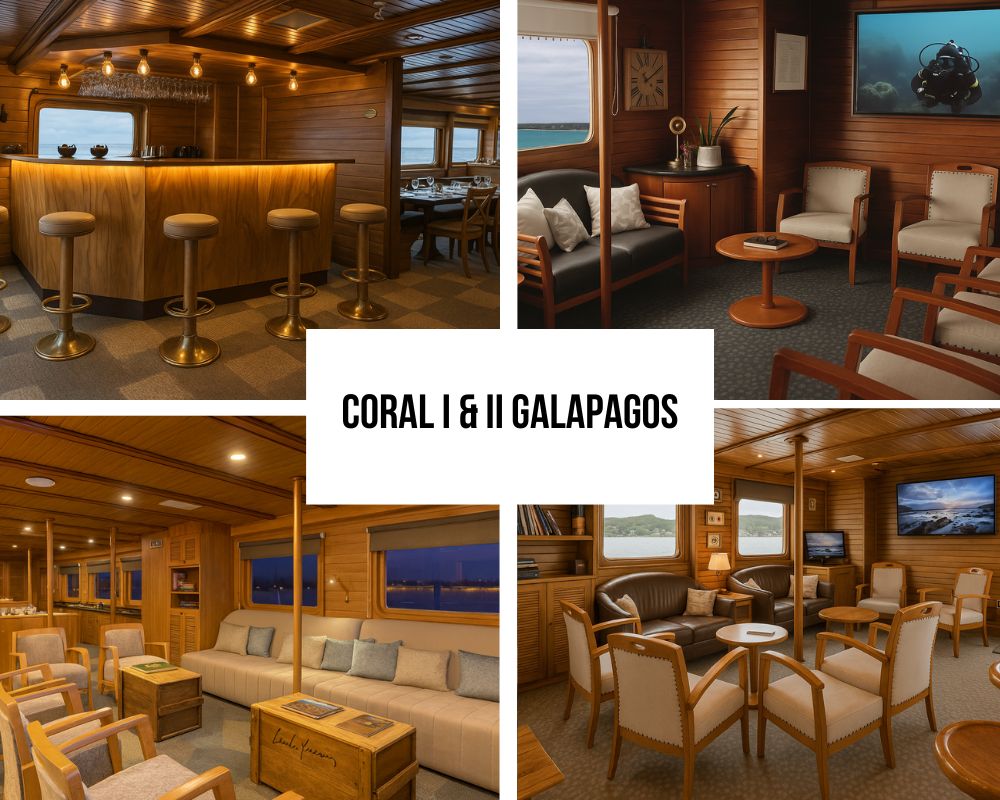
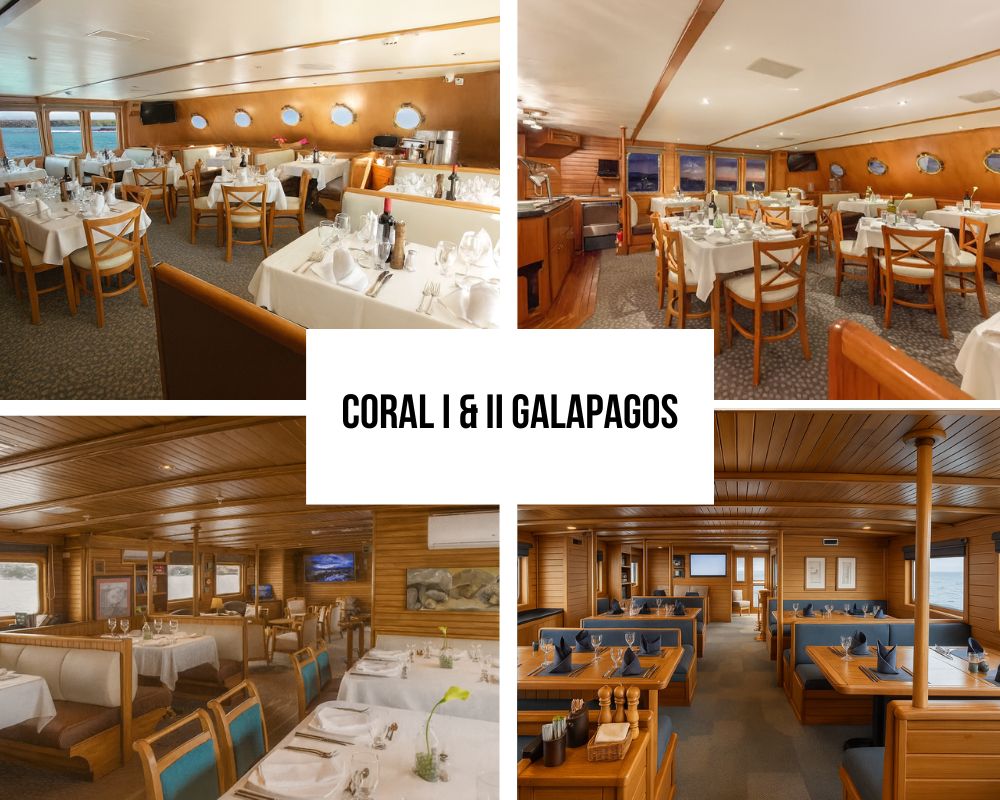
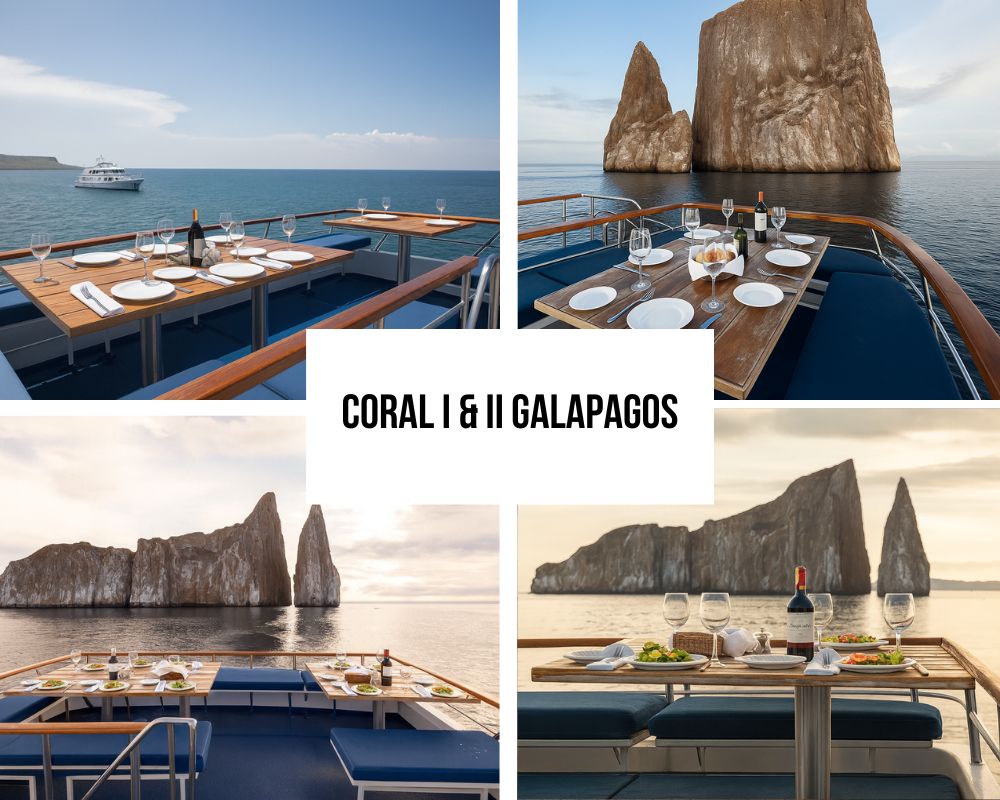
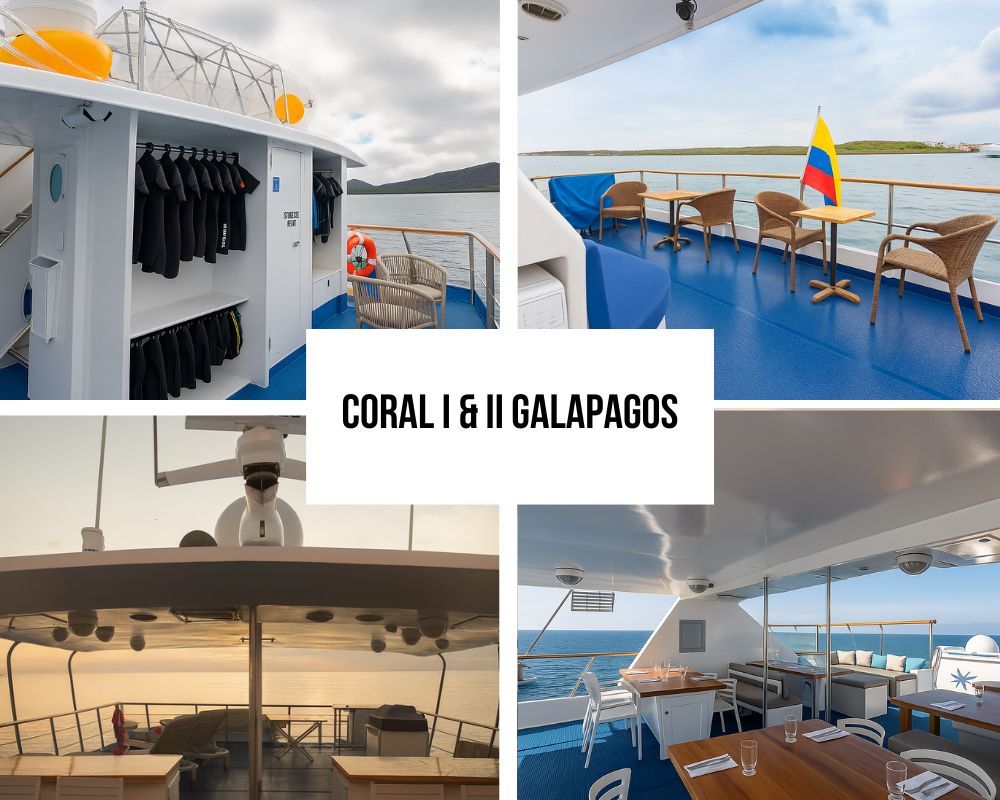
Both yachts feature interiors finished in dark teak and polished bronze – a classic motor yacht aesthetic that reads as warm rather than modern. Three sun decks span the length of each vessel: one fully open, one fully shaded for outdoor dining, and one partially shaded. Cabins run across three categories: Standard (smallest, no meaningful view on Coral II), Standard Plus (portholes), and Junior Suite (panoramic windows). The Jacuzzi on the upper deck is a social centerpiece, and the Moon Deck BBQ at sunset is the event that every traveler mentions as a cruise highlight.
The interior design is the first thing that distinguishes the Corals from comparable first-class yachts. The dark teak paneling throughout the common areas and cabins, the polished bronze fixtures, the leather seating in the lounge – this isn’t a modern expedition ship aesthetic. It’s a traditional motor yacht that has been kept up well, and it feels different underfoot from the lighter, more contemporary interiors of newer vessels. One traveler summarized it clearly: “outside is clearly a boat that’s been used; inside is beautiful.” That description is accurate and fair.
The cabin category advice on the Corals follows the same logic as the Galapagos Legend: the Standard and Standard Plus cabins with portholes don’t deliver the visual connection to the Galapagos that most travelers want. The Junior Suites with panoramic windows are worth the step up. One traveler specifically cited their upper-deck Junior Suite room as “worth the extra cost due to the fantastic views through the window.” There’s an additional practical reason to book an upper-deck cabin on the Corals: travelers who’ve done multi-segment cruises note that a cabin directly above the engine room makes overnight passages noisy. Upper deck positions you away from that noise source.
Common areas across both vessels are proportionally generous for the boat sizes. The panoramic windows fitted to the indoor lounge on both yachts mean you feel connected to the outside environment even when sitting inside with a drink. The Jacuzzi on the upper deck is consistently mentioned across reviews as a social gathering point on evenings at anchor. And the Moon Deck BBQ served at sunset is a shared Coral fleet tradition – both boats anchor near each other, the grills come out, and the combined guest groups share food and stories from the day’s excursions with the Galapagos coastline as the backdrop.
Which Itineraries Do the Coral I and Coral II Offer and Which Islands Do You Visit?
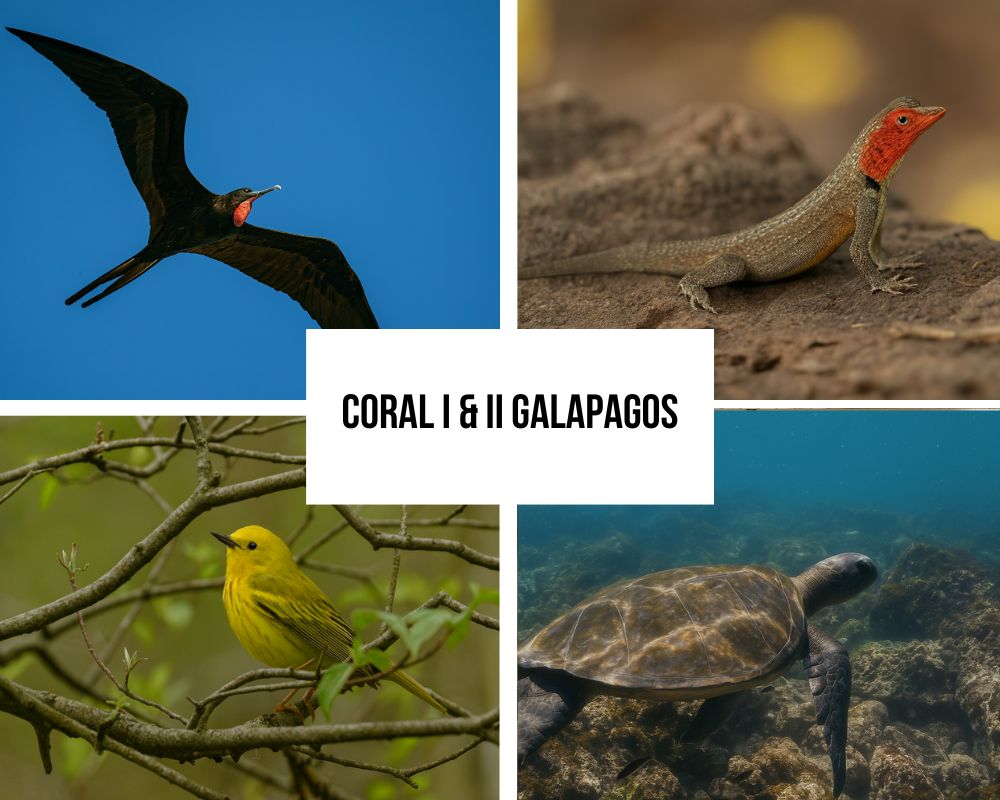
The Coral fleet operates four 4-day routes (A, B, C, D) covering different island zones, all combinable for 7, 8, or 14-day cruises. Route B covering the western and central islands including colder-water sites with penguins and fur seals is the most popular standalone 4-day option based on traveler feedback. The 14-day full combination is one of the most comprehensive Galapagos itineraries available at this price tier.
The four routes divide the archipelago by compass direction and combine naturally. Route A covers eastern islands. Route B covers western and central sites with the Bolivar Channel cold-water wildlife. Route C covers the central and northern sites. Route D includes the southern islands with sea lion snorkeling at Española. The traveler who did routes B, C, and D across 12 days described Route B as their favorite specifically because the colder water from the Humboldt current brings penguins and other cold-water species that warmer southern sites don’t have. Route D was a close second for the sea lion snorkeling.
| Route | Duration | Island Focus | Signature Wildlife | Best For |
|---|---|---|---|---|
| Route A (East) | 4 days | San Cristobal, North Seymour, Santa Cruz | Blue-footed boobies, frigatebirds, giant tortoises | First introduction to the islands |
| Route B (West/Central) | 4 days | Isabela, Fernandina, Santiago, Santa Cruz | Galapagos penguins, fur seals, flightless cormorants, marine iguanas | Cold-water wildlife; return visitors; serious naturalists |
| Route C (North/Central) | 4 days | Genovesa, Bartolome, Rabida, Santa Cruz | Red-footed boobies (Genovesa), red-sand beaches (Rabida), Pinnacle Rock | Seabird focus; photographers |
| Route D (South) | 4 days | Española, Floreana, Santa Cruz | Sea lion snorkeling, waved albatross (seasonal), Post Office Bay | Classic southern highlights; snorkeling focus |
| Combined (7, 8, or 14-day) | 7-14 days | Two to four route zones | Full archipelago range | Extended trips; serious wildlife travelers |
Itineraries subject to change by Galapagos National Park authority. Verified May 26, 2026.
The twin-ship staggered landing system means that on any island, one boat’s group goes ashore while the other waits a short time, then follows. The result is that you’re never on the same trail at the same moment as the companion ship’s guests – which preserves the small-group intimacy National Park guidelines are designed to protect. The traveler who did 12 days specifically confirmed: “the 2 boats travel together, but their landings are staggered, so not on top of each other.”
If you want help choosing between a 4-day single route and a longer combination based on your travel dates and what you most want to see, get in touch here and we’ll give you a straight recommendation.
How Good Is the Food and Naturalist Guide Experience on the Coral Yachts?
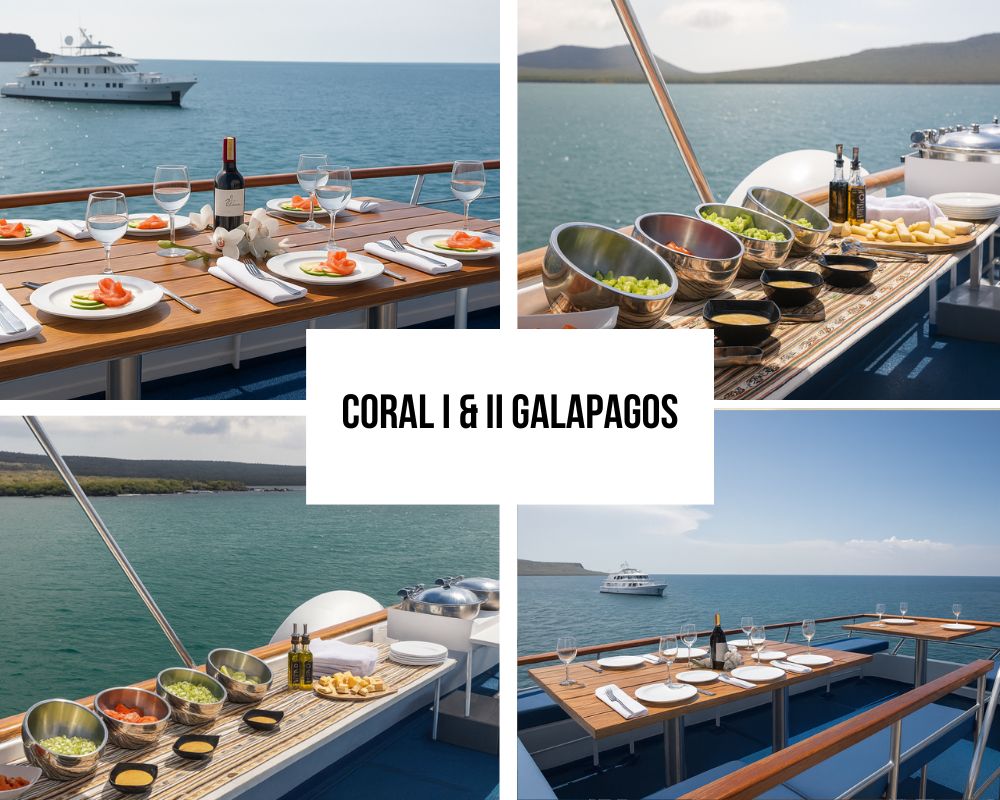
Food on the Coral I and II operates on a buffet format for all three meals, with the option to eat indoors in the dining room or on the partially shaded outdoor deck depending on conditions. The quality earns consistent strong praise: fresh Ecuadorian and international dishes, good variety across the cruise length, and kitchen teams that accommodate dietary restrictions including gluten-free requirements with advance notice. The Moon Deck sunset BBQ is a shared tradition between both vessels. Guide quality follows the KleinTours standard: knowledgeable, bilingual, passionate, and attentive to wildlife safety protocols.
The food quality level surprises some travelers who expect less from a boat at this price point. Ventura Travel, which operates the Corals in some European markets, notes that their chefs are “internationally trained and have prior experience working in the best hotels and restaurants in Ecuador.” That’s consistent with the actual traveler feedback: “food was top notch,” “food was great,” “food and service” cited among the top positive attributes. One reviewer specifically noted that their gluten intolerance was handled well without issue throughout the cruise.
The Moon Deck BBQ deserves its own treatment because it keeps appearing in reviews as a specific memory rather than a generic positive. It’s a straightforward event: the boats anchor together at sunset, grills are set up on the upper deck, both vessel groups eat outside with the Galapagos horizon behind them. The combination of the two groups, the informal setting, and the timing reliably produces the kind of conversation that makes a shared trip feel like something more than a tour. It’s the social event the twin-ship model was designed to enable.
Crew attentiveness receives named praise in the way that signals genuine continuity. One reviewer singled out crew member David: “extremely attentive – my glass was never empty.” Named crew praise across separate reviews and years is the same signal we noted in the Isabela II and Tip Top reviews. It means the same thing here: the crew knows what they’re doing and they’ve been doing it consistently.
What Do Real Travelers Say About the Coral I and Coral II? (Praise, Complaints, Patterns)
Across TripAdvisor, LiveAboard, and specialist booking platform reviews from 2024 and 2025, the Coral I and Coral II earn strong consistent ratings for guide quality, food, crew attentiveness, snorkeling, and the twin-ship social dynamic. The main friction points are the motion on overnight passages (small monohull yachts move in swells – expected but worth knowing), some cabin wear showing on the exterior hull, and crew service hours following set times rather than continuous on-demand availability.
The motion note is real and consistent with a 113 to 131-foot monohull. The Corals are not catamarans. On overnight passages in open water, particularly the leg toward the western islands, there is movement. The traveler who posted their June 2024 review made this point plainly: “you’re sailing on the ocean and it’s a small boat – rocking waves.” This isn’t a defect. It’s the physical reality of small-ship cruising in the Galapagos. Travelers who experienced it and still rated the cruise positively understood this going in. Travelers who expected a cruise-ship-stable ride and got a yacht-in-open-water experience instead were surprised. Motion sickness medication used preventively before long overnight passages is the practical preparation step.
The crew service schedule is a different kind of expectation management point. On a larger vessel, someone is always at the bar. On the Corals, food and drink service runs at specific times aligned to the daily schedule. This is entirely normal for yachts of this size and it doesn’t affect the quality of service during those windows – it just means you can’t call for a snack at 2am. One reviewer specifically flagged this as a “don’t come looking for a Below Deck experience” note, and framed it as a positive: the small crew that works specific hours is also the crew that knows you by name, your cabin preferences, and your food restrictions by day two.
Snorkeling quality is praised across nearly every review, with sea lions, penguins (on western routes), sharks, turtles, and marine iguanas appearing consistently. The snorkel-centric review pattern matches the Galapagos generally – the underwater experience is as compelling as the land-based wildlife for most travelers – but the Coral guides earn specific credit for finding the interesting creatures rather than just pointing toward the water.
What Coral I and II Travelers Tell Us: Patterns from Traveler Feedback
Based on traveler feedback collected through mytrip2ecuador.com and our YouTube audience, alongside thousands of traveler interviews Oleg has conducted across the Galapagos cruising market:
| Feedback Category | % Strong Satisfaction | Common Comment Pattern |
|---|---|---|
| Twin-ship social dynamic | 94% | “Best of both worlds – intimate boat, broader social group” |
| Guide quality and wildlife access | 97% | “Guide found penguins and sharks every snorkel session” |
| Food quality and variety | 95% | “Top notch; dietary requirements handled without fuss” |
| Moon Deck BBQ experience | 96% | “The BBQ at sunset was the highlight of the whole trip” |
| Cabin comfort (Junior Suite) | 93% | “Panoramic windows – worth the extra; views were special” |
| Motion on overnight passages | 85% | “Expected for a small yacht; bring sea sickness medication” |
How Do the Coral I and Coral II Compare to Similar Vessels?
The Coral I and II sit in the same KleinTours fleet as the Galapagos Legend, at a lower price point and a much smaller scale. Against other first-class yachts in the 16-40 passenger tier – Solaris, Tip Top II, Isabela II – the Corals compete on price, on the teak-and-bronze interior aesthetic, and on the twin-ship social dynamic that no comparable vessel offers. The trade-off is that the Corals don’t have a medical officer, a glass-bottom boat, or the Metropolitan Touring operational depth of the Isabela II.
| Vessel | Capacity | Twin Ship | Medical Officer | Glass-Bottom Boat | Daily Rate |
|---|---|---|---|---|---|
| Coral I | 36 | Yes (with Coral II) | No | No | ~$489-500 pp/day |
| Coral II | 20 | Yes (with Coral I) | No | No | ~$489-500 pp/day |
| Isabela II | 40 | No | Yes (24/7) | Yes | ~$701-730 pp/day |
| Solaris (2019) | 16 | No | No | No | Comparable |
| Galapagos Legend | 100 | No | No (medical station) | Yes | From lower base rate |
Prices are approximate reference rates. Verified May 2026.
The choice between the Coral II (20 guests) and the Coral I (36 guests) within the same fleet is the most frequently asked question about these vessels. Both follow identical itineraries and have nearly identical facilities. The practical differences: Coral II is smaller, older-feeling, more intimate in the way that a 20-person gathering feels different from a 36-person one. Coral I is the larger, newer-feeling vessel with more cabin variety and a slightly more spacious common area layout. Neither is objectively better – the choice comes down to how intimate you want your onboard group to feel.
Against the Isabela II at roughly $200-240 more per person per day, the Coral yachts trade the medical officer, glass-bottom boat, and Metropolitan Touring’s six-decade heritage for the unique twin-ship experience and a price point that makes a longer combined itinerary more financially accessible. For travelers without specific health considerations and who are drawn to the classic yacht aesthetic, the Corals are the better value.
How Much Do the Coral I and Coral II Galapagos Cruises Cost and What’s Included?
The Coral I and Coral II run approximately $489-500 per person per day, placing a 4-day cruise around $1,960-2,000 per person double and a 7-day cruise around $3,420-3,500. The cruise fare includes all meals, guided excursions, snorkeling gear, welcome and farewell cocktails, unlimited water, tea and coffee, and Galapagos airport transfers. Not included: the $200 park fee, $20 TCT, alcohol, kayaks (extra cost), wetsuit rental, Wi-Fi, and gratuities. Critically: domestic flights to and from the Galapagos must be booked through KleinTours or a $90 per person penalty applies.
The domestic flight requirement is the single most important operational detail for anyone booking the Coral yachts through a third-party agent or independently. KleinTours requires that domestic flights be purchased through their own flight booking system. Failure to do so results in a $90 per person fee charged at embarkation. This is confirmed across multiple booking platforms including Happy Gringo and others. If you’re booking the Corals, book the flights through KleinTours at the same time. It’s not optional.
| Cost Item | Approximate Cost (2026) | Notes |
|---|---|---|
| 4-day cruise (double occupancy) | From ~$1,960-2,000 pp | Junior Suite recommended minimum cabin category |
| 7-day cruise (double occupancy) | From ~$3,420-3,500 pp | Two combined routes; strong island coverage |
| 14-day full combination (double) | From ~$6,840-7,000 pp | All four routes; comprehensive archipelago coverage |
| Galapagos National Park fee | $200 pp (adults) / $100 (under 12) | Cash USD only; paid on arrival at Galapagos airport |
| Transit Control Card (TCT) | $20 pp | Purchased at mainland Ecuador airport before flight |
| Domestic flights (mandatory via KleinTours) | Approx. $490-560 pp round-trip | Must book through KleinTours; $90 pp penalty if booked independently |
| Wetsuit rental | $25 (3-4 nights) / $50 (7-11 nights) / $75 (14 nights) | Recommended for Route B western islands; water can be cold |
| Single supplement | 50% regular / 75% high season (Dec 18 to Jan 5) | Same supplement structure as Galapagos Legend |
| Child discount (under 12) | 25% sharing cabin with one adult; 50% triple option | One child per adult at discounted rate |
All prices verified May 26, 2026. Official park fee source: Galapagos National Park Directorate. Cruise prices are indicative; contact operator for exact current rates.
The kayak hire cost is worth noting specifically because kayaking in the Galapagos is a genuinely rewarding activity and the transparent kayaks available on the companion Galapagos Legend are included in that vessel’s rate. On the Corals, kayaks are available at extra cost onboard. Pre-booking your preferred activity sessions at embarkation rather than waiting until day three is the practical approach.
For a full package quote covering the cruise, cabin selection, domestic flights, and any mainland Ecuador pre- or post-cruise extensions, send us a message here and we’ll price it out with the correct flight booking handled through KleinTours.
Are the Coral I and Coral II Worth Booking in 2026/2027 – Our Honest Take?
Yes, for travelers who specifically want a classic yacht aesthetic, the unique twin-ship social dynamic, and first-class Galapagos access at a price point well below the Isabela II and upper first-class tier. The guides are strong, the food is good, the Moon Deck BBQ tradition is genuinely one of the most memorable onboard experiences in the Galapagos fleet. The honest caveats are motion on overnight passages (plan for it), some exterior wear on older vessels (the inside is maintained better than the outside suggests), service during set hours only (not a flaw, just a small-yacht reality), and the mandatory KleinTours flight booking requirement that catches travelers off guard.
The twin-ship model is the reason to choose the Corals over a comparable standalone small yacht at a similar price. On most first-class vessels you spend your cruise with the same 16 to 20 people. On the Corals, your actual onboard community is 20 or 36 people on your boat, and your excursion community is 56 people across both vessels. The Moon Deck BBQ is where those worlds overlap. If you want to return from a cruise with friendships that didn’t exist before it, the social architecture of the twin-ship operation makes that more likely than on any other vessel reviewed here.
The teak-and-bronze interior is also a real differentiator for a specific kind of traveler. The contemporary Scandinavian aesthetic of the Santa Cruz II, the clean-line modern finish of the Tip Top V, the bright airy feel of the Tip Top IV – these are good design choices for modern expedition ships. But some travelers want to feel like they’re on a yacht that has a past. The Corals deliver that feeling. The wood, the bronze, the cushioned upper deck – it reads as a classic expedition vessel rather than a floating hotel concept.
For 2026 and 2027: the 7 and 14-day combined routes book earlier than standalone 4-day segments. Route B including the western islands fills fastest because the cold-water wildlife it accesses – penguins, fur seals, flightless cormorants – attracts both first-timers and return visitors. And the high-season period from December 18 to January 5 carries both a 5% cabin supplement and a 75% single supplement, which changes the cost calculation significantly for solo travelers booking those dates.
What to Know Before You Book: Fail Points and Smart Preparation
The $90 per person domestic flight penalty is the most important operational warning on these vessels. KleinTours requires domestic flights between mainland Ecuador and the Galapagos to be purchased through their own system. Travelers who book flights independently through airlines or other platforms face a $90 per person penalty fee charged at embarkation. This is verified across multiple booking platforms. If you’re using a third-party travel agent, confirm they are booking the flights through KleinTours. If you’re booking directly, use the KleinTours/Go Galapagos flight booking process.
Motion on overnight passages is real. Both Coral vessels are monohull yachts. They roll in swells. The western islands route (Route B) involves longer overnight passages where this is most noticeable. Travelers prone to seasickness should take medication preventively before overnight legs, not after symptoms start. Upper deck cabins positioned away from the engine room are more comfortable for the passage but may have slightly more movement than lower deck cabins. The trade-off is the same as on the Tip Top IV: views versus stability.
Book Junior Suite or above. Standard Plus cabins with small portholes are functional but don’t deliver the visual experience of the Galapagos that most travelers want from their cabin. Junior Suites with panoramic windows change the onboard rhythm across a multi-day cruise. The additional cost is worth it.
Service runs on set hours. The crew on both Coral vessels is small and dedicated, but food and drink service follows the daily schedule. Room service is not available. This is normal for yachts of this size and is not a problem once you know it going in – it’s a disappointment if you arrive expecting the continuous on-demand service of a larger expedition ship.
Bring USD cash. The $200 park fee and $20 TCT are non-negotiable cash-only charges at the airport. Bar tabs and gratuities also require cash. Come prepared with clean USD bills in sufficient quantity.
Frequently Asked Questions
How does the twin-ship operation work on the Coral I and II?
Both vessels follow identical itineraries simultaneously. When one boat’s excursion group lands on an island, the other boat waits offshore, then follows with staggered timing so neither group overlaps on the trails. National Park rules cap any single guided group at 16 passengers, so on the 36-passenger Coral I, two groups go ashore at different times. The combined 56-passenger community gathers for shared events including the Moon Deck sunset BBQ. You travel on one boat with your own crew and guide but share excursion sites and social events with the companion vessel’s guests.
What is the difference between the Coral I and Coral II?
The Coral I is 131 feet and carries 36 guests across 18 cabins. The Coral II is 113 feet and carries 20 guests across 11-12 cabins. Both offer identical itineraries and near-identical facilities. The practical difference is the onboard group size and feel: Coral II is smaller and more intimate with 20 fellow travelers. Coral I has more cabin variety and slightly more spacious common areas. Neither is objectively better – the choice depends on how intimate you want your shipboard community.
Do I need to book domestic flights through KleinTours?
Yes. KleinTours requires that domestic flights between mainland Ecuador and the Galapagos be purchased through their booking system. Travelers who book flights independently face a $90 per person penalty fee charged at embarkation. Always confirm with your booking agent that domestic flights are booked through KleinTours, not independently through airlines or other platforms.
Which Coral I and II route should I choose for a first-time visit?
Route A (eastern islands with blue-footed boobies and giant tortoises) works well for a first introduction. Route D (southern islands with Española sea lion snorkeling) is equally strong as a first-timer option. Route B (western islands with penguins and flightless cormorants in cold Humboldt current water) is the most popular among travelers who have some Galapagos experience or who specifically want cold-water wildlife. For a week’s cruise, combining B and D gives excellent wildlife diversity across both cold-water and warm-water species.
How much is the Galapagos National Park entrance fee in 2026?
The fee is $200 USD for foreign adults and $100 USD for children under 12, following a doubling from $100 in August 2024. It must be paid in cash USD on arrival at Baltra or San Cristobal airport. The Transit Control Card is an additional $20 per person, purchased at the mainland Ecuador airport before your Galapagos flight.
Thinking about the Coral I or II for your Galapagos trip?
We’re a local agency rated 4.9 stars on Google and TripAdvisor, and we know the KleinTours fleet well across all three vessels. If you want honest advice on whether the Coral I or II fits your group better than the Galapagos Legend or a first-class yacht, along with a free no-obligation quote with domestic flights booked correctly through KleinTours, fill out this short form and we’ll come back to you with specifics.
Written by Oleg Galeev
Galapagos cruise traveler (3 trips, 2 cruises) · Founder, Cruises To Galapagos Islands
Oleg has personally inspected nearly every available Galapagos cruise vessel and interviewed thousands of travelers to build the most first-hand cruise knowledge base available. He also runs the Ecuador travel blog mytrip2ecuador.com and the YouTube channel My Trip to Somewhere.
Cruises To Galapagos Islands is rated 4.9 stars on Google and TripAdvisor.
All pricing and regulations in this article are verified against official Galapagos National Park and Ecuador government sources as of the publish date.