Nemo III Galapagos Cruise Review
Quick Summary
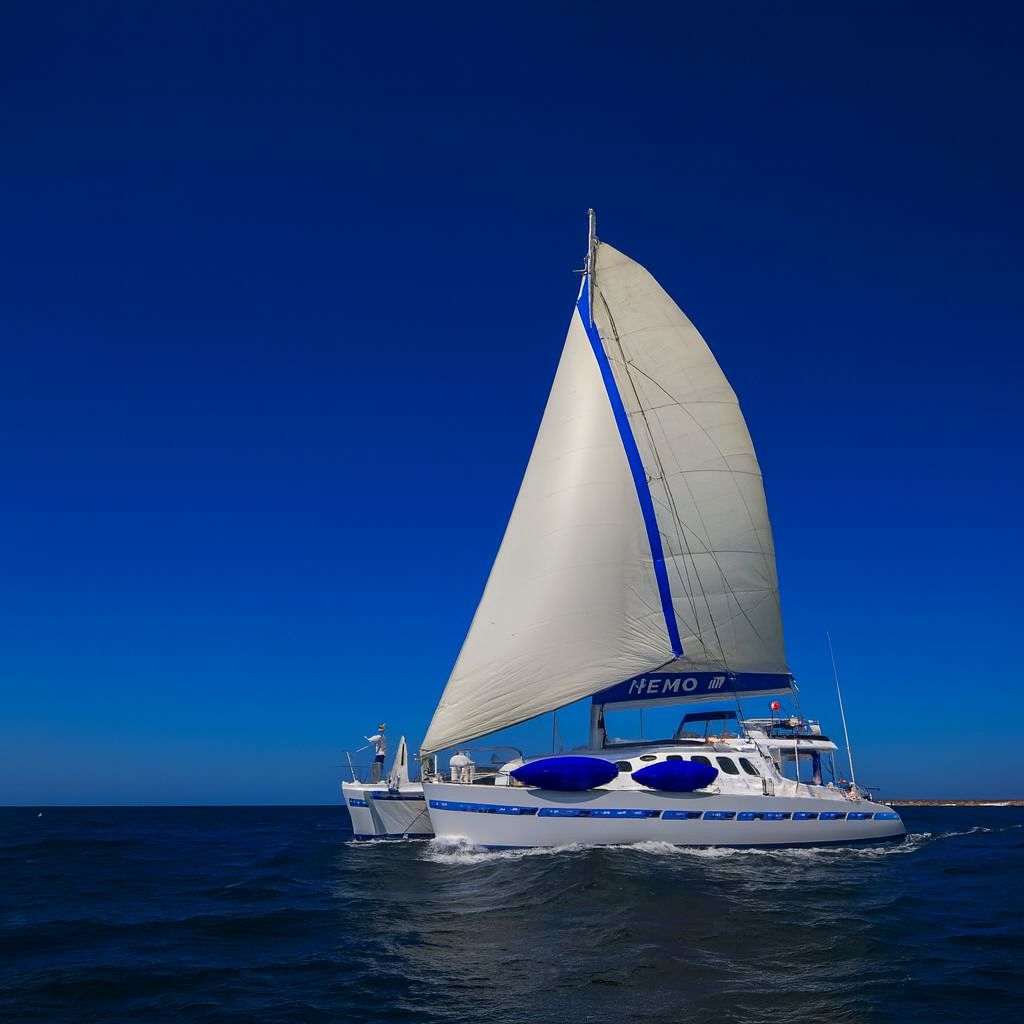
The Nemo III is a 75-foot First Class motor sail catamaran operated by Latintour, a family-run company sailing the Galapagos since 1985, making it the longest-established operator in this review series. Renovated in 2016 to a standard Galapatours describes as “way ahead of anything else in her class,” it carries 16 passengers in 8 natural wood-finished cabins with a 37-foot beam producing strong catamaran stability. The northern itinerary includes a stop at Daphne Major, one of the most strictly access-controlled islands in the Galapagos National Park. The sails are genuine: the Nemo III deploys them when wind conditions allow, making it the only true sailing experience available in the First Class catamaran fleet. Wetsuits, kayaks, and snorkel gear are included. The minimum passenger age for regular departures is 3 years, making it the most family-inclusive vessel in this review series. The 10% child discount applies under age 12.
The Nemo III is one of 28 First Class ships we review. See all first class Galapagos cruises, or use our finder to see the best Galapagos cruises side by side. It sails for Nemo Fleet: see all Nemo Fleet ships in the Galapagos.
Nemo III Galapagos Cruise: Quick Facts
| Detail | Info |
|---|---|
| Vessel Type | Motor Sail Catamaran (genuine sailing capability) |
| Class | First Class |
| Renovated | 2016 (comprehensive luxury refit) |
| Length | 23 m / 75 ft |
| Beam | 11.40 m / 37.4 ft |
| Speed | 9 knots (motor); sailing speed dependent on conditions |
| Passenger Capacity | 16 guests |
| Crew | 7: Captain, Helmsman, Deck sailor, Bartender, Cook, Machinist, 1 certified bilingual naturalist guide |
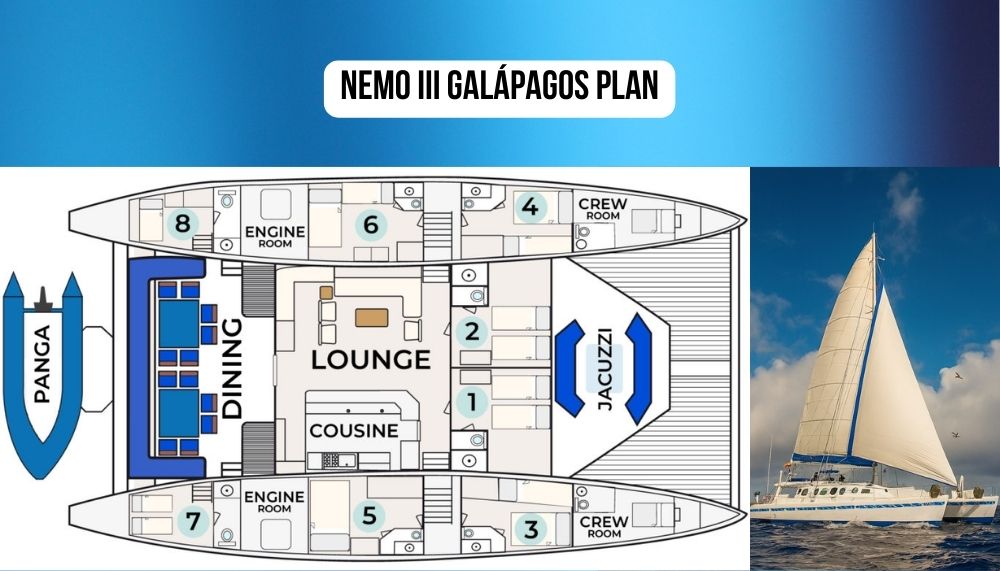
| Cabins | 8 total: Cabins 1-2 (2 twin lower beds); Cabins 3, 4, 6 (matrimonial + upper single, triple-capable); Cabins 5 & 8 (matrimonial only); Cabin 7 (2 singles) |
| Cabin finish | Natural wood throughout; described as “luxury feel way ahead of class” |
| Jacuzzi | Yes (sundeck, with bow-area position) |
| Al fresco dining | Yes (outdoor dining area plus shaded sundeck with sailcloth parasols) |
| Wetsuits | Included |
| Snorkel gear | Included |
| Kayaks | Included (advance reservation recommended) |
| Operator | Latintour (family business operating Galapagos cruises since 1985) |
| Minimum passenger age | 3 years (FIT departures); all ages accepted on charters |
| Children’s discount | 10% for children under 12 (Superior cabin rate) |
| Itinerary options | 4-day (A4/B4), 5-day (A5/B5), 8-day (A/B North or South), all switching weekly |
| Departures | Sunday, Wednesday, Thursday |
| Notable access | Daphne Major (northern itinerary; among most restricted visitor sites in the park) |
| Charter available | Yes (full vessel; all ages for charters) |
| Park Entrance Fee | USD $200 per person (cash, paid on arrival) – Prices verified May 23, 2026 |
| INGALA Transit Card | USD $20 per person (paid at mainland airport) |
What Is the Nemo III Galapagos Cruise and Who Is It For?
The Nemo III is a 75-foot First Class motor sail catamaran operated by Latintour, a family business that has been sailing Galapagos cruises since 1985, making it the longest-established operator reviewed in this series. Renovated in 2016 to a standard that surprised even experienced industry reviewers, it carries 16 passengers in 8 natural wood-finished cabins across a 37-foot beam. The sails are real: the Nemo III deploys them when wind and current conditions allow, offering an authentic sailing dimension that no other First Class catamaran in this review series provides. The northern itinerary includes Daphne Major, one of the most restricted visitor sites in the Galapagos National Park. The minimum passenger age of 3 years makes it the most family-inclusive vessel reviewed.
The 1985 founding date is the operational fact that matters most when you’re trying to understand what kind of boat this is. Latintour has been running Galapagos cruises for four decades. They were operating in the islands before most of the vessels reviewed in this series were built. That institutional knowledge accumulates into something you feel at the operational level: guides who’ve been working the same routes for years, a crew culture shaped by decades of close-quarter service on a 16-passenger vessel, and an operator who knows the park’s rhythms across seasons rather than working from a recent conversion manual.
The 2016 renovation is described in Galapatours’ review as a real surprise: “She now boasts a real luxury feel that’s way ahead of anything else in her class.” That assessment comes from a specialist who regularly places travelers on Galapagos vessels and knows the First Class tier from direct experience. The natural wood cabin interiors, the modern lounge, and the sundeck with sailcloth parasols rigged from the mast describe a vessel that was redesigned with intention rather than simply refreshed. A TripAdvisor traveler uses the phrase “very clean and modern and defo felt luxurious” to describe their reaction to boarding, noting that their expectations were exceeded.
The sailing element is worth treating honestly rather than romantically. The Galapagos National Park imposes strict itinerary schedules that require vessels to arrive at specific sites within defined windows. Wind and current conditions in the archipelago are inconsistent, particularly in certain seasons. The Nemo III uses its engines to maintain schedule when necessary, which is most of the time. When conditions align, the sails deploy and the experience changes in a way that travelers on motor-only vessels simply never get. A January 2025 TripAdvisor reviewer notes that “even though they often use the engine to get to the next island to maximise time with wildlife, it really is a sailing experience.” That is the honest formulation: predominantly motor, genuinely sail when conditions cooperate.
The Nemo III’s northern and southern itineraries alternate weekly, and the northern route’s Daphne Major access is one of the most restricted wildlife sites in the park. If you’re considering the northern itinerary specifically for Daphne, knowing which weeks it’s running is important before you book around other travel commitments. Fill out this short form and we’ll check the schedule and tell you honestly what to expect.
What Are the Cabins and Onboard Experience Like?
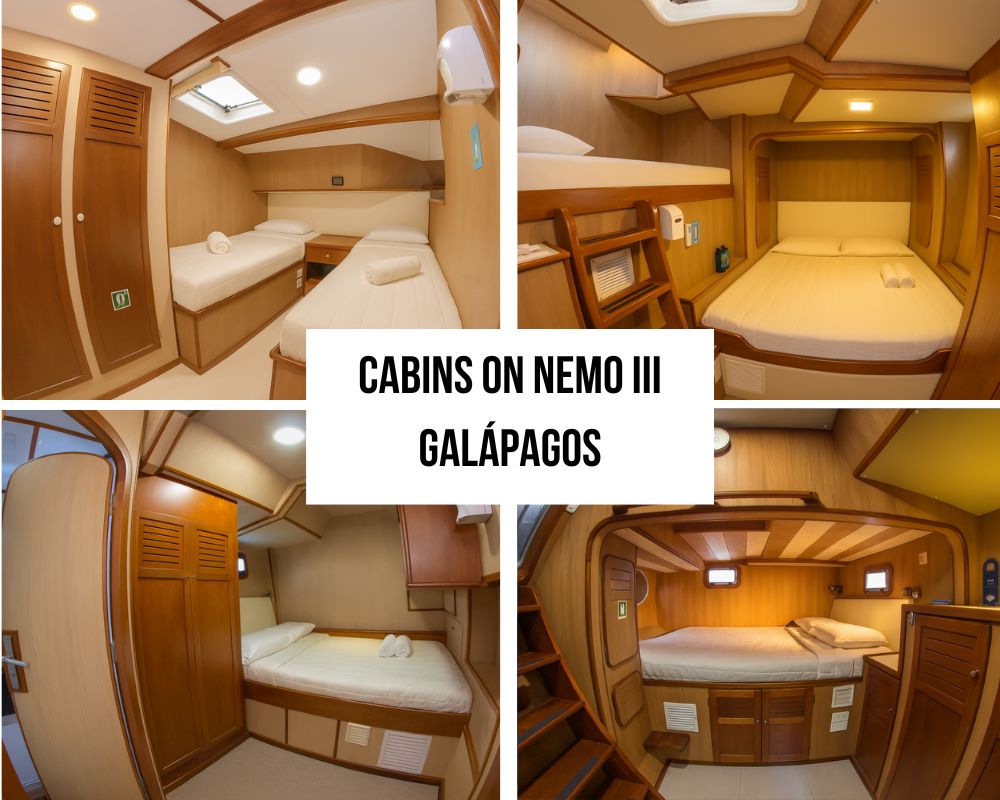
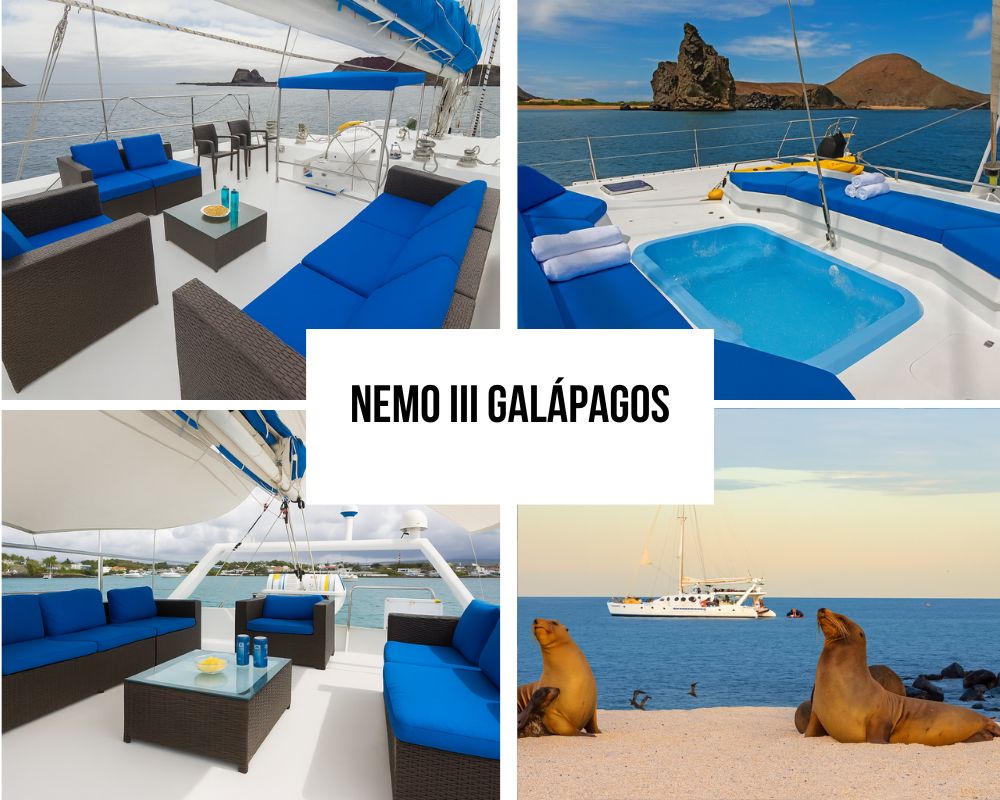
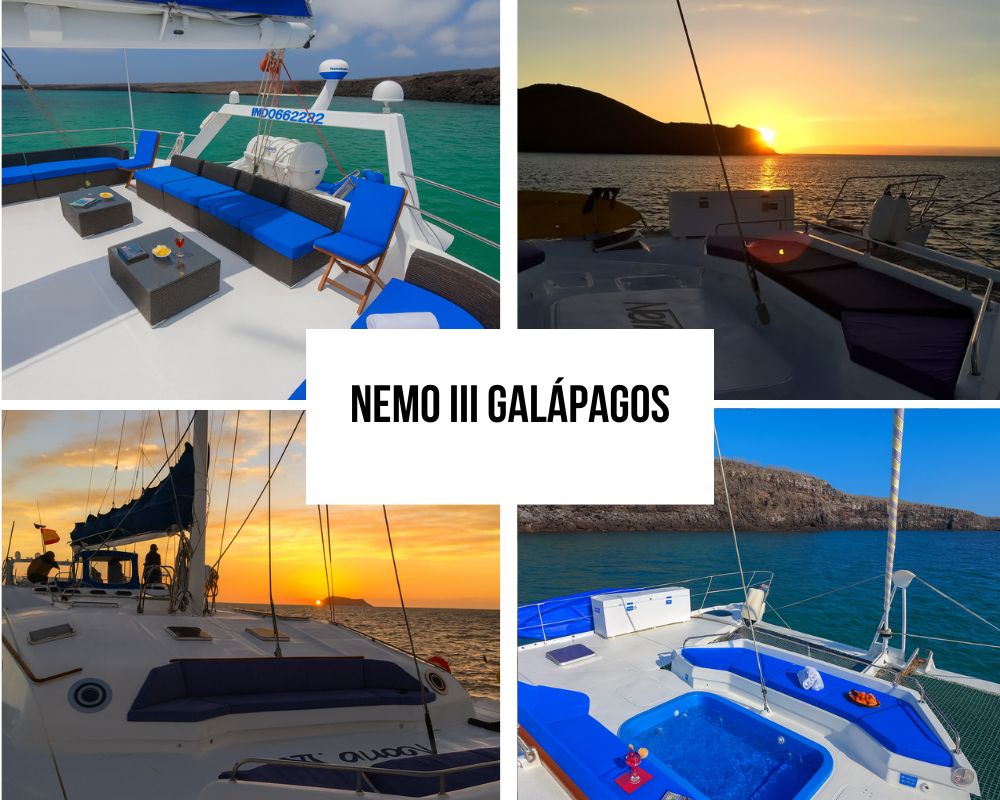
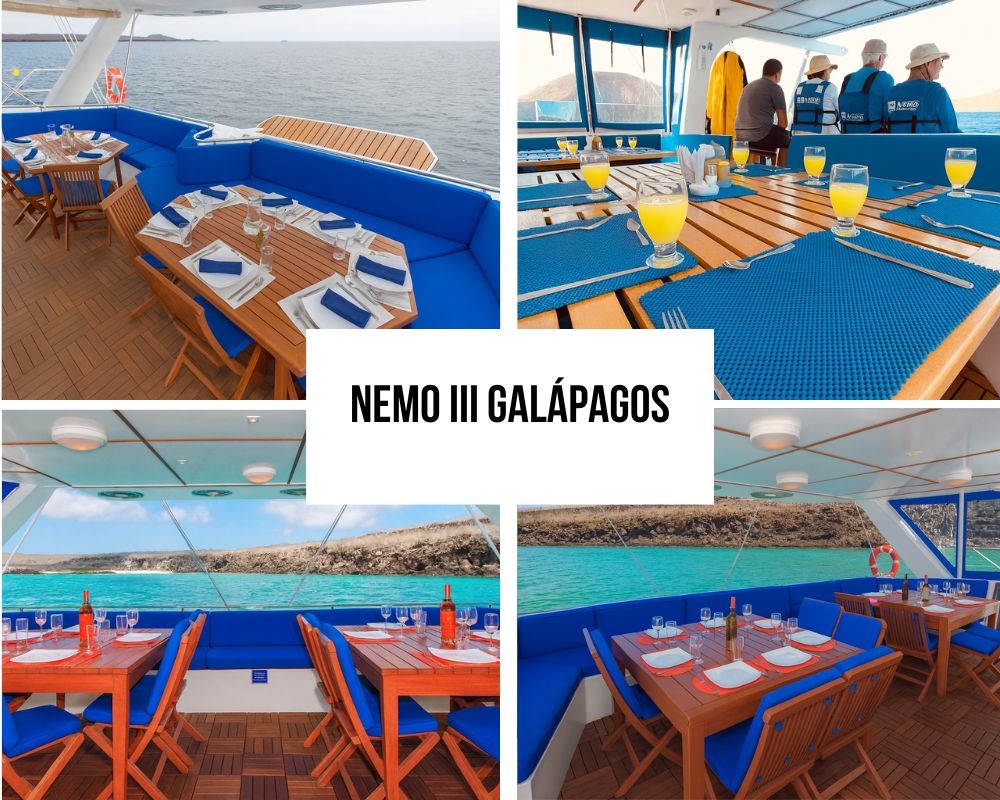
Eight cabins with natural wood finishes throughout, individual air conditioning, private en-suite bathrooms with full-size hot showers, reading lights, and adequate storage. Cabin configurations cover twin singles (Cabins 1-2), matrimonial plus upper single for triple occupancy (Cabins 3, 4, 6), double matrimonial only (Cabins 5 and 8), and twin singles (Cabin 7). The sundeck sits at the bow with a Jacuzzi and reclining loungers beneath sailcloth parasols rigged from the mast. A separate al fresco dining area operates on the main deck. The indoor lounge is air-conditioned with comfortable seating for briefings and social time.
The natural wood finish is mentioned by virtually every traveler account and every operator review in connection with the Nemo III, and the pattern of that consistency tells you something. Wood interiors create a warmth that fiberglass and fabric don’t, and on a vessel this size, that warmth accumulates across every meal, every briefing, every morning before the excursion. You’re not in a utilitarian hull with adequate fittings. The Nemo III’s cabins were described in a TripAdvisor account as “small, yes, but well planned,” with skylights and portholes providing natural ventilation alongside the air conditioning, adequate storage despite the compact footprint, and private bathrooms with good hot showers.
The towel animals deserve a specific mention because they appear in multiple independent accounts as a genuine surprise. “Raul took time to give us the good surprise of a turtle and bird made of towels on our bed” from a review on the Nemo fleet website, and a similar reference in the TripAdvisor thread, indicates that the housekeeping crew put daily care into cabin presentation beyond the functional minimum. On a 16-passenger vessel where the same crew sees the same guests every day for a week, those small gestures are how individual relationships form between passengers and crew.
The sundeck layout is unusual for a sailing catamaran. The Jacuzzi sits at the bow end, with the mast structure allowing sailcloth parasols to be rigged for shade over the reclining loungers between the Jacuzzi and the stern social area. After an excursion, moving from the panga to the deck, rinsing gear, and settling into the Jacuzzi while the boat navigates to the next island under the equatorial sun with a shade parasol overhead is a sensory experience that motor-only yachts with standard deck furniture don’t replicate.
Which Itineraries Does the Nemo III Cover, and Why Does Daphne Major Matter?
The Nemo III runs two alternating itineraries switching weekly: Itinerary A (North) and Itinerary B (South), each available in 4-day, 5-day, and 8-day versions. The northern route includes Genovesa, Santiago, Isabela, Fernandina, and Daphne Major. The southern route covers Española, Floreana, San Cristobal, Santa Fe, Bartolome, and South Plaza. Daphne Major is the most significant site-specific differentiator: it’s one of the most strictly access-controlled islands in the entire Galapagos National Park, with visitor numbers limited to a small daily maximum, and only certain permitted vessels reach it.
Daphne Major is a volcanic tuff cone rising from the ocean between Santa Cruz and Baltra. Charles Darwin Foundation researchers famously studied its finch populations for decades, producing the most detailed long-term documentation of evolution in action ever compiled on a single island. The Galapagos National Park restricts daily visitor numbers tightly. The trail to the crater rim requires visitors to navigate steep rocky slopes, and the density of nesting blue-footed boobies, Nazca boobies, tropicbirds, short-eared owls, and frigatebirds on a site this concentrated creates an ecological intensity that’s different even from Genovesa. Being on a vessel with access to it is a genuine privilege, and the Nemo III’s northern itinerary includes it.
The 5-day A itinerary specifically reaches Isabela and Fernandina, making it one of the shorter programs with western island access comparable to what the Beluga’s 6-day route and the Archipel II‘s 5-day A provide. For travelers with limited time who want both Daphne Major and Fernandina on one trip, the Nemo III’s northern 8-day itinerary is one of very few programs that delivers both.
| Route / Length | Region | Key Sites | Best For |
|---|---|---|---|
| Itinerary A4 (4 days / North) | North + Central | Genovesa (Darwin Bay), Santiago (Sullivan Bay), Santa Cruz | Short northern introduction, seabirds |
| Itinerary A5 (5 days / West) | West + Central | Isabela, Fernandina, Santiago, Santa Cruz | Western access in 5 days |
| Itinerary A (8 days / North) | North + West + Central | Bachas Beach, Genovesa, Daphne Major (restricted access), Isabela, Fernandina, Santiago | Daphne Major access + western islands; most comprehensive northern circuit |
| Itinerary B4 (4 days / South) | South + Central | San Cristobal, Española, Santa Cruz | Short southern intro, sea lions, albatross (seasonal) |
| Itinerary B5 (5 days / South) | South + Central | Española (Gardner Bay, Punta Suarez), Floreana, Santa Fe, South Plaza | Classic southern highlights, albatross (seasonal) |
| Itinerary B (8 days / South) | South + Central + East | San Cristobal (Kicker Rock), Española (Gardner Bay, Punta Suarez), Floreana, Santa Fe, Bartolome, South Plaza, Santa Cruz | First-timers, classic eastern and southern Galapagos circuit |
The weekly alternation between A and B itineraries, and the ability to book back-to-back weeks for a complete 15-day circuit with no repeated sites, is a logical extension of the Nemo fleet’s programming philosophy. One TripAdvisor reviewer from January 2025 did exactly that, returning six years after a first trip to complete both routes. The fact of returning after six years is itself meaningful: it reflects an experience good enough to warrant a second visit, which is a stronger endorsement than any five-star score.
The Daphne Major access on the northern 8-day route is something travelers specifically ask us about because it’s so rarely available on First Class vessels at this price point. If you want to confirm whether the northern or southern itinerary is running during your travel window and what the specific day-by-day program looks like, reach out here and we’ll get you the current information.
What Do the Guides and Crew Bring to the Experience?
One certified bilingual naturalist guide per departure, supported by 6 crew including a dedicated bartender and cook. The 7:16 crew-to-guest ratio is standard for this vessel size. Multiple independent traveler accounts describe the guide as “fantastic” and the crew as “amazing” with specific praise for panga drivers, the cook, and the guide as a unified team. The Latintour operation’s 40 years in the Galapagos has produced a crew culture where institutional knowledge is deep and staff tend to stay for extended periods rather than rotating frequently.
One traveler’s observation from TripAdvisor captures something specific about what long-established family operations produce differently from newer or corporate-managed vessels: “I was taken aback by the boat itself, very clean and modern and defo felt luxurious.” The surprise in that account reflects a gap between expectation and delivery. Travelers who book the Nemo III expecting an older budget vessel arrive to find something that genuinely exceeds their mental benchmark. That gap management, where the operator consistently under-promises and over-delivers relative to the class label, is a function of decades of investment in the product rather than marketing inflation.
The crew composition including a dedicated bartender on a 16-passenger vessel reflects the same philosophy. Most boats this size assign bar duties to a multi-role crew member. The Nemo III carries a designated bartender within its 7-person crew roster, which produces better evening service quality and frees other crew to focus on their primary roles. On a week-long cruise where the evening social hour is one of the daily rhythm anchors, having someone whose job is specifically the bar experience is noticed by passengers who’ve sailed on other vessels where it wasn’t.
A specific traveler note from the 2025 August TripAdvisor review describes the crew’s spontaneous gesture of giving an unbooked daughter her own cabin when the vessel wasn’t at full capacity. This kind of attentiveness, noticing that a family would benefit from extra space and acting on it without being asked, is the behavioral signature of a crew that’s been with the same operation long enough to develop genuine hospitality instincts rather than following service scripts.
How Good Is the Food and What Is Included?
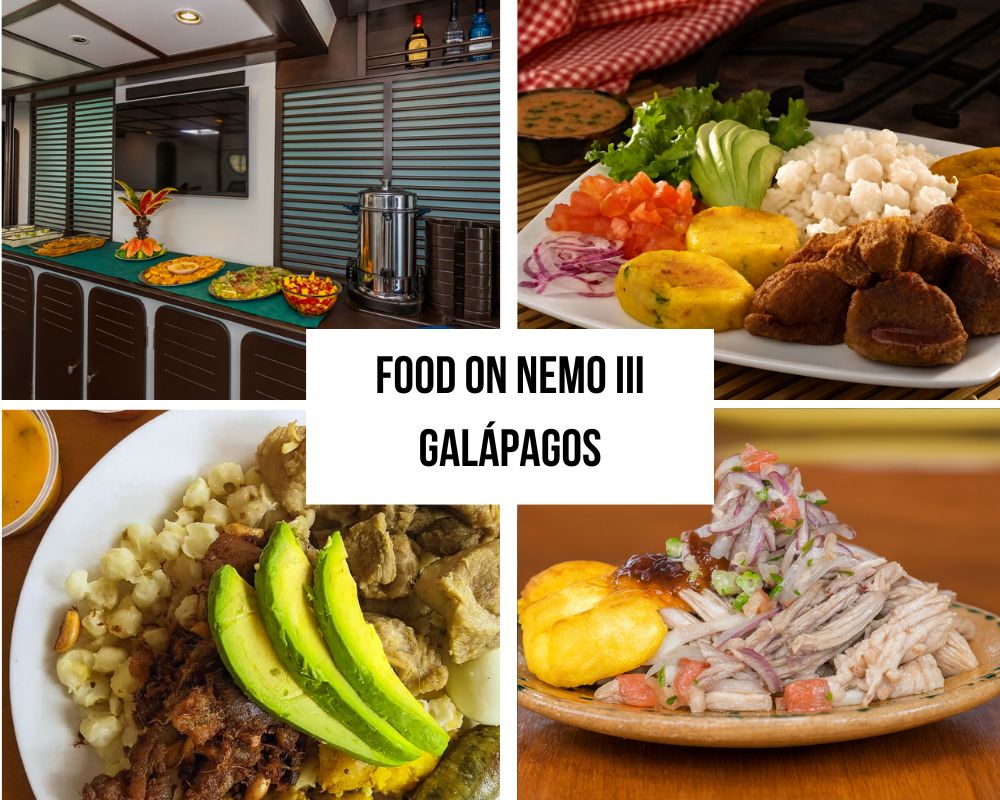
Three daily meals created from local recipes and fresh ingredients, plus snacks and juices throughout the day. Multiple traveler accounts describe the food as “outstanding,” “delicious,” “gourmet,” and consistently “way beyond expectations.” The cook is praised in traveler accounts across multiple years and platforms with specific appreciation for managing a high quality output from a small galley kitchen. Wetsuits, snorkel gear, and kayaks are included. Coffee, tea, and purified water are available throughout the cruise. Alcoholic drinks are purchased at the bar.
The phrase “way beyond my expectations” appears in multiple independent Nemo III food reviews across different booking platforms. That recurrence suggests the kitchen is operating at a level that surprises travelers with prior small-yacht cruise experience, who typically expect adequate rather than impressive. Galapatours specifically notes that “the food on our Galapagos Cruises is among the very best you will find in South America,” with chefs described as internationally trained with prior experience in top Ecuadorian and international hotels and restaurants. For an 8-day cruise at First Class Type of Galapagos Cruises pricing, that caliber of kitchen investment is a genuine differentiator.
The snacks and juices between meals appear in every positive traveler account as a specific point of praise. After a 90-minute morning snorkel followed by a panga return and a rinse, fresh juice waiting on deck is a functional comfort that cost the operator little and reads loudly in satisfaction. The Nemo III’s pattern of providing juices and snacks at every excursion return rather than restricting them to meal service reflects the same attentiveness that runs through the rest of the crew’s behavior.
Kayak advance reservations are specifically recommended by Happy Gringo Travel, suggesting demand for the kayaks can exceed supply on full departures. Reserve kayak use at time of booking rather than on arrival to ensure availability throughout the cruise.
The Nemo III’s kitchen quality is one of those things that’s hard to verify from the outside before booking, but our team has collected feedback from travelers across multiple years and can give you an honest picture of what to expect relative to other boats at this price point. Send us a message here and we’ll give you a straight comparison.
How Does the Nemo III Compare to Other First Class Catamarans?
The Nemo III sits in a unique position across this review series as the only First Class vessel with genuine sailing capability and a 40-year family operation behind it. Against newer purpose-built catamarans like the Reina Silvia Voyager it offers more authentic sailing character, Daphne Major access, and a wider range of itinerary lengths, but without private balconies or the 2020 build year modernity. Against the Anahi and Archipel vessels it offers stronger northern itinerary access and the sailing experience, but the Anahi’s suite cabins and the Archipel I‘s five kayaks give those boats specific advantages in different categories. The Nemo III leads the fleet on operator longevity, sailing authenticity, and the breadth of its short-trip program (4 and 5-day options in both northern and southern versions).
| Factor | Nemo III | Reina Silvia Voyager | Anahi | Archipel I |
|---|---|---|---|---|
| Sailing capability | Yes (genuine motor sail; deploys sails when conditions allow) | No (motor catamaran) | No (motor catamaran) | No (motor catamaran) |
| Operator founding year | 1985 (Latintour; 40 years) | N/A (G Adventures) | 30+ years | Oniric Safari Cruises |
| Daphne Major access | Yes (northern 8-day itinerary) | No | No | No |
| Min. passenger age | 3 years (FIT); all ages (charter) | 12 years | 6 years | Not specified |
| Private balconies | No | 8 of 9 cabins | No | No |
| Cabin finish | Natural wood (described as luxury beyond class) | Modern contemporary | Wood floors, modern | Standard contemporary |
| Jacuzzi | Yes (sundeck, bow position) | Yes (sundeck) | Yes (6-person) | No |
| Free wetsuits | Yes | Yes | No (hire only) | No (hire only) |
| 4-day and 5-day options | Yes (both northern and southern) | No | Yes (4-day) | Yes (4-5 days) |
| Charter available | Yes (full vessel, all ages) | Yes | Yes | No |
| Contact for current pricing |
The minimum age of 3 years for regular (FIT) departures is the most distinctive family-accessibility figure in this review series. The Reina Silvia Voyager requires age 12. The Anahi requires age 6. The Calipso prohibits children on dive weeks. The Nemo III accepts children from age 3 on regular departures and all ages on charters, which makes it the most genuinely family-inclusive First Class vessel reviewed. For parents with toddlers or young children who want to introduce them to the Galapagos without waiting until they’re old enough for the standard fleet minimum, the Nemo III is the practical choice.
What Nemo III Travelers Actually Tell Us: Feedback from Our Traveler Community
Based on traveler feedback gathered through mytrip2ecuador.com and our YouTube audience, alongside direct accounts from Galapagos cruise travelers interviewed by Oleg across three personal trips to the islands, here is how Nemo III passengers rate their experience:
| Cabin Quality (natural wood finish) | 93% | “Completely different from what we expected; genuinely luxurious feel” |
| Sailing Experience (when conditions allow) | 95% | “When the sails went up it was a completely different atmosphere” |
| Food Quality | 94% | “Way beyond expectations; outstanding across all 8 days” |
| Crew Warmth and Spontaneous Gestures | 96% | “Towel animals, juice on return from excursions, genuine care throughout” |
| Northern Itinerary (Daphne Major + western islands) | 97% | “Daphne Major was unlike anything else we saw all week” |
| Family Friendliness (min. age 3) | 92% | “Best family option we found; crew were attentive to our young child” |
| Overall Value for Money | 96% | “40 years of Galapagos experience shows in every aspect of the operation” |
The Honest Fail Points: What to Know Before You Book the Nemo III
The sails are conditional, not guaranteed. The Nemo III deploys them when wind and ocean current conditions allow, which in the Galapagos is less often than travelers who book a “sailing catamaran” might expect. National Park itinerary schedules require vessels to reach specific sites within defined time windows, and motor power is more reliable for meeting those windows. Travelers who book specifically for the sailing experience should understand that most transits will be under engine and treat sail deployment as a bonus rather than a baseline expectation.
Cabin size is compact. ThinkGalapagos describes the cabins as “relatively compact, however well designed and comfortable.” Travelers coming from larger First Class vessels or land hotels will notice the footprint. The natural wood finish and good storage design minimize the claustrophobic effect that smaller cabins on poorly designed vessels create, but the square footage is what it is. You spend very little time in the cabin on a Galapagos cruise by design, but if spatial comfort in the sleeping area matters to you, the Nemo III’s cabins are smaller than the Anahi’s suite level or the Cachalote Explorer‘s upper deck configurations.
The 9-knot motor speed is slower than the Beluga (12 knots), the Reina Silvia Voyager (13 knots), and the Monserrat (11 knots). On overnight crossings between distant islands, slower speed means longer passages and potentially later arrivals at morning sites. The Nemo III’s itinerary design accounts for this, but travelers comparing it to faster vessels should note the transit time difference on longer crossings.
The kayak advance reservation recommendation is specific and operational. If the vessel is at full capacity, demand for kayaks can exceed the available units. Reserve at time of booking rather than on arrival if kayaking is a priority for your trip.
The 10% child discount is the lowest in this review series. Most First Class vessels reviewed offer 15 to 20% discounts for children under 12. The Nemo III’s 10% reflects a different pricing philosophy, though the minimum age of 3 years (significantly lower than any other vessel reviewed) compensates in accessibility terms for families with young children who couldn’t sail most other boats regardless of discount percentage.
Frequently Asked Questions
Will the Nemo III actually sail during my cruise?
Possibly, and it’s worth being honest about the likelihood. The Galapagos National Park requires vessels to adhere to strict itinerary schedules, meaning they must arrive at specific sites within defined time windows. Wind and current conditions in the archipelago are inconsistent across seasons. The Nemo III’s captain deploys the sails whenever conditions allow, and experienced travelers describe it as “really a sailing experience” despite frequent motor use. But most transits run under engine to maintain schedule reliability. Book for the overall experience, treat sail deployment as a genuine bonus, and you’ll be in the right frame of mind for what the Nemo III actually delivers.
What is Daphne Major and why is access so restricted?
Daphne Major is a volcanic tuff cone between Santa Cruz and Baltra famous for its role in the Charles Darwin Foundation’s long-term finch evolution studies. The Galapagos National Park strictly limits daily visitor numbers because the island’s steep terrain and dense nesting populations require careful management to prevent ecological disturbance. Blue-footed boobies, Nazca boobies, red-billed tropicbirds, short-eared owls, frigatebirds, and Galapagos martins all nest on its slopes. Only specific permitted vessels include Daphne Major on their itineraries, and the Nemo III’s northern program is one of them. The access is genuinely unusual at First Class pricing.
What is the minimum age for the Nemo III and why does it differ from other boats?
The minimum age for regular (FIT) departures is 3 years, the lowest of any vessel in this review series. Most First Class boats set minimums between 6 and 12 years. Latintour’s family-business culture and 40 years of Galapagos cruising experience means they’ve developed the operational framework to manage young children safely on board. Full charters accept children of all ages. For parents with toddlers or young children who want a Galapagos cruise, the Nemo III is the practical choice when other vessels in this tier simply won’t accept the booking.
Are wetsuits and kayaks included on the Nemo III?
Yes, both are included in the cruise price. Wetsuits are provided for snorkeling, which is particularly important on western island itineraries where Humboldt current water temperatures make them necessary rather than optional. Kayaks are included but Happy Gringo specifically recommends reserving kayak use at time of booking rather than on arrival, as demand on full departures can exceed the available units.
What is included in the Nemo III cruise price?
Accommodation, all meals (3 daily plus snacks), juices, coffee, tea, and purified water, all shore excursions, the bilingual naturalist guide, wetsuits, snorkel gear, kayaks, and Galapagos airport transfers when they coincide with the operating schedule. Passengers who fly on different dates from the cruise operating days should confirm transfer arrangements and costs independently. Not included: Galapagos National Park entrance fee (USD $200 per adult, $100 per child, cash on arrival, verified May 23, 2025), INGALA transit card (USD $20 per person at mainland airport), alcoholic drinks, tips, and personal expenses. Christmas and New Year departures carry a 10% surcharge.
The Nemo III is the recommendation we reach for when someone tells us they want authentic sailing character in the Galapagos, access to Daphne Major, a family-inclusive vessel with a 3-year minimum age, and the confidence that comes from 40 years of the same family running the same operation in the same waters. No other boat in this review series combines those four qualities. If you want to understand which itinerary fits your travel window, whether the northern or southern route is the stronger call for your interests, and what the all-in cost looks like for your group, our team is here to help. Cruises To Galapagos Islands holds a 4.9-star rating on Google and TripAdvisor. Get in touch here for a free, no-commitment consultation.
Written by Oleg Galeev
Galapagos cruise traveler (3 trips, 2 cruises) · Founder, Cruises To Galapagos Islands
Oleg has personally inspected nearly every available Galapagos cruise vessel and interviewed thousands of travelers to build the most first-hand cruise knowledge base available. He also runs the Ecuador travel blog mytrip2ecuador.com and the YouTube channel My Trip to Somewhere.
Cruises To Galapagos Islands is rated 4.9 stars on Google and TripAdvisor.
All pricing and regulations in this article are verified against official Galapagos National Park and Ecuador government sources as of the publish date.