Galaxy Galapagos Cruise Review
Quick Summary
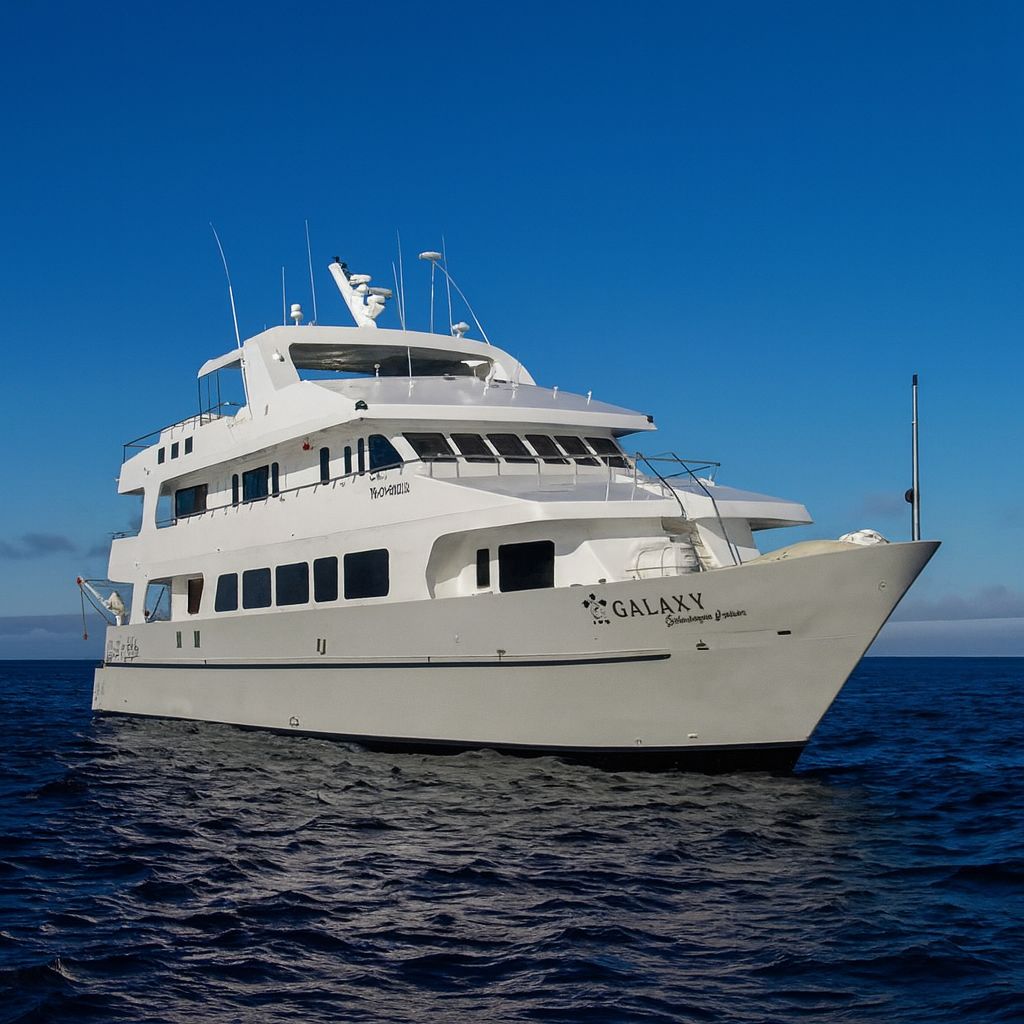
The Galaxy is a 114-foot First Class motor yacht operated by Galaxy Expeditions, a multi-vessel fleet operator with over 15 years in the Galapagos. Designed for up to 19 passengers, it runs at 16 for extra space throughout. Smart Voyager certified. Twelve knots cruising speed. Nine cabins across three decks including an 18 m² upper-deck triple-capable family cabin with a sofa bed, making it one of the better family configurations in the First Class monohull tier. Wetsuits, SUP paddleboards, kayaks, and snorkel gear are all included. An electric towel dryer in every cabin is a practical feature found on very few Galapagos vessels. Guide Sebastian is named across multiple 2024 and 2025 independent reviews with consistent five-star praise. Itineraries run 4, 5, 6, and 8 days in eastern, western, and combined formats, with extensions to 15 days. A Level III certified naturalist guide is standard.
The Galaxy is one of 28 First Class ships we review. See all first class Galapagos cruises, or use our finder to see Galapagos cruises side by side. It sails for Galaxy Expeditions: see all Galaxy Expeditions ships in the Galapagos.
Galaxy Galapagos Cruise: Quick Facts
| Detail | Info |
|---|---|
| Vessel Type | Motor Yacht (single hull, traditional design) |
| Class | First Class |
| Length | ~114 ft / 34.7 m |
| Speed | 12 knots |
| Passenger Capacity | 16 guests (vessel designed for 18-19; runs at 16 for extra space) |
| Crew | 9-10 crew + 1 certified Level III bilingual naturalist guide |
| Guide certification | Level III (highest Galapagos National Park naturalist certification) |
| Operator | Galaxy Expeditions (multi-vessel fleet: Galaxy, EcoGalaxy, Galaxy Orion, Galaxy Sirius, Alya, Bonita; 15+ years in Galapagos) |
| Conservation certification | Smart Voyager certified |
| Cabins | 9 total: 2 lower deck (13 m², twin); 3 main deck (13-14 m², twin or convertible matrimonial); 4 upper deck (15-18 m², matrimonial or twin; 1 upper deck cabin 18 m² with sofa bed, triple-capable) |
| Triple family cabin | 1 upper-deck cabin: 18 m², double bed + sofa bed (triple-capable) |
| All lower beds? | Yes (no bunk beds) |
| Electric towel dryer | Yes (every cabin; shared with EcoGalaxy; rare in fleet) |
| Eco-friendly toiletries | Yes (shampoo, conditioner, soap) |
| Internal telephone | Yes (every cabin) |
| Wetsuits | Included (complimentary) |
| SUP paddleboards | Included |
| Kayaks | Included (advance reservation recommended) |
| Snorkel gear | Included |
| Beach towels | Included |
| Itinerary options | 4-day, 5-day, 6-day, 8-day (eastern, western, combined); extensions to 15 days |
| Isabela departure fee | USD $15 per person on western itinerary B |
| 5-day price pp (2025) | From ~USD $3,200 – Prices verified May 23, 2026 |
| Park Entrance Fee | USD $200 per person (cash, paid on arrival) – Prices verified May 23, 2026 |
| INGALA Transit Card | USD $20 per person (paid at mainland airport) |
What Is the Galaxy Galapagos Cruise and Who Is It For?
The Galaxy is a 114-foot First Class motor yacht operated by Galaxy Expeditions, a fleet operator running six vessels in the Galapagos with over 15 years in the islands. It carries 16 passengers in a vessel designed for 18 to 19, creating extra space throughout the social areas and decks. Smart Voyager certified, 12-knot speed, Level III naturalist guides, and a full inclusion package covering wetsuits, SUP paddleboards, kayaks, and snorkel gear make it one of the most comprehensively equipped First Class monohulls in this review series. The 18 m² triple-capable upper-deck family cabin and the electric towel dryer in every cabin are specific practical features that set it apart from most comparable vessels.
The Galaxy Expeditions fleet context matters for understanding what you’re booking. Galaxy Expeditions operates six vessels: the Galaxy (flagship), EcoGalaxy (eco-catamaran), Galaxy Orion (expedition yacht), Galaxy Sirius (boutique luxury), Alya (catamaran), and Bonita (family-oriented). That fleet scale means the operator has deep institutional knowledge of Galapagos cruise logistics, established relationships with the park authority, and a back-office support infrastructure that smaller single-vessel operators can’t match. When a flight delay threatens your connection, when a sea condition requires an itinerary adjustment, when a dietary restriction needs managing across a full week, the operational depth behind the Galaxy makes those situations smoother than they would be on a vessel run by a two or three-person booking team.
The “designed for 19, runs at 16” operational decision is the same philosophy seen in the Calipso earlier in this series. The effect is concrete: the salon lounge doesn’t feel crowded during evening briefings. The sundeck has room for all 16 passengers to spread out simultaneously. The dining room doesn’t require staggered sittings. When a vessel has three more people’s worth of space distributed across every communal area, you feel it throughout the day even if you can’t point to a specific measurement that explains it.
A solo traveler review published by YourTimeToFly in November 2025 describes the Galaxy specifically as accessible for solo travelers: “the small size also means that you will have ample opportunity to get to know your fellow passengers,” and describes the experience as “comfortable but not overly fancy, offering a great value for the price point.” That framing, from a solo traveler who researched the vessel independently, captures the Galaxy’s positioning well. It delivers genuine First Class quality without the premium pricing ceiling of the suite-level vessels reviewed earlier in this series.
Galaxy Expeditions runs promotions across their fleet, including occasional group discounts of up to 30% on selected departures. If you want to know what’s currently available for the Galaxy’s departure calendar and whether any promotions apply to your travel window, fill out this short form and we’ll check current availability and pricing.
What Are the Cabins and Onboard Experience Like?
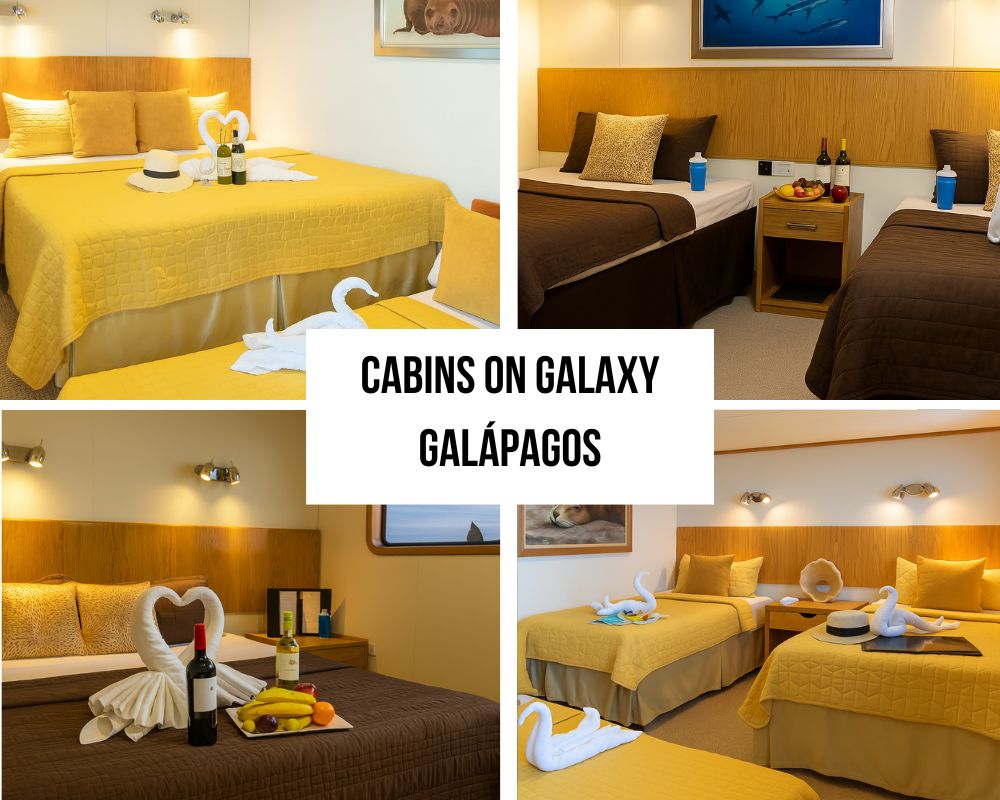
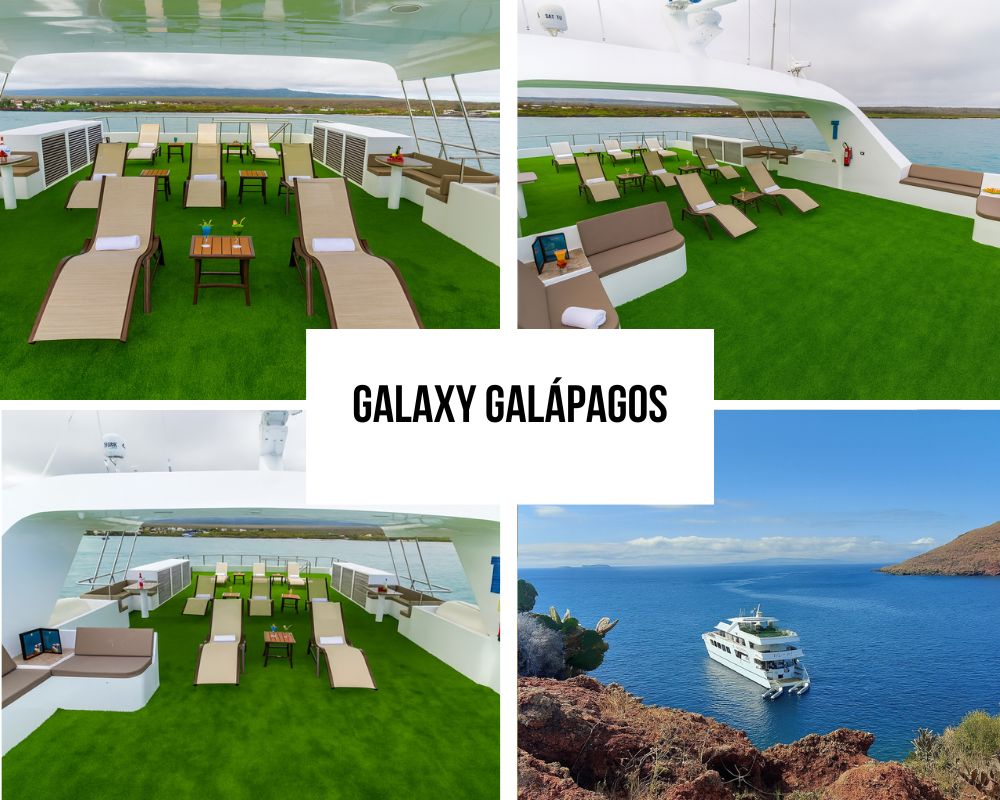
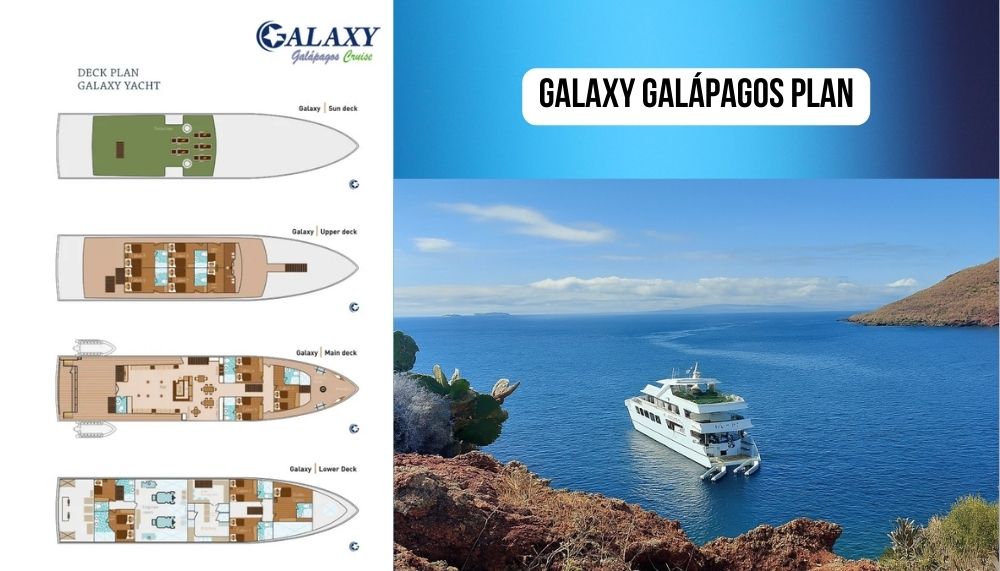
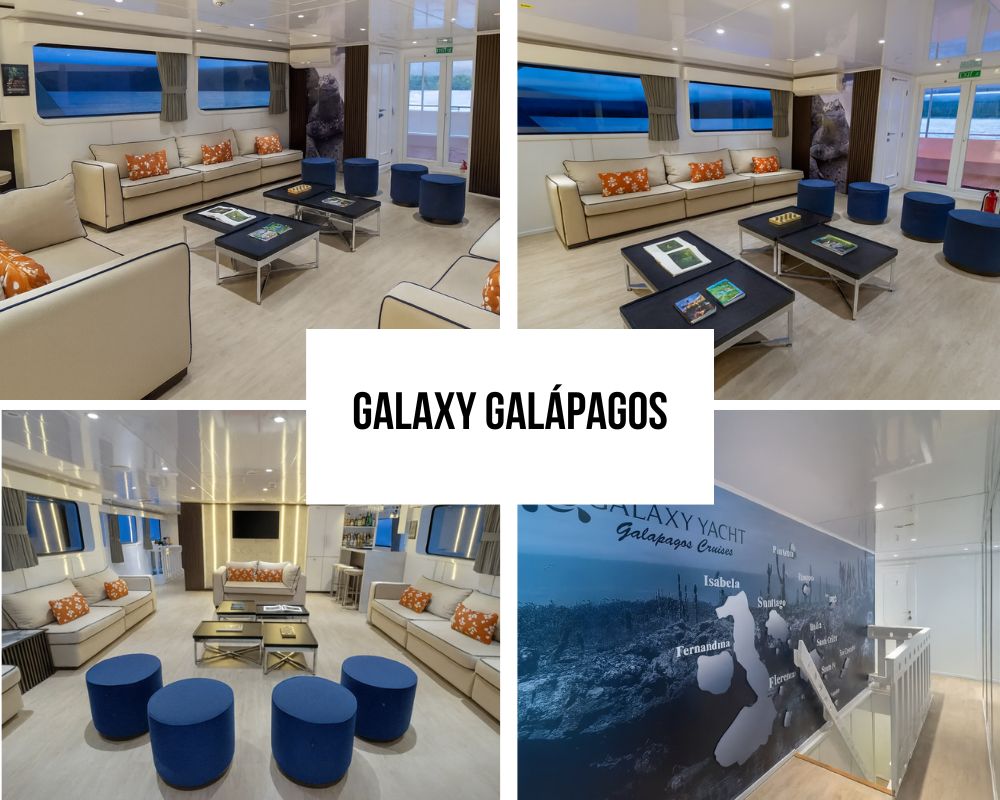
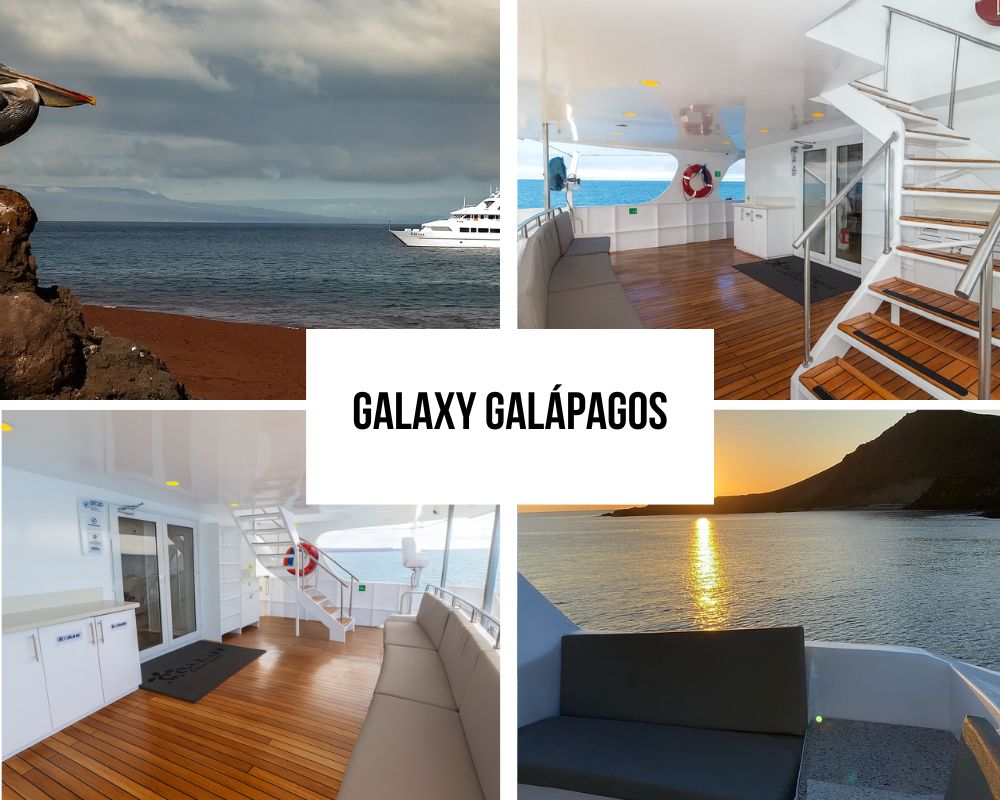
Nine cabins across three decks for 16 passengers. Lower deck: 2 twin cabins at 13 m² with exterior views. Main deck: 3 cabins at 13-14 m² (1 convertible matrimonial/twin, 2 twin) with panoramic windows. Upper deck: 4 cabins at 15-18 m² (3 convertible matrimonial/twin with panoramic views, 1 at 18 m² with double bed plus sofa bed for triple occupancy). Every cabin has a private bathroom with eco-friendly toiletries, hair dryer, electric towel dryer, internal telephone, safe deposit box, air conditioning, and hot/cold water. The social areas include a dining room with panoramic windows, bar and lounge with sumptuous sofas, coffee station, library with TV and DVD, and a large sundeck.
The electric towel dryer is listed in Galaxy Expeditions’ own 2025 rates document as exclusive to the Galaxy and EcoGalaxy within their fleet, and appears as a specific feature in Happy Gringo’s review. On a vessel where you’re snorkeling twice a day in Galapagos water, having a warm dry towel waiting when you return from the next excursion is the kind of comfort that hotels at four times the price provide as standard. On a 16-passenger First Class Galapagos yacht, it’s unusual enough that Happy Gringo highlights it specifically. The practical benefit accumulates across a week of two-activity days.
The 18 m² triple cabin on the upper deck deserves specific attention for families. With a double bed plus a sofa bed, it accommodates two adults and a child or third adult in a single room with upper-deck panoramic windows. The cabin size at 18 m² is larger than the Anahi’s standard main deck cabins (14 m²) and comparable to the lower end of the Anahi’s suite range. For a First Class monohull at Galaxy pricing, this is among the better family cabin configurations in the fleet. The Vaya Adventures listing specifically notes this cabin as “suitable for close friends or family members,” confirming the triple-occupancy design intent.
A LiveAboard reviewer from October 2025 describes their cabin as “far more spacious than expected,” which is the Galaxy’s consistent over-delivery pattern. The vessel runs three fewer passengers than its design capacity, and the effect on cabin perception is that the hallway traffic is lighter, the social areas feel roomier, and the service attention is distributed across fewer people than the vessel was built to accommodate.
The internal telephone in each cabin appears as a standard feature and reflects a service culture where the crew can reach passengers directly with excursion timing updates rather than relying on a public address system or physical knocking. On an early-morning departure day when 16 people need to be ready at different times for different landing groups, that communication infrastructure reduces friction.
Which Itineraries Does the Galaxy Cover?
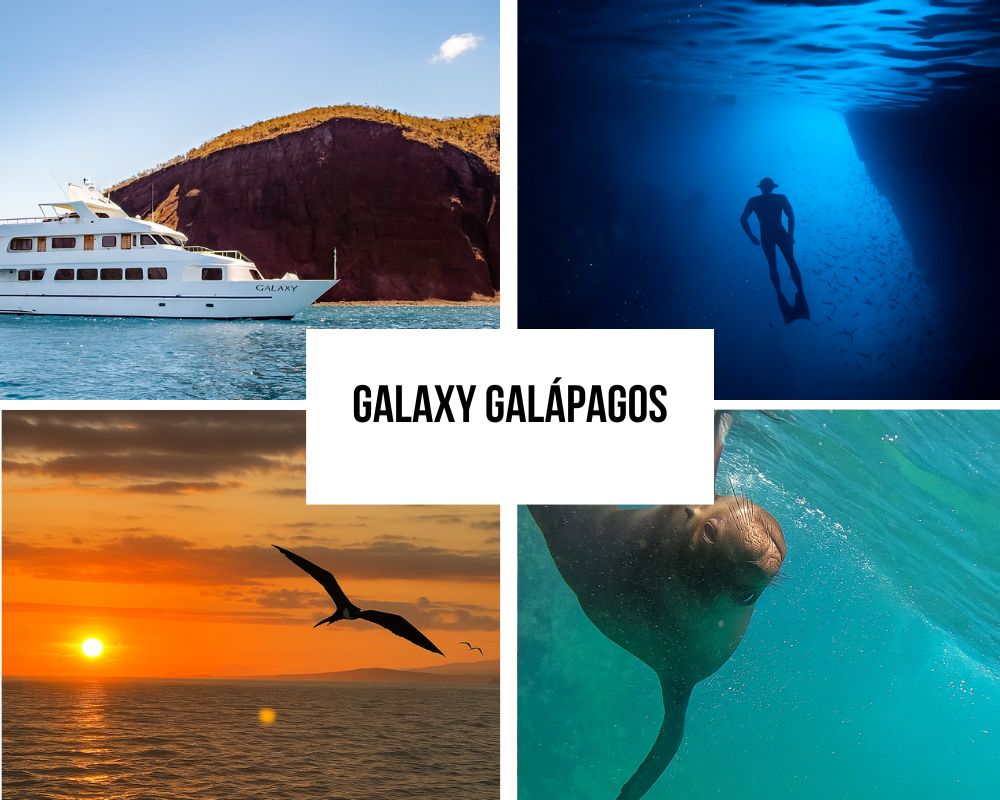
The Galaxy runs four distinct itinerary programs in 4-day, 5-day, 6-day, and 8-day formats: Itinerary A covers southeastern islands (San Cristobal, Española, Floreana, Santa Cruz), Itinerary B covers western islands (Isabela including Fernandina, Santiago), Itinerary C covers the northeast (Santiago, Genovesa), and extended 8-day and 15-day combinations link multiple routes. The 12-knot cruising speed enables more island coverage per day than slower vessels, making the Galaxy’s itinerary programming more ambitious than vessels doing the same routes at 9 knots.
The eastern 5-day Itinerary A is the Galaxy’s highest-volume booking. It departs from San Cristobal rather than Baltra, which builds in the Kicker Rock experience on the first full day and reaches Española’s Punta Suarez and Gardner Bay on day two. That opening sequence, dramatic hammerhead snorkeling at Kicker Rock followed by waved albatross on Española, is one of the strongest two-day itinerary openings in the fleet. The Floreana coverage on day three (Post Office Bay, Cormorant Point, Champion Islet) adds the southern island’s historical dimension and best snorkeling site before heading back through Santa Cruz for the Charles Darwin Research Station.
The western Itinerary B includes Fernandina at Punta Espinoza and multiple Isabela sites, with a $15 Isabela departure fee per person applying at the end of this route. The fee is small but worth knowing before arriving with only the park entrance fee and INGALA card in cash. Confirm at booking and bring the extra cash accordingly.
Itinerary C’s focus on Santiago and Genovesa is one of the more distinct programs in the fleet at 6 days. Sullivan Bay’s lava formations on Santiago are among the most geologically dramatic sites in the islands, and Genovesa’s Darwin Bay combined with Prince Philip’s Steps delivers the seabird density that experienced Galapagos travelers specifically return for. Covering both in a single 6-day program without also trying to reach Española or the western islands gives each site more time than combined itineraries typically allow.
| Itinerary / Length | Region | Key Sites | Best For |
|---|---|---|---|
| A – 4 or 5 days (Southeast) | East + South + Central | San Cristobal (Kicker Rock), Española (Suarez, Gardner Bay), Floreana (Post Office Bay, Champion Islet), Santa Cruz highlands | Strongest 5-day first-timer eastern circuit |
| B – 5 or 6 days (Western) | West + Central | Isabela (Tintoreras, Arnaldo Tupiza, Punta Moreno, Elizabeth Bay, Tagus Cove), Fernandina (Punta Espinoza), Santiago | Western wilderness, Fernandina access, return visitors |
| C – 6 days (Northeast) | North + Central | Santiago (Sullivan Bay, lava formations), Genovesa (Darwin Bay, Prince Philip’s Steps), North Seymour, Bartolome | Seabirds, volcanic geology, depth over breadth |
| Extended (8-15 days) | Multi-region | Combinations of A+B, A+C, or A+B+C without repeated sites | Maximum coverage, dedicated enthusiasts |
The 15-day extended program covering all three base itineraries without site repetition is bookable through Galaxy Expeditions directly. For travelers with the time and desire for comprehensive Galapagos coverage at First Class pricing and 12-knot efficiency, the Galaxy’s 15-day program is a strong option. The fleet infrastructure behind the vessel gives the 15-day logistics more operational reliability than a single-vessel operator running the same length would provide.
The eastern versus western route decision on the Galaxy depends heavily on whether you’ve visited the Galapagos before. Itinerary A is the right starting point for first-timers. Itinerary B is where return visitors typically go. Reach out here and we’ll give you a specific route recommendation for your travel window and wildlife priorities.
What Do the Guides and Crew Bring to the Experience?
One Level III certified bilingual naturalist guide per departure, supported by a 9 to 10-person crew including a skilled bartender. Level III is the highest naturalist certification available from the Galapagos National Park Authority, requiring a university degree plus additional field certification. Guide Sebastian appears by name across multiple 2024 and 2025 independent reviews with consistent five-star praise, described as having “contagious enthusiasm” and making the trip “memorable.” Multiple LiveAboard accounts from 2024 and 2025 specifically call out the guide as exceptional. A crew member named Raul appears in a 2025 review performing towel animal arrangements, reflecting the same attention to cabin presentation detail seen in the Nemo III review.
The Level III guide certification is a specific qualification marker that most First Class vessels list without explaining its significance. The Galapagos National Park Authority issues naturalist certifications at three levels. Level I and II require progressively more ecological training and field experience. Level III requires a university degree in a natural sciences field plus additional certified training in Galapagos ecology, marine biology, and geology. A Level III guide is not simply a knowledgeable person who likes wildlife: they are formally qualified at the highest standard the park authority sets. Ensuring your vessel carries Level III certified guides is one of the clearest quality signals available when comparing First Class options, and the Galaxy specifies it as standard.
Sebastian’s guide quality pattern across accounts reads like guide Omar on the Reina Silvia Voyager: consistent enough to be structural rather than exceptional. A traveler from the August 2025 LiveAboard review describes a “naturalist Sebastian whose enthusiasm was contagious” and who they “looked forward to” hearing from daily at briefings. The October 2025 LiveAboard review praises “perfect organization of the days” and “interesting and varied activities.” These phrases reflect systematic guide performance rather than a single outstanding departure.
The bartender praise in traveler accounts is consistent with other well-reviewed vessels in this series where the barman role is specifically staffed rather than assigned as a secondary duty. On the Galaxy, the “skilled bartender creating exceptional cocktails” language in operator descriptions tracks with the evening social hour quality that travelers describe in their accounts. It reflects a fleet operator that thinks about the evening experience as a product component rather than a service default.
How Good Is the Food and What Is Included?
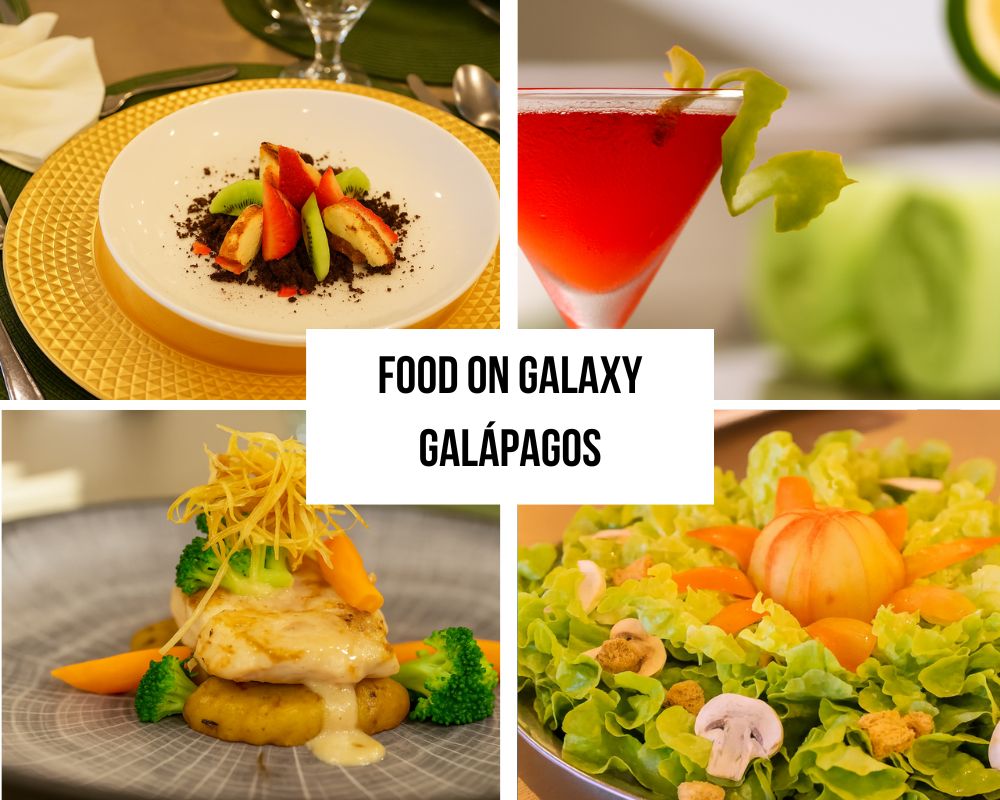
Three daily meals described across multiple 2024 and 2025 independent reviews as “five stars at every meal,” “excellent food,” “delicious and very fresh.” The Dealsgalapagos description references a Level III certified naturalist guide leading “comprehensive environmental education” alongside meals, indicating the food and guide experiences are integrated rather than separate. All meals, snacks after each activity, a welcome cocktail, unlimited water, coffee, and tea are included. Wetsuits, SUP paddleboards, kayaks, snorkel gear, and beach towels are all included. Soft drinks and alcoholic beverages are purchased separately at the bar.
The snack after every activity is a detail that LiveAboard reviewers specifically mention. One October 2025 account says “food and snacks were great!!” as a separate callout from the general meal quality. On a schedule where you’re running two activities per day with excursion durations of 90 to 120 minutes each, having something waiting on return, juice, fresh fruit, something prepared by the kitchen, is the difference between arriving back at the vessel hungry and depleted versus arriving restored and ready for the briefing. The Galaxy’s kitchen manages this consistently enough that it appears in independent accounts unprompted.
The welcome cocktail on arrival is the same touch seen on the Cachalote Explorer and Beluga, and reflects the same psychological insight: the boarding moment sets the emotional tone for the whole week. Having a drink ready before the cabin key is a hospitality decision that costs the operator relatively little and registers clearly in traveler accounts as an indicator of the service culture to come.
The eco-friendly toiletries (shampoo, conditioner, soap) are listed as inclusions in the Galaxy Expeditions rates document. In the context of a Smart Voyager certified vessel operating in a UNESCO World Heritage marine reserve, this isn’t a marketing detail: it’s a verified operational standard reflecting the operator’s commitment to the conservation standards their certification requires.
The Galaxy fleet offers group discounts and promotional fares on selected departures. If you’re traveling with a group or are flexible on dates, those promotions can represent significant savings. Send us a message here and we’ll check what’s currently running for your travel window.
How Does the Galaxy Compare to Other First Class Boats?
The Galaxy occupies a strong mid-range position within the First Class tier: Smart Voyager certified alongside the Beluga, 12-knot speed matching the Beluga and below only the Reina Silvia Voyager, Level III guide certification not universally required by competitors, and the most comprehensive activity inclusion package reviewed (wetsuits + SUP paddleboards + kayaks + snorkel gear all included). Against the Monserrat it lacks the dual guide 1:8 ratio; against the Anahi it lacks the 36-foot catamaran beam and suite cabins; against the Calipso it doesn’t dive. Within its specific offering, the Galaxy represents one of the best value propositions in the First Class monohull tier.
| Factor | Galaxy | Beluga | Monserrat | Calipso |
|---|---|---|---|---|
| Speed | 12 knots | 12 knots | 11 knots | Not specified |
| Smart Voyager cert. | Yes | Yes | No | No |
| Guide certification | Level III | Not specified | Not specified | Certified dive + naturalist |
| Guide ratio | 1:16 | 1:16 | 1:8 (2 guides) | 1:16 naturalist / 1:8 dive |
| Free wetsuits | Yes | No (hire) | Yes | Included in dive package |
| Free SUP paddleboards | Yes | No | Yes | No |
| Electric towel dryer | Yes (every cabin) | No | No | No |
| Triple family cabin | 1 (18 m², upper deck, sofa bed) | 1 (Cabin 1, triple-capable) | 2 lower deck triples | No |
| Fleet operator depth | Galaxy Expeditions (6 vessels, 15+ years) | Enchanted Expeditions (2 vessels) | Via Natura | Royal Galapagos |
| 5-day price pp (2025) | From ~$3,200 | ~$4,400 (6 days) | ~$3,885 (5 days) | Contact for pricing |
| Prices verified May 23, 2026 |
The 5-day price of $3,200 per person, confirmed by ThinkGalapagos for 2025, positions the Galaxy at the accessible end of First Class Type of Galapagos Cruises pricing while delivering Smart Voyager certification, Level III guides, 12-knot speed, and a full activity inclusion package. That combination at that price is difficult to match across the full fleet. The Monserrat’s $3,885 for 5 days includes dual guides, which is a genuine upgrade; the Beluga’s $4,400 for 6 days includes Smart Voyager and National Geographic recognition. But for a traveler who wants First Class quality, proven conservation credentials, and a comprehensive activity package at the most accessible First Class price in this review series, the Galaxy is the strongest case.
What Galaxy Travelers Actually Tell Us: Feedback from Our Traveler Community
Based on traveler feedback gathered through mytrip2ecuador.com and our YouTube audience, alongside direct accounts from Galapagos cruise travelers interviewed by Oleg across three personal trips to the islands, here is how Galaxy passengers rate their experience:
| Guide Quality (Sebastian / Level III) | 97% | “Sebastian’s enthusiasm was contagious; looked forward to every briefing” |
| Food Quality | 94% | “Five stars at every meal; snacks after excursions were a lovely touch” |
| Cabin Spaciousness | 95% | “Far more spacious than expected; electric towel dryer was a great surprise” |
| Activity Inclusion (wetsuits, SUP, kayaks) | 96% | “Everything included; no surprise add-on costs during the cruise” |
| Crew Service | 95% | “Crew took incredible care of us from dinners to getting on and off the boat” |
| Galaxy Expeditions Organization | 93% | “Communication was clear; fleet infrastructure made everything seamless” |
| Overall Value for Money | 97% | “Best First Class value at this price point; exceeded every expectation” |
The Honest Fail Points: What to Know Before You Book the Galaxy
The Galaxy is a monohull. Motion-sensitive travelers will experience overnight crossings differently than on the catamarans reviewed earlier in this series. Lower deck cabins reduce motion noticeably. Bring your own medication and book lower deck if this is a concern. The 12-knot speed shortens crossing durations, which helps, but it doesn’t eliminate the motion.
The Isabela departure fee of $15 per person applies specifically to western Itinerary B. It’s not included in the standard price and is payable at the Isabela dock. Bring the additional cash alongside the $200 park entrance fee and $20 INGALA card. Most travelers who discover it on arrival rather than in advance describe mild frustration at the surprise cost.
Kayak advance reservation is recommended. On full departures, kayak demand can exceed unit availability. The YourTimeToFly solo traveler review doesn’t specifically mention kayaking, but the advance reservation recommendation from Happy Gringo is consistent with similar notes on other vessels in this series. Reserve at booking rather than on arrival.
The Galaxy is not the right boat for travelers who specifically want catamaran stability, private balconies, or a diving liveaboard option. Those requirements point to the Reina Silvia Voyager, the Anahi, or the Calipso respectively. The Galaxy’s strengths are in its speed, conservation credentials, guide certification level, and inclusion package at an accessible First Class price. If those aren’t the factors driving your decision, other vessels may be a stronger fit.
The vessel runs at 16 of a design capacity of 18 to 19, which provides extra space but means the social dynamic runs with a relatively consistent 16-person group for the full week. For travelers who prefer fewer fellow passengers, vessels like the Samba (14 passengers) or the Nemo II (14 passengers) run smaller groups by design. The Galaxy’s 16-passenger count is the standard for its class, not a reduction from a larger design.
Frequently Asked Questions
What is a Level III naturalist guide and why does it matter?
Level III is the highest naturalist certification issued by the Galapagos National Park Authority. It requires a university degree in a natural sciences field plus advanced field certification specific to Galapagos ecology, marine biology, and geology. Level I and II certified guides are competent; Level III certified guides have the deepest formal qualification available in the islands. Ensuring your cruise specifies Level III guiding is one of the clearest quality benchmarks when comparing First Class vessels. The Galaxy provides Level III certified guides as standard, which is specified in their rates documentation rather than as a marketing claim.
What does Smart Voyager certification mean for the Galaxy?
Smart Voyager is a third-party conservation certification specific to Galapagos tourism operations, requiring annual audits covering waste management, invasive species prevention, fuel efficiency, crew environmental training, and support for local communities. The Galaxy holds this certification alongside the Beluga, making them the two monohulls in this review series with independently verified conservation compliance. For travelers who select operators based on ecological accountability, the Smart Voyager certificate is the most credible signal available in the Galapagos context.
Are stand-up paddleboards really included on the Galaxy?
Yes. The Galaxy’s rates document and multiple operator listings confirm that wetsuits, kayaks, stand-up paddleboards, snorkel gear, and beach towels are all included in the cruise price. The Galaxy and EcoGalaxy are among the few vessels in this review series that include SUP paddleboards as a standard activity option rather than requiring separate rental or simply not carrying them. Kayak use is recommended to be reserved in advance due to demand on full departures.
Is the Galaxy good for solo travelers?
Yes, based on consistent independent feedback. A November 2025 first-person review by a solo traveler on YourTimeToFly specifically describes the Galaxy as accessible and social for solo travelers: “the small size also means that you will have ample opportunity to get to know your fellow passengers. It made it much easier as a solo traveler to make connections.” The vessel’s design capacity allows for a single berth option for solo travelers without requiring the 70 to 80% supplements common on some First Class vessels. Confirm solo booking options with Galaxy Expeditions or your booking agent.
What is included in the Galaxy cruise price?
All meals (from lunch on day one to breakfast on the last day), snacks after every excursion, welcome cocktail, unlimited purified water, coffee, and tea, all shore excursions, Level III certified bilingual naturalist guide, snorkel gear, kayaks, stand-up paddleboards, wetsuits, beach towels, eco-friendly toiletries, and Galapagos airport transfers. Not included: Galapagos National Park entrance fee (USD $200 per adult, $100 per child under 12, cash on arrival, verified May 23, 2026), INGALA transit card (USD $20 per person at mainland airport), soft drinks and alcoholic beverages (bar service), tips, personal expenses, Galapagos airfare, and the Isabela departure fee (USD $15 per person on western Itinerary B).
The Galaxy is the recommendation we reach for when a traveler wants the most comprehensively equipped First Class monohull at an accessible price point: Smart Voyager certified, Level III guides, 12 knots, wetsuits and SUP paddleboards included, and a fleet operator with 15 years of institutional knowledge behind every departure. The combination of guide Sebastian’s consistent five-star reviews and the Galaxy Expeditions operational depth makes it one of the more reliable vessels in the fleet for delivering what the brochure promises. If you want to compare itinerary options, check current promotions, or understand how the Galaxy stacks up against other vessels we’ve reviewed for your specific travel window, our team is here. Cruises To Galapagos Islands holds a 4.9-star rating on Google and TripAdvisor. Get in touch here for a free, no-commitment consultation.
Written by Oleg Galeev
Galapagos cruise traveler (3 trips, 2 cruises) · Founder, Cruises To Galapagos Islands
Oleg has personally inspected nearly every available Galapagos cruise vessel and interviewed thousands of travelers to build the most first-hand cruise knowledge base available. He also runs the Ecuador travel blog mytrip2ecuador.com and the YouTube channel My Trip to Somewhere.
Cruises To Galapagos Islands is rated 4.9 stars on Google and TripAdvisor.
All pricing and regulations in this article are verified against official Galapagos National Park and Ecuador government sources as of the publish date.