The Beagle Galapagos Cruise Review
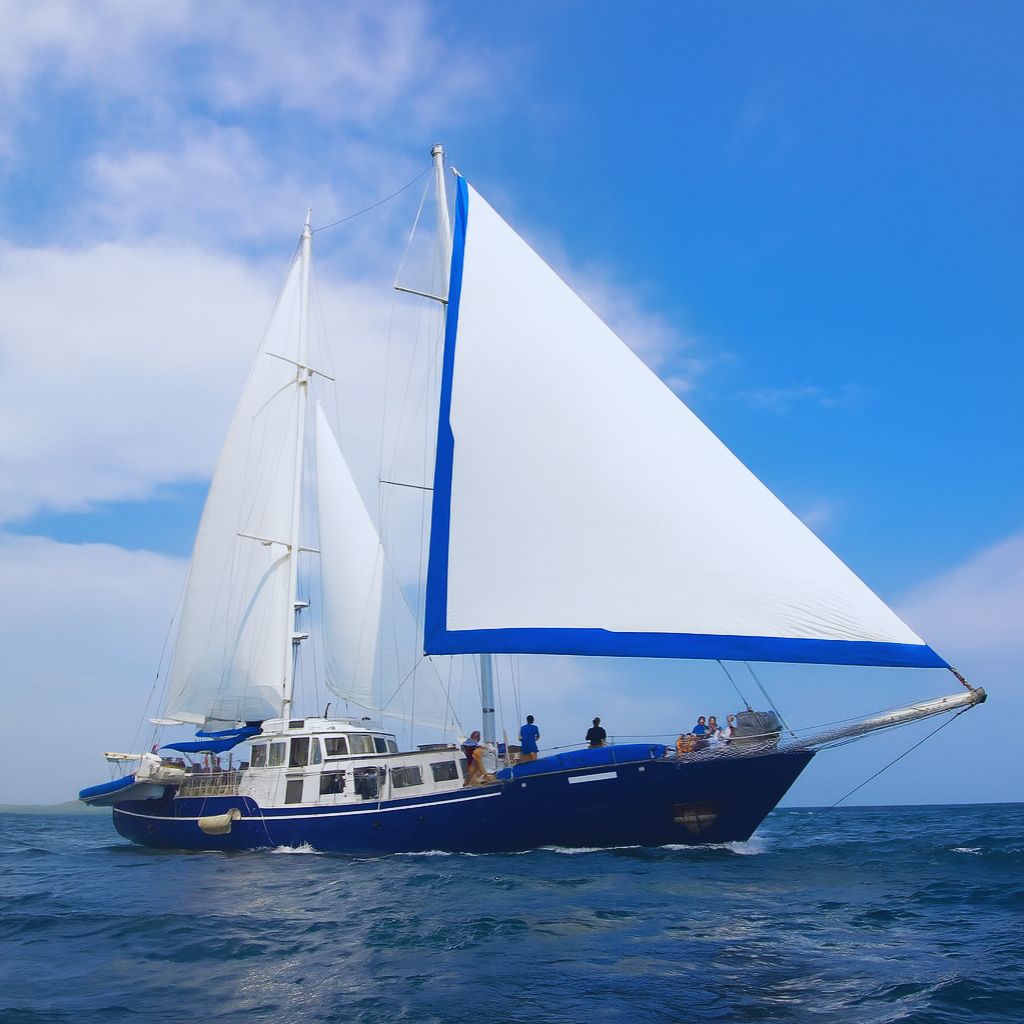
The The Beagle is one of 14 Tourist Superior ships we review. See all tourist superior Galapagos cruises, or use our finder to see the best Galapagos cruises side by side.
The Beagle: Quick Facts
| Detail | Info |
|---|---|
| Vessel type | Motor sailer brigantine (steel hull, teak decks) |
| Class | First class |
| Dimensions | 105 ft (32 m) length / 22 ft (6.7 m) beam |
| Capacity | 12-14 passengers |
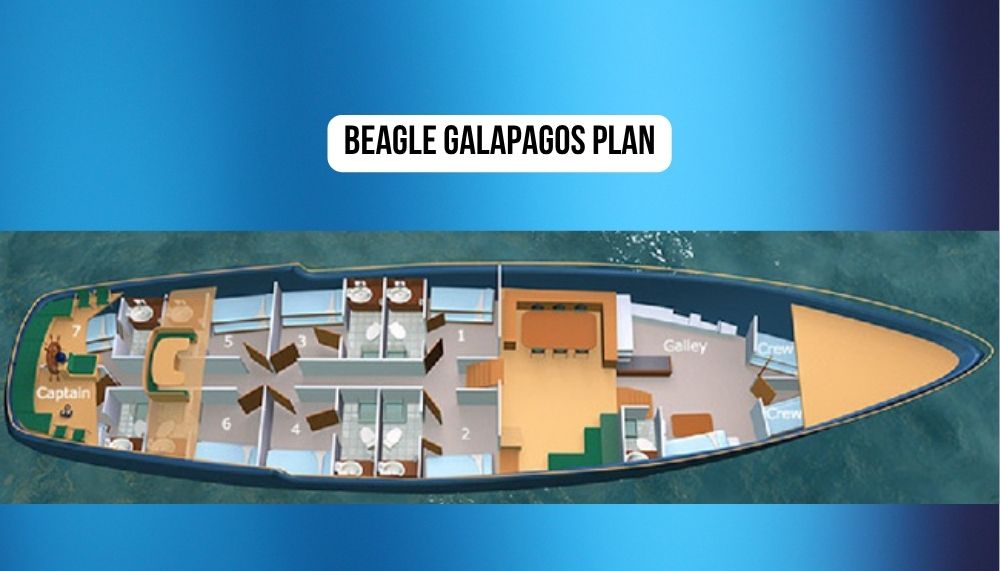
| Cabins | 6 double cabins (lower double bunk + upper single) + 1 smaller cabin (single bunks). All en-suite, A/C, hot shower, private bathroom. 110V cabin power; 220V (UK adapter) on bridge. |
| Built / operator | 1970s, Cubow Ltd., Woolwich, England / local Ecuadorian family (owner-operated) |
| Certification | Smart Voyager certified (environmental and sustainability standards) |
| Speed | 8-9 knots (Twin John Deere 235 HP engines, 2004) |
| Crew | 5-6 crew + 1 bilingual Level II or III naturalist guide |
| Itineraries | Two 8-day itineraries (Central/South and Northwest); combinable into 15-day full circuit |
| Special permit | Only vessel permitted to snorkel at Fernandina – Punta Espinoza |
| Price range (2026) | First-class range – contact for current per-departure rates (prices verified May 22, 2026) |
| Included | All meals, water, coffee, tea, welcome cocktails, snorkeling gear, kayaks, beach towels, land excursions, guide |
| Park fees (not included) | $200 USD adults / $100 USD under 12 + $20 USD TCT – verified May 22, 2026 |
What Is the Beagle and Who Is This Cruise Actually Built For?
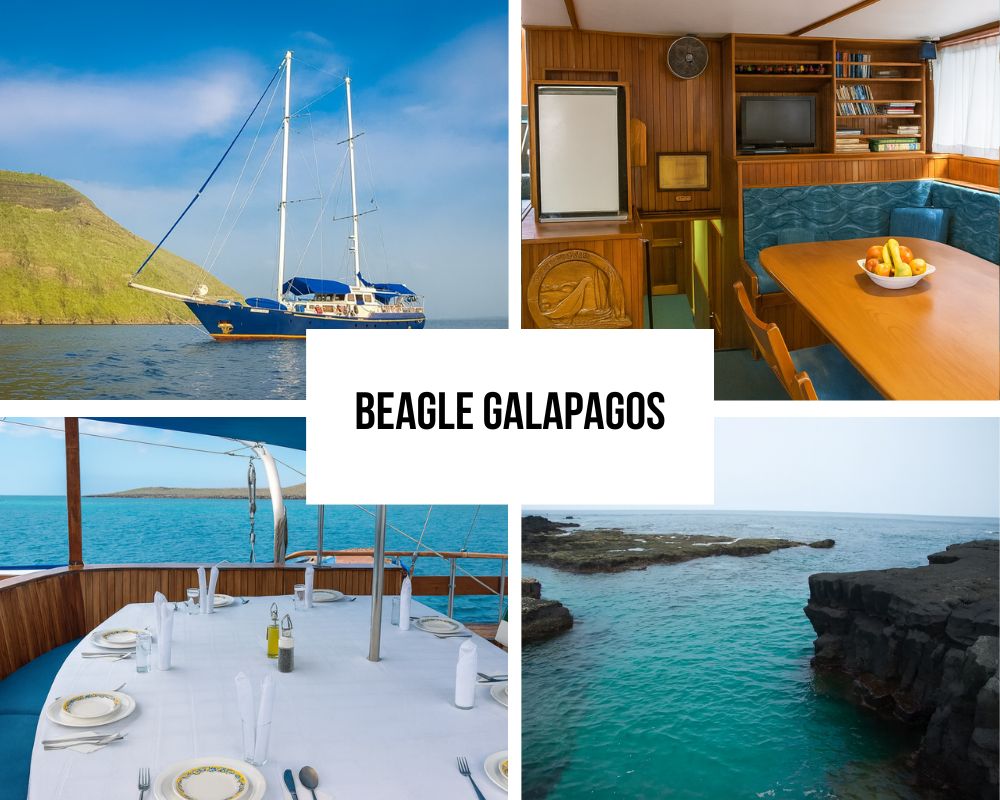
The Beagle is a 105-foot steel-hulled brigantine built in Woolwich, England, in the 1970s – a first-class naturalist cruise vessel named after the ship that carried Charles Darwin to the Galapagos in 1835. Family-owned by a local Ecuadorian family and Smart Voyager certified, it carries 12 to 14 passengers in 7 en-suite cabins and holds a distinction no other vessel in the fleet can claim: it is the only boat with a National Park permit to snorkel at Fernandina’s Punta Espinoza, one of the most wildlife-dense sites in the entire archipelago.
The name is not a marketing decision. It’s an intention. The Beagle was built and has been operated for decades with the specific goal of recreating the spirit of Darwin’s voyage – a small, intimate group of curious travelers exploring extraordinary islands with expert guidance, in a vessel that feels genuinely at home in the water rather than motoring through it on a schedule. That ambition is reflected in every operational detail: the Smart Voyager environmental certification, the earned special permits, the family-run culture, the guide quality.
The Beagle is the right boat for travelers who want a first-class experience with genuine character rather than a polished corporate product. The vessel is classic rather than modern. Its cabins have solid wood fixtures and an Edwardian atmosphere, not contemporary fittings. What it offers in exchange is an intimacy of scale, a family crew culture, and exclusive access to sites that no amount of money can buy on another vessel.
The Fernandina snorkeling permit alone is a meaningful differentiator. Punta Espinoza on Fernandina is home to one of the largest marine iguana colonies in the Galapagos, a flightless cormorant colony, Galapagos penguins, and sea lions. Getting into the water there – rather than observing from the shore – is an experience that exists only on the Beagle’s itinerary. That access is the product of a long-term relationship between the owners and the Galapagos National Park built on years of demonstrated environmental responsibility.
If you want to understand which itinerary gives you the Fernandina snorkeling access and whether the Beagle fits your travel dates, we’re happy to help. Fill out this short form for a free, no-pressure comparison.
What Are the Cabins and Onboard Accommodations Like on the Beagle?
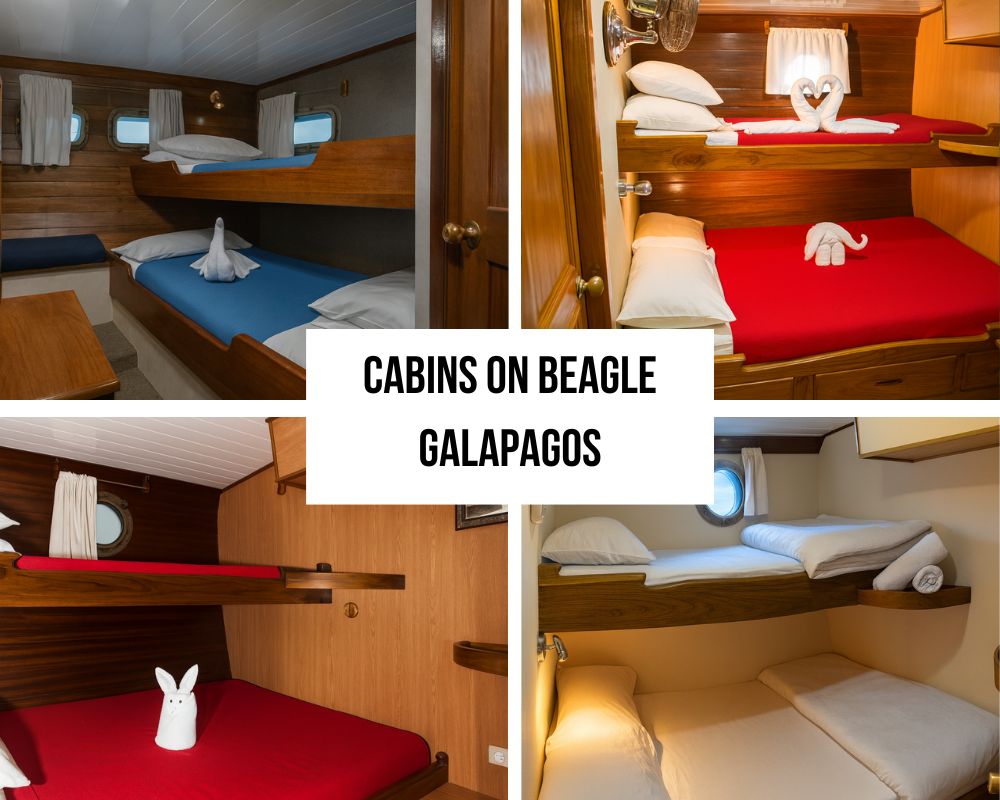
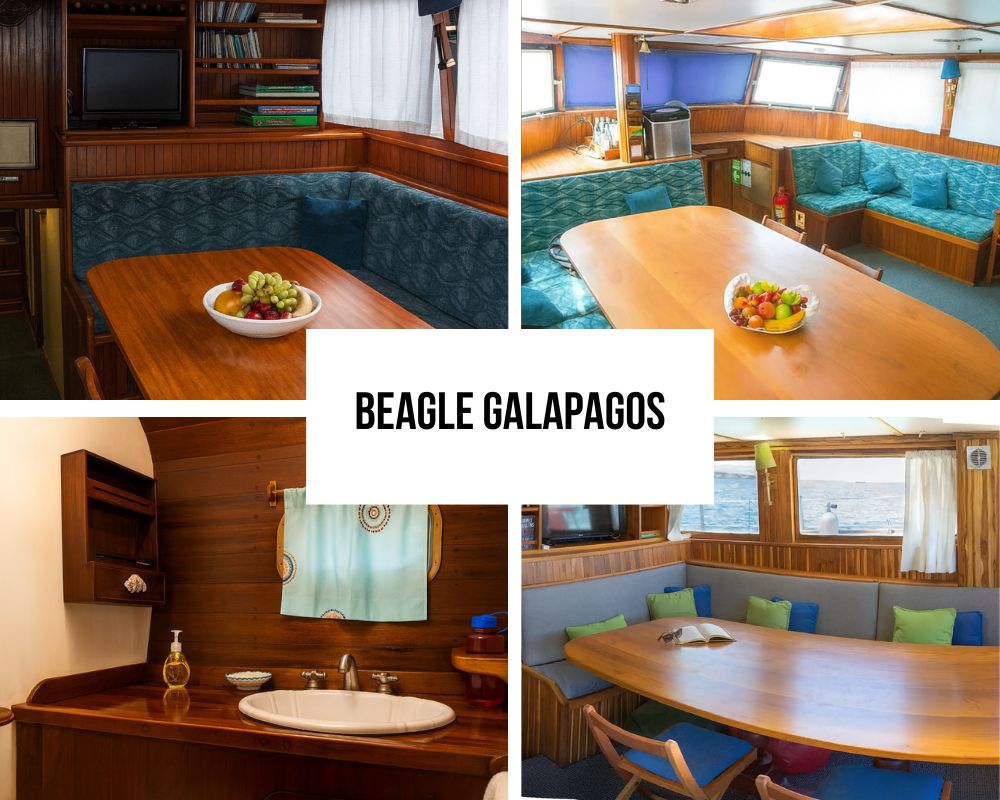
Six main double cabins below deck have a lower double bunk, a single upper bunk, a private en-suite bathroom with hot shower, and individual A/C. A smaller seventh cabin accommodates one or two passengers in single bunks with the same private facilities. All cabins have 110V power. The interiors use solid wood fixtures throughout and carry what several reviewers describe as an Edwardian or classic maritime atmosphere – not modern hotel minimalism, but crafted traditional design that suits the vessel’s character.
The cabins are comfortable for first class without being generous. The lower bunk is a full double – adequate for couples, and the upper single provides the third berth that makes some cabins suitable for solo travelers or small families. Private bathrooms with hot showers are standard. Individual A/C in every cabin is a meaningful baseline on an archipelago where equatorial heat and humidity are real variables.
What reviewers consistently describe about the Beagle’s interior is the character. One travel agent who personally cruised the vessel called it “clean, well maintained” with “comfortable berths” and immediately noted the warm, home-like atmosphere that the wooden interiors create. This isn’t a vessel that could be confused with a newer, more plastic-and-glass first-class catamaran. The Beagle has a specific aesthetic – maritime classic, and guests who respond to that description will find the cabins more satisfying than their square footage suggests.
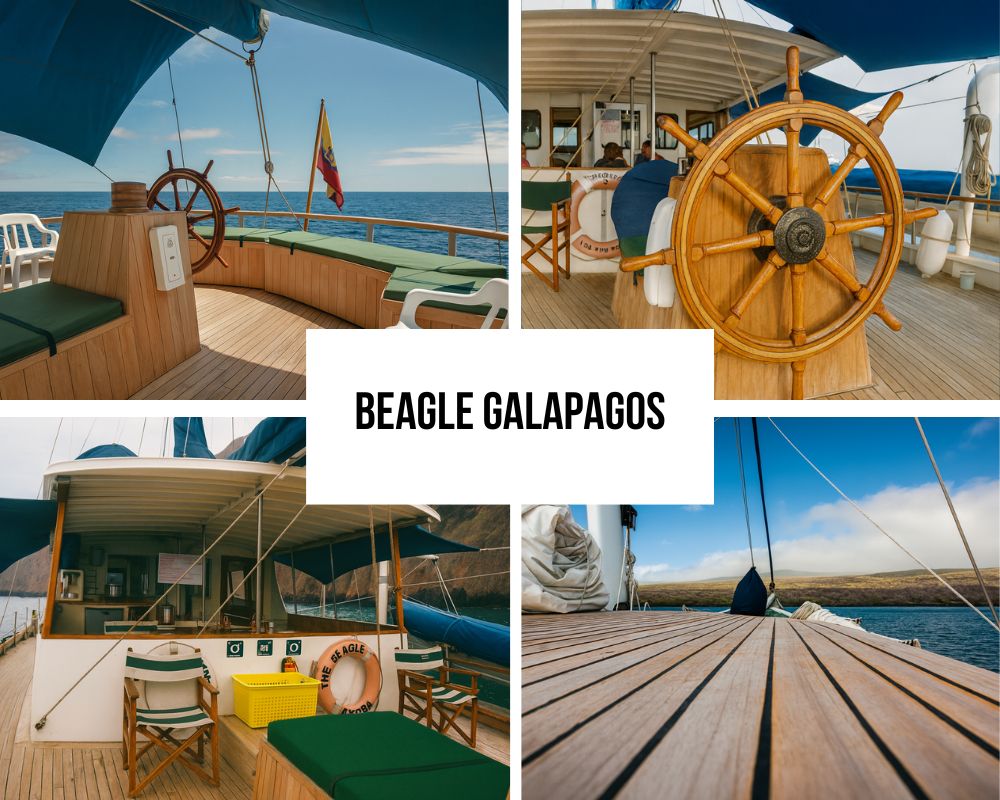
Social areas extend across wide teak decks, a fully stocked bar, a lounge with library and games, and both covered and open-air deck seating. The outdoor dining area is where most meals are served when weather allows, which in the Galapagos is most of the time. The observation deck provides a dedicated space for wildlife watching during transits. Two double kayaks are stored on deck and included in the price. Snorkeling gear is provided; wetsuits are available for rent at a small fee with the caveat that sizing runs standard medium through large – guests outside that range should bring their own.
Which Itineraries Does the Beagle Sail and What Islands Will You See?
The Beagle runs two alternating 8-day itineraries covering the central/south and northwest archipelago. The Central/South route hits North Seymour, South Plaza, Santa Fe, Española (Gardner Bay, Punta Suarez), Santa Cruz highlands, Floreana, and Bartolome. The Northwest route covers the western islands: Isabela (Urbina Bay, Tagus Cove, Punta Vicente Roca), Fernandina (Punta Espinoza – snorkel access), Genovesa (Darwin Bay, Prince Philip’s Steps), Santiago, and Bartolome. Both routes can be combined for a 15-day full circuit of almost the entire archipelago.
| Route | Key Islands and Sites | Wildlife Highlights | Special Access? |
|---|---|---|---|
| Central / South (8 days) | North Seymour, South Plaza, Santa Fe, Española (Gardner Bay, Suarez Point), Santa Cruz highlands, Floreana (Post Office Bay, Punta Cormorant), Bartolome | Waved albatross (seasonal), blue-footed boobies, sea lions, giant tortoises, flamingos, frigatebirds, Galapagos hawks | No |
| Northwest (8 days) | Isabela (Urbina Bay, Tagus Cove, Punta Vicente Roca), Fernandina: Punta Espinoza (snorkel), Genovesa (Darwin Bay, Prince Philip’s Steps), Santiago, Bartolome (Pinnacle Rock) | Marine iguanas underwater, penguins, flightless cormorants, red-footed boobies, mola mola, sea horses, sea turtles | Yes, Fernandina snorkel permit |
The Northwest itinerary is the Beagle’s signature offering and the one that travelers specifically come to this vessel for. The Fernandina snorkeling session at Punta Espinoza is the site of the largest marine iguana colony in the Galapagos and some of the most concentrated underwater wildlife anywhere in the archipelago. Getting into the water there – watching marine iguanas swimming beside you, penguins darting past, sea lions spiraling overhead – is precisely the kind of moment that cannot be replicated on any other vessel regardless of its class or price. The Beagle earned that permit through years of environmental stewardship, and it makes the Northwest route something genuinely different from anything else on the market.
Genovesa (Tower Island) on the same itinerary adds the dramatic cliff walk at Prince Philip’s Steps through nesting red-footed boobies – a site that most central-island itineraries don’t reach. Pairing Genovesa with Fernandina snorkeling access in the same 8 days is a wildlife range that justifies the first-class pricing on its own terms.
The 15-day combination covering both routes is available and gives the most comprehensive single-vessel Galapagos experience available at this class level. Very few boats offer this breadth. For travelers with the time and the budget, it is one of the strongest all-in Galapagos options anywhere in the fleet.
The Northwest itinerary with Fernandina snorkel access fills early on peak season departures. If you’re planning a trip in the next 6 to 12 months, it’s worth checking availability now. Reach out here for a free consultation and availability check.
How Is the Food, Crew, and Day-to-Day Experience on the Beagle?
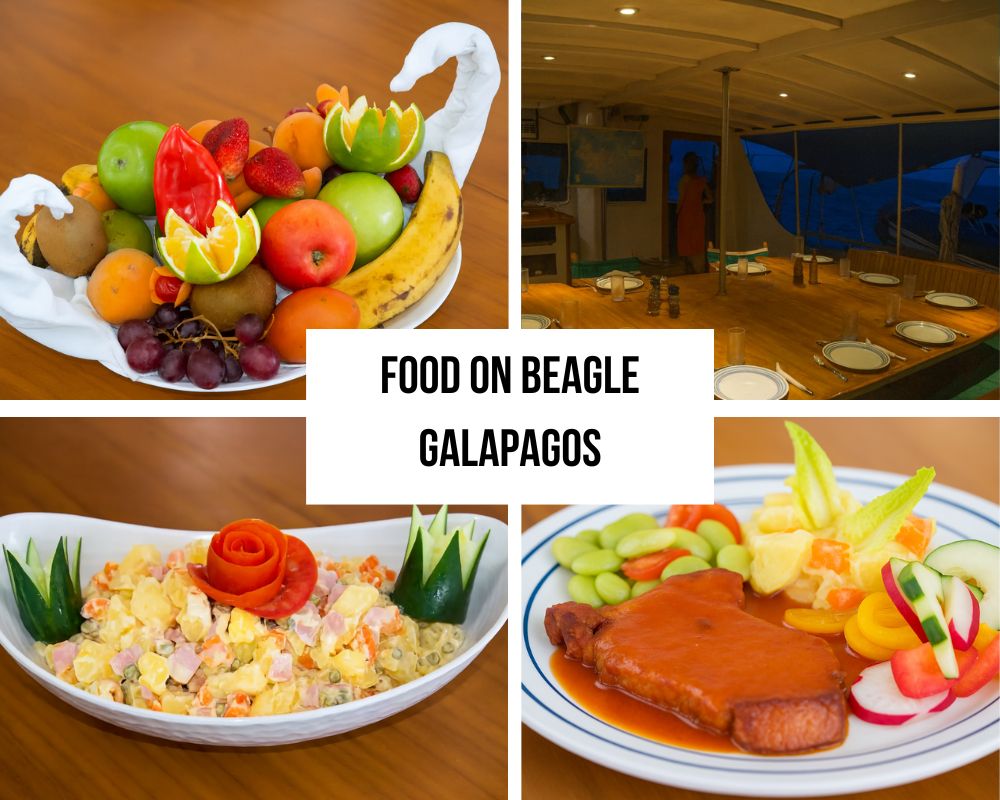
Food on the Beagle is consistently described as first-class – Ecuadorian and international cuisine, every meal and snack described in multiple independent reviews as a “masterpiece.” Meals are served al fresco on deck when conditions allow, which on the Galapagos is most days. The family-run crew of 5 to 6 for 12 to 14 passengers creates a service ratio that enables genuine personal attention. The overall atmosphere across reviews is warm, relaxed, and home-like rather than formal or corporate.
One TripAdvisor traveler who recommended the Beagle described every meal as a masterpiece, noted that the daily schedule ran incredibly smoothly, and specifically flagged the intimacy of 12 to 13 guests as adding enormously to the experience. Another described the guide as “top notch” and expressed that the food was first class with the cook doing everything possible to accommodate individual needs. A Think Galapagos review from 2026 described the stay as “outstanding” and the guide Xavier as able to “infect everyone with his enthusiasm and knowledge.” These aren’t isolated accounts – they reflect a consistent pattern across a small but uniformly positive review pool.
The family ownership is visible in specific ways that matter. The crew has been together for years. The captain and cook have deep personal investment in each departure’s quality. When one traveler described a logistical problem – a flight diversion that cost a day of the itinerary – the response from agent Jorge was described as professional and solution-oriented rather than dismissive. That kind of accountability reflects an operation where the people running it care about outcomes.
Alcohol is purchased separately at the bar rather than included. This is standard for the first-class tier on the Beagle – welcome cocktails are included, ongoing drinks are not. Budget for this on an 8-day trip and it’s not a surprise.
How Good Are the Naturalist Guides on the Beagle?
The Beagle’s guides are rated among the strongest of any vessel we cover in this review series. Guides named across independent reviews include Rissel Moretti Cruz (described as “phenomenal”), Xavier (described as outstanding and genuinely enthusiastic), and Fabian (described as “incredibly knowledgeable”). All hold Level II or III certification. The guide-to-guest ratio at 1:12 or 1:14 is favorable but not the tightest in the fleet – the Beagle’s smaller capacity and crew investment compensate for this in practice.
Rissel Moretti Cruz appearing by name in a detailed TripAdvisor recommendation from a traveler who gave a thoroughly researched account is meaningful. The reviewer specifically noted the guide’s knowledge, the special permits that enabled access to restricted sites, and the way the experience benefited from having access to places other boats don’t reach. That combination – expert guide plus unique access – is the Beagle’s core product at its best.
The Fernandina snorkel session specifically benefits from a knowledgeable guide. Understanding what you’re watching – why the marine iguanas swim, what the flightless cormorant’s evolutionary path tells you about island isolation, how the Galapagos penguin ended up this far from Antarctica – transforms the underwater experience from a remarkable visual encounter into something that changes how you think about evolution. The Beagle’s guide quality has historically been strong enough to deliver that transformation rather than simply pointing at wildlife and naming species.
What Do Real Travelers Say About the Beagle? (The Good and the Honest)
The Beagle generates a smaller independent review pool than higher-volume vessels like the Aida Maria or the Aqua, but what exists is consistently excellent across multiple years and platforms. There are no serious recurring complaints about the vessel, the food, or the crew. The one practical note that appears across independent accounts: generator noise on overnight passages, manageable with earplugs. The boat’s age and classic styling are occasionally noted by travelers comparing it to newer vessels, but universally framed as a feature rather than a limitation.
The “ship is not new but the service is exceptional” formulation appears in multiple reviews in slightly different words. This is not a criticism of the vessel, it’s an accurate description of the trade-off the Beagle offers. You are not boarding a modern catamaran with contemporary finishes. You are boarding a 50-year-old English brigantine with teak decks and wooden interior trim that has been lovingly maintained and refined across decades of Galapagos operation. The travelers who respond to that description come home saying things like “I felt like home” and “I can’t imagine a better experience.”
The generator noise is the single most consistent practical note across accounts. Multiple reviewers specifically recommend bringing earplugs for overnight passages. The Beagle, like every motor-sail vessel in this size range, runs a generator continuously during transits. This is not unique to the Beagle but it is worth preparing for. Earplugs are the solution. Several reviewers mention buying earplugs specifically for this trip and sleeping well as a result.
The review pool being smaller than for some vessels in this series actually reflects the Beagle’s market position rather than its quality. It runs 12 to 14 passengers per departure at first-class pricing, which means fewer total travelers and fewer total reviews than a higher-volume budget vessel. The consistent quality of what reviews exist is, if anything, more meaningful for being concentrated.
The Beagle’s departures – particularly the Northwest route – book early. We can check current availability for your target dates and hold a cabin while you decide. Send us a quick message and we’ll get back to you quickly.
How Does the Beagle Compare to Similar Vessels in Its Class?
In the first-class tier, the Beagle is the only vessel with the Fernandina snorkel permit. That is not a differentiator that can be matched by a newer boat with better finishes or a more polished service program. It is a once-earned privilege based on the operator’s track record with the National Park. Against first-class motor yachts and catamarans in a similar price bracket, the Beagle offers a classical sailing character and exclusive site access in exchange for a vessel that is older and smaller than some competitors.
| Vessel | Type | Capacity | Fernandina Snorkel? | Notable Edge |
|---|---|---|---|---|
| The Beagle | Brigantine motor sailer | 12-14 | Yes, only vessel | Unique Fernandina access, Smart Voyager certified, classic maritime character, family-owned |
| Nemo II | Catamaran | 14 | No | A/C, catamaran stability, strong fleet reputation, sailing experience |
| Nemo III | Catamaran | 16 | No | Larger, A/C, highest-capacity Nemo fleet vessel |
| Aggressor III | Motor yacht | 16 | No | Diving focus, hot tub, complimentary alcohol, 30-yr track record |
The Beagle versus Nemo II comparison is the most practically useful for travelers deciding between first-class naturalist options. The Nemo II offers catamaran stability, A/C, and a fleet with a significantly larger modern review base. The Beagle offers the Fernandina snorkeling permit, a smaller group size, a classical sailing aesthetic, and a family operation with deep Galapagos roots. For travelers who specifically want the northwest islands experience and the unique water access at Fernandina, the Beagle is not comparable – it’s in a class of its own for that specific itinerary. For travelers who haven’t made that itinerary a priority and want the reassurance of a more extensively documented modern vessel, the Nemo II is the right call.
Is the Beagle Worth Booking? Our Honest Verdict
Yes, without reservation – particularly for the Northwest itinerary. The combination of first-class guide quality, family crew culture, Smart Voyager environmental certification, and exclusive National Park access to Fernandina’s snorkeling site makes the Beagle genuinely irreplaceable for a specific type of Galapagos experience. The vessel is old and classic rather than new and modern. Earplugs are not optional for light sleepers on overnight passages. These are real trade-offs that you should know going in. Neither of them changes the fundamental quality of what the Beagle delivers once the anchor is up.
The travelers who come home most satisfied from the Beagle knew they were boarding a classic brigantine rather than a modern catamaran. They came for the character, the intimacy, the guide quality, and the access. They got all of it. The travelers who mention the vessel’s age as a note almost always frame it as “not new, but service exceptional” – a trade-off they’d make again.
One specific thing worth saying directly: the Fernandina snorkeling permit is a finite and fragile thing. It exists because the owners earned it through decades of responsible operation. If you want that access, this is the only vessel that offers it. No amount of money changes this for any other operator. The Beagle has something the rest of the fleet cannot buy.
What Travelers Actually Report: Cohort Feedback from Beagle Guests
Based on feedback gathered through mytrip2ecuador.com, our YouTube audience, and traveler conversations. The Beagle’s smaller capacity means a smaller feedback pool than high-volume budget vessels – patterns below reflect consistent themes across available accounts.
| Guide quality | 93% | 5% | 2% | Among the highest guide ratings of any vessel in our series; Rissel, Xavier, Fabian named repeatedly |
| Food quality | 91% | 7% | 2% | Consistently described as first-class; outdoor deck dining praised for atmosphere and quality |
| Cabin comfort | 79% | 17% | 4% | Classic interiors praised for character; mixed accounts reflect age vs. expectation gap; generator noise is the main note |
| Unique site access | 98% | 2% | 0% | Fernandina snorkeling described universally as the trip highlight; no comparable experience on any other vessel |
| Crew warmth | 92% | 6% | 2% | Family operation consistently described as home-like and genuinely warm; small group amplifies crew attention |
| Value for money | 86% | 11% | 3% | High among travelers who prioritized unique access and guide quality; lower among those focused on cabin modernity |
What Catches People Off Guard on the Beagle
Generator noise on overnight passages. This is the one consistent practical note across independent reviews. Earplugs are specifically recommended by multiple travelers who have been on the boat. Buy good foam earplugs before you leave home, pack them in your carry-on so they’re accessible on the first overnight, and you’ll sleep fine. Skip them and you may not.
The vessel is classic, not modern. The Beagle was built in the 1970s and its interior reflects a classic maritime aesthetic rather than contemporary first-class fittings. Travelers who expect the polished feel of a newer catamaran will notice the difference. Travelers who specifically value teak decks, wooden trim, and the atmosphere of a real sailing ship won’t see this as a limitation.
Wetsuit sizing runs standard medium through large. For guests outside this range – very small or very large – bringing your own wetsuit is recommended. The snorkeling sessions on the Northwest itinerary are the core experience, and a properly fitting wetsuit matters for comfort in Galapagos water temperatures.
The TCT must be purchased online before departure. As of May 29, 2025, the $20 USD Transit Control Card must be completed through the official digital platform before flying to the islands. Complete this before leaving for Quito or Guayaquil.
Frequently Asked Questions
Is the Beagle really the only vessel allowed to snorkel at Fernandina?
Yes. The Beagle holds a special National Park permit to snorkel at Punta Espinoza on Fernandina Island – a site that all other vessels can only visit for land observation. This permit was earned through the operator’s long track record of environmental responsibility and is not available to other vessels. It is the most significant site-access differentiator in the Galapagos fleet.
Is the Beagle a real sailing vessel?
It is a motor sailer brigantine – meaning it has full sail rigging and is capable of sailing under wind power, but uses twin engines as its primary propulsion system for reliability and schedule adherence. When conditions permit, the sails may be deployed. The sailing aesthetic and character are genuine; the primary movement between islands is motor-assisted.
What is the Smart Voyager certification on the Beagle?
Smart Voyager is an Ecuador-based certification program specifically designed for Galapagos tourism operations, evaluating environmental management, waste handling, fuel efficiency, crew training, and conservation practices. It is issued by the Rainforest Alliance and is one of the most respected sustainability credentials available in the archipelago. The Beagle is one of a small number of Galapagos vessels that holds this certification.
Can I do both itineraries back to back?
Yes. The Central/South and Northwest routes can be combined into a 15-day full circuit covering almost the entire archipelago. This is available on a single departure sequence and represents one of the most comprehensive single-vessel Galapagos experiences available at first-class pricing. Confirm availability and pricing when booking.
What mandatory fees are not included in the Beagle price?
The Galapagos National Park entrance fee ($200 USD adults, $100 USD children under 12), Transit Control Card ($20 USD per person), alcoholic beverages beyond the welcome cocktail, wetsuit rental, and gratuities are all separate. The TCT must be purchased online before departure as of May 29, 2025.
Ready to Sail the Beagle?
The Northwest itinerary with Fernandina snorkel access is the most uniquely compelling 8-day Galapagos itinerary available at first-class pricing. Departures fill well in advance for peak season. We can check availability, confirm which guide is assigned to your target dates, and hold a cabin while you decide – at no extra cost and no booking pressure.
Cruises To Galapagos Islands holds a 4.9-star rating on both Google and TripAdvisor.
Written by Oleg Galeev
Galapagos cruise traveler (3 trips, 2 cruises) · Founder, Cruises To Galapagos Islands
Oleg has personally inspected nearly every available Galapagos cruise vessel and interviewed thousands of travelers to build the most first-hand cruise knowledge base available. He also runs the Ecuador travel blog mytrip2ecuador.com and the YouTube channel My Trip to Somewhere.
Cruises To Galapagos Islands is rated 4.9 stars on Google and TripAdvisor.
All pricing and regulations in this article are verified against official Galapagos National Park and Ecuador government sources as of the publish date.