
Quick Summary
The Mary Anne is the only 3-masted barquentine operating regular cruises in the Galapagos and the only vessel in the archipelago capable of navigating by wind power alone. Launched 1997, 216 feet, steel hull, built for 24 passengers but operated at 16. Eight no-supplement single cabins make it the best solo traveler value in this review series. Under full sail with engines off, dolphins and whales approach the vessel in ways no motor boat can produce. Onboard activities found on no other vessel reviewed: sailing lessons, nautical knot contests, star navigation, and cooking classes. Steel hull and deep draft give it one of the best stability profiles in the fleet. All 12 cabins sit below the main deck, minimizing motion for passengers prone to seasickness. Wetsuits are available for hire. Two 8-day itineraries depart Saturdays: Eastern (Española, Genovesa, Bartolome) and Western (Fernandina, Isabela, Floreana). Operated by Andando Tours, pioneers of Galapagos cruising with over 30 years of experience.
Mary Anne Galapagos Cruise: Quick Facts
| Detail | Info |
|---|---|
| Vessel Type | 3-Masted Barquentine Sailing Ship (only one of its kind in the Galapagos) |
| Class | First Class |
| Launched / Renovated | 1997 / 2014 refit |
| Operator | Andando Tours Cia. Ltda. (30+ years in Galapagos cruise industry) |
| Length | 216 ft / 65 m |
| Hull | Steel (one of the most stable vessels in the islands) |
| Sail area | 1,000 m² canvas; navigates under wind power alone |
| Speed | 8 knots (under sail); auxiliary engine available |
| Passenger Capacity | 16 guests maximum (designed for 24; operated at 16 for extra space) |
| Crew | 9: Captain, First Mate, engineers, 2 sailors, chef, chef’s assistant, steward, bilingual naturalist guide |
| Crew-to-guest ratio | ~1:1.8 (one of the best in the First Class fleet) |
| Cabins | 12 total, all below main deck (best motion management); 2 double cabins (lower berths only); 10 standard cabins (double lower berth + single upper berth, usable as double or single) |
| No-supplement single cabins | 8 cabins available at no single supplement (most in this review series) |
| Cabin features | Private bathroom, hot water, air conditioning, closet, safe, portholes |
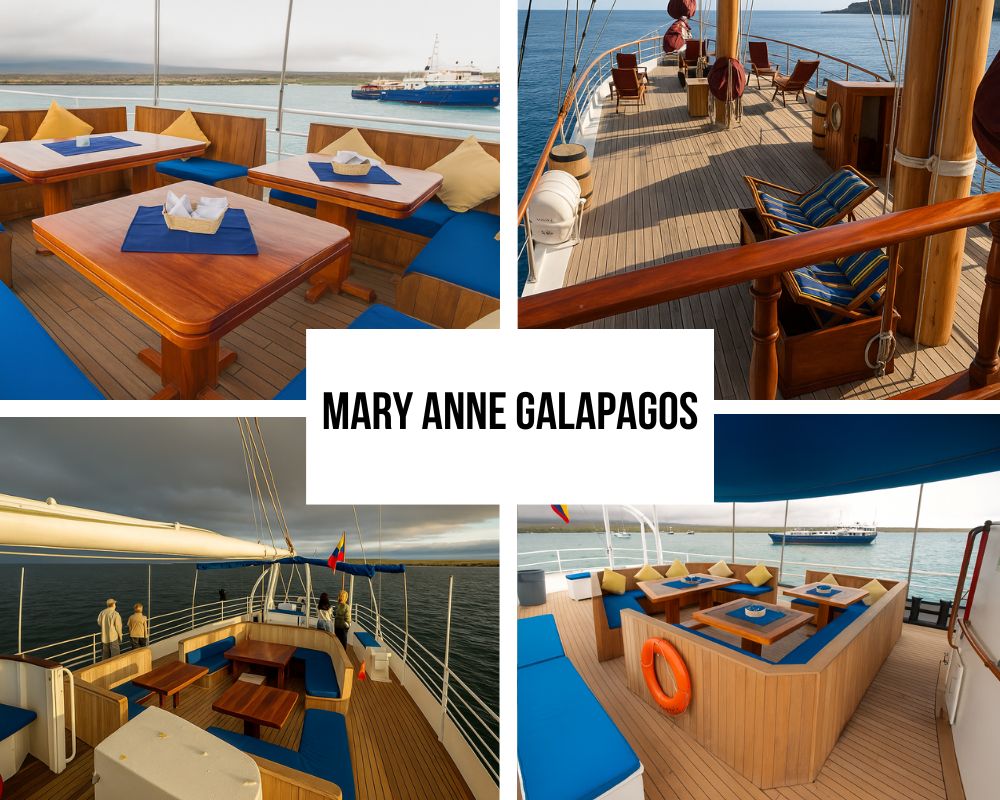
| Social areas | Wood-paneled lounge with bar, library (Galapagos books + games), dining room, al fresco dining, sundeck with open-air seating, bridge (open to guests) |
| Unique onboard activities | Sailing lessons; sail hoisting with crew; nautical knot contests; star navigation; cooking classes (not found on any other reviewed vessel) |
| Wildlife under sail | Dolphins and whales approach engine-silent vessel; cannot be replicated on motor vessels |
| Snorkel gear | Included (mask, snorkel, fins) |
| Wetsuits | Available for hire (shorty wetsuits) |
| Kayaks | Included |
| Departure schedule | Every Saturday, 8-day programs only |
| Itineraries | Eastern (Española, Genovesa, Bartolome, Santa Cruz, Santa Fe, South Plaza) and Western (Fernandina, Isabela, Floreana, Santiago, Santa Cruz); 15-day full circuit combining both |
| Single supplement | None (8 designated no-supplement single cabins) |
| Peak season surcharge | 10% (Christmas Dec 16 to Jan 3) |
| Park Entrance Fee | USD $200 per adult, $100 per child under 12 (cash, on arrival) – Prices verified May 23, 2026 |
| INGALA Transit Card | USD $20 per person (mainland airport) |
What Is the Mary Anne and Who Is It For?
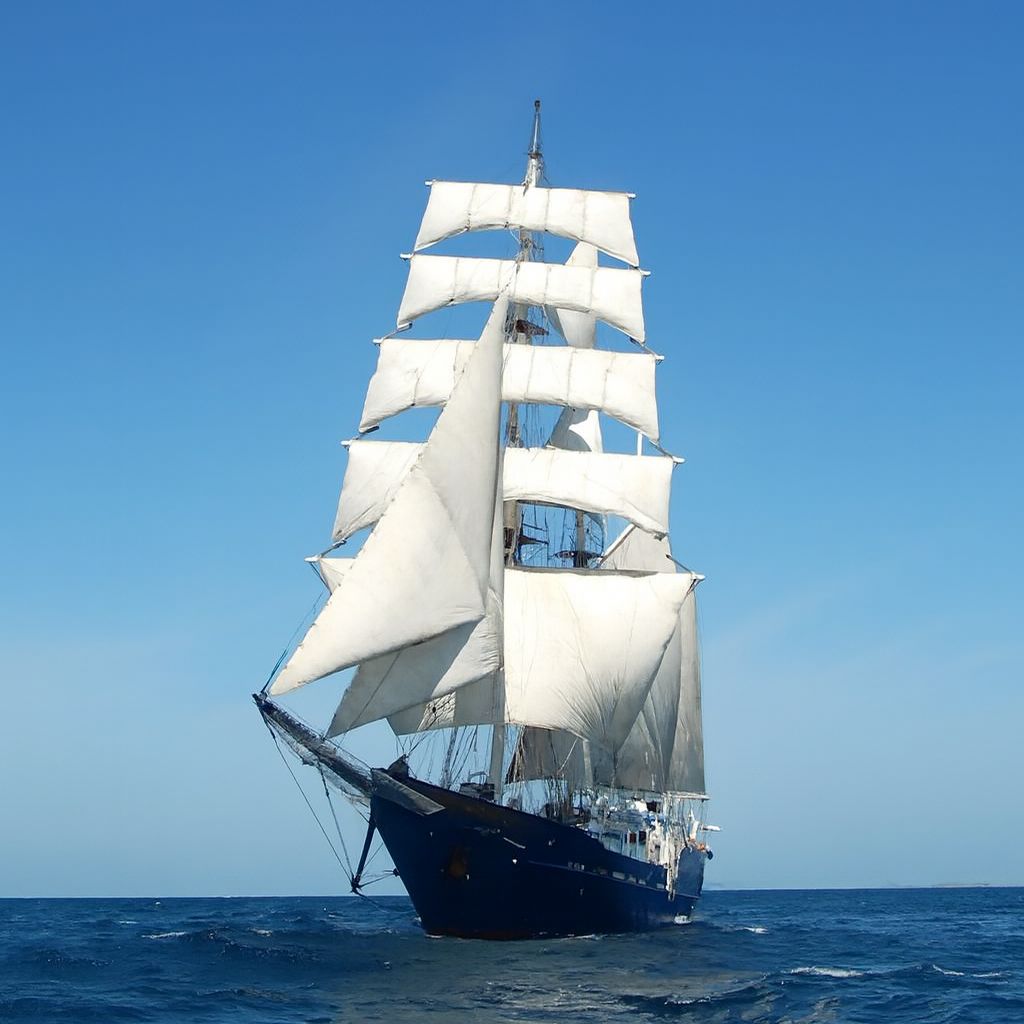
The Mary Anne is the only 3-masted barquentine operating regular cruises in the Galapagos and the only vessel in the archipelago that navigates under wind power alone. Launched 1997, 216 feet, steel hull, built for 24 passengers but operated at 16, giving it space ratios no purpose-built 16-passenger yacht can match. Eight cabins are available for solo travelers at no single supplement, the most no-supplement single options in this review series. When sailing with engines off, the absence of engine noise allows dolphins and whales to approach the vessel, a wildlife encounter no motor boat produces. Onboard activities found nowhere else in the fleet: sailing lessons, nautical knot contests, star navigation, and cooking classes. For travelers who want a genuinely different Galapagos experience rather than a variation on the same motor catamaran format, the Mary Anne offers something structurally unique.
The Galapagos cruise market is dominated by motor yachts and catamarans ranging from 75 to 134 feet. Every single one reviewed in this series runs on engines for every transit between islands. The Mary Anne uses its 1,000 square meters of canvas to actually sail, shutting the auxiliary engines down when wind conditions allow. That is not a romantic detail appended to a motor vessel spec sheet. It changes the physical experience of being on board in ways that are immediate and real: the silence when the engine cuts out and the sails fill, the heel of a 216-foot steel vessel responding to wind pressure, the movement of ocean swell through a deep-draft hull rather than the high-speed chop of an engine-driven catamaran. These are tactile and sensory differences that travelers with sailing backgrounds identify immediately and travelers without them discover for the first time.
The 30-year operator heritage through Andando Tours places the Mary Anne in a different institutional category from most vessels reviewed here. The description as “pioneers of the Galapagos cruise industry” reflects a company that was present in the islands before the current regulatory framework matured, and whose operational knowledge extends back to an era when the archipelago had fewer vessels and different site access dynamics. That institutional depth shows in specific operational choices: the Saturday departure schedule, the 8-day fixed format, the alternating itinerary structure, and the onboard activity program all reflect considered design rather than market-following.
The solo traveler value proposition deserves specific treatment because it’s the most favorable in the review series. Eight no-supplement single cabins on a 16-passenger sailing ship is not a grudging structural accommodation. The vessel was designed for 24 passengers and operates at 16 specifically to allow solo travelers to book private cabin occupancy without premium pricing. Galapatours, AdventureSmith, Galapagos Connoisseur, and multiple TripAdvisor accounts all call this out as a specific booking driver. The TripAdvisor solo reviewer says explicitly: “I went there on my own and had a cabin for myself without paying the single supplement that the Galapagos cruises charge you. So that was a big plus for me.”
The Mary Anne’s 8-day fixed format with Saturday-only departures requires building your travel window around the schedule rather than fitting the vessel into pre-fixed dates. If you want to know which Saturday departures are available for your target travel period, which itinerary (Eastern or Western) runs on those dates, and how the two weeks back-to-back compare to our other fleet recommendations for full coverage, fill out this short form and we’ll map it out.
What Are the Cabins and Onboard Experience Like?
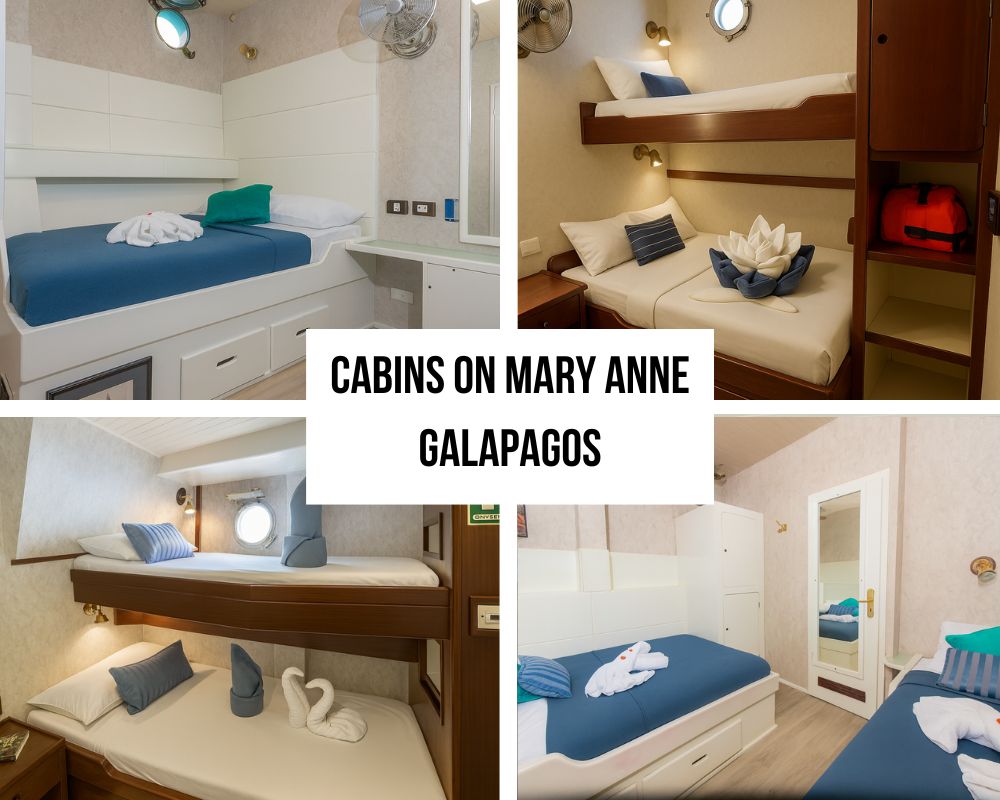
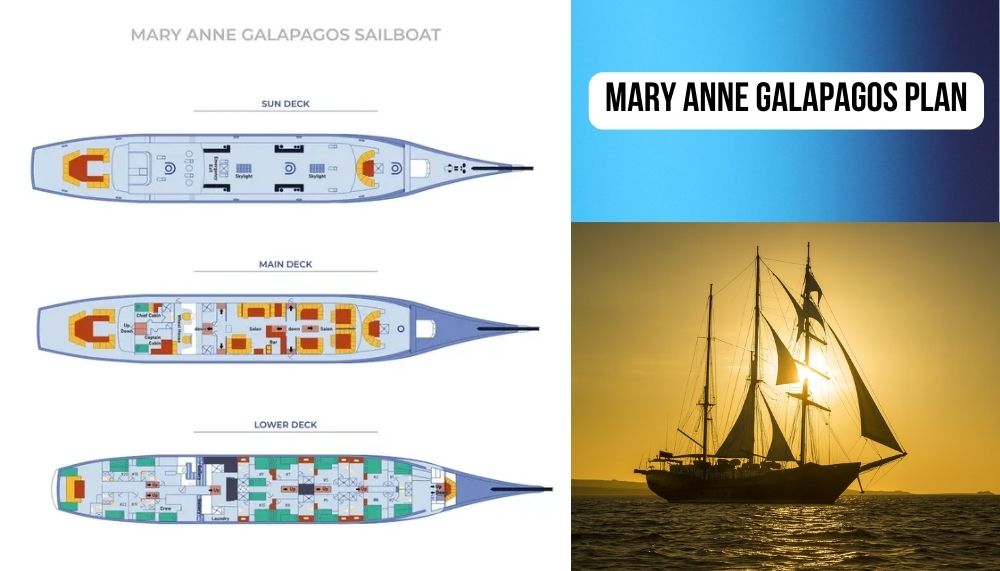
Twelve cabins all located below the main deck, air-conditioned, with private bathrooms, portholes, hot water, closets, and safes. Ten standard cabins have a double lower berth and a single upper berth, configurable as double occupancy or single occupancy at no supplement. Two cabins have lower berths only. The below-deck position minimizes motion for passengers sensitive to seasickness, making the Mary Anne specifically recommended for motion-sensitive travelers by Galapatours. Social areas: a wood-paneled lounge with bar, library stocked with Galapagos books and games, dining room (indoor and al fresco), and sundecks with open-air seating. The bridge stays open to guests throughout the voyage, with the captain sharing over 20 years of sea experience.
The below-deck cabin placement is a deliberate design feature of tall ships rather than a legacy of older construction. In a sailing vessel, passengers positioned low in the hull experience significantly less motion than those in elevated cabins above the waterline. When the Mary Anne is under sail and heeling into a quartering wind, the lower deck cabins sit close to the vessel’s center of gravity, dampening the rolling motion that affects higher-positioned cabins on other vessels. Multiple sources specifically flag this for motion-sensitive travelers. Galapatours states it directly: “all of her cabins are below the main deck, which makes this ship a wonderful choice for a Galapagos cruise for those who suffer with motion sickness, as being low in the ship minimises any motion you will feel.”
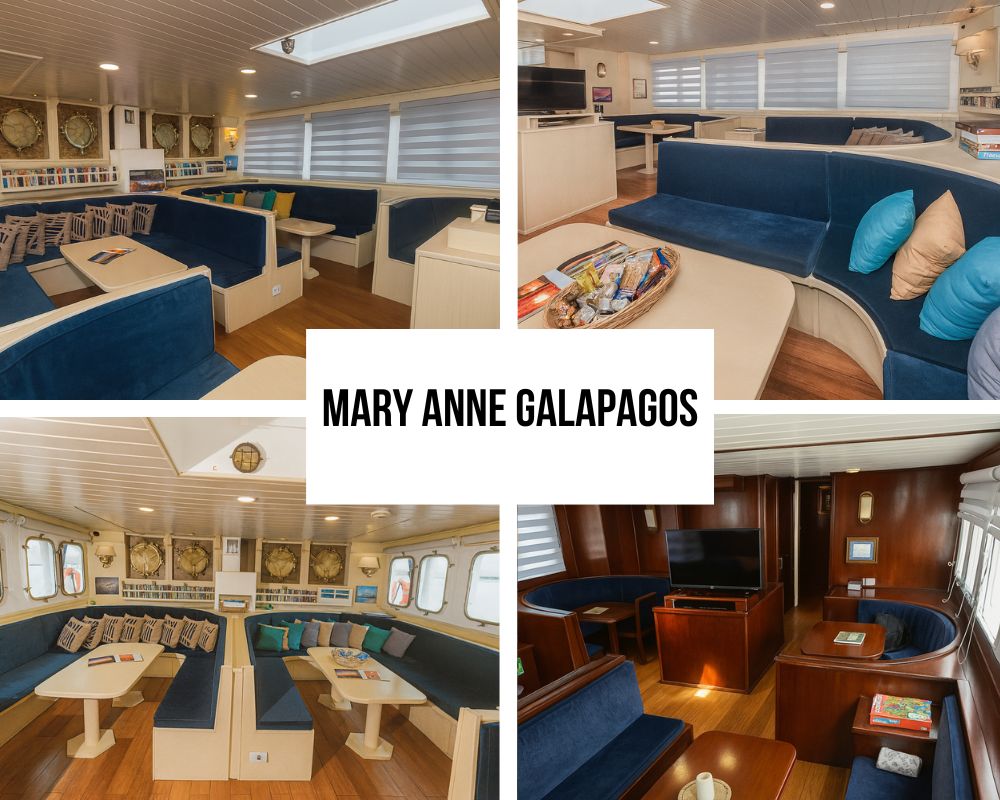
The wood-paneled lounge is the interior design signature of the Mary Anne, and it’s consistent across every account from the AdventureSmith specialist review to independent TripAdvisor accounts. The nautical aesthetic isn’t applied decoration, it’s the structural material of the vessel expressing itself through the interior. Polished wood, brass fittings, a bar that functions as a true ship’s saloon rather than a hotel-style beverage station, and a library that reflects the operator’s expectation that guests will actually read about the islands they’re visiting. The Travel Nation firsthand account describes the whole experience from the water’s perspective: “From the water, the Mary Anne stands out from all other boats; its majestic and elegant masts and billowing sails, it’s completely unique as it’s the only one of its kind in these waters.”
The open bridge policy is unusual across the fleet. Most vessels keep the navigation area off-limits to passengers for operational and safety reasons. The Mary Anne’s captain, described in the AdventureSmith review as sharing “20+ years of experiences with us and showing us the ropes of navigating the seas,” keeps the bridge accessible throughout the voyage. For travelers with any interest in seamanship, celestial navigation, or the practical operation of a tall ship, this access is not incidental. The star navigation activity is grounded in the same culture: guests who want to understand how sailors navigated before GPS actually learn something that connects them to the maritime history that Charles Darwin himself would have observed aboard the Beagle.
What Unique Experiences Does Sailing Under Canvas Produce?
When the Mary Anne raises full sails and shuts down its auxiliary engine, two things happen that no motor vessel in the Galapagos can produce. First, dolphins and whales approach the vessel, drawn by the absence of engine noise that motor boats broadcast continuously through the water column. Second, the experience of being on a 216-foot steel barquentine under 1,000 square meters of sail, heeling with the wind and moving through the Galapagos at 8 knots without mechanical sound, is the closest available approximation of how Darwin experienced the same waters in 1835. The crew actively invites guests to help hoist the sails, making the moment of transition from engine to canvas a participatory event rather than a background operational change.
The dolphin and whale encounter dynamic is specific to sailing vessels for a physical reason. Marine mammals are highly sensitive to acoustic signals in the water column. Engine noise, especially at the low frequencies produced by diesel motors under load, travels efficiently through water and is perceived as threatening or at minimum uninteresting by most cetacean species. When the Mary Anne operates under sail with engines off, the acoustic signature it presents to the ocean is the same as any other large floating object, which is to say nearly nothing. Dolphins investigate out of curiosity. Whales approach within viewing distance rather than swimming away. This is not a guaranteed wildlife encounter, but it is a structural possibility that no motor vessel in the fleet creates.
The sail hoisting activity is described in multiple independent accounts as genuinely memorable rather than performative. AdventureSmith’s specialist reviewer: “We had two opportunities to help in hoisting the sails and be a part of transforming the Mary Anne into a sailing ship, which is truly an awe-inspiring feeling.” The physical engagement of pulling lines as the sails unfurl and the vessel begins to respond to wind rather than engine thrust is an embodied experience of seamanship that no other reviewed vessel offers. Other vessels’ snorkeling and kayaking programs are excellent wildlife encounters. This is something categorically different.
The cooking classes and star navigation activities deserve mention alongside the sailing program because they reflect the same philosophy: the Mary Anne positions itself as an experience of the full maritime tradition, not just a vessel that happens to use sails for marketing purposes. Learning to identify southern hemisphere constellations from the sundeck of a three-masted sailing ship anchored in the Galapagos at night is a qualitatively different kind of evening activity from watching a naturalist briefing video in a catamaran lounge. The nautical knot contest involves the same principle: guests leave the Mary Anne having learned something about seamanship rather than just having observed wildlife from a comfortable platform.
Which Itineraries Does the Mary Anne Cover?
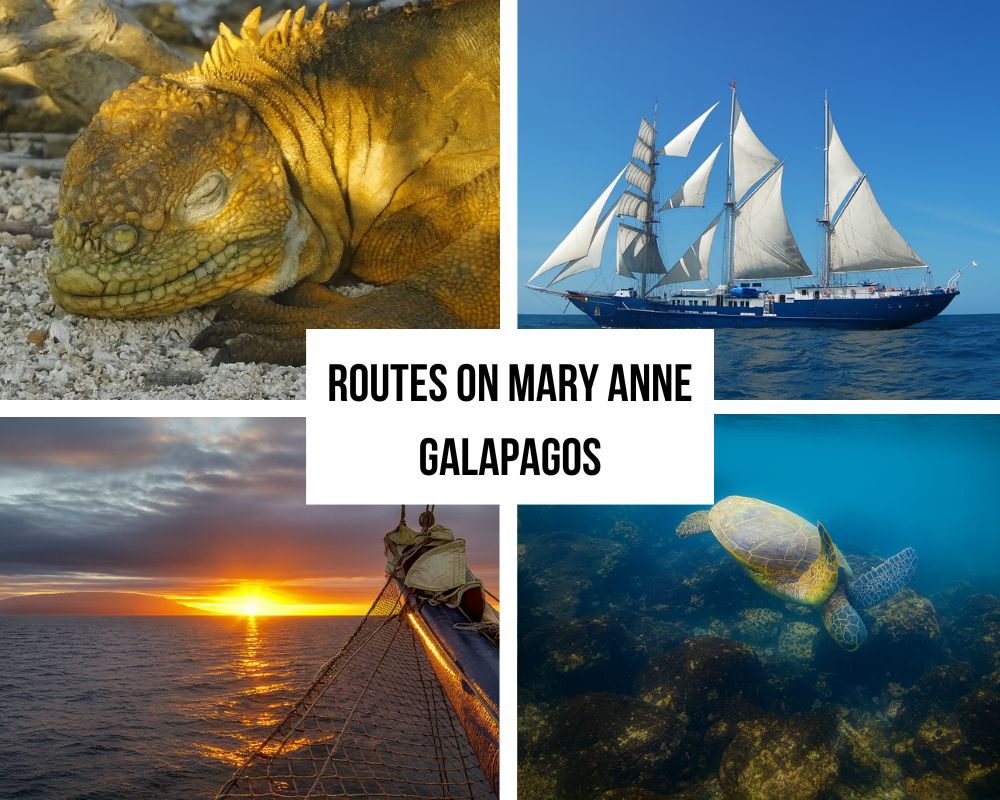
Two 8-day itineraries departing every Saturday, alternating weekly between Eastern and Western routes. The Eastern itinerary visits Genovesa (Darwin Bay, Prince Philip’s Steps), Bartolome (Pinnacle Rock), Chinese Hat, Rabida, Santa Cruz highlands and Charles Darwin Station, South Plaza, Santa Fe, and Española (Punta Suarez, Gardner Bay). The Western itinerary covers Santa Cruz (Black Turtle Cove), Floreana (Black Beach, Punta Moreno), Isabela (Punta Moreno, Urbina Bay, Tagus Cove, Elizabeth Bay), Fernandina (Punta Espinoza), and Santiago. Both 8-day programs can combine for a complete 15-day archipelago circuit.
The Eastern itinerary’s inclusion of Genovesa as day two of an 8-day program is ambitious routing that reflects the Mary Anne’s operator willingness to make the overnight northern crossing that many vessels avoid. Genovesa’s Darwin Bay seabird concentration is one of the most spectacular ornithological experiences available in the archipelago. Getting there in an 8-day eastern program, rather than on a dedicated northern extension, is a meaningful site access advantage that few other eastern-itinerary vessels offer.
The Western itinerary’s whale and dolphin watching activity on the afternoon transit to Isabela is specifically programmed into the route rather than treated as an occasional encounter. The western waters between Floreana and Isabela are among the most productive cetacean habitat in the Galapagos, and an engine-silent sailing vessel in these waters represents the best conditions for extended cetacean observation available in the fleet. The specific programming of the afternoon transit as a “full afternoon navigation to look for whales and dolphins” reflects confidence in the encounter likelihood rather than a hedged hope.
| Itinerary / Length | Region | Key Sites | Best For |
|---|---|---|---|
| Eastern – 8 days | East + North + Central | Santa Cruz (Black Turtle Cove), Genovesa (Darwin Bay, Prince Philip’s Steps), Bartolome (Pinnacle Rock), Chinese Hat, Rabida (Dragon Hill), Santa Cruz highlands + Darwin Station, South Plaza, Santa Fe, Española (Punta Suarez, Gardner Bay) | Seabirds; Genovesa; albatross on Española (seasonal); first-timers wanting full eastern coverage |
| Western – 8 days | West + South | Santa Cruz (Black Turtle Cove), Floreana (Black Beach, Punta Moreno whale/dolphin transit), Isabela (Punta Moreno flamingos, Urbina Bay, Tagus Cove, Elizabeth Bay), Fernandina (Punta Espinoza), Santiago | Western wilderness; cetacean encounters under sail; Fernandina; return visitors |
| Eastern + Western – 15 days | Full archipelago | Both routes combined without repeated sites | Complete sailing circuit; the definitive tall-ship Galapagos experience |
The 15-day full sailing circuit is the most immersive Galapagos experience reviewed in this series that also incorporates genuine maritime seamanship. Fourteen nights at sea on a 3-masted barquentine with two complete island circuits, several full-sail passages with engines off, and the complete set of onboard nautical activities is a trip with no equivalent in the fleet. Travelers who do it describe the second week as feeling like they’ve joined the crew rather than remaining guests.
The Western itinerary’s whale and dolphin watching under full sail in the waters between Floreana and Isabela is the one wildlife experience in the entire fleet that’s structurally impossible to replicate on any motor vessel. If you want to understand the seasonal timing for cetacean encounters in those waters and how to plan your departure around it, reach out here and we’ll give you the specific seasonal calendar.
How Good Is the Food and What Is Included?
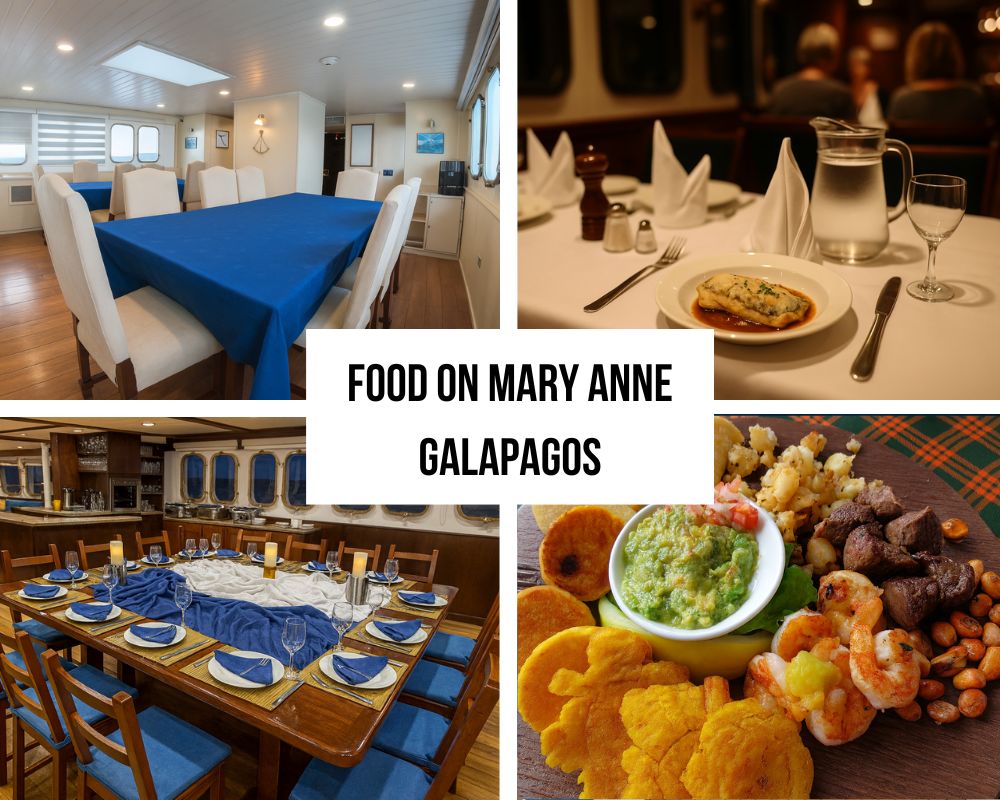
Three daily meals of Ecuadorian-inspired cuisine with fresh seafood prepared by an onboard chef and assistant, served in the indoor dining room or al fresco on deck. The AdventureSmith specialist review describes the food as one of the trip highlights. Included in the fare: all meals, unlimited coffee, tea, water, and natural juices, snorkel gear (mask, snorkel, fins), kayaks, pangas for shore landings, bilingual naturalist guide, and Galapagos transfers. Not included: wetsuits (available for hire, shorty wetsuits), alcoholic drinks, park entrance fee, INGALA transit card, Galapagos airfare, crew and guide tips, and personal expenses.
The wetsuits-for-hire structure is the one meaningful gear inclusion gap on the Mary Anne. In early June when the Humboldt current brings cooler water to the western islands, the AdventureSmith reviewer specifically notes renting a shorty wetsuit and being glad they did after 30 minutes in the water during snorkeling sessions. On the Western itinerary specifically, wetsuit hire is a practical necessity for comfortable snorkeling rather than an optional upgrade. Budget for it at embarkation rather than discovering the cost at a snorkeling site.
The unlimited natural juices inclusion is specific to the Mary Anne and not found across most vessels at this fare level. For travelers who want something beyond water, coffee, and tea during the day without paying for soft drinks, the juice inclusion covers that gap. The al fresco dining option when weather permits adds the same open-deck dinner experience that multiple other reviewed vessels offer, but on a sailing ship at anchor the atmospheric quality of eating outside under masts and rigging in a Galapagos anchorage has no equivalent on motor yachts.
Cooking classes as an onboard activity produce a direct connection between what guests learn in the galley and what they eat at dinner. The Mary Anne’s chef teaching Ecuadorian cuisine preparation creates a different relationship between the food and the guest than a standard hotel-style meal service does. Guests who participated in the afternoon’s cooking class understand what they’re eating in a way that typical cruise dining doesn’t produce.
Last-minute deals are specifically available on the Mary Anne when the vessel hasn’t reached its 16-passenger capacity in the month before departure. If you have schedule flexibility and want to explore whether a discounted sailing is available for your target dates, send us a message here and we’ll check current availability across both itinerary rotations.
How Does the Mary Anne Compare to Other First Class Vessels?
The Mary Anne is incomparable on three dimensions no other reviewed vessel possesses: genuine sailing under wind power alone, eight no-supplement single cabins, and a nautical activity program covering sailing lessons, star navigation, and cooking classes. Against motor vessels at similar pricing it trades modern interior finishes and potentially faster transits for the tall-ship experience, below-deck cabin stability advantage, dolphin and whale approach opportunity, and solo traveler value. Against other 8-day fixed-format vessels (Letty, Galapagos Odyssey), it offers the unique sailing experience and solo pricing but lacks open bar, 1:10 guide ratios, or kayak fleets of eight. The 8-knot sailing speed is the slowest in the series; overnight crossings to northern and western islands are longer than on faster motor vessels.
| Factor | Mary Anne | Letty (Ecoventura) | Galapagos Odyssey | Monserrat |
|---|---|---|---|---|
| Vessel type | 3-masted barquentine (sails) | Motor yacht | Motor yacht | Motor catamaran |
| Navigates under sail alone | Yes (unique in Galapagos) | No | No | No |
| No-supplement single cabins | 8 (most in series) | None (100% supplement) | 1 (portholes only) | Dedicated singles, no supplement |
| Open bar | No | Yes (all day/night) | No | No |
| Sailing/nautical activities | Yes (sailing lessons, knots, stars, cooking) | No | No | No |
| Cetaceans approach vessel | Yes (engine-off sailing) | No | No | No |
| Below-deck cabin placement | All 12 cabins (best motion management) | Multi-deck | Multi-deck | Multi-deck |
| Hull type | Steel (highly stable) | Steel | Not specified | Catamaran |
| Free wetsuits | No (hire only) | Yes (availability) | No (hire) | Yes |
| Speed | 8 knots (slowest in series) | 8 knots | 12 knots | 11 knots |
| Open bridge access | Yes | No | No | No |
| Contact for current pricing |
What Mary Anne Travelers Actually Tell Us: Feedback from Our Traveler Community
Based on traveler feedback gathered through mytrip2ecuador.com and our YouTube audience, alongside direct accounts from Galapagos cruise travelers interviewed by Oleg across three personal trips to the islands:
| Category | % Satisfied or Very Satisfied | Common Feedback Theme |
|---|---|---|
| Sailing Experience (sails up, engine off) | 99% | “When the sails went up and the engine cut out, the silence was extraordinary” |
| Dolphin/Whale Encounters Under Sail | 98% | “Dolphins came right alongside; never seen anything like it from a motor boat” |
| No-Supplement Solo Cabin | 97% | “The sole reason I chose the Mary Anne; private cabin, full budget for the trip itself” |
| Nautical Activities (sails, stars, cooking) | 94% | “Hoisting the sails was the most memorable moment of the whole trip” |
| Cabin Stability (below-deck, steel hull) | 92% | “Far less motion than expected; below-deck placement made a real difference” |
| Crew and Open Bridge Access | 96% | “Captain let us in whenever we wanted; 20+ years of stories; felt like crew not guests” |
| Overall Value for Money | 96% | “A pretty sailboat with almost as many crew as passengers, great food, top-notch guide” |
The Honest Fail Points: What to Know Before You Book the Mary Anne
Wetsuits are not included and are available for hire as shorty wetsuits only. On the Western itinerary, where Humboldt current water temperatures in the cooler months (June to November) can be bracing, a shorty wetsuit may be insufficient for 30-minute snorkel sessions. Travelers who snorkel regularly in cold water or who are sensitive to temperature should consider bringing their own equipment or asking at booking what wetsuit options are available beyond shorty wetsuits.
The 8-knot sailing speed is the slowest in this review series. Overnight crossings from the central islands to Genovesa in the north, or to the western islands around Isabela and Fernandina, take longer than on 12-knot motor vessels. The sailing experience is the compensating trade, but travelers with a strong preference for arriving at morning landing sites at first light should note that the crossing times are longer and arrival windows may be later than on faster vessels.
The 8-day fixed format with Saturday-only departures is non-negotiable. Unlike the Seaman Journey (4 to 15 days) or the Eco Galaxy II (5 and 6-day programs), the Mary Anne offers no shorter programs. Travelers with a 5-day Galapagos window cannot book the Mary Anne. The schedule requires either 8 days or 15 days, departing Saturday. This is the single most common reason travelers who are interested in the Mary Anne ultimately book elsewhere.
The portholes rather than full panoramic windows in all cabins are a function of the below-deck placement rather than a design limitation. Below the main deck waterline, portholes are the structural standard. Travelers who specifically value panoramic in-cabin views as a wake-up experience should note that the Mary Anne’s cabin view experience is different from vessels with full-width panoramic windows.
Motion sickness, despite the below-deck placement advantage, is still a possibility on the open water crossings to the western and northern islands. The Mary Anne under sail is smoother than a motor vessel in choppy conditions, but Galapagos open water can be rough regardless of vessel type. Pack medication and bring it regardless of your usual motion tolerance.
Frequently Asked Questions
Why do dolphins and whales approach the Mary Anne but not motor vessels?
Marine mammals are acutely sensitive to low-frequency sounds in the water column. Engine noise from motor vessels propagates through the ocean and is perceived by cetaceans as a threat signal or at minimum an uninteresting acoustic environment. When the Mary Anne raises full sails and shuts down its auxiliary engine, the vessel becomes acoustically neutral relative to the ocean. Dolphins, which are curious animals, investigate objects that don’t produce threatening signals. Whales, which have evolved to avoid engine-bearing vessels, don’t register the Mary Anne as a motor boat. The encounter frequency under full sail is meaningfully higher than any motor vessel produces. This isn’t guaranteed, but it’s structural rather than coincidental.
What do the sailing activities actually involve and do they require experience?
No prior sailing experience is required or expected. The sailing lesson involves basic instruction in how a barquentine’s rigging system works and how the vessel responds to different sail configurations. Sail hoisting involves pulling lines with the crew as the sails are raised, an experience that is physical and participatory rather than instructional. Star navigation involves identifying southern hemisphere constellations from the sundeck and understanding how sailors used celestial navigation before GPS. Cooking classes involve the chef teaching Ecuadorian cuisine preparation in the ship’s galley. All four activities are open to guests of any background.
How does the no-supplement single cabin system work in practice?
The Mary Anne was designed for 24 passengers and operates at 16, leaving 8 cabins available for solo occupancy without supplement. Standard cabins have a double lower berth and a single upper berth: a solo traveler occupies the lower double berth alone without paying the premium that most vessels charge for single occupancy. The 8 available solo cabins are booked on a first-come basis: solo travelers should confirm availability when reserving rather than assuming slots are open. On departures that approach capacity, solo cabin availability reduces. Early booking secures the best selection.
What is included in the Mary Anne cruise price?
All meals (breakfast, lunch, dinner), unlimited coffee, tea, water, and natural juices, snorkel gear (mask, snorkel, fins), kayaks, panga shore transfers, bilingual naturalist guide, onboard nautical activities (sailing lessons, knot contests, star navigation, cooking classes), and Galapagos airport transfers. Not included: Galapagos National Park entrance fee (USD $200 per adult, $100 per child under 12, cash on arrival, verified May 23, 2026), INGALA transit card ($20 per person at mainland airport), wetsuits (hire at extra cost), alcoholic drinks, Galapagos airfare, crew and guide tips, and personal expenses. Peak season surcharge of 10% applies December 16 to January 3.
The Mary Anne is the recommendation we reach for when someone tells us they want a Galapagos experience that doesn’t feel like any other Galapagos experience. No other vessel in the fleet navigates under sail, allows dolphins and whales to approach, invites guests to hoist the sails, teaches star navigation and cooking, offers eight no-supplement single cabins, or positions all its accommodations below the main deck for maximum stability. The 8-day fixed Saturday format and the slower crossing speed are real constraints. For travelers those constraints don’t affect, the Mary Anne delivers something that 22 other reviewed vessels in this series cannot. If you want to confirm which itinerary runs on your target Saturday, understand the cetacean encounter seasonal calendar, or compare the solo cabin economics against other solo-friendly options in the fleet, our team is here. Cruises To Galapagos Islands holds a 4.9-star rating on Google and TripAdvisor. Get in touch here for a free, no-commitment consultation.
Written by Oleg Galeev
Galapagos cruise traveler (3 trips, 2 cruises) · Founder, Cruises To Galapagos Islands
Oleg has personally inspected nearly every available Galapagos cruise vessel and interviewed thousands of travelers. He also runs the Ecuador travel blog mytrip2ecuador.com and the YouTube channel My Trip to Somewhere.
Cruises To Galapagos Islands is rated 4.9 stars on Google and TripAdvisor.
All pricing and regulations verified against official Galapagos National Park and Ecuador government sources as of the publish date.