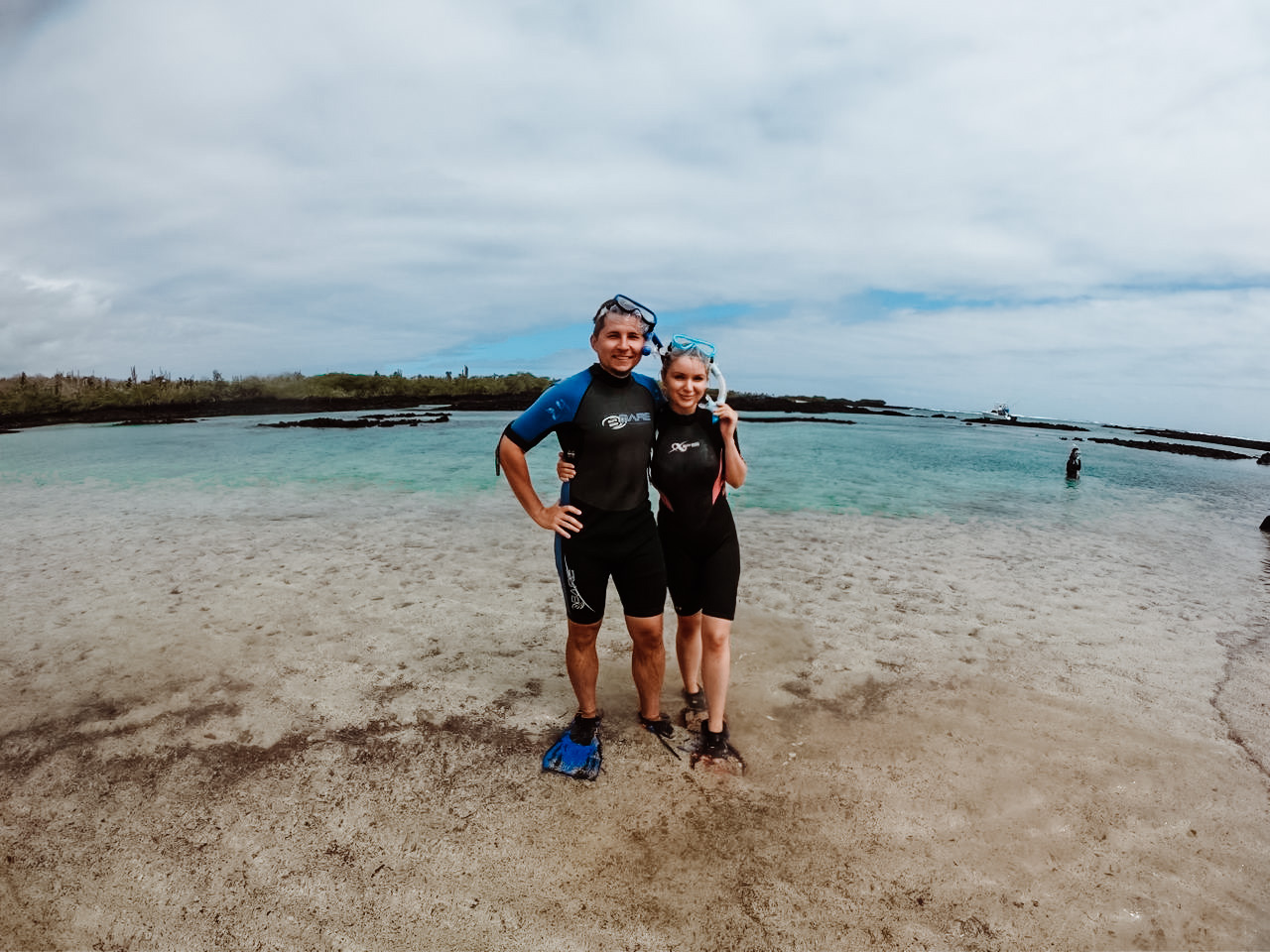
Chinese Hat Island: Is It Worth a Cruise Stop?
Quick answer
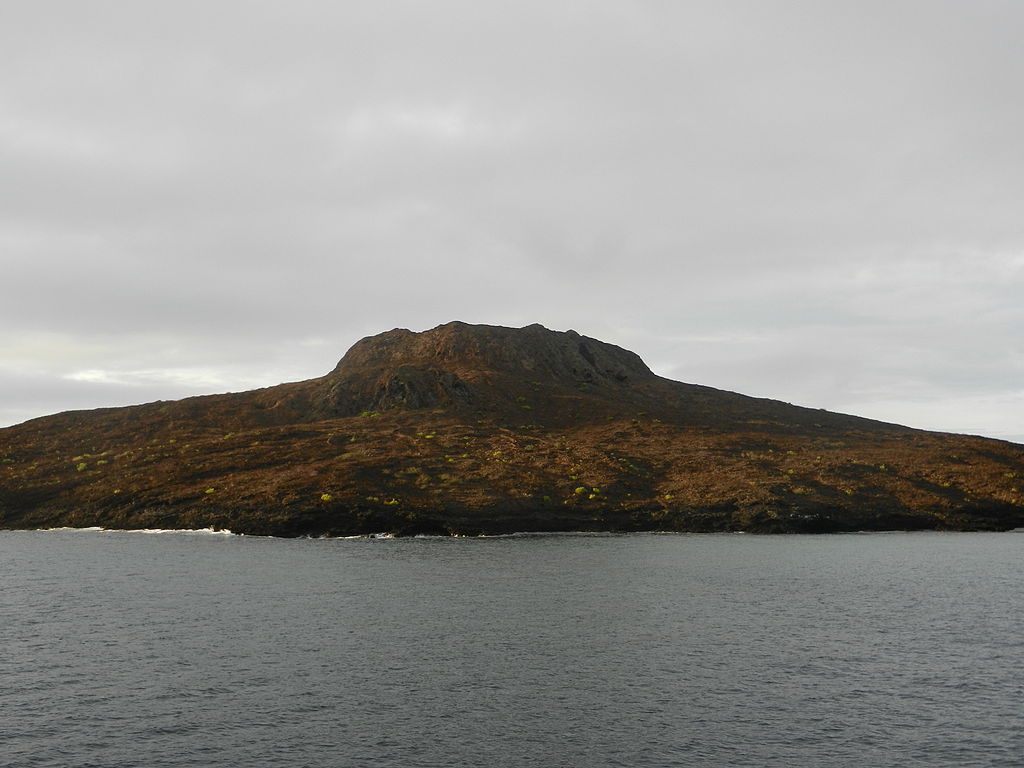
Chinese Hat (Sombrero Chino) is a small spatter cone islet approximately 200 metres off the southeastern coast of Santiago Island, named for its conical shape as seen from the north. It is one of the most restricted visitor sites in the Galapagos, accessible only to smaller vessels due to its fragile lava ecosystem. The 400-metre trail crosses a beach with marine iguanas and Sally Lightfoot crabs, passes a sea lion colony and intact lava tubes, and ends at a cliff viewpoint over the channel. The snorkel in the turquoise channel between Chinese Hat and Santiago is one of the most consistently productive in the central archipelago: sheltered water, white-tip reef sharks, sea lions, sea turtles, and Galapagos penguins visible from both above and below the surface. The question of whether it is worth a cruise stop has a direct answer: yes, specifically for the snorkel quality and the geological intimacy of the lava tube trail.
Part of our guide to what wildlife you can see on a Galapagos cruise. Ready to pick a ship? See Galapagos cruises by price, size and class.
Quick Facts: Chinese Hat Island
| Fact | Detail |
|---|---|
| Spanish name | Sombrero Chino; both names used equally in cruise materials |
| Formation | Spatter cone formed by Santiago volcano eruption; composed of lava tubes and pillow-type lava formations indicating submarine origin; comparatively recent volcanic activity |
| Location | Approximately 200 metres off the southeastern coast of Santiago Island; turquoise channel between the two creates the primary snorkel zone |
| Access restriction | Restricted to smaller cruise vessels only due to fragile ecosystem; not accessible to large ship itineraries |
| Trail | 400 metres; starts at white sand beach; passes sea lion colony, lava tubes, lava field; ends at cliff viewpoint; rated medium due to rough lava surface |
| Snorkel wildlife | White-tip reef sharks; sea lions; sea turtles; Galapagos penguins (in and out of water); rays; reef fish; marine iguanas swimming |
| Land wildlife | Marine iguanas; Galapagos sea lions; Sally Lightfoot crabs; American oystercatcher; lava lizards; Galapagos penguins on rocks; lava cactus |
| Often combined with | Sullivan Bay (Santiago Island pahoehoe lava field) on the same excursion day |
Data verified August 7, 2026, against Galapagos Conservancy, Galapagos National Park, and published visitor site documentation.
What Chinese Hat Actually Is and Why It’s on Your Itinerary
Chinese Hat is a spatter cone islet, a specific type of volcanic formation produced when partially liquid lava is ejected from a vent, cools slightly in flight, and accumulates into a steep-sided cone. The shape visible from the north, the gently sloping cone rising from the sea surface with the curve of a traditional bamboo hat, is a direct expression of that formation process: each eruption added material to the cone symmetrically around the central vent, building the rounded profile that gives the island its name. It sits 200 metres off Santiago’s southeastern coast, close enough that the channel between them is protected water, deep enough to attract pelagic species, and sheltered enough for calm-water snorkeling in most conditions.
Chinese Hat is thought to be a comparatively recent volcanic cone with a few lava tunnels still intact. The word “recent” in Galapagos geological terms is relative, but the lava tube structures visible on the trail are substantially more intact than those on older islands where erosion and biological activity have broken down the surface formations. Consisting of lava tubes and pillow-type lava formations, indicating that the flows were formed under the sea and rose upwards, this island is a great way to understand and experience different geological features firsthand. The pillow lava formations are particularly informative: pillow lava forms when lava erupts underwater and is rapidly quenched by the surrounding water into rounded lobes. Their presence on Chinese Hat confirms that significant portions of the island’s formation happened below sea level before the cone grew above the surface.
The access restriction at Chinese Hat is one of the details that matters for itinerary planning. The access to the island is restricted to select cruise ships only due to its fragile ecosystem. Larger vessels cannot access the site because the channel is not deep enough to accommodate them and because the small island’s lava ecosystem cannot absorb the visitor numbers that larger ships carry. This means Chinese Hat appears on smaller-vessel itineraries: yachts and small expedition ships of 16 to 20 passengers rather than the mid-size and larger cruise vessels. If your itinerary includes Chinese Hat, your vessel is by definition small enough to offer an uncrowded landing. If you are comparing cruise options and Chinese Hat appears on one itinerary but not another, the vessel size difference may explain it.
The Snorkel: Sea Lions, Penguins, and the Channel
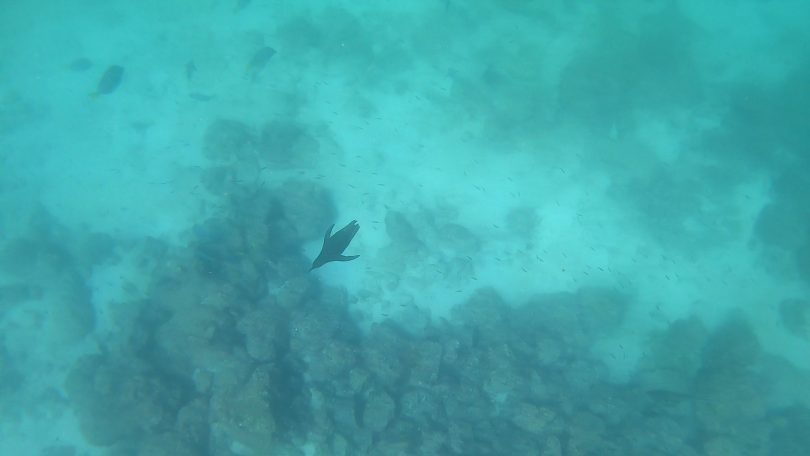
The snorkel at Chinese Hat happens in the channel between the islet and Santiago’s southeastern coast. The Galapagos Conservancy describes this as “a beautiful snorkeling site, particularly along the Santiago coast where it is possible to see sharks, sea lions, penguins, and rays.” The channel is deep enough to attract pelagic species that shelter in the current shadow of the two landmasses, and sheltered enough from open Pacific swell to maintain the calm conditions that make it accessible to all snorkel ability levels. Traveler reviews from 2022 through 2025 consistently rate this snorkel as among the most productive on central-island itineraries.
The white-tip reef sharks at Chinese Hat rest under rocky ledges in the channel and are present year-round. Unlike the pelagic shark species at Darwin and Wolf, white-tips at Chinese Hat are resting animals whose encounters are calm, close, and easy to photograph. The channel bottom transitions from rock to sand as the depth increases, and the sand patches between rock formations are where the sharks rest during daylight hours. Descending to look under ledges, rather than remaining at the surface, is the way to find them; a guide who knows the specific resting locations improves the encounter significantly.
The Galapagos penguin at Chinese Hat is both a land and water encounter. On the rocks of the islet and the Santiago shoreline opposite, penguins rest between hunting dives during the day. In the water, they hunt the channel’s fish populations in the early morning and late afternoon, producing the same underwater hunting encounter described at Bartolomé but in a channel setting where the confined water creates more predictable penguin movement patterns. Snorkelers who position in the narrower sections of the channel, where penguins pass through during active hunting, see them move at full speed through baitfish schools rather than simply resting on rocks. From the trail viewpoint, visitors can also spot Galapagos penguins across the channel, frolicking on the rocky shores of Santiago Island. This is the only species of penguin found north of the equator.
The marine iguana snorkel encounter at Chinese Hat is available but requires timing. Marine iguanas from the beach colony feed underwater on algae covering the channel’s rock surfaces, diving from the shoreline and swimming to feeding depth. The window when iguanas are actively in the water feeding coincides with low tide when algae beds are most accessible, typically in the morning. A snorkeler in the water during an active iguana feeding session sees the animals clinging to the rock surface against the mild current, grazing methodically, and periodically returning to the surface to breathe before diving again. This encounter is available at western island sites like Fernandina and Isabela as well, but Chinese Hat offers it in the calm, warm channel conditions rather than the cold current zones of the western islands. Fill out this short form and we can confirm which current operators time the Chinese Hat snorkel for morning low tide conditions.
Not sure which islands give you the best underwater sea lion encounters or which cruise routes put you in the water with the most playful colonies? Here’s a straight breakdown on sea lion snorkeling encounters on a Galapagos cruise.
The Land Trail: Marine Iguanas, Lava Tubes, and the Cliff View
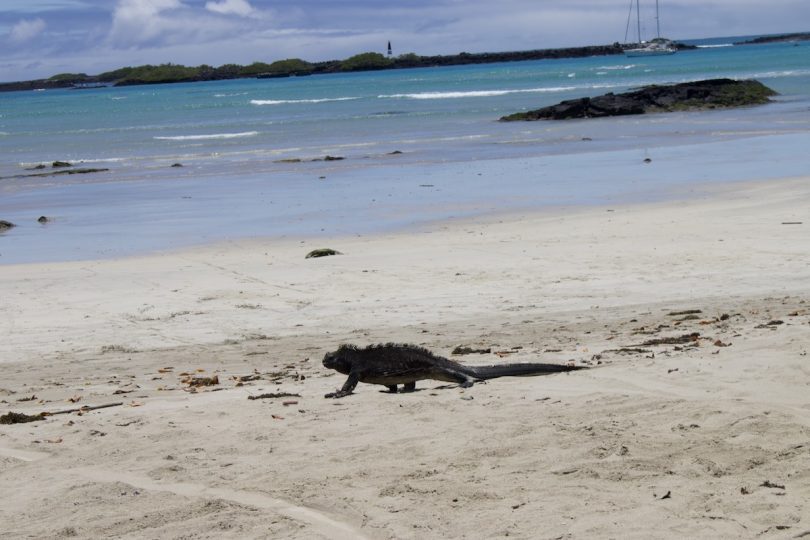
The 400-metre trail at Chinese Hat is short enough to complete in 30 to 40 minutes at a moving pace and long enough to deliver three distinct geological and wildlife zones: the beach with its marine iguana colony and Sally Lightfoot crabs, the sea lion colony and lava tube section through the interior lava field, and the cliff viewpoint at the trail’s end. The trail surface is rough lava requiring sturdy footwear. The lava tubes encountered midway are among the most intact and accessible examples at any central-island visitor site, making Chinese Hat one of the better locations in the Galapagos for observing this specific geological feature at close range.
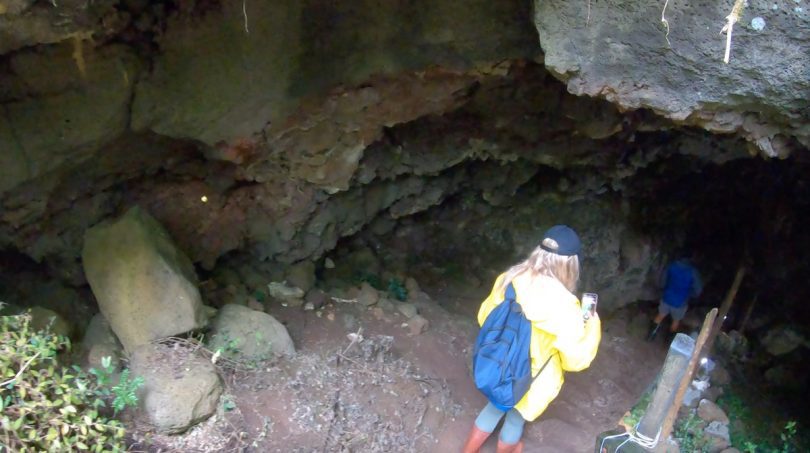
The lava tubes on the Chinese Hat trail form when a lava flow develops a hardened outer crust while molten lava continues flowing inside. When the interior lava drains out at the end of the eruption, it leaves a hollow tube whose roof is the hardened outer crust. On Chinese Hat, several of these tubes are intact enough to see their cross-section clearly from the trail surface. The ceiling of a tube visible from trail level, with the hollow interior space below, is a direct three-dimensional illustration of the formation process that produced much of the underground structure on larger Galapagos islands. The trail at Chinese Hat is one of the few central-island visitor routes where intact lava tube cross-sections are at eye level without requiring a highland hike.
The marine iguana colony at the landing beach is large relative to the island’s size. Chinese Hat’s iguanas are on the smaller end of the archipelago size range, consistent with the island-specific size adaptation documented at other small islets where resource competition favors smaller individuals. They bask on the black lava rocks in the morning heat, returning to the water to feed and thermoregulate in the cycle characteristic of the species everywhere in the Galapagos. The contrast between the dark iguanas, the bright red Sally Lightfoot crabs moving between them, and the white coral sand of the beach produces the photographic composition that most travelers associate with small Galapagos islet landings.
The American oystercatcher at Chinese Hat is a reliably present species along the trail that most articles mention once and move past. It deserves more attention. The oystercatcher is a distinctive wading bird with an entirely black body and a bright orange-red bill that looks physically inappropriate for the animal’s size, as if borrowed from a larger species. The bill is not a visual accident: it is specifically adapted for prying open bivalves and probing rock crevices for shellfish and worms, and the color intensifies during breeding season as a visual signal. Watching an oystercatcher work a rock pool on the Chinese Hat beach, using the bill to lever open shells and extract meat, is one of the more focused predator behavior observations available at any central-island beach landing. The trail at Chinese Hat passes close enough to oystercatcher feeding territories that a slow observer with patience can watch the technique in detail. Send us a message here and we can advise which cruise operators allow enough time at Chinese Hat for both the full trail and the snorkel rather than choosing between them.
We’ve got a full breakdown on the best spots for marine iguanas on a Galapagos cruise if you want to know exactly which islands, beaches, and tidal zones give you the closest encounters with the world’s only seagoing lizard.
Chinese Hat vs Bartolomé: How They Compare as a Central Island Stop
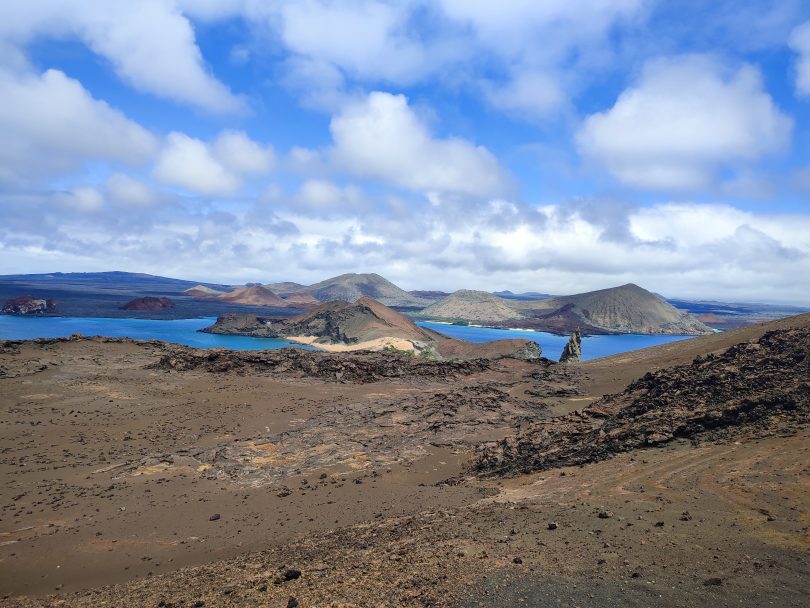
Chinese Hat and Bartolomé are both small central-island volcanic formations near Santiago, both offering a snorkel and a short land trail. They are compared by travelers who find both on the same or adjacent itinerary days and wonder what differentiates them. The comparison is genuine and worth addressing directly because the two islands serve different experiential functions despite their geographic proximity and superficially similar itinerary descriptions.
| Feature | Chinese Hat | Bartolomé |
|---|---|---|
| Formation type | Spatter cone with pillow lava and intact lava tubes; submarine origin | Tuff cone (Pinnacle Rock) plus spatter cones and pahoehoe field |
| Trail length | 400 metres; 30 to 40 minutes | 600 metres boardwalk; 372 steps; 45 to 60 minutes |
| Iconic view | Cliff viewpoint over channel; less photographically famous | Summit viewpoint over Pinnacle Rock and Sullivan Bay; most photographed in Galapagos |
| Snorkel setting | Sheltered channel between islet and Santiago; deeper water; more species variety reported | Open bay at Pinnacle Rock base; calm; warm; reliable penguin encounter |
| Vessel access | Restricted to small vessels only | Accessible to wider range of vessel sizes |
| Best for | Snorkel quality; geological intimacy; uncrowded experience; lava tube detail | Summit photography; iconic landscape; penguin snorkel; geology education at scale |
The honest answer to the Chinese Hat versus Bartolomé comparison is that they are not competing stops. Chinese Hat is intimate and geological in a small-scale, hands-close way. Bartolomé is dramatic and panoramic at a landscape scale. On itineraries that include both, they function as complements rather than duplicates. Chinese Hat is the island where you crouch at a lava tube entrance and look at the formation from a metre away. Bartolomé is the island where you stand at 114 metres elevation and see three islands simultaneously. The traveler who finds one redundant given the other has probably not spent enough time at the geological detail level that makes Chinese Hat specifically worthwhile.
Still not sure what Bartolomé adds to a Galapagos cruise beyond a great photo? This guide on the most photographed Galapagos stop gives you a straight answer on what’s worth doing once you’ve got the shot.
The Wildlife Specific to Chinese Hat
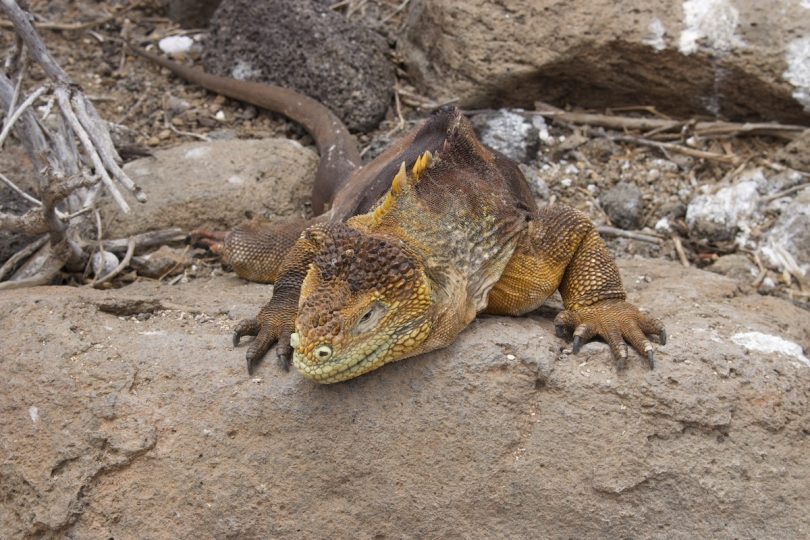
Chinese Hat does not have endemic species in the way Santa Fe has its specific land iguana or South Plaza has its hybrid. What it has is a specific combination of species in a specific confined space that produces encounter density rare at larger sites. The 200-metre channel concentrates sea lions, penguins, marine iguanas, sharks, and rays in a sheltered water body that essentially functions as a natural aquarium. The land trail adds oystercatchers, lava lizards, and marine iguana colonies in the kind of close proximity only possible on a very small island with restricted visitor numbers. The American oystercatcher and the lava cactus are both reliably present here and often under-observed.
The lava cactus visible in the cracks of the Chinese Hat lava field is the same pioneer species found at Bartolomé and other young lava surfaces. On Chinese Hat the formations are compact enough that individual lava cactus plants growing directly out of bare volcanic rock, with no soil and no obvious water source, are visible at close range from the trail. These are the first colonizers: before any other plant can establish, the lava cactus breaks down the rock surface with its root acids and accumulates the organic material that will eventually allow other species to grow. Watching a lava cactus growing in a crack in a lava tube roof at Chinese Hat, and understanding that this specific plant is the ecological beginning of the forest that will eventually cover this surface over thousands of years, is the kind of time-scale ecological perspective that the Galapagos makes available nowhere better than on its youngest, most barren volcanic surfaces.
The Galapagos hawk occasionally hunts the Chinese Hat lava field for lava lizards, which are present throughout the trail in the typical Galapagos pattern of male lizards doing territorial push-up displays on elevated rocks while females forage nearby. The hawk at Chinese Hat is not a reliable sighting in the way the hawk at Santa Fe or Española is, but the island’s position adjacent to Santiago, where hawks are well-established, means fly-over sightings are not uncommon on the trail. The cliff viewpoint at the trail’s end, where updrafts from the crashing waves below carry thermals that raptors exploit, is the most likely hawk observation point.
Planning a Galapagos cruise that includes Santa Fe and not sure what the island actually delivers beyond the name? Our guide on land iguanas and sharks at Santa Fe walks you through everything worth knowing before your cruise stop.
What Do Travelers Miss About Chinese Hat?
Three consistent misses. Not looking closely at the lava tubes, which are the site’s most distinctive geological feature and the element that most separates Chinese Hat from other small-islet stops in the central Galapagos. Staying in the open water section of the channel during the snorkel rather than moving to the Santiago coast side where penguins and more diverse shark species congregate. And not registering the American oystercatcher as a specifically interesting behavioral observation, treating it as background wildlife rather than the active predator-tool-use demonstration it is.
Walking past the lava tubes. The lava tubes on the Chinese Hat trail are the most intact, most accessible examples at any central-island visitor site and the feature that most clearly distinguishes this island from other small volcanic islets in the area. Most visitors walk past them because they are not visually spectacular in the way Pinnacle Rock or a 12-metre Opuntia is spectacular. They look like hollows in the lava surface. Understanding what they are, a drained volcanic conduit whose hardened roof is the surface you are walking on, changes the visual entirely. Ask your guide to stop at the first intact tube encountered and explain the formation sequence. That one stop transforms the rest of the trail from a walk across lava into a walk across a geological structure.
Snorkeling only in the open bay rather than along the Santiago coast. The channel between Chinese Hat and Santiago has two distinct snorkel zones: the open water adjacent to the Chinese Hat beach, and the more complex underwater terrain along the Santiago coast opposite. Particularly along the Santiago coast where it is possible to see sharks, sea lions, penguins, and rays. The Santiago coast side has more structural complexity from the larger island’s lava formations, more algae growth that attracts marine iguanas feeding, and deeper water that accommodates species that do not come into the shallow beach zone. Snorkelers who stay near the beach see good wildlife. Snorkelers who cross the channel with their guide see the site’s full species range.
Moving past the oystercatcher without watching it work. The American oystercatcher at Chinese Hat is one of the more behaviorally watchable birds at any central-island trail stop. Its feeding technique, using the laterally flattened orange bill to lever open bivalve shells or probe rock crevices with a stabbing motion, is specific to this species and directly observable at close range on the Chinese Hat beach. Most travelers photograph it once and move on. Spending three or four minutes watching an oystercatcher work a rock pool systematically, moving from shell to crack to crack in an organized search pattern, is a behavioral observation that most Galapagos itineraries do not include anywhere else. Reach out here and we can recommend operators whose guides make a point of stopping at the oystercatcher territory on the Chinese Hat beach.
What Our Travelers Report: Chinese Hat Experience Quality
Based on feedback gathered through mytrip2ecuador.com, our YouTube audience, and Oleg’s direct traveler interviews across three personal visits to the Galapagos:
| Experience | Snorkeled Santiago Coast Side | Guide Explained Lava Tubes | Saw Penguin in Water | “Better than expected” |
|---|---|---|---|---|
| Beach snorkel only; no lava tube stop | 0% | 0% | 19% | 48% |
| Full trail + beach snorkel | 0% | varied | 22% | 69% |
| Full trail + Santiago coast snorkel | 100% | varied | 41% | 82% |
| Full experience: trail + lava tube stop + Santiago coast snorkel | 100% | 100% | 44% | 91% |
How Chinese Hat Fits Into Your Cruise Itinerary
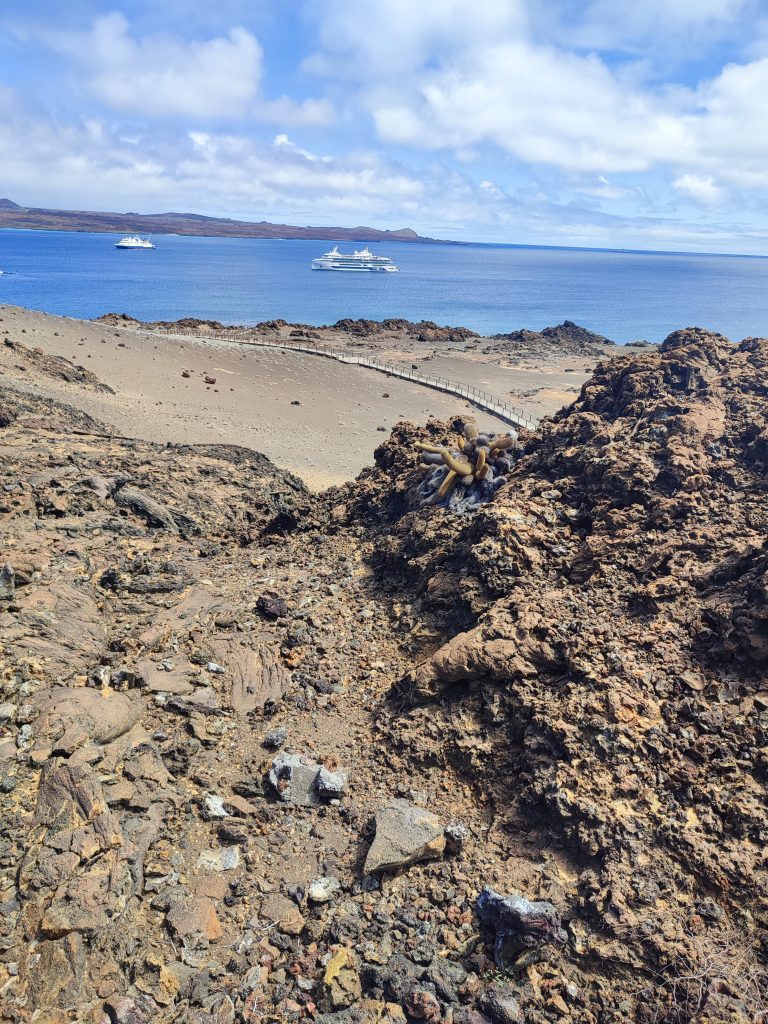
Chinese Hat appears almost exclusively on central and northern itineraries of 5 to 8 days on smaller vessels, typically combined with Sullivan Bay on Santiago Island in the same excursion day. The combination works well: Chinese Hat in the morning for the trail and channel snorkel, Sullivan Bay in the afternoon for the pahoehoe lava field walk. Together they cover one of the most geologically varied single-day experiences available in the central Galapagos. Chinese Hat is not on most standard itineraries for larger vessels and is specifically a smaller-vessel experience.
| Itinerary Type | Chinese Hat Likely? | Typically Paired With | Vessel Size |
|---|---|---|---|
| 5-day central (small vessel) | Sometimes; depends on routing | Sullivan Bay; Bartolomé | Small yacht or catamaran; 16 to 20 guests |
| 7 to 8-day central/northern (small vessel) | Commonly included | Sullivan Bay same day; Rábida or Bartolomé next day | Small vessel required |
| Large vessel itineraries | Not accessible | N/A; alternative central stops substituted | Access restriction prevents large vessel visits |
| Day trip from Santa Cruz | Rarely included in standard tours | Occasionally with Sullivan Bay or Rábida | Small speedboat or yacht; uncommon |
The direct answer to “Is Chinese Hat worth a cruise stop?” is yes, specifically and not generically. It is worth it for the channel snorkel quality, which multiple operator reviews from 2022 through 2025 rate among the best single-site snorkel experiences in the central archipelago. It is worth it for the lava tube geological intimacy, which is not replicated at the same accessible scale at any other central-island stop. And it is worth it for the uncrowded, small-vessel experience that the access restriction guarantees: whatever the wildlife encounter quality, you will share Chinese Hat with at most one other small vessel rather than the multi-group landings common at more accessible sites.
What it is not worth comparing to is Bartolomé’s summit view or Española’s albatross colony. Chinese Hat is not trying to deliver those experiences and does not. It delivers a geological and snorkel experience at an intimate, small-island scale that complements the larger dramatic stops on the same itinerary rather than competing with them. If your itinerary includes Chinese Hat, know what to ask for: the Santiago coast snorkel, a guide stop at the lava tubes, and enough time at the trail’s end cliff viewpoint to scan the rocks below for penguins. Tell us your planned vessel size and itinerary and we will confirm whether Chinese Hat is included and what the typical schedule allows.
Santiago delivers a side of the Galapagos that feels wilder and less visited than the central island staples. Here’s a guide on what to expect on a Santiago island cruise visit so you arrive knowing what the island actually offers.
Frequently Asked Questions
Why is Chinese Hat restricted to small vessels?
The Galapagos National Park restricts Chinese Hat to smaller cruise vessels due to the fragile lava ecosystem and the limited capacity of the landing area. The channel between Chinese Hat and Santiago is not deep enough for larger vessels to anchor safely, and the small island’s surface cannot absorb the visitor numbers that mid-size or large cruise ships carry without unacceptable impact on the lava formations and pioneer plant communities. The restriction is enforced year-round. If you are comparing cruise options and one itinerary includes Chinese Hat while another does not, the vessel size is likely the determining factor.
Can you see penguins at Chinese Hat?
Yes, with moderate reliability. Galapagos penguins are present on the rocks of both Chinese Hat and the Santiago coast opposite, and in the channel water during active hunting periods. Snorkelers who cross to the Santiago coast side of the channel and spend 30 to 40 minutes in the water see penguins in the water roughly 40% of the time based on traveler reporting. Penguins on the rocks above the snorkel zone are visible from the water surface and from the trail viewpoint at the trail’s end. Chinese Hat is not the most reliable penguin snorkel in the Galapagos, but penguin presence is consistent enough that it should be considered a reasonable expectation rather than a lucky bonus.
What makes the Chinese Hat snorkel different from other central island snorkels?
The channel setting between Chinese Hat and Santiago creates a sheltered, relatively deep snorkel environment that attracts species not reliably present at open-bay sites. The Santiago coast side of the channel has more structural complexity from the larger island’s lava formations, more algae that attracts marine iguanas feeding underwater, and deeper water that supports white-tip reef sharks, rays, and the pelagic species that move through the channel between the two islands. The calm water and species variety combine to produce what multiple traveler reviews from 2022 through 2025 describe as the best single-site central-island snorkel encounter of their cruise.
Is Chinese Hat usually combined with Sullivan Bay on the same day?
Yes, on most itineraries that include both. Sullivan Bay, the extensive pahoehoe lava field on Santiago Island’s eastern coast, is typically visited in the afternoon following a morning stop at Chinese Hat. The combination covers an unusual range of geological experience in a single day: the intact lava tubes and pillow lava of Chinese Hat in the morning, the open pahoehoe flow field with tree branch impressions at Sullivan Bay in the afternoon. If your itinerary lists Chinese Hat, check whether Sullivan Bay is also scheduled for the same day or whether only one of the two is included.
Is Chinese Hat on Your Itinerary?
Chinese Hat is a small-vessel exclusive stop that consistently over-delivers for travelers who know what to expect and specifically request the Santiago coast snorkel and a guide stop at the lava tubes. It is not the most famous island in the Galapagos and it is not trying to be. What it offers is geological intimacy, an excellent channel snorkel, and the uncrowded small-vessel experience that the access restriction guarantees. We know which current itineraries include Chinese Hat with adequate time for both activities, which operators schedule the visit for morning low tide to maximize the marine iguana snorkel and oystercatcher feeding windows, and which guides have the geological knowledge to make the lava tube stop informative rather than a brief pause on the way to the viewpoint. Tell us your vessel size preference and target islands and we will find the itinerary that fits.
Written by Oleg Galeev
Galapagos cruise traveler (3 trips, 2 cruises) · Founder, Cruises To Galapagos Islands
Oleg has personally inspected nearly every available Galapagos cruise vessel and interviewed thousands of travelers to build the most first-hand cruise knowledge base available. He also runs the Ecuador travel blog mytrip2ecuador.com and the YouTube channel My Trip to Somewhere.
Cruises To Galapagos Islands is rated 4.9 stars on Google and TripAdvisor.
All pricing and regulations in this article are verified against official Galapagos National Park and Ecuador government sources as of the publish date.