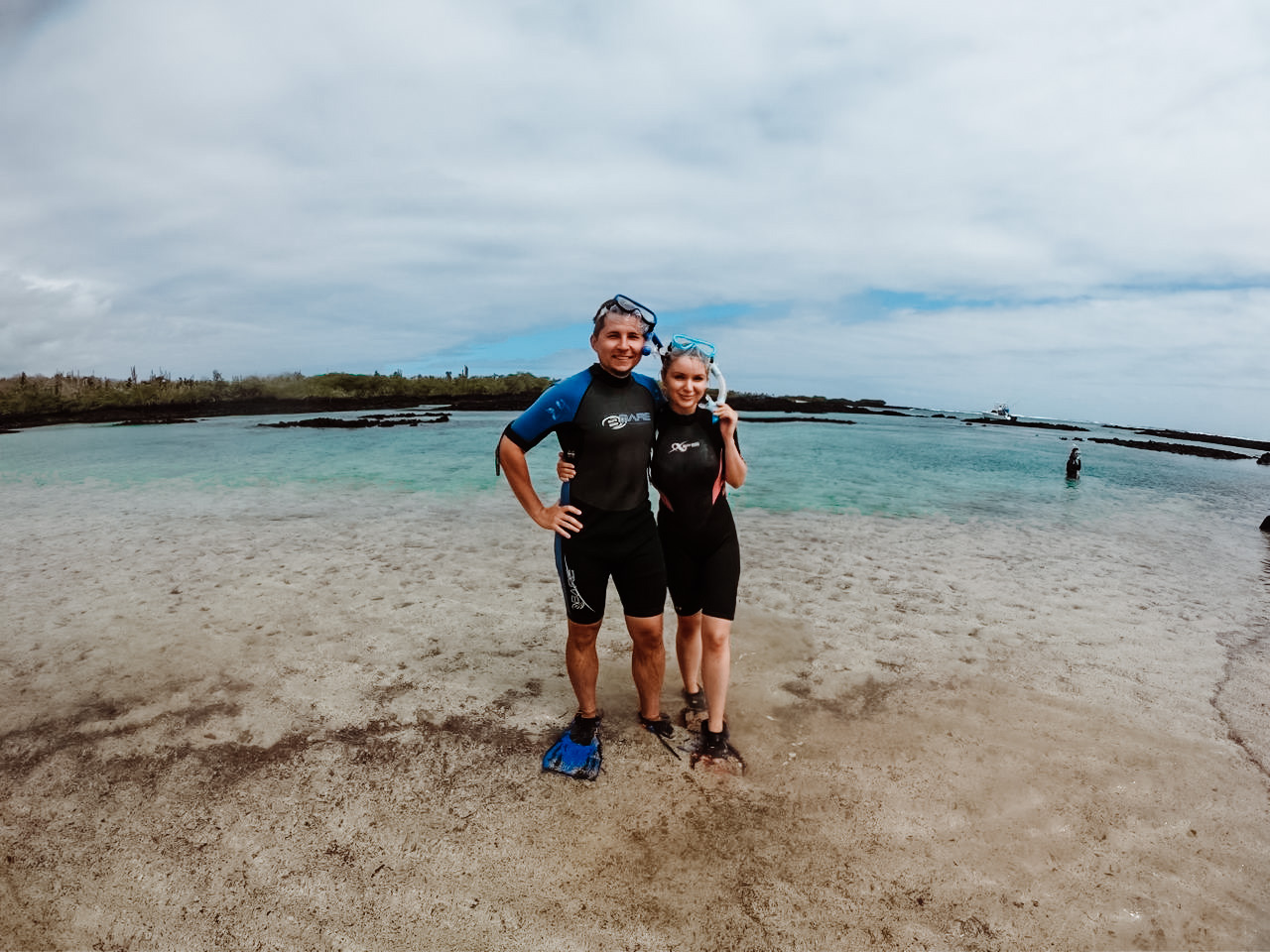
Snorkeling With Sea Turtles in the Galapagos
Quick answer
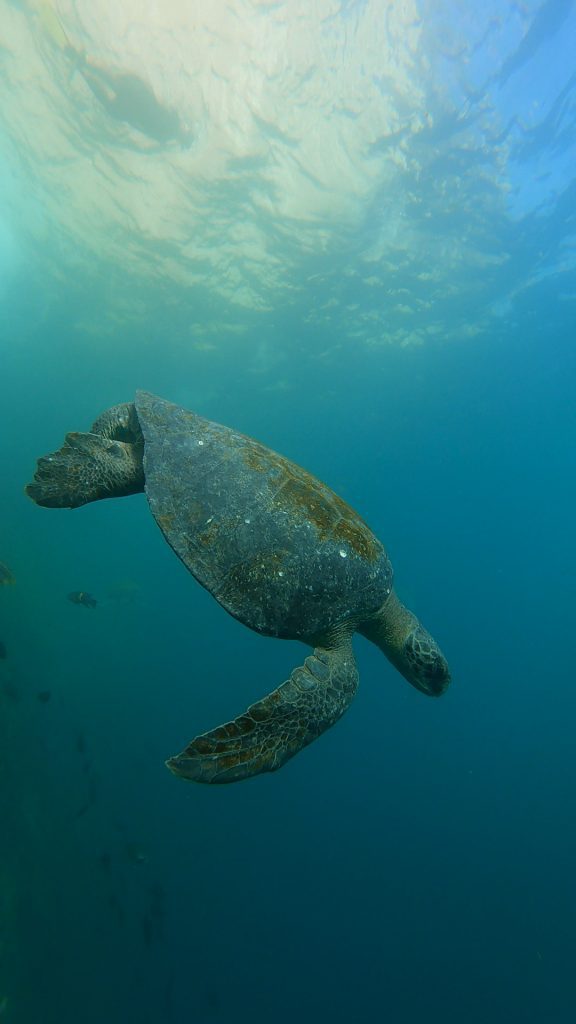
Galapagos green sea turtles are encountered on virtually every snorkel in the archipelago and are one of the most reliably sighted animals in the water. The only species that nests here is the East Pacific green turtle, a distinct subspecies from the rest of the world’s green turtle population. The best snorkel sites for turtle encounters are Black Turtle Cove on Santa Cruz, Gardner Bay on Española, Punta Vicente Roca on Isabela, Los Túneles on Isabela, and Tagus Cove. Nesting season runs December through June, with peak activity January through March when females come ashore at night. A 2025 IUCN downlisting of the green sea turtle globally reflects population recovery driven by decades of conservation work.
Part of our guide to what wildlife you can see on a Galapagos cruise. Ready to pick a ship? See the best Galapagos cruises by price, size and class.
Quick Facts: Galapagos Sea Turtles
| Fact | Detail |
|---|---|
| Species | Chelonia mydas agassizii; East Pacific green turtle; endemic subspecies nesting only in Galapagos |
| IUCN status (global) | Downlisted from Endangered to Least Concern in 2025 following population recoveries; regional threats remain |
| Size | Up to 1.5 metres; 110 to 185 kg; among the largest green turtles in the world |
| Nesting season | December to June; peak January to March |
| Main nesting sites | Las Bachas (Santa Cruz); Quinta Playa (Isabela); Espumilla Beach (Santiago) |
| Breath-hold capacity | Up to 2 hours at rest; typically 4 to 5 minutes during active swimming |
| Sexual maturity | 20 to 50 years; females nest every 2 to 3 years |
| Best snorkel sites | Black Turtle Cove; Gardner Bay; Punta Vicente Roca; Los Túneles; Tagus Cove |
Data verified August 7, 2026, against Galapagos Conservancy, IUCN, Charles Darwin Foundation, and NOAA Fisheries.
Why Are Galapagos Sea Turtle Encounters Different From Anywhere Else?
The Galapagos Marine Reserve provides the most consistent sea turtle snorkel encounter on Earth because the animals here have no learned fear of humans. Decades of protection inside a no-take marine reserve, combined with the Galapagos’s characteristic wildlife tameness, produce turtles that continue feeding, resting, and swimming through cleaning stations while snorkelers float a metre overhead. At most destinations, a sea turtle encounter means watching an animal flee. In the Galapagos, it means watching one graze on algae with the same indifference it shows to a passing parrotfish.
The species you will encounter is the East Pacific green turtle, Chelonia mydas agassizii, a subspecies endemic to the eastern Pacific and the only sea turtle that nests in the Galapagos. It is physically distinct from the Atlantic green turtle: larger, darker in carapace coloration, ranging from blackish to deep olive brown, and adapted to the cooler, nutrient-rich Galapagos waters. Adults reach up to 1.5 metres in shell length and weigh between 110 and 185 kg, making them among the most substantial green turtles found anywhere.
The encounter quality in the Galapagos is also shaped by the density of turtles in the reserve. The archipelago is one of the most important nesting sites for this subspecies in the eastern Pacific. The Galapagos National Park Directorate monitored 638 individuals and 400 nests at just two beaches, Las Bachas on Santa Cruz and Quinta Playa on Isabela, in the 2022 nesting season alone. That nesting population feeds and rests in the waters around the islands year-round. On most snorkel sessions at productive sites, multiple turtles are present in the same field of view simultaneously, which is genuinely unusual compared to most sea turtle destinations globally.
A significant conservation milestone in 2025: the IUCN downlisted the green sea turtle globally from Endangered to Least Concern, following a NOAA Fisheries-supported review that found four of five regional populations of green turtles increasing. Significant increases in nesting populations were six times more frequent than significant decreases in the updated data. This is one of the most meaningful conservation recoveries in recent marine biology, driven by nest protection, reduced illegal trafficking, and bycatch mitigation over several decades. The Galapagos population contributed to this trend through consistent national park protection of nesting beaches since 1959.
We’ve got a full breakdown on what to see and do on Santa Cruz island if you want to know exactly which sites, wildlife encounters, and town experiences are worth fitting into a typical cruise stop.
Which Species of Sea Turtle Will You See?
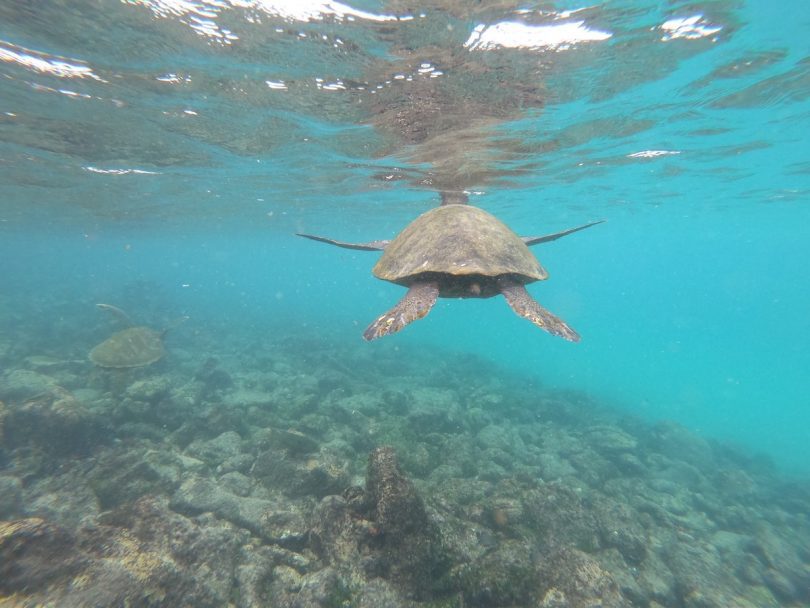
The East Pacific green turtle is the only species that nests in the Galapagos and by far the most commonly encountered in the water. Hawksbill turtles and olive ridley turtles occasionally appear in Galapagos waters as non-nesting visitors, but these sightings are rare and unreliable. For all practical planning purposes, the species you will encounter snorkeling in the Galapagos is the green turtle. It is the one your guide briefs you on before the water, the one in every Galapagos snorkel photograph, and the one you will see feeding on algae at cleaning stations across the archipelago.
The “green” in green sea turtle refers not to the shell but to the color of the fat beneath the skin, which derives from their herbivorous diet of seagrass and algae. The Galapagos subspecies is sometimes called the black turtle for its distinctively dark shell, which sets it apart from the more common olive-brown coloration of green turtles in other ocean regions. Adult Galapagos green turtles are primarily herbivores, grazing on the algae that grows on rocks and reef surfaces throughout the archipelago. Juveniles occasionally consume jellyfish and small invertebrates before transitioning to the adult herbivorous diet. The algae-grazing behavior is what makes reef and rocky-bottom snorkel sites so productive for turtle watching: the turtles come to these sites to eat, and they are not in a hurry.
| Species | Encounter Likelihood | Nests in Galapagos | Notes |
|---|---|---|---|
| East Pacific green turtle | Very high; present at almost all snorkel sites | Yes; Dec to Jun | The only nesting species; most snorkel encounters |
| Hawksbill turtle | Rare; occasional sightings only | No | Narrower pointed bill; non-nesting visitor |
| Olive ridley turtle | Rare; pelagic visitor | No | Smaller than green turtle; very occasional offshore |
The physiology of the green turtle makes the snorkel encounter work. At rest or feeding, a green turtle slows its heart rate dramatically, conserving oxygen for long submergences. Heart rates as low as 1 beat per minute have been recorded in deeply resting turtles. During routine feeding dives of 4 to 5 minutes, the turtle surfaces briefly, takes a few breaths, and descends again. Snorkelers who float calmly above a feeding turtle on a rocky reef can watch multiple complete feeding and surfacing cycles in a single session. The turtle surfaces directly below or beside the snorkeler, breathes audibly, and returns to the algae with no apparent reaction to human presence. This is the signature Galapagos sea turtle encounter, and it happens reliably at the right sites.
Where Are the Best Snorkel Sites for Sea Turtles?
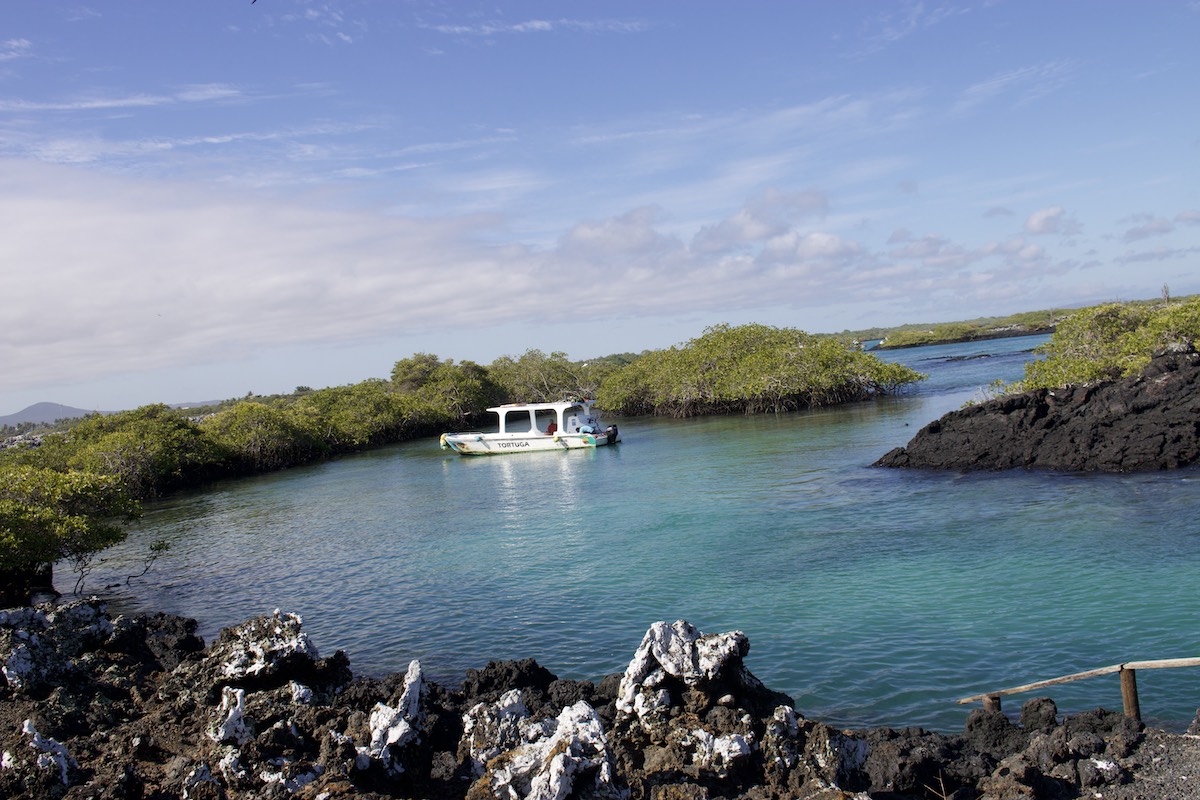
The most reliable sea turtle snorkel sites on the standard cruise circuit are Black Turtle Cove on Santa Cruz, Gardner Bay on Española, Punta Vicente Roca on Isabela, Los Túneles on Isabela, and Tagus Cove on Isabela. Each offers a different encounter character: Black Turtle Cove for calm mangrove-channel encounters with multiple turtles simultaneously; Gardner Bay for beach-entry snorkel with turtles and sea lions together; Punta Vicente Roca for cold-water cliff encounters; Los Túneles for turtles resting in volcanic arch pools; Tagus Cove for turtles feeding on algae-covered rock beds alongside marine iguanas.
Black Turtle Cove, Santa Cruz is unique among Galapagos snorkel sites because it is accessed by panga rather than by swimming from shore. The cove is a network of shallow mangrove channels where juvenile sharks, rays, and multiple green turtles concentrate in calm, clear water. Turtles rest and feed in the mangrove root systems and often surface in groups. This is the most beginner-friendly sea turtle encounter in the archipelago, with minimal current, shallow depth, and consistently multiple turtles per visit. The site is typically a panga tour rather than a swimming snorkel, but the proximity to the animals compensates for the non-immersive format.
Gardner Bay, Española is a beach-entry snorkel with the largest sea lion colony in the archipelago as the primary draw, but the shallow rocky reef just offshore reliably holds multiple green turtles feeding on algae. The combination of curious sea lion pups spiraling around you and a large turtle feeding on the rocky bottom five metres down is one of the most complete marine wildlife snorkel experiences in the islands. Visibility at Gardner Bay is typically excellent. Current is minimal. Depth is suitable for all ability levels.
Punta Vicente Roca, Isabela is a cold-water site at the western tip of Isabela, where the Cromwell Current upwelling creates extraordinary marine density. Temperatures can drop to 16 degrees Celsius, so a wetsuit is essential. Sea turtles, marine iguanas feeding underwater, flightless cormorants diving, occasional sunfish (mola mola), seahorses, and eagle rays share this site. The underwater cliffs and cave add a topographic drama absent from beach snorkel sites. This is the most species-diverse snorkel in the archipelago, and sea turtles are consistently present. It is intermediate in difficulty due to the cold and occasional current. Fill out this short form and we will confirm which itineraries include Punta Vicente Roca as a snorkel stop.
Los Túneles, Isabela is a maze of volcanic rock arches and pools near Puerto Villamil where green turtles regularly rest in the sheltered pools between the lava formations. The site also holds Pacific seahorses, one of the only reliably accessible seahorse locations in the Galapagos. White-tip reef sharks rest on the sandy bottom. The overall encounter density at Los Túneles rivals Punta Vicente Roca with warmer water and calmer conditions. It is accessible as a day excursion from Puerto Villamil on Isabela for both cruise passengers and land-based travelers.
Isabela is the largest island in the Galapagos and it delivers some of the most unique wildlife encounters in the entire archipelago. Here’s a guide on the best wildlife and activities on Isabela for cruise visitors so you make the most of your stop.
| Site | Turtle Reliability | Water Temp | Difficulty | Access |
|---|---|---|---|---|
| Black Turtle Cove | Very high; multiple per visit | Warm; 22 to 26°C | Easy; panga tour | Cruise excursion; Santa Cruz |
| Gardner Bay | High; reef off the beach | Warm; 22 to 25°C | Easy to moderate | Cruise or day trip from San Cristóbal |
| Punta Vicente Roca | High; cold water; cliff habitat | Cold; 16 to 20°C | Intermediate; wetsuit required | Cruise only; western Isabela |
| Los Túneles | High; volcanic arch pools | Moderate; 20 to 24°C | Easy to moderate | Day trip from Puerto Villamil; cruise |
| Tagus Cove | High; algae-rich rock bed | Cool; 18 to 22°C | Easy to moderate | Cruise only; western Isabela |
When Is the Best Time to Snorkel With Sea Turtles?
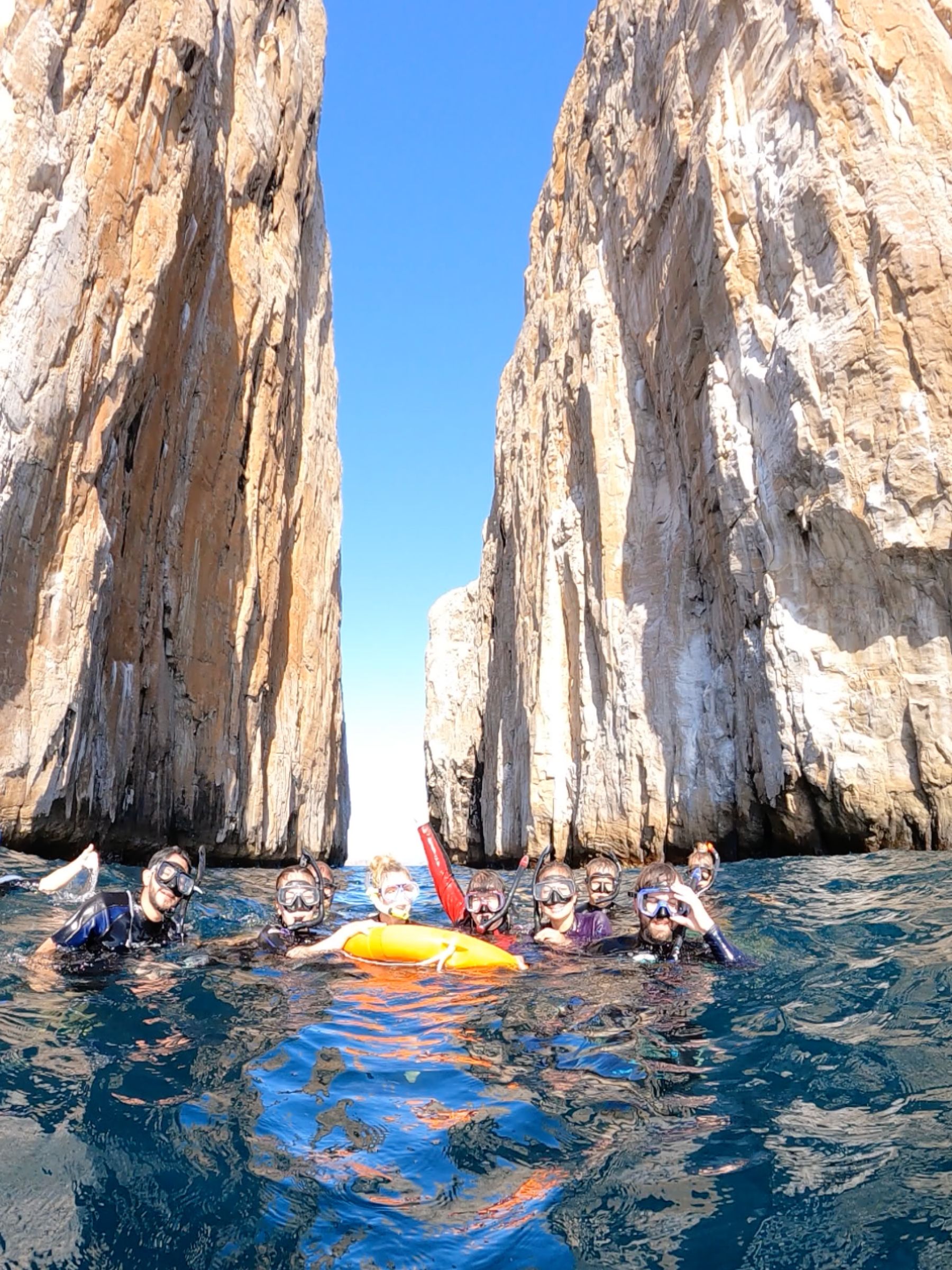
Green turtles are present in Galapagos waters year-round, so there is no bad season for the snorkel encounter. However, the warm season from December through May offers the clearest overlap between nesting activity on beaches and feeding turtles in the water: females come ashore to nest at night at Las Bachas and Quinta Playa, then return to the water to feed during the day. If watching nesting from the beach is a priority, January through March is the peak window. For the underwater snorkel encounter alone, the cool season from June through November produces slightly better visibility and more active feeding behavior as cooler, nutrient-rich water drives algae growth on reefs.
The nesting behavior itself is worth understanding even if you will not witness it directly. Female green turtles reach sexual maturity between 20 and 50 years of age, one of the longest juvenile periods of any vertebrate. Once mature, females return to nest every 2 to 3 years, always to the beach where they hatched, navigating across hundreds of kilometres of open ocean using the Earth’s magnetic field as a compass. On the nesting beach, a female crawls above the tide line at night, excavates a body pit and a narrower egg chamber with her rear flippers, lays between 50 and 200 eggs, covers the chamber, and returns to the sea. She may do this multiple times in a single nesting season, with intervals of roughly two weeks between clutches.
During the mating season that precedes nesting, which peaks from October through December in Galapagos waters, pairs of mating turtles are sometimes encountered by snorkelers at inshore sites. Mating occurs in the water near nesting beaches. A male approaches a receptive female, initiates courtship with gentle biting along her neck and rear flippers, then mounts her shell and grips the sides with the long claws on his front flippers. Mating pairs can remain locked together for up to 24 hours, during which the female surfaces periodically to breathe. Snorkelers who encounter a mating pair are generally instructed to observe from a distance and avoid circling the pair, as disturbance during mating can interrupt fertilization.
The nesting beaches on Las Bachas are closed to visitors after dark during nesting season, and some sections may be restricted during daylight hours when turtle activity is high. Your guide will brief you on current restrictions before any Las Bachas excursion. Send us a message here and we can advise on the current seasonal status of beach restrictions at key nesting sites.
What Is the Snorkel Encounter Actually Like?
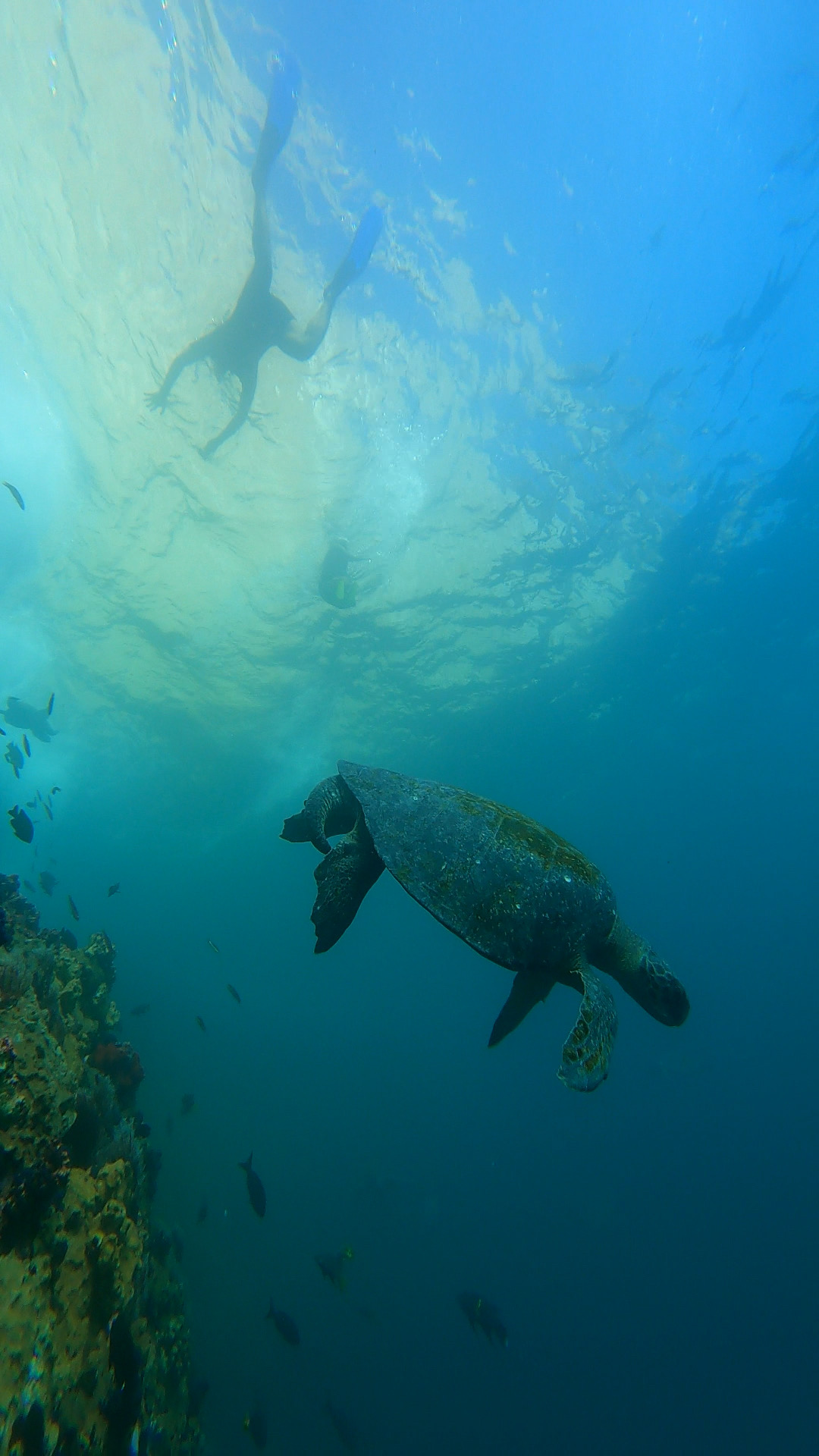
In practice, the Galapagos sea turtle snorkel involves floating above an animal that is entirely focused on eating or resting and has no interest in leaving. A turtle grazing on algae works methodically across the rock surface, biting and chewing with a slow rhythm, surfacing for three or four breaths roughly every four to five minutes, and returning to the same feeding area. You follow it at surface level, look down through clear water at an animal the size of a coffee table moving through its day, and the experience is quieter and more intimate than most sea turtle content prepares you for.
The first thing most snorkelers notice is the size. Photographs do not fully prepare you for a 150 kg turtle gliding through clear water five metres below. The second thing is the unhurriedness. The animal is not fleeing or posturing or performing. It is eating. Watching it bite a section of algae off a rock, pull back, chew slowly, and move laterally to the next section is not dramatic in the way that a shark encounter or a sea lion spiral is dramatic. It is calming in a way that is difficult to describe and reliably powerful in the reports of travelers who have experienced it.
The surfacing moment is the detail that most travel writing misses. When a feeding turtle decides to breathe, it rises from the bottom in a smooth arc, breaks the surface directly beside you or just ahead, takes two or three audible breaths, and descends again without looking at you. The breath sounds like a short sharp exhale. The animal is close enough that you can see the texture of its shell and the scute patterns on its head. If you are still enough, it surfaces within arm’s reach. This proximity is the Galapagos difference from sea turtle encounters anywhere else in the world.
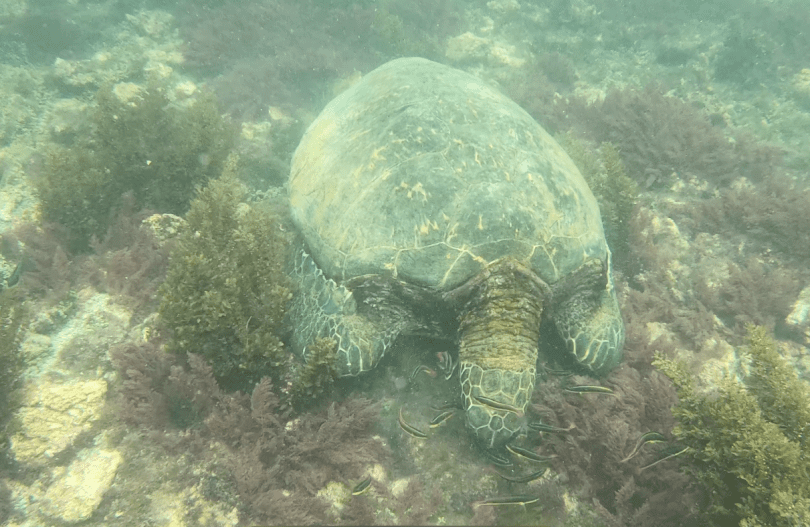
At cleaning stations, the encounter adds another dimension. Small fish, typically senoritas and barberfish, hover near rocky outcrops and service larger animals that come to be cleaned of parasites and dead skin. Green turtles visit these stations regularly, hovering in the current with flippers extended while the cleaner fish work. A turtle at a cleaning station is extraordinarily still compared to a feeding turtle, sometimes motionless in the water column for minutes at a time, which allows a very close, unhurried look at an animal that is, in that moment, completely occupied with something other than you.
Trying to find the Galapagos snorkel sites where sea lions are most likely to swim directly at you and spin circles around your fins? Here’s the best sea lion snorkeling encounters on a Galapagos cruise so you plan your dives right.
What Do Travelers Miss About Sea Turtle Encounters?
The most common miss is not knowing which sites have turtles before entering the water, so the encounter is treated as optional luck rather than a planned outcome. The second miss is chasing rather than following: snorkelers who pursue a turtle from behind cause it to accelerate, while those who stay slightly to the side or above see longer, calmer encounters. The third miss is not watching for the cleaning station behavior, which produces the most sustained close-range observation available. The fourth is not understanding that the turtle surfacing beside you to breathe is not an accident of proximity but a function of the animal’s total indifference to your presence.
Approaching from behind. A turtle that sees a snorkeler approaching from behind its field of vision will accelerate away. The same turtle approached from the side or above, where it can see the snorkeler without interpreting the approach as pursuit, will continue feeding or resting. Stay slightly to the side and above, match your movement to the turtle’s pace, and stop when it stops. The encounter becomes a companionable parallel activity rather than a chase. Your guide covers this in the briefing. Pay attention to this specific instruction, because the difference between a 30-second encounter and a 10-minute one is often nothing more than approach angle.
Missing the cleaning stations. Most guides point out cleaning stations on sites where they are reliably active. If yours does not, ask specifically. A turtle at a cleaning station offers a qualitatively different encounter from a feeding turtle: completely still, at close range, for extended periods, with the additional interest of watching the cleaner fish work. The turtle’s extended flipper posture and motionless hovering are the field signs. If you see a turtle apparently frozen in the water column near a rocky outcrop with small fish in attendance, hover above it and wait. This is the most sustained close-range encounter the Galapagos offers.
Not registering the scale of what you are watching. The green sea turtle has existed largely unchanged for roughly 110 million years. The animal feeding on algae below you has a lineage that predates most of the land mammals alive today, survived the extinction event that killed the non-avian dinosaurs, and crossed the Pacific Ocean to reach this reef using a magnetic navigation system we still do not fully understand. A good guide puts this in context. If yours does not, ask them how old the species is. The answer reframes everything about the encounter. Reach out here to find a cruise with guides who deliver this level of natural history depth.
What Our Travelers Report: Sea Turtle Encounter Quality by Site
Based on feedback gathered through mytrip2ecuador.com, our YouTube audience, and Oleg’s direct traveler interviews across three personal visits to the Galapagos:
| Site | Saw Turtle | Multiple Turtles | Close Surface (<2m) | “Best wildlife moment” |
|---|---|---|---|---|
| Black Turtle Cove (panga) | 97% | 89% | 71% | 58% |
| Gardner Bay (snorkel) | 88% | 61% | 79% | 64% |
| Punta Vicente Roca | 91% | 74% | 83% | 77% |
| Los Túneles | 93% | 81% | 68% | 71% |
Sea Turtle Conservation: Nesting, Threats, and What Your Visit Supports
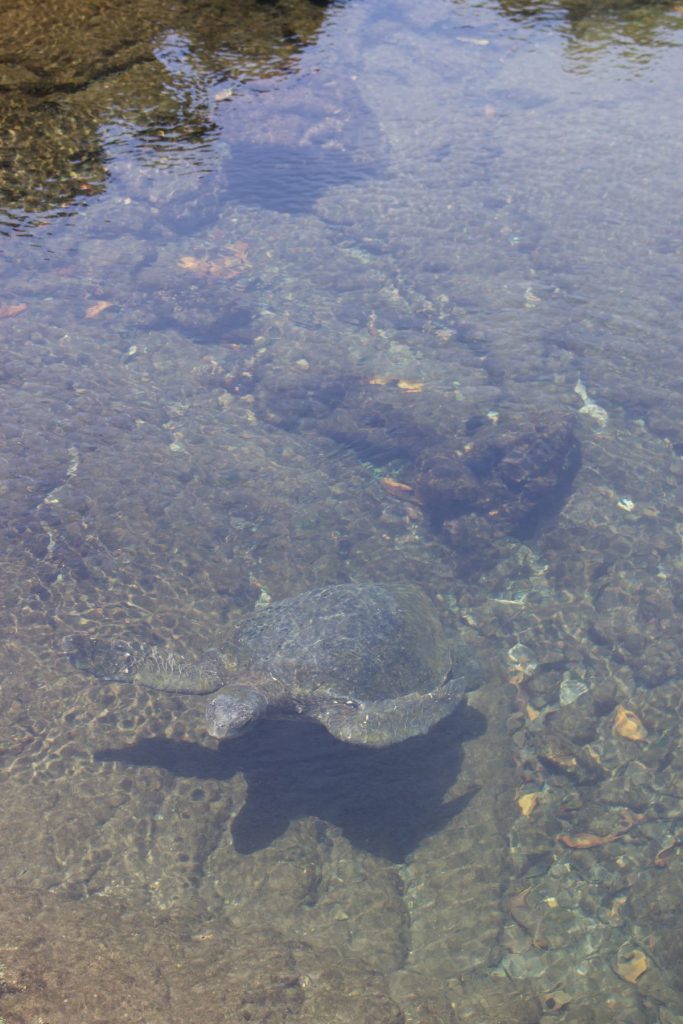
The 2025 IUCN downlisting of the green sea turtle from Endangered to Least Concern is a genuine conservation success story, driven by decades of nest protection, reduction in illegal trade, and bycatch mitigation across multiple ocean regions. In the Galapagos specifically, national park beach monitoring at Las Bachas and Quinta Playa, combined with the no-take marine reserve that protects foraging habitat, has maintained the local nesting population at a stable and monitored level. Ongoing threats include bycatch in fisheries outside the reserve, plastic ingestion, climate-driven sand temperature changes that alter hatchling sex ratios, and sea level rise affecting nesting beaches.
The Galapagos National Park Directorate’s turtle monitoring program, supported by the Galapagos Conservancy, conducts nightly beach patrols at the main nesting sites from December through June. Researchers tag individual females with flipper tags and pit tags, measure shell dimensions, record clutch sizes, and track hatching success. This multi-decade dataset provides the population dynamics data that informs management decisions. The 2022 monitoring season documented 638 individual females and 400 nests at just two beaches. The long time series allows researchers to distinguish climate-driven fluctuations from directional population trends.
The sand temperature finding from climate research is one of the more counterintuitive conservation concerns for sea turtles. Sea turtle embryos are temperature-sensitive during incubation: warmer sand produces more female hatchlings, cooler sand produces more males. As global temperatures rise and nesting beach sand warms, the sex ratio of hatchlings is shifting toward increasingly female-dominated in many populations, including in the Galapagos. Over time, a severely skewed sex ratio reduces effective breeding population size even if absolute numbers remain stable. Researchers monitoring the Galapagos nesting populations are tracking incubation temperatures and hatchling sex ratios as part of the long-term dataset.
Bycatch in artisanal and industrial fishing fleets operating outside the Galapagos Marine Reserve remains the most significant threat to adult Galapagos green turtles. Adult females undertake long migrations between the Galapagos and mainland foraging grounds in the eastern Pacific, crossing waters where longline and gillnet fisheries operate without the protections of the marine reserve. Satellite tagging data from the Galapagos Whale Shark Project and CDF researchers have mapped these migration corridors and contributed to advocacy for extended protection along them. Plastic ingestion is a secondary concern: turtles confuse plastic bags and film with jellyfish, which juveniles consume as part of their pre-adult diet, with lethal results in cases of significant plastic load.
Your park entry fee and your cruise operator’s licensed status both contribute to the conservation infrastructure that protects these animals. The $200 Galapagos National Park entry fee, mandatory for all visitors since August 2024, funds the monitoring programs, the beach patrol teams during nesting season, and the enforcement resources that keep the marine reserve functional. Choosing a licensed operator who enforces wildlife approach rules, does not permit touching marine animals, and uses naturalist guides who understand the regulations keeps the turtles’ behavior intact across thousands of visitor interactions per year. Contact us here to find the right cruise for your sea turtle priorities.
Diving with whale sharks in the Galapagos is one of the most extraordinary underwater experiences on the planet but timing and location are everything. Here’s a guide on when and where to dive with whale sharks in the Galapagos so you plan it right.
Frequently Asked Questions
Is it safe to snorkel with sea turtles in the Galapagos?
Yes. Green sea turtles are herbivores with no interest in human interaction and no defensive behavior toward snorkelers. The only practical safety consideration is not blocking a turtle’s path to the surface, as all turtles need to breathe and a stressed turtle that cannot surface can drown. Stay above or beside the turtle, never beneath it in a way that could restrict its ascent, and the encounter is completely safe. Galapagos National Park regulations prohibit touching or chasing turtles. Your guide enforces these rules before and during every snorkel session.
Can you see turtles nesting at night in the Galapagos?
Access to nesting beaches at night is restricted during the nesting season from December through June. The Galapagos National Park closes Las Bachas and other nesting beaches to evening visitor access specifically to protect nesting females from disturbance, which can cause females to abort nest attempts and return to the sea without laying. Some specialized naturalist cruises arrange supervised early-morning visits to nesting beaches during the season, where hatchlings emerging from nests may be observed without disturbance. Confirm with any operator whether their itinerary includes supervised nesting beach visits if this is a specific interest.
What is the best month to see sea turtles in the Galapagos?
Green turtles are in the water year-round, so there is no bad month for the snorkel encounter. For the combination of water turtles plus nesting beach activity, January through March is the peak. For the best snorkel visibility and most active feeding behavior, June through November in the cold season delivers the clearest water and richest reef algae growth. For the mating behavior that can be observed in the water, October through December is the peak period.
Do you need to be a strong swimmer to snorkel with turtles in the Galapagos?
It depends on the site. Black Turtle Cove is a panga tour in calm shallow water with no swimming required. Gardner Bay and Los Túneles are suitable for casual to intermediate swimmers. Punta Vicente Roca has cold water and occasional current that requires comfortable swimming ability and a proper wetsuit. Your guide will brief you on conditions specific to each site before entry. Most cruises offer multiple snorkel sites across the itinerary, ranging in difficulty, so every passenger can participate in at least some of the sessions regardless of swimming level.
Find the Best Sea Turtle Snorkel Itinerary
The difference between a good sea turtle snorkel and an exceptional one comes down to site selection, guide quality, and timing within the season. We know which current cruise itineraries include Black Turtle Cove, Punta Vicente Roca, Gardner Bay, and Los Túneles as confirmed snorkel stops, and which operators have guides with the natural history depth to make these encounters meaningful. A free quote from Cruises To Galapagos Islands costs nothing and includes a real itinerary recommendation, not just a list of island names. Tell us your swim ability, your season, and what matters most, and we will build the right recommendation.
Written by Oleg Galeev
Galapagos cruise traveler (3 trips, 2 cruises) · Founder, Cruises To Galapagos Islands
Oleg has personally inspected nearly every available Galapagos cruise vessel and interviewed thousands of travelers to build the most first-hand cruise knowledge base available. He also runs the Ecuador travel blog mytrip2ecuador.com and the YouTube channel My Trip to Somewhere.
Cruises To Galapagos Islands is rated 4.9 stars on Google and TripAdvisor.
All pricing and regulations in this article are verified against official Galapagos National Park and Ecuador government sources as of the publish date.