16-Passenger Galapagos Yacht: Why Smaller Is Better
Part of our guide to the types of Galapagos cruises. Ready to pick a ship? See compare all Galapagos cruise ships by price, size and class.
Quick Facts: 16-Passenger Galapagos Yachts
| Category | Details |
|---|---|
| Passenger capacity | Up to 16 (National Park guide maximum per group) |
| Price range | $300-$1,200+/day depending on vessel class |
| Guide ratio | 1:16 maximum; luxury vessels often 1:8 or better |
| Shore group | Entire vessel lands as one group in one panga trip |
| Vessel types available | Monohull motor yacht, catamaran, sailing yacht, trimaran |
| Itinerary lengths | 4-day, 5-day, 7-day, 8-day, 15-day |
| Site access | All standard visitor sites; some sensitive sites limited to 40 passengers or fewer |
| Park entrance fee | $200/adult, $100/child under 12 (USD cash on arrival) |
| TCT card | $20/person (complete online before flight at CGREG portal) |
| Best for | Couples, solo travelers, wildlife enthusiasts, honeymooners |
Prices verified July 20, 2026. Park fees verified against official Galapagos National Park records.
Why 16 Passengers Is the Magic Number in the Galapagos
The Galapagos National Park sets 16 as the maximum number of visitors one certified naturalist guide can legally supervise on shore. A yacht carrying exactly 16 passengers needs exactly one guide and lands as a single unit. That structural fact shapes everything about the experience: how fast you get ashore, how personally your guide knows you, how much flexibility exists on the trail, and how different the trip feels from a larger vessel managing five or six separate groups at the same site.
Roughly 65 of the approximately 80 vessels operating in the Galapagos carry 20 passengers or fewer. The 16-passenger format is the most common configuration. It’s not a coincidence. Operators figured out early that aligning vessel capacity to the National Park’s guide ratio produces the cleanest expedition experience: one boat, one group, one guide, one panga trip to shore. No queuing. No coordinating who goes in which group. No waiting for the third wave of passengers to land before your guide can begin.
The practical effect on shore time is significant. A 16-passenger yacht can have everyone on the trail or in the water within ten minutes of dropping anchor. A 100-passenger ship needs six or seven panga runs, taking 45 minutes or more before the last group lands. Over a week of twice-daily excursions, that difference accumulates into hours of additional wildlife time on a small yacht. Hours, not minutes.
Still comparing vessel sizes before you commit to a Galapagos cruise? This guide on 16 vs 48 vs 100 passengers gives you a straight answer on which size suits which kind of traveler and why it matters more than most people think.
Shore Logistics: 16-Passenger Yacht vs Larger Vessels
| Metric | 16-Passenger Yacht | 50-Passenger Ship | 100-Passenger Ship |
|---|---|---|---|
| Panga trips to land everyone | 1 | 3-4 | 6-7 |
| Time to get all passengers ashore | ~10 minutes | ~25 minutes | ~45 minutes |
| Shore groups per visit | 1 | 3 | 6 |
| Guides per vessel | 1 (sometimes 2 on luxury) | 3 | 6 |
| Itinerary flexibility day-to-day | High | Moderate | Structured |
| Other groups at same visitor site | 2-3 other vessels typical | 1-2 other vessels | Sometimes alone at site |
Estimates based on standard operations. Individual vessels and conditions vary.
What the Shore Experience Actually Looks Like on a 16-Passenger Yacht
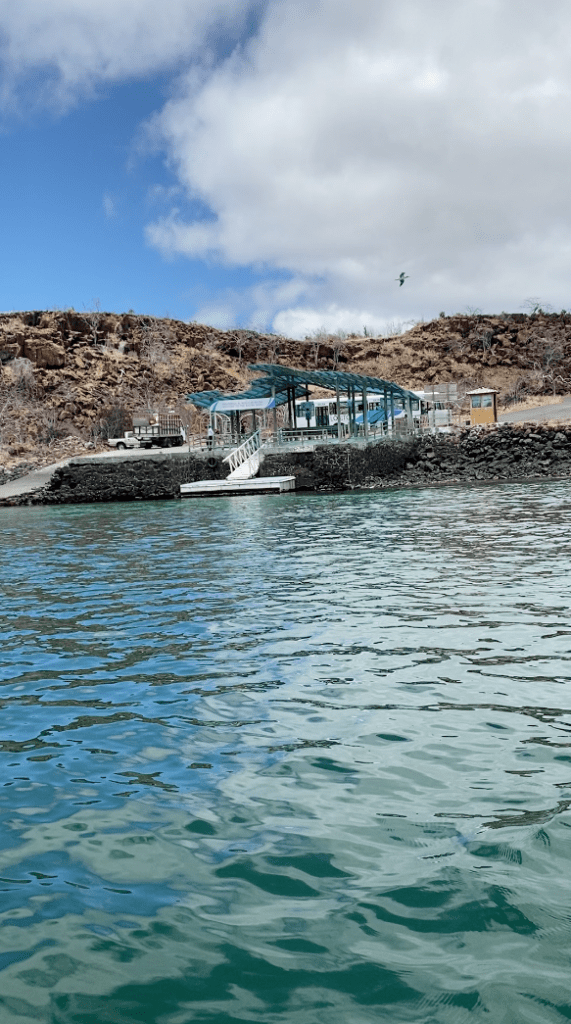
On a 16-passenger yacht, everyone on the boat goes ashore together in a single group with one guide. There is no sorting, no group assignment, no waiting for your wave. The guide leads the same 16 people through every excursion all week, learns individual interests within the first day, and adjusts the pace and depth of explanation accordingly. Shore time typically runs longer than on larger vessels because the logistics of getting everyone back aboard are equally fast.
The moment that best illustrates the difference happened on a western itinerary landing at Punta Espinosa on Fernandina. Our guide slowed the group down near a lava field, pointed to a rock formation, and quietly waited. A camouflaged Galapagos hawk was sitting in plain sight two meters off the trail. Two other boat groups had walked right past it. With 16 people, a guide can afford to slow down, notice things, stop without creating a traffic jam. With 48 or 90 people, the logistics of the group itself work against that kind of observation.
Small yacht shore visits also benefit from anchoring closer to land. Larger ships with deeper drafts cannot always get close enough to the coast to avoid chop in the approach. A 16-passenger yacht, particularly a catamaran, can anchor in shallower protected bays, which means calmer panga rides and sometimes landing at spots that aren’t accessible to larger vessels at all.
Smaller boats get to the landing sites first and larger ships have better stabilizers for rough crossings. Here’s an honest comparison of small yacht vs large cruise ship in the Galapagos so you weigh what actually matters for your trip.
The Guide Relationship: What You Get That Larger Boats Can’t Offer
On a 16-passenger yacht, one guide spends every excursion, every briefing, and every evening recap with the same group all week. By day two, they know who wants the deep ecological explanation and who wants to photograph in silence. By day four, they’re adjusting trail pace, pointing out species specifically for whoever asked about them at breakfast, and making the experience feel tailored in a way that no larger vessel with rotating group assignments can replicate.
Travelers who’ve done the Galapagos on a 16-passenger yacht describe their guide differently from travelers who did it on a larger ship. On a large ship, the guide is described by role: knowledgeable, professional, thorough. On a small yacht, guides are described as people: Venus, who knew where the nesting tropicbirds were. Alex, who grew up on San Cristobal and had been on this same trail a thousand times and still talked about it like he was seeing it fresh. That kind of relationship is not incidental to the experience. It’s the experience, at least as much as the wildlife itself.
There’s a practical dimension too. A guide managing 16 people can answer your specific question without losing the group. They can stop for an unexpected behavior without the group crowding in. They can read energy levels and adjust pacing without coordinating with other guide teams. These are operational advantages that compound across seven days into a meaningfully different kind of trip.
Cabins, Food, and On-Board Life on a Small Yacht
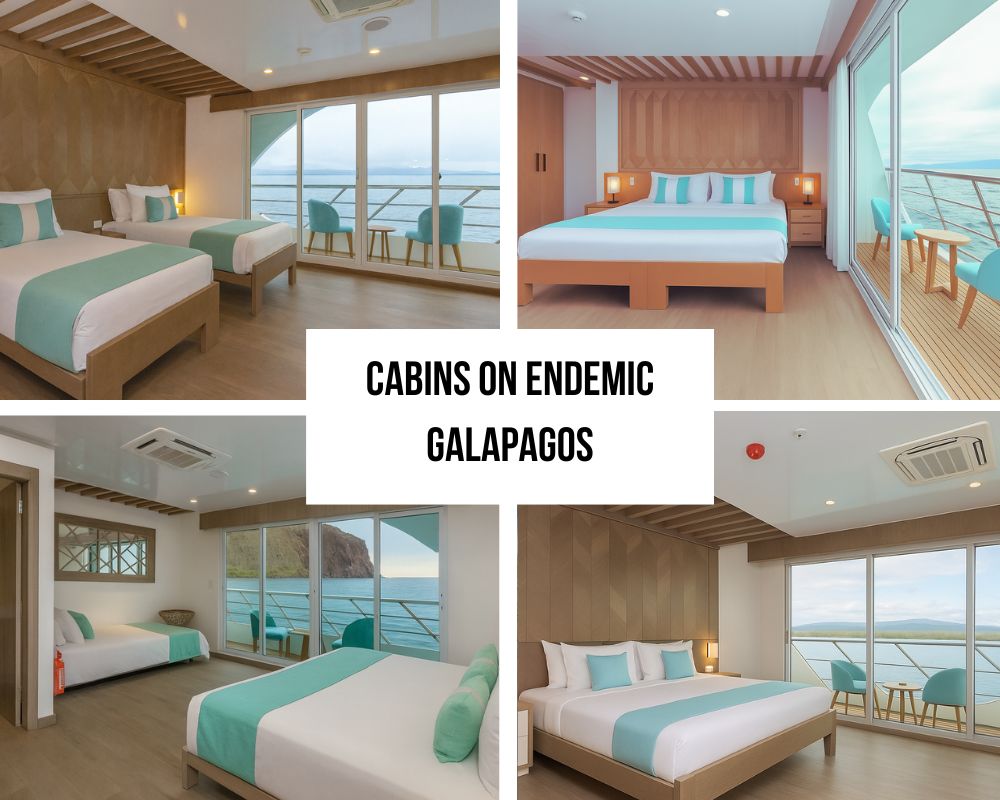
Cabin size, food quality, and amenities on 16-passenger yachts vary more than at any other vessel size, because this format spans every price tier from basic tourist class to ultra-luxury. A $300/day tourist class 16-passenger yacht has compact cabins, simple meals, and minimal social space. A $1,200/day luxury 16-passenger catamaran like the Endemic has suite-level cabins with private balconies, a Relais and Chateaux-level kitchen, and a crew ratio approaching 1:1. Vessel class matters more than passenger count when evaluating on-board life.
The social dynamic on a 16-passenger yacht is worth thinking about specifically. You will spend a week in close proximity to the same 15 people. That is genuinely wonderful when the group chemistry works, and something you simply have to manage when it doesn’t. Larger ships give you social escape valves that a small yacht cannot. Solo travelers and couples who are comfortable with a tight-knit group dynamic tend to love it. Families with young children find the intimacy more of a constraint.
We’ve got a full breakdown on Galapagos cruise cabin types if you want to know exactly how the options compare on size, location, natural light, and what you actually give up by going with the cheaper berth.
What to Expect On-Board by Price Tier (16-Passenger Yachts)
| Feature | Tourist Class ($300-$400/day) | Tourist Superior ($400-$600/day) | Luxury ($800-$1,200+/day) |
|---|---|---|---|
| Cabin beds | Bunks or narrow twin | Twin or double | Queen or king; some with balconies |
| Air conditioning | Limited or none | Yes | Yes, full |
| Food quality | Simple Ecuadorian; functional | Good; varied | Gourmet; locally sourced |
| Guide certification | Certified; English variable | Level II; strong English | Level III; university degree; 10+ years field |
| Snorkeling gear | Often extra cost | Usually included | Included; wetsuit included |
| Jacuzzi | No | Rare | Common |
| Open bar | No | No | Usually included |
| Shore group size | All 16 together | All 16 together | All 16 together; some offer 1:8 guide ratio |
Prices and inclusions verified July 2026. Individual vessels vary.
The range within 16-passenger yachts is wider than any other vessel category. Knowing which specific boats deliver at each price tier requires more than reading a spec sheet. We’ve inspected most of them. Send us a message here and we’ll match you with the right vessel for your budget and travel style.
Best 16-Passenger Galapagos Yachts Worth Booking
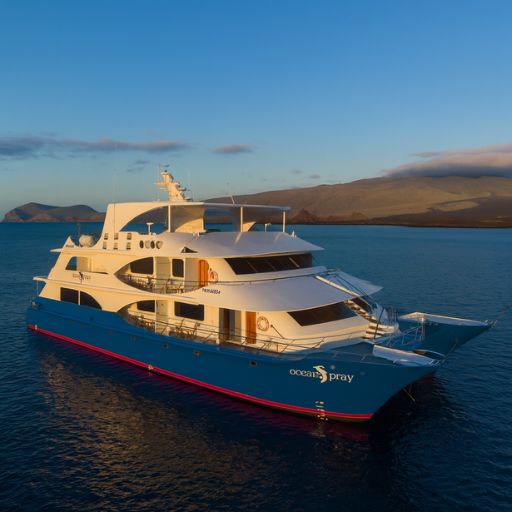
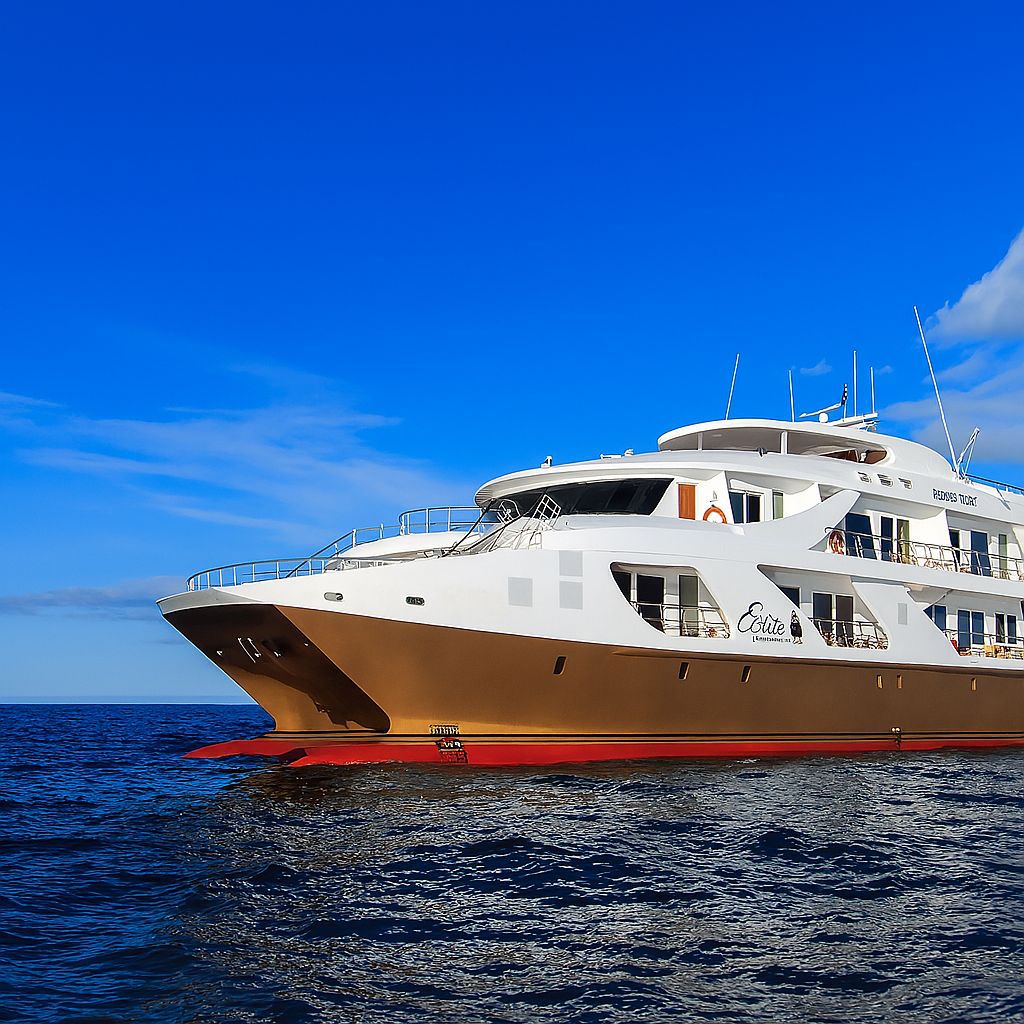
The strongest 16-passenger yachts have been purpose-built or comprehensively refitted for Galapagos conditions, carry guides with multi-year tenure on the same vessel, and receive reviews that name the guide and describe specific wildlife moments. At the luxury end: the Endemic (catamaran, private balconies, best-in-class stability), the Elite (newest luxury catamaran, panoramic windows, sky deck), and the Ocean Spray (purpose-built catamaran, 4 to 15-day itineraries). At mid-range: the Galaxy Sirius, Seaman Journey, and Letty are consistently reliable across years of traveler feedback.
Notable 16-Passenger Galapagos Yachts by Traveler Profile
| Vessel | Class | Hull Type | Best For | Notable Feature |
|---|---|---|---|---|
| Endemic | Luxury | Catamaran | Honeymooners, wildlife depth | Private balcony every suite; best stability |
| Elite | Luxury | Catamaran | Modern design lovers | Newest luxury small yacht; panoramic windows |
| Ocean Spray | Luxury | Catamaran | Western itinerary, longer trips | Purpose-built; 4-15 day itineraries |
| Galaxy Sirius | First Class | Catamaran | Wildlife density, value | Strong guide tenure; western itinerary standout |
| Seaman Journey | First Class | Catamaran | Stability seekers, value | Reliable operations; consistent guide quality |
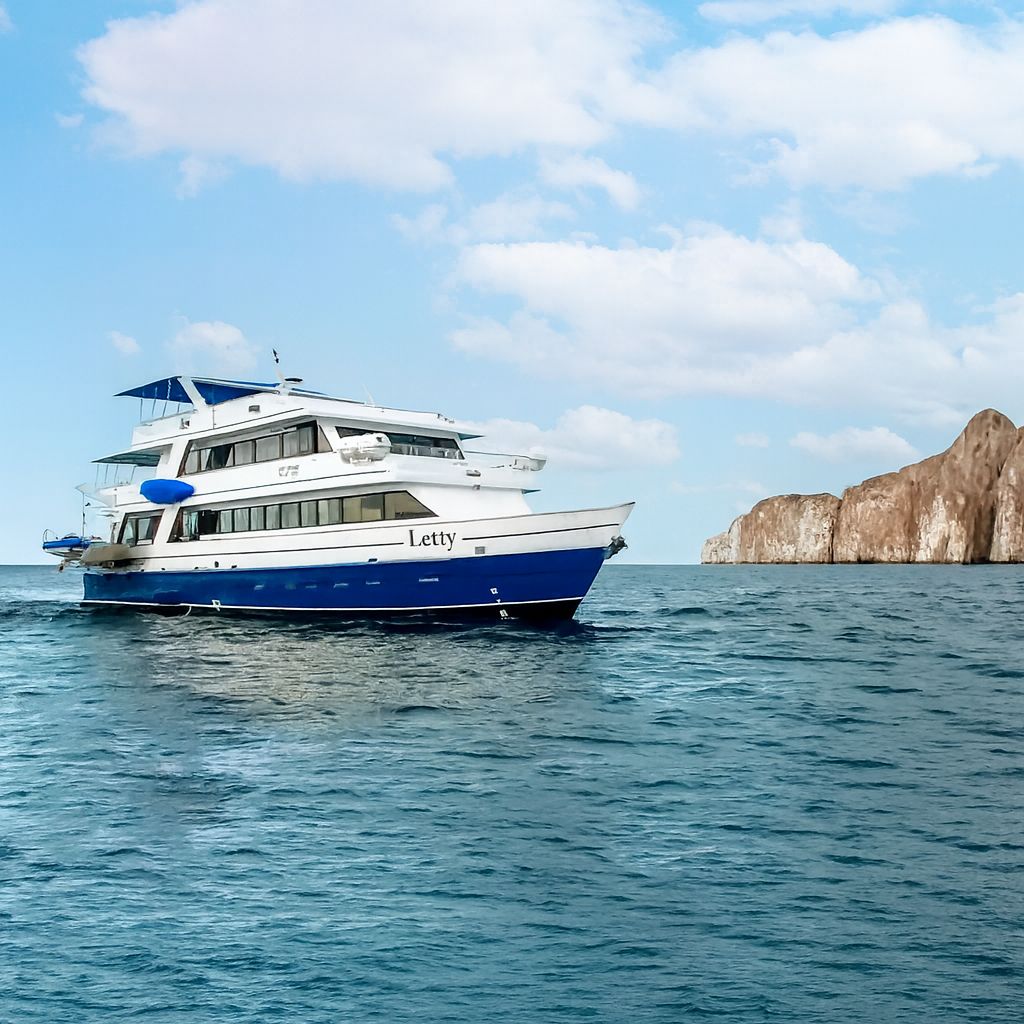
| Letty | First Class | Monohull | Classic yacht experience | Ocean-view cabins; upper and lower deck options |
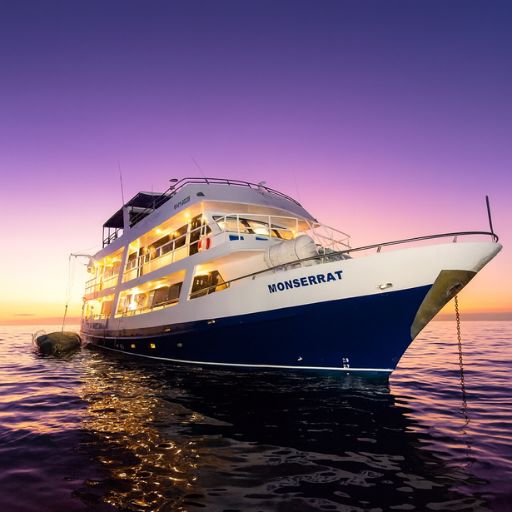
| Monserrat | Tourist Superior | Monohull | Value; mid-range comfort | Former first class; free wifi; 3-15 day itineraries |
| Bonita | Tourist Superior | Monohull | Budget-conscious; solid value | Former first class hull; SUP included |
Classifications and features verified July 2026. Contact us for current availability and pricing.
Vessel quality within the 16-passenger category shifts as boats are refitted, guides change, and operators update their programs. What was excellent two years ago isn’t always excellent today. We track this continuously. Reach out here and we’ll give you a current assessment of which vessels we’d recommend for your specific dates.
Not sure what you actually get by jumping to first class over tourist superior on a Galapagos cruise? This breakdown on first class Galapagos cruises covers the cabins, the service, the guides, and where the difference really shows up on the water.
Who Should Choose a 16-Passenger Yacht (and Who Shouldn’t)
A 16-passenger yacht is the right choice for couples, solo travelers, wildlife enthusiasts who want maximum shore time and the deepest guide relationship, and anyone for whom the expedition itself is the point rather than the vessel amenities. It’s the wrong choice for families with young children who need activity variety and social space, travelers with significant seasickness concerns choosing a monohull, and anyone who needs a gym, spa, or large social areas to enjoy the non-excursion hours.
Solo travelers specifically do better on 16-passenger yachts than conventional wisdom suggests. The assumption is that more passengers equals more potential friendships. In practice, the intimacy of a 16-person boat produces deeper conversations by day three than a 90-passenger ship produces across a week. Everyone at a small table for dinner, the same guide at every briefing, the same group on every trail: these conditions create the kind of connection that larger vessels structurally prevent.
The one group for whom 16-passenger yachts require careful thought is families with children under 12. The social space is limited, cabin proximity is close, and there are no youth programs or child-specific activities the way larger ships provide. Some luxury 16-passenger vessels offer interconnecting cabin configurations, but the confined environment of a small boat with young children for seven days needs honest assessment before booking.
How to Book a 16-Passenger Yacht Without Getting the Wrong One
The single biggest booking mistake on 16-passenger yachts is choosing based on photos and price without verifying guide tenure, hull type for your itinerary, and what the “tourist class” or “tourist superior” label actually means on that specific vessel. The variation within this category is wider than at any other size format. A $400/day tourist superior 16-passenger catamaran and a $400/day tourist superior monohull yacht are not the same experience, and neither is a vessel with a long-tenured guide versus one with whoever is available on departure day.
Three questions to ask before booking any 16-passenger yacht: Who is the guide on my specific sailing, and how long have they worked this vessel? Is the hull a catamaran or monohull, and does that match my itinerary (catamaran strongly preferred for western routes)? When were the cabins last renovated, and does the vessel’s current condition match the photos on the booking page?
On entry logistics: the National Park entrance fee is $200 per adult and $100 per child under 12, paid in USD cash on arrival at Baltra or San Cristobal airport. The Transit Control Card is $20 per person and must be completed online before your flight through the official CGREG government portal. Neither is included in most cruise rates. Bring enough USD cash regardless of what your operator’s literature says, and complete the TCT online in advance rather than relying on airport counters, which are being phased out.
Booking timing on 16-passenger yachts is critical at peak dates. With only 8 cabins to fill, popular vessels in July, August, and the Christmas window fill 4 to 6 months ahead. The shoulder months of May, June, September, and October offer more last-minute availability, sometimes with promotional pricing, but cabin position and guide assignment go to whoever booked first.
Not sure whether a catamaran or a traditional yacht gives you the better Galapagos experience? This breakdown on catamaran vs yacht in the Galapagos covers the real differences in stability, cabin space, and what you actually get for the money.
Traveler Satisfaction: 16-Passenger Yachts vs Larger Vessels
Based on traveler interviews and survey data collected through mytrip2ecuador.com and the My Trip to Somewhere YouTube channel:
| Would book same vessel size again | 86% | 81% | 76% |
| Felt they had enough time ashore | 91% | 82% | 71% |
| Mentioned guide by name in feedback | 74% | 52% | 43% |
| Satisfied with onboard amenities | 69% | 84% | 92% |
| Experienced meaningful seasickness | 24% monohull / 11% catamaran | 15% | 11% |
| Said group social dynamic was a highlight | 68% | 49% | 31% |
Based on traveler interviews and survey data collected through mytrip2ecuador.com and the My Trip to Somewhere YouTube channel.
Most Common Mistakes When Booking a 16-Passenger Yacht
- Choosing a monohull for a western itinerary. The Bolivar Channel crossing between Isabela and Fernandina is the roughest water in the Galapagos. On a 16-passenger monohull, this can be genuinely difficult. A catamaran hull at any price point handles it significantly better. Confirm hull type before booking any western route.
- Not asking who the guide is. On a 16-passenger yacht, the guide is your entire naturalist experience for the week. A vessel with a long-tenured guide is a different trip than the same vessel with whoever filled in last minute. Ask specifically and expect a real answer.
- Assuming tourist class on a small yacht means the same thing across all vessels. The tourist class label is unregulated. Some 16-passenger tourist class yachts are well-maintained with strong guides. Others are older vessels coasting on low pricing. Research the specific boat, not just the category.
- Booking peak dates without planning 4 to 6 months ahead. Eight cabins fill fast. July, August, and the Christmas window on well-regarded 16-passenger yachts sell out well in advance. Last-minute options exist in shoulder months but come with less control over guide and cabin assignment.
- Not bringing enough USD cash for park fees. The National Park entrance fee is $200 per adult and $100 per child under 12, paid in cash on arrival. ATMs in the islands are unreliable. Bring the full amount regardless of what the operator says about fee handling.
Frequently Asked Questions
Why do most Galapagos yachts carry exactly 16 passengers?
Because 16 is the maximum number of visitors one certified naturalist guide can legally supervise on shore under Galapagos National Park regulations. Aligning the vessel to that limit means the entire boat operates as one unit with one guide, eliminating the group-sorting logistics that larger vessels require.
Is a 16-passenger catamaran better than a monohull in the Galapagos?
For western itineraries covering Fernandina and Isabela, yes. Catamaran twin hulls handle the Bolivar Channel swell significantly better than monohulls. For calmer eastern and central island itineraries, the difference is less critical. If seasickness is any concern at all, specifying a catamaran hull is the most effective protective step.
Are 16-passenger yachts suitable for solo travelers?
Yes, and often better than larger ships. The intimacy of the small group creates deeper social connections by day three than a 90-passenger ship generates over a full week. Single supplements apply on most vessels; shoulder months of May, June, September, and October sometimes offer no-supplement windows on select yachts.
Do 16-passenger yachts visit the same islands as larger ships?
Yes, with one exception: some environmentally sensitive landing sites are restricted to vessels carrying 40 passengers or fewer. Larger ships are excluded from these sites. A 16-passenger yacht has full access to all standard visitor sites and these additional sensitive locations.
A 16-passenger yacht is the format that produces the most consistent “best trip of my life” feedback of anything we book. The combination of a single cohesive group, one deeply engaged guide, and maximum time on the islands does something to a person that a larger, more comfortable vessel simply can’t replicate in the same way.
We’ve inspected most of the 16-passenger yachts currently operating in the Galapagos. We know which ones are worth their rate and which ones are trading on a label. Rated 4.9 stars on Google and TripAdvisor. Get your free quote here and we’ll match you with the right vessel within one business day.
Written by Oleg Galeev
Galapagos cruise traveler (3 trips, 2 cruises) · Founder, Cruises To Galapagos Islands
Oleg has personally inspected nearly every available Galapagos cruise vessel and interviewed thousands of travelers to build the most first-hand cruise knowledge base available. He also runs the Ecuador travel blog mytrip2ecuador.com and the YouTube channel My Trip to Somewhere.
Cruises To Galapagos Islands is rated 4.9 stars on Google and TripAdvisor.
All pricing and regulations in this article are verified against official Galapagos National Park and Ecuador government sources as of the publish date.