Darwin’s Finches: What to Know Before Your Cruise
Quick answer
Darwin’s finches are present on every island in the Galapagos year-round, but most cruise passengers walk past them without realizing what they are looking at. There are 18 recognized species, all descended from a single ancestor, differing primarily in beak shape. You will encounter them constantly; the challenge is not finding them but understanding what you are seeing. A good guide makes the difference between a small brown bird and one of the most important animals in the history of science. The vampire finch, the woodpecker finch that uses tools, and the mangrove finch with fewer than 100 individuals remaining are the three encounters most worth seeking out specifically.
Part of our guide to what wildlife you can see on a Galapagos cruise. Ready to pick a ship? See compare all Galapagos cruise ships by price, size and class.
Quick Facts: Darwin’s Finches
| Fact | Detail |
|---|---|
| Number of species | 18 in the Galapagos; 1 on Cocos Island; all from a single ancestral species |
| Common ancestor arrived | 1 to 2 million years ago from mainland South America |
| Main groups | Ground finches (seed crushers); tree finches (insect probers); warbler finches; cactus finches |
| Most threatened species | Mangrove finch (Critically Endangered; fewer than 100 birds on Isabela) |
| Most extreme adaptation | Vampire ground finch (Darwin and Wolf Islands only); drinks blood of seabirds |
| Tool user | Woodpecker finch; uses cactus spines and twigs to probe for insects |
| When to see them | Year-round on all islands; most active and visible during wet season (Dec to May) |
| Primary threat | Philornis downsi; an invasive parasitic fly introduced in the 1960s now affecting 11 of 18 species |
Data verified August 7, 2026, against Galapagos Conservation Trust, Charles Darwin Foundation, and published peer-reviewed research.
Why Are Darwin’s Finches Famous?
Darwin’s finches are famous because they provided some of the most accessible visual evidence that species change over time in response to their environment, a concept that did not have a name when Charles Darwin arrived on the Galapagos in 1835. A single ancestral species, arriving on islands with no competing birds and a wide range of empty ecological niches, diversified over roughly two million years into 18 distinct species, each with a beak shaped for a specific food source. The beak is the story. Everything else about these birds, their plumage, their song, their size, is secondary to the beak, which is the adaptation that made them scientifically famous and that still makes them genuinely interesting to watch.
Darwin himself nearly missed the significance entirely. He collected specimens during his 1835 visit but failed to properly label which island each bird came from, assuming they were a miscellaneous assortment of blackbirds, grosbeaks, and wrens. When the ornithologist John Gould examined them in London in 1837, he reported back that Darwin had actually collected 13 species of finch, all unique to the Galapagos. The realization that all these different birds were finches, all from a single ancestral species, and all from islands Darwin had personally visited, was one of the intellectual moments that shaped the theory of natural selection.
What makes the finches so useful as a teaching example is the directness of the adaptation. You do not need to be a biologist to see that a large, blunt beak suited for crushing hard seeds is a different tool from a long, thin beak suited for probing cactus flowers for nectar, or a short, curved beak suited for gripping a cactus spine to use as a digging tool. The beak differences are visible with the naked eye in the field. A good naturalist guide can walk you through three or four species in the course of a single trail excursion, showing you each beak form and explaining exactly what food source drove its evolution. This is evolution made visible in real time, not a reconstruction from fossils or DNA.
Peter and Rosemary Grant’s 40-year field research program on Daphne Major, which began in 1973, took the story further. After a severe drought in 1977 eliminated small seeds and left only large, hard seeds accessible, the medium ground finch population crashed. Only birds with beaks large enough to crack the harder seeds survived. When the Grants measured the surviving population, average beak depth had increased by 4 percent within a single generation. They had documented natural selection happening over months rather than millennia. This was the first real-time direct measurement of natural selection in a wild population, published in studies that are now among the most cited in evolutionary biology.
How Many Species Are There and Can You Tell Them Apart?
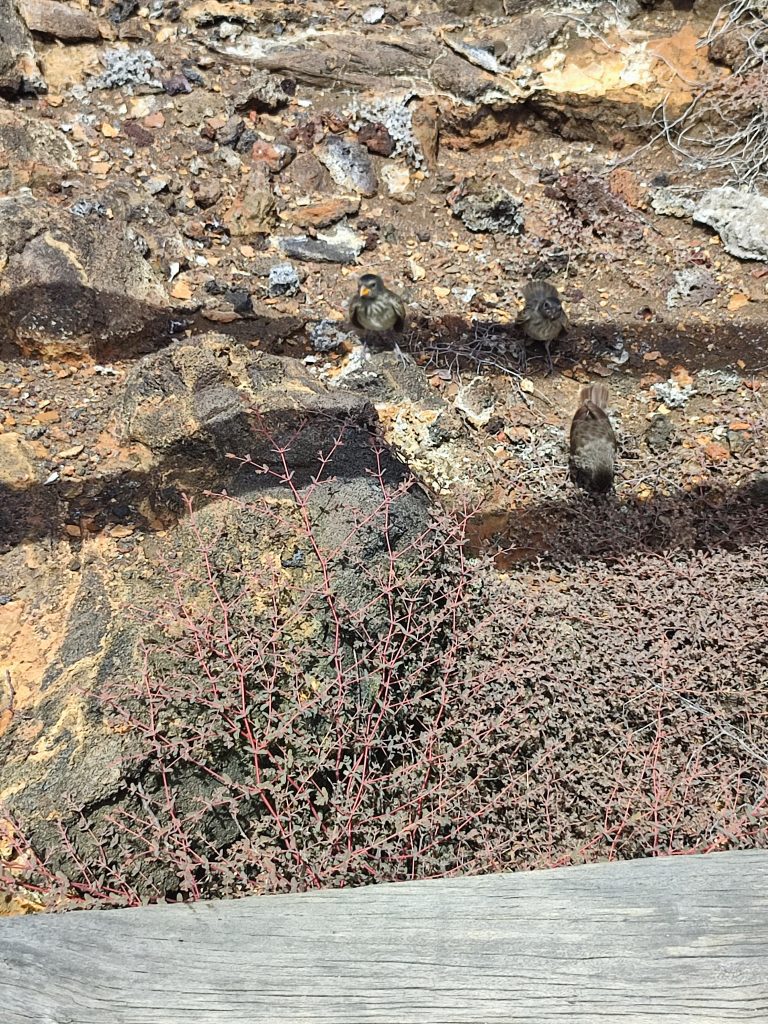
There are 18 recognized species of Darwin’s finches in the Galapagos. Telling them apart is genuinely difficult, even for experienced birdwatchers, because the birds are similar in color (mostly brown or black), similar in size, and often overlap in habitat. The reliable way to identify them is by beak shape and size, the habitat they are feeding in, and which island you are on. Most cruise passengers encounter three to six species without specifically trying. Seeing ten or more requires deliberate birdwatching effort across multiple island types.
The species divide into four main functional groups based on beak form and diet. Ground finches have heavy, conical beaks for cracking seeds. The large, medium, small, and sharp-beaked ground finches differ primarily in beak size, which determines what seed sizes each can process. Tree finches have thinner, more curved beaks for gripping insects and probing wood. The woodpecker finch extends its reach by holding a cactus spine or twig in its beak to lever insects from bark crevices, one of the very few examples of tool use in birds. Cactus finches have elongated beaks for reaching into cactus flowers and pads. Warbler finches are the smallest, with the thinnest beaks, and behave much like warblers, foraging in leaf litter and vegetation for insects.
| Group | Beak Type | Primary Food | Where to Spot |
|---|---|---|---|
| Ground finches | Heavy, conical; varies by species size | Seeds; some insects and ticks | Open ground; trails; visitor landings on most islands |
| Tree finches | Curved, parrot-like; thinner than ground finches | Insects; larvae; plant matter | Vegetation; woodland areas; highland zones |
| Cactus finches | Long, pointed; slightly curved | Cactus nectar; pollen; seeds | Arid lowlands; anywhere opuntia cactus grows |
| Warbler finches | Fine, pointed; thin | Small insects; nectar | Dense vegetation; highland forests; mangroves |
The honest expectation for a typical cruise passenger: you will see ground finches on nearly every island landing. They are the most common and least shy, often hopping around picnic areas and feeding stations at the Charles Darwin Research Station. Cactus finches appear wherever opuntia cactus grows, which includes most of the arid lowland sites. Tree finches and warbler finches require more deliberate searching in vegetation. The woodpecker finch and the mangrove finch require specific habitat types and specific islands. Ask your guide which species are present at each site before you begin a trail. A guide who cannot identify finches to species level is not giving you the full experience these birds deserve.
Which Islands Have the Best Finch Encounters?
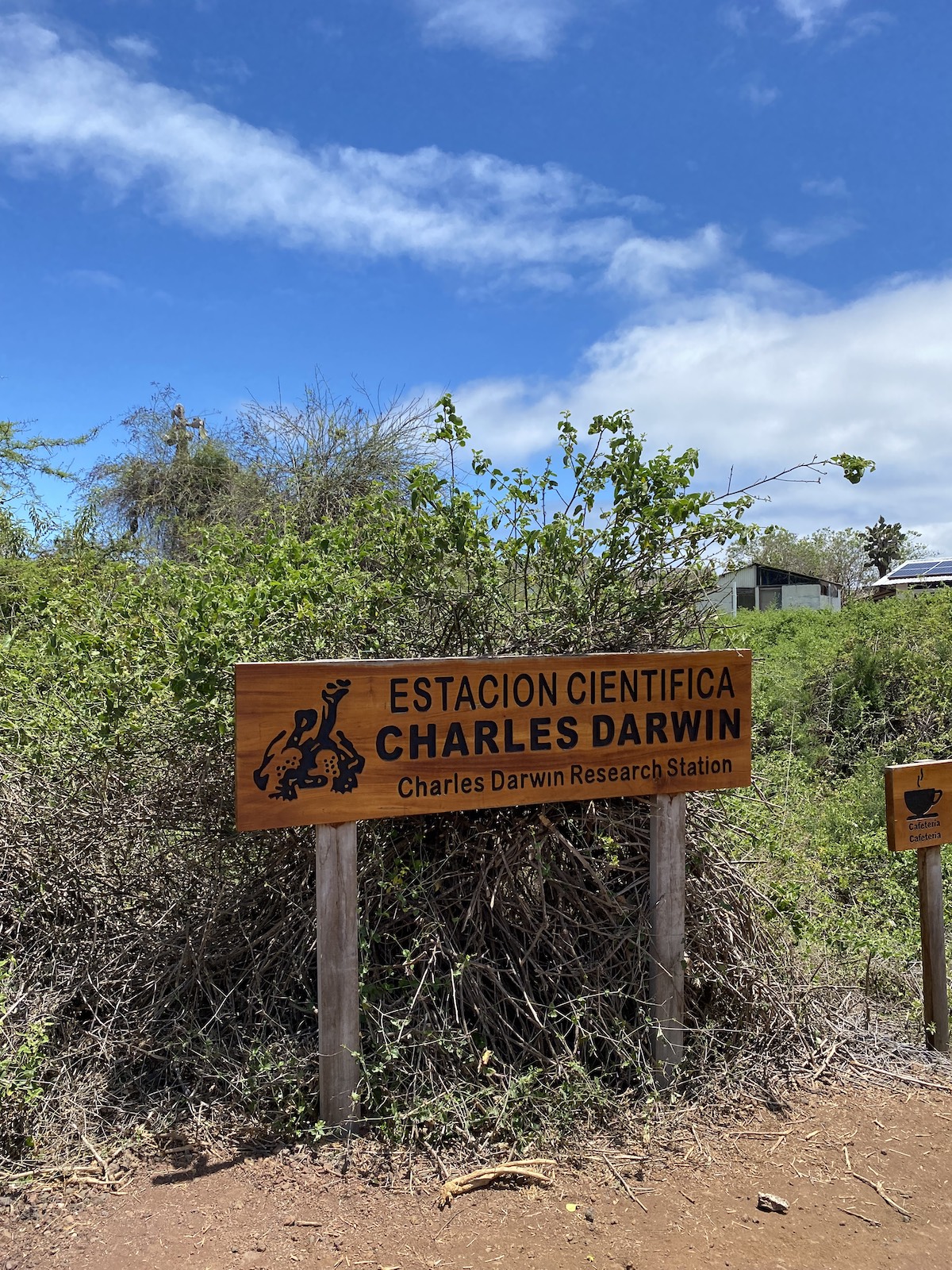
Every inhabited and most uninhabited islands in the Galapagos have finches. The most accessible encounters are at the Charles Darwin Research Station on Santa Cruz, where multiple ground finch species feed in the open and researchers can sometimes point out specific species. Genovesa is excellent for the large ground finch and sharp-beaked ground finch. Española has its own endemic subspecies. The vampire finch is restricted to Darwin and Wolf Islands in the far north, accessible only by liveaboard diving cruise. The mangrove finch survives only in a small area of mangrove forest on western Isabela and is not accessible as a tourist excursion.
Santa Cruz is the starting point for most cruises and the most practical island for an introduction to Darwin’s finches. The Charles Darwin Research Station at Puerto Ayora has ground finches feeding in and around the station grounds in full view. The tortoise breeding pens provide an open habitat where multiple ground finch species appear simultaneously, making direct beak-size comparison possible. The highlands of Santa Cruz hold tree finches and warbler finches in the denser vegetation. A half-day tour of the Santa Cruz highlands specifically targeting finches, combined with a station visit, delivers more species than almost any other single excursion.
Genovesa is the best single island for the sharp-beaked ground finch and large ground finch, which are present in high numbers alongside the seabird colonies. The island’s isolation has produced finch populations that behave somewhat differently from those on more visited islands, which experienced ornithologists find notable. Española has its own distinct population of small ground finches and cactus finches that show subtle morphological differences from the same species on other islands, a visible example of island-level divergence happening within what is considered a single species.
The woodpecker finch is most reliably seen in the highland forests of Santa Cruz and San Cristóbal, where mature tree cover provides the habitat the species needs for its tool-using foraging behavior. Seeing it actively use a cactus spine to probe bark is one of the more striking wildlife moments available on a Galapagos land excursion, though it requires patience and a guide who knows which trees to check. Fill out this short form and we’ll confirm which itineraries include highland excursions where woodpecker finch sightings are most likely.
Not sure what makes Española stand out from the other Galapagos islands or why so many experienced travelers put it at the top of their list? Here’s a straight breakdown on why Española is one of the best cruise stops.
When Is the Best Time to See Finch Behavior?
Darwin’s finches are present year-round. The wet season from December through May is the best time for behavioral observation: birds are breeding, males are singing to defend territories and attract mates, nests are active, and the increased food availability makes foraging activity more frequent and varied. The dry season from June through November still offers reliable finch sightings but less active behavior. The critical point is that the wet season, which is often called the off-season for comfort reasons, is actually the best season for watching finches do what they do.
The Grant research on Daphne Major established that finch breeding is directly tied to rainfall. When rain falls and plants produce seeds and flowers, breeding begins. A wet season visit means active nests, singing males, and the full range of foraging behaviors across multiple food sources. The dry season concentrates food resources, which reduces foraging diversity but can make specific food interactions, like cactus finches working cactus pads, easier to observe because the birds have fewer alternatives.
El Niño years produce dramatically increased rainfall and correspondingly intense breeding activity. During the strong El Niño of 1982 to 1983, the Grants documented explosive population growth in medium ground finches as food became abundant. The beak sizes that had shifted toward larger during the 1977 drought shifted back toward smaller as small, soft seeds returned. This reversibility, evolution tracking environmental conditions back and forth within years rather than centuries, is the finding that most surprised biologists who expected evolution to be directional and slow. The Galapagos finch data showed it was neither.
What Do Travelers Miss About Darwin’s Finches?
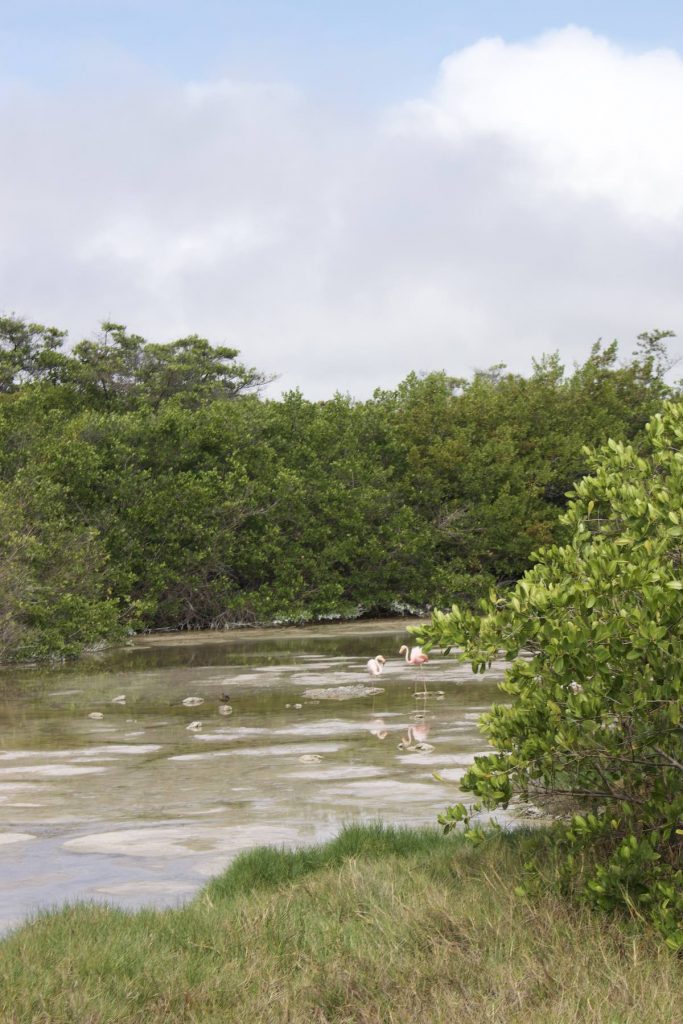
Most travelers miss Darwin’s finches entirely, not because the birds are absent but because they are small, brown, and easy to overlook when you are focused on sea lions, marine iguanas, and blue-footed boobies. The second miss is not asking the guide for species identification, so every finch encountered remains an undifferentiated “small brown bird.” The third miss is not understanding that these birds are still evolving right now, not historical examples of evolution that happened once and stopped. The fourth miss is not looking at the beak before looking at anything else.
Looking at the wrong thing first. With flamingos or frigatebirds, the visual priority is obvious: the color, the pouch, the posture. With finches, the entire story is in the beak, and beaks require looking at a bird for a few seconds rather than a glance. Most visitors scan the trail for large animals and register small brown birds as background. A guide who stops at a ground finch, points at the bill, and explains that this specific beak depth correlates with the specific seed size this bird can crack, and that the neighboring island has a population whose average beak depth shifted measurably after a single drought year, transforms that small brown bird into something genuinely worth stopping for.
Treating the finches as historical exhibits. The common framing, that Darwin visited the Galapagos, noticed the finches, and this led to the theory of evolution, makes the birds sound like props in a story that already happened. They are not. The medium ground finch population on Daphne Major is still being measured annually. Beak sizes are still tracked across generations. Hybridization between species still occurs and is still documented as a mechanism by which new lineages emerge. The 2023 McGill University study, using nearly two decades of field data from over 3,400 finches across four species, confirmed that the birds are still tracking up their fitness landscape and have not yet reached stable optimal adaptations. These are not museum pieces. They are working examples of ongoing biological process.
Missing the tool use entirely. The woodpecker finch’s habit of selecting and using a cactus spine or small twig to probe bark for insect larvae is one of the most remarkable behaviors in the bird world. Tool use in non-primates was considered exceptional when it was first documented in the Galapagos. Most cruise passengers never encounter the woodpecker finch specifically because highland forest excursions are not on every itinerary and the bird requires active searching. If your cruise includes a Santa Cruz or San Cristóbal highland excursion, ask your guide to find a woodpecker finch. Watching it select, position, and use a tool to extract a grub from bark is one of those moments that changes how you think about the boundary between human and animal cognition.
San Cristóbal is often the first or last island on a Galapagos cruise and knowing what it offers changes how you use your time there. Here’s a guide on what to expect on a San Cristóbal cruise visit so you arrive prepared.
The Vampire Finch and Other Extreme Adaptations
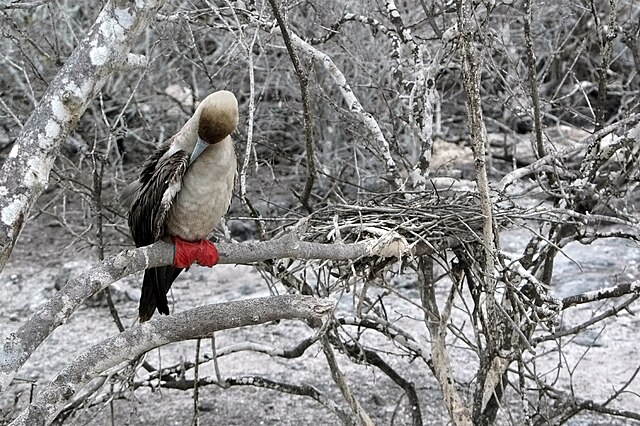
The vampire ground finch lives only on Darwin and Wolf Islands in the far northern Galapagos, accessible only by liveaboard dive cruise. It drinks blood from Nazca and red-footed boobies during the dry season when seeds and insects are scarce. This is not a metaphor. The bird pierces the skin at the base of a booby’s feathers, waits for blood to flow, and laps it up. The boobies tolerate it. Scientists believe the behavior evolved from parasite removal, a service finches provided to boobies, which gradually shifted into direct blood consumption as a food source. It is the most extreme dietary adaptation in any songbird on Earth.
The evolutionary pathway from parasite picker to blood drinker is documented in the scientific literature and is one of the cleaner examples of behavioral evolution that researchers have been able to trace. Finches on many islands pick ticks and mites from seabird feathers, providing a cleaning service that benefits both parties. On Darwin and Wolf Islands, where food is particularly scarce and the dry season runs from July through December, this cleaning behavior gradually extended to pecking at the skin wounds left by parasites, and then to actively creating small wounds for the blood. The boobies’ tolerance for the behavior likely reflects the evolutionary context: birds that were previously helpful cleaners do not suddenly become threats that require a defense response.
The woodpecker finch represents a different category of extreme adaptation: behavioral complexity rather than dietary extremism. Using tools requires cognitive steps beyond standard foraging: selecting an appropriately sized object, manipulating it in the beak, using it as an extension of the body to access food that cannot be reached directly, and in some documented cases, modifying the tool by breaking it to an appropriate length. These are not simple instinctive behaviors. They are learned skills that young woodpecker finches acquire by watching adults, which makes them a cultural transmission in addition to a genetic one. Some populations have been documented modifying their tool selection in response to available materials, suggesting flexible problem-solving rather than fixed behavior.
The cactus finch’s relationship with opuntia cactus is the third major specialization worth understanding before you arrive at any arid lowland site. The bird feeds on cactus nectar, pollen, and pads, and in doing so has become the cactus’s primary pollinator on islands where other pollinators are absent. Remove the cactus finch and the opuntia decline. Remove the opuntia and the cactus finch loses its primary food source. This mutualism, two species whose fates are locked together, evolved on islands where the absence of other species made dependency possible. It is a condensed version of ecological relationship that in larger ecosystems would be diluted across dozens of species.
We’ve got a full breakdown on Darwin and Wolf islands if you want to know exactly which liveaboards reach these remote sites, what the diving conditions are really like, and why serious divers put this trip at the top of their bucket list.
Darwin’s Finches Conservation: A Species Group Under Pressure

The most severe immediate threat to Darwin’s finches is Philornis downsi, a parasitic fly introduced to the Galapagos from mainland Ecuador in the 1960s. Its larvae feed on the blood of nestlings in the nest, killing chicks outright or weakening them enough that they cannot fledge. The fly now affects 11 of the 18 Darwin’s finch species. The mangrove finch, with fewer than 100 individuals surviving on a small area of western Isabela, is the most critical case. The 2026 breeding season recorded 20 breeding pairs and 25 successful fledglings, described by researchers as the most successful season on record and the first sign of realistic hope for recovery.
The mangrove finch story is one of the most concentrated conservation crises in the Galapagos. The bird is restricted to three small mangrove patches on western Isabela, a range so limited that the entire world population fits within a few square kilometres. Introduced black rats predate eggs and chicks. Philornis downsi larvae kill nestlings that survive rat predation. Rat control improved breeding success from 18 percent of nests producing fledglings to 37 percent, and that improvement was still insufficient because Philornis mortality then accounted for 14 percent of additional nestling deaths. The Charles Darwin Foundation’s captive rearing program, removing eggs from wild nests, incubating them, raising the chicks, and releasing fledglings, added 39 birds to the wild population over four years and increased the juvenile population by over 50 percent.
The 2026 result, 20 breeding pairs and 25 successful fledglings in a single season, compares to 11 pairs and 8 fledglings in 2025 and represents the first data point that researchers describe with language resembling optimism rather than managed decline. María Igual Beltrán, principal investigator of the Mangrove Finch Project at the Charles Darwin Foundation, described it as “sustained reproductive success at a scale that gives us more realistic hope for the future.” This is not a recovery story yet. It is the first season that looks like the beginning of one.
The medium tree finch on Floreana faces a similar situation: locally present but now Critically Endangered, primarily from rat predation and Philornis parasitism. Floreana is the site of a major ongoing invasive species eradication effort that would, if successful, remove the introduced rat, cat, and invasive plant species that currently prevent recovery of multiple endemic species including the finch.
The broader Philornis downsi problem affects species that are not yet at crisis level but are showing population declines driven by reduced breeding success. Eleven species now host the parasitic fly’s larvae. Research into control methods includes insecticide treatment of nests with permethrin, encouraging birds to incorporate permethrin-treated cotton into their nest construction, and investigation of biological control agents including sterile insect techniques. No large-scale solution is yet available. Park entry fees and licensed ecotourism revenue directly fund these programs.
Trying to figure out what Floreana adds to a Galapagos cruise that other islands don’t? Here’s the guide on Floreana’s history, wildlife, and highlights so you appreciate what makes this island genuinely different from the rest.
Frequently Asked Questions
Did Darwin actually study the finches in the Galapagos?
Yes, but less systematically than the popular story suggests. Darwin collected bird specimens during his 1835 visit but did not recognize all of them as finches, and crucially he failed to record which island each bird came from. When ornithologist John Gould examined the specimens in London in 1837 and identified them as 13 distinct finch species, Darwin had to reconstruct island origins from his notes and from specimens collected by Captain FitzRoy and the Beagle crew. The finches contributed to his thinking, but he later wrote that mockingbirds were initially more significant to his understanding of island-to-island species variation. The finches became central to the public understanding of evolution because their beak variation is so visually clear and pedagogically useful.
Are Darwin’s finches actually finches?
Taxonomically, no, or at least not in the strict sense. Genetic analysis has established that Darwin’s finches belong to the tanager family Thraupidae rather than the true finch family Fringillidae. They are thought to have evolved from a grassquit ancestor from mainland South America. The name Darwin’s finches has stuck in common usage despite this taxonomic clarification, in part because changing it would create more confusion than it would resolve. Most scientific literature uses the name while acknowledging the tanager ancestry.
Can you see all 18 species on a single cruise?
Not realistically. The vampire finch requires a liveaboard dive cruise to Darwin and Wolf Islands that most standard cruises do not reach. The mangrove finch habitat on Isabela is not open to tourist excursions. Several tree finch species require highland forest habitat that shorter itineraries skip. A realistic expectation for a well-guided 7 to 8-day cruise that includes Santa Cruz highlands, Genovesa, and Española is 6 to 10 species with deliberate effort. A dedicated birdwatching cruise over 10 to 14 days covering all habitat types can reach 14 to 15 species. Seeing all 18 requires multiple trips across multiple seasons.
Why do the finches look so similar if they are separate species?
Because they diverged recently in evolutionary time. All 18 species share a single ancestor from roughly 1 to 2 million years ago, which is geologically very recent. The genome research published in Nature in 2015 identified that only a small fraction of the finch genome differs between species, concentrated in loci that control beak shape and size. The rest of the genome is nearly identical across all species. This genetic closeness is also why hybridization still occurs between some species, and why some taxonomic authorities argue that certain groupings of finch “species” are better understood as a single polymorphic species still in the process of diverging.
See Darwin’s Finches on the Right Itinerary
The finches are everywhere in the Galapagos, but a guide who can identify species, explain beak adaptation, and find a woodpecker finch using tools in the Santa Cruz highlands turns background birds into the most intellectually rewarding encounter on the islands. We know which operators hire guides with genuine natural history depth and which itineraries cover the habitat range needed to see multiple finch groups. A free conversation with Cruises To Galapagos Islands costs nothing and prevents the most common finch-related regret: realizing afterward that you walked past the most important birds in the history of biology without knowing what you were looking at. Tell us what matters to you and we’ll build the right recommendation.
Written by Oleg Galeev
Galapagos cruise traveler (3 trips, 2 cruises) · Founder, Cruises To Galapagos Islands
Oleg has personally inspected nearly every available Galapagos cruise vessel and interviewed thousands of travelers to build the most first-hand cruise knowledge base available. He also runs the Ecuador travel blog mytrip2ecuador.com and the YouTube channel My Trip to Somewhere.
Cruises To Galapagos Islands is rated 4.9 stars on Google and TripAdvisor.
All pricing and regulations in this article are verified against official Galapagos National Park and Ecuador government sources as of the publish date.