Galapagos Flamingos: Which Islands Have Them?
Quick answer
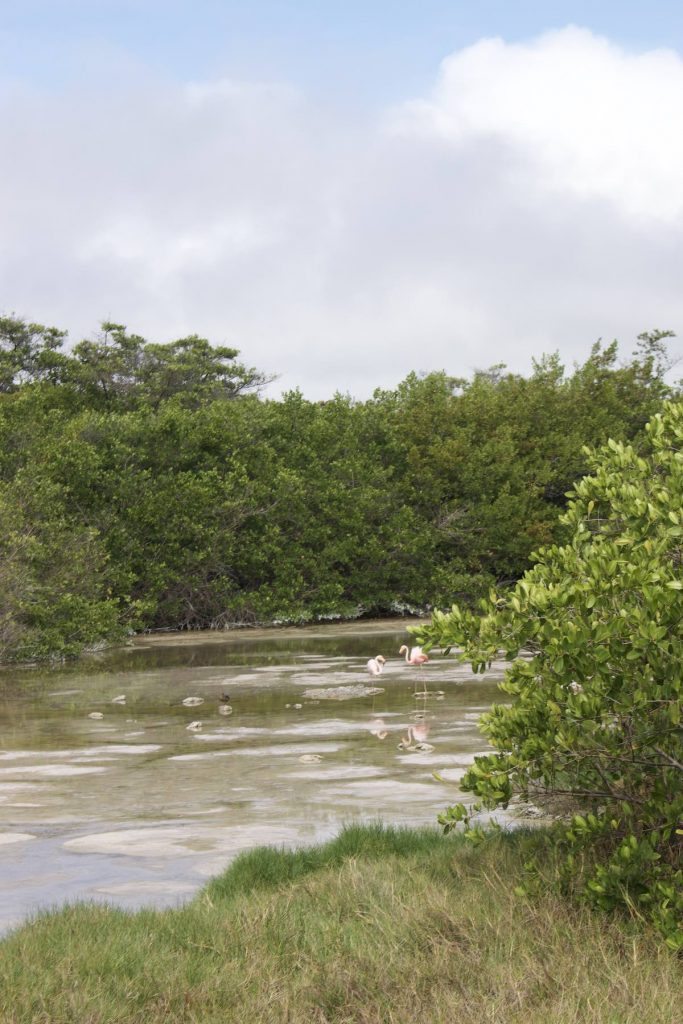
The Galapagos flamingo population sits between 300 and 500 individuals across the entire archipelago, making every sighting genuinely significant. The best flamingo sites on a cruise are Punta Cormorant on Floreana, the lagoons near Puerto Villamil on Isabela, and the red-sand lagoon at Rábida. Flamingos are present year-round, but nesting season from June through March brings the best chance of seeing courtship behavior and chicks. The birds are not on every island or every itinerary. You need to confirm your cruise specifically includes a lagoon stop to see them.
Part of our guide to what wildlife you can see on a Galapagos cruise. Ready to pick a ship? See compare all Galapagos cruise ships by price, size and class.
Quick Facts: Galapagos Flamingo
| Fact | Detail |
|---|---|
| Species | Phoenicopterus ruber (American flamingo); Galapagos population considered a distinct subspecies |
| Population | 300 to 500 individuals; one of the world’s smallest flamingo populations |
| Why so pink | Carotenoid pigments from brine shrimp and algae; Galapagos lagoons are especially shrimp-rich, producing a deeper pink than most populations |
| Breeding season | Year-round; peak nesting June to March |
| Best site on a cruise | Punta Cormorant, Floreana Island |
| Other reliable sites | Puerto Villamil lagoons (Isabela); Rábida Island; Las Bachas (Santa Cruz); Puerto Egas (Santiago) |
| Lifespan | Up to 30 years in the wild |
| Main threats | Introduced predators; El Niño lagoon flooding; nesting disturbance; habitat loss |
Data verified August 7, 2026, against Galapagos Conservancy, Galapagos National Park, and published flamingo research sources.
Why Are Flamingos in the Galapagos Surprising?
Finding flamingos in the Galapagos feels like the wrong planet. You spend a morning watching marine iguanas sneeze salt and sea lions chase penguins through kelp, and then you round a corner of black volcanic rock and a small group of the world’s most improbably pink birds is standing in a brackish lagoon, feeding upside-down. The surprise is partly the contrast: flamingos belong to a mental category of African savannahs and Caribbean wetlands, not equatorial volcanic islands. But they have been here long enough to develop distinct characteristics from every other flamingo population on Earth.
The Galapagos flamingo is classified as the American flamingo, Phoenicopterus ruber, and it was for a long time grouped with the Caribbean population. The current scientific consensus treats the Galapagos birds as genetically distinct, shaped by isolation from the mainland population across generations of living exclusively on these islands. The most visible difference is color: Galapagos flamingos run a deeper, more saturated pink than almost any other flamingo population on Earth. The reason is directly dietary. The brackish lagoons here are exceptionally rich in the brine shrimp that deliver carotenoid pigments to the birds’ feathers. More shrimp, more pigment, deeper pink. A captive flamingo fed a diet without carotenoids fades to pale grey within a few molting cycles. The wild Galapagos bird, feeding in nutrient-dense lagoons, turns a color that photographers routinely assume has been artificially enhanced.
The other surprise is the population size. The entire Galapagos flamingo population is between 300 and 500 individuals. That number fits comfortably in a single restaurant. For context, the Caribbean flamingo population in the Bahamas alone numbers in the tens of thousands. What you are seeing when you find Galapagos flamingos in a lagoon is a meaningful fraction of the entire global breeding group of this distinct population. That weight is worth knowing before you arrive.
The feeding behavior compounds the visual strangeness. The flamingo holds its head inverted in the water and pumps its kinked bill like a sieve, drawing water in and forcing it out through comb-like structures called lamellae that trap shrimp and algae. The bill works only upside-down. It is an anatomical commitment to a single feeding technique in a single type of habitat. Move the bird or change the habitat and the tool becomes useless.
Which Islands Have Flamingo Lagoons?
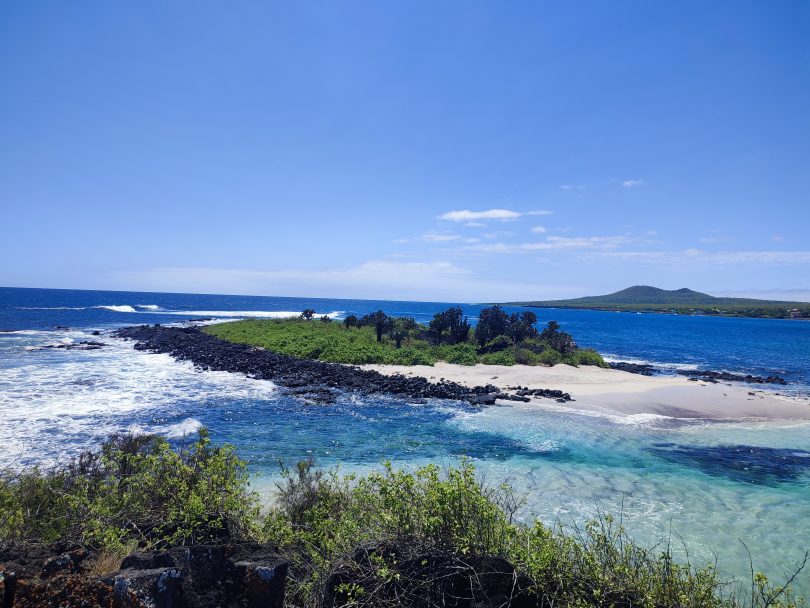
Galapagos flamingos are not spread across the archipelago. They live in a specific type of habitat: shallow brackish lagoons close to the coast, where brine shrimp and algae concentrate. The reliable sites on a cruise are Punta Cormorant on Floreana, the Puerto Villamil lagoons on Isabela, Rábida Island, Las Bachas on Santa Cruz, and Puerto Egas on Santiago. Of these, Punta Cormorant is the most consistent and the most photographically dramatic. Not all cruise itineraries include lagoon stops, so this requires specific confirmation before booking.
Punta Cormorant, Floreana Island is the benchmark for a Galapagos flamingo encounter. The name suggests cormorants but there are none here: the origin of the name is genuinely unknown. What the site does have is a large brackish lagoon set against green vegetation, with flamingos feeding and sometimes nesting in numbers that can reach a dozen or more on a good visit. The contrast between the vivid pink birds, the green shrub backdrop, and the surrounding black lava makes it one of the most photogenic wildlife scenes in the islands. A short trail leads from the olive-green sand landing beach around to the lagoon, where white-cheeked pintail ducks share the water with the flamingos. The same visit continues to a flour-white coral sand beach where green sea turtles nest from December through March.
Puerto Villamil lagoons, Isabela Island hold the largest single concentration of flamingos in the archipelago. A series of brackish lagoons west of the town is accessible on foot or by bike and is one of the most reliable sighting spots in the Galapagos for this species. This is also the site where the greatest recovery has occurred: Isabela’s relative isolation and ongoing introduced predator control have made these lagoons productive breeding habitat. Early morning visits tend to be most productive, when the birds are actively feeding before the midday heat drives them to stand still in shade.
Rábida Island delivers the most visually distinctive setting. The red-sand beach is one of the most striking landscapes in the archipelago, and the small saltwater lagoon behind it typically holds a handful of flamingos against that red and black backdrop. The colony is small, but the combination of the red sand, the sea lion bachelor colony on the beach, and the occasional flamingo makes Rábida a site that rewards slow walking and quiet observation. Several cruise itineraries include Rábida as a full excursion rather than a quick stop.
Las Bachas, Santa Cruz has a lagoon directly behind the beach that occasionally holds flamingos, though sightings here are less consistent than at the main sites. Worth checking on arrival, but do not plan your flamingo encounter around it. Puerto Egas, Santiago has similar occasional flamingo presence in the coastal pools near the trail.
| Site | Reliability | Numbers Typical | Best Paired With |
|---|---|---|---|
| Punta Cormorant, Floreana | Very high | 6 to 20+ | Devil’s Crown snorkel; Post Office Bay |
| Puerto Villamil lagoons, Isabela | Very high | 5 to 30+; largest concentration | Tortoise breeding center; Wall of Tears trail |
| Rábida Island | High | 2 to 8; small colony | Red sand beach; sea lion bachelor colony; snorkel |
| Las Bachas, Santa Cruz | Moderate; inconsistent | 0 to 5 | North Seymour; sea turtle nesting |
| Puerto Egas, Santiago | Moderate; occasional | Variable | Fur seal grottos; marine iguanas; tidal pools |
If a flamingo sighting is important to you, confirm with us before booking which sites your itinerary specifically includes. A cruise that routes through Floreana but only stops at Post Office Bay, skipping Punta Cormorant, misses the best flamingo site. Fill out this short form and we’ll confirm whether your shortlisted itinerary gives you a realistic flamingo encounter.
What Is the Best Time of Year to See Flamingos?
Flamingos are resident in the Galapagos year-round and can be seen at lagoon sites during any month. The most interesting period is during nesting season, which peaks from June through March, when the birds are building their distinctive mud nests, incubating eggs, and raising grey-feathered chicks. Outside nesting season, feeding behavior and the vivid color of well-fed birds are still worth seeing. There is no bad month to see flamingos, but June through March adds behavioral dimensions that quiet months do not.
The nesting behavior is one of the more unusual spectacles the Galapagos flamingo produces. The birds build mud nests shaped like squat volcanos, piling sediment from the lagoon floor into a cone roughly 30 centimetres tall with a shallow depression at the top for the single egg. Both parents share incubation duties. A chick hatches grey and white, looking nothing like the adults around it. The pink develops over years as the chick begins eating carotenoid-rich food. Flamingos do not breed until they are around five or six years old, which means a large portion of the visible population at any lagoon is subadult birds that will not contribute to breeding for years.
The Galapagos flamingo has adapted its breeding behavior in a specific way that differs from every other flamingo population on Earth. Most flamingo species require very large colonies to stimulate breeding: the social cues from hundreds or thousands of birds performing synchronized courtship displays trigger the hormonal cycles that lead to nesting. The Galapagos population, with only 300 to 500 individuals, cannot produce these numbers. Over generations of isolation the birds have adapted to breed in much smaller groups. A handful of pairs can nest successfully in a Galapagos lagoon where a Caribbean or African colony would need hundreds.
El Niño events disrupt the breeding cycle severely. When warm water raises lagoon levels or alters the salinity that brine shrimp require, food availability drops and flamingos abandon nesting attempts entirely. In the worst El Niño years, no successful nesting has been recorded at some sites. Recovery can take multiple seasons. This vulnerability to a single climate event, across a total population of a few hundred birds, is why the Galapagos National Park monitors flamingo populations closely and protects lagoon sites during nesting periods.
How Does Your Cruise Route Affect Flamingo Sightings?
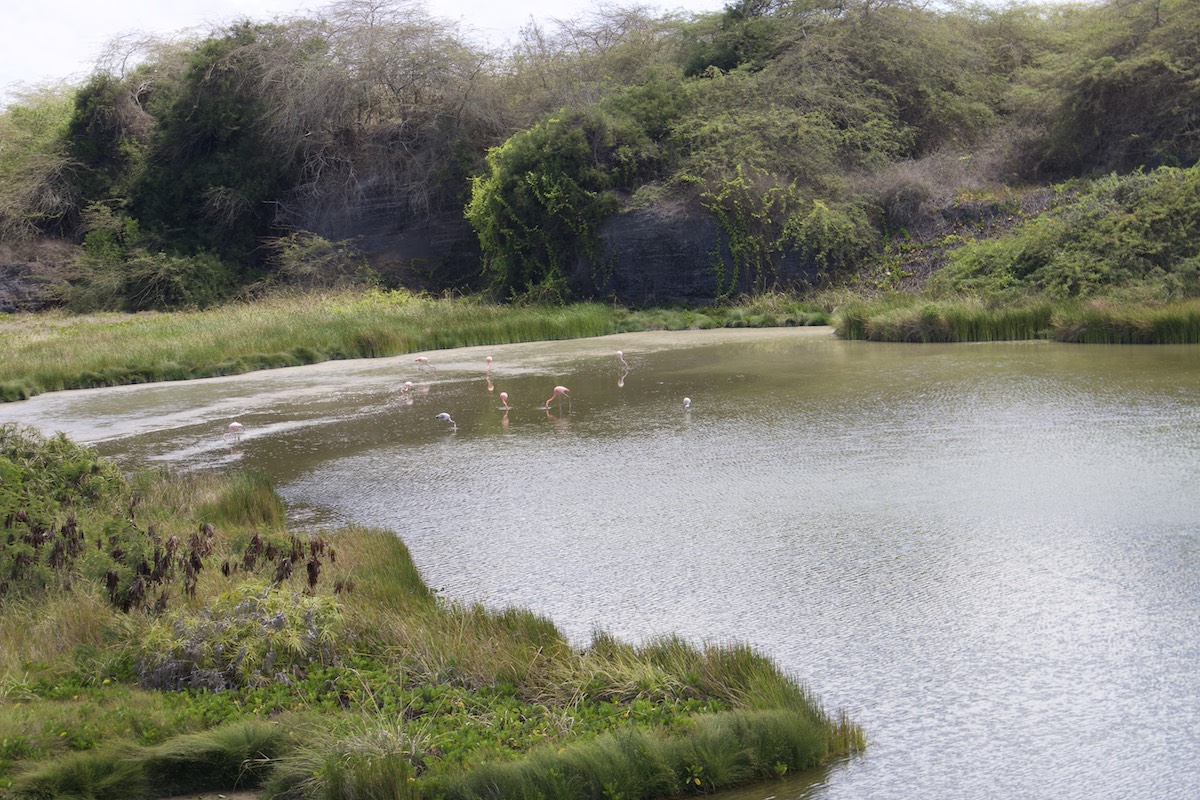
Flamingo sightings are route-dependent in a way that most wildlife in the Galapagos is not. Sea lions and marine iguanas appear everywhere. Flamingos appear only at specific lagoon sites on specific islands. A cruise that does not route through Floreana, Isabela, or Rábida can complete an entire week without offering a single flamingo sighting. Central and eastern routes without southern island stops frequently miss all flamingo sites. The only way to confirm you will see them is to verify that your itinerary explicitly includes a lagoon stop at one of the sites above.
Most 7 and 8-day itineraries that include Floreana will stop at Punta Cormorant, and this is where the flamingo encounter tends to happen for the majority of cruise passengers who see them. Shorter central-island itineraries that focus on Baltra, Santa Cruz, North Seymour, and the northern archipelago may include Las Bachas on Santa Cruz, but the flamingo presence there is less consistent. Western routes that focus on Isabela and Fernandina include the Puerto Villamil lagoons, but access to these depends on whether town time is included in the excursion program.
Rábida is the site most often mentioned as a pleasant surprise: travelers who arrive not specifically looking for flamingos and find a few in the red-sand lagoon behind the beach alongside the sea lion colony. It appears on a range of central itineraries and delivers a more intimate encounter than Punta Cormorant’s larger lagoon, with fewer people and more immediate wildlife.
We track current itineraries across the active Galapagos cruise fleet and can tell you exactly which stops include flamingo lagoon access before you book. Send us a message here and we’ll confirm which routes cover which sites for your travel dates.
What Do Travelers Miss About Galapagos Flamingo Encounters?
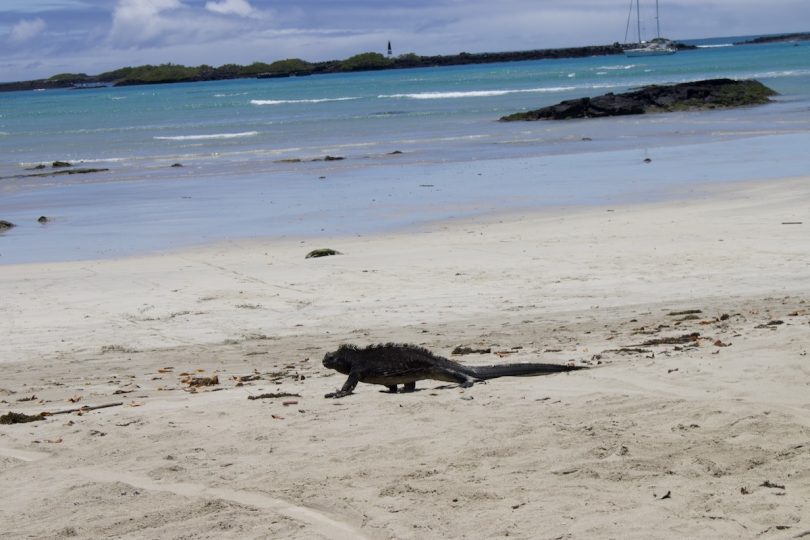
The most common miss is rushing the lagoon visit. Flamingos are shy and sensitive to noise. Groups that arrive loudly and move quickly often see the birds standing still or walking away. Groups that slow down, spread out, and wait quietly almost always see feeding behavior, and sometimes courtship displays, that the impatient group entirely misses. The second miss is failing to appreciate the population context: seeing eight flamingos at Punta Cormorant means you are watching roughly two percent of the entire global population of this distinct subspecies.
Making noise near the lagoon. Flamingos in the Galapagos have the same lack of fear of humans as every other species on the islands, but their response to disturbance is more pronounced. Unlike a marine iguana that simply ignores you, a flamingo that is startled will stop feeding, raise its head, and potentially walk away from the feeding area. A quiet, patient group at a respectful distance will almost always see the birds feeding actively. A loud group arrives to see birds standing still at the far side of the lagoon. The behavior of the group entering the site sets the quality of the encounter for everyone.
Not recognizing what the feeding behavior means. The inverted head and pumping bill motion is not incidental behavior. It is a highly specialized feeding technique that only works in a very specific type of habitat. When you watch a flamingo feeding, you are watching one of the more extreme dietary specializations in the bird world: an animal whose anatomy has been entirely reorganized around a single food source in a single type of water body. The kinked bill, the lamellae filter, the salt glands that allow drinking of briny water. Your guide can walk you through all of this in a few minutes beside the lagoon. It converts a pretty bird into something genuinely remarkable.
Assuming Las Bachas will deliver when the better sites are not on the itinerary. Las Bachas is a beautiful beach on Santa Cruz’s north shore and it does have a flamingo lagoon. But the birds are not reliably present there, and travelers who are told by their guide that Las Bachas “sometimes has flamingos” and arrive hoping to tick the box often leave disappointed. If flamingos are on your wish list, the itinerary needs to include Punta Cormorant or the Puerto Villamil lagoons as confirmed excursion stops, not Las Bachas as an optional add-on.
What Our Travelers Report: Flamingo Sighting Quality by Site
Based on feedback gathered through mytrip2ecuador.com, our YouTube audience, and Oleg’s direct traveler interviews across three personal visits to the Galapagos:
| Site | Saw Flamingos | Saw Feeding Behavior | Saw Nesting/Chicks | “Highlight of the stop” |
|---|---|---|---|---|
| Punta Cormorant, Floreana | 91% | 74% | 28% | 67% |
| Puerto Villamil lagoons, Isabela | 88% | 71% | 33% | 58% |
| Rábida Island lagoon | 76% | 59% | 14% | 51% |
| Las Bachas, Santa Cruz | 41% | 28% | 6% | 22% |
The Las Bachas figure makes the point plainly. Nearly 60 percent of travelers who went to Las Bachas expecting flamingos did not see them. Nearly 10 in 10 who went to Punta Cormorant did. This is a planning problem, not a luck problem. Reach out here and we’ll tell you which routes reliably include the productive lagoon sites.
What Else Lives Alongside the Flamingos?
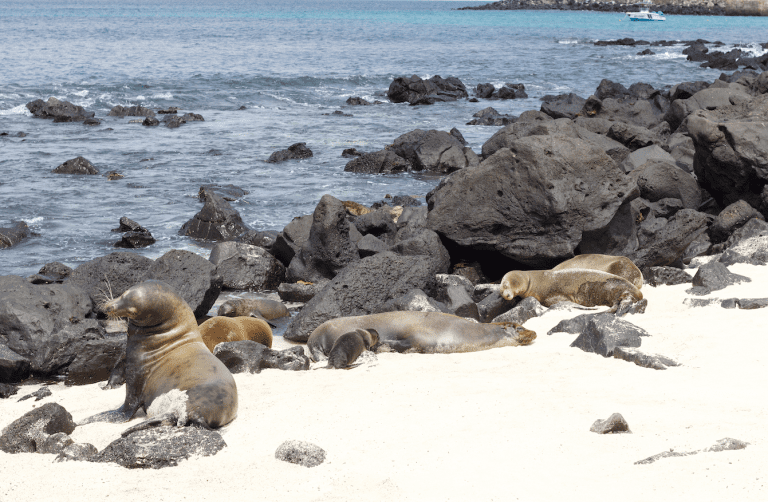
Flamingo lagoon visits are rarely single-species encounters. At Punta Cormorant, white-cheeked pintail ducks feed in the same lagoon and can be observed at close range. The walk between beach and lagoon passes through habitat where Galapagos flycatchers and finches are consistently present. The flour-white coral sand beach at the far end of the trail is a sea turtle nesting site from December through March. At Rábida, the flamingo lagoon sits beside a sea lion bachelor colony on the beach. These are genuinely multi-species visits compressed into a short trail.
The white-cheeked pintail is one of the more overlooked birds in the Galapagos, usually because it shares the lagoon with flamingos and loses the attention contest. It is, however, a genuinely beautiful duck with a vivid red bill and white cheek patch, and it feeds in the same shallow water using a completely different technique: dabbling at the surface rather than filter feeding. Watching both species work the same lagoon simultaneously, using different anatomical tools at different water depths, is a concise illustration of resource partitioning. Your guide, if prompted, will explain this. It is worth asking.
At Punta Cormorant specifically, the transition from the lagoon to the coral sand beach completes one of the better single-site combinations in the archipelago. The beach is made from pulverized white coral, finer than any sand you have walked on, and during nesting season sea turtle tracks lead across it in the early morning. The snorkeling at Devil’s Crown, a submerged volcanic cone just offshore, follows the same stop on most itineraries and adds a marine encounter to a visit that began with flamingos. Few single excursion days in the Galapagos pack this range of experiences into a similar time frame.
At Isabela’s Puerto Villamil lagoons, the flamingo sighting often occurs as part of a longer walk past mangrove channels where herons, stilts, and other shorebirds feed alongside the flamingos. The whole wetland complex west of town is worth exploring slowly. The tortoise breeding center at the edge of town and the Wall of Tears hiking trail are frequently included in the same Isabela excursion day, making it one of the more packed land experiences in the islands.
Trying to find the Galapagos snorkel sites where sea lions are most likely to swim directly at you and spin circles around your fins? Here’s the best sea lion snorkeling encounters on a Galapagos cruise so you plan your dives right.
Galapagos Flamingo Conservation: A Species Under Pressure
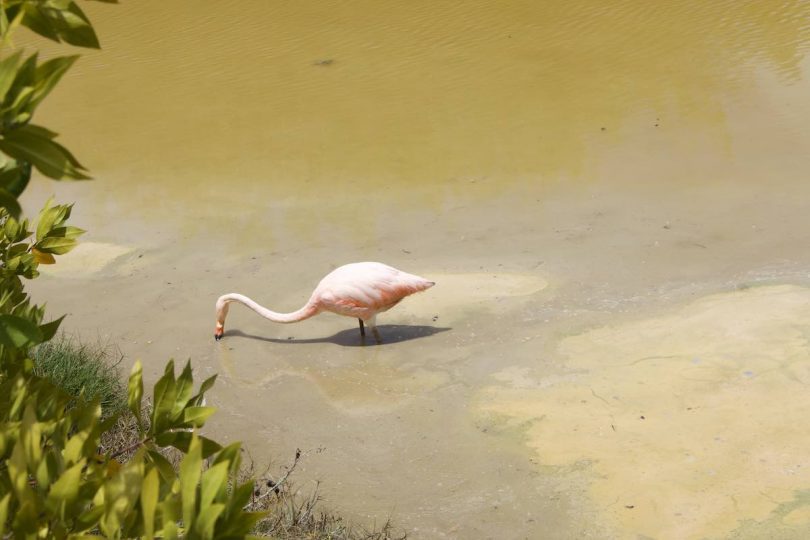
The Galapagos flamingo population sits at between 300 and 500 individuals and has been declining over the past decade according to the Galapagos National Park Directorate. With a total global count that small, a single bad breeding season can erase years of recovery. The primary threats are introduced predators attacking nests and chicks, El Niño events that flood or dry out lagoon habitat, and human disturbance at nesting sites. A 2012 rodent eradication campaign on Rábida Island produced measurable results: in 2022, flamingos nested on Rábida for the first time in 20 years.
The December 2024 report from environmental news sources citing Galapagos National Park director Arturo Izurieta put the situation plainly: flamingo numbers have decreased over the last ten to twelve years. There are an estimated 250 breeding pairs distributed across the brackish lagoons of Isabela, Floreana, Rábida, Santa Cruz, and Santiago. High tides driven by climate change are now flooding nesting sites, affecting egg and chick survival. Introduced pigs, cats, and rats attack eggs and chicks at accessible lagoon margins.
The Rábida recovery story is the conservation positive in this otherwise difficult picture. When rodents were eradicated from the island in 2012, nest predation dropped to near zero. Flamingos that had abandoned the site began tentatively returning. By 2022, confirmed nesting was recorded for the first time in two decades. This direct cause-and-effect evidence of what predator control achieves for this species is now used to justify ongoing eradication work at other lagoon sites across the archipelago.
The national park monitors flamingo populations through regular censuses and maintains protection zones around active nesting areas. During nesting season, certain lagoon sections may be closed to visitors or require greater minimum distances. Your naturalist guide will brief you on current restrictions before any lagoon excursion. These rules are not bureaucratic barriers: they are the direct conservation mechanism that keeps this population viable. A disturbed nesting flamingo that abandons its egg is a real loss from a very small number.
What your cruise visit contributes: park entry fees fund the monitoring programs, the predator control operations, and the protection enforcement that keeps these lagoon habitats functional. A licensed, responsible operator brings you to the lagoon with a guide who enforces the viewing distance rules that protect nesting birds. The connection between how you visit and whether the flamingos are there for the next group is direct and unambiguous at this population size.
Frequently Asked Questions
Are flamingos endemic to the Galapagos?
The flamingo species present, the American flamingo, is not endemic in the strict sense: it also lives in the Caribbean and parts of South America. However, the Galapagos population has been isolated long enough to develop distinct genetic and behavioral characteristics, including the ability to breed in much smaller groups than mainland populations. Many ornithologists treat the Galapagos birds as a distinct subspecies. What is certain is that the combination of the Galapagos lagoon environment and the specific birds that have evolved here produces something not found anywhere else, including the deeper pink coloration driven by the shrimp-rich lagoons.
Why are Galapagos flamingos pinker than others?
The pink color in all flamingos comes from carotenoid pigments absorbed from their food, primarily brine shrimp and blue-green algae. Without these pigments in the diet, flamingos would be grey or white. The Galapagos lagoons are particularly rich in brine shrimp, which means the birds here accumulate more carotenoid pigment than flamingo populations feeding in less productive habitats. The result is a deeper, more saturated pink than you see in most flamingo populations globally. A brighter bird also signals health and good foraging conditions to potential mates, so the color is both a product of the diet and a communication tool during courtship.
Can flamingos be seen on a short Galapagos cruise?
Yes, if the itinerary includes the right stops. A 5-day itinerary that includes Floreana or Rábida can deliver a flamingo encounter. A 5-day itinerary focused on the northern central islands with only Las Bachas on Santa Cruz as a flamingo site will likely not. The key is confirming which specific sites are in the excursion program, not just which islands the cruise visits. We can confirm this before you book.
Why did flamingos come to the Galapagos in the first place?
Flamingos are strong long-distance fliers, and the most likely explanation is that a founding group arrived by chance from the Caribbean or South American coast, blown off course or following a migratory route that ended here rather than elsewhere. Once established in the brackish lagoons, which offered both food and breeding habitat without the large predators present on the mainland, the population became self-sustaining. Over generations, the isolation from mainland populations produced the distinct characteristics we see today.
Make Sure Your Itinerary Includes the Flamingos
With only 300 to 500 flamingos across the entire Galapagos, every sighting matters and every site visit is worth planning deliberately. We know which current itineraries include Punta Cormorant, the Puerto Villamil lagoons, and Rábida as confirmed excursion stops rather than optional additions. A free quote from Cruises To Galapagos Islands comes with a real itinerary recommendation built around what you want to see. Tell us your priorities and we’ll make sure the flamingos are on your route.
Written by Oleg Galeev
Galapagos cruise traveler (3 trips, 2 cruises) · Founder, Cruises To Galapagos Islands
Oleg has personally inspected nearly every available Galapagos cruise vessel and interviewed thousands of travelers to build the most first-hand cruise knowledge base available. He also runs the Ecuador travel blog mytrip2ecuador.com and the YouTube channel My Trip to Somewhere.
Cruises To Galapagos Islands is rated 4.9 stars on Google and TripAdvisor.
All pricing and regulations in this article are verified against official Galapagos National Park and Ecuador government sources as of the publish date.