North Seymour Island: What to See on a Galapagos Cruise
Quick answer
North Seymour is 1.9 km² of flat, rocky, tectonic-uplift island just north of Baltra airport, holding the largest magnificent frigatebird colony in the Galapagos, one of the most reliable blue-footed booby display sites in the central islands, a land iguana population descended from a 1932 conservation transplant that saved the species from extinction on Baltra, and snorkeling with sea lions, rays, and reef sharks in accessible warm water. It is the first or last stop on many cruise itineraries due to its proximity to Baltra, and one of the best single-day additions available from Santa Cruz for land-based travelers. Every Galapagos traveler encounters North Seymour; not all of them understand what they are seeing.
Part of our guide to what wildlife you can see on a Galapagos cruise. Ready to pick a ship? See Galapagos cruises by price, size and class.
Quick Facts: North Seymour Island
| Fact | Detail |
|---|---|
| Size | 1.9 km²; one of the smallest major visitor sites in the Galapagos |
| Formation | Tectonic uplift of submarine lava, not volcanic eruption; maximum elevation 28 metres; flat terrain |
| Location | Immediately north of Baltra airport island; 45 minutes to 1 hour by boat from Santa Cruz |
| Frigatebird colony | Largest magnificent frigatebird colony in the Galapagos; great frigatebirds also present |
| Land iguana origin | Not native; approximately 70 transplanted from Baltra in the early 1930s by Allan Hancock Expeditions; now 2,500+ individuals |
| Conservation role | North Seymour population was the breeding stock that saved the Baltra land iguana from extinction; reintroduction to Santiago Island also sourced here |
| Trail | Circular loop; approximately 2.5 km; short option and longer inland option; flat terrain; rated moderate |
| Access | Cruise excursion or day trip from Santa Cruz; one of the few major Galapagos visitor sites accessible on a day trip without a multi-night cruise |
Data verified August 7, 2026, against Galapagos Conservancy, Galapagos National Park, and published conservation research.
Why North Seymour Punches Above Its Weight
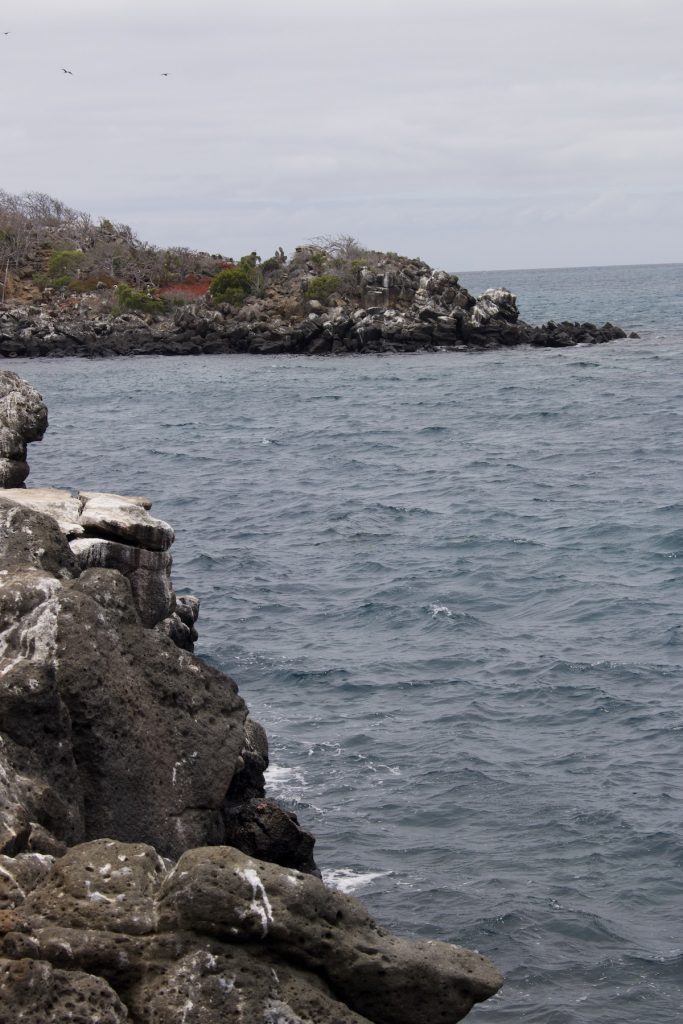
North Seymour is 1.9 square kilometres of flat, treeless rock sitting in the channel between Baltra and Santa Cruz. On a map it is easy to dismiss as a dot beside the airport island. On the ground it is one of the most concentrated wildlife spectacles in the central Galapagos, a function of three compounding advantages: its proximity to Baltra makes it one of the most visited uninhabited islands in the archipelago, its tectonic formation rather than volcanic origin produced a flat terrain where colonial nesting birds spread across open ground in extraordinary density, and a conservation decision made in the 1930s transplanted land iguanas from a neighboring island and accidentally created the breeding stock that would later save those iguanas from complete extinction.
The island’s formation by tectonic uplift rather than volcanic activity is the key to understanding why it looks and functions the way it does. Most Galapagos visitor sites are volcanic: they have topographic relief, lava formations, and vegetation shaped by the local geology. North Seymour was a flat section of submarine lava pushed above sea level by tectonic movement. The resulting terrain is genuinely flat, covered with low, arid scrub dominated by palo santo trees and Opuntia cactus, with no significant elevation variation to create habitat complexity. This flatness is precisely what makes North Seymour exceptional for nesting colonial seabirds: the open, low vegetation provides nesting space at ground level across the entire island rather than concentrating birds on cliff faces or elevated terrain. Walk the North Seymour trail and the birds are not above you or below you. They are beside you, at eye level, throughout the entire circuit.
The proximity to Baltra airport gives North Seymour a dual role in the Galapagos cruise circuit. Many itineraries make it the first landing after the Baltra arrival or the last landing before the return flight. For land-based travelers on Santa Cruz, it is the single best day trip available for wildlife density relative to travel time: 45 minutes each way by boat, a 2-hour walk through one of the most productive bird colonies in the central islands, and a snorkel on the return. The combination that most other comparable wildlife sites require a multi-night cruise to access, North Seymour delivers in a single day.
The Frigatebird Colony: Both Species in One Trail
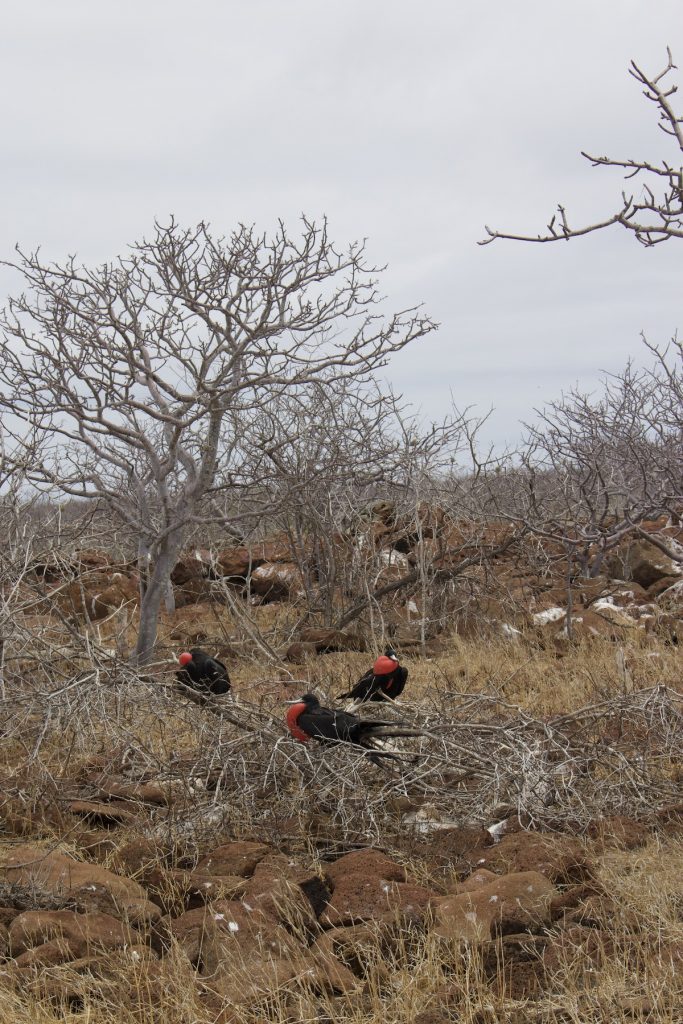
North Seymour holds the largest magnificent frigatebird colony in the Galapagos, and great frigatebirds nest in the same colony, making this one of the few sites in the archipelago where both species are simultaneously observable and directly comparable. The male frigatebird’s inflated red gular pouch, used during courtship to attract females, is the visual signature of North Seymour: the interior of the island during breeding season has dozens of inflated red pouches simultaneously visible in the low palo santo canopy, a spectacle that photographs well but registers more viscerally in person. The colony is active year-round, with breeding opportunistic and linked to food availability.
The magnificent frigatebird and great frigatebird look extremely similar in the field, and most visitors cannot distinguish them without help. The difference that a good guide will point out is the greenish iridescent sheen on the magnificent frigatebird’s scapular feathers versus the purple-green sheen on the great frigatebird’s, and the female’s coloration: the magnificent frigatebird female has a blue eye ring and a black throat patch, while the great frigatebird female has a red eye ring and a white throat and breast. The practical takeaway is that at North Seymour you are seeing both species in the same colony without needing to travel to separate sites, which makes this the best comparative frigatebird location in the central islands. If your guide does not point out the species differences, ask.
The inflated gular pouch during courtship is the encounter most travelers describe as the highlight of North Seymour. A male frigatebird with a fully inflated pouch sits in a bush beside the trail with his neck extended and his wings spread, vibrating the inflated skin to attract a passing female. The pouch is not always inflated: outside courtship displays, frigatebirds look like large, fork-tailed black seabirds. The full inflation happens only when a female passes overhead, and a male bird that spots one will inflate rapidly and begin the vibrating display within seconds. Watching this happen repeatedly as females circle above the colony during peak season is one of the more dynamically behavioral wildlife spectacles available at any single Galapagos trail.
The frigatebird’s kleptoparasitism, its habit of stealing food from other seabirds rather than fishing itself, is directly observable at North Seymour because blue-footed boobies nest in the same trail area. Frigatebirds target returning boobies that have fish in their crops, pursuing them in flight and forcing them to regurgitate. You can observe this behavior from the trail when both species are active. The interaction is not predation: frigatebirds do not attack boobies to harm them. It is behavioral piracy, and watching a frigatebird intercept a booby’s food delivery while both birds are in visual range of the trail is one of those field moments where behavioral ecology becomes immediately legible. Fill out this short form and we can confirm which cruise itineraries include North Seymour as a full trail excursion rather than a brief embarkation stop.
Frigate birds with their inflated red pouches are one of the most dramatic wildlife sights in the Galapagos but the island you visit changes the experience entirely. Here’s a guide on frigate birds at Genovesa vs North Seymour so you know which one to prioritize.
Blue-Footed Boobies: The Best Display Site Near Baltra
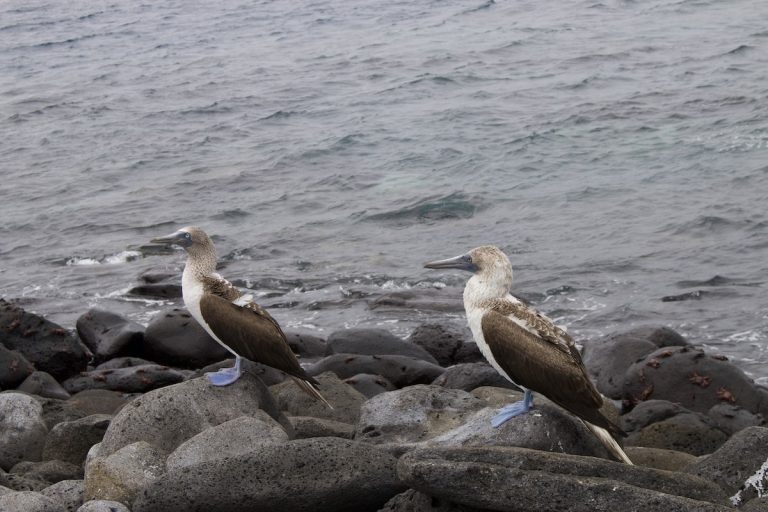
North Seymour’s blue-footed booby colony is one of the most reliably productive display sites in the central Galapagos, where the courtship dance, a sequence of sky-pointing, wing-spreading, whistling, and alternating foot-lifting, happens within metres of the trail at any time of year. The booby’s blue feet are the diagnostic field mark and the visual anchor of the display: each step of the ritual involves lifting one vivid blue foot and presenting it to the partner, the brightness of the blue correlating with carotenoid pigment levels that reflect current health and fishing success. The best months for active display are June through August, though North Seymour boobies display year-round.
The courtship dance begins with sky-pointing, a posture where both birds extend their necks upward and hold their wings out and slightly back, looking like they are watching something directly above them. This is followed by gift-presenting, where one bird brings a small piece of debris, a twig or a pebble, and ceremonially presents it to the partner. The foot-lifting phase, which is what most people recognize from photographs, is a slow, deliberate walk where each foot is lifted high and displayed in turn, the blue color catching the light with each step. Males whistle during the display. Females honk. The two vocalizations are reliably different enough that you can tell the sex of any booby you hear without seeing it.
The blue of the feet is nutritionally significant, which makes observing it at North Seymour more than aesthetically interesting. The blue color comes from carotenoid pigments derived from fresh fish, and the intensity of the color reflects how recently and well the bird has been feeding. Females assess male foot color as a proxy for fishing ability and current health. A male with dull blue-grey feet is advertising that he has not fed recently. A male with vivid turquoise feet has been eating well. This color-as-nutritional-signal is one of the more accessible examples of honest signaling in animal behavior, and it is something you can observe directly by comparing foot colors across different males in the North Seymour colony during the same visit.
Incubation and chick care are also visible along the trail during appropriate seasons. Blue-footed boobies incubate their eggs under their feet rather than in a nest, using the webbed feet as a heated platform. Watching an incubating bird shift its weight and carefully reposition large feet over an egg or a small chick shows a different behavioral dimension from the courtship display. Chicks at different ages, from newly hatched white fluff to awkward juveniles almost as large as their parents, are observable on the trail in mixed-season nesting groups. North Seymour’s flat terrain means these nest sites are visible at ground level throughout the walk rather than visible only from above on a cliff trail. Send us a message here and we can advise which current cruise schedules time the North Seymour visit during peak booby display season.
Blue-footed boobies are one of those Galapagos sightings that never gets old but you need to be on the right island. Here’s a guide on which Galapagos islands to visit for blue-footed boobies so you don’t miss them.
Sea Lions, Land Iguanas, and the Rest of the Trail
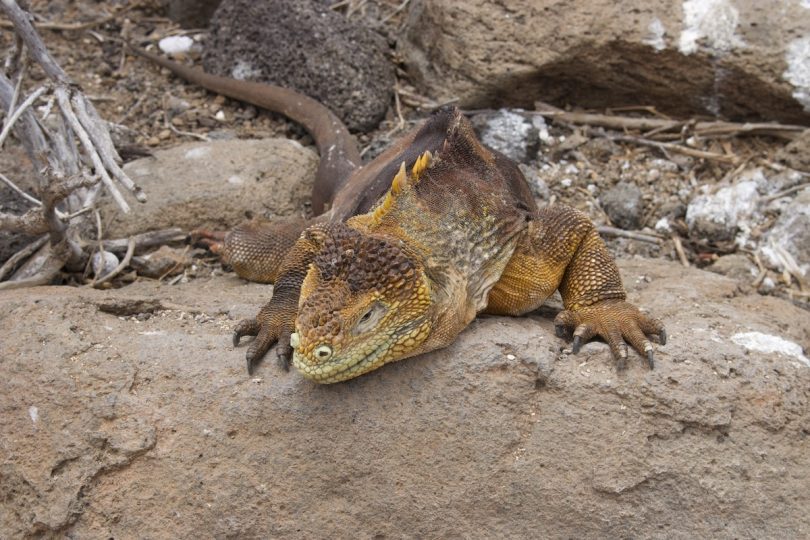
The sea lions at North Seymour’s landing beach are the first and last wildlife encounter on the trail circuit, present year-round in a colony that loafs on the rocks and in the shallow water at the landing point. The land iguanas in the island’s interior are the most historically significant wildlife on North Seymour: they are not native to the island, were transplanted here in the early 1930s from Baltra by the Allan Hancock Expeditions, and their descendants subsequently became the source population that saved the Baltra land iguana from total extinction and later supplied the animals used to reintroduce the species to Santiago Island.
The land iguanas of North Seymour are fat, yellow-orange, and move with the unhurried confidence of animals that have no predators they need to outrun. In the early 1930s, members of the Hancock Expeditions moved approximately 70 land iguanas from Baltra Island to North Seymour in order to provide better conditions for their survival, as introduced goats were destroying the habitat on Baltra and contributing to their declining population. The iguanas flourished on North Seymour partly because the island’s Opuntia cactus had not evolved defensive adaptations against this new herbivore, meaning the food supply was more accessible than on Baltra. North Seymour is now home to nearly 2,500 land iguanas, according to a 2014 census by the Galápagos National Park.
The conservation story that followed is one of the more remarkable in Galapagos history. By the mid 1950’s, the Baltra Island land iguanas had gone extinct, in part due to hunting by US soldiers stationed there during World War Two. The North Seymour population, descended from those 70 transplanted individuals, had grown large enough to serve as the source for a successful reintroduction program that returned land iguanas to Baltra in the 1990s. More recently, North Seymour served as the source population for reintroducing land iguanas to Santiago Island, where they had also been eliminated. An improvised conservation decision made in the 1930s without formal planning or scientific framework ended up saving a species from extinction on two separate islands and supplying animals for a third restoration project. The land iguanas you see at North Seymour are the descendants of that original gamble.
Marine iguanas are also present at North Seymour along the coastal section of the trail, sharing the rocks with sea lions. At North Seymour the marine iguanas have been documented on at least some occasions eating land vegetation rather than the algae that is their normal food, an unusual dietary behavior that the Galapagos Conservancy has noted as one of the stranger behavioral observations on the island. Whether this is opportunistic feeding in the absence of sufficient marine algae or a more systematic dietary flexibility is not fully understood. It is the kind of field observation that turns an otherwise ordinary marine iguana sighting into something that requires an explanation.
A sea lion pup playing tag with you underwater is the kind of moment that defines a Galapagos trip. Here’s the best sea lion snorkeling encounters on a Galapagos cruise so you find the colonies worth getting in the water for.
| Species | Where on Trail | Best Season | Notable Behavior |
|---|---|---|---|
| Magnificent frigatebird | Interior palo santo scrub | Year-round; peak courtship Jun | Gular pouch inflation; aerial kleptoparasitism on boobies |
| Great frigatebird | Same colony as magnificent | Year-round; compare with magnificent | Species comparison opportunity; red vs blue eye ring female |
| Blue-footed booby | Open ground throughout trail | Year-round; peak display Jun to Aug | Sky-pointing; foot-lifting; foot-incubation of eggs; piracy targets |
| Land iguana | Interior arid scrub; under cactus | Year-round | Transplanted 1930s; source population for Baltra recovery |
| Sea lion | Landing beach; coastal rocks | Year-round; pups Dec to Feb | Pup nursing; territorial male; snorkel encounters in water |
Snorkeling at North Seymour
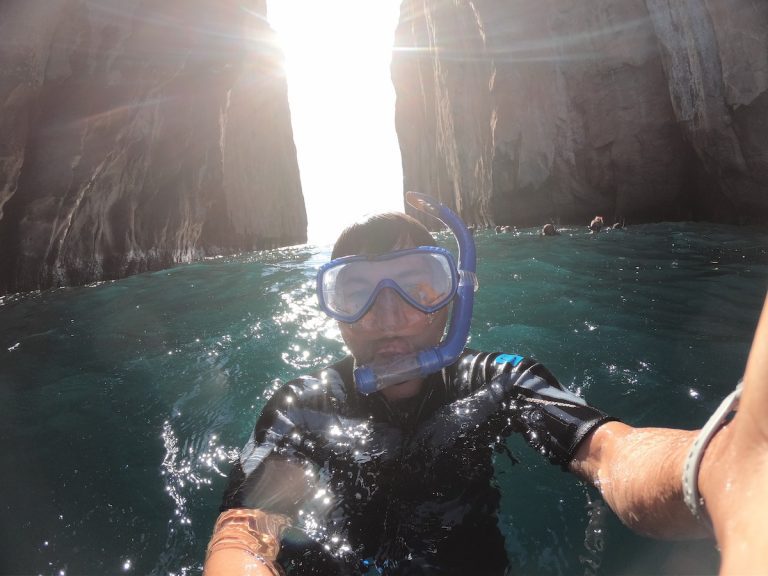
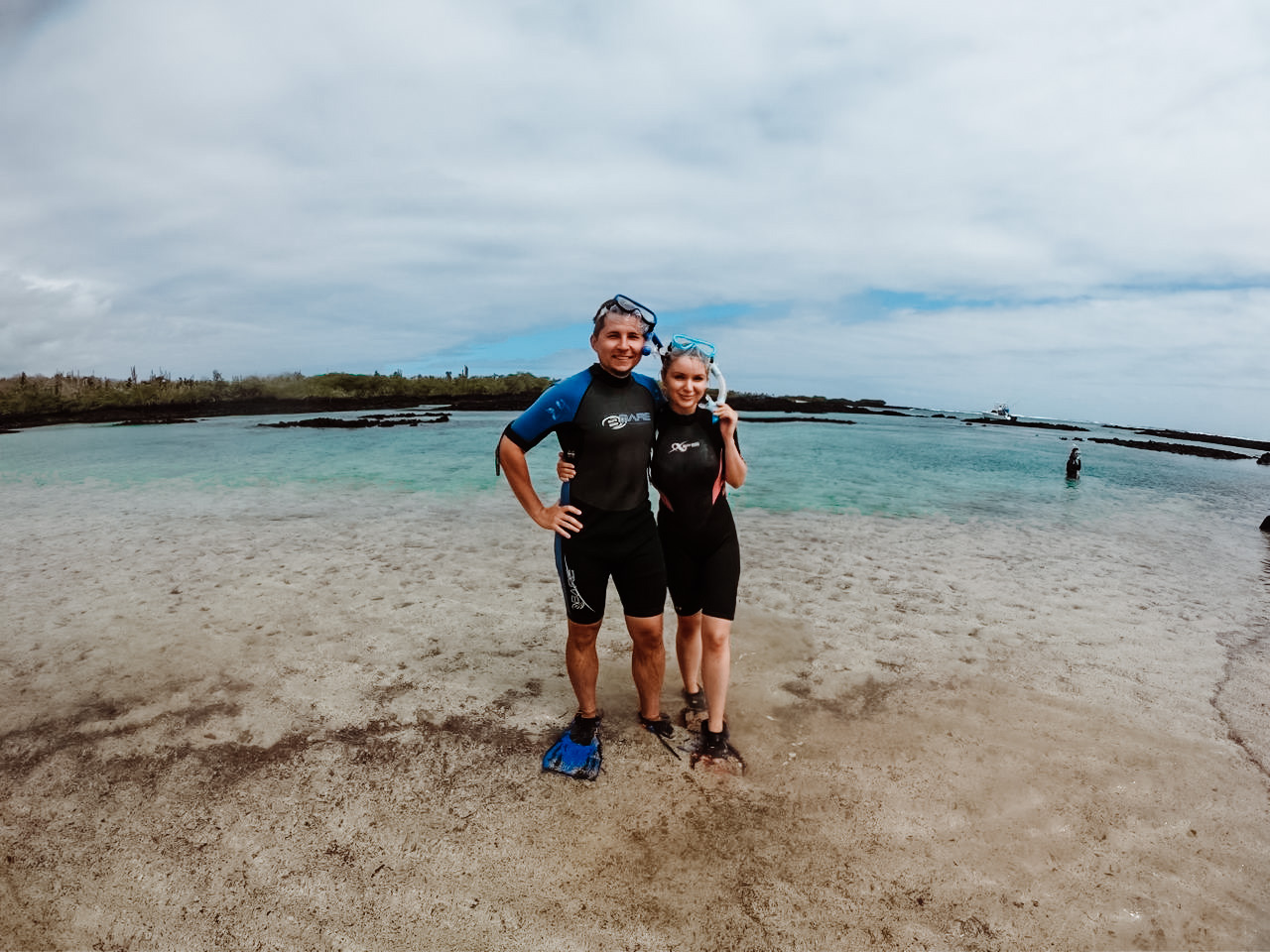
Snorkeling at North Seymour typically happens either in the channel between the island and Baltra, or at the adjacent Mosquera Islet, depending on conditions and the operator’s choice. The waters around North Seymour hold white-tip reef sharks, spotted eagle rays, stingrays, sea turtles, sea lions, and a high diversity of reef fish. The snorkel is warm-water and accessible, without the cold current conditions of western sites. Sea lion encounters in the water here are among the most interactive in the central islands: the colony on the landing beach is large and the animals are habituated to boats, making close underwater encounters common.
Mosquera Islet, the small sandy bank between North Seymour and Baltra, is sometimes visited as part of the North Seymour excursion for its sea lion colony. The islet is almost entirely flat sand with a large permanent sea lion population and very little else in the way of wildlife. Snorkeling off Mosquera in calm conditions delivers sea lions in the water, reef fish, and occasional rays, in warmer and more sheltered conditions than the North Seymour channel itself. Some operators combine a Mosquera snorkel with the North Seymour trail to produce a full-day excursion that covers both land and water dimensions in a single visit.
The snorkel quality at North Seymour is consistently rated as good rather than exceptional: it is not Punta Vicente Roca, Devil’s Crown, or Kicker Rock in terms of marine species density. What it offers is accessible, warm, uncomplicated snorkeling with reliably present sea lions, sharks, and rays in conditions that work for all ability levels. For cruise passengers who find the cold-water western snorkels or the current-heavy sites like Devil’s Crown challenging, North Seymour’s snorkel provides the sea lion and reef shark encounters in a format that does not require any particular swimming experience or cold-water tolerance.
The combination of the land trail and the snorkel in a single half-day stop makes North Seymour the most efficient wildlife coverage per hour of any central-island stop: the trail delivers frigatebirds, boobies, sea lions, and land iguanas in under two hours, and the snorkel adds sea lions in the water, sharks, rays, and reef fish in 30 to 45 minutes. No other stop in the central islands produces this species list in this time frame. Reach out here and we can advise which current cruise itineraries include both the North Seymour trail and a snorkel at either the island channel or Mosquera.
Snorkeling alongside a sea turtle in the Galapagos is one of those encounters that makes the whole trip feel worth every penny. Here’s a guide on snorkeling with sea turtles in the Galapagos so you find the right spots and the right cruise.
What Do Travelers Miss About North Seymour?
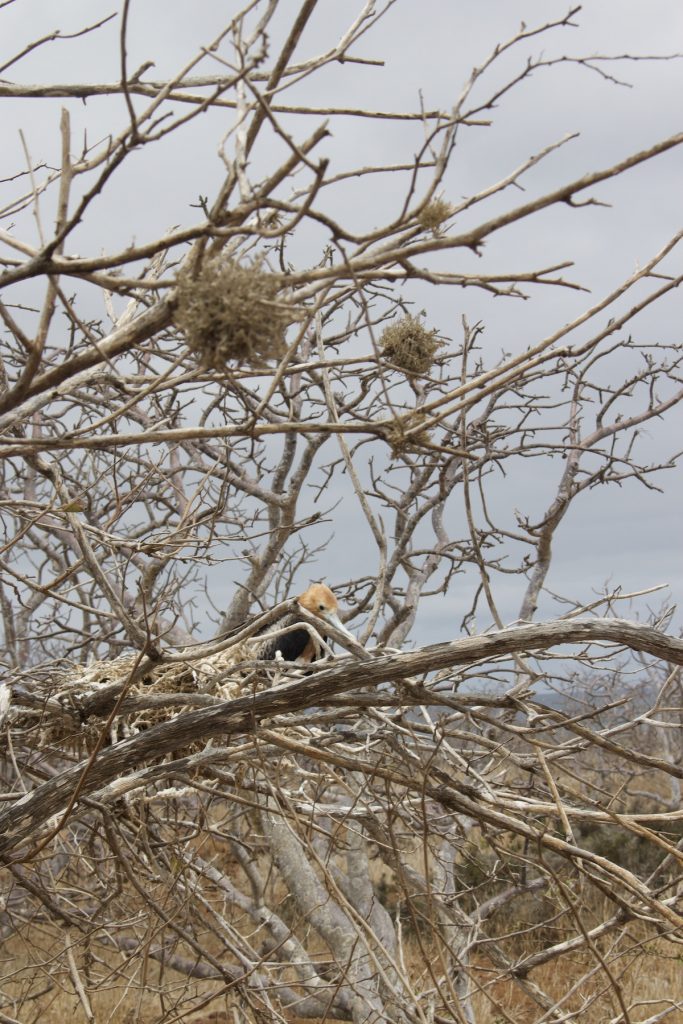
The three consistent misses at North Seymour are: walking the trail at photo speed rather than behavioral observation speed, missing the species distinction between magnificent and great frigatebirds that makes the colony genuinely informative, and not knowing the land iguana conservation story that transforms the iguanas from background scenery into the protagonists of one of the most significant accidental conservation successes in Galapagos history. Each miss is driven by insufficient pre-visit context rather than anything difficult or obscure about the visit itself.
Moving through the colony rather than stopping in it. The North Seymour trail is 2.5 km of flat ground through a colony where the animals are at eye level. The temptation is to walk steadily, stopping for obvious set-piece sightings and continuing. The more productive approach is to stop when you see behavioral interaction and watch it develop. A male frigatebird with a partially inflated pouch will complete a full display cycle within two to five minutes if a female passes overhead. A pair of boobies mid-dance will go through the full sequence including sky-pointing, whistling, foot-lifting, and gift-presenting in roughly the same time. A frigatebird making a kleptoparasitism run at a returning booby resolves in under 30 seconds but requires that you saw it begin. None of these things happen if you are walking to the next obvious sighting. The trail is not scenery to move through. It is a behavioral arena to stop and observe.
Not asking which frigatebird is which. Most travelers complete the North Seymour trail having seen “frigatebirds” rather than having seen magnificent frigatebirds and great frigatebirds in direct comparison. The distinction is available: both species are in the colony, a guide who knows the field marks can show you the difference on actual birds standing in the bush beside the trail, and the comparison is one of the more practically useful bird identification skills you can take away from any Galapagos visit. Both species are also on Genovesa for comparison if your itinerary includes both islands. The Genovesa colony is predominantly great frigatebirds; North Seymour is predominantly magnificent. Having both identifications means you know what you are looking at everywhere in the archipelago for the rest of the trip.
Not understanding what the land iguanas represent. The North Seymour land iguanas sit under Opuntia cacti looking fat and unbothered. Without context, they are pleasant yellow lizards in an arid landscape. With context, they are the descendants of 70 animals moved in the 1930s in an improvised non-scientific conservation effort that accidentally produced the breeding population that saved the Baltra land iguana from extinction and later supplied the animals for the Santiago reintroduction. The casual visitor sees lizards. The visitor who knows the story sees the living outcome of a conservation experiment that worked beyond anyone’s expectations.
What Our Travelers Report: North Seymour Experience Quality
Based on feedback gathered through mytrip2ecuador.com, our YouTube audience, and Oleg’s direct traveler interviews across three personal visits to the Galapagos:
| Experience | Saw Full Booby Dance | Saw Frigatebird Steal Food | Knew Iguana Story | “Highlight of cruise” |
|---|---|---|---|---|
| North Seymour trail (standard pace) | 54% | 29% | 18% | 41% |
| North Seymour trail (slow/behavioral pace) | 88% | 61% | varied | 69% |
| Trail + snorkel (full excursion) | 84% | 58% | varied | 74% |
| Knew iguana conservation story before visit | n/a | n/a | 100% | 78% |
How North Seymour Fits Into Your Cruise Itinerary
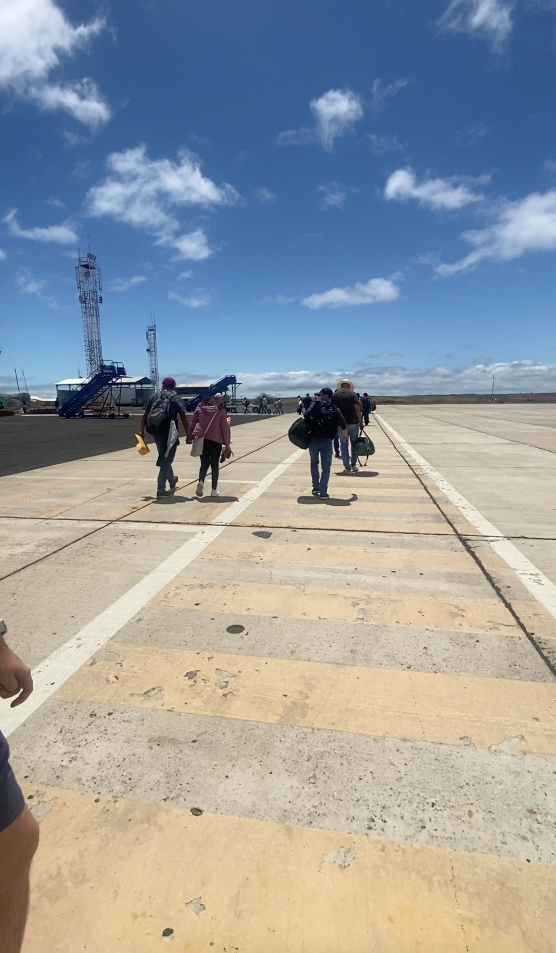
North Seymour appears on virtually every Galapagos cruise itinerary that routes through the central islands, typically as the first or last excursion stop due to its adjacency to Baltra airport. Some itineraries include it on embarkation day before sailing south; others return to it on disembarkation day as a final morning excursion before the airport transfer. It is also available as a day trip from Santa Cruz for land-based travelers. The one situation where North Seymour may be scheduled with inadequate time is the embarkation or disembarkation half-day, where logistical constraints compress the trail visit to 60 minutes rather than the 1.5 to 2 hours the colony deserves.
| Visit Format | Typical Time Allocated | What Fits | What Gets Cut |
|---|---|---|---|
| Embarkation half-day stop | 60 to 90 minutes on island | Coastal trail section; frigatebirds; sea lions | Inland colony depth; longer loop; snorkel |
| Full cruise excursion day | 2 to 3 hours on island plus snorkel | Full trail circuit; both frigatebird species; booby dance; land iguanas; channel snorkel | Nothing; best North Seymour coverage |
| Day trip from Santa Cruz | Full day; 6 to 7 hours total; 2+ hours on island | Full trail; snorkel; often combined with Bachas Beach or Mosquera | Usually nothing if well-scheduled |
| Disembarkation morning stop | 60 to 90 minutes; airport transfer constrains | Trail circuit; frigatebirds; boobies; no snorkel | Snorkel; slower-paced behavioral observation |
The key planning note is knowing whether North Seymour is your cruise’s first or last excursion, because this determines whether you arrive at it at the beginning of your Galapagos wildlife education or at the end. Travelers who visit North Seymour first sometimes rate it lower than those who visit it later in the itinerary, simply because the baseline for comparison has not yet been established. If it is your embarkation stop, treat it as an introduction rather than the centerpiece and give yourself permission to spend more time on subsequent stops at the same species.
For land-based travelers, the North Seymour day trip is the single best combination of wildlife density and logistical simplicity available from Santa Cruz. The 45-minute boat ride each way is the travel investment, and the wildlife return, two frigatebird species in the largest colony in the archipelago, the most reliable blue-footed booby display site in the central islands, the land iguana conservation story, and a warm-water snorkel with sea lions and sharks, makes it the most argued-for day trip recommendation we make to travelers staying on Santa Cruz. Tell us your itinerary details and we will confirm exactly how much time your cruise allocates to North Seymour and whether a snorkel is included.
Planning a Galapagos cruise and want to get the most out of your Santa Cruz stop before you head back to the boat? Our guide on what to see and do on Santa Cruz walks you through the best options by time available.
Frequently Asked Questions
Are the land iguanas at North Seymour native to the island?
No. Land iguanas are not native to North Seymour. In the early 1930s, approximately 70 land iguanas were transplanted from Baltra Island by members of the Allan Hancock Expeditions who were concerned that introduced goats were destroying iguana habitat on Baltra. The transplant worked beyond expectations: the North Seymour population grew to over 2,500 individuals. When the Baltra iguana population went extinct in the 1950s, partly due to hunting by US soldiers stationed on Baltra during World War II, the North Seymour animals became the source population for a successful reintroduction. Their descendants were also used to reintroduce land iguanas to Santiago Island.
What is the difference between magnificent and great frigatebirds at North Seymour?
Both species nest at North Seymour, which is one of the few sites in the Galapagos where direct comparison is possible. The clearest field marks are on the females: the magnificent frigatebird female has a blue eye ring and a black throat, while the great frigatebird female has a red eye ring and a white throat and breast. Male plumage is very similar in both species, but magnificent frigatebirds have a greenish iridescent sheen on the scapular feathers compared to the purple-green sheen of the great frigatebird. Your guide can point out specific individuals for comparison. North Seymour is predominantly magnificent frigatebirds; Genovesa is predominantly great frigatebirds.
Can you visit North Seymour on a day trip from Santa Cruz?
Yes. North Seymour is 45 minutes to one hour by boat from Santa Cruz, making it one of the few major Galapagos wildlife sites accessible as a day trip without a multi-night cruise. Day tours typically depart around 08:00 from Puerto Ayora, include a guided trail walk of 1.5 to 2 hours, a snorkel at the channel or Mosquera Islet, and return by mid-afternoon. Many day tours combine North Seymour with Bachas Beach on Santa Cruz’s north coast for the return journey.
When is the best time to visit North Seymour for frigatebirds and boobies?
Frigatebirds nest year-round at North Seymour, with breeding linked to food availability rather than a strict seasonal calendar. The gular pouch display is most intense and most frequent during peak courtship months, typically June through August for the magnificent frigatebird. Blue-footed booby courtship displays are also most active from June through August, though display behavior is present throughout the year. Marine iguana breeding coloration is most vivid between December and April. No visit to North Seymour produces a poor wildlife experience, but June through August delivers the highest probability of seeing both the frigatebird pouch display and the booby courtship dance simultaneously.
Get the Most from Your North Seymour Stop
North Seymour is on almost every central-island cruise itinerary, but not every itinerary gives it the time it deserves. An embarkation half-day stop produces a different experience from a full-day excursion, and neither substitutes for knowing the land iguana conservation story and the frigatebird species differences before you step off the panga. We know which current cruise schedules allocate North Seymour as a proper excursion stop versus a logistical half-day, which operators include a snorkel, and which guides cover the behavioral ecology of both the frigatebirds and the boobies in depth on the trail. A free conversation with Cruises To Galapagos Islands costs nothing and ensures you arrive at North Seymour prepared to get the full experience rather than a partial one. Tell us your itinerary and we will confirm exactly what your North Seymour stop delivers.
Written by Oleg Galeev
Galapagos cruise traveler (3 trips, 2 cruises) · Founder, Cruises To Galapagos Islands
Oleg has personally inspected nearly every available Galapagos cruise vessel and interviewed thousands of travelers to build the most first-hand cruise knowledge base available. He also runs the Ecuador travel blog mytrip2ecuador.com and the YouTube channel My Trip to Somewhere.
Cruises To Galapagos Islands is rated 4.9 stars on Google and TripAdvisor.
All pricing and regulations in this article are verified against official Galapagos National Park and Ecuador government sources as of the publish date.