Why Is Pinnacle Rock Famous In The Galápagos?
Part of our guide to Bartolomé Island, the most photographed Galapagos stop. Ready to pick a ship? See Galapagos cruises by price, size and class.
Quick Facts: Pinnacle Rock
| Fact | Detail |
|---|---|
| Location | Bartolomé Island, just off the east coast of Santiago, central Galápagos |
| What it is | The eroded remnant of a tuff cone, formed when magma met seawater |
| Island age | Bartolomé is put at roughly 1.5 to 2 million years old |
| Viewpoint | Summit of Bartolomé, 114 m (about 374 ft) |
| Getting up | About 600 m of boardwalk with roughly 360 to 375 steps, 30 to 45 minutes |
| Landing | Dry landing at the dock for the summit; wet landing at the beach for the snorkel |
| In the water | Galápagos penguins, sea turtles, white-tip reef sharks, rays, sea lions, reef fish |
| Best time of day | Early morning, for cooler rock and the best light |
| How to visit | Central and some northern cruise routes, or a day tour from Santa Cruz |
| Day tour price | Roughly US$230 to US$460 per person in recent listings |
| Rules | Licensed naturalist guide required, marked trail only, 2 m from wildlife |
Why Is Pinnacle Rock So Famous?
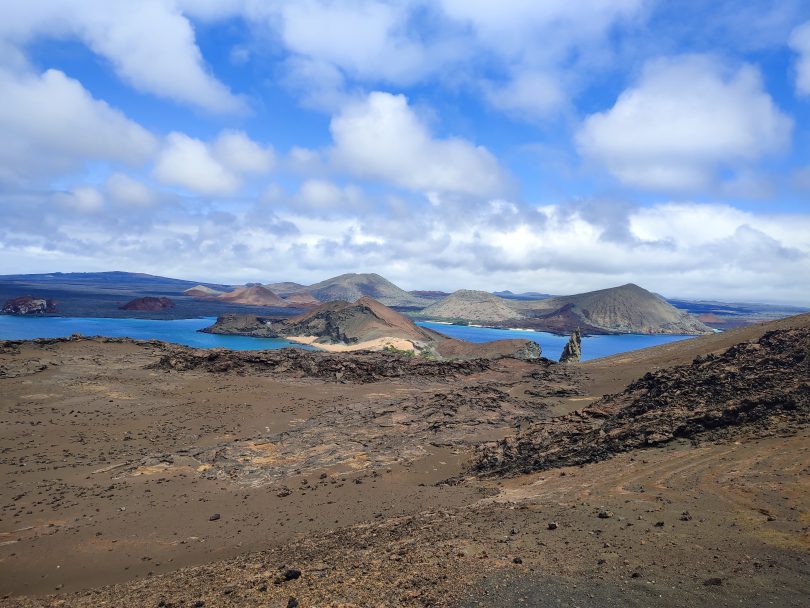
Pinnacle Rock is famous because it is the centrepiece of the most photographed view in the Galápagos. From the summit of Bartolomé, the dark spire rises out of turquoise water between two curved beaches, with the black lava fields of Santiago behind. It is the image on postcards, park brochures and almost every cruise company's website.
Most Galápagos icons are animals: a tortoise in the highlands, a booby lifting a blue foot, a marine iguana sneezing salt. Pinnacle Rock is the one landscape that stands for the whole archipelago. That is partly because it is so photogenic, and partly because the view explains the islands in a single frame. You can see the raw volcanic origin of the place, the young lava with almost nothing growing on it, the bright water, and the way islands sit close together in the central archipelago.
It also helps that the view is easy to reach. Many of the great Galápagos landscapes are far out on the western routes or need a long, hot hike. At Bartolomé a short boardwalk takes you to the top, so travelers of almost every fitness level can stand in the spot where the famous photo is taken. Then, an hour later, they can be in the water at the base of the same rock with penguins.
That combination is rare. Few visitor sites pack a world-class viewpoint, fresh volcanic geology and one of the best snorkels in the central islands into a single morning. That is why Bartolomé shows up on so many itineraries, and why Pinnacle Rock is the picture people take home.
What You Actually See From The Top
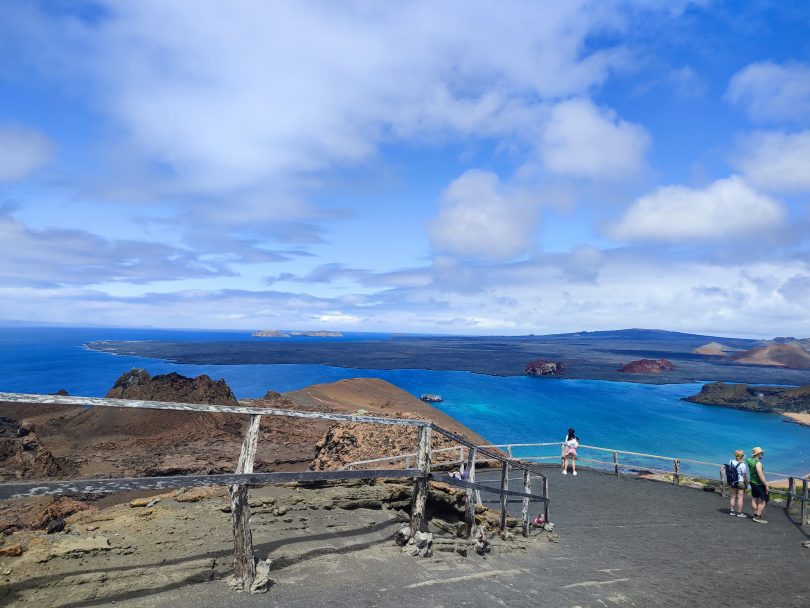
The summit view has more in it than the rock. Look down and you see the narrow isthmus of Bartolomé, with a beach on each side. Pinnacle Rock rises from the northern bay. Across the narrow channel lies Santiago, with the black, barely weathered lava of Sullivan Bay. On a clear day you can pick out other islands of the central group in the distance. Around you on the summit trail are spatter cones, small craters and lava tubes, so the climb itself is a walk through a young volcanic landscape.
How Did Pinnacle Rock Form?
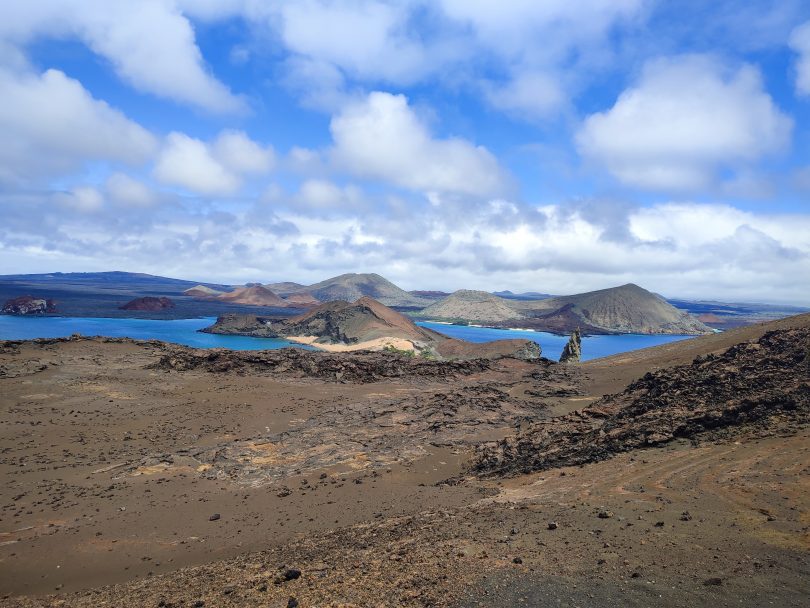
Pinnacle Rock is what is left of a tuff cone. Magma from an underwater vent met seawater, and the steam explosions shattered it into ash and fragments. Those settled in layers and hardened into tuff. Over time, waves and wind stripped most of the cone away, leaving the steep, layered spire you see today.
This kind of eruption is called phreatomagmatic, which is a long way of saying "lava meets water and explodes". It happens all over the world wherever volcanoes erupt in shallow seas or wet ground, and the Galápagos has many examples. What makes Pinnacle Rock unusual is how much has been worn away. A full tuff cone is a broad, rounded hill. Pinnacle Rock is the hardest surviving slice of one, standing on its own because the softer material around it has gone.
Look at it closely from the panga and you can see the layers in the rock face, tilted and stacked like pages. Each band is a separate burst of ash from the original eruptions. The layering is also why the spire has its jagged outline: some bands resist erosion better than others, so the profile steps in and out as it rises.
Bartolomé as a whole is young by geological standards, put at roughly 1.5 to 2 million years old. Its surface is a mix of spatter cones, lava flows and eroded tuff, and very little grows on it. Lava cactus and a few hardy shrubs such as Tiquilia are about all you will see on the way up. That bareness is a big part of why the view feels so otherworldly.
The Link With Sullivan Bay
Across the channel on Santiago, Sullivan Bay shows the same volcanic story in a much fresher form. It is a field of ropy pāhoehoe lava from eruptions around 1897, with more activity in the early 1900s, and it still looks almost new. Many itineraries pair the two sites on the same day, and seeing them together is one of the best geology lessons in the islands. See Santiago Island: what to expect.
Where Is Pinnacle Rock?
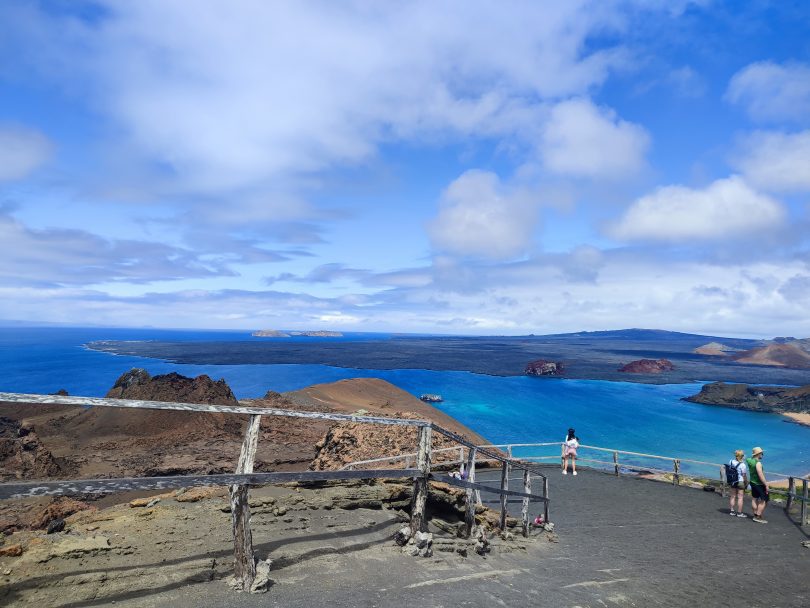
Pinnacle Rock stands on Bartolomé, a small island just off the east coast of Santiago in the central Galápagos. It sits between Santiago and Santa Cruz, which is why it fits so easily into central cruise routes and day trips.
Bartolomé is tiny. The whole island is only a little over one square kilometre, and the visitor site covers two parts of it: the dock and boardwalk up to the summit, and the beach and bay below Pinnacle Rock. Nearby you will also find Chinese Hat (Sombrero Chino), another small volcanic islet often visited on the same routes.
Boats coming from Santa Cruz, whether cruise ships or day-tour yachts, take about two hours each way from Puerto Ayora or the Itabaca Channel. On a cruise the boat usually moves overnight and you wake up at anchor in the bay. On a day tour, that crossing comes out of your day.
How Do You See It: Summit Hike Or Snorkel?
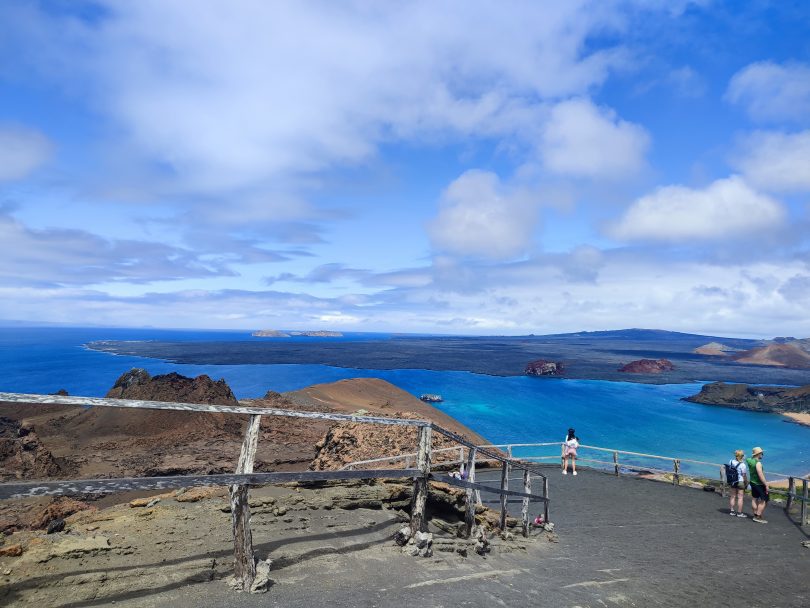
Most visits do both, as two separate parts of the same stop. The summit hike gives you the famous view from above. The snorkel puts you in the water at the base of Pinnacle Rock, where the wildlife is. If your itinerary only offers one, ask which, because they are completely different experiences.
The Summit Hike
The hike starts with a dry landing at a small dock, where you step straight from the panga onto rock. From there a wooden boardwalk of about 600 m climbs to the 114 m summit, with roughly 360 to 375 steps along the way. Most groups take 30 to 45 minutes to the top with stops. The boardwalk is there to protect the fragile volcanic surface, so it is also the only place you are allowed to walk.
It is rated moderate rather than hard. There is no scrambling and no difficult terrain, just a long staircase. What makes it tiring is the heat. There is no shade at all, and the dark rock absorbs the sun quickly, so by mid-morning the climb feels much harder than the numbers suggest. Go early, bring water, wear a hat and take your time. Travelers with knee problems usually manage fine at their own pace, as there are regular landings to stop on.
The Snorkel
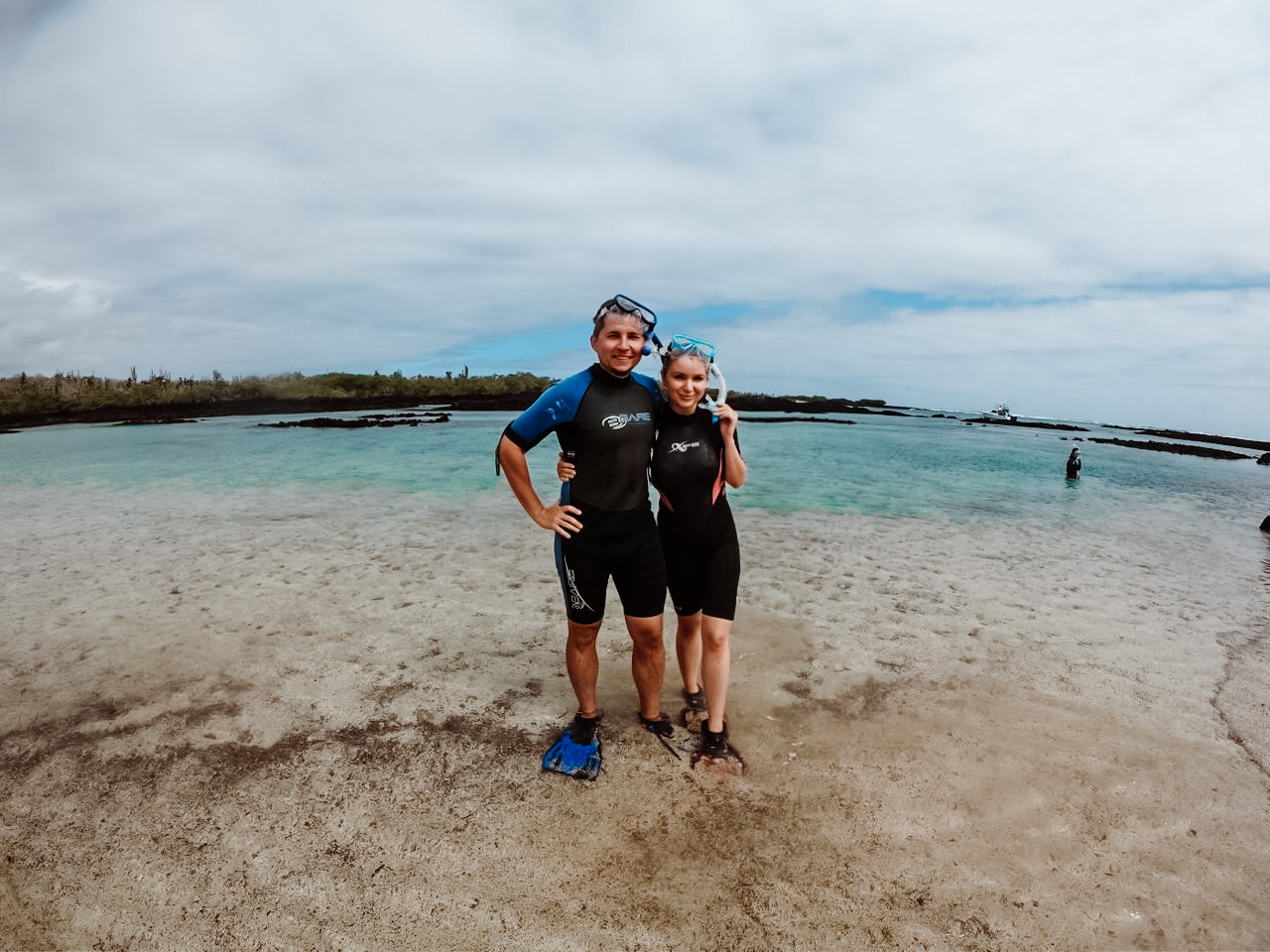
The snorkel is either a wet landing on the beach below Pinnacle Rock, where you wade ashore from the panga, or a deep-water entry straight from the boat near the rocks. The best area is along the base of the rock itself, where the underwater slope drops away and fish gather. Depending on your group's ability and the conditions, the guide may keep you closer to the beach.
The water here is influenced by cooler currents and is rich in nutrients, which is what draws the wildlife. In the dry season you will want a wetsuit. In the warm season, roughly December to May, many people snorkel without one. See our best itinerary for snorkeling for how Bartolomé compares with other sites.
Can You See Penguins At Pinnacle Rock?
Yes. A small resident group of Galápagos penguins lives around the base of Pinnacle Rock, which makes it one of the most accessible places in the central islands to see them. They are present all year, and are often spotted resting on the rocks from the panga or darting past snorkelers in the water.
The Galápagos penguin is the only penguin that lives on the equator, and most of the population is found on the cold western coasts of Isabela and Fernandina. Bartolomé is the notable exception, the place where a central-route cruise or a day tour from Santa Cruz has a real chance of a sighting. For many travelers who do not sail west, this is the only time they see one.
They tend to be more active in the cool season from June to November, when the water is colder and full of the small fish they hunt, and courtship is most visible from around September to December. In the warm season they are still there but less predictable, sometimes spending more time out of sight. A sighting is likely on most visits, but never guaranteed: they are wild animals and the guide cannot call them in.
If you do see them, enjoy it from a distance. The rule is at least 2 m from all wildlife, and penguins resting on the rocks should not be approached. In the water, the best encounters happen when you stay still and let them come past. For other places to see them, read where to see Galápagos penguins.
What Else Lives Around Pinnacle Rock?
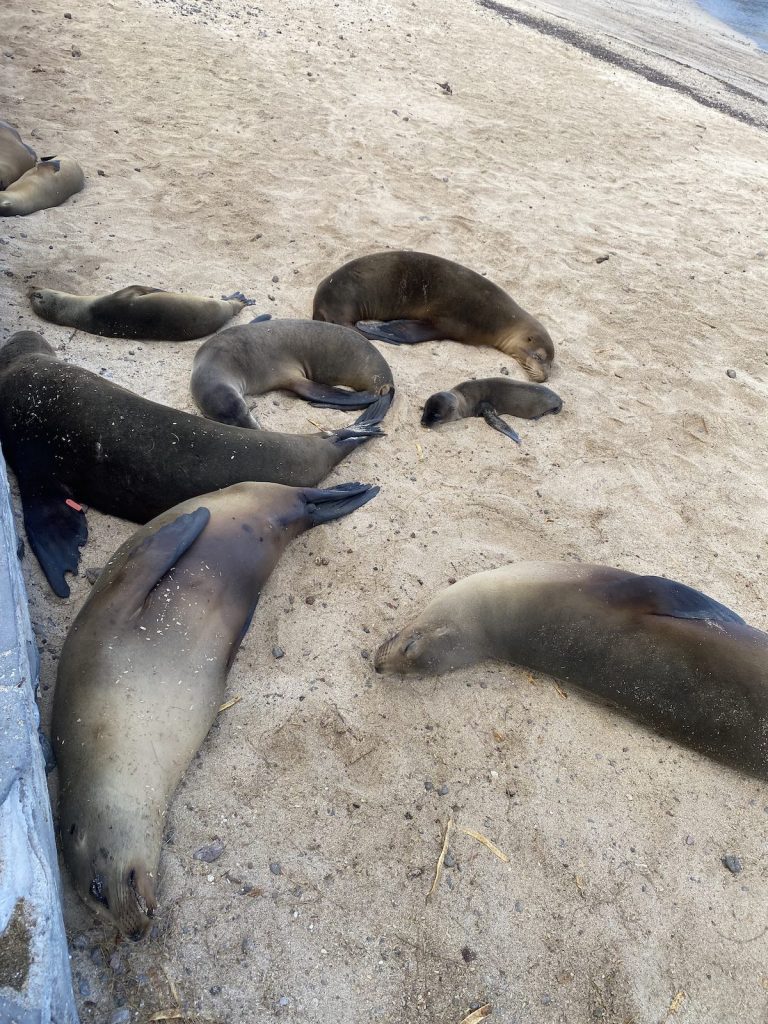
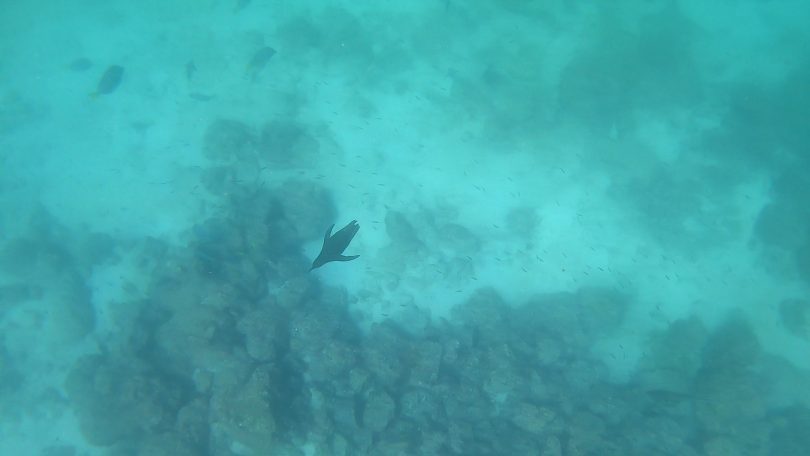
The water at the base of Pinnacle Rock is one of the best snorkels in the central islands. Besides penguins, the regulars are green sea turtles, white-tip reef sharks, rays, Galápagos sea lions and large schools of reef fish. On land, look for lava lizards, marine iguanas and seabirds along the shore.
- White-tip reef sharks often rest on the sandy bottom or in crevices near the rocks. They are small, calm and not a danger to snorkelers.
- Green sea turtles graze and rest in the bay, and you can usually float above them for minutes at a time.
- Rays, including stingrays and eagle rays, glide over the sand near the beach.
- Sea lions haul out on the rocks and sometimes swim over to investigate snorkelers, especially the young ones.
- Reef fish such as parrotfish, surgeonfish and sergeant majors gather along the underwater slope of the rock.
What you see depends on the season, the tide and the time of day, and no guide can promise a particular animal. The good news is that Bartolomé rarely disappoints. Even on a quiet day, the turtles and reef fish are reliable, and the setting with the spire above you is unlike any other snorkel in the islands. Compare it with other wildlife sites in our guide to what wildlife you can see on a Galapagos cruise.
How Do You Get The Famous Photo?
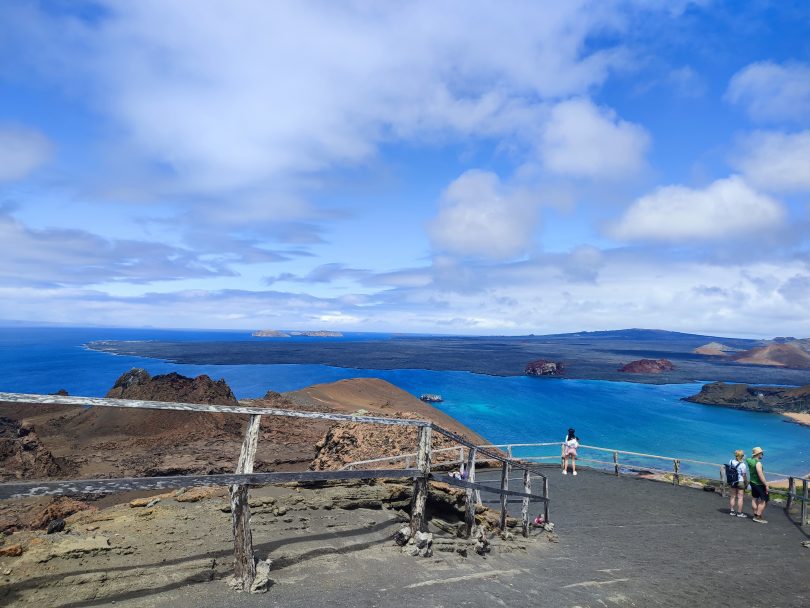
The classic shot is taken from the summit viewpoint, looking down over the isthmus with Pinnacle Rock on the right and the two beaches curving away from it. Morning light gives the best colour on the volcanic slopes, a wide-angle lens or your phone's wide setting fits the whole scene in, and patience at the top lets you wait for a gap between groups.
The summit has a small viewing platform at the end of the boardwalk, and every group stops there. You will usually have a few minutes, so know what you want before you arrive. A wide-angle setting captures the full sweep of the bay, the rock and Santiago behind. A slightly tighter frame on the rock and the northern beach gives you the postcard version. A polarising filter, if you have one, deepens the turquoise of the water.
Morning light falls from the east and brings out the red, orange and rust tones in the volcanic slopes behind the rock. By the middle of the day the light flattens and the heat haze grows, so the early landing is better for photos as well as comfort. If your boat visits in the afternoon, wait for the sun to drop a little before you start the climb if the guide allows it.
Do not forget the shots from below. From the panga, Pinnacle Rock rises straight above you and the layered tuff is easy to see. From the beach, it frames the bay. And if you have an underwater camera, the snorkel at the base of the rock is where the penguin and turtle photos come from. Our guide to the best camera gear for a Galapagos cruise covers lenses, housings and drones (drones are not allowed without a permit).
Which Cruises Stop At Bartolomé?
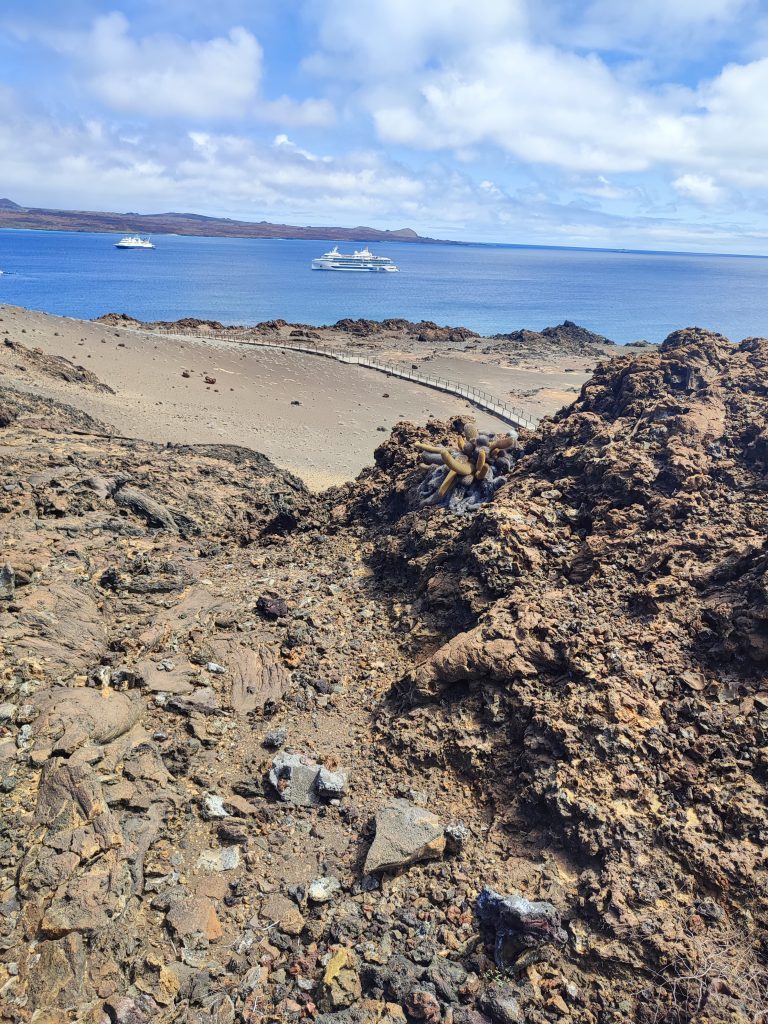
Bartolomé appears most often on central and some northern routes, because it sits between Santiago and Santa Cruz. Itineraries change from season to season and boats usually alternate between two or more loops, so always check the day-by-day plan for your exact departure before booking.
Among the ships we review, the itineraries described for Tip Top II, Letty and Danubio Azul include Bartolomé. Many other boats include it on one of their loops. The best way to find it is to start from the central islands itinerary and then compare the boats that sail it on your dates.
When you compare, look at three details. First, whether the visit includes both the summit hike and the snorkel, or only one. Second, whether it is scheduled in the morning, when it is cooler and the light is better. Third, whether Sullivan Bay is on the same day, which turns a good stop into a great one. These details vary between boats on what looks like the same route.
Can You Visit Without A Cruise?
Yes. If you are staying on Santa Cruz, guided day tours go to Bartolomé, leaving from Puerto Ayora or the Itabaca Channel with about two hours by boat each way. Recent listings price them at roughly US$230 to US$460 per person, depending on the operator and the yacht, usually including the guide, snorkel gear and lunch. Some combine the summit and snorkel with Sullivan Bay.
A day tour is a good option if you are on a land-based trip, but it is a long day. You spend about four hours on the boat, arrive later in the morning when it is hotter, and share the site with other day groups. A cruise usually arrives first thing, after an overnight move, with more time on the island and no return trip. See our comparison of a cruise versus day trips.
What Rules Apply When Visiting Pinnacle Rock?
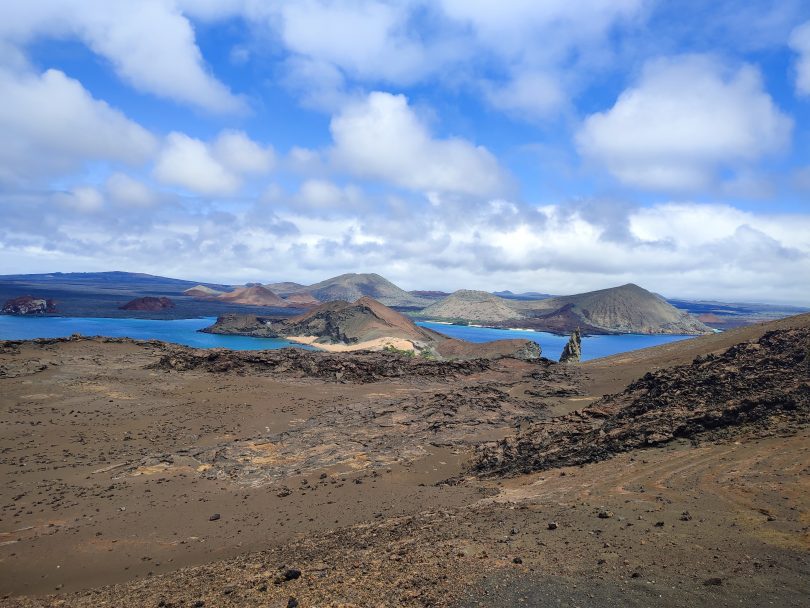
Bartolomé is a Galápagos National Park visitor site, so the standard park rules apply. You must be with a licensed naturalist guide, stay on the boardwalk and marked areas, keep at least 2 m from wildlife, and never touch or feed animals. You cannot climb Pinnacle Rock itself.
- Guides are mandatory. Every group ashore or in the water at a visitor site must be led by a park-licensed naturalist guide.
- Stay on the boardwalk. The volcanic surface is fragile and the trail exists to protect it.
- Keep your distance. At least 2 m from wildlife, including penguins on the rocks and sea lions on the beach.
- No touching, no feeding, no collecting. That includes shells, sand and rock.
- Think about sunscreen. Reef-safe sunscreen is the better choice for the water around the rock.
These rules are why the site still looks the way it does after decades of visitors. They also mean the experience is managed: time ashore is set by the park schedule, and groups take turns at the summit. You will not have the viewpoint to yourself, but you will rarely have to wait long. Before you go, read up on entry requirements and park fees.
Frequently Asked Questions
How Tall Is The Bartolomé Summit?
The viewpoint at the top of Bartolomé is 114 m (about 374 ft) above sea level. Pinnacle Rock itself is the spire below, seen from that summit. You cannot climb the rock.
How Many Steps Are There To The Bartolomé Viewpoint?
The boardwalk has roughly 360 to 375 wooden steps over about 600 m. Most visitors reach the top in 30 to 45 minutes with stops.
Is Pinnacle Rock On Bartolomé Or Santiago?
Pinnacle Rock is on Bartolomé, a small island just off the east coast of Santiago. Sullivan Bay on Santiago is visible across the channel from the summit.
Can You Visit Pinnacle Rock Without A Cruise?
Yes. Guided day tours to Bartolomé run from Santa Cruz, with about two hours by boat each way, and recent prices range from roughly US$230 to US$460 per person. All visits must be with a licensed naturalist guide.
What Can You See Snorkeling At Pinnacle Rock?
Galápagos penguins, green sea turtles, white-tip reef sharks, rays, sea lions and reef fish. The best area is along the base of Pinnacle Rock, where the underwater slope drops away.
When Is The Best Time To See Penguins At Bartolomé?
Penguins live at Bartolomé all year, but they are usually more active from June to November, when the water is colder and richer in fish. Early morning visits tend to be best for both wildlife and comfort.
Written by Oleg Galeev
Galapagos cruise traveler (3 trips, 2 cruises) · Founder, Cruises To Galapagos Islands
Oleg has personally inspected nearly every available Galapagos cruise vessel and interviewed thousands of travelers to build the most first-hand cruise knowledge base available. He also runs the Ecuador travel blog mytrip2ecuador.com and the YouTube channel My Trip to Somewhere.
Cruises To Galapagos Islands is rated 4.9 stars on Google and TripAdvisor.