What Fish and Marine Life Will You See Snorkeling in Galapagos?
Quick answer
Galapagos snorkeling delivers a combination of marine life found nowhere else: over 500 fish species in one place, including cold-water and tropical species mixed by seven converging ocean currents. What sets it apart is not just diversity but proximity and tameness. White-tip reef sharks rest a metre from your fins. Penguins torpedo past at full speed. Marine iguanas cling to rocks below you feeding on algae. Mola mola the size of refrigerators appear from the deep. The standard expectation on any cruise snorkel is sea turtles, sea lions, reef fish, rays, and white-tip sharks. The extraordinary encounters, marine iguanas feeding underwater, mola mola, Galapagos penguins in the water, and the red-lipped batfish that walks instead of swims, depend on site, season, and which islands your itinerary includes.
Part of our guide to what wildlife you can see on a Galapagos cruise. Ready to pick a ship? See compare all Galapagos cruise ships by price, size and class.
Quick Facts: Galapagos Marine Life for Snorkelers
| Category | What to Expect | Where and When |
|---|---|---|
| Sea turtles | East Pacific green turtle; feeding, resting, surfacing beside you | Year-round; nearly all snorkel sites |
| Sea lions | Curious pups and females that spiral and investigate snorkelers | Year-round; virtually all islands |
| Reef fish | 500+ species; parrotfish, king angelfish, surgeonfish, wrasse, sergeant majors | Year-round; all reef sites; peak Jun to Nov |
| Sharks | White-tip reef sharks resting on sandy bottoms; Galapagos sharks patrolling | Year-round; rocky reef sites and sandy channels |
| Rays | Eagle rays, golden rays, stingrays; manta rays seasonally | Rays year-round; mantas peak Dec to May |
| Marine iguanas | Only ocean-feeding lizard on Earth; gripping rocks and grazing on algae underwater | Warm season best; Fernandina, Isabela, Punta Espinosa |
| Penguins | Galapagos penguin; fastest underwater swimmers in the archipelago; torpedo-like | Isabela and Fernandina; year-round; peak cool season |
| Mola mola (sunfish) | World’s largest bony fish; disc-shaped; up to 1,000 kg; appears from deep | Peak Jun to Nov; Punta Vicente Roca; western Isabela |
Data verified August 7, 2026, against Charles Darwin Foundation, Galapagos National Park, and published marine biology research.
Why Is Galapagos Snorkeling Different From Any Tropical Destination?
The Galapagos Marine Reserve sits at the convergence of seven major ocean currents, including the cold Humboldt Current from Antarctica, the equatorial Cromwell Current, and several warm-water flows from the north. This collision produces a water chemistry that supports both cold-water and tropical species in the same location simultaneously. Over 500 fish species live in Galapagos waters, a number that includes endemics found nowhere else on Earth alongside species from the Indo-Pacific, the Caribbean, and sub-Antarctic zones. The marine life density is compounded by decades of protection inside the no-take marine reserve, producing animals that behave around snorkelers the way wildlife everywhere did before human disturbance.
Experienced snorkelers who have dived the Caribbean, the Maldives, and the Coral Triangle consistently describe the Galapagos underwater experience as categorically different. The difference is not primarily the coral, which is modest compared to these destinations, and not primarily the visibility, which is variable and often lower than tropical reef systems. The difference is the animal behavior and the species composition. In most marine environments, wildlife treats snorkelers as threats and maintains distance. In the Galapagos, a white-tip reef shark rests on the sandy bottom a metre from your fins and does not move. A sea lion pup investigates your mask at arm’s length. A marine iguana uses its claws to grip a rock directly below you while feeding on algae. These encounters happen because the animals here have no evolutionary conditioning to treat humans as predators.
The seven-current convergence also means the Galapagos supports ecological communities that should not logically coexist. Galapagos penguins, which are sub-Antarctic cold-water birds, swim alongside tropical parrotfish and surgeonfish in the same cove. Mola mola, which are deep cold-water oceanic fish, surface at sites where flightless cormorants dive for reef fish. This mixing of species from incompatible thermal regimes happens because the current system creates localized cold upwellings against warm surface water, allowing both communities to persist side by side. For a snorkeler, the practical result is that what you encounter in the Galapagos in a single session has no equivalent anywhere else in the ocean.
Reef Fish: What to Expect at Every Snorkel Stop
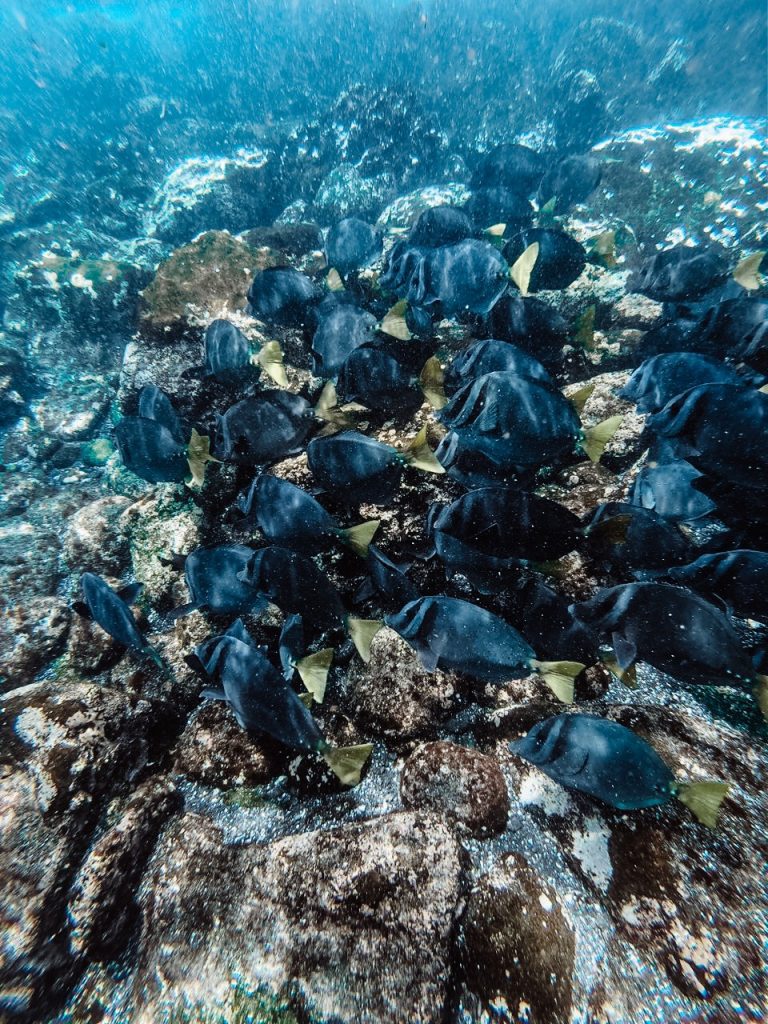
Certain reef fish appear on virtually every Galapagos snorkel regardless of island, season, or site type. The sergeant major, a small striped damselfish, is present at every reef site. Parrotfish in multiple color phases graze on algae and coral alongside sea turtles. King angelfish, with their vivid blue body, orange fins, and white vertical stripe, are among the most distinctive and reliably encountered species. Schools of surgeonfish and yellow-tailed surgeonfish move in synchronized formations along rocky walls. Wrasse of multiple species, including the brilliantly colored harlequin wrasse, work the reef surface. Moray eels, both the zebra moray with its black-and-white banding and the speckled moray, occupy crevices at almost every rocky site.
The king angelfish deserves specific mention because it is one of the more visually striking animals in the Galapagos water and one that many first-time snorkelers do not recognize before arriving. The body color shifts from deep blue to iridescent brown depending on the angle of light, with bright orange pectoral fins and a long white vertical stripe behind the gill plate. King angelfish live in monogamous pairs and are documented as cleaner fish for sharks at some sites, hovering beside a resting white-tip and picking parasites from the skin. Watching this at close range at a cleaning station is one of the more quietly remarkable behavioral observations available on a standard cruise snorkel.
The reef fish community in the Galapagos includes a significant endemic component. The red-lipped batfish, Ogcocephalus darwini (named for Darwin directly), is found only in Galapagos and coastal Peru. It does not swim. Instead, it uses modified pectoral and pelvic fins to walk across the sandy seafloor, and it has bright red lips whose precise function remains debated among researchers but which likely play a role in mate recognition. It carries a modified dorsal spine with a lure at the tip to attract prey, making it simultaneously an anglerfish and a walking fish. Finding one on the sandy bottom at Punta Vicente Roca or around reef edges is one of those encounters that makes experienced snorkelers stop moving entirely.
Pufferfish inflate when threatened, and in the Galapagos they demonstrate this behavior without particular urgency, sometimes inflating partly and then drifting past. Frogfish use camouflage so effective that they are genuinely invisible on the rocky substrate until they move. Scorpionfish present the same visual challenge with the added complication that they are venomous: stepping on one would be unpleasant, but they are easy to avoid by not placing hands or feet on rocky surfaces. Your guide briefs you on all of these specifics before each snorkel. Fill out this short form and we can recommend which operators have guides with the species ID depth to make your reef fish observations genuinely informative.
Sharks You Will Encounter While Snorkeling
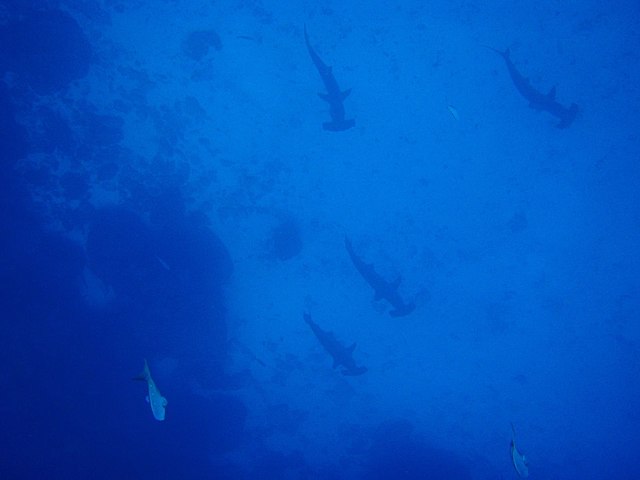
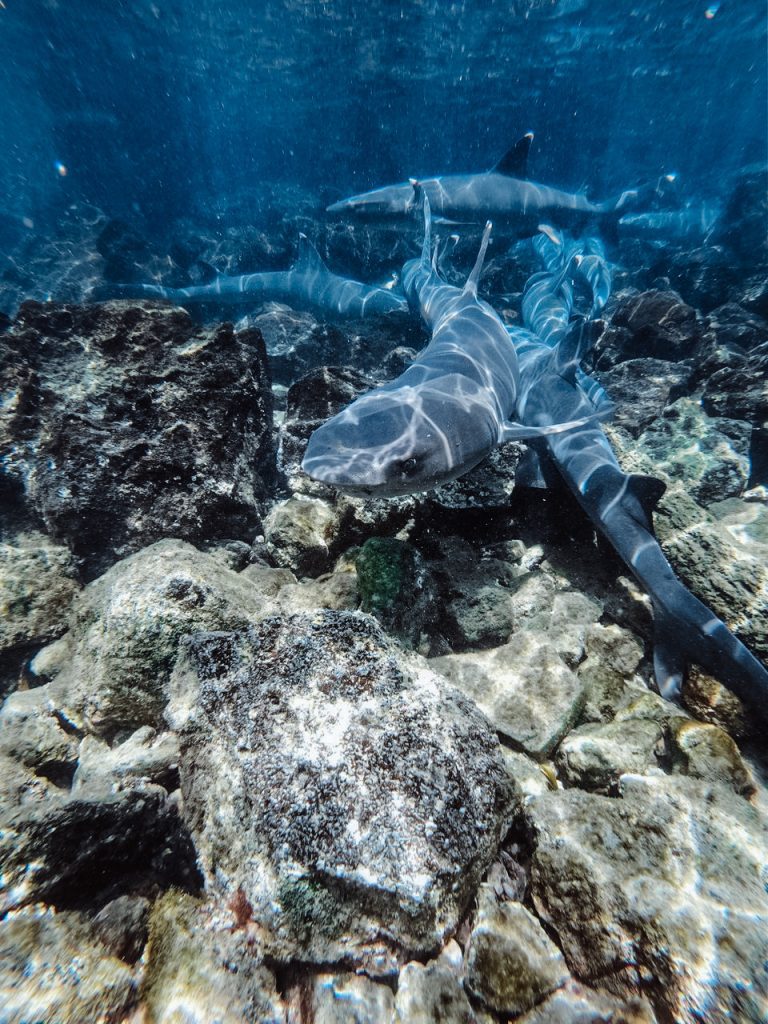
White-tip reef sharks are the most consistently encountered shark species for Galapagos snorkelers: small to medium-sized, identifiable by the white tips on the dorsal and caudal fins, and habitually resting motionless on sandy bottoms during the day. They are not aggressive toward snorkelers and typically do not move when approached at a reasonable distance. Galapagos sharks, a larger species endemic to the region, patrol reef edges and occasionally investigate snorkelers with a slow curious pass. Hammerhead sharks appear at deeper snorkel sites like Kicker Rock during the cool season. Whale sharks are dive-only encounters at Darwin and Wolf Islands from June through November.
| Shark Species | Encounter Likelihood | Typical Behavior | Best Sites |
|---|---|---|---|
| White-tip reef shark | Very high; most common shark for snorkelers | Resting on sandy floor; slow patrol; non-aggressive | Los Túneles; Santa Fe; most reef sites |
| Galapagos shark | High; especially near North Seymour, Wolf | Curious passes; confident; reef edge patrol | North Seymour; Rábida; Wolf Island |
| Scalloped hammerhead | Moderate at Kicker Rock; high at Gordon Rocks (diving) | Schooling at depth; rarely approach surface | Kicker Rock (San Cristóbal); Gordon Rocks; Darwin (dive) |
| Blacktip reef shark | Moderate; shallower reef habitats | Fast; shy; passes through; does not linger | Shallow reef channels; Las Grietas area |
The white-tip reef shark is the animal most people do not expect to encounter and then find entirely unremarkable once they have. This is not a criticism. A shark resting in plain sight on a sandy channel floor, completely relaxed, with grouper and parrotfish moving around it, is exactly what it appears to be: an apex predator in an ecosystem where it has no reason to be alarmed by anything. White-tips rest during the day and hunt at night, so daytime snorkelers find them passive and stationary. The appropriate response is to float above and observe without touching or chasing, which produces the extended close-range encounter that makes for the better photograph and the better experience anyway.
The Galapagos shark is a different kind of encounter: more active, larger, and behaviorally more present. These are the sharks that patrol reef walls and occasionally make slow passes at snorkelers from ten or fifteen metres, approaching to four or five metres and then turning away. It is not threatening behavior; it is the same investigative curiosity that sea lions demonstrate, expressed by an animal that weighs 170 kilograms and moves with the economy of something that has nothing to fear in its environment. Maintaining calm, floating still, and not making sudden movements is the appropriate response. The shark will complete its pass and resume patrolling.
Trying to time your Galapagos dive trip around a genuine whale shark encounter rather than just hoping one shows up? Here’s when and where to dive with whale sharks in the Galapagos so you plan with purpose.
Rays, Eels, and Other Bottom Dwellers
Three ray species are reliably encountered on Galapagos snorkels: the spotted eagle ray, the golden ray, and the marble stingray. Spotted eagle rays, with their distinctive spotted pattern and long tails, travel in pairs or small groups near the bottom and sometimes in large schools that pass through mid-water during the cool season. Golden rays, smaller and closer to sandy bottoms, are often overlooked by snorkelers focused on larger animals. Manta rays appear seasonally, primarily December through May, and are most often seen at cleaning stations or cruising the surface in warm-season calm water. Moray eels occupy reef crevices at almost every rocky site and are frequently pointed out by guides because they are invisible until indicated.
The spotted eagle ray is one of those animals that appears unexpectedly and recalibrates the scale of the whole snorkel session. A group of six or eight eagle rays in formation, moving through the water column in synchronized undulation, each with a wingspan of a metre or more, is a visual that requires no guide commentary to process. They move with the quality of controlled flight rather than swimming. If a school passes beneath you, the thing to do is not chase but hold position and let the formation complete its transit. They will circle back, sometimes multiple times.
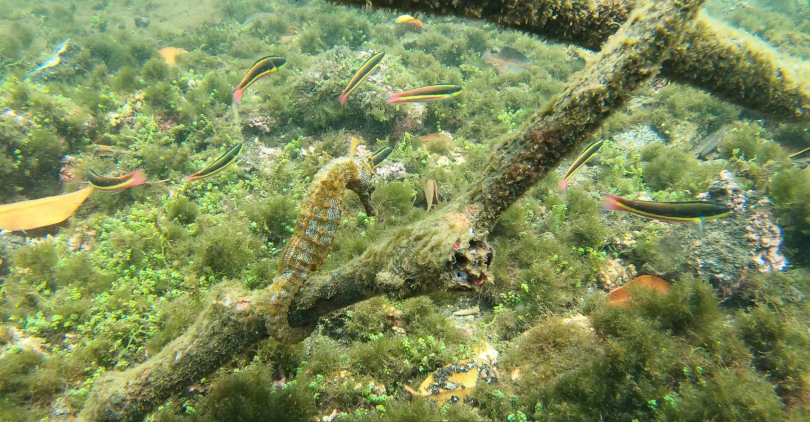
Pacific seahorses at Los Túneles on Isabela are one of the more specific and memorable finds available on a cruise snorkel. They reach up to 30 centimetres in the Galapagos, larger than most seahorse populations globally, and grip the gorgonian fans and volcanic rock surfaces with their prehensile tails. They are not easy to spot without a guide who knows specifically where to look, and they do not move when you find them, which makes the experience of hanging above one and watching it breathe through its snout while gripping a fan coral one of the quieter moments in Galapagos snorkeling.
Octopuses are present at rocky reef sites across the archipelago and are encountered by snorkelers who look carefully at shadowed rock surfaces. They are masters of chromatic camouflage, able to match the texture and color of virtually any background, and finding one requires a guide who can spot the slight irregularity in a rock surface or the ripple of a skin chromatophore firing. When found and observed from a safe distance, they typically stay still, watching back with a stillness that feels more cognitively present than most other reef animals. Send us a message here and we can advise which cruise guides are particularly skilled at finding bottom-dwelling species that others routinely miss.
Open Water Encounters: What Appears Without Warning
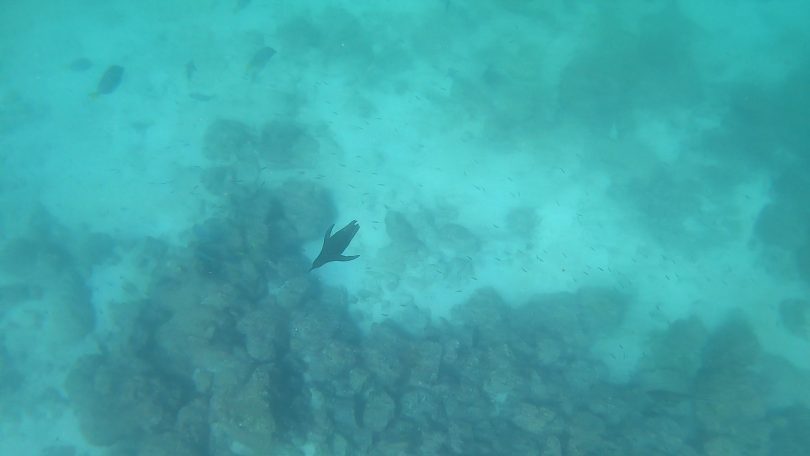
The most memorable Galapagos snorkel encounters are often the unplanned ones: a mola mola appearing from depth at Punta Vicente Roca, a Galapagos penguin flashing past at speed, a marine iguana descending from the surface on the way to the algae bed below, a boobies plunge-diving into the water twenty metres ahead. These open-water appearances cannot be scheduled or guaranteed. What can be said is that at the right sites in the right season, they happen regularly enough that surprise is part of the expected texture of Galapagos snorkeling, in a way that it is not at most other snorkel destinations.
The mola mola is the most extreme of these encounters in terms of scale. This is the world’s largest bony fish, capable of reaching two metres in length and 1,000 kilograms in weight. The body is an almost perfect disc, with two enormous fins, one above and one below, that propel the fish through the water in a slow, slightly lurching motion. Mola mola rise from cold deep water to surface in warm sun, where they roll on their sides to be cleaned by cleaner fish. At Punta Vicente Roca and around western Isabela, during the June through November cold season when the Cromwell Current upwelling is strongest, mola mola appear from depth and hover at cleaning stations near the surface. They make no attempt to flee. They are too large and too physically strange to register on any familiar wildlife encounter scale, and snorkelers who find one hovering beside them frequently describe the experience as disorienting in a way that is difficult to articulate.
The Galapagos penguin in the water is a different kind of surprise. On land these birds walk with the comical waddling gait common to all penguins. In the water they accelerate to speeds that make sea lions look sluggish. A penguin hunting fish produces a burst of motion that registers as a silver flash in the peripheral vision before the animal has already changed direction and vanished. They do occasionally circle snorkelers out of apparent curiosity before returning to hunting, but the encounter is measured in seconds rather than minutes. The best penguin snorkel sites are the western waters of Isabela and Fernandina, where the cold Cromwell Current creates the dense fish schools that penguins hunt.
Marine iguanas entering the water from the shoreline to feed are visible from the surface as the animal descends past the snorkeler on its way to the algae bed below. Underwater, the marine iguana uses a flattened tail as a rudder and lateral swimming motion more similar to a crocodile than to a lizard, gripping exposed rocks with long curved claws to anchor against current and then biting algae off the rock surface. Watching an iguana feed in the exact same way a sea turtle feeds, on the same reef, is one of those Galapagos moments where convergent evolution becomes physically tangible rather than conceptual. Two unrelated animals, a reptile and a reptile, solving the same feeding problem with nearly identical tools.
What Do Travelers Miss About Galapagos Marine Life?
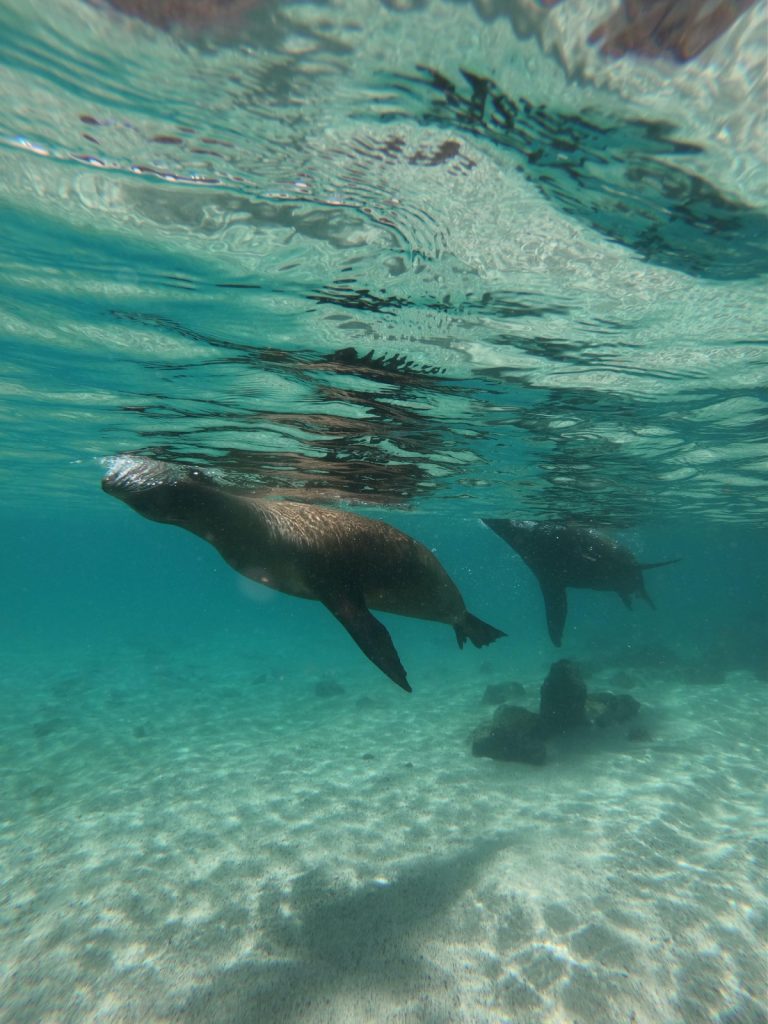
The most common miss is not looking down. Most first-time snorkelers in the Galapagos orient toward large visible animals at the surface or mid-water and miss the extraordinary density of life on the rocky and sandy bottom directly below them. The second miss is not knowing which species are which, which makes a school of surgeonfish a blur of movement rather than a named, understood animal. The third miss is not watching for behavioral interactions between species: king angelfish cleaning sharks, sea lions playing with octopuses, frigate birds plunge-targeting the same baitball that the sea lions are working from below.
Not looking at the bottom. The visual pull at the surface of a Galapagos snorkel is toward the large, obvious animals: the turtle, the sea lion, the passing eagle ray. But the sandy and rocky bottom in the four to ten metre range holds white-tip reef sharks resting, stingrays half-buried in sand, octopuses occupying rock crevices, frogfish stationary on algae-covered surfaces, and in the right locations, red-lipped batfish walking across the floor. Spending one minute of every five actively looking at the bottom rather than the mid-water column transforms the species count for the session.
Not recognizing endemic species. The Galapagos has a higher proportion of marine endemics than almost any comparable marine reserve. The Galapagos bullhead shark, the harlequin wrasse, the Galapagos damsel, the Pacific seahorse found here in unusually large sizes, the red-lipped batfish: these are not generically tropical fish that could have come from anywhere. They evolved in isolation on these islands. A guide who identifies these species as endemics during a post-snorkel debrief elevates the encounter from “nice fish” to something connected to the broader Galapagos evolutionary story. Ask your guide to identify the endemics specifically before you enter the water at each site.
Underestimating the seasonal difference. The warm season from December through May and the cool season from June through November produce genuinely different marine life communities at the same sites. Warm season brings calmer water, better visibility, manta rays, and warmer temperatures that are more comfortable for less experienced snorkelers. Cool season drops the temperature to 18 to 22 degrees Celsius, reduces visibility to 10 to 15 metres, but brings the nutrient-rich Humboldt Current that drives the marine biomass explosion: denser fish schools, more active feeding behavior, mola mola at accessible depths, and the overall animal density that makes experienced divers describe the Galapagos cool season as the richest marine environment they have ever been in.
Still not sure which island gives you the best frigate bird sighting on your Galapagos cruise? This guide on Genovesa vs North Seymour gives you a straight answer on which colony is worth the detour.
How Season and Site Affect What You See
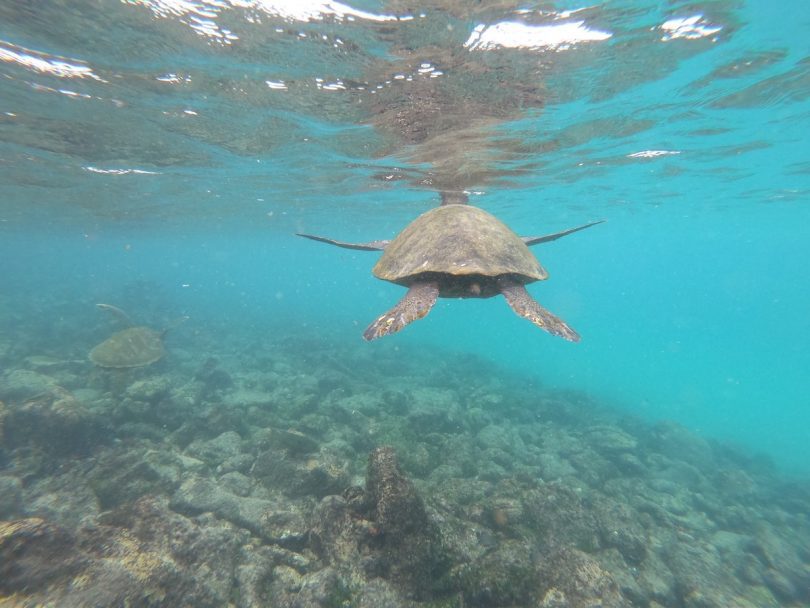
The single most important planning variable for Galapagos snorkeling marine life is which islands your itinerary includes. The western islands (Isabela and Fernandina) have cold-water endemics, penguins, marine iguanas feeding underwater, mola mola, and the greatest species density. The central islands (Santa Cruz, North Seymour, Bartolomé, Santiago) have the most accessible, beginner-friendly sites with reliable sea turtles, sea lions, and reef fish. The southern islands (Española, Floreana) add Devil’s Crown and Gardner Bay. The northern islands (Genovesa) deliver snorkeling with fur seals at the cliff base. Itineraries that include western Isabela produce a categorically richer marine life experience than those that do not.
| Season | Water Temp | Visibility | Marine Life Highlights | Best For |
|---|---|---|---|---|
| Dec to May (warm) | 22 to 26°C | 15 to 20m+ | Manta rays; sea turtle nesting; baby sea lions; calmer conditions | Families; first-timers; comfort-priority snorkelers |
| Jun to Nov (cool) | 18 to 22°C | 10 to 15m | Mola mola; dense fish schools; hammerheads; most active feeding; highest biomass | Experienced snorkelers; species diversity priority; photographers |
The transition month of May is genuinely underrated for snorkeling. Both current systems are active simultaneously, producing the unusual situation where cold-water and warm-water species coexist in the same snorkel session at central island sites. A May session at Gordon Rocks or Santa Fe can produce hammerheads, eagle rays, sea turtles, and tropical reef fish in the same 45-minute session, a combination that exists in neither the pure warm nor the pure cool season.
Site selection within your itinerary matters more than most travelers realize before booking. Two 7-day cruises departing the same week can have entirely different marine life profiles depending on whether one includes western Isabela and the other focuses on central and northern islands. Punta Vicente Roca on western Isabela is consistently described by marine biologists as one of the most species-dense snorkel sites in the world. Tagus Cove, also on Isabela, delivers marine iguanas feeding underwater alongside penguins and flightless cormorants. These encounters are only available on itineraries that route to western Isabela.
One final variable: guide quality. Two snorkelers in the same water at the same site with different guides have different experiences. A guide who spots a frogfish on a rock, identifies the species of moray in a crevice, knows which direction the eagle ray school typically comes from, and can identify endemic versus non-endemic fish for each species encountered turns a good snorkel into an educational and taxonomically rich experience that cannot be replicated from a book. When comparing cruise operators, ask specifically how many years of Galapagos experience their guides have and whether they hold naturalist category 2 or higher certification from the Galapagos National Park. This single variable is the most reliable predictor of how much you will learn and see during every underwater session on the trip. Contact us here and we will match you with the operators whose guides best fit your interests.
Still not sure what Isabela adds to a Galapagos cruise beyond what you’ve already seen on other islands? This guide on the best wildlife and activities for cruise visitors gives you a straight answer on what makes it worth the stop.
Frequently Asked Questions
How many fish species can you see snorkeling in the Galapagos?
Over 500 fish species live in Galapagos waters, though a single snorkel session at any site will typically encounter 20 to 40 species. The exact number depends on the site, the season, and the observer’s ability to identify what they are seeing. The cool season from June through November produces the highest overall density and diversity due to the nutrient-rich current system driving food web abundance. A well-guided cruise across multiple site types over 7 to 8 days typically produces encounters with 60 to 100 identifiable species across all snorkel sessions combined.
Are sharks dangerous to snorkel with in the Galapagos?
No. The sharks most commonly encountered by snorkelers, white-tip reef sharks and Galapagos sharks, are not aggressive toward humans. White-tips rest on the sandy bottom during daytime and do not move when approached at a respectful distance. Galapagos sharks make curious passes but do not harass snorkelers. No unprovoked shark attack on a snorkeler has been recorded in the Galapagos Marine Reserve in the history of regulated tourism. Follow your guide’s instructions, do not block or chase any animal, and the shark encounters you have will be among the calmer and more remarkable moments of the trip.
Can you snorkel with penguins in the Galapagos?
Yes, at the right sites. Galapagos penguins are found primarily on western Isabela and Fernandina, and itineraries that include these islands offer snorkeling in the same waters where penguins hunt fish. The encounter is brief because penguins move at extraordinary speed underwater, but a penguin at full sprint passing within a metre of a snorkeler is one of the most viscerally impressive wildlife moments available in the Galapagos water. To maximize the probability, your itinerary needs to include western Isabela, and the cool season from June through November is when penguins are most actively feeding in the shallows.
What is the best single snorkel site in the Galapagos?
Punta Vicente Roca on western Isabela is the most consistently cited answer from experienced Galapagos guides and from travelers who have snorkeled multiple sites across multiple visits. It delivers the highest species diversity of any standard cruise snorkel stop: sea turtles, flightless cormorants diving beside you, marine iguanas feeding, eagle rays, mola mola during peak season, seahorses, and endemic fish species found nowhere else. The water is cold and requires a proper wetsuit, but the quality of the encounter is in a different category from any warm-water beach entry snorkel in the islands.
Find the Right Snorkeling Itinerary for What You Want to See
The Galapagos marine life experience depends on which islands your cruise visits, which season you travel in, and which operator’s guides accompany you in the water. We know the current fleet inside out: which vessels route through western Isabela, which guides have the species ID knowledge to make a snorkel session genuinely informative, and which itineraries give you the best chance of the extraordinary encounters like mola mola, marine iguanas feeding underwater, and penguins at full speed. A free quote from Cruises To Galapagos Islands comes with specific itinerary recommendations, not generic island lists. Tell us your priorities and we will build the right recommendation.
Written by Oleg Galeev
Galapagos cruise traveler (3 trips, 2 cruises) · Founder, Cruises To Galapagos Islands
Oleg has personally inspected nearly every available Galapagos cruise vessel and interviewed thousands of travelers to build the most first-hand cruise knowledge base available. He also runs the Ecuador travel blog mytrip2ecuador.com and the YouTube channel My Trip to Somewhere.
Cruises To Galapagos Islands is rated 4.9 stars on Google and TripAdvisor.
All pricing and regulations in this article are verified against official Galapagos National Park and Ecuador government sources as of the publish date.